
Content Pruning for Topical Authority
Learn how to audit, decide, and prune content by cluster to protect link equity, strengthen topical authority, and improve site architecture.
Content pruning for topical authority is the process of removing, merging, redirecting, de-indexing, or upgrading pages that no longer support a cluster. SEO agencies and content teams run into trouble when outdated URLs, thin posts, and overlapping pages spread authority across the wrong parts of the site. It gives a clear way to decide which pages stay, which ones fold into stronger assets, and which ones should leave the index.
The workflow covers a content inventory from Search Console, Analytics, and crawl data, plus a pruning matrix, cluster-based audits, and rules for merge versus redirect versus delete. Expect practical checkpoints for internal links, backlink protection, noindex decisions, and review windows that show whether the cleanup improved visibility or exposed gaps. A 90 day follow-up keeps the work tied to search performance instead of one-time housekeeping.
Heads of content, agency leads, and in-house growth teams get the most value because they need decisions they can defend to clients, editors, and stakeholders. A thin support post with weak traffic but strong backlinks might be merged into a pillar page, then 301 redirected to keep equity intact. The sections ahead turn that into a repeatable operating model for live site clusters.
Topical Authority Pruning Key Takeaways
- Pruning strengthens topical authority by removing, merging, redirecting, or upgrading weak pages.
- Build one inventory from Search Console, Analytics, and crawl data before deciding anything.
- Map every URL to a cluster to spot cannibalization, orphan pages, and thin content.
- Use clear verdicts like keep, update, merge, redirect, delete, and noindex.
- Protect backlinks and conversions with 301 redirects, internal-link updates, and rollback notes.
- Prune in small batches and measure clicks, impressions, indexation, and crawl efficiency.
- Use pruning gaps to plan stronger pillar pages and support content.
What Is Content Pruning For Topical Authority?
Content pruning is the deliberate removal, merging, redirecting, de-indexing, or upgrading of pages that no longer help your search plan. You use it to keep search engine optimization (SEO) focused on one clear topical authority cluster instead of scattering strength across thin, outdated, overlapping, or cannibalizing URLs.
The payoff goes beyond cleanup. Pruning reduces index bloat, removes redundant semantic paths, and helps each indexed page support the topic, entity relationships, search intent, and conversion path you want to win. It also concentrates link equity and internal-link flow on your strongest pillar pages, supporting articles, and money pages.
That tighter set also makes trust easier to see. Fewer orphaned pages, fewer contradictions, and clearer expertise signals support E-E-A-T, or Experience Expertise Authoritativeness Trustworthiness, because the site reflects what you actually cover well. A cluster-based content planning for topical authority approach gives you the cluster structure that makes those calls easier to defend.
A practical site pruning framework usually sorts pages into four paths:
- Keep: the page earns traffic, matches intent, and strengthens the cluster.
- Optimize: the page has value, but needs better coverage, links, or on-page fixes.
- Consolidate: the page overlaps with a stronger asset and should merge into it.
- Prune: the page is low-intent, redundant, or stuck in keyword cannibalization.
This cluster-level view matches Floyi’s hub-first approach. You define scope, set hub coverage targets, and map every URL to the cluster before you decide whether it should stay, merge, redirect, de-index, or be removed.
How Do You Build a Pruning Workbook With Floyi?
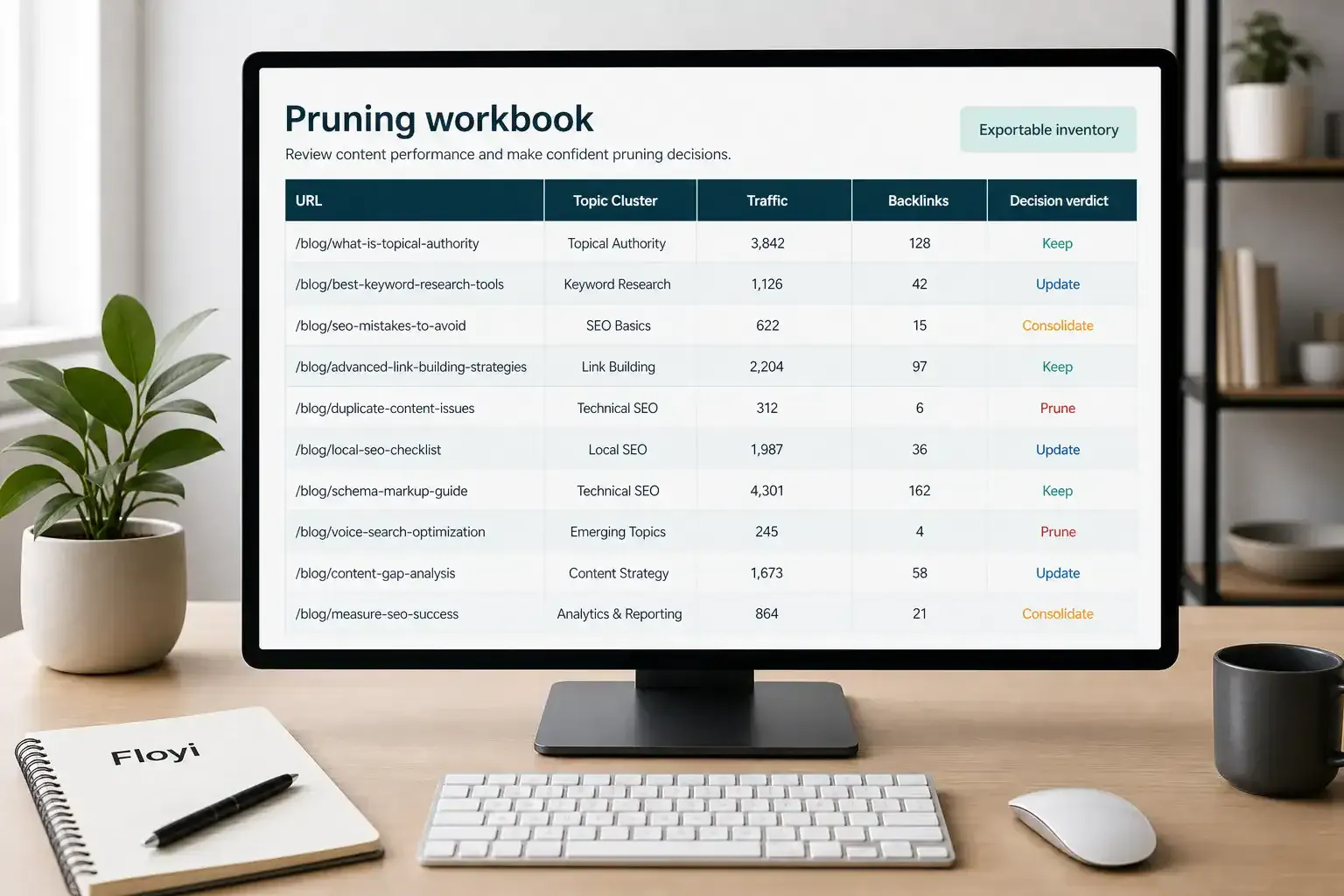
The cleanest pruning decisions come from one exportable content inventory, not a stack of disconnected sheets. Build it from Google Search Console, Google Analytics, and crawl data so you can review URL, publication date, target keyword, core topic, organic traffic 12-month data, clicks, impressions, average position, internal links, backlink metrics, and business-value notes in one place. That shift moves the work from page-by-page guesswork to a real content audit.
A practical content pruning matrix starts with Floyi-style topic clusters and bidirectional URL-to-topic matching. Every row should map to a topical node, then show whether the page is a pillar, support page, or duplicate cluster member. That makes cannibalization easy to spot when multiple URLs compete for the same SEO intent.
The site pruning framework becomes usable when the decision columns are explicit:
| Workbook field | Purpose |
|---|---|
| Decision verdict | Keep, Update or Refresh, Merge or Consolidate, Redirect, Noindex or Deindex |
| Rule note | Short reason for the verdict, especially for 45 to 90 day pages, niche support content, and backlink-rich pages with weak traffic |
| Action dropdown | Redirect target URL, merge destination page, canonical or internal-link update status, removal or retention queue |
| Safeguard fields | Backup-export status, change batch ID, stakeholder sign-off, rollback notes |
Those fields turn a content pruning workflow into an execution list instead of a debate sheet.
Redirect decisions need a clear rule set. A page can 301 to a close topical match, stay live as part of a consolidated set, or be retired with 404 or 410 logic documented in the row. That protects historical backlinks and the key entry paths that still send traffic.
A few safeguard fields should stay visible in every batch:
- Backup-export status: Confirms the source data is saved before changes
- Change batch ID: Groups pages into micro-batches for cleaner review
- Rollback notes: Captures how to reverse a merge, redirect, or noindex decision
- Stakeholder sign-off: Reduces surprises after implementation
Pruning works best when you move in small clusters, measure impact, and then continue. Filter by priority, export selected rows, and keep the workbook synced to the topical map so pruning decisions feed future planning instead of becoming a one-time cleanup exercise. The content refresh cadence for topical authority keeps refreshes and removals aligned across topic clusters.
How Do You Audit Content By Cluster?
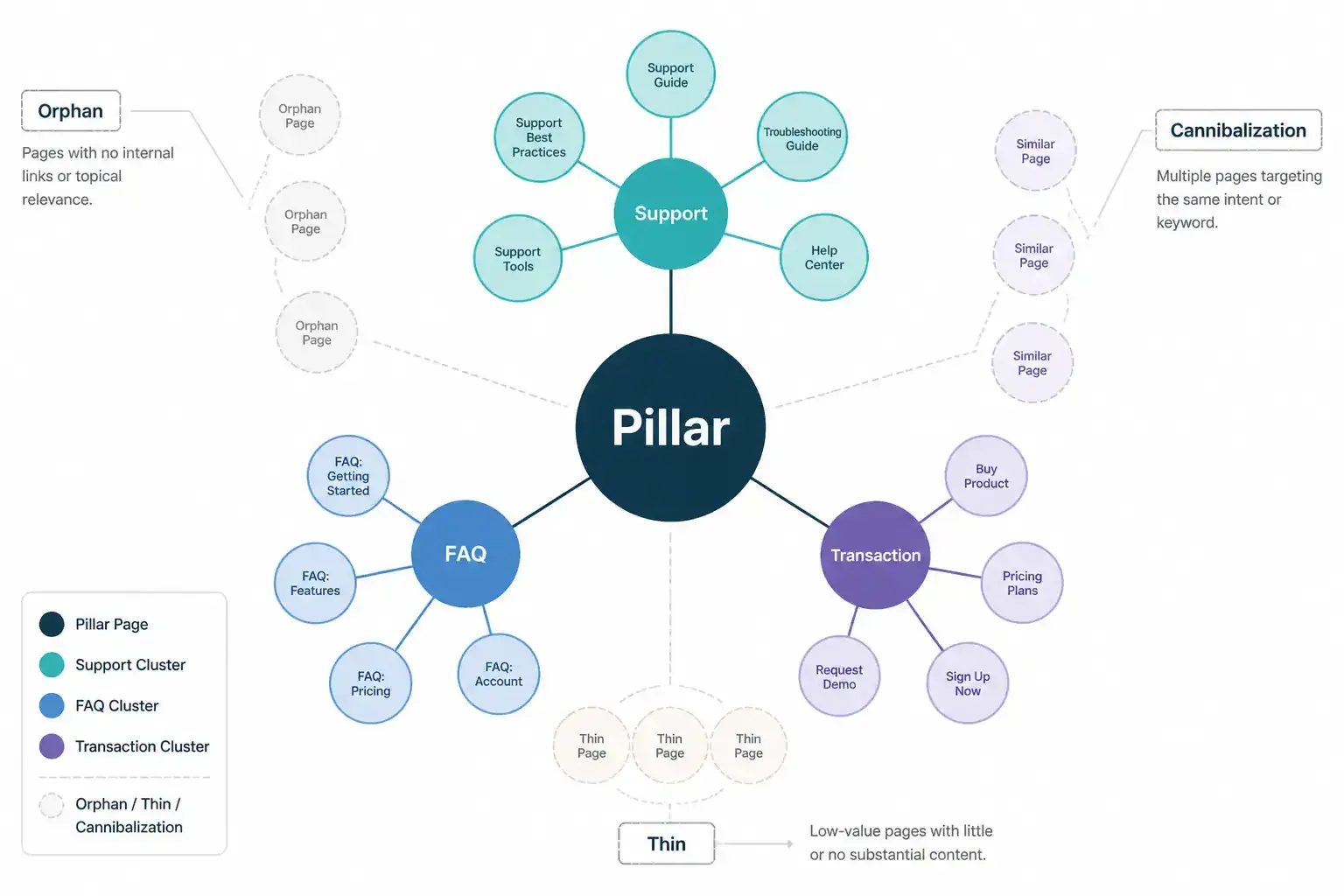
A strong content audit starts with structure, not a flat URL dump. When you group pages into content clusters and topic clusters first, each URL is judged by the role it plays in the full system. That makes it easier to see where a pillar page needs support, where a cluster is bloated, and where a page is in the wrong place. Clustered audits also keep low-value noise from hiding inside strong themes.
Use this cluster view to sort pages fast:
- Map each URL to one core topic: Place every page in a single cluster, then separate pillar pages, supporting pages, transactional pages, FAQs, and obsolete or off-topic content.
- Flag weak structure early: Orphan pages with no internal linking usually belong in a relevant cluster or should be removed. Outliers often need stronger internal linking, consolidation, or deletion.
- Score each page twice: Build a content score from topical fit and business value. Topical fit shows whether the page supports the cluster’s main intent. Business value comes from traffic, conversions, backlinks, and strategic importance.
- Tag by page type: A thin FAQ, duplicate support post, outdated transactional page, or underbuilt pillar page should each route to keep, optimize, merge content, consolidate, or prune based on risk and conversion impact.
- Use performance signals to rank demand: Floyi’s Organic Audit ties Google Search Console queries to topic nodes and adds By Topic and By Page views, plus Strong, Emerging, Broad Reach, and Weak Signal labels.
Micro-batch pruning works best when you start with clusters that show overlap, cannibalization, or thin coverage. That approach lets you merge, redirect, or prune the smallest set of pages that improves the whole cluster without hurting stronger revenue drivers.
A repeatable audit cadence can help teams keep content reviews current and reduce drift between clusters, especially when the schedule is tied to internal linking and redirect checks (source). Pair it with internal linking checks, redirect checks, and a simple decision matrix so you protect backlink equity and conversion paths before anything ships. When two pages serve the same intent, the cleanest move is often to merge content first and then decide whether redirect or deletion makes more sense.
The content audit checklist for topical authority keeps that pruning logic consistent across teams.
How Do You Decide What To Keep Or Cut?
The cleanest pruning calls come from a content pruning matrix, not gut feel. Each URL should earn one verdict. Keep, update, merge, redirect, delete, or noindex all have a clear place when you cross-check traffic, backlinks, conversions, engagement, intent overlap, and business value.
| Verdict | When it fits |
|---|---|
| Keep | The page supports conversions, a key funnel step, or hard-to-replace backlinks |
| Update | The page still matters, but it needs fresher facts, deeper coverage, or stronger E-E-A-T |
| Merge | Two pages chase the same query or split authority across similar intent |
| Redirect | One URL should absorb another page’s equity and replace it cleanly |
| Delete | The page has no equity, no strategic role, and no intent fit |
| noindex | The page helps users or internal teams, but should stay out of search results |
Page age comes first. Newly published URLs should usually get enough time for indexing and early performance data before they are pruned, and many teams use a 90 day review window as a practical checkpoint (source). That gives search engines time to index the page, collect impressions, and settle its SEO pattern. Persistent underperformance can justify pruning when a page has had no organic traffic for a long stretch, earns no backlinks or conversions, shows weak engagement, or stays buried beyond the first few search result pages (source).
Business value can outweigh raw traffic. A low-traffic page may still deserve to stay if it protects revenue, supports Experience Expertise Authoritativeness Trustworthiness, or carries backlinks that are hard to replace. Traffic-weighted scoring helps you give conversions and links more weight when they matter most.
Use this sequence for consistent decisions:
- Check age
- Review traffic trend
- Inspect backlinks and conversions
- Gauge engagement and intent overlap
- Choose the lightest action that fixes the problem
If a page is thin but useful, update it. If it is redundant, merge it. If it is obsolete or irrelevant, noindex or delete it to protect topical authority and reduce cannibalization. Segment by topic or content type when needed, and rank the biggest impact-versus-effort wins first so you protect internal-link equity fast.
When Should You Merge Or Redirect?
Content consolidation makes sense when two or three thin posts target the same intent and split impressions. That usually signals keyword cannibalization, and the strongest page should absorb the weaker material.
Use this decision rule when you fold pages together:
- Choose the survivor by the strongest current signals: the clearest query match, the most backlinks, the best rankings, or the highest impression share. If one page already holds 70% or more of impressions, treat it as the primary page.
- Absorb the best material from weaker URLs. Bring over the strongest sections, examples, semantic variants, and internal links so the survivor keeps topical depth.
- Send retired URLs through a 301 redirect to the closest relevant sister page. This protects link equity, especially when the old page has external root-domain backlinks.
- Avoid deletion when a page still earns impressions or has meaningful backlinks. Delete only when you have no relevant destination to send users and crawlers to.
After consolidation, the redirect should be the default, not an afterthought.
When Should You Noindex Or Delete?
Use noindex, follow when a page still helps users or supports internal linking, but should not compete in search. That fits calculators, localized landing pages, older press releases, author profiles, and other pages that create index bloat without a clear search role. The page stays live, and link equity can still flow.
| Situation | Best move | Why |
|---|---|---|
| Zero traffic, zero backlinks, no strategic role | delete 404 410 | It is the cleanest option for disposable URLs. |
| Permanent removal with no return planned | 410 Gone | It can speed deindexing because the URL is clearly retired. |
| Useful page with weak search value | noindex, follow | It remains available for users and conversion paths. |
For outdated press releases and utility pages, decide case by case. Keep them out of the index when they still serve a purpose. Delete them when they are obsolete, unused, and no longer support site architecture.
How Do You Prune Without Damaging Equity?
Protecting equity starts with restraint. Treat content pruning as a controlled sequence, not a mass cleanup. In your content pruning workflow, work cluster by cluster so you can watch rankings, impressions, and internal linking behavior after each round. That pacing makes traffic volatility easier to catch before it spreads.
Before any URL is removed, audit it like it still matters. Check backlink profiles, referring domains, historical rankings, impressions, conversion assists, internal-link dependencies, and direct business value. A page with low traffic can still protect revenue or strengthen topical authority through internal-link support.
Use this safeguard rule when the decision gets messy:
- Consolidate first: When two pages overlap in intent, merge the strongest sections into one survivor and protect equity with a 301 redirect.
- Rebuild support: Refresh internal linking so the canonical URL keeps the best anchors and the cluster stays coherent.
- Delete last: Use delete 404 410 only when the page adds no unique value and no equity risk remains.
Content consolidation works best when the survivor page fully satisfies the original search intent. The combined asset should feel more complete, not thinner, and it should reduce cannibalization.
Before launch, document which URLs were merged, redirected, or deleted. Secure stakeholder sign-off. Set a review window so you can restore redirects or URLs quickly if visibility or conversions decline.
How Do You Measure Results And Fill Gaps?
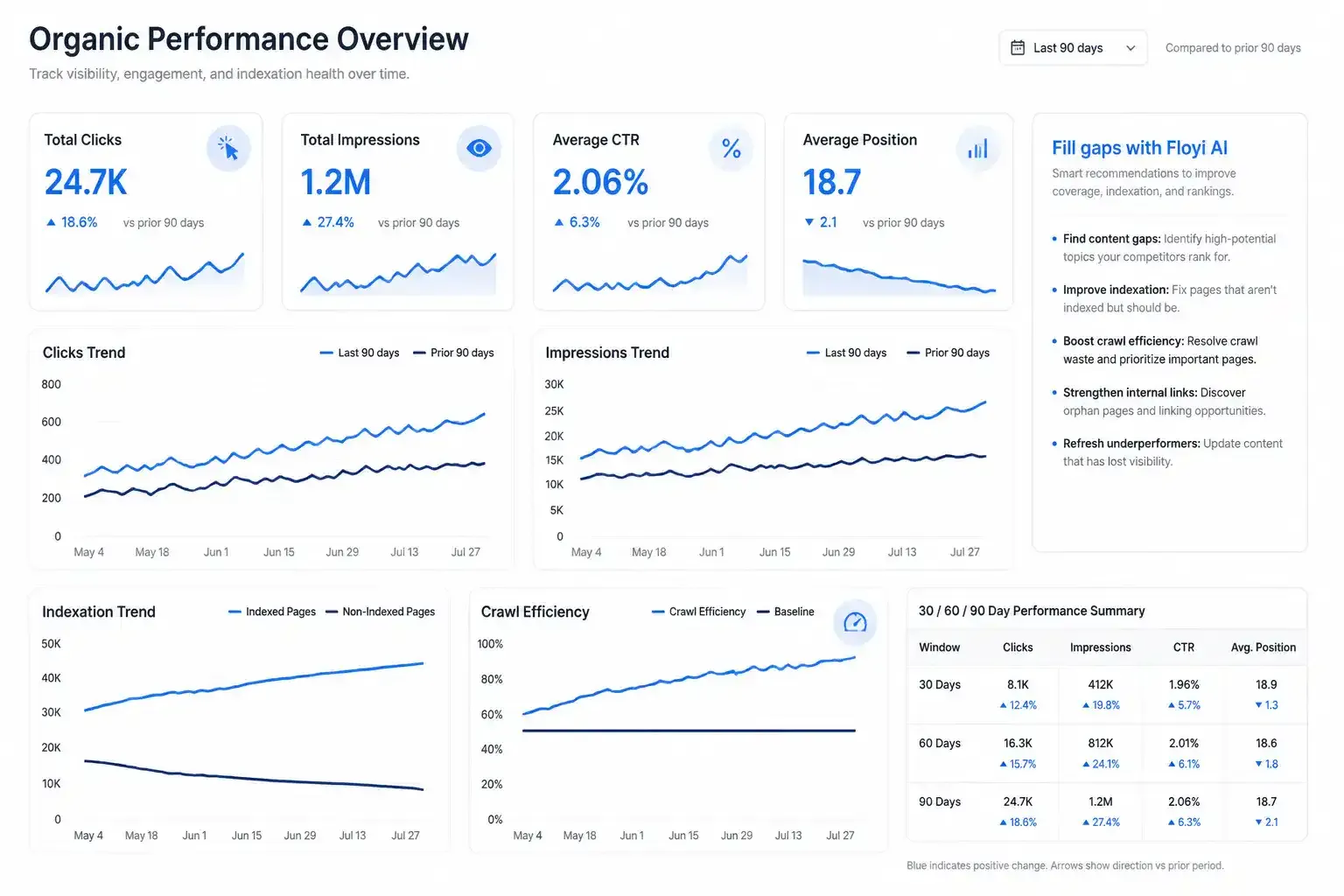
Measurement should start before you prune. Pull a cluster-level baseline so the readout reflects real topical authority, not one lucky URL. Use organic traffic 12-month data, then compare retained pages, redirected pages, and the cluster as a whole after the changes go live.
Track the signals that show whether pruning helped or hurt search performance:
- Google Search Console clicks: Watch retained pages and redirected landing pages for recovery or steady growth.
- Google Search Console impressions and CTR: Check whether visibility improved and whether stronger snippets are earning more clicks.
- Indexation status: Confirm priority URLs are indexed cleanly and low-value duplicates fall out.
- Crawl efficiency: Look for fewer wasted hits on thin pages and faster discovery of refreshed URLs.
- Conversion signals: Check whether the pages that kept equity still support leads, sales, or sign-ups.
A 30 to 90 day window can give teams an early read on pruning impact, and a longer review at about 90 days can show a fuller trend line in traffic and indexation signals (source).
| Window | What to expect | What to watch |
|---|---|---|
| 30 to 60 days | First meaningful read | Faster indexing, cleaner crawl paths, early click and impression movement |
| 90 days | Fuller trend line | Stable or rising performance on pages that absorbed equity, plus stronger cluster visibility |
Crawl efficiency matters because it shows how well search engines spend crawl budget. The goal is fewer low-value URLs competing for attention, fewer orphaned or near-duplicate pages, and less index bloat crowding out pages that build topical authority. After major pruning, many teams also refresh XML sitemaps so priority URLs are easier to discover.
Floyi helps you fill the gaps that pruning exposes. Compare your cluster against winning pages and AI answers, then use Floyi to surface missing, covered, and overused entities. That turns semantic gaps into a ranked next-step content plan instead of another round of thin overlap.
Anchor the next build list in authority gaps, not search volume alone. Floyi’s AI Search Gaps and prioritized planner can point to adjacent subtopics, supporting pages, and hub extensions when coverage looks broad but intent is still weak. If clicks and impressions rise but breadth is thin, ship the missing support pages. If coverage is strong but performance stalls, fix trust signals, internal links, and hub structure before adding more content. Understanding topical depth and breadth decisions helps you decide whether to deepen existing clusters or expand into adjacent topics after pruning.
Content Pruning for Topical Authority FAQs
These FAQs cover the decisions that matter most when you prune content for topical authority, including what to keep, merge, or retire. They give you a clear read on the tradeoffs before you change a single URL.
Should You Prune Pillar Pages?
You usually should not delete a pillar page first. Keep it if it still anchors the topic, refresh it when the coverage is stale, or merge overlapping pages into one stronger version and redirect the weaker URL when two pages chase the same intent and split topical authority. Before any pruning move, check backlinks, referring domains, historical rankings, impressions, conversion assists, internal link dependence, and sales value. A true pillar page still organizes the hub, supports internal links, and covers the core entity set, so deletion belongs mostly to obsolete or off-topic content.
How Do Backlinks Affect Pruning Decisions?
Treat backlinks as a hard constraint in your pruning decision. If a page has relevant links from authoritative referring domains, a 301 redirect or consolidation usually preserves more value than deletion, especially when the URL maps to a core topic. Before you cut it, check backlink profiles against historical rankings, impressions, conversions, internal link paths, and sales assist value. Link strength matters more than raw count, so prioritize niche-relevant referring domains and ignore low-quality or irrelevant links that are unlikely to support topical authority.
Which Cluster Pages Should Stay Untouched?
Pages with unique entity depth are usually worth keeping, even when traffic is light, because they can satisfy a narrow long-tail query and support topical authority. Conversion-assist pages should also stay when they move readers from research to action or support a downstream CTA. The same goes for pages with a clear internal-link role or a real cluster gap, while redundant, off-map, or isolated pages are better candidates for consolidation, redirect, noindex, or deletion.
Can Pruned Pages Still Support Authority?
Yes, pruned pages can still support authority when you 301 redirect them to the closest sister page or pillar instead of deleting them outright, because the redirect keeps backlink equity in play. When pages overlap in intent, merging them usually beats removal since it preserves external links, reduces cannibalization, and gives the surviving page fuller coverage. If a pruned URL has strong root-domain backlinks, redirect it to the most relevant page, then fold any useful examples, stats, or sections into the pillar and refresh internal links so the cluster keeps reinforcing that core topic.
About the author

Yoyao Hsueh
Yoyao Hsueh is the founder and CEO of Floyi, the topical authority platform, and the founder of Main Heading, an SEO and AI search agency. He created Topical Maps Unlocked, a course studied by thousands of SEOs, content strategists and digital marketers, founded TopicalMap.com, a done-for-you topical mapping service for agencies and enterprise teams, and publishes the weekly Digital Surfer newsletter on SEO, content strategy and AI search.
About Floyi
Floyi is a closed loop system for strategic content. It connects brand foundations, audience insights, topical research, maps, briefs, and publishing so every new article builds real topical authority.
See the Floyi workflow