
How To Measure Topical Authority
Learn how to measure topical authority with Topic Share, TAR, competitor benchmarks, and dashboard KPIs that prove ROI.
Topical authority is measured with a mix of ranking breadth, Topic Share, TAR, backlink topicality, and AI visibility, not one score. For SEO agencies, content strategists, and in-house teams, that mix shows whether a topic cluster is gaining real market control.
The article maps the signals, weights Topic Share against TAR, and shows formulas you can reproduce in Semrush, Ahrefs, Search Console, and GA4. It also covers backlink relevance, entity coverage, internal linking, competitor benchmarking, and the reporting outputs that turn measurement into topic-level decisions.
That matters now because heads of content and SEO leads need proof that content investment is building durable coverage, not just isolated rankings. A page set that owns 93 of 96 weighted topic units, for example, signals far more than a single keyword win. Continue for the framework, metric definitions, and reporting rules that make topical authority measurable.
Topical Authority Measurement Key Takeaways
- Measure topical authority with Topic Share, TAR, rankings, backlinks, and AI visibility together.
- Topic Share shows how much ranking value your cluster owns versus competitors.
- TAR shows how completely your indexed topic map covers the opportunity.
- Backlink topicality matters more than raw link count for trust signals.
- Entity coverage and internal linking help search systems classify topic depth.
- Benchmark only direct SERP rivals using a fixed keyword map and weighting model.
- Report TAS monthly and use GA4, Search Console, and AI citations to validate progress.
What Signals Best Proxy Topical Authority?
Topical authority works best as a bundle of measurable signals, not a single score. The Topical Authority metric should combine content coverage and ranking performance, market share across the topic map, backlink quality and topical relevance, and AI visibility in artificial intelligence (AI) Overviews, AI Mode, ChatGPT Search, and Gemini. Read them together, because each signal predicts a different outcome.
The signals map to different outcomes:
| Signal | What it measures | Best proxy for |
|---|---|---|
| Coverage plus performance | Topic clusters, internal linking, and meaningful rankings | Traffic growth and durable ranking gains |
| Market share | Share of total ranking value in a topic | Competitive upside |
| Backlink profile | Referring domain quality, anchor text, authority score, and backlink type | Trust and flagship-page strength |
| AI visibility | Mentions and citations in AI systems | Source recognition |
Coverage and performance are useful near-term proxy signals because proxy metrics are commonly used to estimate harder-to-measure outcomes, and combining them can help teams track whether topic clusters are gaining traction (source, source). Broad content clusters with strong internal linking should earn more impressions, more clicks, and more stable ownership over time. A Content Authority lens makes the gap obvious. Shipping pages without performance does not prove authority, and strong rankings without coverage usually mean the map is incomplete.
That is why semantic SEO favors depth, structure, and clear topical relationships.
Market share is the clearest competitive proxy for ranking upside. Topic Share or Market Authority shows how much of the total ranking value in a topic you own versus competitors. That view is especially useful when you compare traffic share by domain in Ahrefs through Keyword Explorer and Matching Terms.
Backlink relevance as a trust signal matters more than raw link count. Referring domain quality, anchor text, authority score, and backlink type all shape the signal. Semrush Backlinks reports can show whether links reinforce the subject area you want to own and support flagship-page rankings.
AI visibility is the newest proxy for authority. Mentions and citations show that your content is recognized as a source, not just indexed. An AI Presence Score helps separate being seen from being referenced.
Keep reporting expectations grounded:
- Coverage and internal linking: Should move rankings first.
- Market share: Should rise as your strongest pages take more of the topic map.
- Backlinks: Should compound trust over time.
- AI citations: Should improve when content is structured clearly enough to quote.
Which Signals Best Proxy Topical Authority?
There is no single Google metric for topical authority, so you need proxy signals that show whether a site is trusted across a defined topic set. The best read comes from combining coverage, visibility, and trust instead of chasing one vanity score.
| Signal | What it tells you |
|---|---|
| Ranking breadth | How many cluster keywords and related queries you own. A wider footprint usually signals stronger authority. |
| Topic Share | The share of search traffic or ranking value your domain captures within the topic. This gives you a market-style view of ownership. |
| Topical Authority Ratio (TAR) | How much of the topic map you cover and rank for compared with the full opportunity. It helps you spot underperformance or oversaturation in a cluster. |
| Backlink topicality | Whether links and mentions come from pages that are semantically close to the topic. |
| Entity coverage | Whether your pages address the key subtopics, concepts, and related entities that winning pages repeatedly surface. |
| Content depth | Whether the page answers the topic completely enough to compete with strong organic results and AI answers. |
| Internal linking | Whether hub and support pages are connected in a way that clarifies relationships and channels authority. |
The signals work best as a set. Ranking breadth and Topic Share show visibility. TAR shows how efficiently you cover the map. Backlink topicality, entity coverage, content depth, and internal linking show whether the site has enough trust and structure to hold that visibility over time.
A practical review usually looks like this:
- Breadth first: Check how many related queries rank in the cluster.
- Ownership next: Measure Topic Share and TAR against the full opportunity.
- Trust and structure last: Review backlink topicality, entity coverage, content depth, and internal linking together.
How Do We Weight Topic Share And TAR?
A blended composite works best when topic share carries the main weight and topical authority ratio acts as the durability check. Topic share reflects how much organic traffic the topic earns, so it should drive most of the score. The topical authority ratio confirms that result is supported by enough indexed coverage to last.
A practical starting split looks like this:
| Scenario | Topic Share Weight | TAR Weight | Why it fits |
|---|---|---|---|
| Fast-moving, competitive topics | 70% | 30% | Ranking strength matters more than page count |
| Balanced content programs | 65% | 35% | Traffic capture and coverage both matter |
| New or sparse topic maps | 60% | 40% | Structure matters more until the cluster matures |
That split is outcome-based. Topic share answers how much demand your cluster captures. TAR is structure-based because it measures the share of indexed topic pages versus total indexed pages, usually checked with site:domain queries and keyword-based SERP reviews to estimate how much of the domain is invested in the cluster.
A transparent formula keeps the score easy to reproduce in SEO workflows:
- Composite score:
(Topic Share x weight) + (TAR x weight) - Default starting point:
Topic Share 0.65 + TAR 0.35 - Competitive topic maps: Raise topic share when rankings swing fast
- New topic maps: Raise TAR when coverage is still thin
The weighting should match the decision you need to make. Performance reporting usually benefits from a stronger topic share bias because leadership wants to see traffic contribution. Planning and investment discussions often benefit from a slightly higher TAR weight because coverage gaps matter more there.
The balance also protects against two common errors. A large catalog of indexed pages can look authoritative even when it is not earning meaningful topic traffic. A few strong URLs can also create a false sense of health when the cluster is too thin to defend against competitors. Keep TAR from dominating the composite, and avoid letting topic share hide weak breadth.
A simple recalibration rule keeps the metric useful:
- Reweight upward when the score reacts too slowly to real market shifts
- Reweight downward when a temporary ranking spike distorts the result
- Review volatility at the topic level before changing the formula
- Hold steady when the score matches traffic, coverage, and rankings
That gives you one number that is easy to explain while still preserving the difference between demand capture and content depth.
How Do We Score Topic Share And TAR?
Topic Share becomes defensible when you lock the inputs and keep the scoring frame stable. We use keyword research to build the topic set, then sanity-check it with the site:intitle operator and Personal Keyword Difficulty so the map reflects real demand and realistic competition. The topical authority technical setup guide shows the setup logic behind that workflow.
A transparent scoring model keeps the math auditable:
| Metric | Formula | What it does |
|---|---|---|
| Rank Score | max(1/position, floor) | Gives higher value to higher rankings and keeps deep rankings from dropping too low |
| Importance | log10(search volume + 1) | Weights the keyword by demand without letting huge volumes dominate |
| Page or keyword value | Rank Score x Importance | Turns each ranking into a comparable unit |
| Topic Share | Your Value / Total Market Value x 100 | Shows how much ranking value you own across the tracked competitors |
| Topical authority ratio | Owned Topic Units / Total Topic Units | Measures breadth and strength across the topic set you actually cover |
You get the cleanest result when the numerator and denominator never drift. Keep the same topic map, the same keyword set, and the same ranking snapshot for every competitor. That keeps keyword coverage comparable over time and prevents the score from shifting just because topic boundaries moved.
Topic Authority Ratio, or TAR, needs one unit system to stay in place. Topic units can be normalized pages, keywords, or subtopics, as long as you use one definition consistently. A simple example makes the math easy to audit. If a competitor owns 93 of 96 weighted topic units for promotional products, their TAR is 93/96 = 0.96.
| TAR range | Label |
|---|---|
| 0.00 to 0.24 | Weak |
| 0.25 to 0.49 | Developing |
| 0.50 to 0.74 | Competitive |
| 0.75 to 0.89 | Strong |
| 0.90 to 1.00 | Dominant |
Topic Share and TAR work best as a pair when you measure topical authority for SEO reporting. Topic Share shows how much ranking value you own today. TAR shows how complete your footprint is across the market. A high TAR with low Topic Share usually means broad coverage without enough ranking strength, while a high Topic Share with middling TAR means you are winning a smaller part of the map.
When you report the score, keep the context attached:
- Topic: the exact category or cluster you scored
- Keyword set: the fixed list used in the calculation
- Date: the ranking snapshot date
- Competitor group: the specific sites in the benchmark set
That label set makes the result reproducible, easier to defend in internal reviews, and more useful as your map expands and your rankings shift.
How Do We Weight Backlinks, Entities, And Rankings?
A useful composite topical authority score balances off-site trust with on-site relevance. In your model, backlinks signal trust, entity coverage reflects semantic SEO depth, and rankings show performance. That keeps backlink analysis tied to topical relevance instead of raw volume. It also keeps the link profile from overpowering a site that still needs stronger on-page coverage.
A simple weighting frame looks like this:
| Signal | What it measures | Default weight | Raise it when |
|---|---|---|---|
| Backlinks | Trust, authority, and E-E-A-T support | Moderate | The topic is crowded, coverage is already solid, and the links are clearly topic-relevant |
| Entity coverage | Breadth and semantic completeness | Highest on-site weight | Coverage is thin, subtopics are missing, or AI answers surface entities your content skips |
| Rankings | Real search performance | Validation layer | Strong positions appear across related queries, or you need to separate visibility from ownership |
Backlinks should be weighted by quality and topical proximity. A contextual link from a relevant page is stronger than a generic brand mention. Strong anchor text and surrounding copy add more weight when the page sits inside the same subject cluster.
Entity coverage should usually carry the most weight on the site side of the model. Compare the entities and subtopics in winning pages and AI answers with your own content. Mark each item as missing, covered, or overused. When coverage is thin, raise the on-site weight before expecting links to carry the result.
Rankings belong in the model as the validation layer, not the main driver. A 1/position score gives stronger positions more credit than pages buried deeper in the SERP. That keeps the score anchored to measurable outcomes instead of content inventory.
The decision rule stays simple:
- Up-weight links when competitors already cover the key entities, the topic is saturated, and your pages rank but do not break through.
- Up-weight on-site signals when the topic is early, coverage is incomplete, or rankings swing across related queries.
- Favor entities and rankings first when the page still needs proof of depth, then increase backlink weight once the content base is strong enough to earn it.
That gives you a practical way to tune the score without turning it into a black box.
How Do We Benchmark Competitors?
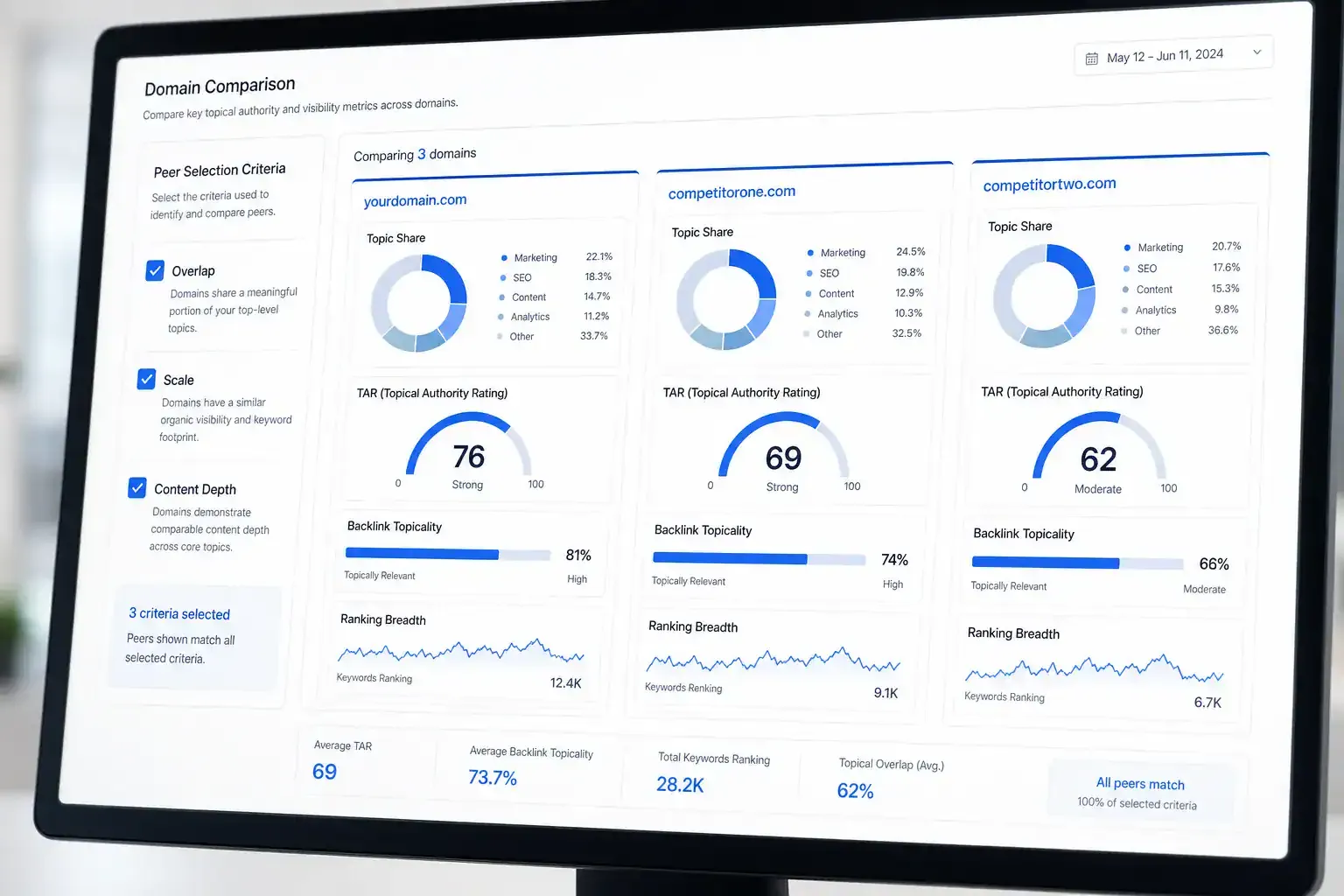
A useful benchmark starts with direct SERP rivals, not every brand in your category. The strongest peer set is made of domains that keep ranking for the same topic cluster, because that reflects real search competition instead of broad market rivalry. Larger publishers and adjacent sites can still matter, but they belong outside the core set when their authority profile or content model is too different.
Build the peer set with three filters:
- Overlapping target queries
- Similar site scale
- Comparable content depth
Google Search Console helps confirm recurring queries. SEO tools such as Semrush, Ahrefs, or Moz surface the domains that keep appearing in the same search space. That filter separates true topic rivals from sites that only look similar at a high level. None of those tools score authority at the topic level, and we break down why topical authority checkers fall short in a dedicated teardown.
The benchmark should compare four signals across each peer:
| Signal | What it tells you |
|---|---|
| Topic Share | How much topic value a domain captures |
| TAR | How fully a domain covers and performs across the mapped cluster |
| Backlink topicality | How relevant the referring domains are to the subject |
| Ranking breadth | How many unique keywords and important SERP features the domain owns |
Ranking breadth should include both keyword count and ownership of key SERP features across the topic map. Backlink topicality is a backlink analysis measure, and it works best when you measure the share of referring domains that fit the topic context. Together, these signals show whether a competitor wins through coverage, trust, or SERP ownership.
Before you interpret the results, normalize the model. Use the same keyword map, weighting, and position-based scoring for every domain. A manual ranking-ownership view helps because it buckets positions, converts them into percentage topic ownership, and keeps the readout focused on the topic scope rather than full-domain scale.
A strong gap analysis turns the numbers into decisions. Your readout should show where each competitor leads and why. It should separate gains from stronger coverage, better link relevance, broader ranking breadth, or concentrated authority. The final summary should call out the highest-value subtopics, your thinnest areas, and the biggest opportunity gaps across Market Authority and AI Authority views so stakeholders can see what to fix first.
The link profile adds useful context, but anchor text should support the pattern rather than replace it. Understanding the difference between topical authority and domain authority helps you separate which metric matters most for each competitor comparison.
Which Peer Set Should We Compare?
The smallest peer set that still answers the business question is usually the right one. Direct competitors give a true market benchmark. Niche leaders show what strong topical coverage looks like. Aspirational domains belong in the mix only when you need a stretch target for Topic Share or TAR.
A simple decision tree keeps the comparison honest:
- If the goal is to beat rivals in your exact market, compare against direct competitors.
- If the goal is to see what strong coverage looks like in the niche, add niche leaders.
- If the goal is to judge how far a topic can scale, include aspirational domains, but limit the view to the relevant hub or section.
Peer selection should follow overlap, not brand size alone. A low-DR site can be the right comparator when it owns the same query set, audience, and format. A giant publisher can add noise when its coverage is broad, mixed, or aimed at different intent.
Sample peer sets by topic type:
| Topic type | Peer set | Why it works |
|---|---|---|
| Tactical how-to | Ahrefs, Semrush, and one niche specialist | Shows the baseline, the depth needed to rank, and the specialist angle that wins long-tail queries |
| Product-led comparison | Clearscope and direct alternatives | Reveals feature framing, comparison structure, and the claims your page needs to beat |
| Broad strategic topic | One niche authority and one aspirational publisher with adjacent clusters | Exposes the ceiling for citations, internal coverage, and AI Search visibility across the topic map |
Direct competitors establish the baseline gap. Niche leaders reveal the coverage depth and ranking breadth needed to win. Aspirational domains show the upper bound for citations, internal coverage, and AI Search visibility.
Floyi’s scope guardrail is simple. Keep the peer set tight enough to compare apples to apples, then expand only when a new domain changes the decision. That keeps the benchmark useful for prioritizing gaps instead of turning analysis into endless comparison.
How Do We Normalize By Topic Size?
Normalization works best when the denominator reflects topic size, not raw keyword count. A 20-keyword niche and a 2,000-keyword category should sit on the same scale before you compare Topic Share or TAR. We usually anchor that scale to total topic search volume, tracked keyword count, or a blended map-weight denominator.
The cleanest Topic Share view is demand share, not traffic in isolation. Compare your topic traffic against the full peer set, then express ownership as a percentage of total topic demand or total topic ranking value. When available, Ahrefs-style traffic share for topic-related keywords gives you a useful benchmark for the same logic.
For TAR, divide each domain’s ranking value by the topic’s total available ranking value. Floyi’s market-authority approach sums rank score multiplied by importance across every domain, then calculates your share of the full map value. That keeps broad topics from overpowering narrow ones just because they have more surface area.
A simple framework looks like this:
| Method | Divide by | Why it helps |
|---|---|---|
| Topic Share | Total topic demand or ranking value | Keeps ownership comparable across topic sizes |
| TAR | Total available ranking value | Preserves weighted authority signals |
| Breadth coverage | Shared cluster boundaries and map size | Prevents page count from inflating scores |
When topic sizes vary sharply, bucket them into like-for-like bands or compare percentiles. That keeps small, high-intent topics visible and helps you spot where authority density is stronger than raw scale. A single roll-up can combine normalized Topic Share and TAR with a fixed floor and weighting rule, giving stakeholders one comparable score without losing the underlying signal.
What Dashboard KPIs Should We Monitor?
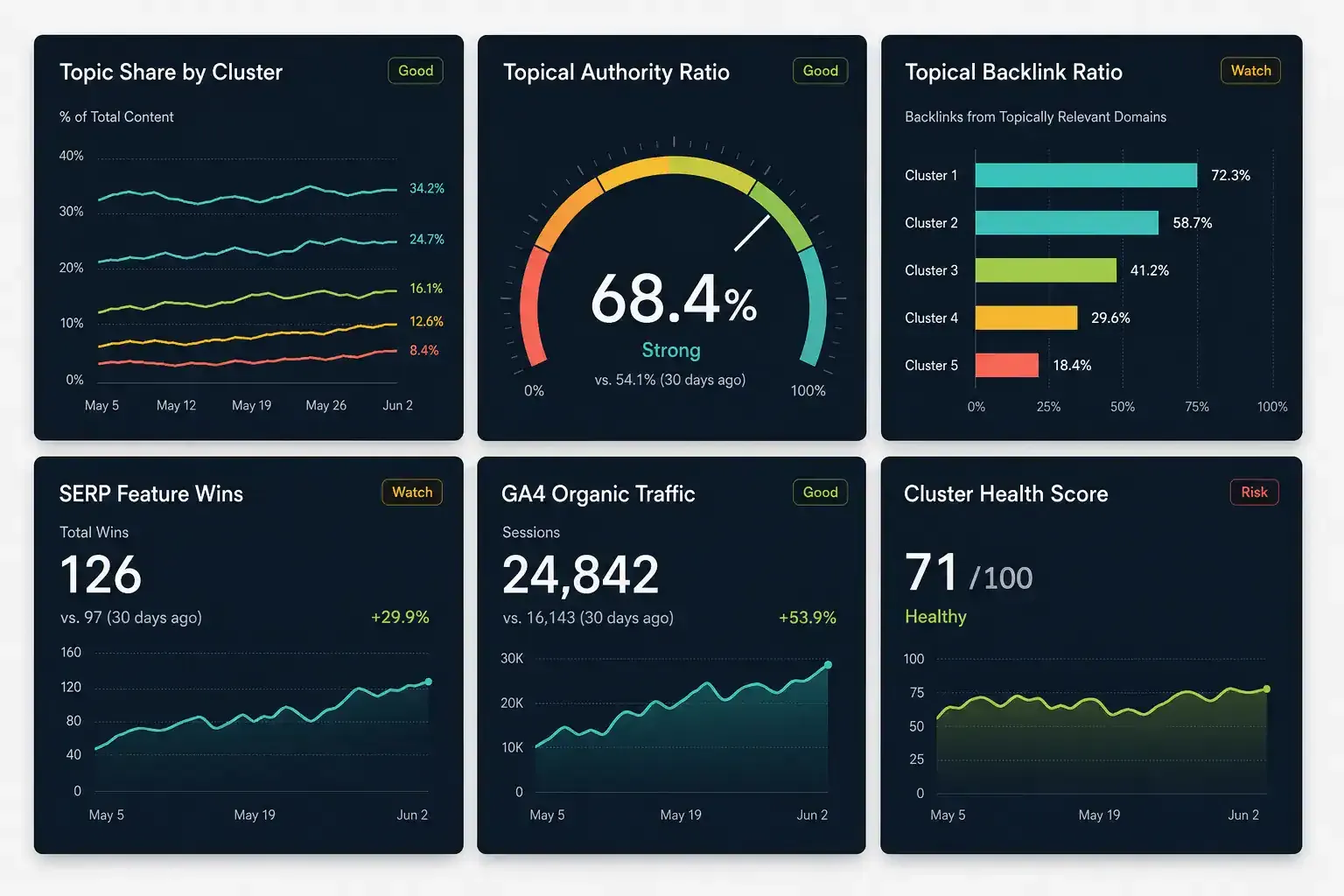
Track whether topical authority is improving at the cluster level, not just whether a few pages rank. Your dashboard should center on topic clusters, content clusters, Topic Share by cluster, Topical Authority Ratio, ranking ownership, topical backlink ratio, SERP feature wins, and GA4 organic traffic.
Use these KPIs and alert thresholds:
- Topic Share by cluster: Measure the share of relevant keywords, URLs, or ranking value owned inside each cluster. Trend it month over month, and trigger an alert when a priority cluster falls more than 5 percentage points below its 3-month average or when a competitor takes share in a cluster you used to lead.
- Topical Authority Ratio and ranking ownership: Use TAR as the share of pages on topic divided by total pages. That matches the framing SEOwind uses. Pair it with ranking ownership so you can see when coverage is expanding but competitive control is not.
- Topical backlink ratio: Track the share of referring domains or backlinks that come from thematically relevant pages instead of the full backlink profile. Flag a review when the ratio declines for two reporting periods or when a new cluster has strong content coverage but weak topical links.
- SERP feature wins: Separate this KPI from average rank. Featured snippets, People Also Ask results, AI Overview-style surfaces, and other prominent placements often show authority before traffic follows. Alert when feature wins drop in a cluster even if average position stays flat.
- Organic traffic growth: Read this at the topic-cluster level, not sitewide. In GA4 organic traffic, watch for sustained month-over-month growth of 10 percent or more in target clusters, and flag any case where traffic rises while Topic Share or ranking ownership falls.
That mix helps you separate visibility, authority, and outcome. Keyword research should define the cluster boundaries, and AI prompts for SEO can speed up the first pass on grouping terms and mapping pages. The metric set matters because a strong system can win traffic without real market control, or it can gain control before traffic fully catches up.
A simple reporting hierarchy keeps the view useful for leadership and practitioners:
- Executive rollup: Topical Authority Score trends across the site or business unit
- Cluster tiles: Topic Share and TAR for each priority cluster
- Detail view: Links, SERP features, and traffic by page or keyword group
That layout gives heads of content and SEO leads a stakeholder-ready view of whether authority is expanding, stalling, or slipping without depending on raw rankings alone.
Which KPIs Show Authority Trends?
The strongest headline KPI is Topical Authority Score (TAS). It combines Content Authority, Market Authority, and AI Authority with a geometric mean, so a spike in one area cannot hide weakness in the rest of the cluster. Track TAS month over month to see whether authority is becoming balanced and durable.
| KPI | What it shows | How to read the trend |
|---|---|---|
| Topic Share | Your share of ranking value inside a topic cluster | Rising share means you are taking more of the map. Flat share while publishing more often usually means volume is growing faster than visibility. |
| TAR | How much published content is turning into authority | A rising TAR points to a more efficient cluster. A falling TAR often means expansion is outrunning performance or new pages are too thin. |
| Backlink topicality | The trust quality of links, not just link count | More links from closely related pages and domains is a healthy sign. More links with weak topical fit is noise. |
| Ranking breadth | How widely the cluster ranks across related queries | Broader gains signal real authority. A single hero keyword win with little movement elsewhere suggests the topic is still narrow. |
| Personal Keyword Difficulty | How easy the domain is becoming to rank within that topic | A lower Personal Keyword Difficulty usually confirms growing topical strength. Semrush uses this signal to show how authority can reduce ranking effort. |
| GA4 organic traffic | Downstream proof that visibility is turning into visits | Use it to confirm that ranking gains are producing real traffic, not just better positions. |
Pattern reading matters more than any single number. Fast Topic Share growth plus wider ranking breadth points to genuine category ownership. Rising TAR with flat share suggests efficiency without competitive takeover.
Backlink topicality often improves before rankings move. That usually means trust is building first. A lower Personal Keyword Difficulty can reinforce that shift.
Graphite reported that pages with high topical authority gained traffic 57% faster than low-authority pages. That makes GA4 organic traffic the clearest downstream check. Sustained upward trends should eventually show up there.
How Often Should We Report Progress?
The best reporting rhythm is weekly for movement, monthly for performance, and quarterly for strategy. That cadence keeps your topical authority program actionable without turning every small ranking change into noise. Weekly tracking catches shifts fast, while monthly and quarterly views turn those shifts into decisions.
| Cadence | What it answers | What to include | When to act |
|---|---|---|---|
| Weekly | What moved? | New pages shipped, coverage gained or lost, ranking breadth changes across the cluster, notable backlink or entity-coverage wins, and AI surface mentions or citations for priority topics | When a cluster moves sharply or a priority topic slips |
| Monthly | Is the program compounding? | Content Authority, Market Authority, AI Authority, TAS, plus Topic Share and TAR trends | When TAS or Topic Share is flat or down for two consecutive months, or when coverage rises but performance does not |
| Quarterly | Where should effort go next? | Defensible clusters, competitor share gains, AI visibility changes, and roadmap implications | When the evidence supports expansion, consolidation, or reweighting |
Monthly reviews should translate metrics into plain English. A higher TAS means a cluster is gaining strength. Rising Topic Share and TAR suggest Search Engine Optimization (SEO) work is compounding across the market.
Quarterly readouts should stay narrative-driven and stakeholder-ready. They should name the clusters becoming defensible, the competitors taking share, and the places where AI visibility is shifting. Pair each chart with one recommendation so the metric movement connects to revenue, pipeline, or content investment priorities.
How Do We Diagnose Stalled Scores?
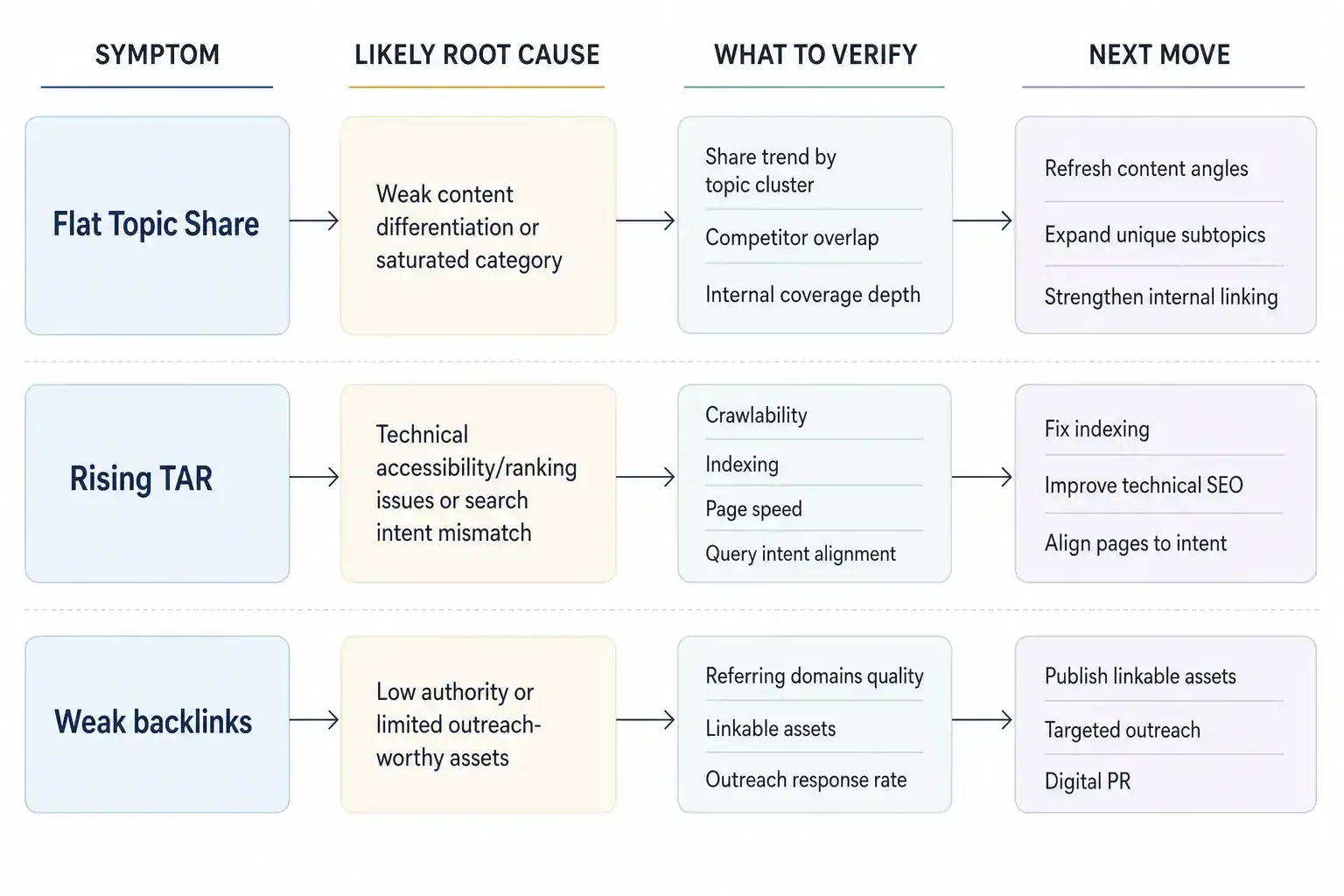
We diagnose stalled topical authority by matching each signal to the bottleneck. Flat Topic Share, a stagnant TAR, and weak backlink growth usually point to different problems in coverage, relevance, or competitive position.
Use this symptom-to-cause check:
| Symptom | Likely root cause | What to verify | Next move |
|---|---|---|---|
| Topic Share is flat while rankings do not expand | Too few hub pages, weak entity completeness, or a stopping rule that cuts expansion too early | Check hub depth, entity coverage, and whether the topic map has enough distinct pages | Expand the hub, add missing entities, and keep building until ownership shifts across the map |
| TAR stays flat after new content | Dilution from overlapping pages, keyword cannibalization, or broad pages with no clear job | Review URL overlap, page intent, and internal competition | Consolidate redundant URLs and give each page one distinct intent |
| Few topical backlinks arrive | A trust and relevance bottleneck, not just a link-building gap | Measure whether links come from authoritative sites in the same subject area | Prioritize topic-relevant citations and outreach that strengthens subject validation |
| Ranking breadth stays narrow | Content is thin, generic, or missing the entities winning pages repeat | Compare your pages with competitor coverage and AI answer patterns | Run content gap analysis and close missing, overused, or weak concepts |
| Publishing volume looks fine, but scores still stall | Competitors control the best queries, referral sources, and topical backlinks | Separate production pace from share of demand | Treat the issue as market-share pressure, not just content depth |
| A Floyi-style score is stalled | One pillar is lagging more than the others | Check Content Authority, Market Authority, and AI Authority separately | Focus the fix on the weakest pillar first |
A stalled score often means the site has enough pages to look active, but not enough distinct coverage to own more of the topic map. It can also mean the team is publishing into the same cluster without improving keyword coverage or adding the entities search systems expect. That is why a clean diagnosis matters before you add more content.
For stakeholder reporting, tie each stalled signal to one next move:
- Coverage expansion: Add missing subtopics, entities, and supporting pages
- Consolidation: Merge pages that compete with each other
- Entity fixes: Tighten definitions, related terms, and internal links
- Backlink priorities: Pursue links from topic-relevant, high-authority sites
This keeps the measurement framework tied to SEO ROI and roadmap decisions instead of turning it into a scorecard with no next step.
Is Coverage Too Thin Or Too Broad?
Start by splitting the problem into two checks. Thin coverage means your topic map is missing important subtopics or entities. Broad coverage means you have drifted into redundant pages, weak-intent angles, or internal competition that does not add authority. A quick content gap analysis helps separate missing pieces from pages that are already doing too much.
Topical Authority Ratio, or TAR, is the fastest first-pass signal. If the share of indexed pages tied to the topic is low against the full site footprint, coverage is probably too thin. If TAR keeps rising while rankings stay flat, the cluster may be past useful expansion. Pair TAR with a content depth score and ranking spread so you judge quality, not just volume:
| Check | Thin signal | Broad signal |
|---|---|---|
| TAR | Low topic share across indexed pages | Rising TAR with weak ranking gains |
| Content depth score | Short, repetitive pages that reuse the same angle | Many long-form pages with similar intent |
| Ranking spread | Authority sits on one or two URLs | Multiple pages rank for the same query set |
A practical decision rule keeps the cluster honest. Classify each idea as missing, covered, or overused. Prioritize the missing high-value concepts first. Stop adding pages when marginal value drops, a new page overlaps an existing asset, or internal linking would become less clear.
Pillar pages earn their place once the core cluster has enough depth, distinct query coverage, and clear ranking ownership. Expand only when the next page closes a real authority gap.
Is Internal Linking Or Consolidation The Fix?
The simplest rule comes first. If a strong page already covers the topic, improve internal linking or consolidate overlap before you publish anything new. The content planning and cluster strategy framework helps separate discoverability problems from real coverage gaps.
The right move usually falls into one of three buckets:
| Choice | Best fit | Action |
|---|---|---|
| Internal linking | The page has real depth, matches intent, and includes the right entities, but it sits too far from pillar pages or related cluster pages | Tighten anchor text, add contextual links, and reinforce the page from nearby explainers |
| Consolidation | Two or more URLs target the same intent, cannibalize each other, or stay too thin on their own | Merge the strongest sections into one canonical page, then redirect the weaker URLs |
| New content | The subtopic is structurally missing and supports the hub with distinct demand | Publish a new page only when the gap is real, not just lightly mentioned |
A quick depth test keeps the cluster clean:
- 800 to 1,200 words: A new page should reach that range of unique, non-redundant depth before it stands alone.
- Core question and follow-ups: The page should answer the main query and the most relevant adjacent questions.
- Entity context: The page should include enough related terms, examples, and context to hold its own.
If a topic only adds a paragraph or two beyond what already exists, it belongs on the parent page. Internal linking improves how existing coverage is interpreted. Consolidation removes dilution. New content expands the map only when the cluster still has uncovered demand, and that is how you protect topical authority while you grow it.
Measuring Topical Authority FAQs
These FAQs help you compare how to measure topical authority with a Topical Authority metric, SEO tools, E-E-A-T signals, and the site:intitle operator. For ready-to-run spreadsheets and benchmark templates, the measurement formulas and dashboard templates walks through the practical setup.
How Long Until Topical Authority Changes?
You usually see early movement in about 3 months, clearer directional change by 6 months, and durable topical authority by 12 months if you keep expanding coverage, tightening internal links, and improving rank ownership. At 3 months, look for better crawl paths, first-page lifts on priority cluster pages, steadier long-tail rankings, and the kind of lift Graphite tied to high-topical-authority pages, which gained traffic 57% faster than low-authority pages. By 6 months, Topic Share and coverage gaps should improve, and by 12 months flagship pages should hold rankings, adjacent topics should inherit visibility, and AI and SERP mentions should look more stable. If you start near zero, the timeline stretches, while a strong domain and relevant backlinks can move results faster, so 3, 6, and 12 months work well as your SEO reporting cadence.
Can Search Console Measure Topical Authority?
Google Search Console shows impressions, clicks, and average position, but it cannot measure topical authority on its own because it does not show topic share, competitor ownership, or AI visibility. You can use it as the traffic proof layer by mapping queries to topics, then checking which clusters drive clicks, which pages have broad reach or weak signals, and where cannibalization may be holding back authority. Pair it with Semrush or Ahrefs, a topical map, and AI presence metrics to compare SERP control and SEO visibility without mistaking raw traffic for authority.
Does Content Depth Improve Topical Authority?
Yes, deeper content can support topical authority, but it is an indirect signal rather than a guaranteed cause. Depth helps most when it closes real topic gaps with clearer answers, entities, examples, and subtopics, while internal links and trust signals still shape how search systems classify the page. If performance stalls after expansion, credibility may be the bottleneck, so in your SEO workflow, track rankings, Topic Share, Topical Authority Ratio, cluster win rate, internal link growth, SERP coverage, and AI mentions or citations before adding more filler.
How Do You Track Authority By Topic Cluster?
A compact scorecard lets you track each topic cluster through Content Authority, Market Authority, and AI Authority across AI Overviews, AI Mode, ChatGPT Search, and Gemini. Weekly inputs should include rank score, keyword importance, cluster coverage, and competitor share of traffic or ranking value so you can tell whether gains are expanding authority or just reshuffling the pack. A single weekly dashboard per cluster should surface TAS, top-page movement, coverage gaps, and AI citation or mention counts with color-coded deltas, while Floyi’s closed-loop view ties the score back to the pages you shipped so you can see why authority is rising. Silo-level authority analysis breaks the same metrics down per topic area, so you can see which silos you lead and which ones competitors own.
About the author

Yoyao Hsueh
Yoyao Hsueh is the founder and CEO of Floyi, the topical authority platform, and the founder of Main Heading, an SEO and AI search agency. He created Topical Maps Unlocked, a course studied by thousands of SEOs, content strategists and digital marketers, founded TopicalMap.com, a done-for-you topical mapping service for agencies and enterprise teams, and publishes the weekly Digital Surfer newsletter on SEO, content strategy and AI search.
About Floyi
Floyi is a closed loop system for strategic content. It connects brand foundations, audience insights, topical research, maps, briefs, and publishing so every new article builds real topical authority.
See the Floyi workflow