
Internal Linking Patterns as a Topical Authority Signal
Learn how internal linking patterns signal topical authority, with audit steps, anchor rules, and measurement tips for SEO teams.
Internal linking patterns are a practical signal of topical authority in SEO. Agency SEOs and in-house content teams often have the pages, but the structure still leaves Google guessing which URLs belong to the same subject and which ones deserve support. In plain terms, internal links show search engines how your pages connect, how authority moves, and which cluster owns a topic, leaving teams with a clearer route to stronger rankings and cleaner crawl paths.
The sections ahead cover how link placement, anchor text, hub-and-spoke paths, and cross-cluster links shape that signal. They also show how authority flows through your site, how to audit orphaned pages and click depth, and how to set rules for cluster leakage and measurement. Expect practical checks such as an intra-cluster ratio target, placement rules for body links, and a scorecard you can apply in a crawl review.
For content strategy leads, technical SEO leads, and agencies managing multiple brands, the value is in repeatable rules that fit existing workflows instead of one-off fixes. A cluster with 75% of followable links kept inside the topic family, plus a pillar page that receives links from its strongest supports, gives Google a cleaner map of relevance. Use the pattern here to tighten internal paths, support priority pages, and make topical authority easier to defend in reporting.
Internal Linking Patterns Key Takeaways
- Internal links reveal topic relationships and help Google classify content.
- Hub-and-spoke structures concentrate authority around pillar pages.
- Keep most contextual links inside the same topical cluster.
- Use descriptive anchor text that matches the destination subtopic.
- Put important links in body copy for stronger contextual signals.
- Audit orphan pages, click depth, broken links, and cluster leakage.
- Track crawl coverage, indexation, and cluster-level performance changes.
What Does Internal Linking Signal To Google?
Internal linking is one of the clearest structural signals in search engine optimization (SEO). It tells Google which URLs exist, which pages belong together, and how your site hierarchy moves from broad hub pages to narrower subtopic pages. A clean structure makes crawling simpler and helps search engines classify content with less guesswork. The topical authority implementation and deployment kit covers the technical foundation these link patterns depend on.
It also decides where authority flows. Backlink equity does not stay fixed on the page that earned it. Your internal structure redistributes link equity, so a strong page can reinforce related cluster pages while weak or poorly placed links leave important content underpowered.
Think of the site as a semantic graph. Pages act as nodes, links act as edges, and anchor text plus nearby copy explain what the destination page covers. Those semantic signals help Google see topic relationships instead of isolated pages.
Internal linking works best when it supports value, not when it just fills space. It amplifies strong content, solid topical coverage, external authority, and crawl understanding, but it cannot create authority on its own. Thin, off-topic, or low-credibility pages still need better substance before links can do real work.
A simple link placement rule keeps the signal sharp:
- High-value pages: Use contextual links from closely related content to reinforce topic depth and ranking confidence.
- Secondary pages: Place them in navigation or footer areas when they need access but should not take main-body attention.
- Anchor text: Keep it natural and specific so users and crawlers understand the destination without guessing.
- Topical trust: Connect ideas in a way that shows how they relate, not just where to click.
When link placement matches importance, you give Google a cleaner map of relevance and authority. That makes internal linking a core topical-authority signal, not a housekeeping task.
Which Linking Patterns Build Topical Authority?
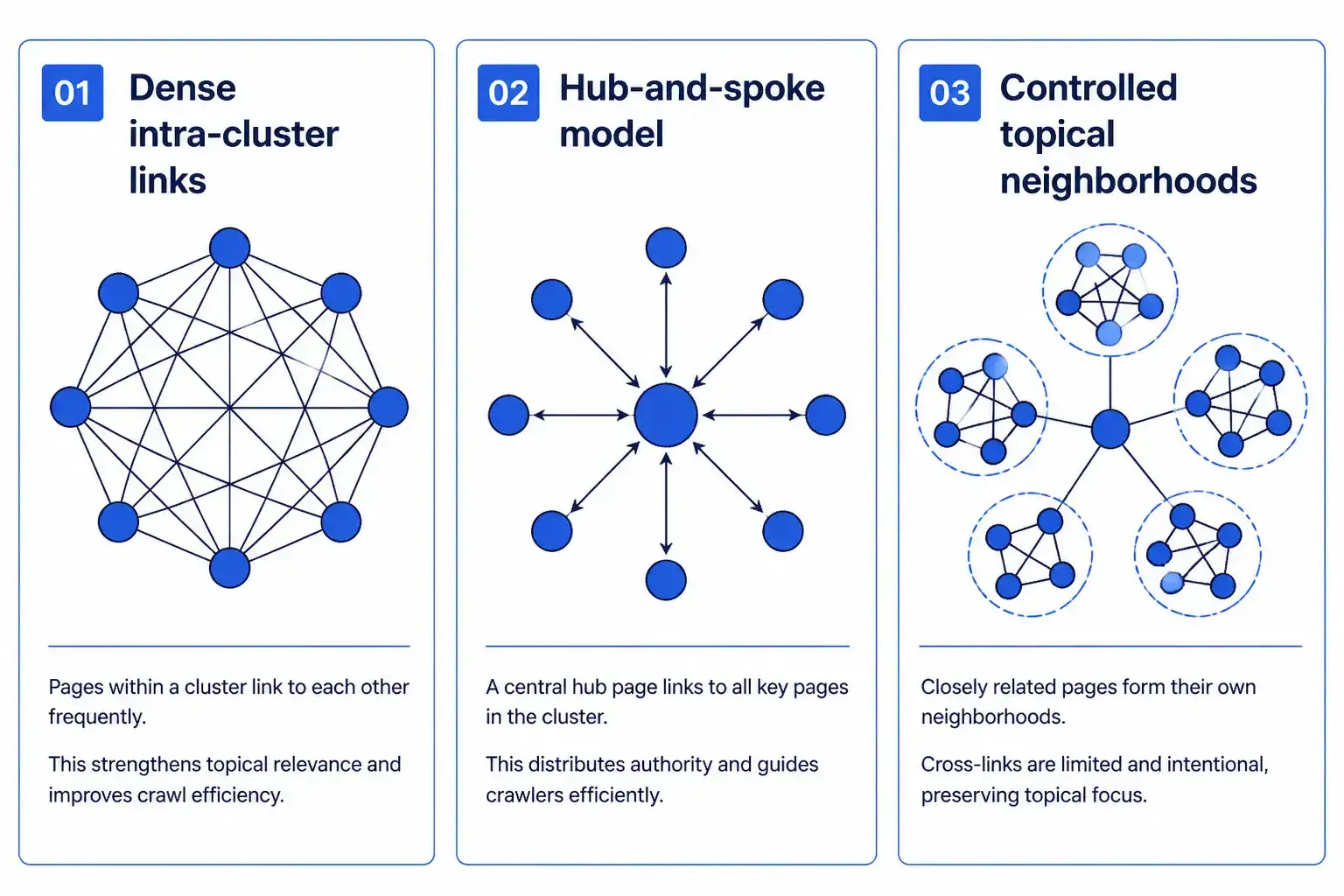
Topical authority grows when your internal links behave like a clear map of a subject, not a pile of stray references. SEO engines read that pattern as a semantic neighborhood, so topic clusters need to show the subject boundary, the subtopics inside it, and the depth of coverage. The content architecture for topical authority step comes first, because the architecture works best when page roles are set before linking begins.
A few link patterns do the heavy lifting:
- Dense intra-cluster links: Use intra-cluster links when pages belong to the same topic set. Each supporting article should point to the pillar page, and the pillar page should point back to the strongest supports. Sibling pages should cross-link only when the jump helps a reader move from broad coverage into a narrower subtopic.
- Hub-and-spoke model: Use a hub-and-spoke model for authority hubs that attract the most backlinks or visibility. The hub and spoke structure lets the main page distribute external authority through contextual links to deeper pages. Those deeper pages then reinforce the hub and spread equity across the cluster.
- Controlled topical neighborhoods: Keep the signal clean by linking heavily within one cluster. Link laterally only when the intent matches. Irrelevant cross-topic links blur ownership and make the hierarchy harder to read.
- Descriptive anchors: Treat anchor text as a relevance cue, not a place for exact-match stuffing. Give the destination enough detail to explain what comes next. Vary phrasing naturally, and use generic labels like “read more” only when the surrounding copy already makes the target obvious.
- In-content placement: Put links inside explanatory copy when you want the strongest topical signal. Footer-only or navigation-only links carry less context. In-content placement helps users move through the topic and gives the link more semantic weight.
The practical test is simple. If a link helps a reader move from a broad concept to a useful next step, it usually strengthens topical authority. If it points across unrelated subjects, it weakens the cluster and muddies the signal. Keep the link graph tight, descriptive, and anchored in the topic itself. The silo architecture patterns for topical authority guide covers when strict silos help and when flexible clusters work better.
When Should You Use Cross-Cluster Links?
Cross-cluster links work best when they serve a real reader need. Use them only when two topic clusters share the same goal, a named entity, or a clear prerequisite step. Otherwise, keep the silo intact so each cluster preserves intent consistency and topical clarity.
Use this as your filter:
- Shared intent: The destination page answers the next logical question in the same research path.
- Entity association: Both pages refer to the same named thing, process, or concept in a meaningful way.
- Prerequisite step: One page explains the idea, and the other covers the measurement or implementation step.
- Best next action: The reader gets more value by moving forward than by staying in the current cluster.
The hub-and-spoke model is the safest default. The pillar page should own the broad subject, and spoke pages should stay tightly linked inside their own cluster. A cross-cluster link belongs only when the reader has reached a natural stopping point and needs the next adjacent deep topic.
An SEO audit article can point to a click depth page when the next step is measurement. On category-heavy sites, keep links mostly inside the silo and cross only when a shared parent hub or a clearly better path exists. Keep the anchor text descriptive, and avoid overlinking that blurs the boundaries between topics.
Measure the bridge with a simple check:
- Intra-cluster share: Most links should stay within the same cluster.
- Cross-cluster share: Keep this lower unless the bridge clearly improves navigation.
- Link quality: Keep only the bridges that strengthen SEO relevance without weakening topic focus.
How Does Authority Flow Through Your Site?
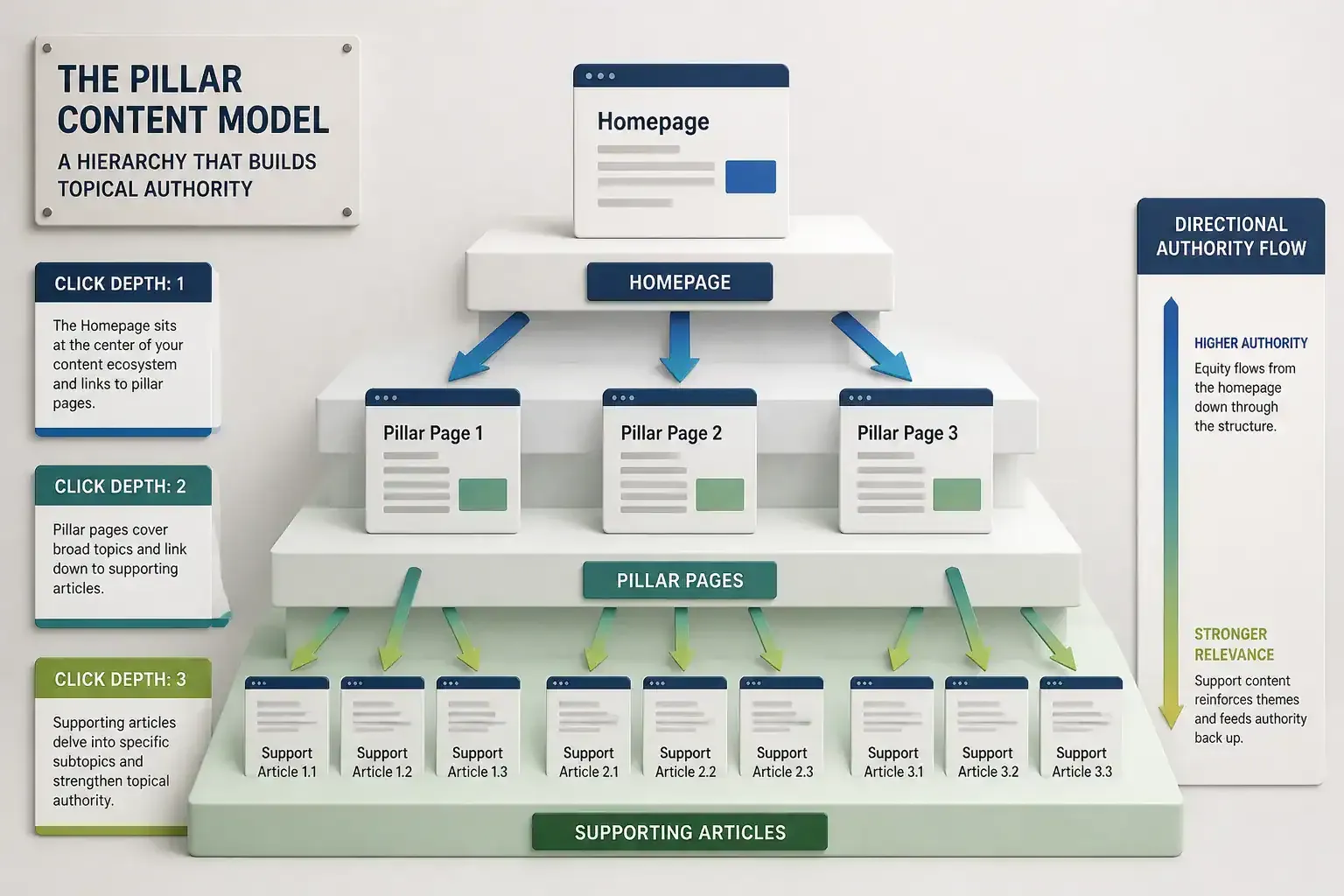
Authority routing shapes which pages receive more internal support. External backlinks usually land on one page first, and internal linking spreads that value across related URLs. In PageRank terms, that first page receives link equity and passes part of it onward. CheiRank-style thinking matters too, because strong pages should also point to the pages you want discovered and crawled.
Your site hierarchy should do two jobs at once in a hub and spoke structure. The homepage and top-level authority hubs need to send strength down into category pages, pillar pages, and supporting articles. Deeper cluster content should also send authority back up to evergreen core resources so the main pillar never sits alone.
A practical rule set keeps that flow clean:
- Click depth: Keep important pages close to the homepage.
- Placement: Favor body-context links for key paths. Navigation and footer links help access, but they usually carry less weight than a natural link in the main copy.
- Relevance: Match the link to the surrounding topic. A forced sitewide link to an unrelated page scatters authority instead of reinforcing it.
- Inherited authority: Pages linked from strong authority hubs usually benefit more than pages tied only to weak posts or orphaned content.
Google says every page you care about should have a link from at least one other page, so a shorter path can help crawlers and readers reach priority content more easily (source).
That is why internal linking works more like a distribution system than a decoration layer. Pages inside a strong topic cluster borrow trust from the hub, then feed that trust back into the same cluster. The result is a tighter hub and spoke model where the most important assets keep getting reinforced.
The same logic should guide earned links. When one article or asset attracts outside attention, send that backlink equity into the evergreen pillar or service page that should rank long term. That stronger page can then redistribute link equity to the supporting cluster and turn a single win into durable topical strength.
Seen this way, authority is not a static score. It is a routing problem, and the pages you connect first usually become the pages that matter most.
How Do You Audit Internal Links For Authority?
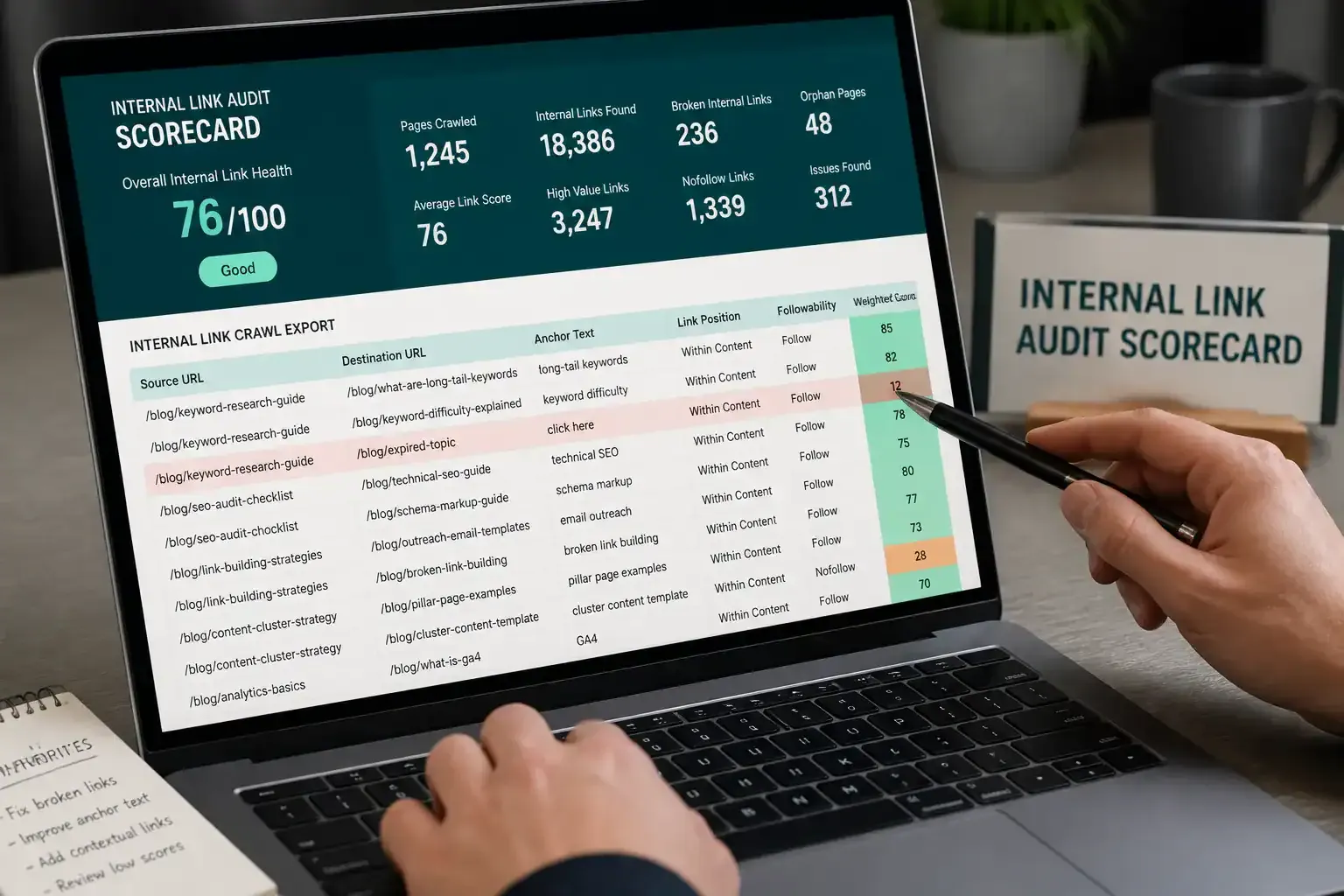
A strong internal link audit starts with the crawl, not the guesswork. Pull the source URL, destination URL, anchor text, link position, and followability for every internal link, then sort pages into topical clusters before you score performance. That gives you the only view that shows where authority moves, where it slows, and where a nofollow tag changes the route.
Use a scorecard like this:
| Criterion | Weight | Pass rule |
|---|---|---|
| Crawl coverage and link completeness | 20 | Nearly all indexable pages and internal links are captured |
| Orphan coverage | 15 | Every priority page has a contextual inbound internal link |
| Intra-cluster link ratio | 20 | About 75% or more of followable internal links stay within the same topical family |
| Anchor text topicality | 15 | Anchors match the destination subtopic clearly |
| Click depth | 10 | Important pages stay within three clicks |
| Cross-topic leakage | 10 | Off-topic links remain rare |
| Structural health | 10 | Broken links, redirect chains, and loops stay minimal |
Use a weighted internal-link audit score to prioritize fixes, and set the passing line based on your own crawl and performance data rather than treating 80 out of 100 as a universal standard. Google’s guidance still makes crawlable, contextual links the core requirement for discovery and understanding (source). Any priority page that lacks a contextual internal link should fail, even if the total score looks fine.
Cluster quality tells you whether the site behaves like a focused map or a noisy directory. Strict silos work best for tightly bounded topics, flexible clusters fit adjacent subtopics, and lateral links should appear only when two spoke pages share direct logical overlap. If a large share of followable links points outside the cluster, the topic structure may be too loose and the internal signal may be harder to read. Keep most contextual links inside the same topical group, and use cross-topic links only when they help the reader move to the next logical step.
Anchor text needs its own check because generic wording hides meaning. Strong anchors reflect the real subtopic on the destination page, whether that page supports a pillar, an informational query, a comparison page, or a transactional path. Weak anchors look like homepage labels, vague verbs, or random cross-topic phrases that muddy intent.
Structural problems can quietly drain internal authority even when the content is solid. Broken links are common, and they interrupt crawl understanding as well as distribution of equity. Redirect chains, loops, excessive low-value links, and pages buried more than three clicks deep all deserve a flag in the audit.
The fix should follow the score, not instinct:
- Strengthen pillar pages that have too few contextual inbound links.
- Add lateral links only between spoke pages with clear overlap.
- Remove or rewrite noisy cross-topic links that blur relevance.
- Consolidate thin or redundant pages so the network carries more semantic coverage.
That is how an internal link audit turns into cleaner crawl paths, stronger topical signals, and better support for external authority without pretending links create authority on their own.
How Do You Implement And Measure Improvements?
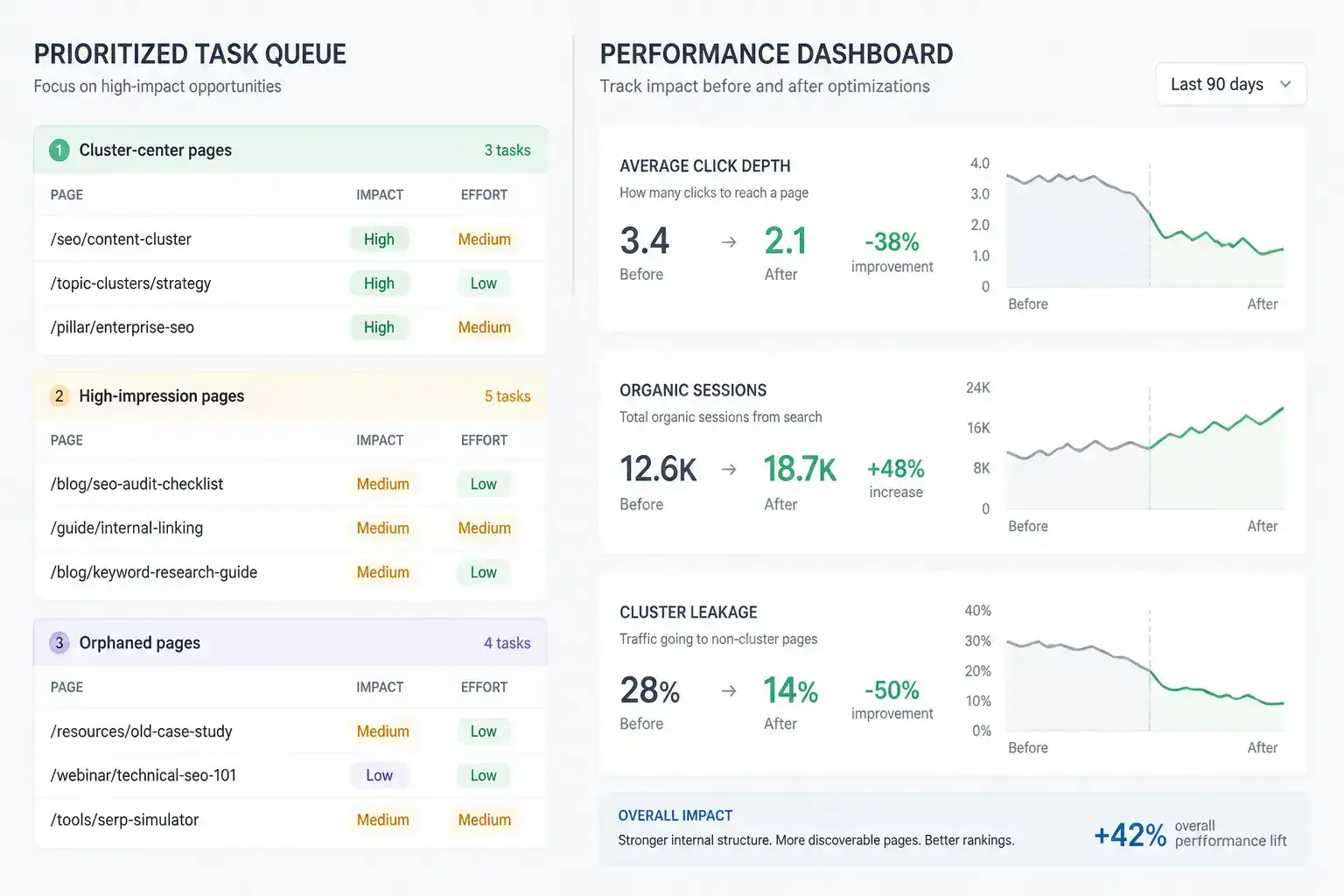
The fastest gains come from the pages that already carry authority. Your internal link program should start with a prioritized queue, not a sitewide sweep. An internal link audit should sort fixes by impact and effort, because page count is a weak guide when crawlability and organic visibility are the real goals.
Focus on the fixes that usually move the needle first:
- Cluster-center pages: Strengthen the pillar page and the pages that sit at the center of cluster content.
- High-impression pages: Add support where visibility already exists but internal signals are thin.
- Orphaned or thin pages: Repair pages that interrupt crawl paths or sit outside the main flow.
- Fresh-to-evergreen links: Connect new pieces to older, relevant content when they extend the same topic.
Structure should mirror intent flow. A hub-and-spoke model works best when the pillar page introduces the topic, supporting articles expand subtopics, and sibling pages cross-link only when the fit is real. Contextual linking keeps relevance tight and avoids noisy cross-topic clutter. The goal is a clean path, not content bloat.
Link placement matters more than most teams expect. Body links usually carry more value than navigation or footer links because they sit close to the sentence that explains why the click matters. Good link placement gives the link context and helps the reader move naturally through the topic. The site architecture patterns for topic clusters guide explains how flat, hierarchical, and faceted structures each affect these link paths.
Set the measurement plan before launch so crawl gains do not get mixed up with ranking gains:
| Metric | What it tells you |
|---|---|
| Click depth to core pages | Whether users and crawlers reach priority pages faster |
| Crawl frequency | Whether search engines visit important pages more often |
| Index coverage | Whether key cluster pages are being indexed reliably |
| Internal-link count by page type | Whether the structure is balanced |
| Share of links inside the cluster | Whether authority stays concentrated |
| Impressions, clicks, click-through rate, and rankings | Whether visibility improves for target queries |
Run controlled tests when you can. Split comparable clusters into treatment and control groups, keep stable page IDs, check results weekly, and use difference-in-differences analysis so seasonality and publishing cadence do not hide the signal. Compare week-over-week changes in depth, organic sessions, and assisted conversions.
Engagement still matters, but only as a secondary signal. Strong linking should move you from broad informational pages into specific long-tail intents, and a broad query fan-out should funnel into the pages that answer one need well. If users bounce between unrelated pages or never reach supporting content, the structure is too diffuse. Keep the report at the cluster level so the pages that drive authority get the attention they deserve.
What Click Depth Should You Target?
Your most important pages should usually sit within three clicks of the homepage, or closer. Each extra hop dilutes link equity, and both users and crawlers are less likely to keep going when a page feels buried.
A simple rule keeps the structure honest:
- 1 to 3 clicks: core money pages, primary hub pages, and high-priority subtopics
- 4 or more clicks: a warning sign unless the page is intentionally low priority or nested by design
- Beyond that: a page that needs a review of internal links, placement, or priority
Measure depth by the shortest internal-link path from the homepage, not by URL folders. Sample key URLs and flag pages that rely on redirect chains, orphaned pages, or too many on-page links to reveal the real path.
Structured learning paths are the clearest exception. A Beginner, Intermediate, Advanced sequence can sit deeper when the progression matters, but hub pages should still provide shortcuts. If a page must stay deep, strengthen contextual links from nearby hub pages and sibling pages so it still feels reachable.
How Do You Track Cluster Leakage?
A simple leakage score gives you a fast read on whether a cluster is staying coherent. Count the cross-topic internal links inside one cluster, then divide that by all links in the cluster. When that share rises, the semantic neighborhood gets noisy and your SEO signal starts to blur.
Track these checks side by side:
- Leakage score: Cross-topic internal links divided by total cluster links.
- Anchor mix: Tag each anchor as topically relevant, topically irrelevant, or generic, then watch the mix over time.
- Intent consistency: Compare the search intent of the source page and the destination page. Informational links into commercial, location, or support pages can fit when they read naturally, but repeated mismatches point to intent-mix drift.
- Topical-anchor relevance: Read the surrounding sentence and nearby entities, not just the anchor text. If the link only makes sense with heavy extra context, the page is probably drifting out of cluster.
Practical thresholds help you act before the problem spreads. A cluster that falls below that level deserves attention. The same warning applies when generic or off-topic anchors become a material share of links, or when the same page keeps getting cross-topic links from different silos.
Secondary symptoms usually confirm the pattern. Orphaned pages, accidental rankings from the wrong topic, and pages fed by multiple unrelated silos all point to noisy internal linking. Clean those paths, because strong clusters depend on clear internal-link patterns and steady intent consistency.
Internal Linking Patterns as a Topical Authority Signal FAQs
Make sure every important page has at least one contextual internal link so it is not orphaned. Then add additional links where they fit naturally and help readers move through the topic, since Google says every page you care about should have a link from at least one other page on the site (source). Keep outbound internal links in a body section limited to what helps the reader, and remove links that do not add clear topical value.
Are internal links enough to build topical authority?
No. Internal links help search engines read your site, but topical authority still depends on content and backlinks.
They act as contextual labels because the anchor text, nearby words, and related entities help Google move from broad themes to narrower subtopics, including long-tail queries.
Real authority still comes from semantically complete content, relevant backlinks from reputable domains, and enough expert-level coverage to earn trust, while internal linking simply organizes and strengthens that signal.
How many internal links should each cluster page get?
A practical target is 2 to 3 inbound contextual internal links for each cluster page, with at least 1 link to every important page so nothing valuable becomes an orphan. Send the strongest links from authoritative hub pages or pages that already earn the most backlinks and visibility, since they usually pass more perceived authority. Cluster pages can deserve more links than the pillar, but keep the pattern natural and cap any single body section at about 5 outbound internal links.
Can too many internal links dilute authority signals?
Yes. Too many internal links can spread link equity too thin, blur priority, and make a page feel noisy for readers and SEO. Keep your strongest contextual links for high-value pages, place low-value or secondary pages in global navigation, the footer, or utility areas, and avoid repeating the same anchor too often. When every link is emphasized, none of them stands out.
When should you prioritize backlinks over internal links?
Prioritize backlinks when your site is still low-authority overall, because internal links can redistribute equity while earned links add new authority. If a page has weak E-E-A-T signals and no strong hub can support it yet, earned links from relevant, reputable domains should come first. The same goes for an orphaned high-intent page with real commercial or informational value, since a direct backlink can build authority faster than navigation tweaks alone. Once those links start working, use internal links to push that strength through the hub and supporting cluster.
How do you avoid topical authority content bloat?
Set a stopping rule that tells you when a cluster is complete, then stop adding pages once new ideas start repeating the same intent, filling weak gaps, or risking cannibalization. Give every URL one clear job, and consolidate pages that answer the same question or serve the same stage of the journey into a stronger asset. Prune thin support pages, orphan pages, deep pages buried beyond three clicks, broken-link targets, and pages with no meaningful internal demand, while keeping internal links selective so authority flow stays focused.
About the author

Yoyao Hsueh
Yoyao Hsueh is the founder and CEO of Floyi, the topical authority platform, and the founder of Main Heading, an SEO and AI search agency. He created Topical Maps Unlocked, a course studied by thousands of SEOs, content strategists and digital marketers, founded TopicalMap.com, a done-for-you topical mapping service for agencies and enterprise teams, and publishes the weekly Digital Surfer newsletter on SEO, content strategy and AI search.
About Floyi
Floyi is a closed loop system for strategic content. It connects brand foundations, audience insights, topical research, maps, briefs, and publishing so every new article builds real topical authority.
See the Floyi workflow