
Site Architecture Patterns for Topical Authority
Learn site architecture patterns for topical authority, from topical maps and URLs to internal linking, measurement, and AI-search readiness with Floyi.
Site architecture patterns for topic clusters give SEO teams a clear way to turn topical maps into crawlable page systems. Topic cluster architecture is the visible page structure that connects pillar pages, cluster pages, internal links, and breadcrumbs around one subject. For SEO agencies, content strategists, and in-house growth teams, that structure reduces cannibalization and makes topical authority easier to scale.
The article compares hub-and-spoke, hierarchical, flat, matrix, sequential, faceted, four-tier enterprise, and B2B semantic graph models. It also covers page mapping, URL paths, breadcrumbs, crawl depth, schema markup, and internal-link rules. Readers get repeatable topic lists, AI-assisted briefs, URL blueprints, and refresh rules that keep clusters aligned as content grows.
Right now, teams managing multiple brands or product lines need a structure that keeps every page role clear and prevents orphaned content. Technical SEO leads can protect crawlability while content teams publish faster with fewer overlap checks. A CRM pillar near the homepage with implementation, comparison, and troubleshooting pages below it shows how the system stays readable in practice. The next sections show the patterns and rules that make that system work.
Topic Cluster Site Architecture Key Takeaways
- Topic cluster architecture turns topical maps into crawlable site structure.
- Pillar pages should sit closest to the homepage and main navigation.
- Internal links should flow from pillar pages to cluster pages and back.
- URLs, breadcrumbs, and folders should reinforce the same hierarchy.
- Different site types need different patterns, including hub-and-spoke and faceted models.
- Architecture briefs should define intent, slugs, schema, and link rules.
- Measure crawl depth, indexation, cannibalization, and cluster-level organic performance.
What Is Topic Cluster Site Architecture?
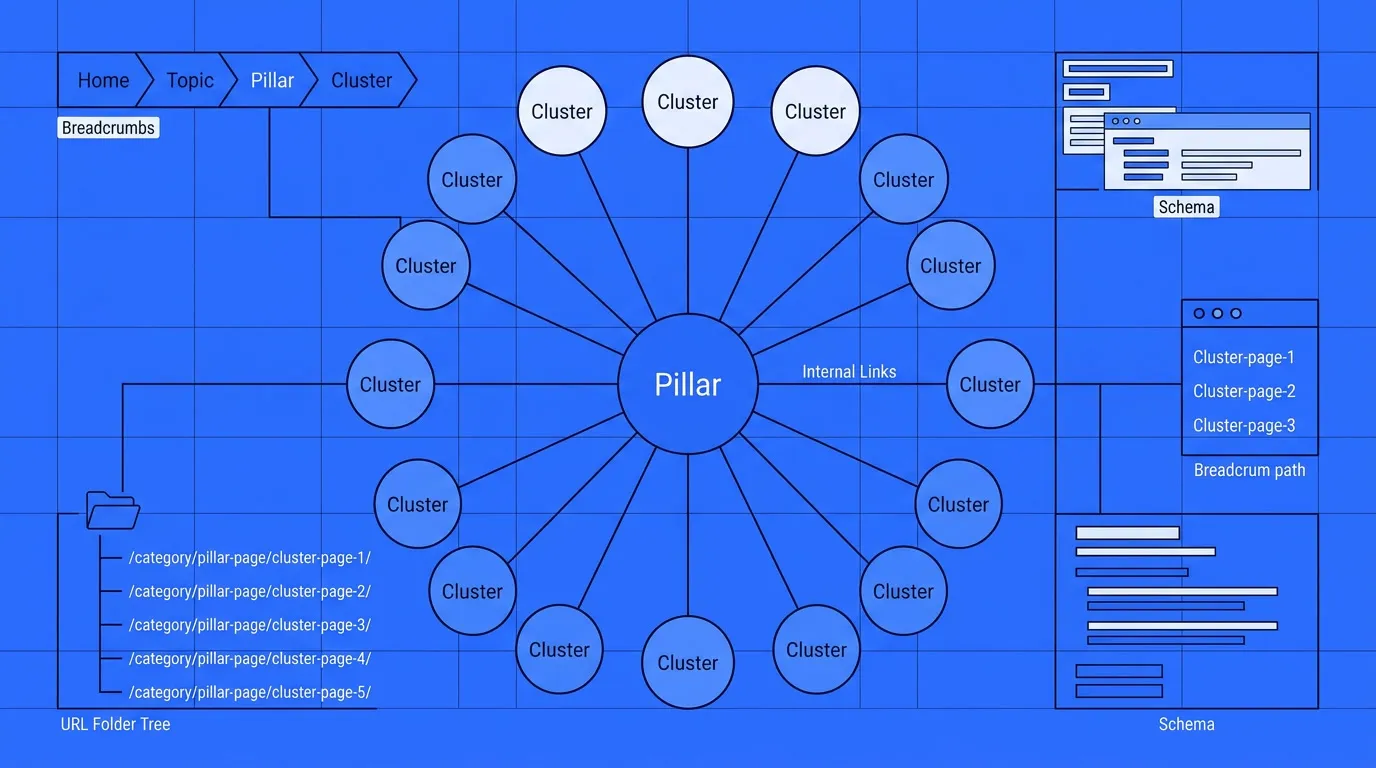
Topic cluster architecture is a search engine optimization (SEO) information architecture system that turns a topical map into crawlable website structure. It uses pillar pages, cluster pages, semantic relationships, internal links, navigation paths, and structured data to make a topic visible on the live site, not just in a spreadsheet. Floyi’s Site Architecture tool automates much of this by generating URL blueprints and folder structures directly from your topical map.
That matters because site architecture, website structure, and backend architecture are not the same thing. Generic website architecture organizes pages for people and search engines. Backend architecture covers servers, databases, code, and infrastructure. Topic cluster architecture focuses on how topical relationships appear on the public site so crawlers and users can follow them.
The main architecture types differ in scope:
| Type | What it covers | What it does not cover |
|---|---|---|
| Site architecture | Page organization, labels, links, and hierarchy | Server setup and application code |
| Website structure | How content is grouped and connected for navigation and SEO | Database logic or hosting layers |
| Backend architecture | Servers, databases, frameworks, and infrastructure | On-page topical relationships |
| Topic cluster architecture | The visible structure of pillar and cluster pages around a theme | Hidden planning documents or disconnected content |
The core pieces work together like this:
- Pillar pages act as the broad topic hub.
- Pillar and cluster pages connect a central page to narrower supporting pages.
- Topic clusters group related pages around one subject area.
- Semantic relationships link entities, questions, and subtopics.
- Internal links create explicit pathways between related pages.
- Navigation and schema send architecture-level signals to users and crawlers.
Hierarchy turns the topical map into a usable experience. Broad themes usually sit closest to the home page and main navigation. Narrower subtopics move deeper, such as cars to electric cars to Tesla to Model S care and maintenance.
Navigation, uniform resource locators (URLs), and breadcrumbs make that structure easy to read. Navigation exposes the main topic areas. Subdirectories can reinforce parent-child order. Breadcrumbs help users and crawlers move between related pages without depending on a hidden planning file.
Schema markup supports the structure rather than replacing it. Structured data can reinforce page type, entity relationships, breadcrumbs, and article context. It works best when the underlying pages already form a real cluster and cover the topic with enough depth.
Topic cluster architecture works when every page has a clear topical role, logical neighbors, and crawlable paths back to the pillar and related subtopics. That is why architecture is not just a design choice. It is an SEO strategy decision.
Why Do Topic Clusters Improve SEO?
Topic clusters improve SEO because they turn separate articles into a connected subject system. That structure helps Google understand breadth, depth, and relationships across a site. It also gives you a clearer path from broad questions to narrow decisions, so readers do not have to start over on every page.
Search engines now look well beyond a single keyword match. Semantic SEO rewards subject coverage, related entities, and strong page-to-page relationships. Topic clusters make that coverage easier to interpret than a set of isolated posts built around one query each. For the broader framework behind these signals, see the implementation framework for topical authority.
Topical authority grows when a pillar page sets the main subject and supporting pages answer specific subtopics. Internal linking shows which page is the hub, which pages add detail, and how the pieces fit together. The silo architecture impact on topical authority becomes easier to see when that hierarchy stays consistent.
The performance upside can be meaningful, but it is not automatic. Search Engine Land reported HireGrowth 2025 analysis findings that clustered content drove about 30% more organic traffic and held rankings 2.5 times longer. Those results still depend on quality, credibility, and execution.
Crawlability is another major reason topic clusters work. A flat site often leaves orphan pages, dead ends, and weak paths for crawlers. Cluster architecture gives search engines logical routes from the main topic into subtopics and back again, which improves discoverability and authority flow.
That structure also helps link equity move in a way search engines can read clearly. Vertical internal linking should connect the pillar to supporting pages and then back up to the hub. Horizontal links between related same-level pages can deepen context, while jumps across unrelated hierarchy levels can blur the signal.
The practical gains usually show up in a few places:
- Better discoverability for supporting pages
- Clearer authority flow across related content
- Stronger user journeys from overview to detail
- More natural conversion paths from education to action
- Less pogo-sticking because readers find the next relevant page faster
A good cluster gives every page a job. One page introduces the topic, another answers a narrower question, and another helps readers compare options or take the next step. That clarity helps teams measure page roles, semantic relationships, and performance instead of publishing disconnected articles with no path between them.
Topic clusters also make scale easier. Content teams can build around one subject family at a time, keep new pages aligned to the same intent, and expand coverage without cannibalizing their own work. That is where Topical authority becomes a durable advantage, because the site can expand without fragmenting its subject coverage.
How Do You Choose The Right Architecture Pattern?
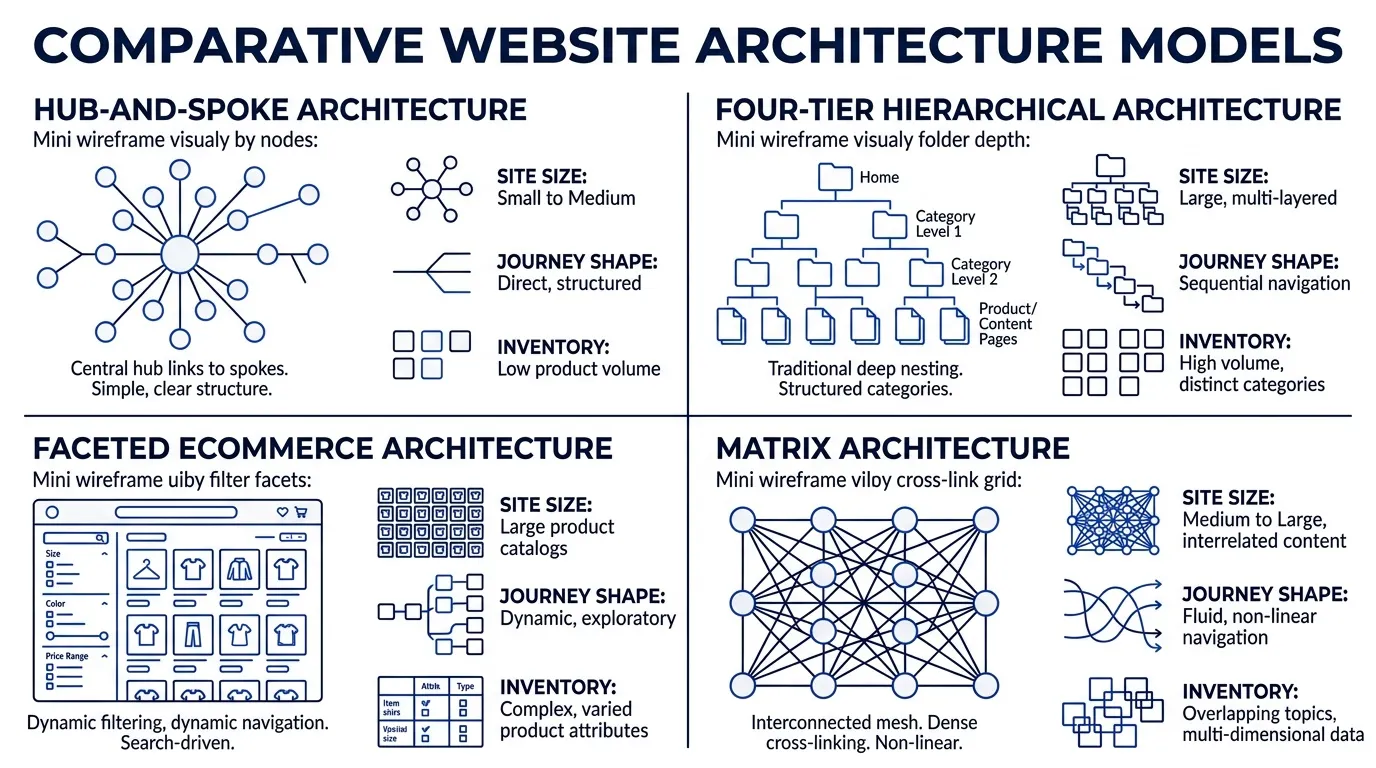
The best site architecture patterns for topic clusters match user journeys, site size, content inventory, governance needs, and the business model. Small specialist sites can stay flat or use a Hub-and-spoke model. Enterprise, marketplace, and B2B category sites usually need deeper hierarchy, cross-linking, and taxonomy control to prevent crawl waste, orphaned pages, and cannibalization.
A quick comparison makes the tradeoffs easier to see:
| Pattern | Best use case | Site size | Journey shape | Inventory type | URL depth | Internal-link model | Primary risk |
|---|---|---|---|---|---|---|---|
| Hub-and-spoke model | One core topic with supporting angles | Small to midsize | One pillar with branching questions | Subtopics, FAQs, use cases, intent pages | Shallow to moderate | Spokes point to the hub with selective lateral links | Thin spokes or an overstuffed hub |
| Hierarchical | Marketing sites, blogs, and category-led sites | Small to enterprise | Predictable parent-child paths | Service pages, blog posts, category pages | Moderate to deep | Parent-child links plus breadcrumbs | Orphaned pages when the tree gets messy |
| Flat | Portfolios and lean small sites | Very small | Simple and direct | A limited page set | One to two clicks | Global navigation with light contextual links | Weak depth once the site grows |
| Matrix | Educational sites and catalogs | Midsize | Multi-angle navigation | Persona, problem, industry, feature, and content-type pages | Moderate | Cross-links across dimensions | Confusing paths and duplicate overlap |
| Sequential | Onboarding, tutorials, certifications, and migration guides | Small to midsize | Step-by-step progression | Funnel-style education and training | Linear and guided | Next-step links and checkpoints | Drop-off and dead ends |
| Faceted/database | Ecommerce, marketplaces, directories, and libraries | Large | Filter and retrieve | Products, locations, prices, audiences, industries, formats, difficulty | Deep but controlled | Hub pages plus filtered paths | Duplicate URLs and crawl budget waste |
| Four-tier enterprise | Large content systems with layered depth | Large | Overview to detail to assets | Broad editorial and support inventories | Deep but organized | Tiered hubs, category links, and asset ties | Complexity without governance |
| B2B semantic graph | B2B category sites with long evaluation cycles | Enterprise | Non-linear and multi-stakeholder | Entities, jobs-to-be-done, integrations, pain points, competitors, compliance, roles | Variable and relationship-led | Contextual links, comparison hubs, entity pages, schema relationships | Scattered authority and message mismatch |
The Hub-and-spoke model works best when one canonical pillar can support about 8 to 20 related pages. The pillar carries the main theme, while the spokes handle FAQs, use cases, and intent-specific angles. That shape keeps the site focused without forcing every page to do the same job.
The Four-tier model fits when a topic needs a clear ladder of depth. Tier 1 gives the overview, Tier 2 covers category deep-dives, Tier 3 handles tactical how-to content, and Tier 4 holds checklists, tools, templates, and comparison aids. A hierarchical structure is the safest default for marketing sites and blogs because parent-child navigation stays predictable, while flat architecture only belongs on small sites where most pages live within one or two clicks.
Matrix architecture is stronger when a reader might arrive by persona, problem, industry, feature, or content type. Sequential architecture fits onboarding, tutorials, certifications, migration guides, and other funnel-style education. Those patterns work because they match the way people move through content, not just the way a team wants to publish it.
Faceted/database architecture belongs in ecommerce, marketplaces, directories, and content libraries where users need filters like product type, location, price, audience, industry, format, or difficulty. Topic clusters organize meaning and authority. Faceted systems organize retrieval across a large inventory. When filters start multiplying, category taxonomy best practices for topical authority becomes the guardrail that keeps canonicalization, indexable facets, and category pages aligned.
The B2B semantic graph is the strongest fit for non-linear commercial journeys with long evaluation windows, multiple stakeholders, technical scrutiny, procurement review, and category confusion. It connects jobs-to-be-done, industries, integrations, pain points, competitors, compliance needs, and decision roles through contextual links, comparison hubs, glossary and entity pages, use-case bridges, and schema-supported relationships for users and AI search systems. That model is especially useful when the buyer path is messy and the right answer depends on context.
Website structure should be locked in an architecture brief before the content team scales production. Site architecture, content architecture, and navigation rules need to follow the same logic or users will feel the gaps before crawlers do. A usable brief should document:
- Core entity and pillar objective
- Page types and audience fit
- Slug and breadcrumb conventions
- Navigation entry points
- Contextual link rules
- Related-content modules
- Expected click depth
- Schema needs and success metrics
Floyi’s implementation kit for deploying topical authority turns that brief into a repeatable operating model. Clustering validates groups against SERP patterns, the Topical Map converts clusters into MT, ST2, ST3, and ST4 layers with slugs, and Site Architecture creates URL blueprints for multi-location or multi-market expansion. Audits then flag keep, optimize, or prune actions plus cannibalization risk before you scale the content system.
How Do You Map Topics Into Pages?

A page map turns research into site architecture by showing which intents deserve standalone pages, which ideas belong together, and where each page fits in the hierarchy. You use keyword demand, entities, SERP evidence, intent, journey stage, and business priority to turn raw research into something your team can publish against.
Content mapping works best when the structure follows Search intent segmentation instead of raw volume alone. Broad themes become Pillar pages, while narrower topics sit underneath them as supporting assets. That is how Pillar and cluster pages move from theory into a usable publishing plan.
A practical page map usually records these fields:
| Field | What it captures | Why it matters |
|---|---|---|
| Topic | The core subject of the page | Keeps the page focused on one idea |
| Primary keyword | The main query theme | Anchors relevance without stuffing |
| Supporting keywords | Related terms and variants | Expands coverage naturally |
| Entity set | The people, products, concepts, and attributes tied to the topic | Helps search engines connect meaning |
| Intent | The searcher goal behind the query | Prevents mismatched content |
| SERP content type | What already ranks, such as guides, lists, or product pages | Shows the format the market expects |
| Page type | Pillar page, cluster page, comparison, guide, or service page | Clarifies the job of the page |
| Funnel stage | Awareness, consideration, or decision | Connects content to buyer movement |
| Business value | Revenue impact, lead value, or strategic importance | Keeps the map tied to outcomes |
| Target URL | The planned URL for the page | Supports clean architecture and reuse |
| Parent page | The hub or higher-level page | Makes hierarchy explicit |
| Child pages | Supporting pages below the parent | Improves internal linking and depth |
| Conversion path | The next step after the page | Connects education to action |
Strong pillar candidates usually share four traits:
- Broad enough to support multiple cluster pages
- Durable enough to justify a long-term URL
- Aligned with your core offer and audience demand
- Clear enough to own one topical silo without drifting into overlap
Volume matters, but it is not the only signal. A smaller head term can still be the better pillar if it sits closer to your service line, product, or revenue path. The best Pillar pages match business goals, user intent, and real search behavior.
Cluster pages should sit under the pillar as narrower subtopics, long-tail questions, use cases, tactical how-tos, comparisons, or deep dives. The deciding factor is not whether the keyword looks related in a spreadsheet. It is whether the topic shares intent, semantic overlap, and entity coverage with the parent page.
A simple merge-or-split rule keeps the map clean:
- Merge queries into one page when the dominant SERP type, searcher goal, and entity set are the same.
- Split them into separate pages when the format, audience, or conversion moment changes.
That rule helps prevent thin duplication and reduces the risk of Keyword cannibalization. For example, “old rowing machines” may signal used equipment, while “rowing machines for older people” may signal seniors and accessibility. Word choice alone can mislead you, so SERP context should decide the mapping.
Group cluster pages by topic logic, not by disconnected keyword lists. That usually means organizing pages around a few clear patterns:
- Beginner questions that need definition and context
- Tactical guides that explain process or setup
- Comparison pages that support evaluation
- Use-case pages that show fit for a specific audience
- Deep dives that expand entity coverage or technical detail
Hierarchy still matters in page mapping. Broad topics should sit closest to the homepage or hub, while more specific subtopics can live deeper in the structure. Clear parent-child relationships also make future internal links easier to plan, because each page already has a defined place in the system.
Every mapped page should connect to a next step. That next step might be a checklist, comparison, demo, service page, or product-led asset. When the path is explicit, Content mapping does more than organize topics. It creates a route from discovery to conversion.
Prioritization should start with one topical silo before you branch into unrelated areas. Sequence pages by topical importance, SERP opportunity, internal-link value, and conversion potential. Treat the map as a living artifact, because SERPs, seasonality, entities, and performance data will keep changing what deserves attention next.
How Should URLs And Breadcrumbs Work?
URLs, folders, Breadcrumbs, navigation, and click depth should tell the same cluster story. When the hierarchy stays consistent, you can see the path from pillar to subtopic to supporting page without opening a spreadsheet. Search engines get the same signal, which reduces ambiguity and makes the site easier to crawl and maintain.
A flat layout often weakens topical authority because the page path stops reflecting its role in the cluster. The flat site structure impact on topical authority becomes obvious when a strong topic sits in the wrong place. The answer is a system where the folder tree, navigation, breadcrumb trail, and internal links reinforce the same meaning.
A topical map usually translates into folders like this:
- The pillar becomes the main directory, such as
/crm/ - Durable subtopics become nested directories, such as
/crm/implementation/ - The page slug carries the final destination, such as
/smart-home/security-cameras/best-indoor-cameras/
That pattern keeps URL structure readable without forcing every page into one rigid template. It also helps you spot pages that belong in the same cluster but were published in the wrong folder.
Hard hierarchy and soft hierarchy solve different problems.
| Approach | What it signals | Best use case | What supports it |
|---|---|---|---|
| Hard hierarchy | Direct parent-child structure in subdirectories, categories, or page relationships | Core pillars and durable subtopics | Clear folders, strong nav placement, and consistent internal links |
| Soft hierarchy | Context implied by content, anchors, and links rather than the slug alone | Supporting pages with shorter or cleaner URLs | Breadcrumbs, contextual links, and hub pages that explain the relationship |
Soft URLs can rank well, but they should not stand alone when the path is unclear. If a slug is short or generic, Breadcrumbs and surrounding links need to show where the page belongs. That extra context keeps the cluster readable for both users and crawlers.
Breadcrumbs work best when you keep one canonical cluster path. A simple pattern like Home > Pillar > Subtopic > Supporting Page usually does the job. Anchor text should match hub names and H1 intent closely, and secondary relevance should live in contextual links rather than competing breadcrumb trails.
Click depth should match page value, not publishing convenience:
- Pillars should sit one click from the homepage or primary navigation
- Subtopic hubs should sit about two clicks away
- High-value supporting pages should stay within three clicks
- Four-click depth should be reserved for narrow long-tail content
This setup keeps the most important pages visible to users and crawlers. It also lowers the chance that a useful page gets buried behind a weak path.
Navigation should echo the same architecture instead of inventing a second one. Main navigation should expose broad pillars, hub pages should reveal subtopics, and related-content modules should surface supporting pages in context. When pages, categories, internal links, and breadcrumbs all agree, the cluster becomes easier to understand and easier to scale.
The durable rules are simple:
- Avoid query-string parameters for evergreen content
- Keep slugs lowercase, hyphenated, descriptive, and short
- Use breadcrumbs and hub links before planning a large restructure
- Change established URLs only when hierarchy problems justify redirects
That approach protects crawlability and preserves accumulated signals while the site grows. Stable architecture is one of the simplest ways to support topical authority over time.
How Should Internal Links Distribute Authority?
Internal linking should make the topical hierarchy obvious to crawlers and useful to readers. Googlebot discovers pages through links, so buried cluster pages need stronger internal paths when they sit too deep. A clean structure supports topical authority and gives each page a clear job in the site.
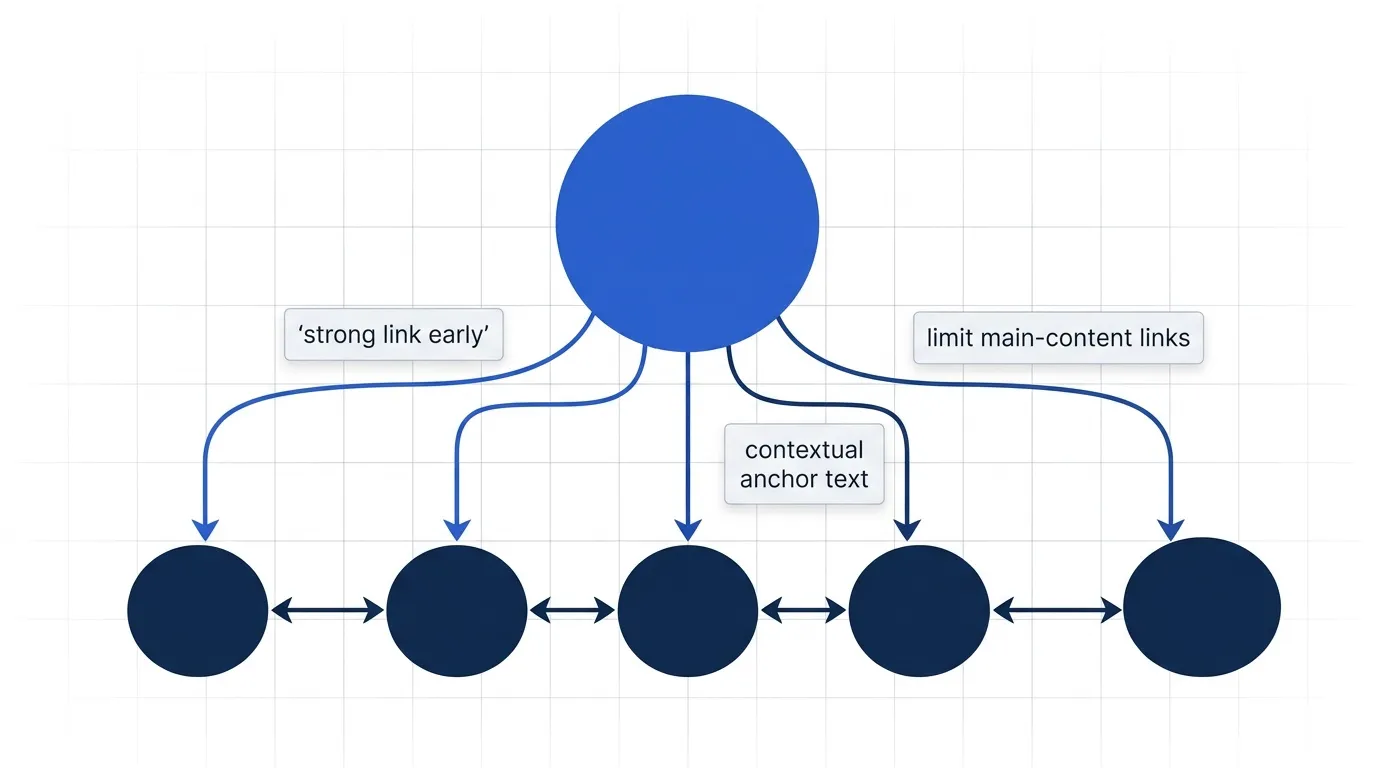
The most effective pattern is a Hub-and-spoke model inside a broader Hub and spoke architecture. The pillar page points down to the major cluster pages, each spoke links back to the pillar near the top when the topic fits, and related siblings connect laterally when they solve adjacent problems. That flow helps link equity move through the cluster without turning every page into a second homepage.
A simple hierarchy keeps those signals readable:
| Link direction | What it should do | Example use |
|---|---|---|
| One level up | Reinforce the parent topic | A subtopic page links back to the pillar |
| One level down | Send readers into more specific coverage | The pillar links to a deeper guide |
| Across | Connect closely related pages | Two sibling articles on adjacent subtopics link to each other |
The rule is straightforward. Move broad to narrow and narrow to broad before jumping elsewhere. That keeps the topical map clear for search engines and helps readers understand where they are in the cluster. When a page jumps too far too early, the authority signal gets noisier and the user journey gets weaker.
Contextual internal links should do most of the work. Place the strongest internal link early in the main copy, usually the parent topic or the strongest next step, and keep the rest selective. As a default, about five or fewer main-content links is a solid target unless the page truly needs more to solve the reader’s problem. Descriptive anchor text should match the destination, stay varied across the cluster, and sound like the natural next move.
Horizontal links matter just as much as vertical ones. Cross-link pages that cover adjacent subtopics, audience segments, use cases, or product considerations so equity does not pool only at the hub. Those links help readers keep exploring naturally, and they also tell crawlers that the cluster is a connected body of expertise rather than a set of isolated pages.
Commercial pages need a little more care. Supporting articles can link to service, location, or money pages when that page solves the problem being discussed. For local businesses, a topical authority approach to local SEO shows how to connect service pages, location pages, and GBP into one architecture. If the fit is weak, route the reader through a stronger informational parent first. That keeps the link useful instead of forcing relevance where it does not exist.
A practical rule set keeps the balance tight:
- Place the strongest link early in the page.
- Link to the parent topic when the page sits inside a cluster.
- Add sibling links only when the pages answer related questions.
- Use Contextual internal links where the sentence naturally supports the destination.
- Keep Descriptive anchor text specific and varied across the cluster.
- Limit main-content links unless the page has a clear reason for more.
When you treat internal linking as an architecture decision instead of a cleanup task, the whole cluster becomes easier to crawl, easier to read, and easier to expand. That is the difference between pages that sit on a site and pages that build lasting topical authority.
How Do You Implement The Architecture Brief?
The architecture brief is the handoff artifact that turns an approved topic map into buildable pages. It turns site architecture patterns for topic clusters into page-level instructions for writers, developers, SEO leads, and content managers. When you treat it as the contract between architecture and publishing, you reduce guesswork and keep pages, links, slugs, and templates from drifting into production by accident.
A strong brief captures the page logic in one place. It should record the core entity, parent topic, child topics, page intent, funnel stage, audience, query set, secondary entities, objective, canonical URL slug, Breadcrumbs, template, Schema markup needs, indexability status, and success metrics.
| Brief field | Why it matters |
|---|---|
| Core entity and parent topic | Keeps the page tied to the right cluster |
| Child topics and query set | Reduces overlap and supports coverage planning |
| Page intent, funnel stage, and audience | Aligns the page with search demand and buyer need |
| Canonical URL slug and Breadcrumbs | Stabilizes the URL structure and navigation path |
| Template, Schema markup, and indexability status | Gives developers and SEO teams clear build rules |
| Success metrics | Defines what good looks like after launch |
That structure also keeps execution stable. A validated hierarchy with zero missing URL slugs gives you durable page identifiers that carry through topical mapping, Planner workflows, WordPress publishing, reporting, and future optimization without strategic drift.
Page specs should change with the cluster role. A pillar page needs enough depth to anchor the topic, hub navigation to move readers through the cluster, summary sections that clarify the theme, and links to priority child pages. Cluster pages should be classified clearly so you know what each one is meant to do:
- How-to
- Comparison
- Use-case
- Problem and solution
- Glossary
- Template
- Product-category
- Support-intent
Proven pillar formats help teams move fast without flattening intent. Common options include ultimate guides, topic hubs, how-to libraries, glossary pages, comparison pages, tool or template libraries, and trends or insights hubs. Product or category strategy should sit inside the architecture too, so the content plan matches search demand instead of drifting into generic thought leadership.
The blueprint also needs a taxonomy layer that makes scale visible. Each record should show the pillar URL, cluster URL pattern, click depth, parent-child relationship, and navigation entry point. It should also tag topic silo, content type, entity, persona, industry, product line, market, language, lifecycle stage, and related cluster so your Information architecture stays clean as the library grows.
Enterprise sites need that visibility most. Hundreds or thousands of pages can fragment across departments, campaigns, and product lines if the map is unclear. A visible pillar-cluster structure groups related content, reduces duplication, and strengthens topical authority across a large Content architecture.
Internal linking should be planned inside the brief, not left to draft time. Every pillar should link to child pages, every cluster page should link back to the pillar, and sibling pages should connect when intent overlaps naturally. Reusable modules make that easier:
- Related guides
- Next step
- Compare
- Resources
- Popular questions
- Topic hub navigation
Descriptive anchor text matters just as much as page planning. It should be specific and relevant, not a repeated exact-match pattern that feels forced. We encode parent, sibling, child, relevance, and available-anchor suggestions before drafting begins so link choices support the architecture instead of becoming an afterthought.
Governance keeps the system from drifting after launch. Each brief should name the owner, source of truth, review cadence, status, launch date, last updated date, and dependencies. QA should verify intent match, slug, Breadcrumbs, required links, cannibalization risk, brand voice, compliance, and entity coverage.
Maintenance turns that QA into a live operating model. Use keep, optimize, or prune guidance, plus cannibalization visibility, authority concentration, and coverage-gap reviews, to decide whether a page should be refreshed, consolidated, expanded, or removed. That keeps the cluster healthy instead of letting weak pages accumulate.
Multilingual programs also need hreflang implementation for multilingual topic clusters to keep language versions aligned with the same hub-and-spoke structure.
A reusable brief template makes the system repeatable. Use columns for cluster name, page type, URL, Breadcrumbs, primary intent, target entity, pillar or cluster role, required sections, schema, link-in targets, link-out targets, owner, status, publish priority, review cadence, and KPI. That exportable view gives writers, stakeholders, and implementation teams one shared plan, which is how you keep Content architecture, URL structure, and execution aligned.
How Do You Measure Architecture Performance?
Architecture performance is a combined signal, not one SEO metric. You should compare crawlability, Indexation, internal-link flow, visibility, engagement, and business outcomes before and after a site change. The strongest read comes from performance by hub, cluster, support page, and conversion path, not from domain-wide averages alone.
Google Search Console is the first validation layer because it shows how Google sees the site at scale. The most useful signals are:
- discovered but not indexed
- crawled but not indexed
- duplicate canonical issues
- sitemap inclusion gaps
- page status changes
Then tie those signals to impressions, clicks, click-through rate, average position, and query-page pairs by cluster. That pairing shows whether a topic group is winning the right intent or losing visibility to a nearby page.
Crawl tools fill the gaps that Search Console does not show cleanly. Screaming Frog and Sitebulb help you inspect click depth, orphan pages, broken links, redirect chains, canonical tags, noindex tags, sitemap mismatches, duplicate titles, thin pages, breadcrumbs, and internal-link counts. Crawlability becomes visible at the URL level, which is where most architecture problems live.
Important pages should usually sit within three to four clicks of the homepage. Googlebot discovers pages through internal links, so buried or unlinked URLs are harder to crawl, index, and value. If a money page sits deeper than that, the architecture usually needs stronger hub placement, better breadcrumb support, or more relevant internal links.
Internal-link distribution is the clearest measure of authority flow. Review which pages receive the most links, whether pillar pages point to critical cluster pages, whether support pages link back to their hubs, and whether anchor text reinforces the intended topic relationship. Strong distribution means the architecture is directing trust where it matters instead of spreading it across low-value pages.
Technical SEO and Core Web Vitals still matter, but they are supporting diagnostics rather than the full story. Check status codes, mobile usability, Structured data, XML sitemap health, robots.txt access, canonical consistency, breadcrumb markup, and duplicate URL patterns. Speed can influence performance, yet fast pages with weak architecture still underperform if they are hard to find, hard to classify, or poorly connected.
A simple scorecard makes reporting easier to act on:
| View | What to measure | What good looks like |
|---|---|---|
| Coverage | Indexation, crawl errors, sitemap inclusion | Key URLs are discovered and indexed |
| Visibility | Rankings, impressions, CTR, non-branded growth, market share | The right pages earn the right queries |
| Authority flow | Internal-link counts, anchor alignment, hub links | Links support topic hierarchy |
| Business impact | Sessions, scroll depth, form fills, demo requests, revenue | Organic traffic supports pipeline |
| Risk | Cannibalization, duplicates, thin pages | Pages have clear roles |
For board-ready reporting, group results by hub, cluster, template, intent stage, or business line. Then compare organic sessions, ranking distribution, assisted conversions, scroll depth, and revenue. Add AI presence, trend direction, and silo-level performance to the same view. Keep, Optimize, Consolidate, or Prune gives each page a clear next step, and cannibalization risk visibility keeps the architecture honest.
How Do You Retrofit Existing Content?
Retrofitting works best when you start with the ideal topical map, then fit existing pages to it. Content mapping should follow strategy, not the other way around. When the map comes first, you avoid biased audits that favor legacy URLs and hide gaps.
The audit pass needs enough detail to show where each blog post and landing page belongs in the pillar-cluster structure. Track these fields for every relevant asset:
| Field | Why it matters |
|---|---|
| Target keyword | Shows the page’s main search focus |
| Secondary terms | Reveals topical breadth and overlap |
| Search intent | Clarifies whether the page is informational, commercial, or transactional |
| Funnel role | Shows whether the page supports awareness, consideration, or decision |
| URL | Identifies the exact asset under review |
| Ranking URL | Confirms which page search engines already prefer |
| Internal links | Shows how strongly the page is connected |
| Cluster assignment | Places the asset in the right topic group |
Once that inventory is in place, the retrofit choices get much clearer. Keep pages that already fit the map and strengthen them. Refresh thin but valid subtopics. Merge redundant pages. Redirect URLs that no longer deserve a separate asset. Leave content outside the strategic topical scope out of the cluster plan, even if it once earned traffic.
Cluster content should go deeper than thin keyword swaps. Prioritize these page types:
- Related long-tail keywords
- Subtopics that support the pillar
- Common questions
- Use cases
- Tactical guides
- Deep dives
Enterprise sites often need this most because departments, campaigns, and product lines can create fragmented pages that look different but satisfy the same search need.
Weakly connected pages need stronger signals, not just new copy. Reconnect them with contextual internal links, breadcrumbs, and anchor text that matches the destination topic. Clean up accidental associations as well, because each page should reinforce its intended cluster rather than dilute relevance across the site.
Keyword cannibalization cleanup works best when you group pages by search intent and topic similarity before any merge happens. If two URLs satisfy the same search need, consolidate the strongest material into one canonical asset and use a 301 redirect where it makes sense. That gives search engines one clear page to rank and reduces confusion for your audience.
A practical retrofit sequence keeps the work controlled:
- Define scope and capture the current baseline.
- Audit each page against the map and assign it to a cluster.
- Resolve orphaning and Keyword cannibalization together.
- Refresh thin content that still has strategic value.
- Build only the missing pages that close buyer-journey gaps, entity gaps, and coverage gaps.
That final step matters because the goal is stronger coverage, not content bloat. When the map is clean, your older assets become a faster path to topical authority instead of pages that compete with each other.
How Do You Prepare Clusters For AI Search?
Preparing clusters for AI search means making every important page easy for generative systems to understand, quote, verify, and connect to adjacent questions. That is the shape of Generative Engine Optimization. For you, the goal is not only to rank a page. It is to make the full cluster usable as a source layer for AI Overviews, ChatGPT-style discovery, and answer engines.
AI-search readiness extends topic cluster architecture instead of replacing it. The pillar page should own the canonical entity and the main intent. Supporting pages should handle narrower variants and related questions. Internal links need to make those relationships explicit so search systems can trace the structure without guessing.
A clean cluster model usually looks like this:
| Cluster layer | What it owns | Why it matters |
|---|---|---|
| Pillar page | Canonical entity, primary intent, broad overview | It becomes the main reference point for the topic |
| Support page | Narrow variant, specific task, edge case, or role | It reduces overlap and limits cannibalization |
| Comparison page | Tradeoffs, alternatives, decision criteria | It helps systems surface nuanced answers |
| Evidence page | Examples, proof, methods, or datasets | It strengthens trust and citation likelihood |
Entity-based SEO works best when you define the page set before anyone writes copy. Start with the primary entity, related entities, and the attributes each page covers. Then map user roles, tasks, problems, comparisons, and outcomes to specific URLs. Search intent segmentation keeps the cluster precise and helps writers avoid vague overlap.
Semantic triples make that structure easier to read and reuse. A loose topic becomes clearer when it turns into a subject-predicate-object statement such as “intent data improves account prioritization.” The same pattern can be reused as “[topic] affects [outcome]” or “[process] solves [problem].” Those statements help readers and systems see exactly what each page claims.
AI search engines also fan one query into many sub-queries. A strong cluster answers the parent query and the supporting intents around it. It should also cover edge cases, comparisons, definitions, steps, examples, objections, and adjacent follow-up questions. That broader coverage is what keeps the cluster useful when a model breaks a single query into smaller parts.
Visibility pressure is already shifting toward answer layers. AI Overviews reportedly appeared in roughly 15% of Google searches by mid-2025, and click-through rates may drop about four times when summaries appear. ChatGPT has also been described as the world’s fifth most-visited site. That means your cluster needs generative discovery coverage, not only blue-link rankings.
Quote-ready passage design improves the odds that systems pull the right text. Place a clear 40 to 80 word lead answer near the top of each strategic page. Then use scannable sections, stable anchors, consistent terminology, and standalone claim blocks for each sub-question. The cleaner the passage, the easier it is to quote without distortion.
The evidence layer is what turns content depth into credible content. Strong E-E-A-T signals come from visible proof, author or reviewer context, dates, original examples, datasets, screenshots, customer proof, methodology notes, and supporting material a human can inspect. Floyi’s principle is simple. AI citation odds improve when content is clear, structured, and easy to quote. Depth alone does not replace backlinks or credibility signals, but it helps the right pages earn trust by anchoring high-value claims to permanent claim IDs and retrievable evidence.
Structured data and schema markup should mirror the visible page, not add claims users cannot see. FAQPage works well for question sections, HowTo fits step pages, and Article or WebPage usually fits guides. When a page makes a canonical assertion, claim-style markup can help preserve that assertion in machine-readable form. Provenance matters too, so a machine-readable /provenance.json file linked from the page head with rel="alternate" can map claims to URLs, anchors, dates, authors, datasets, and checksums.
A simple readiness check keeps the work honest:
- Audit whether the cluster covers the full query fan-out, not just the head term.
- Confirm that each page represents its main entity consistently and avoids redundant overlap.
- Check whether the lead answers, stable anchors, and schema are aligned with the visible content.
- Review whether the cluster earns brand mentions or citations across target prompts and answer surfaces.
- Compare one priority cluster against generative discovery before you scale the pattern sitewide.
If the cluster cannot answer the fan-out cleanly, prove its claims, and surface the right structured signals, it is not ready for AI search yet.
Topic Cluster Site Architecture FAQs
These FAQs help you pressure-test the architecture choices behind topic cluster performance. You’ll see the questions that matter most for URL structure, internal links, crawl depth, and schema before you scale the site.
1. What Is Topic Cluster Architecture 3.0?
Topic Cluster Architecture 3.0 is a B2B semantic system, not just a pillar page with supporting posts. You organize the site around an entity layer, a relationship layer, and a journey layer, so each page maps to the topics you cover, how those topics connect, and the buying-stage intent behind them. That makes Topic cluster architecture easier to interpret for search engines, AI systems, and buyers, while strengthening Semantic SEO, reducing cannibalization, avoiding thin pages, and building a topical map that matches how B2B teams research and compare solutions.
2. Can Service Pages Join Topic Clusters?
Yes, service pages can join topic clusters when the page matches the cluster’s intent and offer. They work best as commercial spokes, conversion destinations, or pillar-adjacent pages, and cluster planning should start with your product, category, or service strategy instead of keyword volume alone. An informational article should link to a service page only when the problem it explains maps naturally to that service, such as sending a Service 2 article to the Service 2 page or a local issue to the right location page. That keeps links topically relevant, passes qualified authority, and avoids the context blur that can hurt click satisfaction and crawler clarity.
3. How Do Entity Links Support Clusters?
Entity links turn your cluster into a connected content graph, not just a set of related pages. In Entity-based SEO, Contextual internal links connect company, audience, problem, solution, industry, evidence, outcome, and decision entities so search engines and AI answer systems can infer relevance from relationships, not only repeated keywords. Labels such as “causes,” “reduces,” “requires,” and “is measured by” strengthen Generative Engine Optimization, and a path from your industry page to a problem, product, case study, and outcome helps readers, reduces ambiguity, and spreads authority with clear purpose.
4. Should Clusters Map To Buyer Roles?
Yes, when you sell into a complex B2B committee, role-based cluster lenses help you separate what an economic buyer, operational owner, technical evaluator, and executive sponsor need from the same topic set. The goal is to change page type and evidence, not to create duplicate clusters, so executives get ROI and risk pages, technical evaluators get integration and proof pages, and operators get workflow, implementation, and comparison content. Strong internal links can send each reader to the right proof or product page, while Floyi-style topical maps layer persona, intent, content type, and journey stage onto one canonical hierarchy so authority stays intact and URL logic stays clean.
5. When Should Clusters Become Subdomains?
Keep most topic clusters in subfolders because they concentrate authority, breadcrumbs, internal links, and crawl signals on the main domain. A subdomain makes sense when the cluster is a separate product, market, application, language or region, or governance model, or when it needs different navigation, technical stack, analytics, or ownership. If the audience, conversion path, brand promise, and linking ecosystem stay the same, keep it in a subfolder, and use Floyi’s scoping rule to define the boundary first and separate architecture only when scale or strategic separation improves discovery.
About the author

Yoyao Hsueh
Yoyao Hsueh is the founder and CEO of Floyi, the topical authority platform, and the founder of Main Heading, an SEO and AI search agency. He created Topical Maps Unlocked, a course studied by thousands of SEOs, content strategists and digital marketers, founded TopicalMap.com, a done-for-you topical mapping service for agencies and enterprise teams, and publishes the weekly Digital Surfer newsletter on SEO, content strategy and AI search.
About Floyi
Floyi is a closed loop system for strategic content. It connects brand foundations, audience insights, topical research, maps, briefs, and publishing so every new article builds real topical authority.
See the Floyi workflow