
Silo Site Architecture: How It Builds Topical Authority
Learn how silo site architecture impacts topical authority, internal linking, crawl depth, AI visibility, and SEO performance measurement.
Silo site architecture groups related SEO pages into topic sections that signal topical authority. For SEO operations managers, technical SEO leads, content strategists, agency teams, and in-house growth teams, it shows how pages should connect without turning the site into rigid buckets.
The sections cover topical mapping, physical versus virtual silos, internal linking, crawl depth, indexation, and AI search visibility. They also show how to build topic lists, AI-assisted briefs, and refresh rules through research, clustering, and QA checks. Automation matters when teams need faster planning without losing intent alignment or page ownership.
Right now, multi-brand and multi-topic sites need cleaner paths from hub pages to supporting content because weak structure creates orphan pages, cannibalization, and slow discovery. For agencies and in-house teams, the payoff is clearer crawl depth, better measurement, and authority that compounds across clusters. A well-planned electric cars hub that leads to Tesla, Model S, and maintenance pages shows how one topic can expand without losing focus, and the next sections show how to plan, link, and measure the structure.
Silo Site Architecture Key Takeaways
- Silo site architecture groups related pages into clear topic sections.
- Topical authority comes from hierarchy, internal links, depth, and coverage.
- Strict silos work best when topic boundaries are genuinely separate.
- Topic clusters fit overlapping intent and shared entities better.
- Internal links should reinforce parent, child, sibling, and hub relationships.
- Crawl depth, breadcrumbs, and clean URLs help search engines read structure.
- Measure success with ranking breadth, indexation, orphan pages, and AI visibility.
What Is Silo Site Architecture?
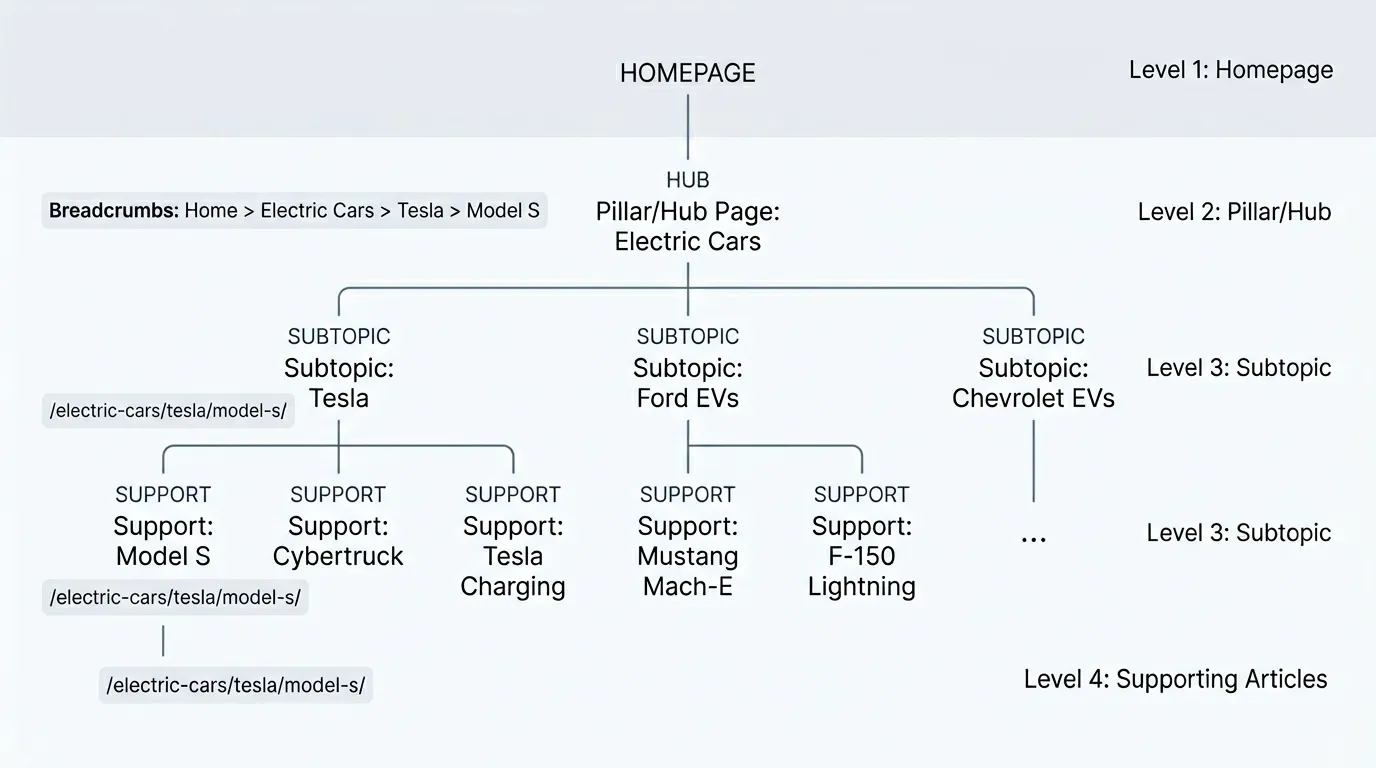
Silo site architecture is a topic-based SEO structure that groups related pages into clear sections so users and search engines can see the main theme and the pages that support it. Website structure matters here because it turns a loose set of URLs into a clear content hierarchy.
A silo is more than a folder path. It combines navigation, breadcrumbs, internal links, and page depth to show how content silos relate inside one topic. That is why Silo SEO depends on relationships, not labels alone. A strong structure makes the topic obvious from the homepage to the most specific page.
Semrush often frames an SEO silo structure as a self-contained topic section with little or no cross-linking. That can improve focus, but strict isolation can also block useful discovery when two subjects overlap. In practice, flexible site architecture SEO usually works better because it protects topical focus without sealing every section off. For the broader framework behind why structure matters, see the topical authority implementation guide.
The two implementation models are:
| Model | How it works | Best fit |
|---|---|---|
| Physical silo | Uses parent-child Uniform Resource Locator (URL) paths or subdirectories | Sites with nested information architecture |
| Virtual silo | Uses internal links, hub pages, breadcrumbs, and navigation patterns | Sites with flatter URLs or overlap across topics |
A simple topical map shows the logic:
- cars
- electric cars
- Tesla
- Model S
- Model S care and maintenance
Broad topics sit near the homepage. Narrower pages sit deeper in the structure. That content hierarchy helps you move from general authority to specific coverage.
Search engines infer topical relevance from page relationships more than from page labels. Parent-child structure, anchor text, breadcrumbs, crawl paths, and proximity between related pages all reinforce vertical relevance. Good site architecture SEO helps crawlers and people see what the section covers, which pages matter most, and how each page fits the larger topic without trapping everything in a rigid bucket. Choosing the right site architecture patterns for topical authority makes that structure easier to implement across hub-and-spoke, hierarchical, and faceted models.
How Do Silos Build Topical Authority?
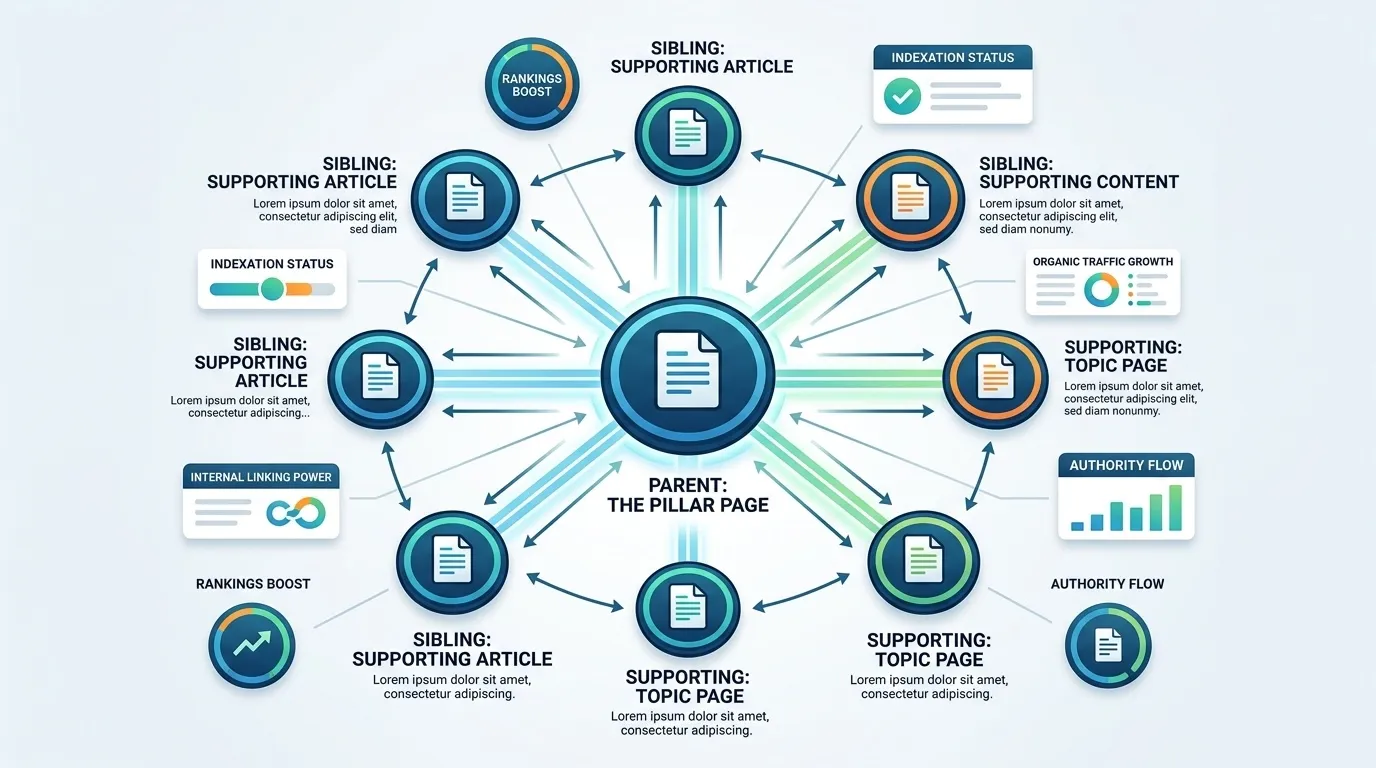
Content silos build topical authority by turning isolated keyword pages into a connected body of evidence around one theme. The silo site architecture impact on topical authority comes from depth, hierarchy, semantic consistency, internal links, and trust signals, not from folders alone. When the structure is clear, search engines can see which page leads and which pages support it.
A strong silo starts with a topical map. That map works as both the architecture blueprint and the living content plan, moving from a broad hub into subtopics, use cases, comparisons, and long-tail questions. The technical implementation for topical authority becomes easier when the map defines what gets built first and what belongs under the same theme.
Keyword clustering helps keep that coverage coherent. Instead of publishing one page for a term and then jumping to unrelated themes, you keep building within one cluster until the subject is covered from several angles. That consistency strengthens Semantic SEO and gives Topical authority more weight through repeated, related coverage.
The relationship layer matters just as much as the pages themselves:
- Parent hubs point to supporting articles.
- Supporting pages link back to the hub.
- Closely related sibling pages cross-link where intent overlaps.
- Crawl paths stay simple for users and crawlers.
An electric cars example makes the hierarchy concrete. An electric cars hub can point to Tesla, then to Model S, and that page can branch into care and maintenance, Model S Plaid, and Model S zero to sixty content. Those pages should also connect back up the tree so the cluster reads like one system, not separate posts.
Content silos also strengthen experience, expertise, authoritativeness, and trustworthiness (E-E-A-T). A coherent cluster lets expertise compound through helpful content, expert perspective, brand credibility, relevant backlinks, and consistent quality. That matches the logic behind the topic-based grouping approach often discussed by Semrush and Acute SEO.
You get the best results when silos reduce ambiguity about hubs, subtopics, page priority, and crawl paths. Clear definitions make content easier to discover and easier to trust. That clarity can support stronger cluster rankings, better discovery, and fewer accidental or cannibalized rankings.
What Is The Causal Impact Model?
The causal impact model shows how silo site architecture signals compound into authority outcomes. Silo structure can connect semantic grouping, URL hierarchy, internal links, and crawl paths to improved entity coverage, link distribution, indexation, and crawl efficiency. Practitioners note these elements may support broader rankings and AI visibility through clearer topical signals. The silo site architecture impact on topical authority is not a new ranking factor. It is a practical way to trace how Semantic SEO choices show up in search performance.
Strong silos do more than help search engines read context. They help a parent theme collect related entities, subtopics, questions, and supporting pages around one core subject. That broader coverage makes the site look repeatedly useful across a topic map, not just relevant to one keyword or one page.
The chain from structure to authority looks like this:
- Clear topic grouping improves entity coverage and makes classification easier.
- Pillar pages, support pages, breadcrumbs, contextual links, and descriptive anchors improve Internal link distribution.
- Better authority flow sends value from the pillar page to supporting pages and back again.
- Flagship pages get reinforcement, while long-tail pages gain discoverability.
- Logical hub-to-cluster-to-detail paths make crawling and revisiting easier for bots.
- Shallow depth, fewer dead ends, and fewer orphan pages support faster discovery and cleaner canonical selection.
That flow changes how the whole cluster behaves. When pages reinforce one another, the site is easier to evaluate as one authoritative body instead of a pile of separate URLs. Weak silos usually fail for familiar reasons. Thin coverage, rigid grouping, weak cross-links, topic overlap, and competing near-duplicate pages usually cause the problem, not the existence of a silo itself.
A simple measurement view ties the model to outcomes:
| Authority lens | What to watch | What it signals |
|---|---|---|
| Content Authority | Shipped coverage and page performance | The cluster answers the topic well |
| Market Authority | Ranking value owned across the topic map | The site wins more eligible queries |
| AI Authority | Importance-weighted absence, mention, and citation signals | The site is more likely to appear in AI search answers |
Well-built silos expand ranking breadth because they can cover head terms, modifiers, comparisons, use cases, problems, and adjacent intents within the same topic. That breadth only helps when coverage is complete and useful. Thin cluster pages, rigid silos, and weak cross-links can dilute relevance and trigger cannibalization.
A healthy system should show stronger entity coverage, more links to strategic URLs, fewer deep or orphan pages, cleaner indexation, more ranking pages, and better AI mentions or citations. If those signals are missing, the issue is usually structure quality, coverage depth, or trust signals, not the mere presence of a silo.
When Should You Use Strict Silos?
Strict silos make sense when major topic groups are genuinely separate, user intent rarely crosses between them, and forced cross-links would add noise instead of clarity. In Silo SEO, that is a precision architecture choice, not a default setting. When taxonomy is fuzzy, hard boundaries usually create more confusion than order.
A strong fit usually shows up in these cases:
- Low-overlap categories: cardio equipment can split into mini silos for treadmills, rowers, exercise bikes, steppers, and ellipticals when each group has its own keyword set, modifiers, and comparison intent.
- Vertical or regulated specialization: the AcuteSEO law-firm example works because personal injury, car accidents, slips and falls, and medical malpractice follow different queries, evidence standards, and conversion paths.
- Taxonomy control: BrightEdge’s ecommerce example shows why a red puffer jacket can sit under women’s jackets, puffer jackets, and red jackets without creating messy duplication or overusing canonical tags.
- Clear ownership rules: navigation, URL structure, breadcrumbs, and internal links should all reinforce one primary home for each page.
- Cannibalization prevention: a single pillar owner makes duplicate content and conflicting category relationships easier to avoid.
Strict silos work best when each page has one obvious parent and one clear purpose. That structure helps search engines read hierarchy and helps teams keep category logic clean.
The caution is simple. Keep the silo strict for ownership and taxonomy, but do not block genuinely useful contextual links. Semrush notes that silos can help crawling and understanding, yet they become restrictive when they prevent relevant cross-topic internal links. The best setup protects clarity without turning the site into a closed set of isolated folders.
When Are Topic Clusters Better?
Topic clusters are better when strict silo SEO keeps the site tidy but makes the journey harder for readers. A cluster model still keeps topical discipline through content pillars and cluster pages, but it lets related pages connect where the overlap is real. That usually improves user experience because people can move from comparison to troubleshooting to how-to content without fighting the structure.
The difference is control, not chaos. Strict silos act like isolated vertical folders, while a hub-and-spoke model works like a controlled topical network that keeps flexibility without losing order.
In Floyi’s topical-map view, the map decides which topics deserve their own page. Site architecture then decides how navigation, breadcrumbs, crawl paths, and internal links reinforce depth. Search Engine Land’s framing is similar, with a broad pillar page supported by subtopic pages to build topical authority at scale.
| Architecture | Best fit | Risk if overused |
|---|---|---|
| Strict silos | Separate business lines, compliance topics, or distinct audiences | Thin cross-linking and awkward user movement |
| Topic clusters | Interconnected search intent, shared entities, and multi-step journeys | Too much overlap if every page tries to cover everything |
A practical rule makes the choice easier:
- Use topic clusters when search intent spans several related queries.
- Use cluster pages when recurring entities appear across more than one page.
- Use topic clusters when users expect links between related resources.
- Use strict silos when the boundaries are truly separate.
Accidental rankings are the last clue. If one page starts ranking for a mapped topic that deserves its own page, treat that as a signal to build a focused page and link it into the right cluster. That keeps ranking focus, preserves topical clarity, and aligns your page architecture with demand instead of forcing one page to do too much.
How Should You Plan A Silo?
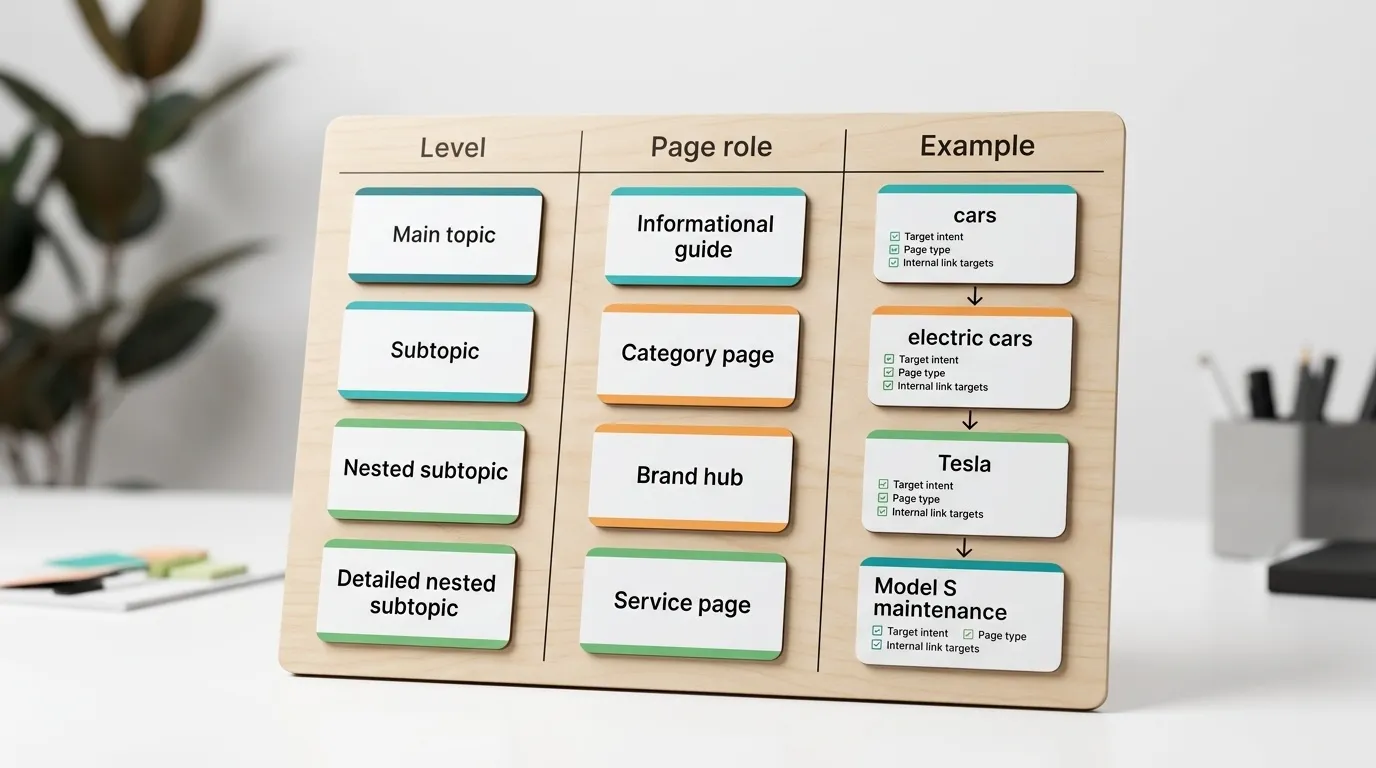
The safest way to plan a silo is to treat it as a topical map before writing any pages. Start with one core topic that is broad enough for a pillar page, but narrow enough to build clear expertise. That balance keeps your SEO silo structure focused and stops Content pillars from drifting apart.
A practical baseline looks like this:
| Level | Page role | Example |
|---|---|---|
| Main topic | Broad theme | cars |
| Subtopic | Major branch | electric cars |
| Nested subtopic | Narrower branch | Tesla |
| Page level | Specific query | Model S care and maintenance |
Pillar pages carry the broad theme. Cluster pages handle major subtopics. Supporting articles answer narrower questions, comparisons, and use cases. A destination-style model often fits well, with Europe at the top, then Italy, France, and Spain, then city pages under each country.
Content hierarchy should move from broad to specific. A clean path might run from cars to electric cars to Tesla to Model S care and maintenance. Keyword clustering helps you see where one topic ends and a new branch begins.
Before you brief anything, validate the plan against live SERP clusters. Check the ranking pages, dominant Search intent, content format, difficulty, and topic fit. If a query is mostly navigational and dominated by one brand or retailer, it usually belongs outside the silo.
URL planning should support the map without becoming rigid. Use clear subdirectories, breadcrumbs, click-depth planning, and internal links. Avoid deep paths that bury important pages or imply that authority comes from folder depth alone.
If you manage multiple content pillars, finish one silo before opening the next. That keeps the queue manageable, improves knowledge gain, and exposes gaps faster. Larger topics can also split into nested silos when a branch gets too wide for one publishing stream.
Keep the brief queue as a living document. Each planned URL should include:
- Target intent
- Page type
- Primary SERP cluster
- Supporting questions
- Internal link targets
- Priority level
Update that queue as rankings, seasonality, trends, and content gaps change. This keeps your Content hierarchy coherent, your briefs sharper, and your publishing plan easier to execute.
How Should Internal Links Reinforce Authority?
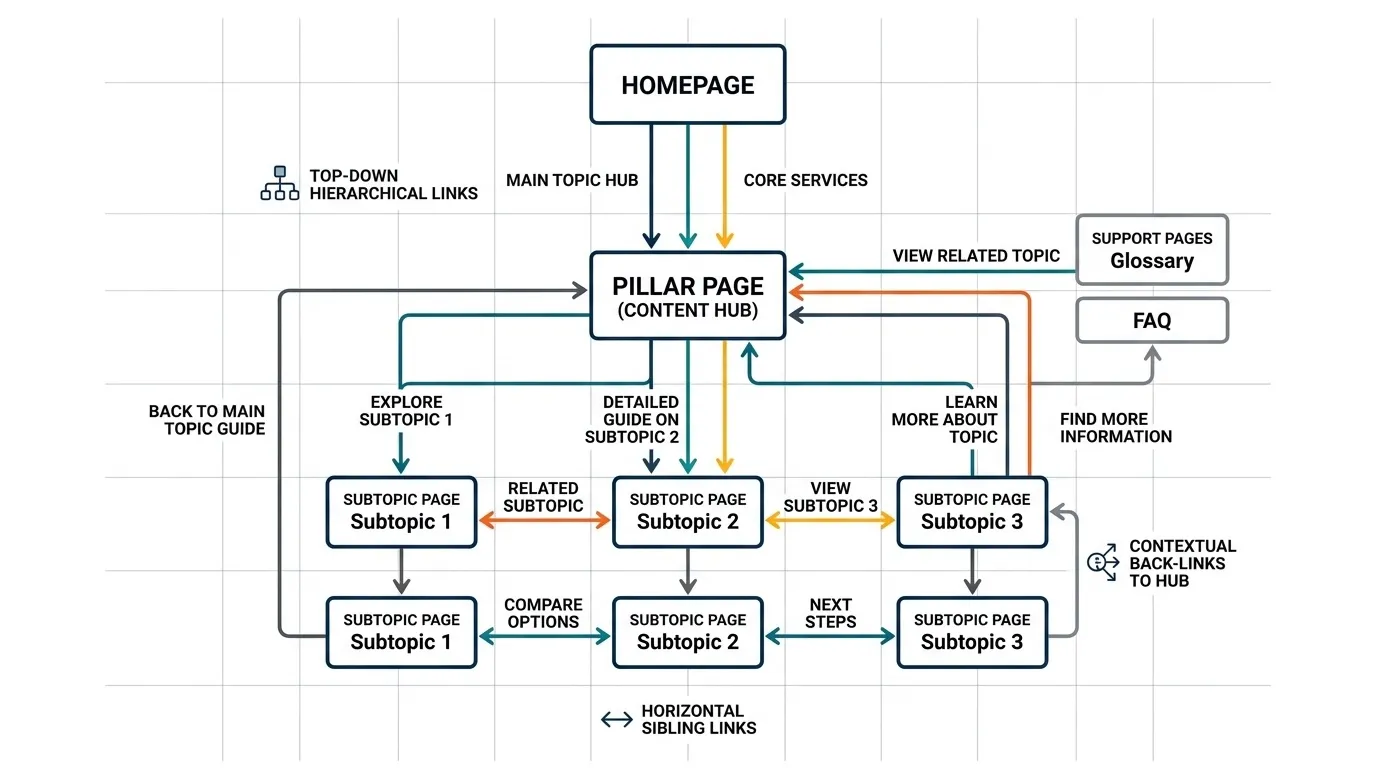
Internal linking turns a topical map into a crawlable authority structure. It shows users and crawlers how each page fits the whole. That matches Google’s naturally flowing hierarchy guidance and John Mueller’s point that internal linking is super critical for SEO.
Use a top-down path that moves one step at a time. A site should flow from the home page to the main topic, then to the subtopic, and then to the supporting article. That keeps authority and context moving through the silo without skipping the pages that define it.
Support also needs to move back up. Supporting pages should link to their parent pillar pages and to relevant intermediate parents. Long-tail content often wins visibility first, then helps consolidate relevance and link equity around broader commercial pages. That improves internal link distribution without flattening the site into a loose web.
Natural internal linking should also work across the same content family. Closely related pages at the same depth can link to siblings when the next step helps the reader. Those horizontal links can spread link juice while keeping the topical boundary clear. Descriptive anchor text matters here. Use phrases that name the destination topic, and avoid repetitive exact-match anchors or generic labels like “read more” or “click here.”
Helpful internal linking patterns usually include:
- Broad pages that point to the next logical layer down.
- Supporting pages that point back to pillar pages and relevant parent pages.
- Sibling pages that link when the topics are tightly related.
- Navigation, breadcrumbs, and hub pages that keep important pages reachable.
- Contextual links that prevent orphan pages and improve crawl discovery.
Selective cross-silo links still have a place. They work when two topics genuinely overlap or when user intent spans both. Excessive cross-linking can blur the hierarchy and weaken the authority signal the silo is meant to build. The rule is simple. Link to reinforce meaning, not to decorate the page.
How Do Technical Signals Support Silos?
Technical SEO does not create authority on its own. It makes silos legible by aligning hierarchy, crawl paths, indexation signals, internal links, and parent-child page relationships. In practice, strong site architecture SEO turns your website architecture into a map search engines can follow.
The most useful signals work together:
- Crawl depth keeps pillar pages one click from the homepage and major subtopics within two to three clicks.
- URL structure mirrors the topical map with clean, descriptive subdirectories.
- Breadcrumbs and navigation show where each page sits in the hierarchy.
- XML sitemaps include only indexable pillar, subtopic, and support pages.
- Schema markup clarifies page type and entity relationships.
- Canonical tags and redirects consolidate signals onto one preferred version.
Crawl depth is the first hard constraint. Pages buried beyond four clicks are often harder for users and crawlers to reach, so important pages need a shorter path. A pillar page should sit near the root. High-value supporting pages should stay close enough for regular crawling, not hidden deep in an expanding folder tree. That distance matters because crawlability drops when discovery depends on too many hops.
URL structure reinforces the model, but it does not replace internal linking. A path like /electric-cars/tesla/model-s/maintenance/ can mirror a topical cluster, while a shallow root-level page can still be easier to surface if the descriptive path stays consistent. Clear menus, breadcrumb trails, page titles, and labels help bots read the same relationship, especially when breadcrumb schema supports the visible trail. For multilingual sites, hreflang impact on topical authority can keep those signals aligned across versions.
Duplicate content creates drift. Multiple URLs that target the same intent can split link equity and weaken focus. Canonicalization, redirects, noindex rules where appropriate, and content audits help keep one primary page per intent. Strong crawlability also depends on clean sitemaps, valid breadcrumbs, no important orphan pages, and a URL blueprint that exposes hierarchy gaps before they become ranking problems.
How Do Silos Affect AI Search Visibility?
Clear silo structure may aid AI systems in interpreting site entities, subtopics, and relationships through organized content paths (source).
When pillar pages, supporting articles, FAQs, comparisons, and use cases stay grouped around the same entity set, retrieval systems can infer what your brand knows and which page should answer each query. That structure also supports topical authority. AIOSEO and AcuteSEO treat silos as signs of topical depth, while Zadroweb frames modern topic authority as an extension of silo principles that have been used since the early 2010s.
The citation-ready layer comes from how the pages connect. Pillar-to-cluster links, descriptive anchor text, breadcrumbs, consistent URL paths, and Schema markup help AI systems identify the canonical overview, the supporting evidence, and the granular answer page. That structure also strengthens E-E-A-T because the content is easier to navigate and verify.
A strong silo also needs modular coverage:
- Answer direct questions and implied follow-ups within each cluster.
- Keep each page self-contained around one clear intent.
- Use original analysis, examples, and expert judgment instead of generic mass-produced copy.
- Build around one topic at a time instead of chasing scattered low-competition terms.
Measurement should match that architecture. Floyi’s Topical Authority Score, with Content Authority, Market Authority, and AI Authority, gives you a practical way to track mentions and citations across Google AI Overviews, AI Mode, and ChatGPT Search. That is how silos turn an abstract goal into a system you can measure and improve.
How Do You Measure Silo Performance?
Measure a silo as a topic portfolio, not as a stack of isolated URLs. The strongest read combines Google Search Console, analytics, crawl data, SERP tracking, and AI visibility trends. That mix shows whether the cluster is expanding search reach instead of just nudging one page.
The core silo scorecard should compare these signals:
- Indexed pages versus planned pages
- Ranking breadth across target and adjacent queries
- Average position trend
- Impressions, clicks, and click-through rate
- Organic sessions
- Assisted conversions
- Revenue or lead contribution
Healthy silo performance shows broader query coverage, more ranking pages, stronger hub-and-cluster visibility, better engagement, and clearer business value across the whole topic group. A silo that wins one vanity query is still thin, even if a single URL looks strong.
Google Search Console gives you the fastest diagnostic read when you filter by URL path, page group, or a mapped silo list. That view helps you check index coverage, query expansion, hub discovery patterns, and accidental rankings that point to new article opportunities. It also shows whether the hub is pulling related queries or whether the cluster is fragmenting.
Crawl and internal-link data are leading indicators, so they often move before rankings do. Track these signals after architecture changes:
- Crawl depth
- Orphan pages
- Links into cluster pages
- Anchor consistency
- Hub-to-child links
- Child-to-hub links
- Breadcrumbs
- Revisit frequency
Set your main evaluation window at 3 to 6 months. Topical authority shifts more slowly than page-level optimization. Results vary by niche competitiveness, publishing cadence, and internal linking quality. HubSpot’s cited 10 to 20 percent ranking improvement benchmark should stay directional, not guaranteed.
Floyi adds one more layer with Content Authority, Market Authority, and AI Authority tracked together. Topical Authority Score uses this formula: TAS = (CA * MA * AIA)^(1/3). That balance matters because strong execution in one area can hide weak competitive share or weak AI presence elsewhere.
| Signal mix | What it means |
|---|---|
| CA rising, MA flat, AIA flat | Content is improving, but category strength is still weak |
| CA steady, MA rising, AIA flat | Classic search is improving, but AI visibility is lagging |
| CA, MA, and AIA all rising | The silo is building durable authority across search surfaces |
That layered view keeps the silo honest about ranking growth and business impact.
How Do You Troubleshoot Silo Problems?
Silo troubleshooting is an authority-consolidation audit, not just a crawl cleanup. You are checking whether crawlers can reach priority pages, whether users can move to related content without friction, and whether links and anchors reinforce the topic structure you want search engines to see.
Start with Crawl depth and Orphan pages. Pages buried too many clicks from the hub, missing internal links, or visible only through XML sitemaps, filtered navigation, or orphan-page reports deserve first attention. That is where Crawlability breaks down most often in Technical SEO.
Over-siloing is the next risk. Related topics can become isolated when rigid rules block natural connections, so selective cross-links help when intent overlaps. Duplicate taxonomy paths and competing URLs matter too, especially when articles or products appear under multiple category paths, tag pages compete with hubs, or faceted and paginated routes create near-duplicates that split canonical signals.
Use this order to fix the structure:
- Repair orphan pages and crawl-depth blockers.
- Resolve taxonomy conflicts and canonical confusion.
- Improve internal linking and anchor quality with destination-specific phrases instead of vague text like “read more.”
- Fill content gaps when a topical map shows that a query deserves its own page, which reduces cannibalization and prevents one URL from serving two intents.
Accidental rankings are structural symptoms, not just keyword misses. If a query belongs on a separate page, create that page instead of forcing the same URL to do too much, as strong editorial sites often do when they separate adjacent topics cleanly, including patterns seen on The Spruce Pets.
Measure progress through crawl accessibility, internal-link flow, cannibalization risk, and cluster-level coverage. When those signals improve together, the silo is doing its job and authority can consolidate instead of leaking across weak paths.
Silo Site Architecture FAQs
These FAQs on Silo site architecture help you pressure-test site structure, internal linking, and topical depth before a rebuild. They center on the questions SEO teams ask when they want clearer crawl paths and stronger authority without locking the site into rigid silos.
1. Can One Page Belong To Multiple Silos?
Yes, a page can support multiple silos when its value genuinely spans two related topic paths, and contextual internal links can signal that relevance from each side. Even then, it should keep one primary parent topic so the main URL, breadcrumbs, and strongest relevance signal stay clear. If the same content is replicated across several taxonomy paths, duplication can create duplicate content and blur topical clarity, so use canonical tags when overlap is unavoidable, but create a separate page when the secondary intent deserves real depth.
2. Do Subdomains Weaken Silo Authority?
Subdomains do not automatically weaken silo authority, but they can blur topical context when users and crawlers cannot move cleanly between the root domain and the subdomain. The subdomain choice impact on topical authority depends on whether shared navigation, breadcrumbs where they fit, contextual internal links, consistent anchor text, XML sitemap coverage, and crawlable paths back to the parent hub make the relationship obvious. Internal links still pass perceived value and topical authority, so if you keep the connective signals strong, you preserve the same topical map and make discovery, indexing, and ranking easier.
3. Can Flat Sites Build Topical Authority?
Yes, a flat site can build Topical authority when pages go deep on a topic and internal links make the relationships clear. The flat site structure impact on topical authority matters less than whether your Website structure ties cluster pages, hub pages, and related subtopics together in a way crawlers and readers can follow. Flat setups can work for smaller sites, but hierarchy usually wins as the site grows because it improves crawlability, context, navigation, and control over thin or redundant pages, while also reducing bloat and confusion through clear coverage boundaries.
4. Should Ecommerce Sites Use SEO Silos?
Yes, ecommerce sites can use SEO silos when the category tree matches how shoppers browse, such as outdoor gear to tents to backpacking tents or cardio equipment to treadmills to folding treadmills. That structure helps you group products, buying guides, comparisons, and supporting content around one commercial theme, which improves product discovery and topical relevance. The model gets fragile when items fit multiple paths, and BrightEdge has noted duplicate content risks in overlapping categories like women’s jackets, puffer jackets, and red jackets, so flexible internal linking, strong primary category links, canonical URLs, indexation control, and clean parameter handling matter for facets like color, size, brand, and use case.
5. Do Silos Restrict Content Discovery?
Silos restrict discovery when useful cross-links are blocked. When useful cross-links are blocked, related pages get isolated, orphan-page risk rises, and visitors and crawlers have a harder time reaching the right content. Topic clusters keep the hub-and-spoke structure, but they allow natural internal linking when pages are semantically related, while breadcrumbs, logical navigation, parent-child links, and sibling links keep the user experience clear without trapping pages inside one section.
About the author

Yoyao Hsueh
Yoyao Hsueh is the founder and CEO of Floyi, the topical authority platform, and the founder of Main Heading, an SEO and AI search agency. He created Topical Maps Unlocked, a course studied by thousands of SEOs, content strategists and digital marketers, founded TopicalMap.com, a done-for-you topical mapping service for agencies and enterprise teams, and publishes the weekly Digital Surfer newsletter on SEO, content strategy and AI search.
About Floyi
Floyi is a closed loop system for strategic content. It connects brand foundations, audience insights, topical research, maps, briefs, and publishing so every new article builds real topical authority.
See the Floyi workflow