
Backlink Relevance as a Topical Authority Signal
Learn how backlink relevance builds topical authority, improves AI search visibility, and helps you audit link quality with practical SEO guidance.
Backlink relevance as a topical authority signal is a practical SEO framework for choosing links that actually strengthen a page. For SEO teams, the tension is obvious when a high-DR mention looks attractive but a smaller niche citation does more for the pages that matter. Backlink relevance is the fit between the linking page, the source domain, and the destination topic. The result is a clearer way to separate links that build topical authority from links that only add noise.
The article breaks down the core relevance layers, from site-level fit and page-level fit to anchor semantics and surrounding text. It also shows how to score opportunities with a weighted rubric, compare relevant backlinks with generic ones, and account for AI search visibility and GEO in link selection. Expect a practical audit method, a prioritization model, and clear signals for deciding whether a prospect belongs in outreach.
For agency strategists, technical SEO leads, and in-house growth teams, that means spending link budget on citations that support pillar pages and content clusters instead of chasing broad metrics. A niche editorial mention beside a closely related article can do more than a stronger unrelated domain when topical authority is the goal. The payoff is a cleaner link profile, tighter entity coverage, and a more defensible path to rankings and AI citations.
Topical Backlink Relevance Key Takeaways
- Relevant backlinks reinforce topic fit more than raw authority.
- Page, domain, anchor, and context all shape the signal.
- Same-niche editorial links usually outperform broad generic mentions.
- Score prospects with relevance, authority, and semantic alignment.
- Strong internal linking helps external links deliver more lift.
- Relevance also supports AI search visibility and citation readiness.
- Audit every placement against the target page, cluster, and entity map.
What Is Backlink Relevance As A Signal?
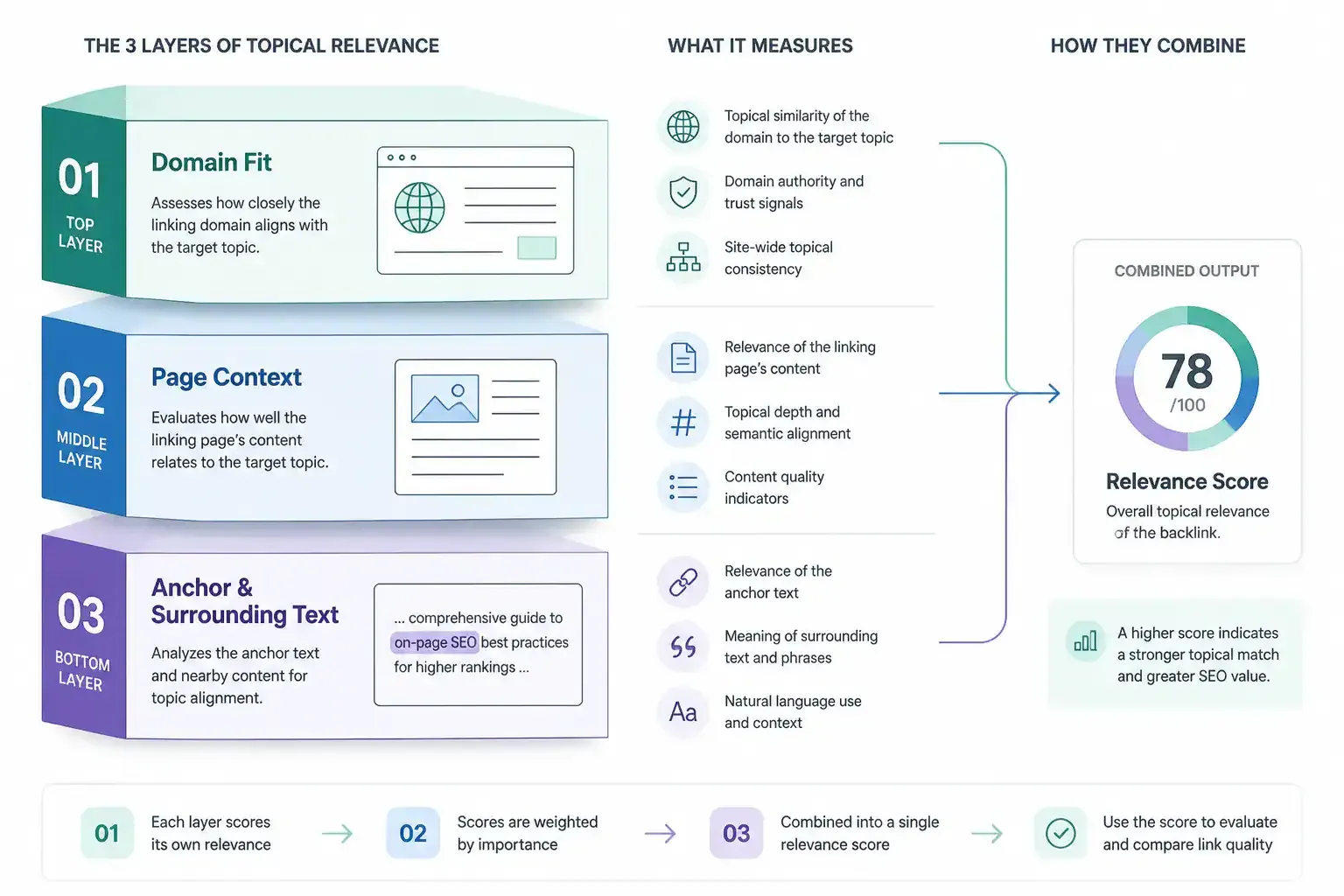
Backlink relevance is the match between the linking page, the linking domain, and the surrounding context on one side, and the topic of the destination page on the other. In practice, a small set of closely related editorial links can be more useful than a larger set of unrelated mentions because search systems use topic and context signals when they evaluate links (source).
Search systems do not weigh every link the same. Topic modelling and a knowledge graph help them map what a site is really about, so a backlink from a site that already lives in your niche often carries more weight than a larger number of off-topic links, even when those other domains have decent metrics. That is why relevance beats volume in most practical link-building decisions.
The signal gets stronger when the link sits inside a relevant paragraph, citation, or resource list. In that setting, the link acts like a Contextual Endorsement, which is a third-party vote that reinforces entity associations and supports Experience, Expertise, Authoritativeness, and Trustworthiness (E-E-A-T). The surrounding copy gives search engines more proof that the citation fits the subject, not just the domain.
A simple way to think about it is this:
| Factor | What it measures | Why it matters |
|---|---|---|
| Link relevance | How closely the source page matches your topic | Keeps the citation aligned with the page’s subject |
| Source authority | How trusted the referring domain is | Raises the credibility of the link |
| Semantic alignment | How well the surrounding text fits the destination page | Makes the endorsement feel natural and useful |
That model is a useful shorthand. Backlink value is often best understood as Link Relevance x Source Authority x Semantic Alignment. A highly relevant link from a trusted source can outperform a stronger but unrelated domain because the signal comes from relevance, trust, and context working together.
This is also why topical backlinks matter so much for site-wide performance. When related sites link to you again and again, search engines can map your subject coverage with more confidence. That helps build Topical Authority across an entire cluster instead of isolating value on one keyword page. Measuring topical authority with reproducible signals covers how backlink topicality fits into the broader measurement framework alongside Topic Share, TAR, and AI visibility.
Natural links also tend to look more human. They mirror real citation patterns, match user intent, and improve the reader experience. That lowers algorithmic risk and makes the link profile more durable than scattered generic backlinks that feel forced or disconnected from the surrounding content.
The practical difference is easy to spot in the wild:
- A niche trade publication linking to a guide inside a relevant expert roundup usually sends a stronger topical signal than a broad directory listing.
- A resource page in your category often helps more than a high-profile but unrelated domain because the context is doing part of the ranking work.
- A paragraph-level citation in a supporting article can reinforce entity relationships more cleanly than a footer link that sits far from the subject matter.
A quick test helps separate real value from noisy metrics. If the link would still make sense after removing the SEO lens, the backlink relevance is probably strong enough to support your broader topical roadmap. If it feels awkward, generic, or out of place, the connection is likely too thin to matter much.
The real payoff comes when those links accumulate around related pages. Each citation strengthens the cluster, not just the individual URL, and that is what makes backlink relevance such a useful signal for modern search strategy. Building for that pattern gives your content a cleaner path to visibility and a more believable subject footprint in the eyes of both search engines and readers.
What Are The Core Relevance Layers And How Do You Score Them?
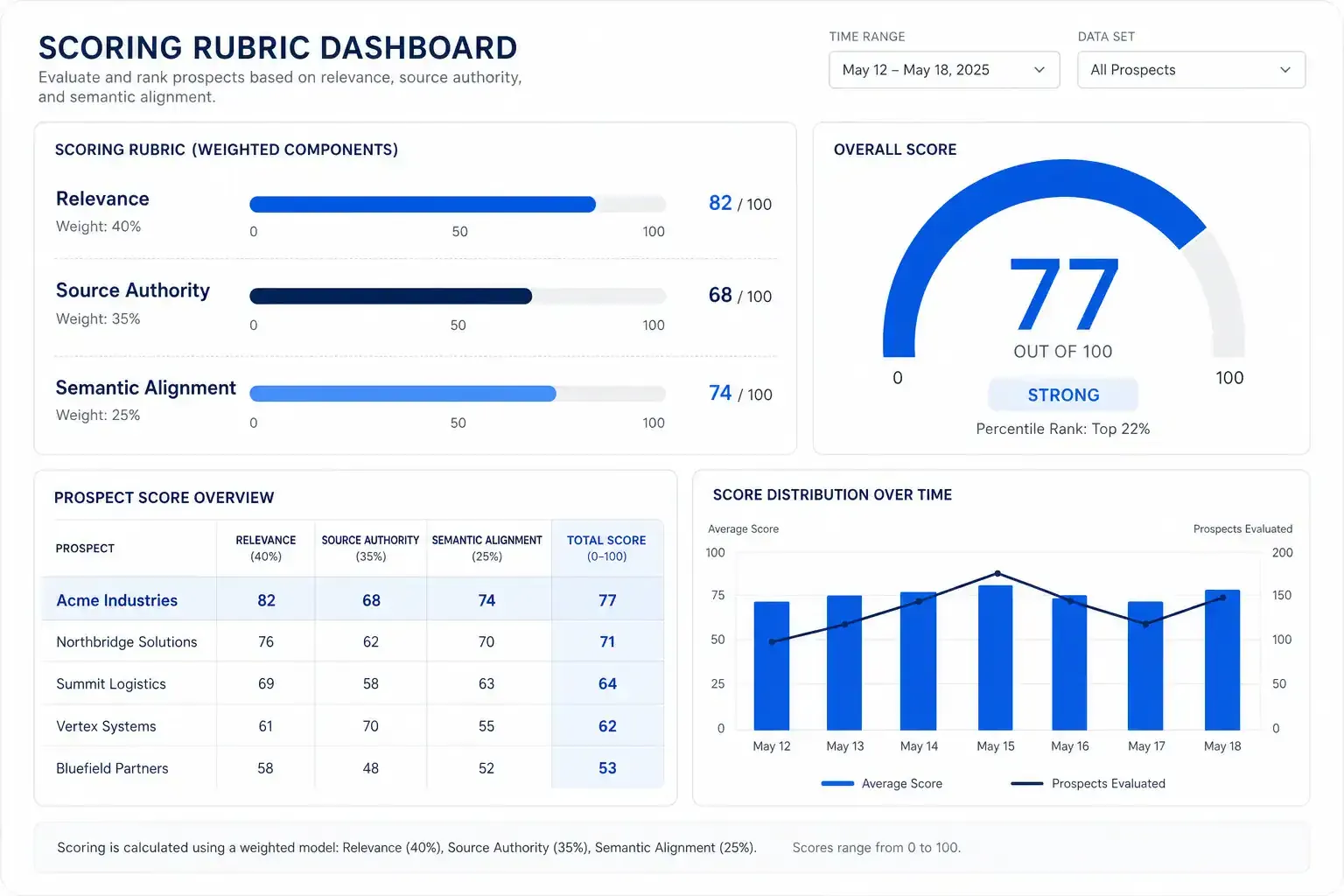
Backlink relevance works best as a layered signal, not a yes-or-no test. A domain can look strong on paper and still add little topical relevance if the page, anchor text, and surrounding copy miss the point.
Topic-sensitive PageRank is a useful mental model here. Search systems reward links more when the source site, the linking page, and the context all point to the same subject. That is where semantic SEO depends on semantic signals, not just raw authority.
A simple scoring rubric keeps the evaluation consistent across campaigns:
| Layer | What you score | 0 to 5 rubric | Weight |
|---|---|---|---|
| Macro or site-level fit | Referring domain niche and audience match | 0 = unrelated vertical. 1 = loosely adjacent industry. 3 = same broad category with mixed editorial focus. 5 = highly specialized site with a clear semantic footprint and consistent topical coverage. | 40% |
| Micro or page-level fit | The specific linking page | 0 = off-topic page. 1 = thin or tangential page. 3 = somewhat related page inside a broader site. 5 = the same subtopic, inside a relevant cluster, with enough depth that the link feels earned. | 30% |
| Anchor semantics | How the anchor text describes the target page | 0 = misleading or off-topic. 1 = weakly related. 3 = generic but acceptable. 5 = exact or closely related semantic anchor that matches the page intent. | 20% |
| Surrounding-text fit | Sentence and paragraph context around the link | 0 = boilerplate, bio, or random placement. 1 = vague context. 3 = partially related copy. 5 = copy that names related entities, concepts, or use cases and reinforces meaning. | 10% |
The macro score tells you whether the referring domain lives in your topic neighborhood. The micro score tells you whether the exact page belongs in the same cluster. Anchor text and surrounding copy show whether the link reads like a natural citation or a forced placement.
Once you weight the four layers, combine them into a 100-point total. A score from 80 to 100 is highly relevant. A score from 60 to 79 is conditionally relevant, which means the link may help only if the page and campaign fit your strategy. Anything below 60 is low relevance and usually belongs lower in your link-building outreach queue.
That framework gets sharper when you compare backlink relevance with on-site signals. Content depth, keyword coverage, query-topic alignment, and internal linking patterns all affect how much lift the link can actually deliver. A strong external link often underperforms when the target cluster is thin or scattered.
For planning, the real decision is whether the gap sits in the backlink profile or on the page itself. If your pages already map tightly to the query set, a higher-scoring external link can support topical authority faster. If the cluster is weak, improve the content first and use the rubric to guide link-building outreach.
Why Do Relevant Backlinks Outperform Generic Ones?
Relevant backlinks usually beat generic ones because they reinforce what your page is about, not just who mentions it. A backlink from a page that already sits in your topic space sends a cleaner relevance signal in SEO, so it often helps the page you care about more than a stronger but unrelated domain does. In other words, topical backlinks tell search engines what the page should rank for.
That difference shows up in the ranking pattern. Topically relevant links tend to drive focused gains inside one content cluster, while generic links may lift broad domain metrics without moving the priority pages that matter most. When the link matches the subject, it strengthens Topical Authority in that cluster.
A quick hierarchy makes the choice easier:
| Priority | Link type | Why it matters |
|---|---|---|
| Highest | Same-niche editorial citations and industry research mentions | Strongest topical fit and clearest relevance signal |
| Strong | Contextual expert guest articles and relevant SaaS or tools list placements | Adds Contextual Endorsement in a real editorial setting |
| Weak | Unrelated high-authority sites, generic business directories, sitewide links, and footer links | Delivers authority, but little topical proof |
That order works because the surrounding copy, the publisher’s subject matter, and the audience all frame the link. A link can look strong on paper and still underperform if the context points somewhere else. That’s why fit matters more than raw authority when you’re trying to win a specific query set.
A niche-relevant site can outperform a stronger but unrelated site for a tight keyword set. That pattern is consistent with Google’s explanation that links and content are evaluated in context, not by raw volume alone (source). The lower-DR page may have less overall strength, but it sends a sharper topical signal to the right cluster. The result is usually a more surgical ranking gain rather than a vague domain-wide lift. Across 42 topical maps, ranked coverage tracked AI citations more closely than Domain Rating on all four AI engines.
Quantity alone also falls short. A pile of generic links can create diluted domain lifts, but it rarely builds the entity and topic associations needed to win within a focused cluster. Search engines want more than popularity. They want evidence that your page, your site, and your brand belong in the same subject map through relevant citations, brand mentions, topical distribution, digital PR, and even ChatGPT citations when AI surfaces echo the same source pattern.
The practical move is simple:
- Prioritize niche-relevant editorial links before generic authority plays
- Use contextual mentions to strengthen page-level relevance
- Treat brand mentions as useful when they appear in the right subject neighborhood
- Measure movement at the cluster and page level, not just domain metrics
SEOs keep seeing the same pattern in live projects. Links that match the topic move rankings more reliably than high-volume generic placements, especially when the target page sits inside a tight topical cluster. Build for relevance first, and the authority gains usually become much more useful. Understanding the how topical authority differs from domain authority helps you decide where link relevance matters most.
How Does Backlink Relevance Affect AI Search Visibility?
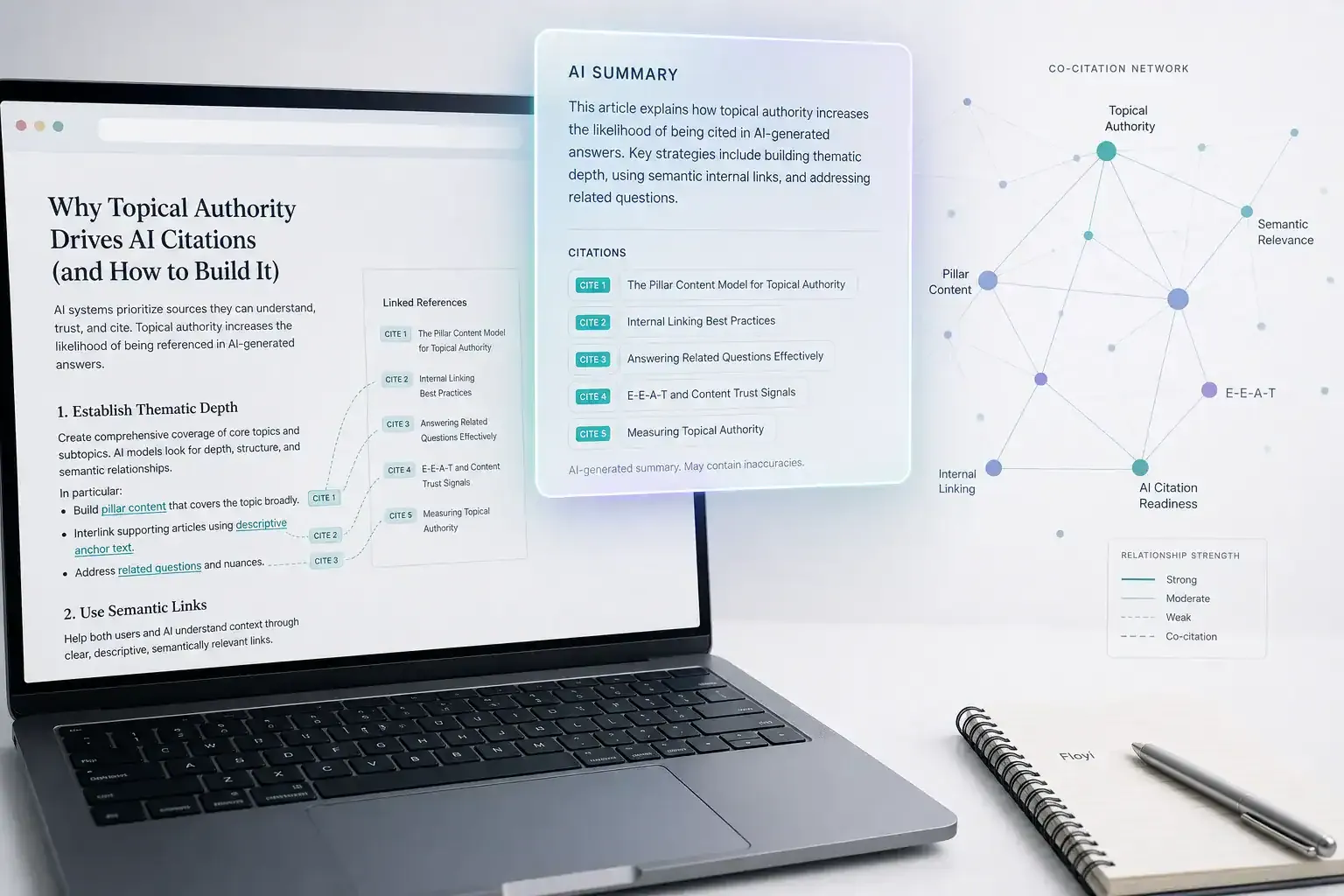
Backlink relevance shapes AI search visibility because search systems treat links as topic evidence, not just votes. When your backlinks come from the same subject area, your page looks more credible for both traditional rankings and AI citations. That credibility is strongest when your content sits inside a clear topical neighborhood.
Modern systems rely on topic-sensitive authority models instead of one global authority score. A niche-relevant link from a specialist publication can outweigh a generic mention from a stronger but off-topic domain when the query is highly specific. In practice, that means a focused industry link can do more for a narrow B2B query than a broader mention from a general news site.
A compact comparison makes the pattern easier to scan:
| Link pattern | What search systems infer | Impact on AI visibility |
|---|---|---|
| Tight niche editorial links | Your site belongs in a specific subject area | Faster classification and stronger topical trust |
| Repeated subject co-occurrence | Your brand is consistently tied to one theme | Better topic modelling and semantic alignment |
| Independent expert mentions | Other authorities endorse your work | Stronger E-E-A-T and better AI citations |
| Broad, unrelated mentions | Your domain has reach but weak focus | Lower confidence for specialized retrieval |
A concentrated inbound link profile also helps engines classify your site faster. The pattern tells crawlers what your core expertise is, which semantic cluster you belong to, and which new pages should surface first. That is where semantic SEO and the knowledge graph start to work together. The same signal helps the system connect your brand to the right entities and topics.
The signal is rarely just the anchor text. Co-citation, subject co-occurrence, and recurring editorial patterns build topical proximity even when the exact phrase never appears in the link. Those are semantic signals, and they matter because the surrounding page context often carries more weight than a keyword match. A link inside a deeply relevant article sends a cleaner message than the same link placed in a random roundup with weak editorial fit.
Your backlink profile also shapes how quickly a machine can place new content in the right lane. A tightly themed set of links gives the crawler a clearer map of your expertise, which supports faster discovery inside a known subject cluster. That is why topic-sensitive PageRank matters so much for specialized queries. The older idea that every good link passes roughly the same value does not hold up well once topic relevance enters the picture.
A deep, in-niche site can outperform a broader page with more backlinks when the query is specific. Learning-to-rank and NLP-driven systems reward semantic relevance, latent domain context, and topical depth over raw link volume or keyword stuffing. That is also why topic modelling matters. It helps the system group your pages with the right entities, related terms, and adjacent questions before a human ever clicks.
For AI search visibility, the citation question is even sharper. AI Overviews are expanding across Google Search, and pages with clear editorial support, strong topic fit, and verifiable sourcing are more likely to be useful candidates for AI-generated summaries. Independent mentions from recognized authorities can strengthen that trust signal, but the exact selection rules are not public (source, source).
These link traits tend to matter most:
- Subject match: The linking domain covers the same niche or a very close one.
- Editorial independence: The mention comes from a real writer, editor, or publication.
- Page-level relevance: The article around the link matches your topic closely.
- Repeated association: Multiple links point to you from similar subject clusters.
- Clear entity fit: Your brand already connects to a known topic in the knowledge graph.
The practical test is simple. If the source page would make sense beside your content in a human editorial package, it probably helps the machine too. If it would feel out of place, the signal is weaker. That is the real split between general authority and topic authority.
For SEO, AI, LLM, and GEO visibility, the takeaway is straightforward. Build links that reinforce the same subject story your content already tells. Strengthen the neighborhood around your pages and keep the editorial context tight. When the topical fit is obvious, backlink relevance works for both rankings and generative answers.
How Do You Audit And Prioritize Link Opportunities?
A simple scoring matrix keeps link-building outreach honest. It keeps you from overvaluing flashy metrics and helps you rank prospects by fit, trust, and context instead of chasing the biggest number in a spreadsheet.
Use a 1 to 5 scale for each axis, then apply a weighted total so every prospect gets scored the same way. The math should stay simple. The decision should stay repeatable.
| Axis | What it measures | Score guide | Suggested weight |
|---|---|---|---|
| Relevance | Topic fit at the page and site level | 1 = off-topic, 5 = same cluster or closely adjacent entity set | 45% |
| Source Authority | Overall trust and editorial strength of the linking domain | 1 = weak or unstable, 5 = durable and well-edited | 25% |
| Semantic Alignment | How well the anchor, nearby copy, headings, and entities support the target page | 1 = thin or awkward, 5 = highly consistent with intent | 30% |
A weighted formula like this works well: total score = (Relevance x 0.45) + (Source Authority x 0.25) + (Semantic Alignment x 0.30). That gives you a clean comparison across prospects. It also keeps raw domain metrics from hijacking the process.
Relevance should be the first test, not the last. The linking page should sit in the same topic cluster, an adjacent subtopic, or a closely related entity set as the page you want to strengthen. A modest-authority site can beat a stronger but generic one when the audience, depth, and context line up tightly.
Source Authority still matters, but it should not be confused with fit. A domain with strong editorial standards, stable traffic, and durable equity can reinforce trust. That matters most when the placement supports a broader topical distribution strategy across content clusters.
Semantic Alignment is where many audits get sharper. Anchor text, surrounding sentences, headings, and co-mentioned entities should point toward the same intent as the target page. That matches the Reasonable Surfer concept, where contextually relevant links are more likely to be clicked and treated as more meaningful signals.
A practical workflow keeps the review consistent:
- Score each prospect on relevance, authority, and semantic alignment.
- Add the weighted total and sort the list from highest to lowest.
- Flag any link that scores high on fit but only medium on authority.
- Remove any prospect that looks strong on metrics but weak on topic match.
- Map the winner to the right page type, whether that’s a pillar page, a cluster page, or a supporting article.
That last step matters more than most teams admit. The best links reinforce the structure you already built in your content planning and topical authority workflow, because the goal is not just more backlinks. The goal is better internal linking, cleaner entity coverage, and stronger SEO signals across the whole architecture.
Here are the decision rules that make the matrix useful in real work:
- Choose the niche fit first: If a lower-authority page scores high on relevance and semantic alignment, prioritize it over a stronger but unrelated page.
- Protect the cluster: If a prospect supports a pillar page or a key supporting article in your content clusters, give it a lift because it strengthens the whole map.
- Discount vanity authority: If the domain looks impressive but the page is broad, generic, or mismatched, treat the authority score as secondary.
- Favor contextual depth: If the surrounding copy, headings, and entities reinforce the target intent, the link usually does more work for you.
- Skip forced placements: If the link requires awkward copy or irrelevant anchor text, keep the semantic score low even if the site is strong.
- Reward editorial consistency: If the page has a stable publishing pattern, clear topical focus, and clean on-page context, the link is easier to trust and easier to defend.
This is also where AI visibility enters the audit. You want links that make your page more useful to systems that generate answers, not just systems that rank blue links. Favor prospects that improve citation readiness for AI Overviews, AI Mode, ChatGPT Search, and Gemini by pairing niche-relevant backlinks with structured content that clearly states the entity, the offer, and the answer.
That matters for AI citations and for GEO. A highly relevant link from a smaller source can outperform an unrelated link from a larger site when the goal is to strengthen a defined topic and make the page easier to quote, summarize, or surface in an AI answer. Digital PR can still help at scale, but the best-earned mentions are the ones that also reinforce your topical authority.
A good audit also keeps the target page in view. Before you approve any prospect, check whether the link helps a pillar page, a cluster page, or a support article that closes an entity gap. If it does not improve the page’s role in the structure, the link may still be useful, but it should not outrank a cleaner fit that advances your SEO plan.
Use this final filter before you send outreach or accept a placement:
- Same topic family: The page belongs in the same subject area as the target.
- Real trust, not just size: The domain adds credibility without distorting the topic.
- Natural context: The placement reads like part of the page, not a bolt-on.
- AI-ready support: The page helps with AI citations as well as classic search.
When most of those checks pass, the opportunity belongs near the top of your list. When a link is high-authority but off-topic, it belongs lower, or it belongs nowhere at all. That discipline is what turns backlink review into a real topical authority system for link-building outreach.
The best teams treat this as part of their broader SEO operating model. They look at topical relevance first, then confirm whether the link strengthens pillar pages, supports content clusters, and improves internal linking across the site. They also use the same logic in digital PR, where a high-profile mention still needs to fit the topic if it is going to help long-term topical authority. The measurement toolkit for topical authority provides the scoring templates for tracking these link quality signals over time.
You can keep the scoring honest with one simple habit. Ask whether the link improves the page, the cluster, and the entity map at the same time. If it only boosts the domain on paper, the opportunity is probably weaker than it looks.
Backlink Relevance FAQs
These FAQs address the questions that usually come up when you evaluate backlink relevance, from topical fit to its role in SEO decisions. They help you separate meaningful signals from noise before you invest in outreach or content planning.
Can Irrelevant Backlinks Still Help Rankings?
Yes, irrelevant backlinks can still pass some value, but they usually support broad authority more than topical trust, so they’re rarely the links that move competitive rankings. In a low-competition niche, a few mismatched editorial mentions can help early visibility, but generic guest posts, random directories, mass HARO replies, and DA chasing often create noisy signals that do little for topical authority. Search engines map topic models and knowledge graphs across a site, so related-page links reinforce your footprint more cleanly, while repeated mismatch can be discounted in core updates, caught by spam systems, or simply dilute relevance over time.
How Many Relevant Backlinks Do You Need?
There isn’t a universal backlink count, but a concentrated cluster of highly relevant links usually builds topical authority faster than a bigger pile of generic ones. When most of those links come from the same niche, search engines can classify your expertise more confidently, and new pages in that topic often rank faster. Loosely related links can still add breadth, but the authority signal is usually more diluted, while a few links from authoritative, topically adjacent sites can create sharper wins inside one topical cluster. Most sites see noticeable movement in about 3 to 12 months, and some see progress in 3 to 6 months when publishing stays consistent and the link profile keeps reinforcing the same core subject.
Does Anchor Text Change Relevance Signals?
Yes, anchor text changes relevance signals because its meaning helps search engines infer what the target page covers. The surrounding words matter too, because nearby entities and sentences reinforce the same subject, and editorial in-content links usually carry more weight than footer, sidebar, or boilerplate placements. You get the strongest match when descriptive, varied anchor text fits the sentence naturally and the surrounding copy names the same subtopics without repeating the phrase so often that it looks over-optimized.
Are Editorial Mentions Different From Relevant Links?
Editorial mentions still build trust and awareness, but a relevant in-content link sends a clearer topical signal because it gives search engines explicit context and placement. Links inside the body of an article on an authoritative industry site usually carry more weight than footer, sidebar, directory, or boilerplate placements, especially when the surrounding copy is positive and on topic. Over time, repeated independent editorial endorsements compound authority, strengthen topical hierarchy, and improve your chances of being treated as a credible source in AI citation surfaces.
About the author

Yoyao Hsueh
Yoyao Hsueh is the founder and CEO of Floyi, the topical authority platform, and the founder of Main Heading, an SEO and AI search agency. He created Topical Maps Unlocked, a course studied by thousands of SEOs, content strategists and digital marketers, founded TopicalMap.com, a done-for-you topical mapping service for agencies and enterprise teams, and publishes the weekly Digital Surfer newsletter on SEO, content strategy and AI search.
About Floyi
Floyi is a closed loop system for strategic content. It connects brand foundations, audience insights, topical research, maps, briefs, and publishing so every new article builds real topical authority.
See the Floyi workflow