
Topical Authority vs Domain Authority Explained
Learn the difference between topical authority and domain authority, when to prioritize each, and how to build topical authority with clusters.
Topical authority versus domain authority compares two different SEO signals and shows how each affects ranking decisions. SEO agencies often see one client with deep coverage and weak links, while another has strong backlinks but thin subject coverage. Topical authority is topic-specific trust, while domain authority is a broader estimate of site strength across search. The practical question is where the next quarter of effort goes: depth on one subject, or links across the domain.
A site can score well on domain authority and still lose to a smaller competitor that covers the subject more completely. Which one to invest in depends on the query set you’re chasing, not on which number looks better.
A niche site with one tight pillar and a supporting cluster regularly outranks a bigger brand on a long-tail query when the intent match is stronger. A 2026 study of 42 topical maps also found that how much of a subject a site ranks for tracked AI citations more closely than Domain Rating on every AI engine tested.
Topical and Domain Authority Key Takeaways
- Topical authority measures depth and trust around one subject.
- Domain authority estimates site strength through backlink and trust signals.
- Topic clusters and internal links help search engines read subject structure.
- High-quality backlinks raise domain authority more than weak link volume.
- Moz DA and Ahrefs DR are comparative metrics, not Google ranking signals.
- New and niche sites often win faster with topical authority first.
- Track cluster traffic, long-tail rankings, and internal link depth together.
- Ranked coverage tracked AI citations more closely than Domain Rating on all four AI engines.
What Is Topical Authority?
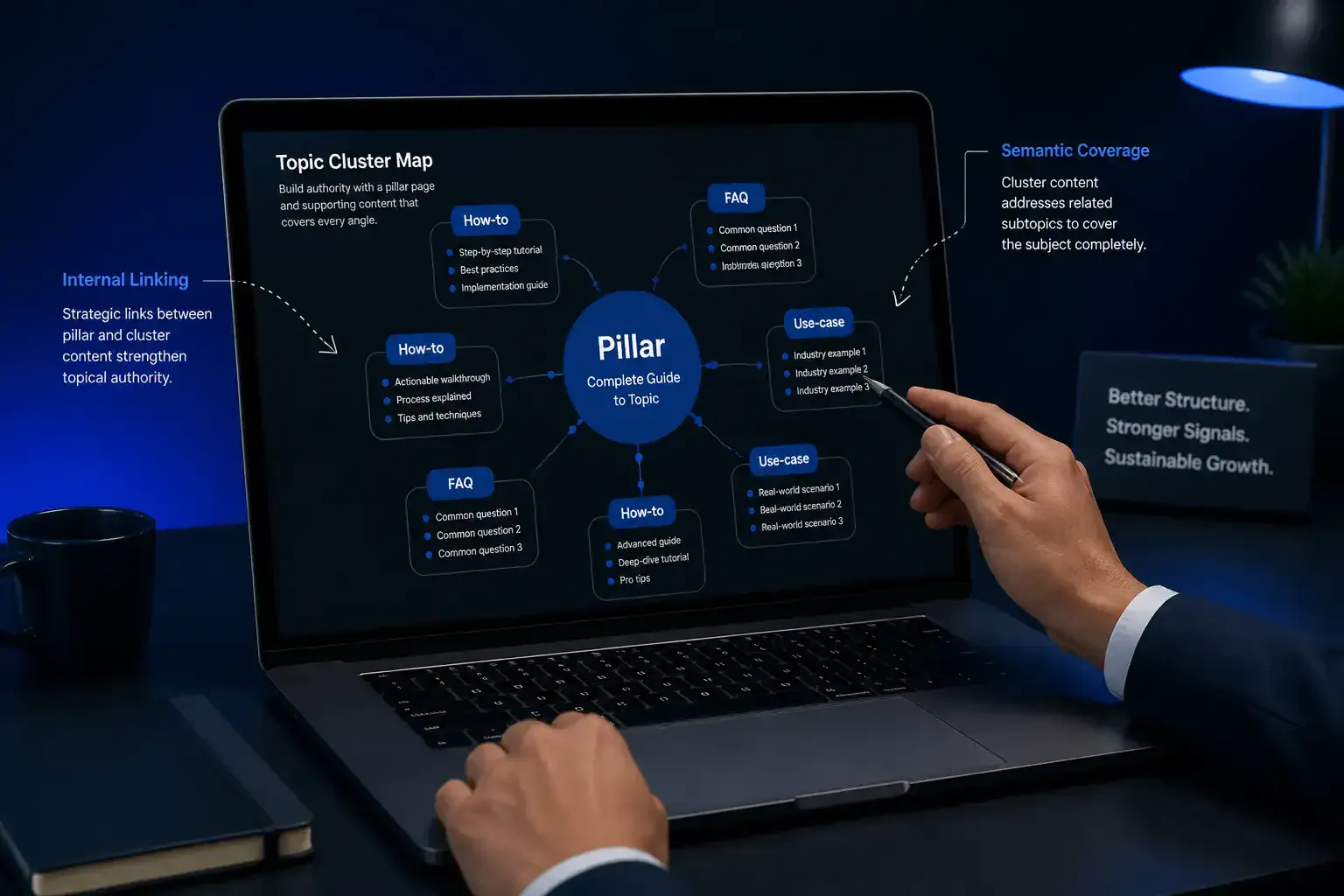
Topical authority is the degree to which search engines expect your site to be a reliable expert on a specific subject or sub-niche. If you’re asking what is topical authority, the simplest answer is that it is topic-specific trust, not a broad measure of overall site strength like domain authority. For SEO, that difference matters because search engines reward depth on a subject, not just a strong site name.
It isn’t a single score. It grows from signals that reinforce one another:
- Content depth: enough substance to answer the main question and the follow-up questions
- Semantic coverage: related terms, entities, and concepts that show full subject knowledge
- Topic clusters: connected pages that cover a subject from multiple angles
- Internal linking: clear paths that show how pages relate to each other
- Relevance consistency: steady focus on the same niche instead of scattered publishing
- User intent coverage: content that matches the searcher’s full job to be done
- Off-page trust: relevant backlinks, brand mentions, and visible subject-matter expertise
Relevant, authoritative links usually carry more weight here. A site with tighter topical depth and cleaner structure can outperform a stronger domain on a specific query when the page matches search intent more closely (source). That is why topical authority changes how you prioritize content, links, and SERP coverage.
You win the topic by owning the full content map around it. One strong page rarely carries the rest of the journey. Build the topic map, connect the subtopics, and make every supporting article reinforce the same core theme. How to measure topical authority covers the signals and scoring frameworks that make this progress visible.
How Does Topical Authority Work?
Topical authority comes from repeated proof, not a public score. Search engines read your Search Engine Optimization (SEO) signals as a pattern and ask whether you cover a subject more completely than thinner pages do. Content depth, semantic coverage, internal linking, and consistent terminology all work together.
| Signal | What it looks like | What search engines infer |
|---|---|---|
| Content depth | Full answers plus follow-up detail | You know the subject beyond the basics |
| Semantic relevance | The right terms and subtopics appear in order | Your topic map is coherent |
| Internal links | Descriptive links connect related pages | The site has clear subject structure |
| Engagement | People click, stay, and keep reading | The page fits intent better than thin alternatives |
Search engines also look beyond the head term. They judge the surrounding query set and track whether you earn clicks on related long-tail searches. That wider footprint shows that your page answers the topic, not just one keyword.
Entity relationships matter because the right terms help a crawler connect pages into a clear theme. When subtopics follow a logical hierarchy and descriptive internal links point between them, semantic relevance becomes easier to read. A strong topic hub makes that structure obvious.
Engagement adds another layer. When readers click, stay, and find follow-up answers on-site, that behavior reinforces the signal that your content satisfies intent. The practical goal is a coherent cluster that proves expertise from multiple angles.
What Is Domain Authority?
If you’re asking what is domain authority, it’s a third-party SEO metric that estimates how strong a domain looks in search. Moz calls it Domain Authority, while Ahrefs uses Domain Rating. Neither is an official Google signal. Both are comparative estimates that try to predict how a site may perform in the SERPs.
| Metric | What it measures | Common scale | Practical use |
|---|---|---|---|
| Moz Domain Authority | Estimated ranking strength of a domain | 1 to 100 | Competitive analysis and audits |
| Ahrefs Domain Rating | Estimated strength of a site’s backlink profile | 1 to 100 | Link research and competitor comparison |
The score is predictive, not absolute. It usually runs on a 1 to 100 scale, and it is logarithmic, so gains get harder as the number rises. Moving from 20 to 30 is usually easier than moving from 70 to 80.
Google does not use Moz’s DA score directly. Treat domain authority as a comparison tool, not something you can optimize in isolation. Backlink changes can move the score even when your on-page content stays flat.
The main drivers are:
- Linking root domains: More unique sites linking to you usually strengthen the signal.
- Link quality: Relevant, trusted links matter more than weak ones.
- Spam signals: Unnatural patterns can pull the score down.
SEO teams still use DA in audits and competitor research. It gives a fast read on relative strength, helps you spot stronger backlink profiles, and shows how much off-page authority you may need to close ranking gaps. Moz and Ahrefs fit that job well, while topical authority requires topic clusters and semantic analysis because DA does not measure subject depth or content coverage.
How Does Domain Authority Work?
Domain authority is a proxy score, not a Google metric. It estimates how strong a site looks by weighing external backlinks, referring domains, trust, and the long-term shape of the link profile. That is why it often tracks ranking potential without acting as an official ranking signal.
The DA vs DR distinction is easier to read side by side:
| Metric | What it models | What matters most | How to read it |
|---|---|---|---|
| DA | Moz-style broader predictive authority | Link quality, trust, and historical strength | A general gauge of competitive strength |
| DR | Ahrefs’ 1 to 100 backlink-profile score | Referring domains and link equity relative to competitors | A narrower link-based benchmark |
Both scores are logarithmic. Bigger jumps need standout links and steady momentum.
Quality beats volume here. A small set of relevant, authoritative links usually carries more weight than a pile of weak ones. Some vendor models also factor in branded search demand, technical SEO health, content value, root domains, and broader trust signals.
Higher authority can improve your odds of ranking because strong domains attract and pass more trust through links. You still need topic-relevant pages and a solid internal structure to turn that authority into real SERP visibility.
What Is The Real Difference Between Them?
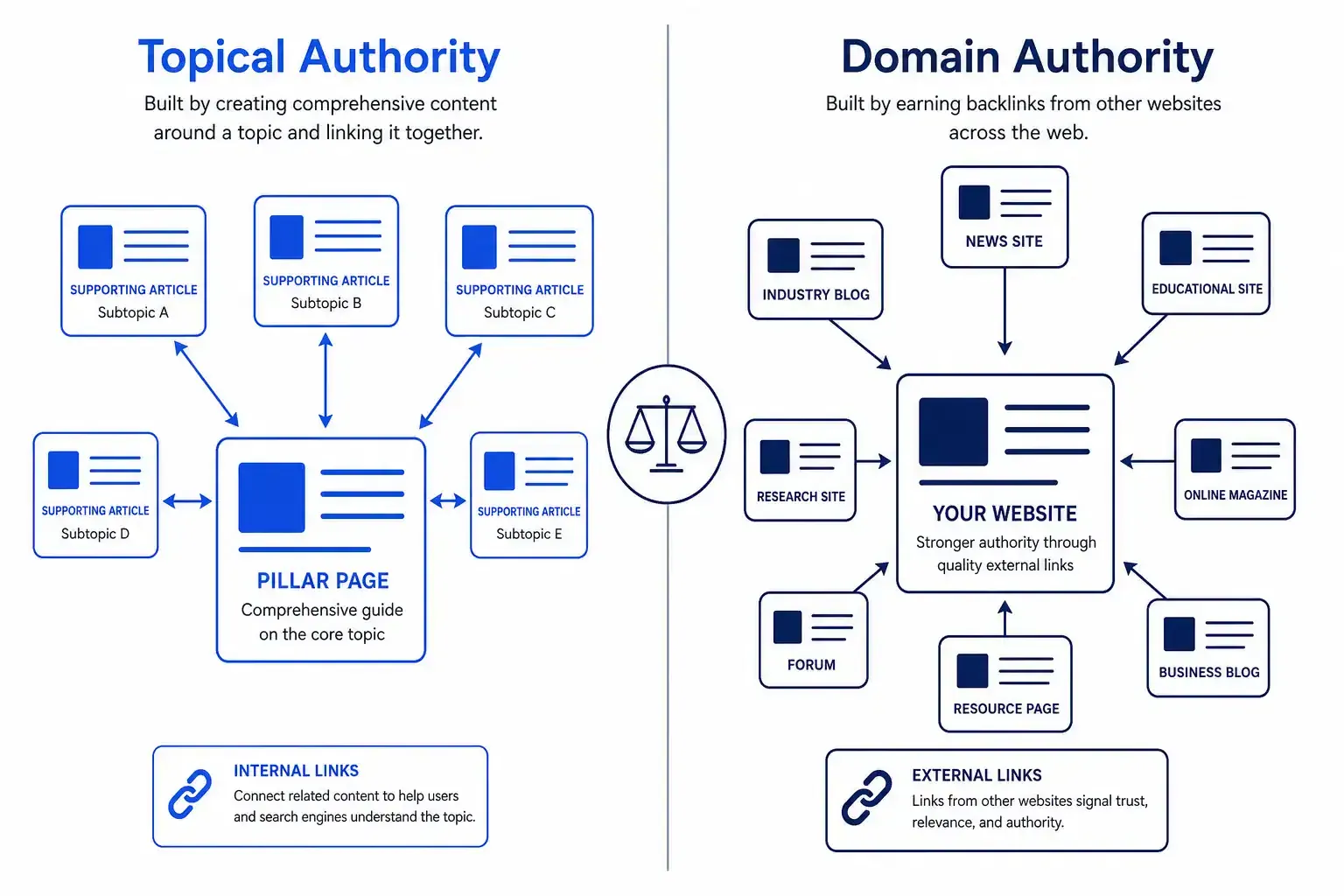
The difference between domain authority and topical authority is simple. Topical authority is focused trust around one subject. Domain authority is broader site strength and site-wide trust across the web. Search engines reward them in different ways.
| Dimension | Topical authority | Domain authority |
|---|---|---|
| Core signal | Depth in a defined topic | Broad site-wide trust |
| Main drivers | Content clusters, internal linking, content depth, intent match, entity coverage | High-quality organic backlinks, brand mentions, and overall trust signals |
| Build speed | A tight topic map can help a new or niche site build topical coverage faster than a broad, unfocused plan, but the timeline depends on competition, crawl frequency, and link growth. | Usually slower, because trust and links compound over time |
| Best SERP fit | Narrow, specific queries | Broader head terms and competitive generic queries |
That difference between domain authority and topical authority shows up fast in rankings. A newer or niche site can win a focused query when the cluster is more complete and closer to search intent. A larger domain often holds broader keywords because its trust carries more weight across the SERP.
Common traps keep teams stuck:
- Treating topical authority like E-E-A-T: The two overlap, but they are not the same. E-E-A-T is a quality lens, while topical authority comes from repeated, structured coverage.
- Counting on one strong article: Depth comes from a connected cluster, not a lone page.
- Chasing random links: Irrelevant link building may add noise, but it does not create topical depth.
The practical move is to start with topical authority when you work in a defined niche or on a newer site. Then layer in relevant backlinks and brand mentions so the cluster gains broader site-wide trust and can keep growing. The strongest results usually come when the page wins first and the domain helps defend it.
For agencies and growth teams, the sequence is straightforward:
- Build the cluster: Map the topic, cover the intent, and interlink the pages tightly.
- Reinforce the cluster: Earn relevant mentions and backlinks from credible sources.
- Expand carefully: Add adjacent subtopics only after the core cluster is already working.
Which Signals Drive Each Authority Type?
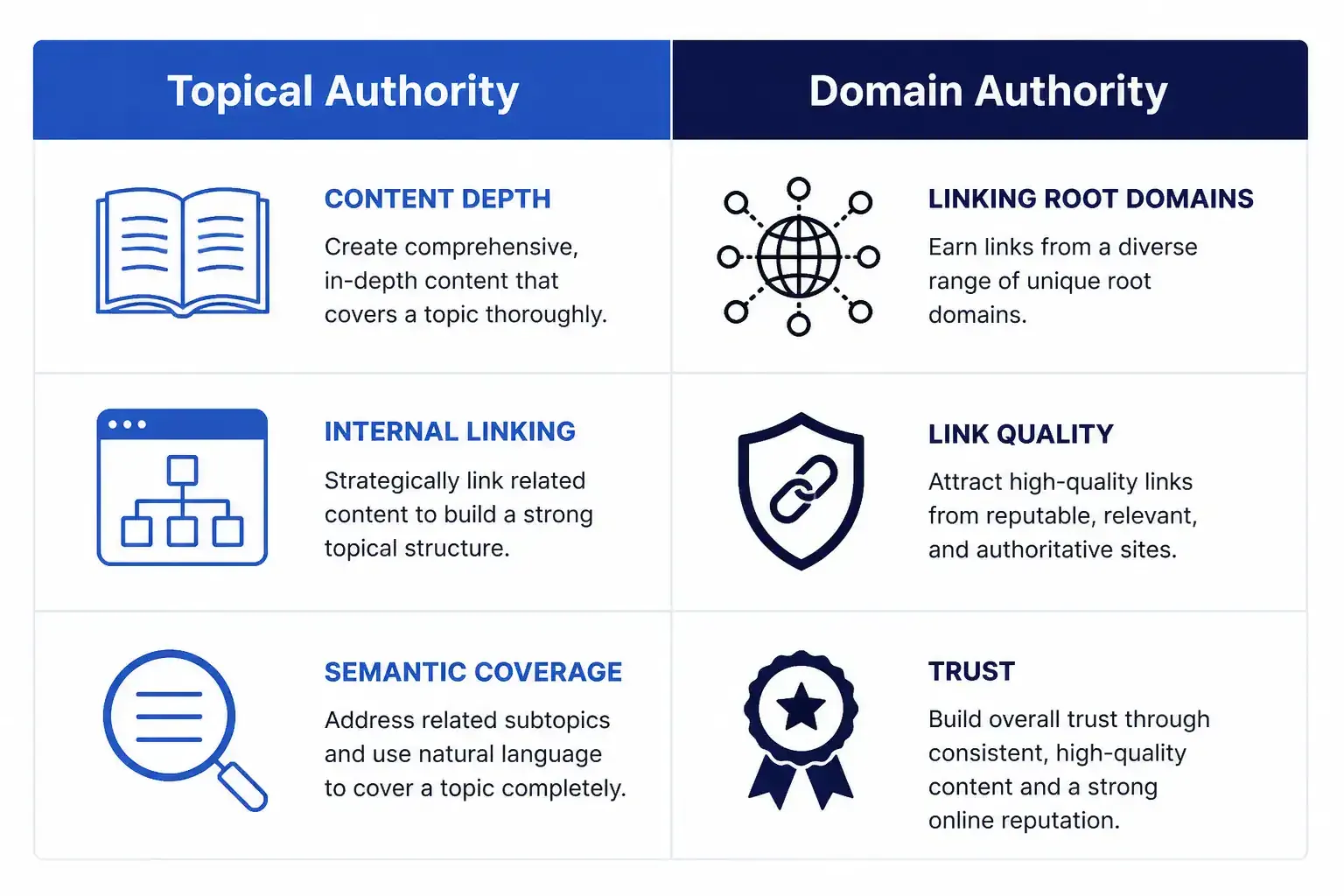
The cleanest split is this. Domain Authority grows from outside trust. Topical Authority grows from how completely you cover one subject on your own site. Chasing one without the other leaves ranking upside on the table.
Use this quick split to keep the two models straight:
| Authority type | Signals that matter most | What to build |
|---|---|---|
| Domain Authority | Relevant, high-quality backlinks, steady referring-domain growth, a natural backlink profile, site trust, brand strength, domain age, and historical authority | Earn external backlinks from respected sites in your niche and build assets worth citing |
| Topical Authority | Deep coverage, clear topic clusters, semantic breadth, internal links, entity coverage, and question coverage | Map the topic, answer the full question set, and connect every related page |
For DA, quality beats volume. A smaller set of industry-specific mentions usually helps more than a pile of weak or off-topic placements. Your backlink profile should look earned, not manufactured. Linkable assets, original data, and expert commentary give other sites a real reason to cite you.
For TA, depth comes first. A strong pillar page needs focused cluster content that answers core, adjacent, and long-tail questions. A topic map with several tightly related cluster articles can make a subject easier for search engines to read as one body of expertise, especially when the pages are linked with clear structure and matched to search intent (source).
Internal structure matters as much as the pages themselves. Internal linking patterns help search engines connect the dots. Descriptive anchor text helps too. So does semantic coverage that includes related entities and People Also Ask-style questions. Backlink relevance as a topical authority signal explains how link quality and topic fit work together to build trust.
The smartest strategy is not to pick a winner. Build both through high-information content, tighter clusters, relevant backlinks, and brand mentions that reinforce the same subject area. Topical Authority often moves faster on defined subjects and long-tail SERPs. Domain Authority still matters for broader trust and tougher head terms.
How Do You Measure Topical Authority In Practice?
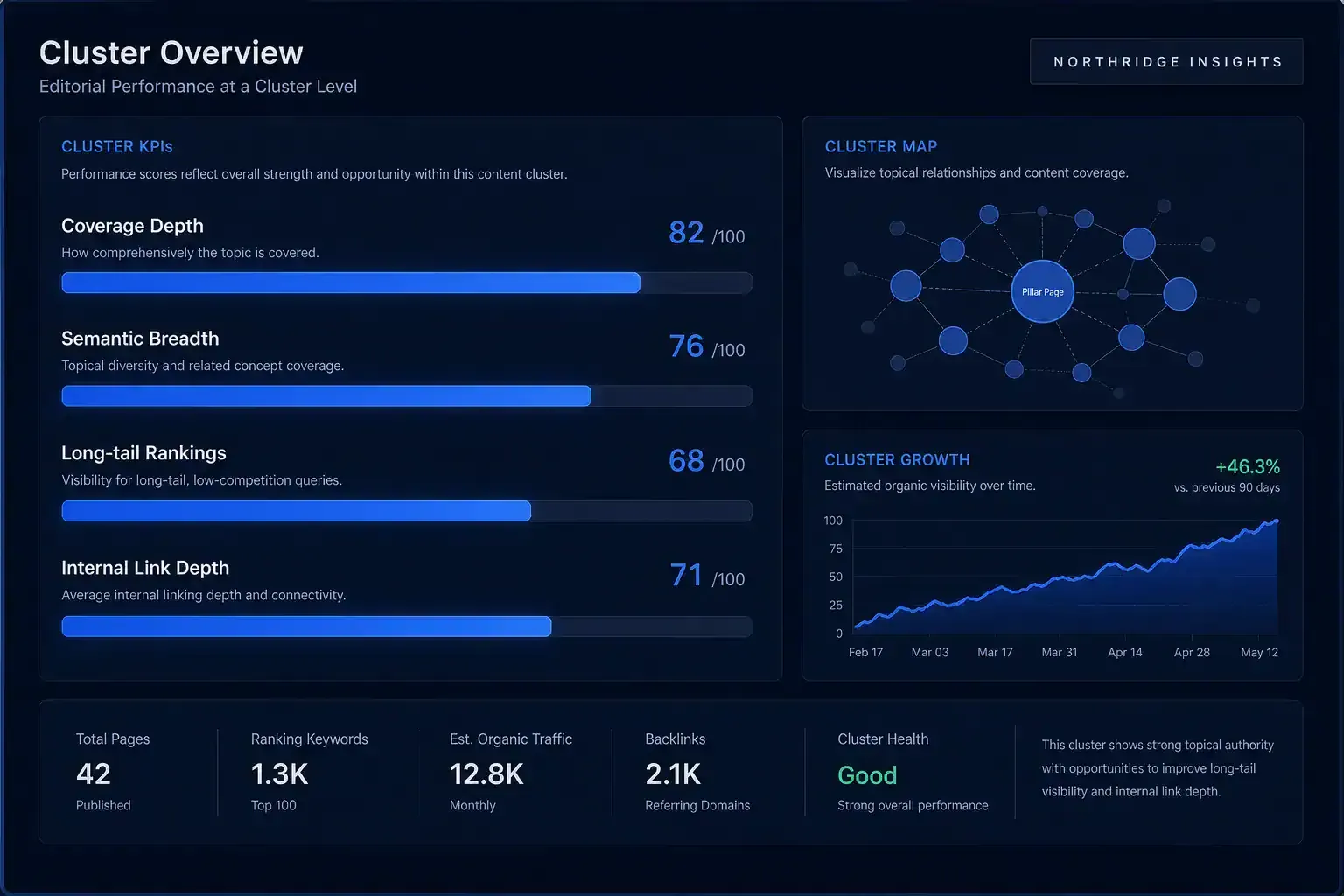
Topical authority works best as a blended scorecard, not a single public metric. You get the clearest read by combining coverage depth, semantic relevance, content consistency, engagement, and entity relationships across a cluster. Search engines do not publish one neat number for this, so the real job is to read the pattern across multiple signals.
A practical KPI stack keeps the focus on the cluster instead of the page:
| KPI | What it tells you | What to watch |
|---|---|---|
| Content gap coverage | How much of the needed subtopic surface you have filled | Missing questions, entities, and modifiers |
| Entity and question coverage | Whether the cluster matches real search demand | Thin sections and weak semantic overlap |
| Internal link depth | How clearly the cluster reinforces hierarchy | Orphaned pages and shallow links |
| Long-tail visibility | Whether the cluster is gaining reach in specialized queries | Flat impressions or stalled rankings |
| Consistency score | Whether terminology and intent stay aligned | Mixed framing, duplicate angles, and cannibalization |
A strong audit starts with content gap analysis. Compare the entities, questions, and modifiers that show up in winning SERPs, competitor pages, and AI citations with your own cluster. The fastest wins usually sit in the missing or thin areas, because they expand breadth without creating filler or inviting cannibalization.
Topic maps and clusters should be the unit of review for SEO. A healthy cluster has a pillar page, enough supporting articles to cover the subtopic surface area, and a clear internal linking path that signals hierarchy. Consistent terminology matters too, because mixed wording can blur the theme and weaken the cluster signal.
A repeatable scoring routine keeps the work honest:
- Score coverage depth on a 0 to 100 scale or a simple checklist.
- Score semantic breadth by counting covered entities, questions, and modifiers.
- Score content consistency by checking intent, terminology, and link structure.
- Review monthly or quarterly so you can see whether long-tail visibility and AI mentions are moving with the cluster.
The decision point is where strategy gets real. Newer or niche sites usually benefit from closing topical gaps inside one focused cluster first. Broader or established sites often need cluster expansion plus stronger domain-level signals, such as relevant backlinks and public relations. That is where topical authority and Domain Authority start to diverge, so you measure them in context instead of treating them like the same signal. The ready-to-run measurement spreadsheets and benchmarks provides ready-to-run spreadsheets and benchmark templates for this scoring routine.
What KPIs Should You Track?
Track cluster-level traffic first. Page-by-page reporting misses how topical authority compounds across related content.
A useful KPI set shows whether your content clusters are gaining depth, earning visibility, and holding attention in the same subject area:
- Traffic by cluster: Measure organic sessions, clicks, and impressions at the cluster level so you can spot which subjects are compounding and which need more coverage or stronger internal linking.
- Long-tail rankings: Watch semantically related queries, not just head terms. Rising coverage across niche searches is a strong sign that your SEO is building topical authority, especially for newer sites and niche entrants.
- Internal link depth: Count the clicks between supporting pages and the pillar page. Shallow, intentional internal linking helps search engines crawl the cluster and read its theme.
- SERP feature wins: Track featured snippets, People Also Ask placements, and AI-style citations or mentions. These wins show that your content is being selected as a concise answer across search surfaces.
- Engagement metrics: Review CTR, engagement rate, time on page, scroll depth, and return visits. Strong topical authority usually shows up as deeper movement through the cluster, not a one-page bounce.
- Coverage breadth: Compare your topic map with competitors. If they have a pillar and 5 to 8 supporting articles and you do not, your KPI review should flag weak semantic breadth and incomplete coverage.
A clean dashboard should make gaps obvious. When traffic, rankings, links, and engagement move together, your topical strategy is doing real work.
How Do Topic Maps And Clusters Help?
Topic maps turn a broad subject into a clear hierarchy of main themes, subtopics, and keywords, so you build topical authority through sustained relevance instead of one-off articles.
Floyi’s content planning for topical authority fits that model because the pillar page becomes the hub. It covers the core query in full, then points to supporting pages that address narrower intent stages, related entities, and long-tail variations.
A strong cluster architecture reinforces that structure with repeated signals across the site. Search systems read content depth, semantic coverage, entity relationships, internal linking, consistent relevance, and broader intent coverage as signs that the site is trustworthy on the topic. That is why content clusters and topic clusters work best when they behave like a mapped system, not a loose pile of posts.
A simple template can include a pillar page plus supporting pages such as how-to, comparison, use-case, mistakes, FAQ, checklist, and adjacent subtopic pages that fill known gaps (source).
- 1 pillar page, built as the main guide
- 1 how-to page
- 1 comparison page
- 1 use-case page
- 1 mistakes page
- 1 FAQ page
- 1 checklist page
- 1 to 3 adjacent subtopic pages that close known gaps
Every cluster page should link back to the pillar page, and the pillar page should link to every cluster page. Related cluster pages should cross-link only when the intent overlaps, and the anchor text should name the subtopic instead of using vague phrases like “learn more.”
Measure the map by tracking gap coverage, semantic breadth, keyword cluster coverage, long-tail visibility, and whether new pages expand the topical map without cannibalizing the same intent. You are not publishing more pages for their own sake. You are building distinct hubs that earn trust on one subject and help you own it with less guesswork.
When Should You Prioritize One Over The Other?
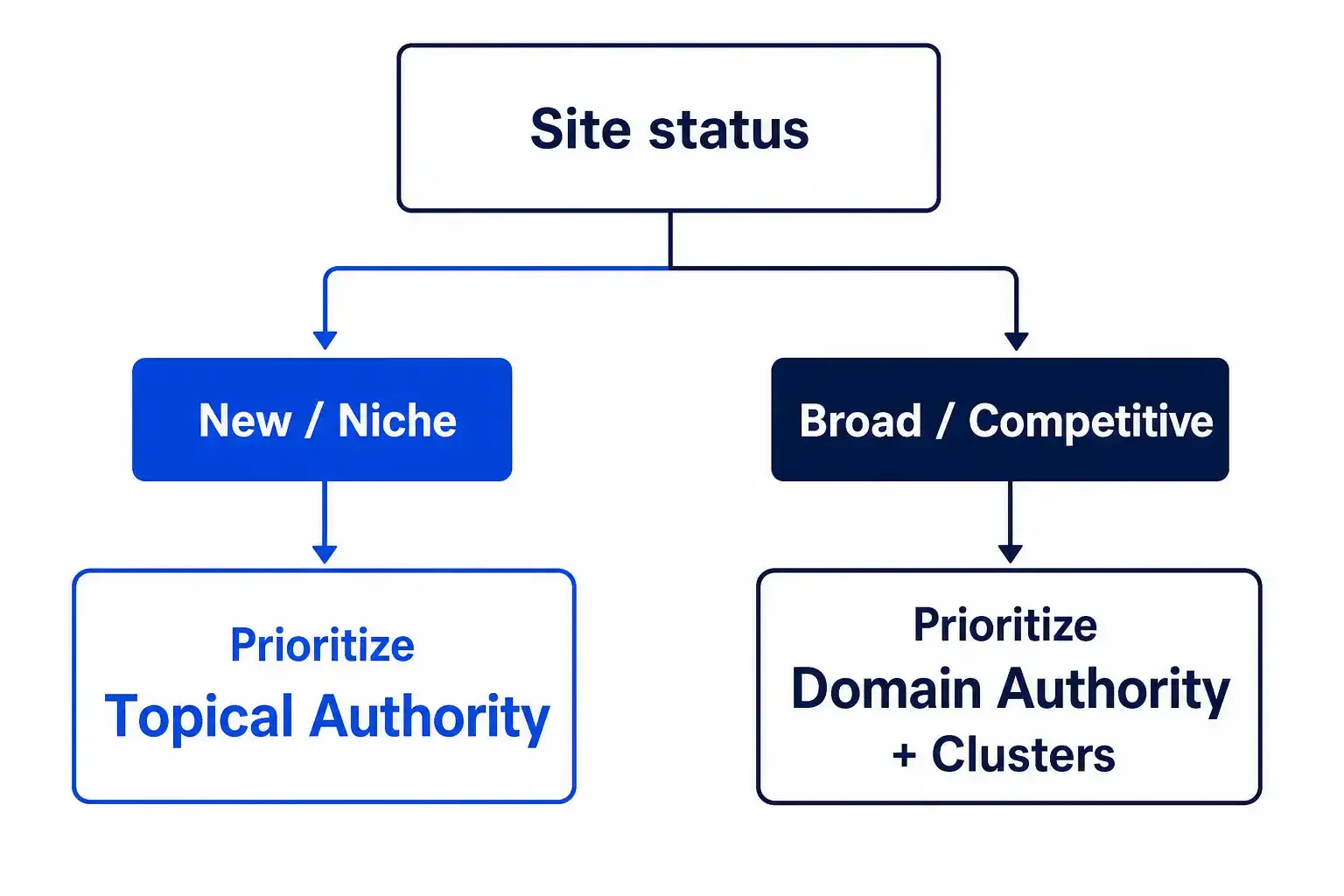
Topical authority usually comes first when your site is weak, new, or built around a narrow niche. Domain authority matters more when you’re pushing into broad, competitive terms. The rule is simple. Remove the biggest ranking obstacle first.
| Situation | What to prioritize first | Why it wins |
|---|---|---|
| New site or low-authority domain | Topical authority | A clear topic map, full coverage, and tight internal linking can create early visibility faster |
| Narrow niche or long-tail informational queries | Topical authority | Search intent is specific, so depth matters more than broad trust signals |
| Broad head terms or national-scale markets | Domain authority | Strong backlinks, digital public relations, and brand mentions help you compete where depth alone is not enough |
| Commercial or category-level queries | Both, in sequence | You need relevance first, then trust to clear the final ranking hurdle |
Query intent should be your tie-breaker. Informational searches usually reward topical authority faster because the searcher wants a precise answer. Commercial and category-level terms often need both a strong content cluster and a stronger domain profile. In SEO, the goal is to remove the first barrier that is blocking the page.
The cleanest sequence is topical-first, then amplify:
- Build the pillar page around one core topic.
- Publish supporting cluster pages that fill in the subtopics.
- Connect the pages with strategic internal links.
- Promote the strongest assets with backlinks and brand mentions.
A focused niche site can often win by owning one subject area. A broader business should build multiple topical hubs and treat each hub like a mini authority engine. When the topic space is large enough, that structure gives you a repeatable way to grow without spreading thin.
Topical authority and domain authority are not rivals. They are complementary playbooks for different stages of the same SEO job. Topic maps and internal linking help you prove relevance first, then stronger trust signals help you hold that position in tougher Search Engine Results Pages (SERPs).
How Do Moz DA, Ahrefs DR, And Page Authority Fit In?
Moz Domain Authority and Ahrefs Domain Rating are useful directional signals, but they aren’t proof of topical authority. Both sit on a 1 to 100 logarithmic scale, so gains near the top get harder and small changes can still matter. If you’re asking what is domain authority, the practical answer is that it’s a third-party estimate of site strength, not a Google-owned score.
The scores each do one job well:
| Metric | Best use | What it misses |
|---|---|---|
| Moz Domain Authority | Comparing broad site strength | Whether Google uses it directly |
| Ahrefs Domain Rating | Estimating backlink profile strength | Whether the site covers a topic deeply |
| Page Authority | Comparing individual URLs | Whether the whole domain has cluster coverage |
Google doesn’t use Moz DA directly, so a high score can still lose to a lower-scoring page with tighter cluster content, stronger internal links, and a better SERP match. These scores work best beside topical relevance, content depth, and real SERP performance. A strong number without matched intent is still just a number.
A safer workflow looks like this:
- Screen prospects with credible DA or DR.
- Verify topical fit, traffic relevance, and link context before you pitch.
- Use Page Authority to compare the exact URLs you want.
- Pair authority scores with pillar pages, supporting cluster content, internal linking, and niche-relevant backlinks.
That lens helps you spot when a lower-DA page outranks a stronger domain because the topic match and site structure are better. Treat DA and DR as context, not a verdict. Technical SEO, page relevance, and content coverage should make the final call.
How Well Does Domain Rating Predict AI Citations?
Not well, at least where AI answers are concerned. A Floyi study of 42 topical maps, 535,239 Google rankings and 354,955 AI citations measured both signals on the same websites inside the same maps, so the two could be compared on identical ground. Ranked coverage, meaning the share of a map’s topics where a website holds a top-20 Google position, tracked AI citations more closely than Domain Rating on every AI engine tested.
| AI engine | Ranked coverage | Domain Rating |
|---|---|---|
| AI Overviews | 0.51 | 0.09 |
| AI Mode | 0.48 | 0.16 |
| ChatGPT | 0.33 | 0.15 |
| Gemini | 0.36 | 0.11 |
Those are Spearman rank correlations, so they describe how closely two orderings of the same websites match. They don’t establish that coverage causes citations, and the study says so directly.
The two measures also barely move together, at 0.11, which is what you’d expect from a link-based score sitting next to a ranking-based one. In practice that shows up as heavy overlap between the coverage bands:
- 6 of the 45 broadest-coverage placements in the study carry a DR below 60, and those are websites ranking in the top 20 for at least half the topics in their subject.
- Nearly 25% of the next tier down sits below DR 60 as well.
- 7.9% of the narrowest-coverage placements carry a DR of 90 or higher, despite ranking for under 5% of their subject.
A strong backlink profile doesn’t tell you how broadly a website ranks inside a topic. You can read coverage and Domain Rating measured on the same websites in full, including what the study can’t show.
None of this makes coverage a replacement for links. The screening workflow above still holds. What changes is the second step: verifying topical fit now means checking how much of the subject a site actually ranks for, rather than reading a domain-level score and inferring it.
Difference Between Topical Authority and Domain Authority FAQs
These FAQs help you sort out the difference between domain authority and topical authority so you can choose what deserves attention in your SEO plan. They also clarify how each signal shapes SERP visibility, content priorities, and long-term growth.
Can topical authority beat low domain authority?
Yes. You can outrank a low-DA site when your topic cluster is tighter, your pages answer the query more fully, and your internal links make the subject easier to crawl. That’s why understanding what is topical authority matters so much in SEO. A niche pet insurance blog or a 100-article cybersecurity site can beat a major news publisher on a long-tail query, often within weeks to months, but broad head terms still usually favor stronger domains unless your relevance and trust signals are exceptional.
Does domain authority help new topical clusters?
Yes, strong Domain Authority can help your new cluster get indexed and gain early traction because search engines already trust your site, especially on fresh URLs and new content paths. Treat DA as a launch boost, not the core strategy, because topical depth, internal linking, and semantically complete coverage still do the real work. For broad, highly competitive head terms, DA can tip the scale early. For niche or intent-specific queries, a complete hub on a weaker domain can still win with relevant backlinks, brand mentions, and strong page-to-page relationships.
Can one strong article raise topical authority?
A single standout article can create an early authority signal, especially when it is the clearest, most complete answer to the query, but it usually lifts one page before it lifts the whole topic area. Topical authority builds through steady, semantically connected coverage, with content depth and clear E-E-A-T signals doing the real work over time. To make the gain durable, connect the article to related pages and back to the hub, then expand it into nearby sub-questions so the cluster, not one asset, carries the topic.
Should local sites favor topical authority?
Yes, local sites should usually favor topical authority first, especially when localized clusters match local intent. A tight local topic map gives you a core service page, plus city, neighborhood, and problem-based pages, while internal links keep the cluster centered on one theme and protect semantic relevance. Quality still beats volume, so use content gap analysis to fill the full local query set, add local proof points, relevant mentions, and niche backlinks, but remember that YMYL topics can still need broader domain authority and trust signals.
Does Domain Rating predict AI citations?
Weakly, and less well than ranked coverage does. Measured on the same websites inside the same 42 topical maps, Domain Rating correlated with AI citation presence at 0.09 on AI Overviews against 0.51 for ranked coverage, and coverage stayed ahead on AI Mode, ChatGPT and Gemini too. DR also can’t tell you which coverage band a site sits in, because the ranges overlap heavily: 7.9% of the narrowest-coverage placements carry a DR of 90 or higher, while 6 of the 45 broadest-coverage placements sit below DR 60. Use DR to read link strength and a coverage percentage to read subject breadth. They answer different questions, and a correlation between two measurements is not evidence that one causes the other.
About the author

Yoyao Hsueh
Yoyao Hsueh is the founder and CEO of Floyi, the topical authority platform, and the founder of Main Heading, an SEO and AI search agency. He created Topical Maps Unlocked, a course studied by thousands of SEOs, content strategists and digital marketers, founded TopicalMap.com, a done-for-you topical mapping service for agencies and enterprise teams, and publishes the weekly Digital Surfer newsletter on SEO, content strategy and AI search.
About Floyi
Floyi is a closed loop system for strategic content. It connects brand foundations, audience insights, topical research, maps, briefs, and publishing so every new article builds real topical authority.
See the Floyi workflow