
How to Refresh Content for Topical Authority
Learn how to refresh content for topical authority with update-vs-new rules, prioritization, pillar and cluster updates, and impact tracking.
Refreshing content improves topical authority when a page still fits the topic cluster but has drifted off intent. For SEO agencies, content strategists, and in-house content teams, the goal is to restore relevance, trust, and cluster fit without adding more pages.
The workflow covers page audits, refresh versus new scoring, pillar and cluster updates, internal linking, QA checks, and cadence rules. It also uses Google Search Console signals and topic maps to produce topic lists, AI-assisted briefs, and refresh rules that teams can repeat. Automation helps standardize prioritization while keeping brand voice and buyer intent intact.
Agencies and content operations leaders need a repeatable process because refresh work now has to protect brand voice while improving SEO and AI citation likelihood. A page that moves from position 12 to 6 after a title fix and two added support sections shows how targeted edits can beat broad rewrites. Use the next sections to build a refresh system that holds up across clusters and clients.
Topical Authority Refresh Key Takeaways
- Refresh pages that still match intent but have drifted off the topic cluster.
- Prioritize pages with Search Console impressions, ranking potential, and cannibalization risk.
- Update pillar pages first, then move through cluster pages in priority order.
- Strengthen internal links so refreshed pages reinforce the hub and supporting assets.
- Score refresh versus new content by intent fit, rank position, and speed to impact.
- Add fresh facts, entities, and proof to improve SEO and AI citation readiness.
- Measure results at 30, 60, and 90 days using rankings, clicks, and engagement.
What Makes Content Refresh Improve Topical Authority?
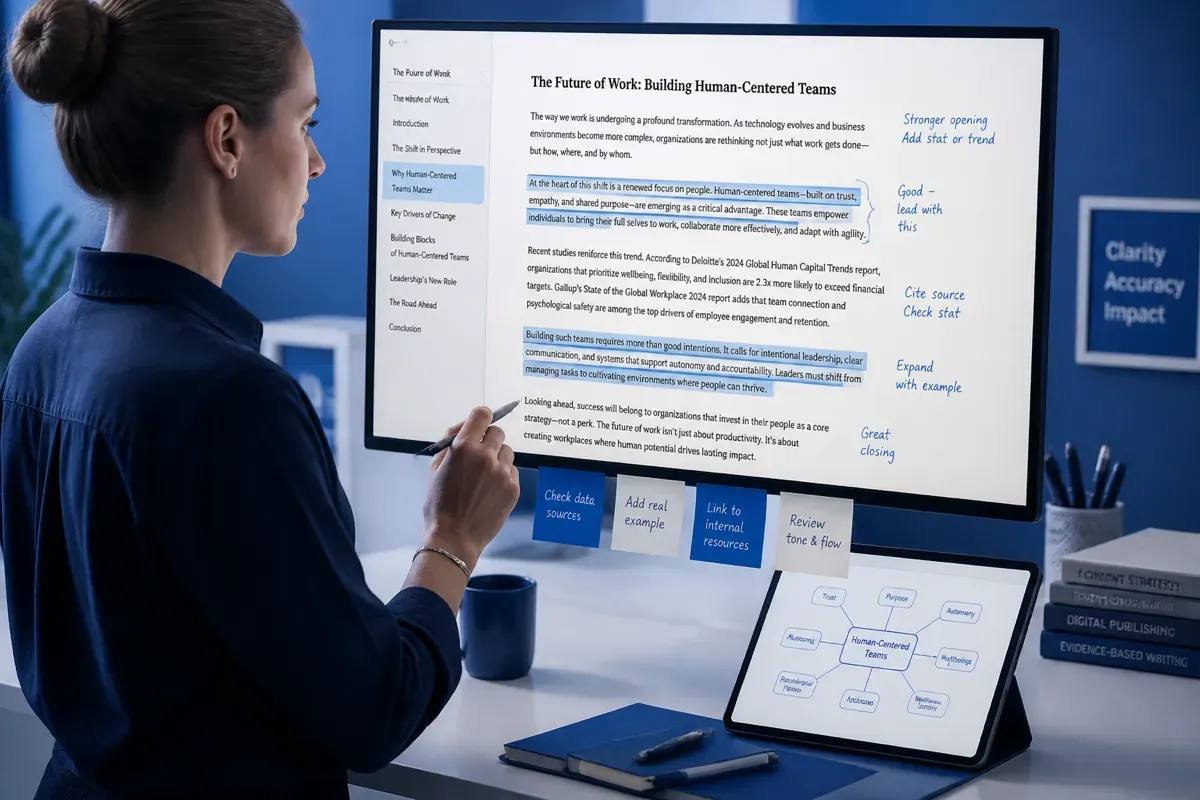
Topical authority improves when a content refresh shows that a page still deserves a place inside your topic clusters. The gain comes from relevance and trust, not from publishing more pages just to raise volume. In search engine optimization (SEO), the refreshed page aligns more closely with user intent, cluster context, and the evidence search systems use to judge expertise. A strategic content planning process for topical authority helps you organize clusters so search engines evaluate depth and breadth of coverage across a topic.
Content drift is the hidden problem that refreshes solve. Older pages can drift off the original query theme, accumulate dated examples, or leave out entities that belong in the subject. That weakens semantic relevance and can make one strong page pull against the rest of the topic map. A focused content refresh pulls the page back to the core intent so it supports the cluster instead of diluting it.
The biggest cluster gains usually come from changes like these:
| Update area | Why it helps |
|---|---|
| Pillar alignment | Re-centers the main page on the primary topic and removes side paths that blur hierarchy. |
| Support-page fit | Keeps related articles aligned to the same topic map instead of repeating the same angle. |
| Internal linking | Points the refreshed page toward the most relevant supporting assets and reduces outdated references. |
| Cannibalization control | Cuts near-duplicate coverage so competing pages stop splitting attention across topic clusters. |
Freshness matters because search systems use it as a recency cue. Updating facts, examples, screenshots, statistics, and date-sensitive guidance sends a stronger signal than leaving legacy copy untouched. That matters for crawl attention and for artificial intelligence (AI) systems that prefer sources with current evidence. The page does not need a total rewrite to look alive. It needs visible proof that the material still matches the topic and the moment.
Revision quality matters as much as publication volume, especially when you want stronger E-E-A-T, which stands for experience, expertise, authoritativeness, and trustworthiness. A refresh gives you room to sharpen author signals, add more specific proof, and replace vague claims with concrete examples. Those changes make the page easier to trust, easier to summarize, and easier to cite. Clear evidence also helps when several sources cover the same subject.
The authority transfer effect is strongest when the link structure changes with purpose. The refreshed page should receive links from the strongest related assets in the cluster, and it should send readers toward the most useful supporting pages. That improves discovery and helps search engines interpret the refreshed page as a central reference rather than a loose standalone article. Internal linking is not just navigation here. It is a signal that shows how depth, priority, and relevance fit together.
A useful refresh often works because it makes the page easier to quote. Clean answers, consistent terminology, and the right entities reduce friction for both readers and systems that extract summaries. Pages that state the point directly and support it with evidence are easier to reuse in search results and AI-generated answers. That is why a focused content refresh can outperform a new page that says the same thing with more words.
When you decide what to update, compare the page against the cluster, not against the calendar. The best candidates are the pages that still attract impressions but no longer match the topic map, the pages with outdated evidence, and the pages that compete with stronger assets. A content planning workflow helps you choose which pages deserve that work first. Prioritize the refreshes that restore relevance, reduce cannibalization, and strengthen the path through your topic clusters.
How Do You Score Refresh Vs New-Content Decisions?
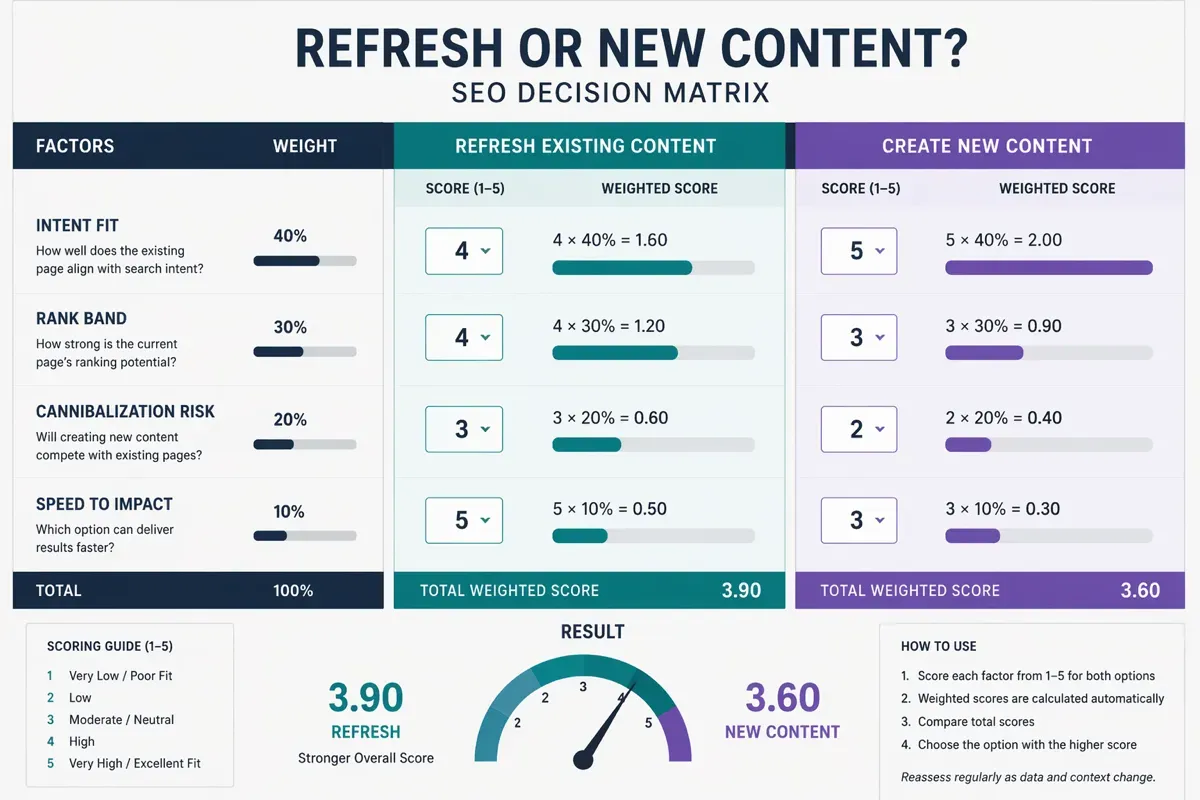
A practical refresh-vs-new-content score works best when intent fit does most of the work. You can keep the model simple, repeatable, and tied to Google Search Console data so the result points to a content refresh or a new page without a long debate. Floyi’s Search Console organic audit maps those GSC signals onto your topical hierarchy so weak topics surface automatically. For search engine optimization (SEO) teams, that keeps on-page SEO decisions grounded in signal instead of opinion.
A usable starting model looks like this:
| Factor | What to score | Refresh signal | New-content signal |
|---|---|---|---|
| Intent fit | How well the page matches the core search intent | High fit, but the page underperforms | Low fit, mixed intent, or the wrong query cluster |
| Rank position | Where the page sits in Search Console rank bands | Positions 3 to 20, especially when impressions exist | Far from page one, or no meaningful traction |
| Cannibalization risk | Whether multiple URLs compete for the same query set | Overlap is moderate to high | The topic is adjacent, but distinct |
| Speed to impact | How fast the page can move with existing assets | Existing links, impressions, and rankings already exist | The topic gap is real, and a slower ramp-up is acceptable |
Score each factor on the same scale, then weight the ones that matter most. Intent fit usually deserves the heaviest weight, followed by rank position, cannibalization risk, and speed to impact. That order works because a page that already matches the query intent is usually a better candidate for a content refresh than a page that only looks relevant on the surface.
Intent fit should be your first filter. A page that covers the main question but misses a supporting section or weak long-tail keywords often deserves an update. A page that blurs two intents, skips the core subtopic, or targets a different query cluster is usually better handled as new content.
Rank bands make the decision faster. Pages in positions 3 to 20 are often close enough to page-one visibility that a refresh can move them sooner than a net-new URL. Pages already earning impressions and links can also benefit from tighter copy, stronger internal links, and better on-page SEO before you invest in a full rewrite.
Cannibalization risk should stay visible in the score. When multiple URLs target the same search terms, consolidation plus refresh often restores clarity and improves rankings. When the topic is adjacent but genuinely separate, a new page is safer because it can capture a distinct search intent without overlap.
Speed to impact keeps the model honest. Existing pages already have history, so they usually deserve priority when the gap is small and the upside is clear. New content should win only when the topic gap is real, the intent is different, and a rewrite will not fix the mismatch.
A simple decision rule keeps the process audit-friendly:
- Refresh: Intent fit is high, the page sits in the 3 to 20 range, and cannibalization risk is moderate to high.
- Create new content: Intent fit is low, the query cluster is distinct, and the current structure cannot solve the mismatch.
- Use one threshold model across audits: Freelance strategists and content operations leaders can explain priorities to clients or stakeholders with the same logic every time.
That consistency matters more than perfect scoring math. A repeatable framework helps you defend the choice, move faster, and invest in the page most likely to earn traction.
How Do You Prioritize Pages For Refresh?
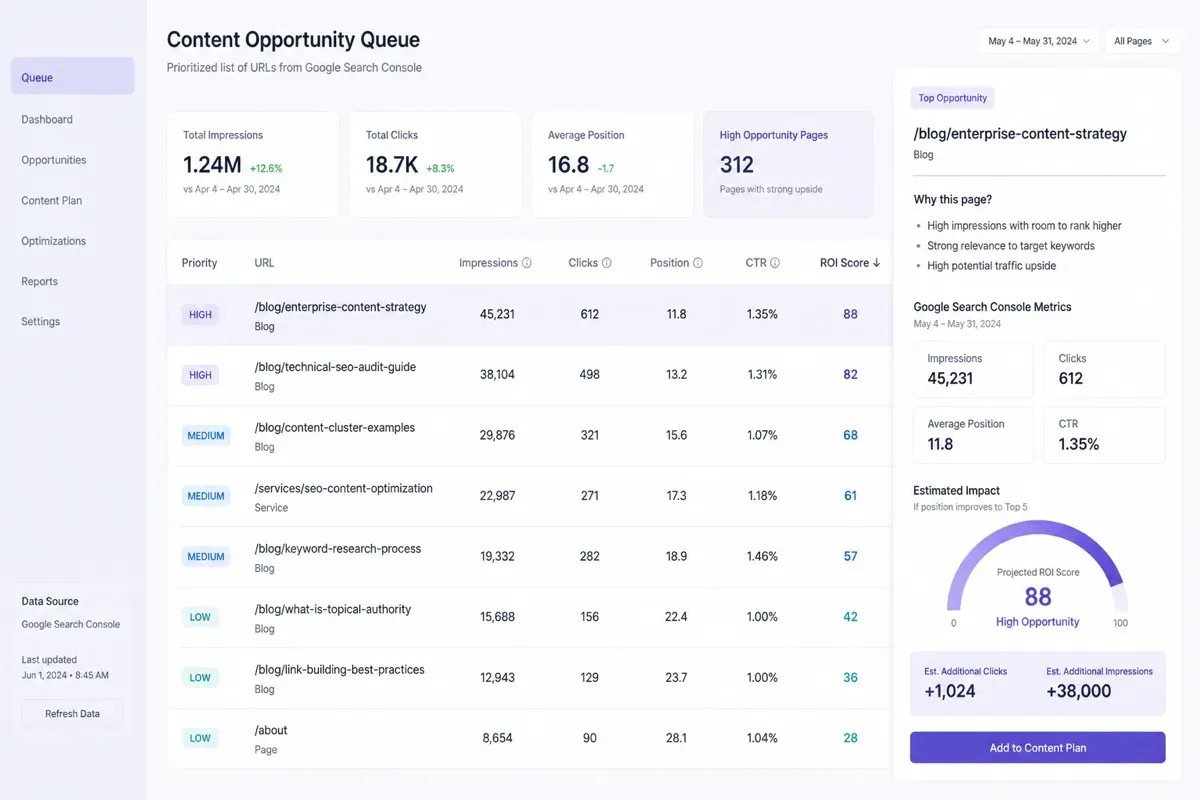
The fastest wins usually come from pages that already earn impressions in Google Search Console. Those pages often need a focused refresh, not a full rewrite, because the URL already has equity and the ranking gap is small enough to move with light edits. A structured audit of your topic map gives you a repeatable way to surface these candidates across every cluster.
A simple scorecard keeps the queue objective:
| Factor | What to look for | Why it matters |
|---|---|---|
| Ranking band | Positions 3 to 20, with close attention near page one | Small edits can create faster movement |
| Impression volume | Steady or rising impressions with weak clicks | Demand exists, but relevance or the snippet is lagging |
| Decline velocity | Flat, slipping, or volatile click trends | The page may be losing relevance or CTR |
| Cluster importance | Pillar page, support page, or core query | Gains compound topical authority |
| Cannibalization risk | Another URL is competing for the same term | A rewrite may not fix the real issue |
| AEO signal | Clear structure and source support for AI citation readiness | Better citation potential adds long-term value |
You get the strongest returns when a page is close to a page-one threshold, supports a pillar page, or targets a query that matters to the topical map. Those wins compound topical authority instead of isolating gains on one URL.
Content drift should be checked before you edit. Compare the current H1, section coverage, and internal links with the queries the page actually earns. If impressions still arrive for terms the page no longer addresses, the intent mismatch is already visible. That is where coverage gaps and content gap analysis usually show up together.
Use a clear refresh-versus-new rule so you do not spend time on the wrong fix:
- Refresh when the search intent still matches, the URL has history, and the page is near ranking movement.
- Create new content when the cluster lacks a dedicated page, another URL is cannibalizing the query, or the topic is too broad for edits alone.
- Hold off on a refresh when demand is weak and cluster value is low, since the return on effort is usually poor.
When a page wins the queue, protect existing performance in order:
- Update the title tag and meta description to improve click-through rate.
- Align the H1 and subheads to the dominant query pattern.
- Add missing sections or evidence where the page is thin.
- Strengthen internal links so the refreshed page both supports and receives relevance from related cluster pages.
A lightweight return-on-effort lens often beats traffic size alone. Moderate-impression pages with clear gaps and strong strategic value can outperform bigger pages that need a full rewrite.
Keep the same inputs every time. Use Google Search Console clicks, impressions, average position trend, cannibalization risk, drift flags, cluster role, and an AEO overlay so the queue stays defensible across 30, 60, and 90 days. That makes prioritization easier to repeat and more likely to improve SEO and AI citation readiness together. Teams that use Floyi’s Topical Authority scoring can track Content Authority, Market Authority, and AI Authority in one view, so refresh priorities stay connected to the metrics that matter.
How Do You Refresh Pillar And Cluster Pages?
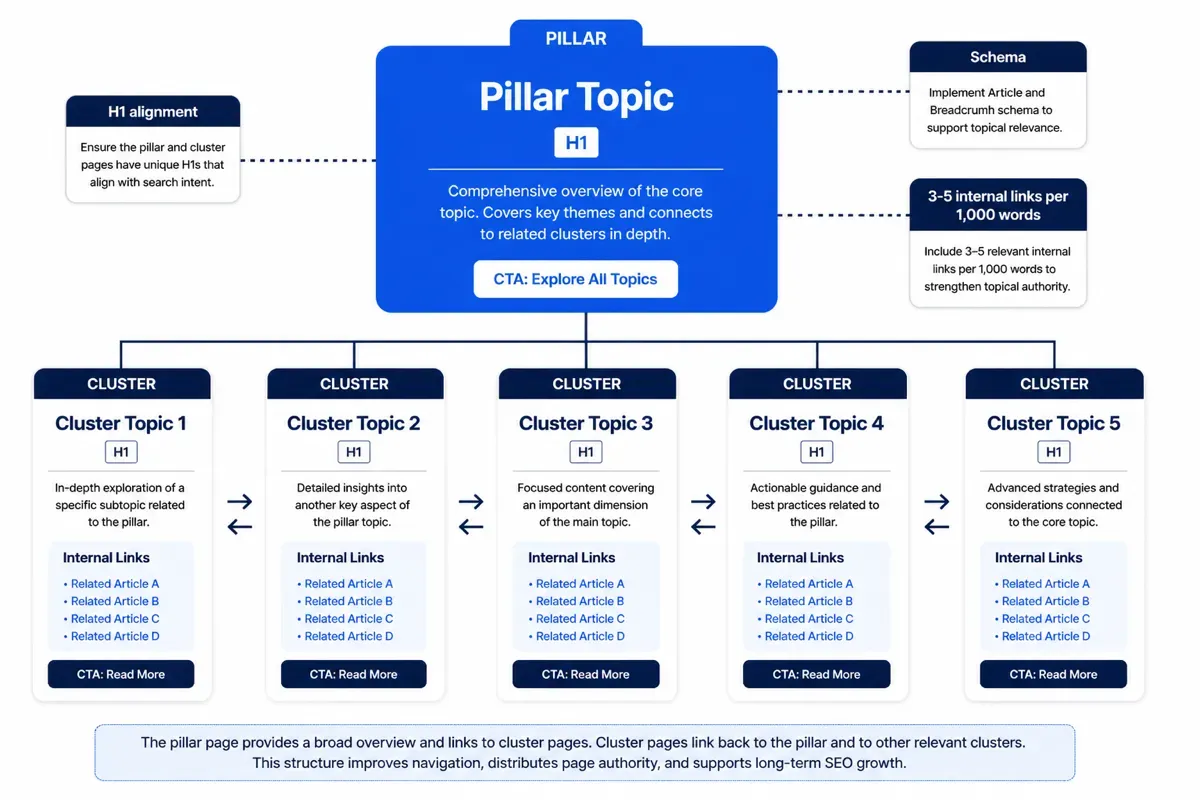
Refresh the pillar page first, then move through cluster pages in priority order so the hub keeps the strongest topical signal. That sequence protects authority on the main page, reduces cannibalization, and keeps internal linking aimed at the page that should rank for the broad term.
A clean refresh order looks like this:
- Lock the target topic and search intent. Confirm the primary keyword for the pillar page and the long-tail query for each cluster page before you touch copy.
- Rewrite the pillar title tag and H1 first. Match the broad head term, then tighten the H2 and H3 structure so each section owns one subtopic instead of competing with nearby pages.
- Rework the introduction to restate scope. The opening should say what the page covers, who it serves, and where it fits in the overall topic map.
- Expand or reorder body sections. Add missing subtopics, move weak sections lower, and remove overlaps that pull the page toward a cluster query.
- Add support blocks only when they earn their place. An FAQ or comparison section works when it helps the reader decide, but it should not turn the pillar into a grab bag of unrelated answers.
- Finish with internal linking, schema, and CTA placement. Those elements should match the page role, not just fill space.
The best pillar page edits follow a repeatable sequence because order matters. Confirm intent and the primary keyword first. Then rewrite the intro so it clearly frames the scope. After that, expand thin sections, reorder the ones that are out of sequence, and only then add support blocks, Schema.org markup, internal linking, and the primary CTA.
A pillar page should stay broad and complete. A cluster page should stay narrow and answer one specific query, one intent, and one next step. That difference is what keeps a content cluster from collapsing into duplicate coverage. Understanding how silo site architecture for topical authority helps teams keep these boundaries clean across large refresh programs.
Use this page-role table to keep the structure clean:
| Page type | Title and H1 | Body focus | Linking target | CTA |
|---|---|---|---|---|
| Pillar page | Broad head term | Full topic coverage across major subtopics | Receives links from clusters and external mentions | Primary organizational CTA |
| Cluster page | Long-tail query | One subtopic and one use case | Links back to the pillar with descriptive anchor text | Routes to the pillar or the next logical cluster page |
Cluster pages are not mini-pillars. Their titles and H1s should stay aligned with the long-tail query, and their copy should avoid broad-topic overlap that competes with the hub. If a cluster page starts sounding like a second pillar, trim the general explanation and make the page answer one narrow question with one clear outcome.
Internal linking should happen in a controlled order. Repair links from clusters to the pillar first, because that is the fastest way to reinforce the hub. Then add only the most relevant cross-links between clusters when the relationship between subtopics is clear and useful.
A practical benchmark is 3 to 5 relevant internal links per 1,000 words. Stronger links and external backlinks should point to the pillar page so link equity concentrates where you want the broad ranking signal to live. Descriptive anchor text matters here because it signals the parent topic without repeating the same keyword across every page.
Use this simple refresh pattern to prevent overlap:
- Pillar page: broad, complete, and organized around the main topic
- Cluster page: specific, intent-matched, and limited to one question
- Supporting CTA: one action that fits the page role
- Linking logic: cluster to pillar first, then selective cluster to cluster links
- Schema placement: broad topic schema on the pillar, lighter supporting schema on clusters
A page on content refresh strategy can cover scoring, prioritization, and execution. A separate cluster page can cover how to refresh title tags with a tight workflow and one CTA back to the hub. That split keeps each page useful without stealing ranking potential from the other.
For multi-page refresh programs, Floyi’s Topical Maps help you sort terms by volume, difficulty, funnel stage, and page target before editing starts. That planning step makes it easier to decide what to update versus what to create, and it also helps preserve brand voice across the topic map. It reduces manual research while giving SEO teams a cleaner path to better on-page SEO and stronger AI citation readiness.
Finish each refresh by matching schema and CTA to the page role. The pillar should carry the primary organizational CTA and the broader schema for the full topic. Cluster pages should use lighter supporting schema and a CTA that sends readers back to the pillar or forward to the next logical cluster page.
Treat the pillar page as the authority center and every cluster page as a focused support asset. That approach keeps topic clusters tight, protects your content cluster from cannibalization, and channels internal linking toward the page that should own the strongest ranking signal.
How Do You Measure Impact And Set Cadence?
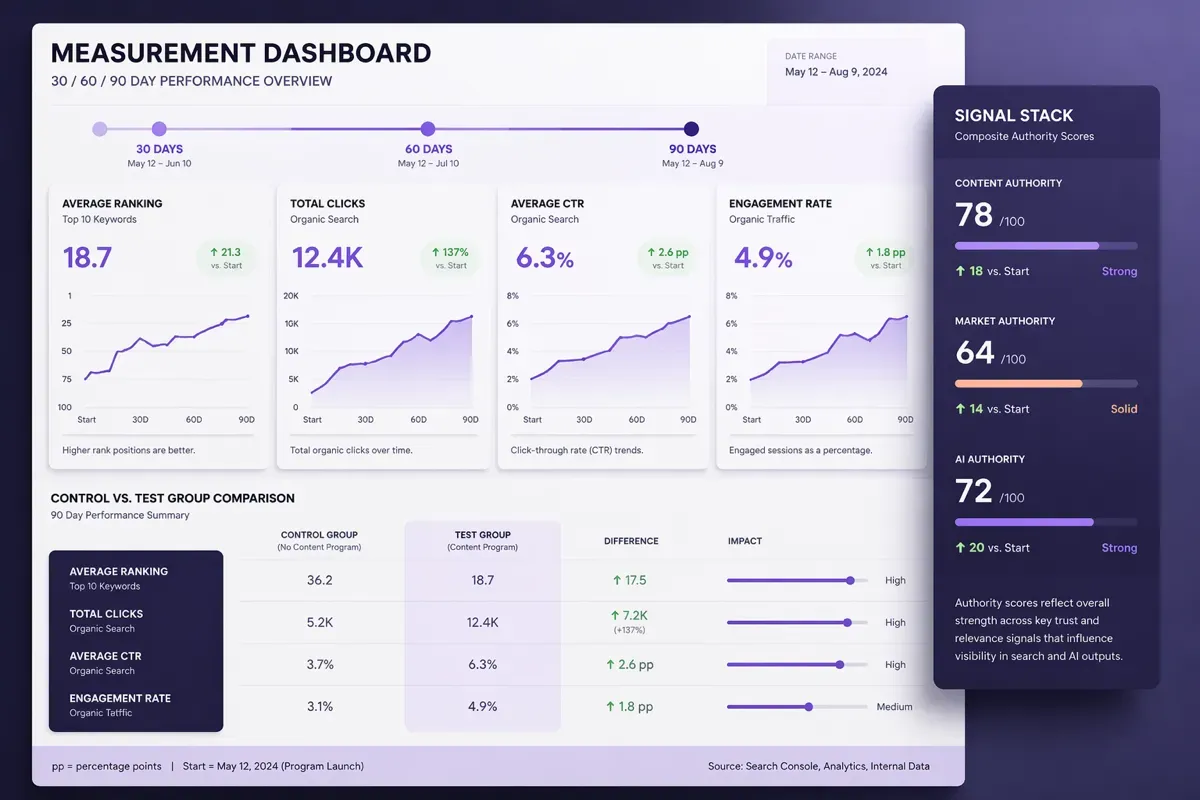
A compact signal stack works best for each refresh. It keeps visibility separate from quality, which makes it easier to tell whether a page is earning authority or just riding broader demand.
A compact signal stack for each refresh:
| Metric | What it tells you | Why it matters |
|---|---|---|
| Keywords in the top 10 | Visible ranking progress | Shows whether the page is breaking into meaningful search demand |
| Average Search Engine Results Page (SERP) position | Overall ranking strength | Helps you see whether the page is moving into stronger territory |
| Organic traffic lift | Demand captured from search | Connects ranking change to visits |
| Click-through rate | Snippet and intent fit | Shows whether the result earns the click |
| Time on page | Engagement quality | Signals whether readers are staying with the content |
| Bounce rate | Early exit risk | Helps flag mismatched intent or weak page structure |
A refreshed cluster that lands in average positions between 3 and 5 is a stronger topical authority signal than one that stays in the teens. That range is still only a target, but it gives you a better read on authority than isolated keyword wins.
A baseline-to-after return on investment (ROI) model gives you the cleanest before-and-after view. Capture pre-refresh benchmarks for each page. Use one topic cluster as the control group so broader traffic shifts do not blur the result.
A simple measurement workflow keeps the math usable:
- Record starting rankings, traffic, click-through rate, and engagement before edits.
- Publish the refresh and log the scope of the change.
- Recheck the same metrics at 30, 60, and 90 days.
- Compare the refreshed page with the control cluster.
- Attribute the lift to the rewrite, the topic, or external demand.
That framework also helps you decide between a refresh and a new page. Refresh the page when the query already matches intent but the URL is stuck between positions 3 and 20. Refresh it when the URL shows cannibalization risk. Refresh it when the page is missing key sections.
Publish a new page when the query needs a different angle. A different format or a separate intent layer also points to a new page.
A content audit cadence should follow page value and expected time to impact, not a fixed calendar alone. High-value or fast-moving pages deserve monthly review. Stable cluster pages usually fit a quarterly rhythm. Shorten the interval when title changes should produce a measurable lift.
The same is true for heading changes. Internal link changes can also justify a shorter cycle.
Freshness matters for SEO and answer engine optimization (AEO), and it also supports trust. BrightEdge research has reported that pages updated within 60 days are 1.9 times more likely to be cited by AI, and pages with author schema are 3 times more likely to appear in AI answers. That makes content freshness and E-E-A-T part of the measurement model, not just editorial cleanup.
The strongest refresh programs pair content gap analysis with competitor gap analysis. That gives you a practical view of whether a page is missing a section, an angle, or a proof point that search results already reward. It also keeps the work focused on the highest-value gap instead of chasing every small ranking swing. The measurement toolkit for tracking authority metrics walks through how to track these dimensions in a single scorecard.
A closed-loop scorecard makes the system easier to run at scale:
- Content authority: ranking progress, internal link strength, and cluster coverage
- Market authority: share of voice against competing pages and category peers
- AI authority: visibility in AI answers, citations, and branded mention patterns
That scorecard tells you whether refreshes are increasing ranking value and improving AI visibility. It also shows whether the pages that support your topic cluster are getting stronger. When the same pattern repeats across multiple pages, the cadence is working.
When lift is weak, the page usually needs a deeper rewrite. It may also need a new angle or a better content brief before the next cycle. Floyi’s Content Plan can help you queue and prioritize refresh work alongside new content so nothing falls through the cracks.
About the author

Yoyao Hsueh
Yoyao Hsueh is the founder and CEO of Floyi, the topical authority platform, and the founder of Main Heading, an SEO and AI search agency. He created Topical Maps Unlocked, a course studied by thousands of SEOs, content strategists and digital marketers, founded TopicalMap.com, a done-for-you topical mapping service for agencies and enterprise teams, and publishes the weekly Digital Surfer newsletter on SEO, content strategy and AI search.
About Floyi
Floyi is a closed loop system for strategic content. It connects brand foundations, audience insights, topical research, maps, briefs, and publishing so every new article builds real topical authority.
See the Floyi workflow