
Topical Authority Content Audit Checklist
Learn how to audit topical authority, find coverage gaps, fix cannibalization, and improve AI readiness with a practical checklist.
A topical authority content audit checklist helps teams spot coverage gaps, cannibalization, and weak internal links before they drag down search performance. SEO managers and content strategists often inherit sprawling URL sets, partial entity coverage, and pages that no longer match the intent behind them. In practice, topical authority means a site covers a subject so completely that related pages reinforce one another and signal expertise to search systems. The result is a clearer scope, cleaner prioritization, and a practical plan for what to refresh, merge, or create next.
The checklist walks through scope setting, URL and entity inventory, competitor gap analysis, weighted scoring, and AEO and AI readiness checks. It also includes spreadsheet fields, prioritization rules, and an action matrix that turns raw findings into a workable remediation plan. That structure keeps the audit focused on the pages and clusters most likely to improve topical coverage, retrieval signals, and SEO performance.
Content teams at agencies, mid-market brands, and in-house growth orgs benefit most because they need a repeatable process they can defend in a meeting and hand off to production. A page pair that both targets the same entity set, for example, can be flagged for consolidation, then rebuilt with one primary URL and stronger internal links. The next sections give those teams a fast, measurable way to turn topic sprawl into a cleaner content system.
Topical Authority Audit Key Takeaways
- Define scope around revenue-critical pillars and supporting sub-pillars.
- Inventory live URLs, sitemaps, and entity coverage in one spreadsheet.
- Tag each page by pillar, intent, cluster, and topical role.
- Identify gaps, content drift, thin pages, and cannibalized URLs.
- Score pages with weighted criteria instead of gut feel.
- Prioritize keep, optimize, consolidate, or prune actions by impact.
- Validate AEO and AI readiness with structure, schema, and extractable answers.
How Do You Define Your Topical Authority Audit Scope?
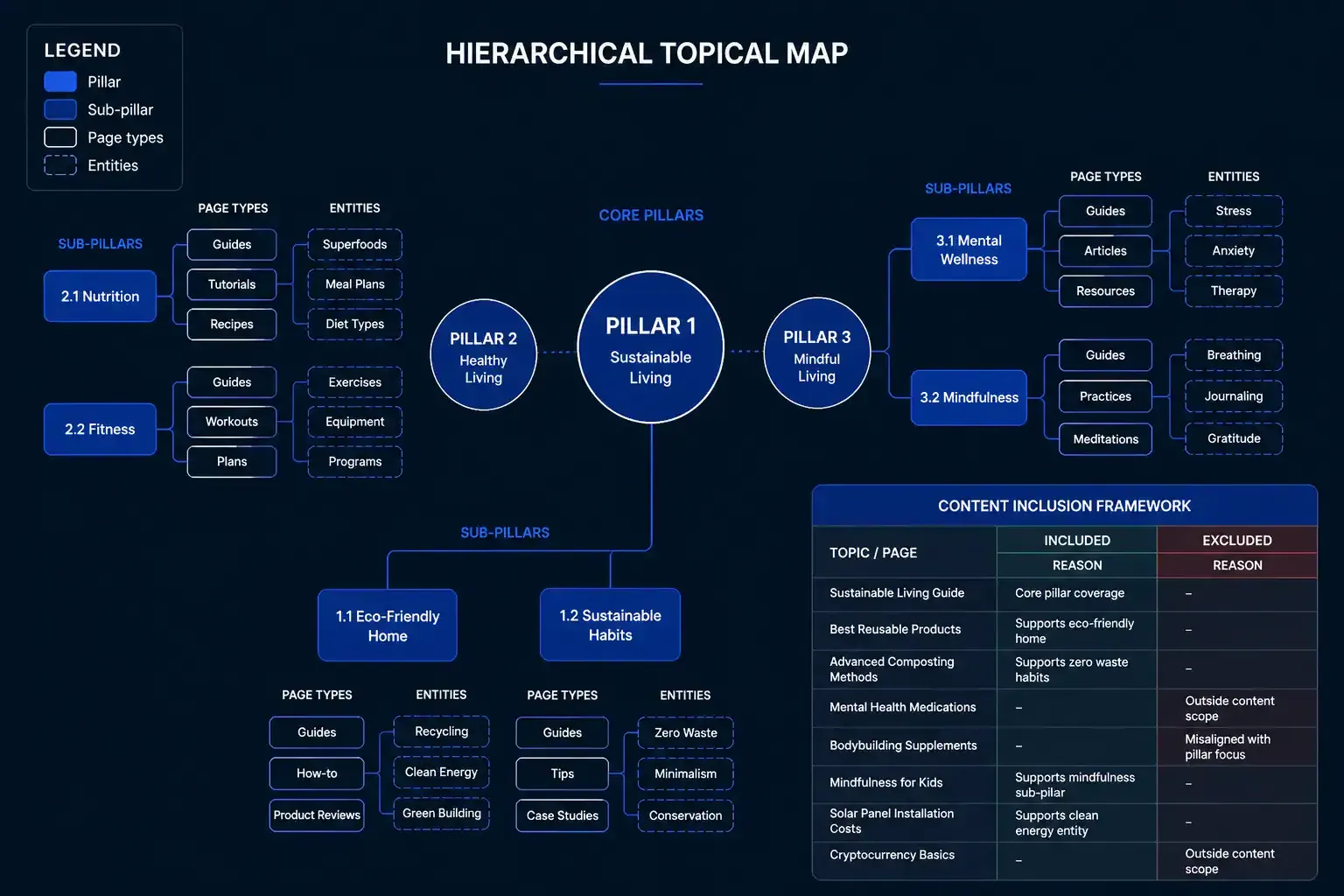
A tight scope keeps a topical authority audit useful instead of noisy. Start by defining the core pillars that matter to revenue, pipeline, or strategic brand goals. Then map your topic territory so search engines and large language model (LLM) retrieval systems can read it as topical authority.
A useful starting frame looks like this:
- Core pillars: Choose a small set of business-driven themes to own.
- Sub-pillars: Build a focused set of related angles under each pillar.
- Page types: Include pillar pages, glossary entries, FAQs, comparisons, case studies, tutorials, and advanced guides.
- Entity sets: Add the brands, products, services, problems, audiences, and adjacent entities that shape your knowledge graph.
- Channel boundary: Decide whether the audit covers only the main site or also the blog, resource hub, product docs, location pages, YouTube, and other owned channels.
Choose a small set of business-driven themes to own, then build a focused set of related angles under each pillar so the audit stays broad enough to map coverage and narrow enough to stay actionable.
That structure gives your topical map enough breadth to measure semantic completeness without drifting into random content. It also makes topic clusters easier to score, because each page can be tied to one pillar and one sub-pillar before you touch traffic, backlinks, rankings, cannibalization, or internal linking.
The crawl should come first. Export every live URL from Screaming Frog, Ahrefs, or Semrush, then assign each URL to a pillar or sub-pillar before you score anything else. That inventory becomes the base layer for a topical authority audit, and it keeps the rest of the analysis honest.
A practical scope table helps teams stay aligned:
| Scope choice | What to include | What to exclude |
|---|---|---|
| Site areas | Main site, blog, resource hub, docs, location pages | Any area that does not support the pillar strategy |
| Entity sets | Core brands, offers, audiences, problems, adjacent entities | Off-topic entities that blur the knowledge graph |
| Content depth | Informational, investigational, transactional coverage | Pages that do not fit the planned funnel |
Once the inventory is in place, benchmark it against your top three search competitors. That gap check will show where your clusters are too thin, too shallow, or missing key subtopics. It also tells you whether an adjacent silo should stay out of scope or move in to strengthen coherence.
A content planning for topical authority workflow can help turn that scope into a repeatable brief. The audit still starts with disciplined boundaries. Define the scope first, then score only the pages and entities that belong inside it.
How Do You Inventory Content And Entities For A Topical Authority Audit?
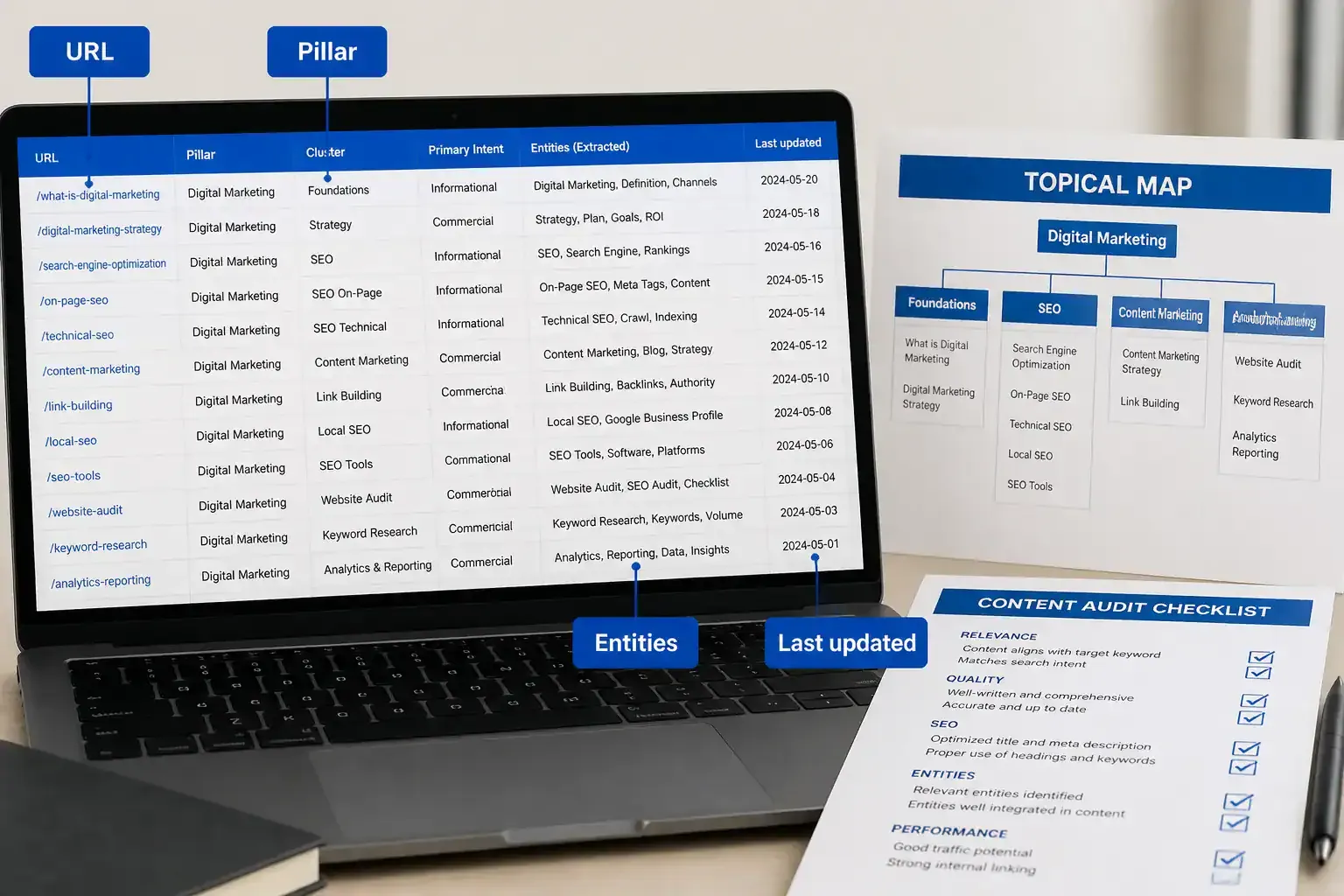
A useful topical authority audit starts with a complete content inventory by topic. Crawl the site, export every live URL into a spreadsheet, and supplement that crawl with sitemap data so you catch indexable pages, deep subfolders, and anything the crawler misses. That first export should include URL, title, content type, internal links, and the core topic cluster before scoring begins. If you’d rather not stitch that together manually, Floyi’s crawl-based topical audit discovers a site’s topical structure automatically.
Use a fresh topical map as the source of truth. Old menus often hide orphan pages, duplicate themes, thin coverage, and pages that drift away from their core pillars. A clean map also makes it easier to separate pillar pages from cluster articles and spot gaps in topic clusters.
Build the inventory in this order:
- Crawl the site and export every live page into the sheet.
- Add sitemap URLs so you capture anything the crawl misses.
- Tag each URL with its pillar, cluster, primary search intent, and topical role.
- Capture entity extraction fields so the inventory shows the terms, tools, methods, expert names, and missing entities a page actually covers.
- Layer in performance and authority data, including organic traffic, rankings, backlinks, internal links, word count, and last update date.
- Flag cannibalized pages, outdated posts, weak entity coverage, and missing cluster pieces around your highest-value core pillars.
Keep the file filterable so it supports decisions, not just reporting. That turns the audit into a working asset instead of a static export.
A simple spreadsheet structure looks like this:
| Column | What it tells you |
|---|---|
| URL | The exact page being audited |
| Pillar | The main hub the page supports |
| Cluster | The topic cluster it belongs to |
| Intent | The search need the page serves |
| Entities | The concepts, tools, and names covered on-page |
| Traffic | Whether the page already earns demand |
| Rankings | Whether visibility is stable or slipping |
| Backlinks | Whether authority already exists |
| Internal links | Whether the page is connected well |
| Update date | Whether the page is stale |
| Recommended action | Refresh, merge, expand, or create new |
Entity extraction matters because a page can target the right keyword and still miss the language search engines and artificial intelligence (AI) systems expect to see. When the sheet compares entities across pillar pages, cluster articles, and supporting assets, the gaps show up fast.
Once the inventory is complete, use it to plan execution. High-value pillar pages should rise first, followed by the missing cluster articles that strengthen them. Low-value pages can be merged or refreshed, and every action should roll into a content calendar with a due date and a responsible team member. That gives your search engine optimization (SEO) work a clear roadmap.
How Do You Find Topical Authority Coverage Gaps And Content Drift?
A strong content gap analysis starts with your top three thematic competitors. That comparison shows where your site is missing subtopics, formats, FAQs, comparisons, media, and schema. It also separates true coverage gaps from pages that already exist but rank poorly, which usually signals an opportunity instead of a dead end.
Look for these miss points first:
- Missing subtopics
- Weak content formats
- Absent FAQs
- Missing comparisons
- Media gaps
- Structured data gaps
For each cluster, run entity gap analysis to check whether your pages cover the people, places, products, concepts, and related terms that define the topic. Manual search, spreadsheet mapping, and content optimization tools can support the review, but they should not replace deeper research. Entity extraction helps surface which terms and relationships your cluster articles still miss.
The best pages answer the main query fast and then cover the next two or three logical questions. A short definition near the top helps when it sits beside a clear “What is…” or “How to…” answer. That structure builds content depth without padding the page.
The quickest way to sort what needs attention is to label each URL by symptom and likely fix:
| Signal | What it usually means | Best next move |
|---|---|---|
| Content drift | The page has expanded beyond the original cluster intent | Rewrite, refocus, or fold it into a better-fit page |
| Thin page | The page has limited substance, often around 500 to 800 words or too few distinct entities | Consolidate, redirect with a 301, delete, or substantially rewrite |
| Keyword cannibalization | Multiple URLs target the same query or entity set | Merge shared-intent pages and sharpen distinct ones |
| Coverage gap | A subtopic, format, FAQ, or comparison is missing | Create a new page or expand an existing one |
Content drift shows up when older pages no longer match the original topic map or the current entity set. If a page has wandered into a different subject, update it, rewrite it, or move it into a better-fit silo so the cluster stays focused. Thin pages deserve a practical threshold, and 500 to 800 words is a useful starting point when the page also lacks distinct entities, examples, or subquestions.
Keyword cannibalization needs a careful read of overlap. Shared intent usually calls for consolidation. Related but not identical topics need tighter entity focus, not a blunt merge. The same logic applies when accidental rankings appear in search results. Those pages often point to demand you can serve better with a stronger asset.
Once you tag each URL, use one spreadsheet or topical map to plan the fix. Put gap, drift, thin, and cannibalized pages in order by how fast they can restore cluster quality. Then work through internal linking, rewrites, and SEO updates in that sequence. For a faster diagnostic pass, the 15-minute topical authority audit gives you a quick three-pillar scorecard before you dive into the full checklist.
How Do You Score Your Topical Authority Audit And Prioritize Fixes?
A weighted scorecard turns a topical authority audit into a real decision system. Score each URL or cluster from 0 to 100, then sort by impact instead of instinct. That keeps topical authority work tied to SEO performance, AEO readiness, and the retrieval signals that matter most.
A practical weighting model looks like this:
| Factor | Weight | What to look for |
|---|---|---|
| Entity coverage | 20% | The page covers the core entities and related subtopics |
| Content depth | 20% | The page goes far enough to answer the query with real substance |
| Internal linking | 15% | The page receives and sends relevant links inside the topic cluster |
| Semantic structure | 10% | Headings, copy, and media reflect a clear topical hierarchy |
| Search intent match | 10% | The page fits the query stage and the task behind it |
| Information gain | 10% | The page adds something new, specific, or more useful than competing pages |
| AI retrieval readiness | 10% | The page is easy for LLMs and answer engines to parse and cite |
| Schema and metadata | 5% | Titles, descriptions, and schema support discovery and classification |
The score only matters if the buckets are blunt and consistent. Strong pages with stable traffic and clear E-E-A-T signals belong in Keep or Protect. Thin or drifting pages move into Optimize or Expand, while consolidation and pruning should be reserved for real overlap or no-value URLs. When the verdict is to remove or merge weak pages, pruning strategies for topical authority walks through the decision rules and safeguards.
Use this Action Planning Matrix:
| Score band | Bucket | Decision rule |
|---|---|---|
| 80 to 100 | Keep or Protect | Hold the page steady and monitor for drift |
| 60 to 79 | Optimize or Expand | Improve thin coverage, weak intent match, or declining clicks |
| 40 to 59 | Consolidate | Merge overlapping pages that split the same topical signal |
| 0 to 39 | Prune | Remove zero-value pages with no clicks and no backlinks |
Consolidation needs to stay explicit. When multiple URLs target the same entity set or keyword cluster, choose one authoritative asset and fold the best sections into it. Use 301 redirects after the merge, and reserve delete or 410 responses for pages with no business value, no clicks, and no backlinks.
A simple decision tree keeps the roadmap practical:
- Fix high-value pages first if they rank, attract clicks, and still underperform on depth or internal links.
- Merge competing assets when two or more URLs confuse the same search signal.
- Expand thin but strategic pages when the topic matters and the page already has a path to traffic.
- Prune dead weight when the page adds nothing, earns nothing, and supports no cluster goal.
You should also add an operational review layer:
- Google Search Console confirms demand, clicks, and page-level decay.
- Ahrefs shows competing coverage, ranking weakness, and link gaps.
- ChatGPT and Perplexity reveal whether a page is likely to be selected or cited in generative search.
That workflow gives you a sharper read on coverage gaps, entity completeness, and citation readiness. It also helps separate real topical gaps from pages that simply need better packaging.
Each cluster should end with a specific next action. Freshness updates, deeper subtopic coverage, stronger internal linking, schema and metadata cleanup, or a full consolidation plan all belong in the output. That is how an internal linking audit becomes an execution plan instead of a static report.
How Do You Validate AEO And AI Readiness After The Audit?
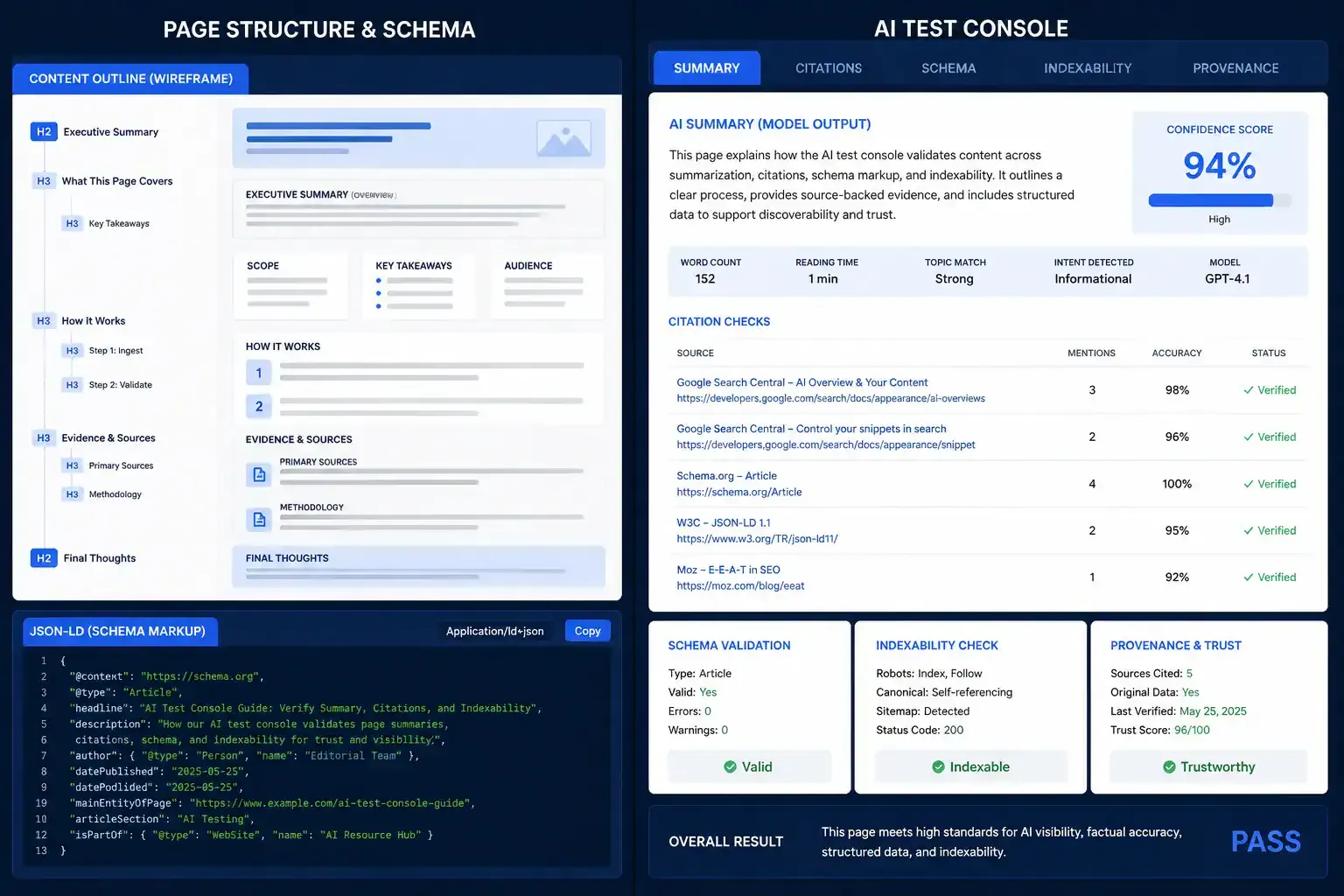
AEO validation works best as a second pass, not a guess. After the audit, you need to test whether the page can be retrieved, summarized, and trusted by AI search engines. That means checking structure, chunk clarity, schema, and citation signals with the same discipline you’d use for SEO quality control.
The fastest way to pressure-test a page is to review it in layers:
| Layer | What to verify | Why it matters |
|---|---|---|
| Semantic structure | H2 and H3 labels are specific, entity-rich, and logically ordered | Cleaner hierarchy helps AEO systems parse the topic |
| Answer-first formatting | The opening paragraph gives a concise direct answer | AI Overviews and similar summaries favor immediate responses |
| Extractability | Each section carries one claim, evidence, and named entities | LLMs can lift the chunk without breaking meaning |
| Schema and provenance | JSON-LD, author, date, canonical URL, anchor IDs, robots.txt, sitemaps | Strong provenance improves indexing and citation eligibility |
Start with structure. Vague subheads should be removed or rewritten so the page reads like a retrieval asset, not a content dump. The opening paragraph should stand alone as a usable answer, then expand with context, examples, and supporting proof.
Then test the page at the chunk level. Each section should work on its own with a clear claim, explicit entity references, and supporting evidence. Tables, summaries, and callouts should carry enough context to survive being pulled into an LLM answer. They should also add information gain instead of repeating the obvious.
Before launch, validate the technical layer carefully:
- Schema: Confirm JSON-LD is accurate and keep one JSON-LD block per type.
- Provenance: Make sure the cited evidence matches the claim on the page.
- Stability: Keep author, date, canonical URL, and anchor IDs consistent.
- Indexability: Check robots.txt, sitemaps, and canonicals so the page can be crawled and cited.
The cross-tool loop is where the audit becomes operational. Use Google Search Console to compare query impressions and page-level performance. Use Ahrefs to rank the pages most likely to benefit from stronger AI readiness. Then test the page in ChatGPT and Perplexity to see whether the answer is readable, correctly summarized, and attributed back to your domain.
Freshness and authorship deserve a final pass. Keep update dates current and use author schema where it fits the page type, because both signals help search systems and AI tools evaluate trustworthiness. Refresh weak pages, reinforce authorship details, and rerun the same prompts so you can compare citation behavior before and after the update. A structured content refresh process helps you pair that cadence with planned updates instead of reactive cleanup.
Topical Authority Content Audit FAQs
These FAQs cover the questions you’re likely to ask before or during a topical authority content audit. They highlight where prioritization gets messy and how to turn scattered pages into a cleaner SEO and AI retrieval plan.
How Often Should You Run This Audit?
A quarterly topical authority audit works well for most teams. Treat each review as a strategic reset, and run an ad hoc audit after major launches, migrations, taxonomy changes, or large content pushes, as well as when SERPs become volatile, rankings fall across a cluster, or AI search visibility shifts. Understanding the topical depth vs breadth balance helps you decide whether a cluster needs more depth or whether it is ready to expand.
What Pages Should You Audit First?
Prioritize your pillar and hub pages first, since one weak anchor can drag down the cluster around it. After that, move to pages already earning clicks, impressions, or conversions in Google Search Console, plus URLs with falling clicks, lower average position, or slipping CTR. Orphan pages, lightly linked assets, and older content that has drifted off topic should rise next, and a Keep, Optimize, Consolidate, or Prune lens helps you focus on the pages most likely to improve topical coverage and SEO performance.
How Do You Spot Cannibalized Pages?
SERP overlap is the fastest signal. If two or more URLs from your site keep surfacing for the same query or entity, cluster the pages by intent and entity coverage. Near-matching titles, H1s, shared modifiers, and repeated core entities usually mean the pages are competing for one topic, so compare query sets and apply threshold rules before you move. Flag 3+ pages with at least 2 impressions each, or 2 pages with 10+ impressions each and 10%+ impression share, then consolidate the weaker page or retarget it if one URL holds 70%+ of impressions.
Which Metrics Prove Topical Authority Gains?
Topical Authority Score is the clearest proof point, and it should rise when content authority, market authority, and AI authority improve together. The score components matter too: entity coverage, content depth, internal linking, semantic structure, search intent match, information gain, schema and metadata, and AI retrieval readiness should all trend up, not just the final number. You should also track topic share of voice, cannibalization rate, SERP feature ownership, and AI citation appearances across featured snippets, PAA, AI Overviews, ChatGPT, and Gemini, with quarter-over-quarter gains and near-zero overlap. Strong internal-link health means hub pages point cleanly to every support page, support pages link back with descriptive anchors, and shipped coverage, rank quality, semantic completeness, and AI presence rise together.
About the author

Yoyao Hsueh
Yoyao Hsueh is the founder and CEO of Floyi, the topical authority platform, and the founder of Main Heading, an SEO and AI search agency. He created Topical Maps Unlocked, a course studied by thousands of SEOs, content strategists and digital marketers, founded TopicalMap.com, a done-for-you topical mapping service for agencies and enterprise teams, and publishes the weekly Digital Surfer newsletter on SEO, content strategy and AI search.
About Floyi
Floyi is a closed loop system for strategic content. It connects brand foundations, audience insights, topical research, maps, briefs, and publishing so every new article builds real topical authority.
See the Floyi workflow