
Topical Depth vs Breadth for Topical Authority
Learn when to use topical depth or breadth, how to sequence both, and how to measure topical authority for SEO and AI search.
Topical authority grows fastest when topical depth covers one subtopic fully and topical breadth maps the related subtopics across the site. SEO agency leads, content strategists, and in-house growth teams need that balance to rank, avoid cannibalization, and justify the content plan.
Google and AI read depth and breadth differently, then reward the pages that fit one clear intent. The scope covers research, topic mapping, briefing, QA, and refresh rules for pillar pages and clusters. The output is a set of topic lists, AI-assisted briefs, and expansion criteria you can apply in planning.
Right now, agency SEOs and content teams need a clean answer on when to deepen and when to expand because resourcing depends on it. Depth protects high-intent pages, while breadth closes adjacent gaps that competitors can take. A pillar that sits at positions 3 to 5 with stable impressions, then gains support from one new adjacent page, is the kind of result this plan is built to create. Continue for the sequencing rules that keep the cluster focused and profitable.
Topical Depth and Breadth Key Takeaways
- Topical depth answers one subtopic completely and signals expertise on a single page.
- Topical breadth covers related subtopics, entities, and intents across the domain.
- Google and AI favor connected clusters with semantic coverage and strong passage quality.
- Start with one pillar and focused cluster before adding adjacent topics.
- Use internal links and descriptive anchors to route authority to the right pages.
- Expand only when impressions, rankings, and query coverage are stable.
- Use a semantic coverage scorecard to track entities, intent mix, and cannibalization risk.
What Do Topical Depth And Breadth Mean?
Topical depth is how completely you cover one subtopic. Topical breadth is how widely you cover the related subtopics, entities, and intents inside a larger domain. Topical authority grows when depth and breadth work together, not when you pick one in isolation. That balance matters when you plan search engine optimization (SEO) content.
A simple comparison helps:
| Dimension | Operational meaning | What it signals |
|---|---|---|
| Topical depth | Exhaustive coverage of one subject area, including core questions, follow-up questions, edge cases, variations, and practical implications | Subject-matter expertise on a specific page or subtopic |
| Topical breadth | Coverage across the full semantic field, including major subtopics, supporting entities, and adjacent questions | Category-level relevance across the site |
Operationally, topical depth means answering the main question and the next layer of follow-up needs without drifting into vague summaries. Strong depth also shows enough nuance to signal firsthand experience or subject-matter expertise. That is why content depth vs breadth is not an abstract debate, because shallow coverage rarely earns trust on high-intent pages.
Topical breadth is different. It is not just a higher page count or a longer keyword list. It comes from a topical map built through topic mapping that connects the core theme to the supporting questions, entities, and use cases that define the full problem space. A content planning approach for topical authority helps separate page-level coverage from broader brand strength and set up the right cluster boundaries.
The strategic split is straightforward:
- Depth builds trust on a specific page or subtopic.
- Breadth proves range across the topic universe.
- Depth reduces thin or repetitive content that can weaken rankings on high-intent queries.
- Breadth closes competitor gaps and exposes adjacent opportunities.
For planning, treat topical depth and topical breadth as complementary scoping rules. Use hub-level coverage targets, define a stopping rule so content does not bloat into cannibalization, and prioritize the biggest authority gaps first. That is the practical way to turn topical authority into a content plan that scales without losing focus.
How Do Google And AI Systems Read Them?
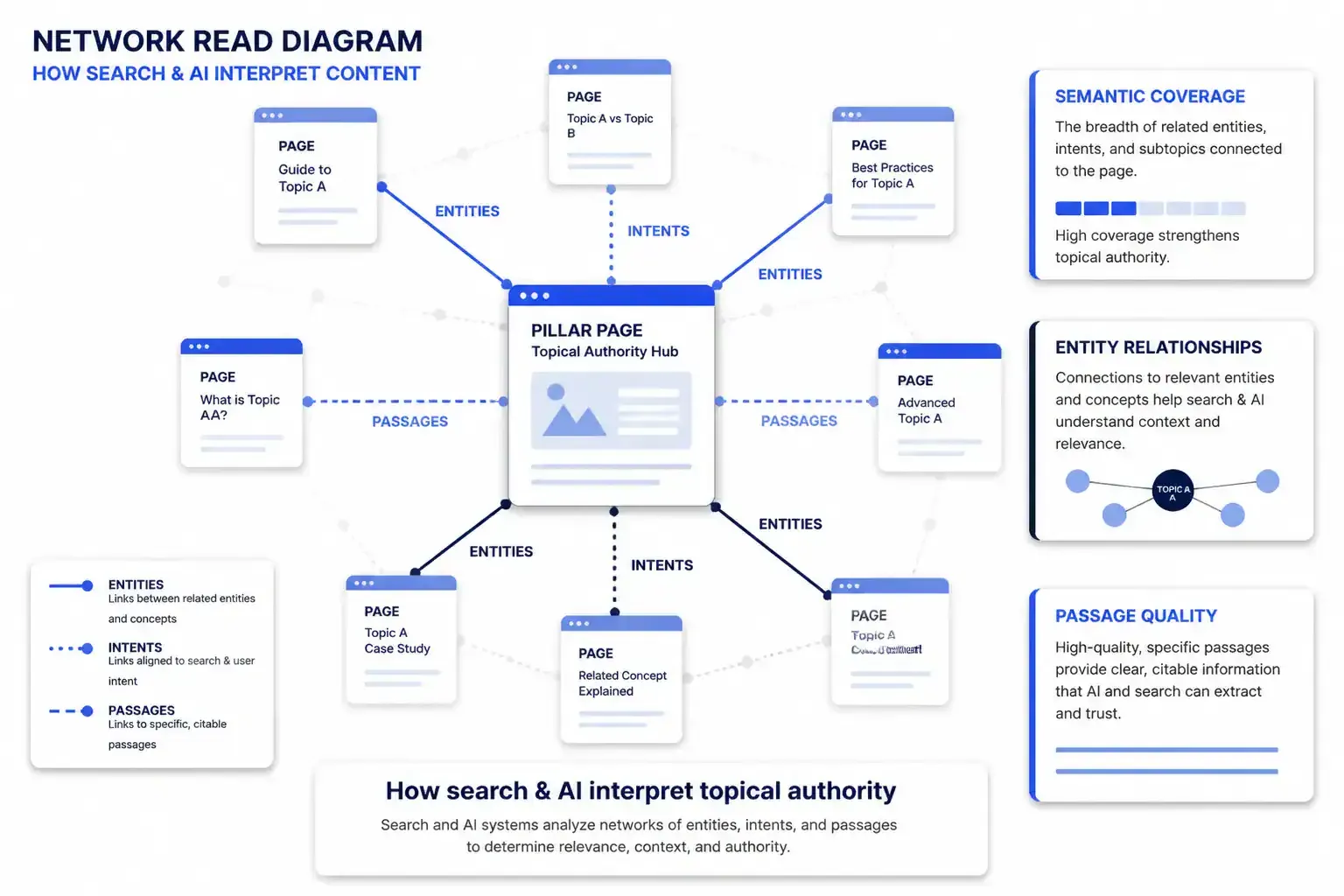
Google and artificial intelligence (AI) retrieval systems read topical authority as a network, not a raw count of URLs. They look for semantic coverage, entity relationships, contextual coherence, and passage-level answer quality that can be reused in search results or AI responses. In practice, semantic SEO and entity SEO work best when each page shows what it means, how it connects, and which questions it can answer.
The main signals are easier to scan in a simple map:
| Signal | What the system infers | Content decision |
|---|---|---|
| Semantic coverage | The topic is broad enough to feel complete | Add supporting angles, not random keywords |
| Entity relationships | The page understands the people, tools, and concepts around the topic | Use related entities naturally and consistently |
| Passage quality | A section can stand alone as a useful answer | Write clear, reusable passages with direct answers |
| Contextual coherence | The article reads like one expert treatment | Keep scope tight and connect ideas logically |
| E-E-A-T signals | The content shows experience, expertise, authoritativeness, and trustworthiness | Add first-hand detail, case studies, and specific how-to guidance |
Depth usually signals expertise because it gives search systems stronger passage-level support. Strong pages show E-E-A-T through lived examples, practical steps, and specifics that generic summaries skip. The Helpful Content Update pushed Google further toward content that helps people finish a task, not pages that only repeat a theme.
Breadth helps when it sits inside a small set of tightly connected expert resources. A broad cluster gains strength when each page has semantic density, corroboration from nearby pages, and strong internal links. Thin pages built around one keyword each usually add noise. Depth without breadth can also hit a traffic ceiling because adjacent intents still go unanswered.
Structured data can make those relationships easier for search engines and large language models to interpret. Article, FAQPage, HowTo, and BreadcrumbList markup can clarify topic relationships and passage hierarchy. The writing still has to do the heavy lifting. Topic modeling and the site’s knowledge graph should be reflected in the copy, not hidden in code.
A practical reading test keeps the decision honest:
- Deepen first: obvious questions still go unanswered.
- Deepen first: entity coverage feels thin or generic.
- Deepen first: the page cannot be broken into credible, reusable passages.
- Expand next: the resource is rich, focused, and tightly connected.
- Expand next: adjacent topics have a defined scope and a stopping rule.
If the first three checks fail, deepen the page before adding more URLs. If the last two checks hold, branch into adjacent topics and keep the cluster disciplined. That is how topical authority compounds instead of scattering.
How Do You Sequence Depth First Then Breadth Second?
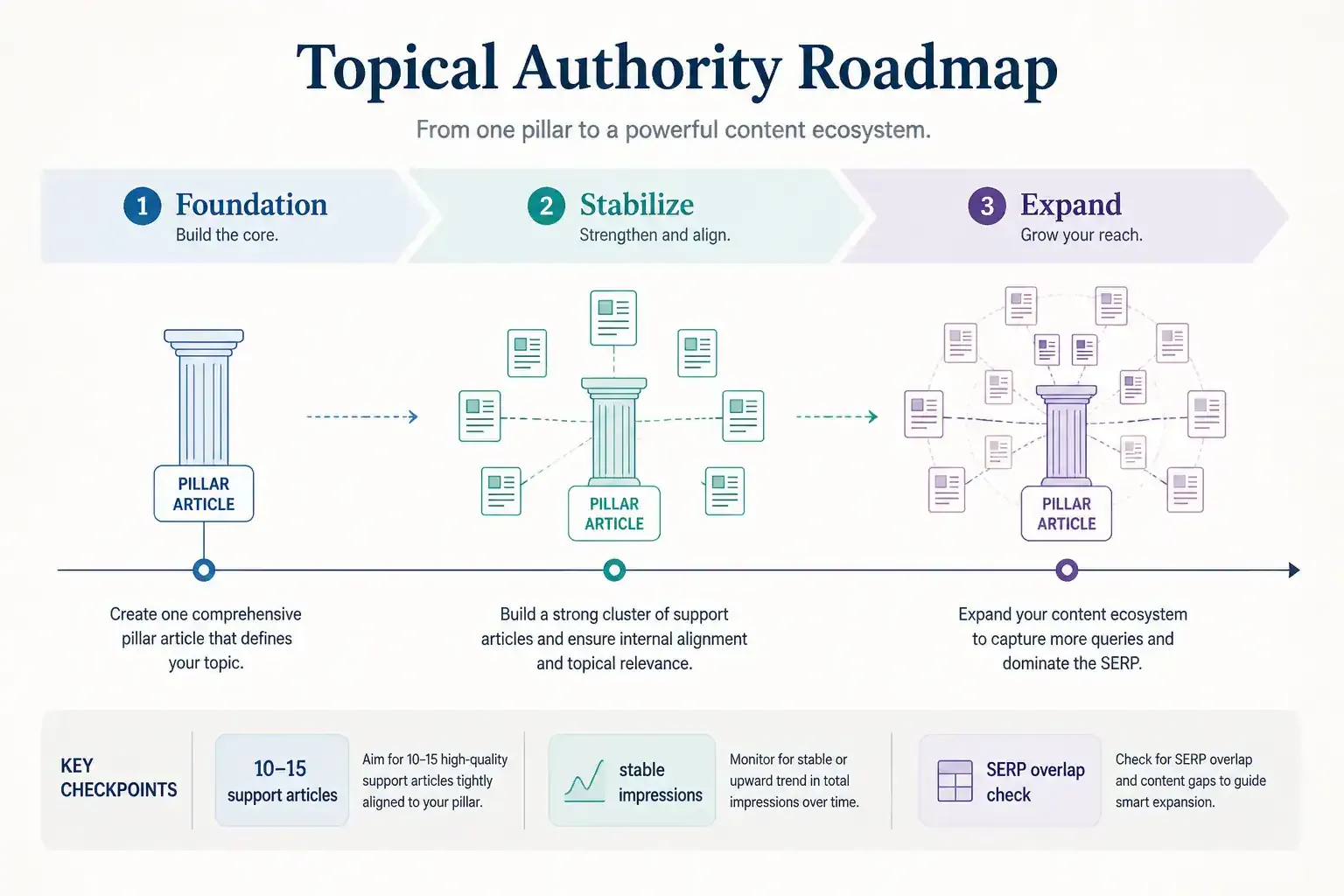
You get the safest sequencing when you go deep on one narrow niche before you widen the site. The first topic cluster should behave like a complete unit, not a loose pile of posts. One pillar page should anchor the theme, and 10 to 15 supporting articles should cover definitions, comparisons, problem cases, and decision points until the cluster feels complete (source, source). That is the core of your content strategy, because it gives search engines and AI systems a clear signal that the site owns the subject.
A simple rollout shows the logic:
| Phase | What you build | What you check |
|---|---|---|
| Foundation | One pillar page and one focused topic cluster | The niche is tight, the intent is clear, and every page supports the same theme |
| Intent control | Keyword clustering and SERP overlap review | Similar pages are merged, and distinct sub-intents get their own page |
| Stability test | Keep publishing inside the silo | The pillar shows stable impressions and rankings, not just fresh-index momentum |
| Expansion | Add adjacent themes one at a time | Each new page supports topical breadth without weakening the core silo |
Keyword clustering keeps that system clean. It shows which queries belong on the pillar page, which belong in support articles, and which deserve their own URL because the intent is different enough to avoid cannibalization. SERP overlap checks make the decision sharper, since two drafts chasing the same result usually need consolidation rather than duplication.
Breadth should wait until the core cluster proves it can hold position. Stable impressions and rankings matter more than a burst of publishing activity, because raw output does not prove trust. Once the first silo is steady, you can expand into semantically close, commercially relevant adjacencies without turning the site into a loose catalog of ideas.
The stabilization step is what helps the next wave perform better. Run quarterly audits, refresh pages sitting in positions 11 to 20, add new evidence or E-E-A-T signals, and fix broken links before you move on. That keeps the core compounding while the next cluster is being built. When pages start to drift or lose relevance, refreshing content to sustain topical authority gives you a repeatable way to bring them back into alignment.
This is how topical depth creates trust first and how topical breadth scales second. For SEO and AI visibility, the win comes from proving that you can own one defined area before you ask the site to carry more ground.
What Signals Show You’re Ready To Expand?
Expansion is a milestone when your deep pillar compounds instead of merely holding position. At that point, the topic is no longer being proven from scratch. It is building momentum across traffic, impressions, rankings, and query coverage.
The clearest readiness signals usually move together:
| Signal | What it looks like | What it means |
|---|---|---|
| Organic demand | Sustained traffic growth and rising impressions over several weeks | The topic is gaining reach, not just riding a short spike |
| Keyword lift | More terms entering the top 10 at the same time | The cluster is widening its footprint across the SERP |
| Rank stability | The pillar and support pages hold an average position between 3 and 5 with little week-to-week volatility | Search engines trust the cluster enough to keep it steady |
| Query coverage | Broad coverage of variants, questions, and long-tail intents tied to the same hub | The pillar is serving a real semantic field, not a narrow phrase |
| SERP feature wins | Featured snippets, AI Overviews, People Also Ask-style visibility, and similar placements | The page is becoming a reference point for the topic |
| Cluster depth | Multiple interconnected pages reinforce the same subject area | The topic is trusted as a system, not as an isolated article |
Expansion usually makes sense when the next deep page starts to flatten. If another article no longer drives meaningful impression growth, keyword gains, or internal-link lift, breadth is usually the better next move. Adjacent subtopics can extend the cluster without draining the core.
If coverage is still thin, keep deepening first. A strong pillar already answers variants, questions, and long-tail intents across a connected page network. Once that pattern is in place, horizontal expansion becomes a controlled step instead of a guess.
How Do Pillar Pages And Internal Links Connect Them?
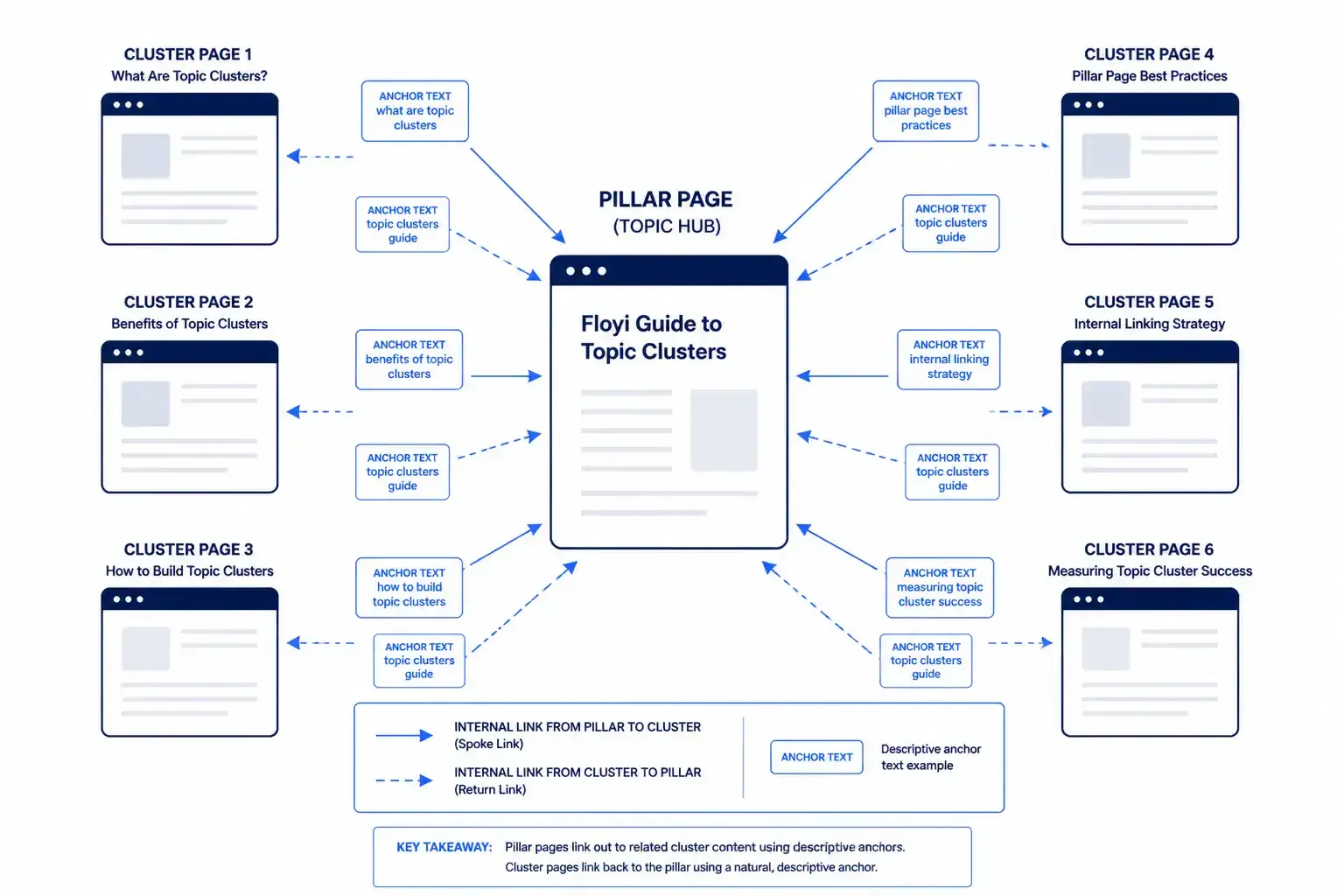
A strong topical structure starts with a pillar page, which acts as the broad core page for the subject. The hub and spoke model works because the pillar gives readers the big picture. Cluster pages and satellite pages handle narrower subtopics and long-tail queries, while internal linking connects those pieces into a clear topic cluster that both users and SEO systems can follow.
The linking hierarchy should stay simple and directional. Your pillar page should point to directly related cluster pages, and every cluster page should link back to its pillar page. Lateral links between sibling pages make sense only when the relationship is real and useful to the reader.
A clean depth model helps breadth and detail stay out of each other’s way. For broad, high-intent topics, your pillar page needs enough depth to feel complete without trying to answer every edge case. Satellite pages should stay focused so they cover one subtopic well instead of competing with the main page for attention.
Pillar pages should be long enough to cover the main topic clearly, and cluster or satellite pages should answer one focused intent without repeating the pillar (source, source). The exact word count should come from the query and the level of detail the page needs (source, source).
Descriptive anchor text matters as much as page count. Generic phrases like “learn more” waste context, while anchors that name the subtopic tell crawlers what the destination covers. Clear anchors, consistent hierarchy, and contextual references also help distribute authority to the right pages inside the content clusters.
The strongest systems keep the network compact. A small, tightly connected cluster can be easier to manage and easier for readers to navigate (source, source). The right size depends on how many related subtopics the pillar needs to cover (source, source).
A practical path keeps movement natural and adjacent:
- Start with the broad topic on the pillar page.
- Move one level down to the most relevant subtopic.
- Expand into adjacent pages only after the core structure is stable.
- Add lateral links only when two pages genuinely support each other.
- Keep the internal linking pattern consistent across the whole cluster.
That sequencing protects topical relevance and prevents your site from jumping across tiers too early. When the hub, spokes, and support pages stay tightly connected, the structure sends a stronger signal about what you know and which page should rank for each intent.
How Do You Measure Readiness To Expand?
You should expand only after a hub can sustain semantic coverage, rankings, and internal-link integrity at the same time. That is the clean stopping rule. Deepen until the cluster is stable, then move into adjacent intents instead of chasing theoretical completeness.
A niche-specific readiness matrix keeps your content strategy aligned with the real shape of demand:
| Topic type | Depth and breadth mix | What readiness looks like |
|---|---|---|
| Narrow technical topic | More depth than breadth | Strong hub coverage, clear entity mapping, and very few open subtopics. |
| Broad consumer topic | A more even depth and breadth mix | Enough pillar authority to support multiple related angles without dilution. |
| Competitive enterprise category | Strong depth and strong breadth | Strong structure, clear page roles, and tight internal linking across subtopics. |
The core KPI stack should blend search, engagement, and AI visibility signals:
- Priority keywords in the top 10: Count how many hub terms sit in positions 1 through 10, then watch whether the set grows without one page taking traffic from another.
- Average SERP position: Treat the 3 to 5 range as a practical sign that the cluster is moving from visibility into contention.
- Organic traffic lift and engagement quality: Use visits, engaged sessions, scroll depth, and return visits to confirm that rankings are bringing the right audience, not just more impressions.
- AI visibility: Track presence in AI Overviews, AI Mode, ChatGPT Search, and Google Gemini so you can see whether the cluster is being cited or summarized in AI-driven surfaces.
Semantic completeness needs a repeatable audit recipe, not a gut check. Start by inventorying blogs, guides, and product pages, then map the entities, subtopics, and search intents attached to each asset. Classify each gap as missing, covered, or overused so the next cluster fills real authority gaps instead of creating cannibalization. When pages become weak or redundant, content pruning for topical authority gives you the framework to remove or consolidate them cleanly.
A simple workbook gives you the clearest read on expansion readiness. Copy these fields into Sheets or Excel and score the hub, not the page:
- Topic: The hub or subtopic under review
- Target page: The canonical URL that should own the intent
- Intent: Informational, commercial, or transactional
- Funnel stage: Awareness, consideration, or decision
- Coverage status: Missing, partial, or complete
- Rank quality: Top 10, top 5, or stable contender
- AI mention or citation status: Present or absent across AI surfaces
- Internal-link target: The next page that should support or receive authority
Phase changes should happen only after impressions and rankings settle across the deep pillar set. Once that baseline holds, expand horizontally in small moves into logically related subtopics so the hub keeps its identity. That protects topical authority and keeps filler pages out of the build.
Tool-informed measurement helps you separate real readiness from optimistic bias. MarketMuse-style mention ranges, Content Score, and distribution views can show whether coverage is thin, balanced, or repetitive. Semrush SEO Content Templates or similar clustering tools can then validate depth, coverage, and cannibalization risk before you widen the map.
Use that sequence as your operating rule for content depth vs breadth. A stable hub earns the right to expand, and a disciplined scorecard keeps your content strategy focused on authority rather than volume.
What Should Your Semantic Coverage Scorecard Check?
Your semantic coverage scorecard should test whether the full topical map is covered, not just the primary keyword. It needs to confirm entity coverage, intent mix, and relationships that signal category-level authority in semantic SEO.
A scorecard like this keeps the review consistent:
| Check | What to measure | Strong threshold |
|---|---|---|
| Entity coverage | Core entities, attributes, and related concepts from the winning SERP set and AI answers | 90%+ of high-priority entities covered |
| Intent mix | Informational, comparison, commercial investigation, and navigational/support intent | No intent type above 25% of expected demand without dedicated coverage |
| Mention depth | Priority entity mentions and related vocabulary across the hub and support pages | Key entities land in the 3 to 10 mention band or higher |
| SERP feature coverage | Featured snippets, People Also Ask, AI Overviews, AI Mode, and other extractable answers | Clear, concise passages for each target surface |
| Cannibalization risk | SERP overlap and keyword clustering across competing pages | No unresolved overlap for the same intent |
| Internal link density | Links from supporting pages to the right pillar and sibling pages | 3 to 5 relevant internal links per supporting article, or one contextual link per major subtopic |
Entity SEO works best when you compare the draft set with the pages already winning the query set and AI answers. Mark each entity as missing, covered, or overused. Treat any missing high-importance entity as a publish blocker, and use 90%+ coverage of the high-priority set as the minimum baseline for expansion.
Search intent deserves its own score because volume can hide gaps. If informational, comparison, commercial investigation, or navigational/support intent makes up more than 25% of expected demand without a dedicated page or section, the cluster is incomplete. That same check applies to keyword clustering, where one page can rank for several terms and still miss the full need.
Mentions and related vocabulary show semantic depth. A simple scale of 0, 1 to 2, 3 to 10, and 10+ mentions helps you spot thin pages fast. Pages that stay in the 0 to 1 range for priority entities should score low.
A weighted readiness score makes the expand-versus-deepen decision clear. Use 80 out of 100 as a green light when there are no critical entity gaps, no unresolved cannibalization, and full coverage of the highest-value intents. Score 60 to 79 as yellow when breadth is partial but depth is strong. Score below 60 as red when the cluster still lacks semantic completeness and needs more topic mapping before scaling.
Topic Depth And Breadth FAQs
These FAQs help you sort out how much depth or breadth your plan needs. They also frame the tradeoffs through the Helpful Content Update lens, so you can align content effort with search quality goals.
Can Too Much Breadth Dilute Topical Authority?
Yes. If you expand breadth before core depth is in place, you create overlapping pages, generic summaries, and thin coverage that looks busy but still misses search intent. Breadth works best when it extends a strong pillar into closely related subtopics, not when it spreads into loosely connected ideas that fragment SEO signals and miss key entities. It only helps once your core coverage is solid, because otherwise the plan starts to resemble content farming and dilutes authority across too many shallow pages.
How Deep Should One Topic Page Go?
A single topic page should go deep enough to satisfy one search intent, with one core question, one primary angle, and the entity coverage needed for the funnel stage you’re targeting. For broad pillar pages, 1,500 to 3,000 words is a practical range, while tighter long-tail pages often work well at 1,200 to 2,500 words when the query is specific. Depth should show up through concrete examples, brief case studies, comparisons, and supporting subtopics, while breadth should handle discovery and depth should own high-intent pages.
When Should You Split One Topic Page?
A split makes sense when the SERP mixes informational, commercial, and navigational intent, because one URL rarely serves all three cleanly. It also makes sense when one page starts stretching across too many subtopics, when multiple URLs compete for the same query set, or when impressions split without a clear winner. If keeping SEO relevance requires constant rewrites, the topic boundary is too broad, and a thin starter page usually works better as part of a focused cluster.
Does Niche Size Change Depth Versus Breadth?
Yes. Niche size and competitive intensity should change your resource allocation, but your goal stays the same: cover the core cluster with enough depth and breadth to earn topical authority. For a narrow technical niche, a roughly 70/30 depth-heavy mix helps you own edge cases and expert-level questions without drifting into irrelevant topics. For a broad consumer niche, a closer 50/50 split works better because the topic universe is wider and you need enough breadth to map adjacent subtopics while still going deep on the highest-value ones. In competitive enterprise spaces, you often need both high breadth and high depth, since a category like home security can support 171+ articles in one subtopic or 1,100+ pages across a broader area, while a tightly bounded niche like dog food for golden retrievers calls for a much tighter map.
About the author

Yoyao Hsueh
Yoyao Hsueh is the founder and CEO of Floyi, the topical authority platform, and the founder of Main Heading, an SEO and AI search agency. He created Topical Maps Unlocked, a course studied by thousands of SEOs, content strategists and digital marketers, founded TopicalMap.com, a done-for-you topical mapping service for agencies and enterprise teams, and publishes the weekly Digital Surfer newsletter on SEO, content strategy and AI search.
About Floyi
Floyi is a closed loop system for strategic content. It connects brand foundations, audience insights, topical research, maps, briefs, and publishing so every new article builds real topical authority.
See the Floyi workflow