
How to Do Content Gap Analysis for Topical Authority
Learn how to find, prioritize, and close topical authority gaps with a practical workflow for internal linking, AI search visibility, and cluster roadmaps.
Content gap analysis for topical authority identifies where a site is missing topics, entities, intent coverage, depth, or structure needed to own a subject. For SEO agencies, content strategists, and content operations teams, it turns broad research into a focused plan that supports stronger rankings and cleaner execution.
A practical workflow starts with a topical boundary, a full content inventory, competitor and AI SERP checks, and a scoring model for business impact. From there, teams can produce topic lists, AI-assisted briefs, refresh rules, and internal linking plans that match the site’s pillar and cluster structure.
That matters now because topical authority depends on consistent coverage, not random keyword growth, and junior teams need a repeatable system they can execute without redoing research every sprint. A page that ranks at position 6 can still justify a new cluster when the topic is central and the intent is clear, and that kind of decision is what keeps strategy tied to revenue. Keep reading for the framework.
Content Gap Analysis Key Takeaways
- Define a topical boundary before reviewing gaps.
- Build a full content inventory across all indexable assets.
- Separate topic gaps from keyword gaps.
- Compare competitor pages with AI search outputs.
- Score gaps by business impact and semantic centrality.
- Turn priorities into a cluster and internal linking roadmap.
- Use refresh, consolidate, or prune decisions to reduce cannibalization.
How Do You Define a Topical Boundary for Content Gap Analysis?

A strong topical boundary starts with a clear scope statement. You define the topics you want to own, the pages that belong inside that set, and the subjects you are deliberately leaving out for now. That focus keeps a content gap analysis usable for agencies and content teams, and it keeps a content audit from collapsing into a broad keyword dump.
The boundary should come from a topical map, not from isolated queries. Start with the core topic, then break it into a pillar page, pillar content, and cluster content so the structure matches how the subject should be covered. That hub-and-spoke model makes the scope easier to defend, easier to brief, and easier to expand without losing direction. The editorial planning framework for topical authority helps when you need to turn that map into a repeatable planning model.
Entities make the boundary measurable. Pull the people, places, products, attributes, and subtopics that show up across winning pages and artificial intelligence (AI) answers, then compare them with your current coverage. That comparison helps you sort semantic gaps into three buckets:
- Missing: The entity or subtopic is absent from your current coverage.
- Covered: The entity appears in the right place and with enough depth.
- Overused: The same idea repeats across too many pages and creates redundancy.
Topic gap analysis and keyword gap analysis should stay separate until the end. Competitor keyword coverage can point to useful opportunities, but the boundary should still be content-led. A keyword matters only if it belongs inside the cluster and supports the topic you want to own.
Stopping rules protect the boundary from bloat. Stop expanding when a topic is low-intent, duplicates another page’s purpose, or increases cannibalization risk. Keep going when the hub still lacks depth, internal linking integrity, or coverage of critical subtopics. These rules make prioritization cleaner because they connect expansion to business impact instead of sheer volume.
Measurement should be set before the first page gets reviewed. Define success as the page set, entity set, and intent layers required for a complete hub, then use that baseline to decide what gets filled now and what waits for a later expansion. That turns your topical map into a practical operating frame for future SEO decisions.
How Do You Map Your Topical Content Audit?
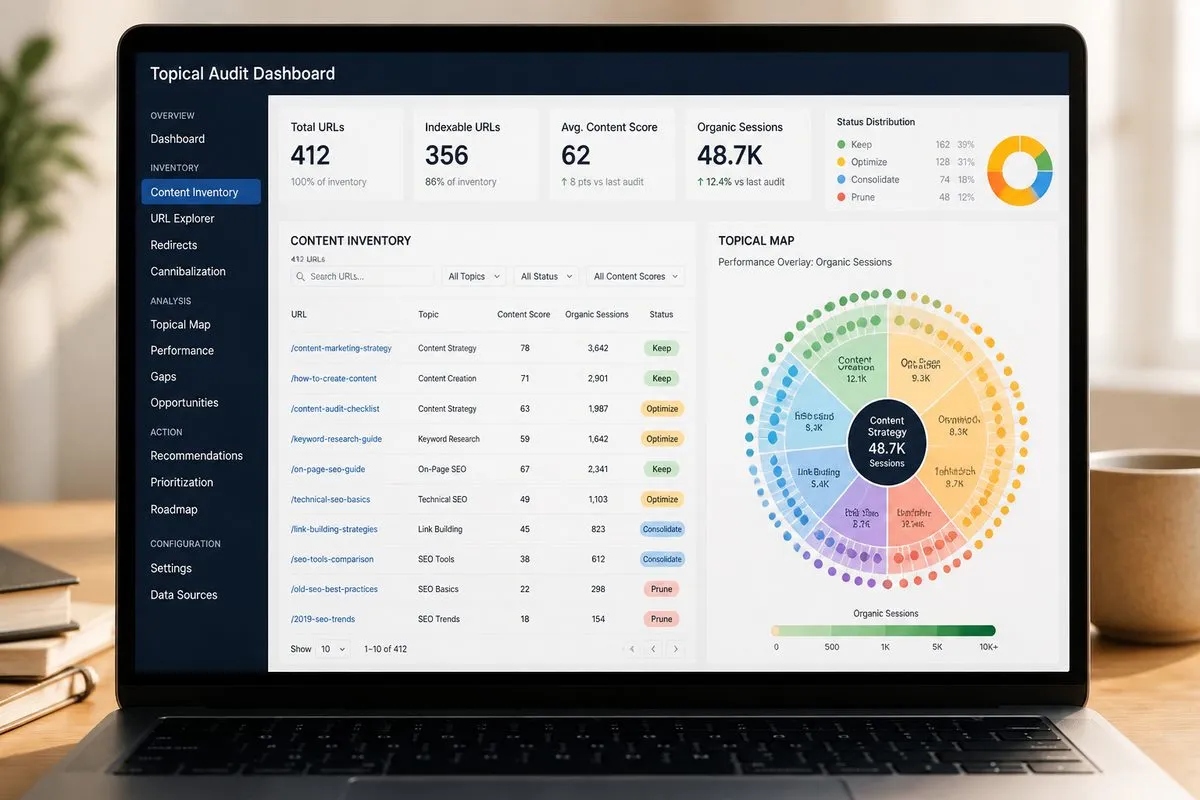
A strong topical audit starts with a full content inventory, not just the URLs that are easy to find in your CMS. Export every indexable page, then add legacy posts, category pages, support pages, and other assets a crawl can miss so the audit reflects the whole site. The structured checklist for topical content audits gives you a clean starting point for that inventory work.
Once the inventory is in place, build a topical hierarchy and tag each URL by core topic, supporting entity, and user intent. Mind-mapping software, a spreadsheet, or semantic research tools can all support that work. The goal is to place every page in the right pillar, cluster, or branch so coverage stays visible instead of implied.
A practical classification pass helps you see what the site already covers and where it is weak:
- Fully covered: The page answers the query and matches the buyer journey stage.
- Thin or under-optimized: The page exists, but it falls short of informational intent or another clear user intent.
- Consolidated: The page overlaps with stronger content and should be merged.
- Missing: The topic deserves a page, but no real asset exists yet.
Coverage gaps usually show up fast when you apply simple thresholds. Pages under about 500 words that still fail to answer the search need should count as weak coverage, but word count alone is not the test. Weak rankings matter too. A page sitting in position 6 can still justify a focused cluster page if the query has clear demand.
Visualize the results as a topical map with pillars in the center and clusters radiating outward. Then layer performance data onto the map where you can. That view helps you spot breadth, authority dilution, and places where one topic needs deeper cluster content before the site expands into adjacent themes.
A quick cross-check catches the problems that inventory sheets miss:
- Run a site:yourdomain.com search for the target topic.
- Compare the results with your content repository.
- Flag orphaned pages with no internal path.
- Note duplicate coverage and near-duplicate angles.
- Mark pages that mention a topic but do not rank meaningfully.
That step matters because topical authority is not only about publishing more. It is about aligning each cluster page with the right search intent and the right phase of the buyer journey so the site builds depth instead of noise.
Turn the audit into a usable roadmap by tagging every URL as Keep, Optimize, Consolidate, or Prune. Connect each decision to a topical gap, a cannibalization issue, or an internal linking fix. The table below keeps the plan tight and easy for junior teams to execute:
| Status | What it means | Typical action |
|---|---|---|
| Keep | Page is aligned and performing | Strengthen links and preserve coverage |
| Optimize | Page has value but needs improvement | Expand, refresh, or better match intent |
| Consolidate | Multiple pages overlap | Merge into the strongest asset |
| Prune | Page adds little value | Remove or redirect with care |
When you follow this structure, your topical map becomes a practical operating tool instead of a static diagram.
How Do You Benchmark Competitors And AI Search?
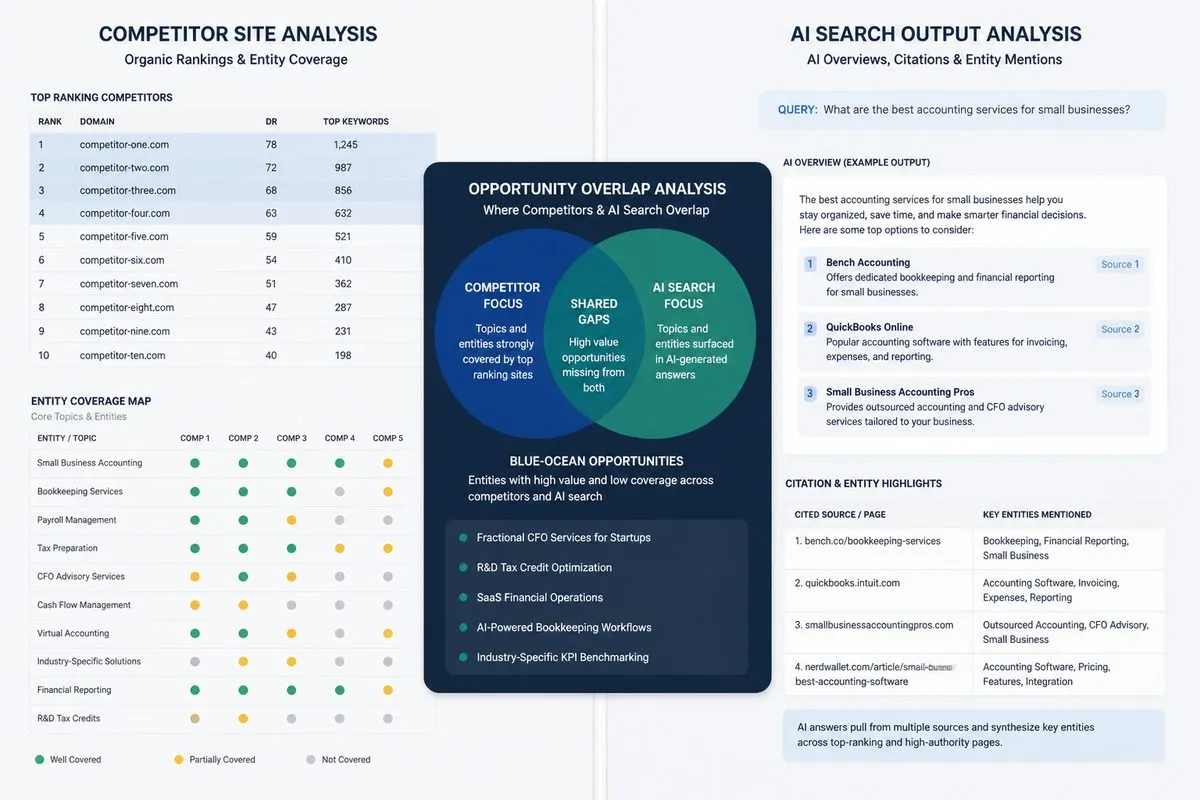
Benchmarking works best when you compare three layers at once: direct topical competitors, AI search outputs, and the page structures that get quoted most often. That gives you a clearer view of topical authority than a keyword list alone, and it helps you separate real opportunity from noisy overlap.
Start with a small set of direct competitors, then add one larger aspirational site and one similar-sized peer if those examples help compare scope and depth (source). Mix ranking rivals with one larger aspirational site and one similarly sized peer so your benchmark reflects both the ceiling and the realistic baseline for your topic map.
A simple competitor set looks like this:
| Type | Why it matters |
|---|---|
| Direct ranking rival | Shows what already wins for your core queries |
| Larger aspirational site | Raises the bar for depth, breadth, and trust |
| Similar-sized peer | Gives you a practical benchmark for scope and speed |
From there, extract each site’s full topic graph, not just a keyword list. Track core topics, subtopics, entities, and intent coverage, then compare that structure with your own map. That process reveals adjacent questions, use cases, and entity relationships you may have missed, which is where many semantic gaps live.
Raw overlap is not enough. Competitor authority mapping is stronger because it shows how often the same priority entities appear, how deep the subtopics go, and whether the site covers informational, commercial, and navigational paths with real completeness. A keyword gap tool can help surface ideas, but it should not replace this structure-first review. Ahrefs content gap is useful for discovery, yet the content gap vs keyword gap distinction still matters because one is about missing topics and the other is about missing search terms.
Page format matters too. Generative systems tend to favor content that is easy to quote and easy to parse, so watch for these content format gaps:
- Definitions: concise and direct
- Comparison tables: cleanly separated options
- Step-by-step sections: clear process flow
- FAQ blocks: common follow-up questions answered fast
- Evidence-led paragraphs: claims supported with specifics
Then test the same topic set in AI search surfaces such as AI Overviews, Gemini, and ChatGPT Search. Compare citations and answer summaries against your competitor audit, because repeated entities or repeated phrasing often signal what the model treats as authoritative and extractable. AI tools for content are most useful here when they help you spot what appears across sources and what gets ignored.
Use the overlap to label three buckets:
- Shared gaps: topics, entities, or formats that competitors and AI results both handle poorly
- Blue-ocean opportunities: credible subtopics with thin coverage and clear user intent
- Priority pages: assets with strong search demand, citation potential, and room for topical depth
That is where your SEO roadmap should point. The strongest pages win on completeness and citation-worthiness, not just volume, and that is the difference between a visible topic cluster and a fragile one.
How Do You Build A Prioritization Matrix?
A practical prioritization matrix can use a simple 1 to 5 scoring grid so teams can rank gaps with a consistent method (source). Rate each gap on business relevance, semantic centrality, query demand, competitive weakness, and internal link leverage. Then total the scores and sort the opportunities from highest to lowest so the ranking is repeatable instead of opinion-driven.
Semantic centrality should carry more weight when a gap sits close to the core of the topical boundary. Missing intent layers, thin supporting coverage, and disconnected clusters usually weaken topical authority more than a few missing keywords or standalone pages. Query demand and competitive weakness still matter. Search volume and keyword difficulty size the opportunity, while competitor depth shows whether the market already owns the topic. The internal linking strategy should also affect the score because a gap that strengthens a pillar, reconnects orphaned cluster pages, or improves crawl paths can lift more than one URL.
A simple scoring model can look like this:
| Factor | Score range | What high scores mean |
|---|---|---|
| Business relevance | 1 to 5 | Direct tie to revenue, lead quality, or conversion (source) |
| Semantic centrality | 1 to 5 | Core coverage near the topical boundary |
| Query demand | 1 to 5 | Stronger search volume or clearer demand signal |
| Competitive weakness | 1 to 5 | Competitors have shallow or inconsistent coverage |
| Internal link leverage | 1 to 5 | Strong ability to reinforce hubs, clusters, and crawl paths |
Clear score bands keep the team aligned on what happens next:
- High priority: Build or expand immediately.
- Medium priority: Queue for the next cluster sprint.
- Low priority: Defer unless the gap unlocks a critical hub or conversion path.
The matrix should also be checked against a broader topical authority score. That score can combine topic coverage, entity coverage, intent coverage, depth quality, internal linking, semantic cohesion, and AI retrieval readiness. This is more useful than relying on keyword counts, page counts, Domain Rating, or traffic alone because it reflects how well the cluster can win visibility in SEO and AI surfaces.
Treat the matrix as an operating tool, not a one-time audit. A clean six-step workflow can keep it useful by defining scope, scoring gaps, reviewing the rankings, turning top items into a roadmap, and checking results over time (source).
- Define goals and scope.
- Map the topical boundary.
- Score the gaps.
- Review the rankings with stakeholders.
- Turn the top items into a cluster roadmap.
- Track results and adjust thresholds over time.
That process keeps the prioritization model tied to execution, which is where topical authority is actually won.
How Do You Turn Gaps Into An Internal Linking Roadmap?
Turn each prioritized gap into a page-level decision before you change the roadmap. A thin subtopic usually fits inside existing pillar content. A true missing theme may justify a new cluster page with its own supporting links. Some gaps should trigger an update instead of a new URL, especially when the page already has relevance, traffic, or a decent search footprint.
The strongest internal linking strategy makes site hierarchy obvious to both readers and crawlers. Every cluster page should point back to its pillar page, and the pillar page should link out to the most relevant subpages when the relationship is truly topical. Descriptive anchor text works better than vague labels because it signals what the destination covers and helps users predict the next click.
A practical roadmap uses two-way linking, not one-way handoffs. Cluster pages reinforce the pillar content, and the pillar redistributes authority across the cluster set so the network stays coherent. Route authority from pages that already earn traffic, homepage modules, and hub pages where the structure supports it, but avoid skipping levels that break the broad-to-narrow pattern search engines expect.
Link placement should follow publishing cadence and context, not habit. Add internal links when a new cluster launches, when an existing page is refreshed, or when an older article already mentions the related topic, so the link structure stays aligned with the site hierarchy (source). The content pruning process for topical authority can also remove weak paths and free up stronger routes to priority pages.
A clean roadmap usually looks like this:
- Topic gaps: Create a new cluster page and connect it to the right pillar content.
- Format gaps: Add a supporting guide, comparison page, or media-rich subpage.
- Depth gaps: Expand the existing page with a fuller explainer and stronger anchors.
- Orphaned clusters: Link vertically to the pillar page and horizontally to sibling articles.
- High-priority pillars: Send authority from proven pages into the most strategic topic hubs.
That structure keeps your site architecture readable, repairs isolated pages, and gives every important topic a clear path through the site.
How Do You Avoid Topical Authority Mistakes?
Topical authority breaks down when a map gets too wide, too shallow, or too tied to keywords. The first fix is to keep that topic boundary and hold a hub-by-hub scope rule, so adjacent ideas do not creep in just because SEO tools surface more terms. Stop expanding a page when it adds little new value or starts raising cannibalization risk.
Keyword lists are useful, but they do not equal semantic completeness. A stronger audit compares topic gaps, entity gaps, intent gaps, depth gaps, and structure gaps against the pages already winning in search and AI answers. That matters because user intent shifts by page type, and the buyer journey often moves from informational intent to transactional intent, then to navigational intent or comparison behavior.
The most common misses show up fast when you compare live pages, drafts, and top-ranking competitors side by side:
- Missing entities: Important concepts appear in winners, but not in the draft or cluster map.
- Thin coverage: An entity appears once, then never gets enough context.
- Overused entities: The same term repeats so often that the page feels narrow or forced.
- Content format gaps: Competitors earn visibility with long guides, checklists, videos, diagrams, or snippet-friendly layouts, while your page stays a plain post.
- Intent blind spots: Pricing, limitations, failures, and implementation complexity get skipped even when search demand is clear.
Closing those gaps is only half the job. The other half is adding what the winners never say, the net-new angles that earn a ranking instead of matching it. A closed-loop workflow keeps those mistakes from multiplying. Research, topical mapping, drafting, publishing, and human editing need to work together so the team does not ship thousands of generic pages and should instead publish fewer pages that match clear intent, cover the topic fully, and fit the site’s cluster structure (source). The result is a repeatable cluster roadmap that stays credible, covers informational intent and navigational intent, and strengthens topical authority with less rework.
Content Gap Analysis for Topical Authority FAQs
These FAQs cover the practical side of content gap analysis for topical authority, including the role of a content audit, People Also Ask results, and AI tools for content. They give your team clear, repeatable context before the work gets mapped.
Should You Update Pages Or Create New Ones?
Update the page when it already matches search intent but is thin, stale, or missing key entities, because that closes the depth gap and strengthens a URL with existing authority and internal links. Create a new page when the missing topic reflects a separate intent that would blur the current page’s purpose or create cannibalization. In AI-driven workflows, a strong content refresh plan often uses both moves, and content refresh schedule template for topical authority helps you refresh older underperformers while adding new pages where the cluster still has gaps.
How Do You Measure Gap-Fill Success?
Track gap-fill success by measuring rank delta on the target URLs before and after the update for the exact queries you want to win. Pair that with SERP feature share and AI citation presence, including featured snippets, AI Overviews, AI Mode mentions, and citations in ChatGPT or Gemini, then confirm the lift with organic traffic, CTR, and internal-link equity on the right landing pages after the content refresh. Review the pages weekly for the first 4 to 6 weeks, then judge the 8 to 12 week trend line.
How Do You Find Missing Search Intent?
Use People Also Ask, related searches, AnswerThePublic, Reddit, Quora, and AI answer summaries to surface the questions, objections, and pain points keyword tools often miss. Compare those queries with your current pages, then tag each gap by intent type, buyer stage, and content format so your topic map shows whether it should become a new page, a section expansion, or an internal-link target. Group similar questions into clusters and prioritize the highest-impact gaps first so you build topical authority through depth instead of scattered long-tail ideas.
How Often Should You Recheck Topical Gaps?
A quarterly recheck works well for most sites because it catches coverage drift, new competitor pages, and shifts in search demand without turning analysis into busywork. Move to a monthly cadence when the topic changes fast, the site is large, or you publish across several clusters, since that helps you spot fresh entities, intent shifts, and new opportunities before rankings soften. Run an ad-hoc audit after a competitor sitemap expansion, a core update, a new cluster launch, a sharp drop in impressions or clicks, or when AI answers expose missing coverage. If budget is tight, keep it lightweight by cross-checking competitor sitemaps and validating interest with People Also Ask, AnswerThePublic, and Google Trends before you prioritize new gap-fill content.
Can One Gap Analysis Support Multiple Topic Clusters?
Yes. One gap analysis can support multiple topic clusters when they share the same audience, intent, and SERP patterns, because the real job is to surface missing semantic groups and subtopics, not just isolated keywords. Use that shared analysis as the master view for a broader pillar, then split it only when product lines, personas, buyer stages, or commercial priorities diverge enough that each cluster needs its own roadmap, coverage targets, and internal linking plan.
About the author

Yoyao Hsueh
Yoyao Hsueh is the founder and CEO of Floyi, the topical authority platform, and the founder of Main Heading, an SEO and AI search agency. He created Topical Maps Unlocked, a course studied by thousands of SEOs, content strategists and digital marketers, founded TopicalMap.com, a done-for-you topical mapping service for agencies and enterprise teams, and publishes the weekly Digital Surfer newsletter on SEO, content strategy and AI search.
About Floyi
Floyi is a closed loop system for strategic content. It connects brand foundations, audience insights, topical research, maps, briefs, and publishing so every new article builds real topical authority.
See the Floyi workflow