
Information Gain in Floyi: Briefs That Add, Not Rehash
Information gain is what your page adds that the top results do not. Floyi briefs now surface the net-new angles only you can add, then verify they land in the draft.
AI made it easy to publish faster. It also made it easy for everyone to say the same thing.
Type any query into a model, ask for an article, and you get a summary of the ten top pages already ranking. So does your competitor. So does theirs.
That is the problem.
When every tool reads the same SERP and paraphrases the same consensus, the web fills up with content that agrees with itself and adds nothing. Google has a name for what it wants instead. So do its patents.
It is called information gain.
I have built topical maps for 300+ brands. The thing that quietly kills rankings now is not thin content. It is ten pages that all say the same thing, and yours being the eleventh (if your thin content ever gets indexed).
What Information Gain Actually Means
Information gain is the net-new value a page adds on top of what is common on competitor pages. Google holds patents describing a system that scores how much fresh information a document contributes relative to the documents ranked before it. Low gain means you simply restated the consensus. High gain means you said something the other results did not.
This matters more now, not less. AI Overviews and answer engines synthesize the consensus for free. If your page only repeats what ten other pages say, an AI answer replaces it. The pages that survive are the ones that add a data point, an angle, or a piece of firsthand expertise the model could not assemble on its own.
Most content tools optimize for coverage. They tell you which terms and entities to include so you match the top results.
Coverage gets you to the table. Information gain is what wins the seat.
How Floyi Builds Information Gain Into Briefs
Floyi’s briefs and drafts now build information gain into the brief itself, then verify it in the draft. Three moves, in sequence.
1. SERP Consensus Claims: the table stakes
Before you can add something new, you need to know what everyone already agrees on. So every brief now surfaces the claims that multiple ranking pages independently make, with a count of how many make each one.
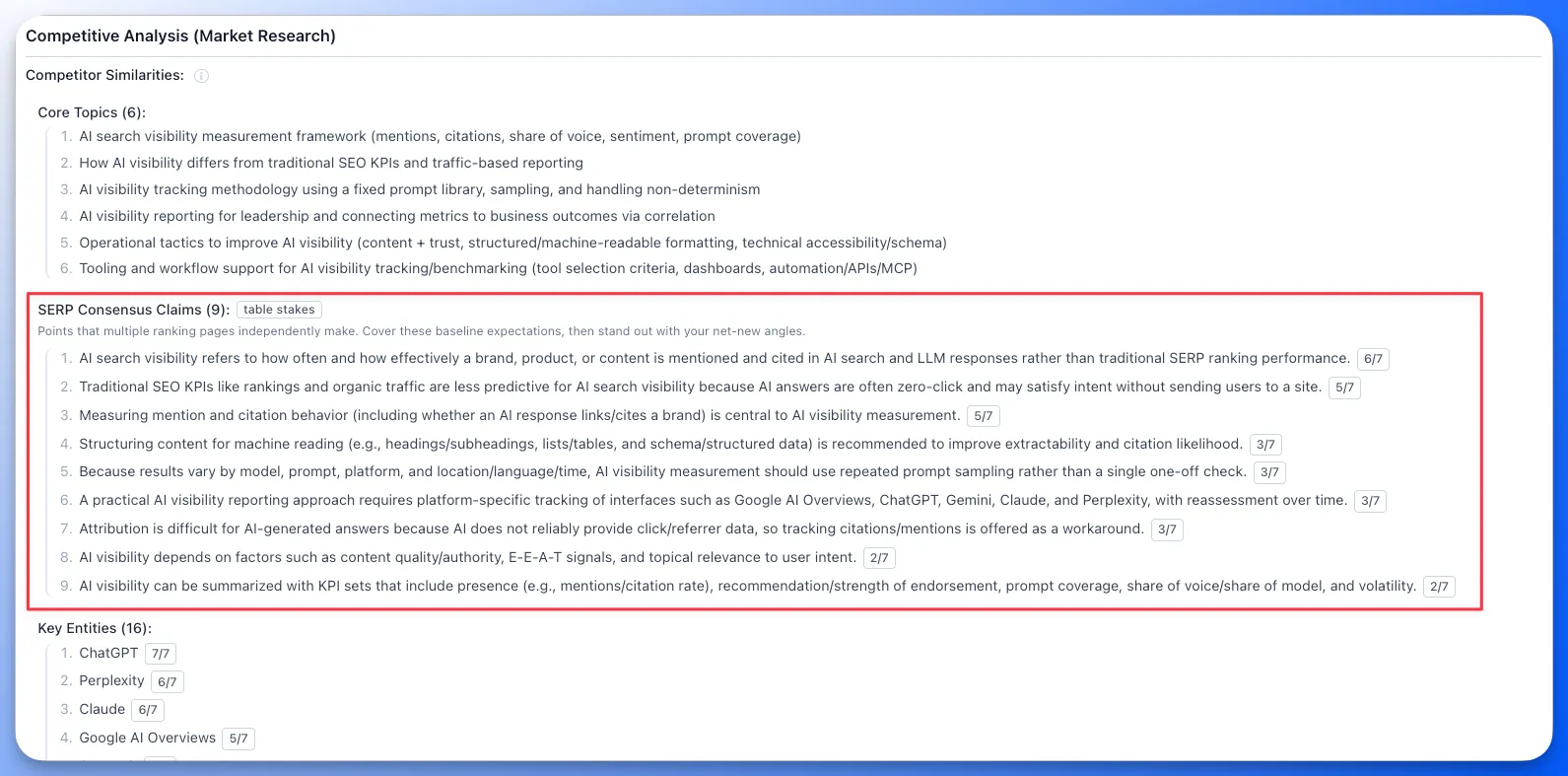
Points made by multiple competitors are consensus and table stakes. Miss them and you look thin. Cover them and you have earned the right to add your own angle.
2. Grounded net-new angles: what only you can say
Most tools stop at coverage. This is the part they skip.
Floyi inventories the facts the current top results already cover, then finds the angles your page can add that none of them state. Then it does the thing that matters: it grounds each angle in your own context. Your Brand Foundation, your positioning, your Knowledge Base.
That grounding is the whole point. An angle is only useful if you can actually back it up. A generic tool that “adds novelty” invents a statistic and hopes nobody checks. Floyi surfaces angles that are both absent from the SERP and supportable by your own expertise. Things only you can credibly claim.
Novelty you cannot defend is not gain. It is a liability.
3. Blocked Opportunities: the gap only your data fills
Sometimes the strongest angle is one no competitor covers and nothing in your brand context can prove yet. Before-and-after numbers from your own client work. A benchmark from your own dataset. A result you have seen but never published.
Floyi will not invent that number. Instead of dropping the angle, it hands it back to you.
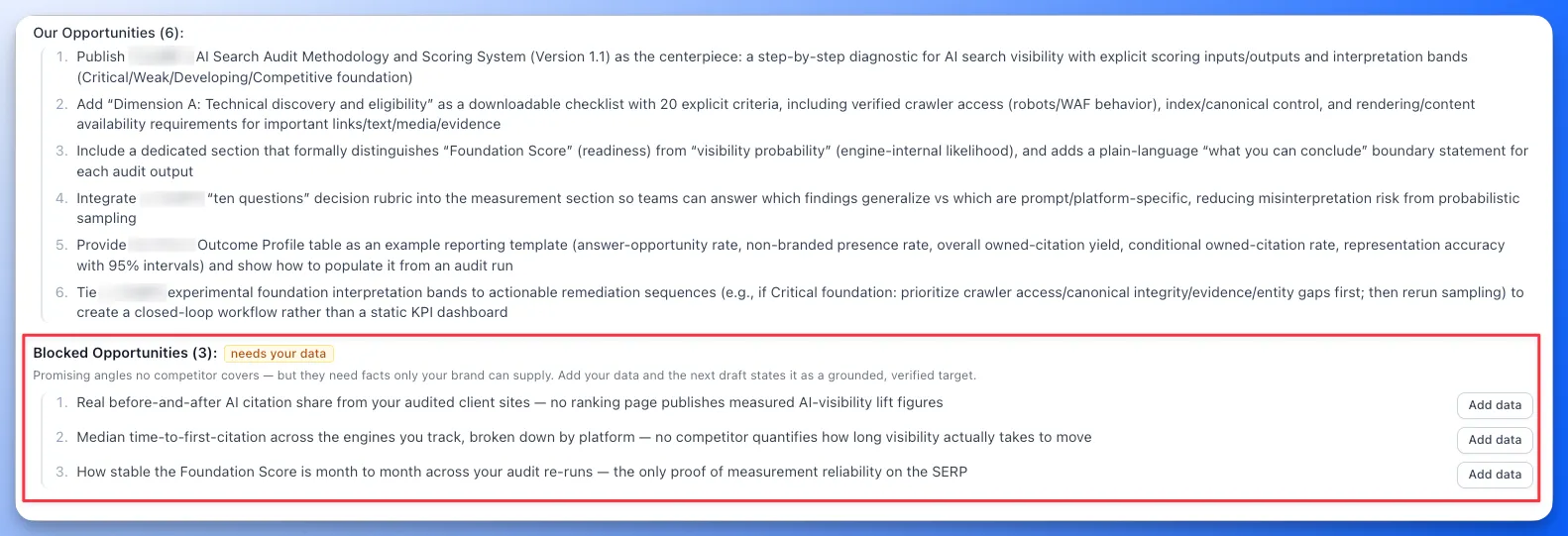
Each Blocked Opportunity has an Add data button. Enter your fact, pick the section it belongs in, and it becomes a grounded target for the next draft. You are supplying the one thing an AI model can never scrape: your firsthand proof. That is exactly the kind of experience signal both Google and AI answer engines reward for E-E-A-T.
The Draft Has to Prove It
A brief that promises information gain and a draft that quietly reverts to rehashing consensus is worse than useless.
So the loop closes in the Content Editor’s quality score. When a draft finishes, its Information Gain dimension checks which of your net-new angles actually made it into the writing, and shows how much of the page still restates what the ranking pages already cover.
You get a verdict, not a vibe. If the draft drifted back toward the consensus, you see it, and you fix it before you publish.
What to Do With It
You do not need to overhaul your process. Run one brief the new way.
- Generate a brief for a topic where you keep losing to the same competitors.
- Read the SERP Consensus Claims first. Those are non-negotiable. Cover them.
- Look at the net-new angles. Keep the ones that fit your positioning, cut the ones that do not.
- Fill at least one Blocked Opportunity with a real number from your own work.
- Generate the draft, then check the Information Gain score before it publishes.
If you want the full mechanics of how briefs assemble competitors, personas, and links, the content brief workflow documentation walks through every step. And if information gain is new to your process, it pairs naturally with finding the coverage gaps on your existing pages first.
The bar has moved. Matching the top ten used to be the goal. Now matching them is the floor, and an AI answer does it for free.
The content that earns a ranking, and a citation, is the content that adds what the others could not.
Are you writing to match the SERP, or to add to it?
About the author

Yoyao Hsueh
Yoyao Hsueh is the founder and CEO of Floyi, the topical authority platform, and the founder of Main Heading, an SEO and AI search agency. He created Topical Maps Unlocked, a course studied by thousands of SEOs, content strategists and digital marketers, founded TopicalMap.com, a done-for-you topical mapping service for agencies and enterprise teams, and publishes the weekly Digital Surfer newsletter on SEO, content strategy and AI search.
About Floyi
Floyi is a closed loop system for strategic content. It connects brand foundations, audience insights, topical research, maps, briefs, and publishing so every new article builds real topical authority.
See the Floyi workflow