
Pillar Pages for SEO and AI Search Guide
Learn how to build AI-ready pillar pages for SEO, topic clusters, internal links, and measurable authority that boost citations and ROI.
Pillar pages for SEO and AI search give one topic a central home instead of scattering related content across disconnected posts. For content teams and SEO agencies, the pressure shows up when a strong page still fails to explain its subtopics cleanly, which makes rankings, AI citations, and internal links harder to control. A pillar page is the main hub for a topic, built to organize the core entity, support pages, and links in one readable structure. That setup leaves you with a practical framework for building topical authority and making the page easier for search engines and AI systems to interpret.
The sections ahead cover the hub and spoke model, entity-first topic clustering, fan-out questions, pillar page structure, blurb-first section writing, internal linking, performance tracking, and legacy content upgrades. Expect concrete guidance on heading hierarchy, schema markup, anchor text, audit steps, and KPI tracking for search visibility and AI visibility.
For heads of content, senior in-house marketers, and freelance SEOs, the real value is in moving faster without losing control of brand voice or search intent. One example is a pillar page that opens with a direct answer, then uses linked cluster pages to cover comparisons, troubleshooting, and decision support without overlap. That structure gives your team a clearer production workflow, tighter reporting, and a better case for ROI to stakeholders.
Pillar Pages for SEO and AI Key Takeaways
- Pillar pages act as the central hub for one broad SEO and AI search topic.
- Entity-first clusters organize content by meaning, not just matching keywords.
- Strong pillar pages use clear headings, jump links, and blurb-first sections.
- Internal links should flow from pillar to cluster and back again.
- Descriptive anchor text helps users, crawlers, and AI systems follow topic relationships.
- Performance tracking should include rankings, engagement, and AI citation signals.
- Legacy pages can be upgraded into hubs through audit, consolidation, and relinking.
What Are Pillar Pages For SEO And AI Search?
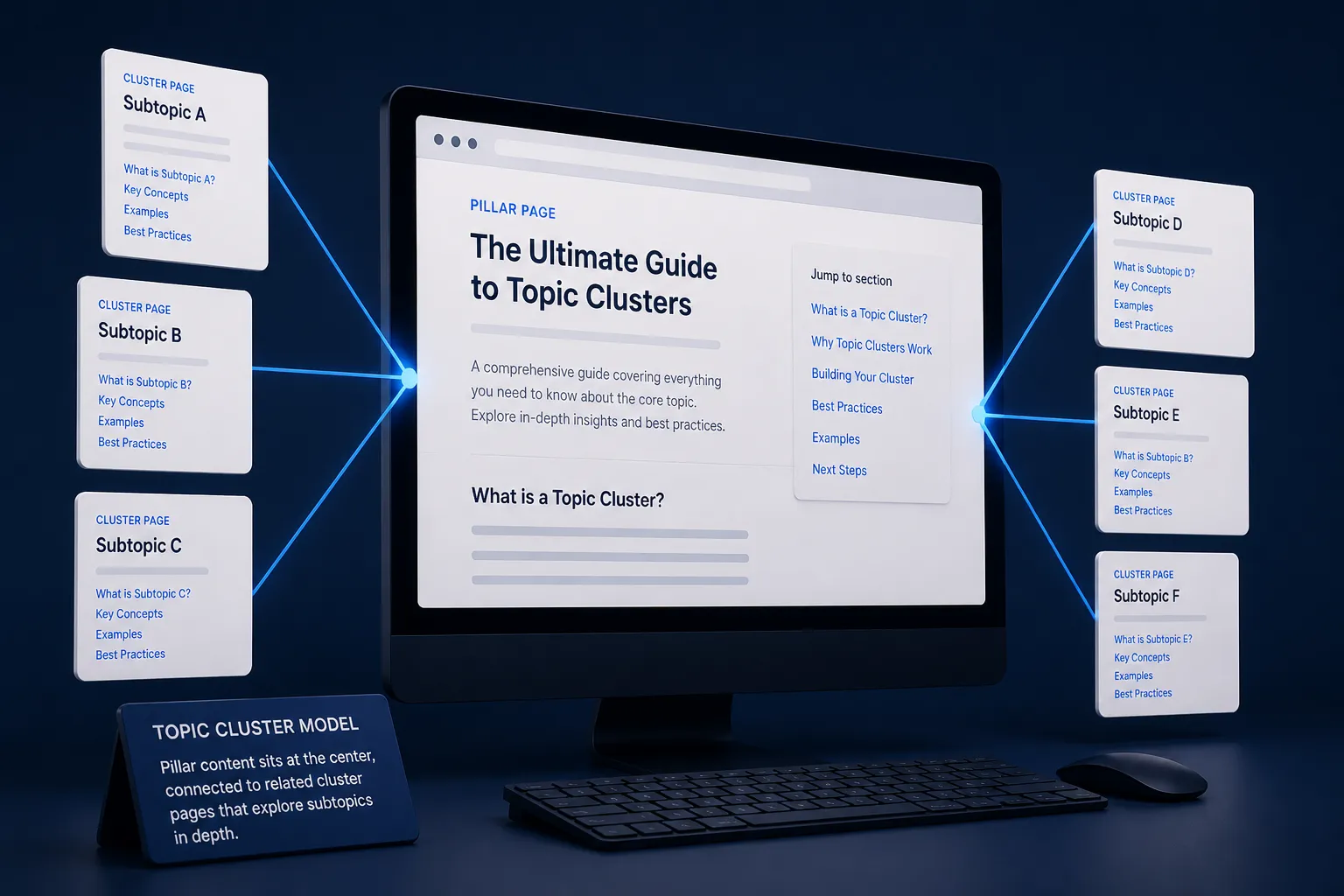
A pillar page is the central page that organizes one broad topic for search engine optimization (SEO) and AI search. It is more than a long article. It is the structural anchor for the topic, built to help you group related content around one clear hub.
The strongest version follows a hub-and-spoke model. The pillar page covers the core entity and the main subtopics at a high level. Cluster pages handle narrower questions, use cases, and related intents that need their own space. That setup keeps the hierarchy readable for both people and crawlers.
Here’s the basic structure:
- Pillar page: broad, comprehensive content that frames the topic and sets the hierarchy
- Cluster page: focused content that answers one specific question or intent in depth
- Internal links: paths that let users and crawlers move from the hub to the spokes and back again
That linking pattern matters because it makes the topic easier to follow. Search engines can read the structure more cleanly. Large language models can also trace the relationships between pages more reliably when the content is organized this way.
That is where AI visibility starts to improve. Clear content hierarchy and strong internal linking help systems identify which page owns the core topic and which pages support it. Over time, that makes your site more likely to be treated as a single authoritative answer for complex queries.
Pillar pages also support topical authority and citation potential. A topic-first content planning approach keeps that structure grounded in real entity relationships instead of guesswork. When the page is comprehensive content, tightly organized, and easy to quote, it has a better chance of surfacing in AI Overviews, AI responses, and featured snippets. The supporting cluster content then reinforces breadth, depth, and staying power across the topic map.
| Element | Role | Why it matters |
|---|---|---|
| Pillar page | Central hub | Sets topic scope and the main narrative |
| Cluster content | Supporting pages | Covers detailed questions and sub-intents |
| Internal links | Navigation layer | Shows topical relationships to users and crawlers |
In practice, a strong pillar page gives you more than one ranking opportunity. It gives you a clearer path to being cited, summarized, and trusted across AI search experiences.
How Do You Design An Entity-First Topic Cluster?
An entity-first cluster starts with one core entity and expands from meaning, not matching phrases. That core entity is the subject you want search engines to connect with your brand, such as a product category, a method, or a problem space. From there, you define the semantic perimeter. That perimeter includes adjacent concepts, attributes, subtypes, and real-world use cases that belong to the same subject graph.
A practical way to build it is to map the entity network before you write a page. That gives each spoke page a clear role inside your topic clusters and keeps overlap in check. The strategic prioritization roadmap for cluster pages helps you decide which pages deserve priority when the cluster is still taking shape.
The strongest clusters usually cover three supporting page types:
- Definitional pages: Pages that explain the core entity and its close variants
- Comparison pages: Pages that separate the entity from neighboring concepts or alternatives
- Problem-solving pages: Pages that answer the practical questions people ask after they learn the basics
Those pages should use semantic keywords and entity-focused language in headings and body copy. That approach helps your cluster content cover the full related topic range and signals topical authority more clearly than a scattered keyword list ever can.
Fan-out questions are what turn the map into publishable structure. They translate the core entity into the next questions a reader asks, and artificial intelligence (AI) systems tend to follow that same path. A strong set of fan-out questions usually includes definitions, comparisons, and troubleshooting angles, because those mirror both search intent and how people move through a topic.
Entity-centric clustering is stronger than keyword-centric clustering for AI search because it connects concepts, relationships, and intent. Keyword-first structures group pages by similar wording, which can miss the real subject relationship. Entity-first structures build a true topic hub that AI Overviews and similar experiences can interpret more cleanly.
| Approach | How pages are grouped | What it misses | Best use case |
|---|---|---|---|
| Keyword-centric | Similar phrasing and variants | Concept links and intent depth | Narrow, query-level coverage |
| Entity-first | Related entities and relationships | Less focus on exact-match repetition | Topic hubs and broader authority building |
A practical scoping rule keeps the system tight. Ship the core hub set first, then add pages only when they close meaningful authority gaps, strengthen internal linking, or reduce cannibalization. That makes content clusters easier to govern and keeps the site from drifting into bloat.
Gap analysis should focus on missing, covered, and overused entities rather than missing keywords alone. That lens shows where your search intent coverage is thin and where the entity graph needs reinforcement fastest.
Map One Core Entity And Its Fan-Out Questions
Start with one core entity you want to own. Then break it into the questions people and AI systems naturally split out, because strong search intent work answers the full query family around that entity, not just the head term.
A clean cluster usually starts with intent labels that make content mapping easier to sort and scale:
- Definitional: what the entity is, how it works, and why it matters
- Comparison: how it differs from close alternatives or sibling terms
- How-to: how to apply it, set it up, or use it well
- Troubleshooting: why it fails, stalls, or creates confusion
- Decision-support: when to choose it, when not to, and what to prioritize next
From there, score each possible spoke against three filters:
| Factor | What you’re judging |
|---|---|
| Business value | Revenue impact, pipeline potential, or strategic fit |
| Search opportunity | Demand, difficulty, and room to win visibility |
| SERP overlap | Whether the query deserves its own page or belongs with another one |
That scoring keeps search intent visible and helps you decide what ships now versus later. Competitor guidance is useful at this stage because it shows where the market already rewards depth before you lock the pillar and spokes.
Aim for 8 to 15 spokes. That range is deep enough to prove coverage without drifting into bloat. Narrow entities usually sit near the lower end, while broader topics can support the 10 to 20 subtopics that stronger competitors often surface.
The final check is structural. Your cluster should reduce ambiguity between near-duplicate terms, cover the full related topic set, and reinforce topical authority through clean entity relationships and close contextual links. AI retrieval matters too, so signal supporting entities and concept relationships clearly enough for models to embed, retrieve, and cite the right page for each sub-question.
Cut any spoke that feels redundant, low-intent, or too close to another page’s purpose. Tight clusters win because they stay distinct, ranked, and easier to expand without cannibalizing themselves.
How Should You Structure A Pillar Page For AI Visibility?
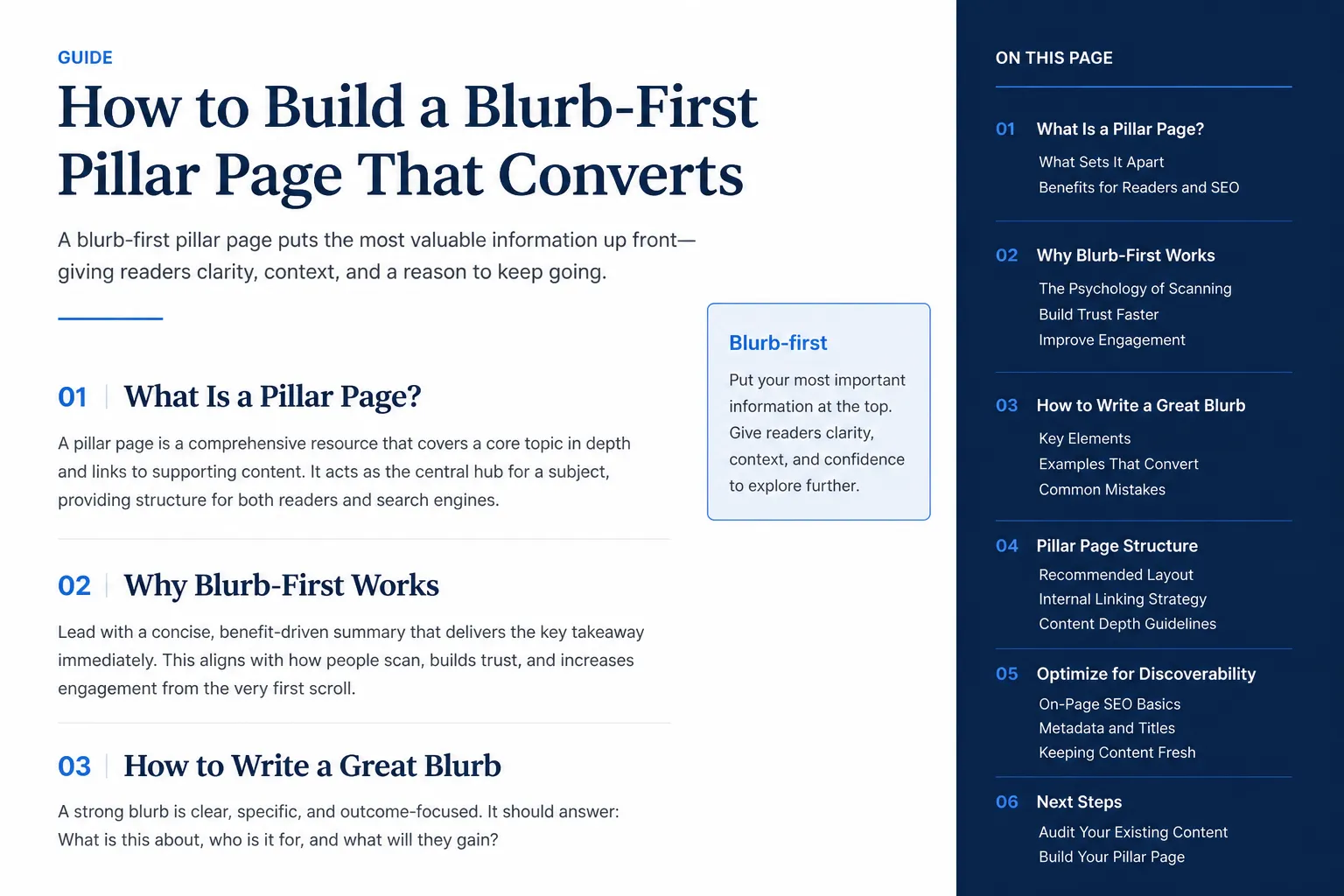
A strong pillar page structure makes the page easy to scan and easier for AI systems to interpret. It gives your pillar page one clear job, then breaks that job into predictable modules that support quick answers and deeper reading.
Start with a clean heading hierarchy. Use one H1 for the core topic, H2s for major sections and FAQs, and H3 or H4 levels for supporting definitions, examples, and subpoints. Specific headings matter because vague labels blur both reader flow and AI visibility.
Put a concise navigation block near the top. Jump links or a sticky menu help readers move straight to the section they need. On longer pages, that table of contents gives crawlers and AI systems a clearer map of the content.
The strongest pages also use a blurb-first format under each major heading. Open with a direct 2 to 3 sentence answer, then add proof, examples, or tactical detail beneath it. That pattern helps your page surface concise passages for summaries while still giving people the depth they expect.
A practical pillar page template usually mixes repeatable section modules like these:
- Definition: Explain what the topic means and why it matters.
- Background: Set up the problem or context the page solves.
- Key terms: Clarify the language readers need before they go further.
- Pros and cons: Show tradeoffs when a decision is involved.
- Examples: Ground the idea in real use cases.
- How-to steps: Lay out the sequence when action matters.
- Tips and analysis: Add judgment, nuance, or optimization guidance.
- Resources: Point to supporting pages and tools.
Structured data should match the job of the page. Use Article schema on the core pillar page, FAQ schema for question sections, and How-To schema when you include step sequences. When your CMS supports it, relationship-oriented schema markup can also help connect the pillar to cluster pages more clearly.
Media should clarify, not decorate. Add diagrams, comparison tables, or simple visuals only when they remove confusion. Then link each section to the most relevant cluster page with descriptive anchor text that reinforces topic depth instead of generic “read more” phrasing.
The design test is simple. Each section should be easy to quote, easy to navigate, and easy to connect to supporting pages. That is the standard for AI visibility, and it turns your pillar page into a reliable source instead of a loose collection of headings.
Use A Blurb-First Template For Each Section
A blurb-first template gives each heading a fast, self-contained answer before the supporting detail starts. Open with a 2 to 3 sentence blurb that resolves the question right away, then add proof, nuance, or steps underneath.
That structure works because the first lines become the canonical answer. It also fits pillar page structure, where the page has to serve skimmers, search engines, and AI extractors at the same time. Strong sections make the main point obvious, then build confidence with focused detail.
A practical version looks like this:
- Open with the answer. State the core takeaway in plain language under the heading.
- Add the why. Explain the logic, benefit, or tradeoff in one short paragraph.
- Layer in support. Use examples, implementation notes, or a quick comparison.
- Close with a recap. A one-line summary box works well when the section feels dense.
Design cues matter too. Jump links help readers move through long pages, and a sticky menu keeps orientation easy on desktop and mobile. Those cues reduce friction, while the blurb gives AI a high-signal passage it can quote without digging through setup text.
Competitor patterns point to a simple rule. The best sections answer the core question in under 150 words, then use visuals, accordions, or lightweight summaries to keep attention moving. That rhythm matches how strong content pages earn citations and keeps human readers from bouncing.
Use the blurb as the promise and the body as the proof. When each section follows that pattern, your page is easier to scan, easier to trust, and easier to reuse across AI search experiences.
How Do You Build Internal Links That Reinforce Authority?
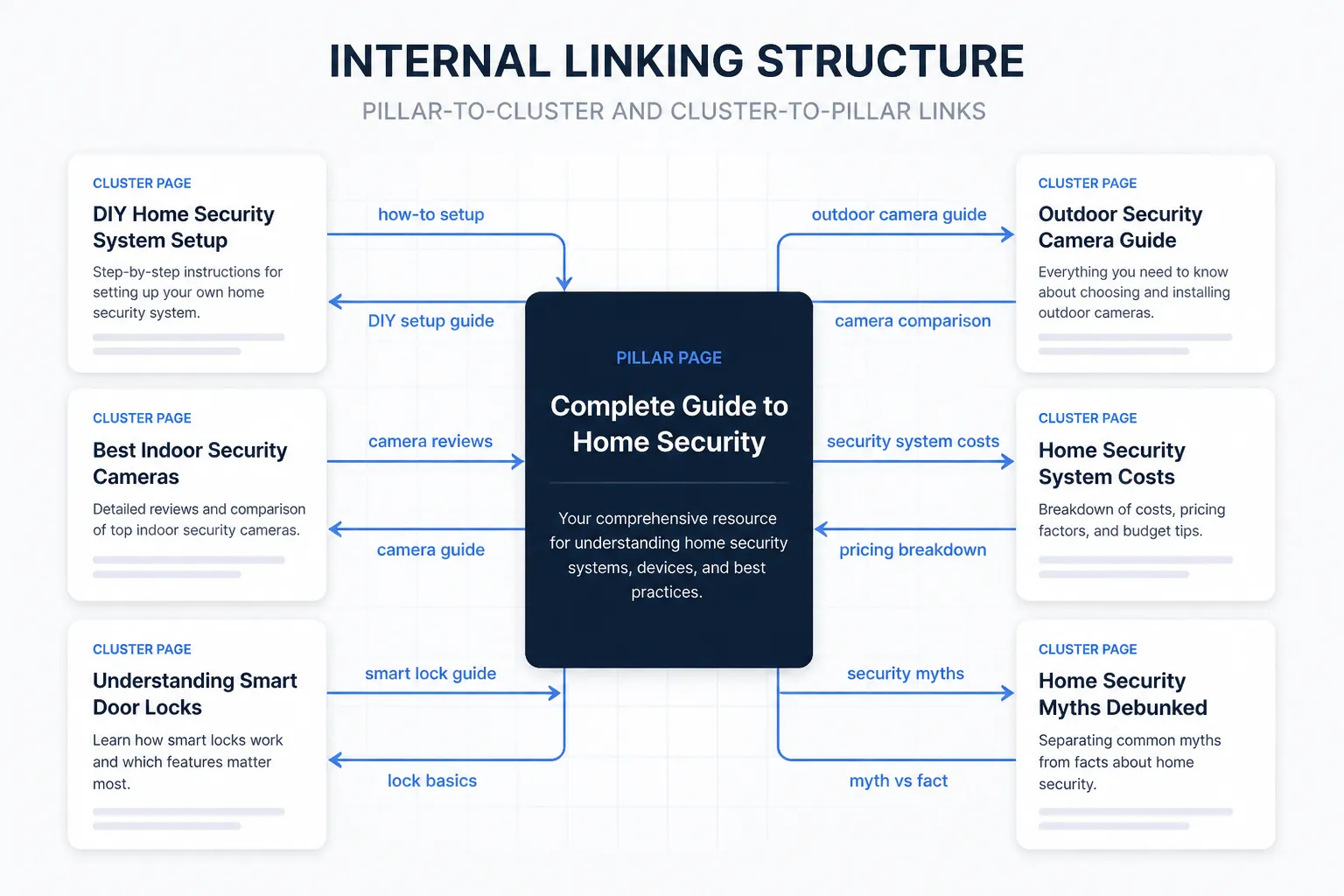
Internal linking works best when the pillar page acts as the central hub in a hub-and-spoke model of content. Your pillar should point to every relevant cluster page, and every cluster should point back to the pillar. That two-way structure helps search engines read the site map, see the topical relationship, and connect broad intent with narrower subtopics.
The strongest internal linking pattern is simple, disciplined, and easy to follow. Keep the flow moving from broad to narrow topics. Avoid jumping across multiple layers in one step. Signals should move upward from cluster pages to the pillar, then back down to the most important subpages and adjacent topics, including commercial or money pages when they fit the user journey.
Anchor text does a lot of the heavy lifting here. Use descriptive wording that tells the reader what the next page covers, such as the topic, entity, or subtopic being referenced. Vary the phrasing across the cluster so the pattern feels natural and avoids repetitive, over-optimized links.
A practical linking system usually looks like this:
- Pillar to clusters: Link from the main page to each supporting page where the topic is explained in more detail.
- Clusters back to pillar: Link from each supporting page to the main page so authority flows upward.
- Sibling to sibling: Cross-link related spokes when one page answers a neighboring question that genuinely helps the reader.
- Context-rich placement: Put links in the opening explanation and in relevant body copy where the surrounding sentence clarifies why the page matters.
- Priority routing: Send the strongest signals toward the pages that need visibility most, then redistribute that value to adjacent topics that support conversion.
That horizontal cross-linking matters, but only when the connection is real. A cluster about keyword research can point to a page about intent mapping if the reader needs that next step. It should not force a detour back to the pillar after every click. SEO improves when the crawl path feels logical, not crowded.
Audit Links For Depth, Relevance, And Crawlability
Start with link depth. Your pillar should sit at the center of 8 to 12 supporting cluster articles, and each cluster page should point back to it so internal linking builds one clear hierarchy instead of scattering authority across unrelated URLs. The topical authority audit checklist is a useful companion when you want to pressure-test that structure against the rest of the site.
Relevance matters just as much as volume. Every internal link should fit the surrounding paragraph, stay inside the same silo, or move only one level up or down in the topical map. If a link crosses categories, it should do real work for navigation. Strong anchor text helps here because it tells users and search engines what the destination page covers. Keep anchors descriptive, varied, and free of repeated exact-match patterns or filler phrases like “click here” or “read more.”
Crawlability is the next gate. The pillar needs to load fast, work cleanly on mobile, stay public, and render without barriers that block search engines or AI systems. Technical SEO signals should support that access:
- Heading structure: Use one clear H1, then logical H2 and H3 sections.
- Jump links: Make on-page navigation functional and easy to follow.
- Schema markup: Add markup that can help the page qualify for richer SERP features and AI consumption.
The final pass is the closed authority loop. The pillar points to the right clusters, the clusters point back with natural anchors, and the strongest paths keep reinforcing the same core entity. When that loop holds, equity compounds around one topic instead of leaking into weak or off-topic pages.
How Do You Measure Pillar Page Performance Over Time?
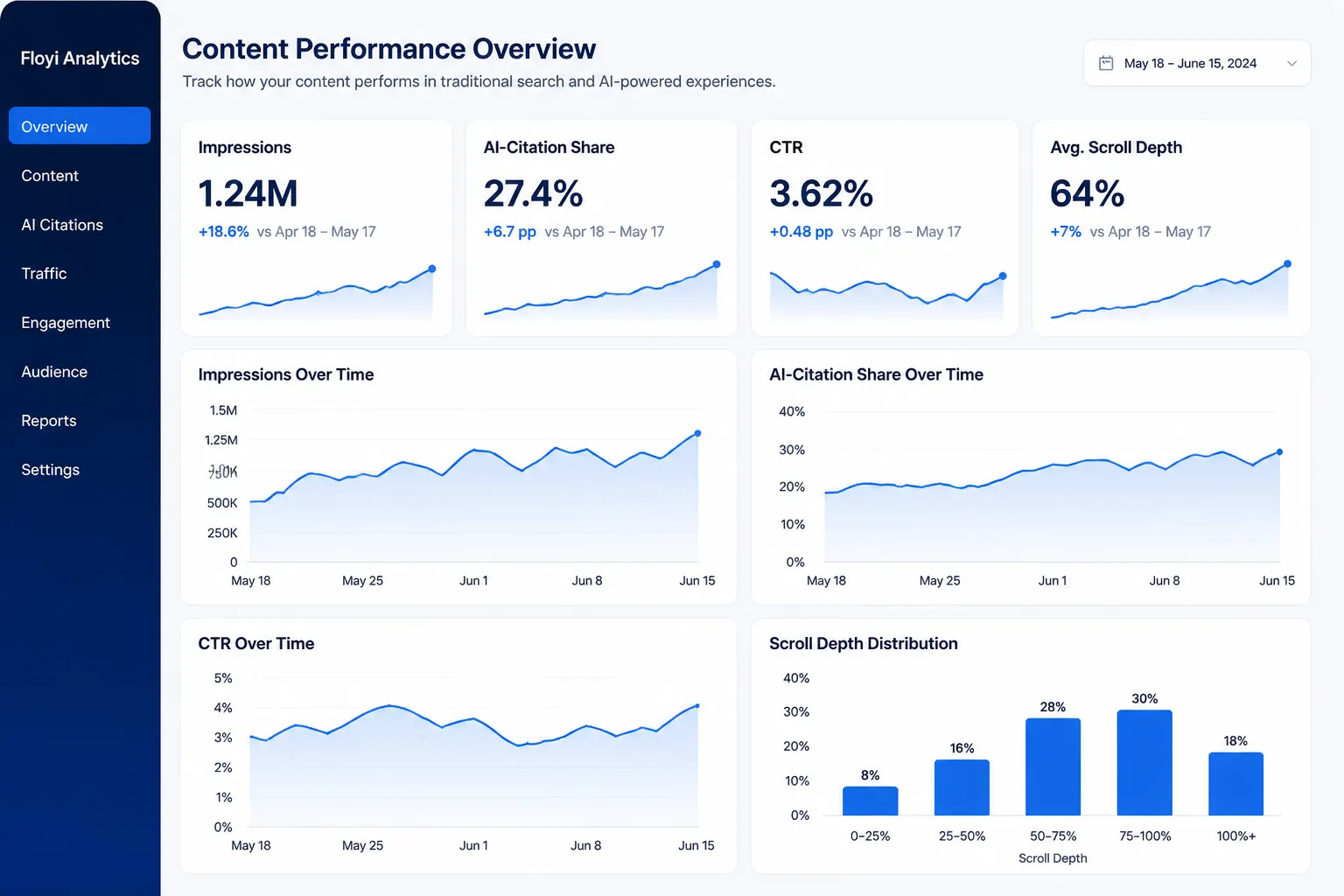
Measure the pillar at the query level first. Page traffic alone can hide what’s working and what’s drifting. You need the core pillar query and the cluster questions it is meant to answer. Break those queries out by intent type, then connect SEO and analytics data so rankings, SERP features, and click behavior all point back to the same topic cluster.
A practical scorecard blends visibility, engagement, and AI signals:
| Metric set | What to watch | What it tells you |
|---|---|---|
| Search visibility | Impressions, clicks, CTR, average position, SERP feature presence in Google Search Console | Whether the pillar is earning attention and holding demand |
| On-page engagement | Scroll depth, time on page, internal click-through rate, conversion lift | Whether readers are moving deeper into the cluster and taking action |
| AI visibility | AI-citation share, answer presence, and share of voice across Google AI Overviews, AI Mode, ChatGPT Search, Gemini, and similar answer surfaces | Whether the pillar is becoming a cited source in AI-driven search |
The best pillar pages do more than rank. They become the topic’s trusted answer. When AI systems consistently cite the hub, summarize it accurately, and pull supporting passages from cluster pages, the page is doing the job AI search rewards. That’s a strong sign your topical authority is holding up against competing hubs.
Use a steady cadence so the data stays useful:
- Weekly: Check AI citations, answer presence, share of voice, CTR, and engagement anomalies.
- Biweekly: Refine lead answers, headings, and internal anchors where the page is underperforming.
- Monthly: Review conversions, topic coverage, link audits, and pruning or consolidation when cannibalization appears.
Trend direction should drive the decision, not one snapshot. A pillar that keeps rankings but loses AI visibility, engagement depth, or internal click-through rate is slipping as an answer source. A pillar that gains citations and assisted conversions is proving that it is improving discoverability and downstream business value. Watch the curve, then update before decay sets in.
Track KPIs And AI Citation Signals
Track a narrow KPI set so search visibility and AI visibility stay separate in reporting. The most useful mix is AI-citation share, answer inclusion rate, share of voice, organic and AI-surface CTR, assisted conversions, and scroll depth on the pillar page. Keep the same field names every week. That consistency makes trend lines readable across engines, pages, and AI models.
A simple dashboard should split the story by engine and query set, not just by rank. Google AI Overviews, ChatGPT Search, Gemini, and similar surfaces can cite the same domain for different reasons, so compare treatment pages against a control group on a weekly baseline. Add entity visibility to the scorecard, too. When the pillar maps the core entity to related fan-out questions, AI search is more likely to treat it as complete coverage than as a thin keyword match.
| Metric | What it tells you | Where to pull it |
|---|---|---|
| AI-citation share | How often your domain appears in AI answers | AI answer checks |
| Answer inclusion rate | Whether the pillar appears in direct answers | SERP and AI checks |
| Internal CTR | How often readers move deeper into the cluster | Analytics |
| Scroll depth | Whether the pillar is holding attention | Analytics |
| Entity visibility | How fully the page covers the topic graph | Content audit |
One operational dashboard in Google Search Console, analytics, and Looker Studio is enough for most teams. Pair it with a weekly query-by-engine table so you can see which subtopics earn citations. Track engagement signals in the same view so the AI story and the user story stay connected.
Keep the targets simple. Aim for AI-citation share above the control group by 10% for three straight weeks, answer inclusion in at least half of weekly checks, and share of voice up by 5 percentage points by week 8. Rising scroll depth and internal CTR should confirm that the pillar is moving readers into the cluster.
How Do You Upgrade Legacy Content Into AI-Ready Hubs?
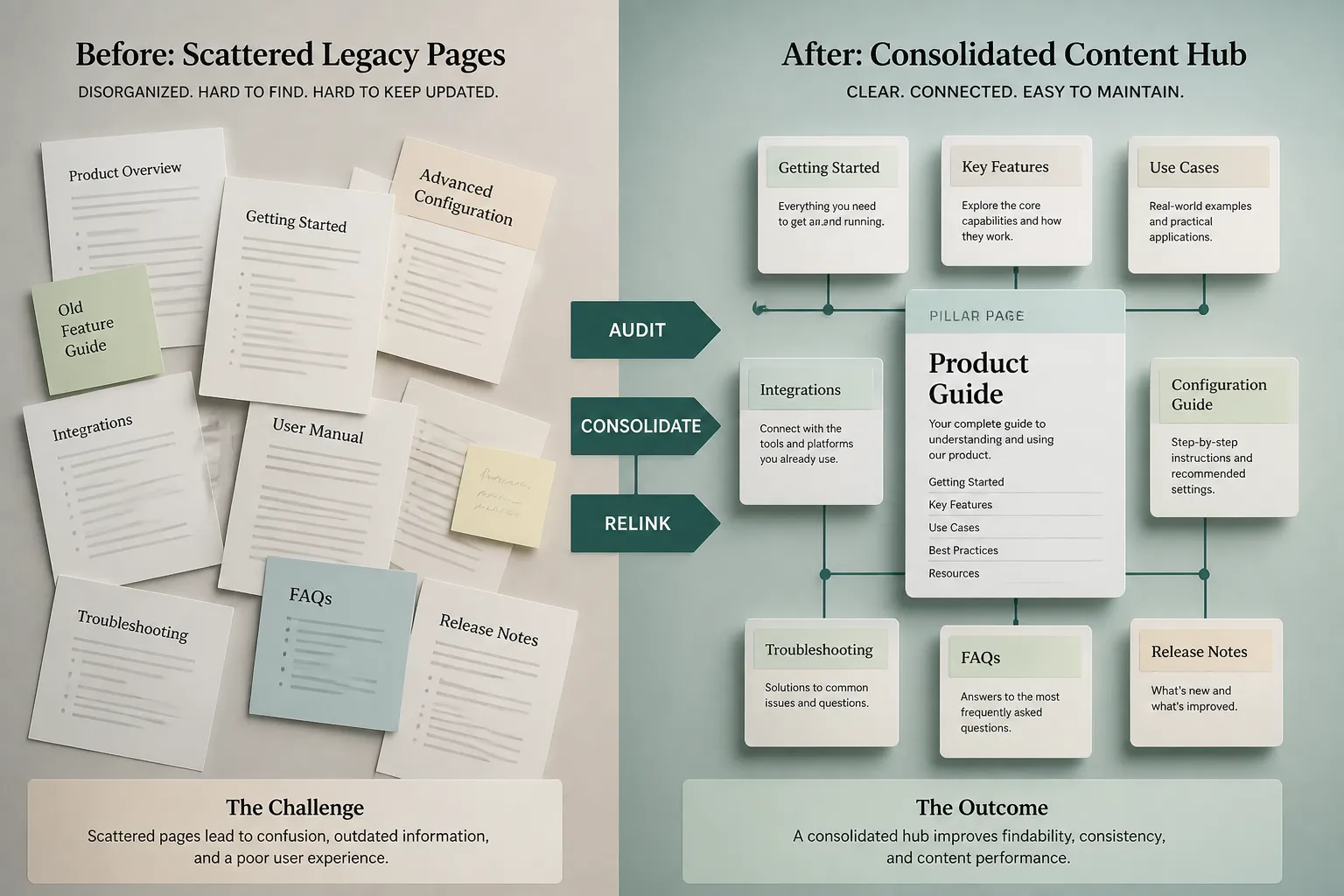
Legacy pages turn into strong AI-ready hubs when you rebuild them as a system, not as a one-off rewrite. Start with a legacy audit that sorts every URL into keep, optimize, consolidate, or prune. Then rank the survivors by business value and search opportunity.
A content planning framework gives that audit a clear target. It helps you decide which pages deserve hub treatment and which ones should stay in place for now.
The audit should also surface cannibalization before you spend time rebuilding. Compare SERP overlap, quick intent checks, and each page’s actual role in the journey. If two posts chase the same query but answer it at different depths, one usually becomes the primary asset while the other gets folded in, redirected, or retired.
Entity work comes next. Map the core topic, then trace the fan-out questions, subtopics, and supporting terms already scattered across your library. Broad pillar targets should own the main high-volume topic. Long-tail cluster pages should handle the conversational, intent-driven variations. That is where content mapping earns its keep, because it shows where coverage is thin, duplicated, or missing.
A simple consolidation frame keeps the rebuild moving:
| Page type | Best move | Result |
|---|---|---|
| Near-duplicate post | Merge into the main pillar | Cleaner authority and less overlap |
| Outdated explainer | Fold into a current section | Better accuracy without extra pages |
| Thin supporting article | Expand or repurpose as a cluster page | Stronger semantic coverage |
| Off-topic or low-value page | Prune or redirect | Less clutter and better crawl paths |
Once you know what stays, reshape the strongest page into one of your content hubs. Use crisp section blurbs, clear headers, and internal anchors that make the page easy to scan and easier for AI systems to quote. If the legacy page already has strong bones, treat it as a working skeleton and ship version 1 fast. Then improve the modular sections over time instead of waiting for a perfect rewrite.
The finishing layer is what makes the page feel complete. Add concise definitions, step-by-step explanations, original insight where you have it, and schema markup that reinforces meaning. Keep the page focused and useful. A 2,000-plus-word hub only works when every section earns its place.
A practical rollout looks like this:
- Build the hub from the strongest surviving page.
- Publish the supporting cluster pages around it.
- Link the hub to each cluster and link each cluster back to the hub.
- Add cross-links between related pages where they help the reader.
- Recheck the topology for overlap, gaps, and weak semantic coverage.
That final relink pass matters because it makes the upgraded hub the clearest authority destination on the site. Done well, the structure supports better pillar page examples, stronger internal discovery, and a cleaner path for AI to cite the right page.
How Do You Write Pillar Pages That AI Can Cite?
AI can cite pillar pages more easily when the page reads like a structured answer set, not a keyword dump. The cleanest approach is an entity-first outline. Each major section should center on one concept, one question, or one relationship so the page feels like a knowledge map instead of a loose SEO topic list.
A strong pillar page template can start with the answer and then add depth in a consistent order. That approach helps readers and search systems find the core point quickly and can make the page easier to quote.
Under each heading, extend the Blurb-First method with this fixed sequence:
- Direct answer: Open with 2 to 3 plain sentences that answer the heading immediately.
- Short explanation: Add the context, scope, or nuance the first answer leaves out.
- Practical example: Show how the idea works in a real search or content scenario.
- Evidence or takeaway: Close with a proof point, definition source, or clear implication.
That rhythm gives you comprehensive content without burying the main point. It also makes each section easier to quote, which is exactly what you want when AI systems are scanning for clean citations.
Natural question-and-answer coverage matters just as much as structure. Real questions make stronger subheads than polished marketing phrases because they match voice search, People Also Ask patterns, and the way people actually frame problems. An FAQ section at the bottom helps you capture long-tail cluster questions without cramming them into the body copy.
Semantic coverage does the rest of the work. AI does not need the same phrase repeated over and over. It needs related entities, modifiers, and adjacent concepts that show the topic has depth, such as audience intent, search behavior, use cases, internal linking, page type, and schema markup.
A simple repeatable pattern keeps the whole page machine-friendly:
| Part of the section | What it does | Why it helps citation |
|---|---|---|
| Definition or direct answer | States the core idea fast | Gives AI a clean snippet to quote |
| Short explanation | Adds context and nuance | Clarifies the meaning of the answer |
| Practical example | Shows the concept in use | Makes the passage easier to trust |
| Evidence or takeaway | Supports the claim | Creates a visible citation target |
Visible proof blocks belong close to the claim they support. A benchmark, a statistic, a brief methodology note, or a source-backed definition gives AI a clear place to anchor the citation. That also strengthens E-E-A-T because the page shows care, specificity, and editorial discipline.
Use this structure as your pillar page template, and each section becomes easier to scan, easier to quote, and easier for AI search to surface.
What Benchmarks And Tools Prove Pillar Page ROI?
A clean ROI baseline starts with a side-by-side view of pillar pages and standalone posts over the same window. Compare organic traffic, rankings, assisted conversions, and AI citation share so you can prove lift instead of describing activity. Compare pillar-plus-cluster pages with isolated pages on broad head terms and long-tail, intent-driven queries. The goal is to see whether the structured system captures more of the topic than standalone pages do.
Google Search Console should be the source of truth for demand and visibility. Track these signals:
- Reach: impressions, clicks, CTR, and average position
- Growth: query growth and new terms won by the pillar
- Coverage split: the exact searches captured by the pillar page versus cluster pages
- Behavior: the engagement signals that show whether the page holds attention
That split tells you whether the pillar owns the broad topic while supporting content captures the follow-up questions.
Pair GSC with Ahrefs and Semrush to prove topical authority and competitive strength. Ahrefs helps you review Matching Terms, Parent Topics, SERP Overview patterns, and entity gaps. Semrush helps you watch ranking momentum, keyword overlap, and share of voice. Together, they show whether your coverage is expanding into more queries instead of defending one position.
A practical benchmark stack looks like this:
| Metric area | What to measure | Why it matters |
|---|---|---|
| SEO reach | Impressions, clicks, CTR, average position | Shows demand capture and visibility changes |
| Coverage | Query growth, keyword overlap, entity gaps | Shows breadth across the topic cluster |
| AI visibility | AI-citation share, answer presence, share of voice | Shows whether the page is visible in AI surfaces |
| Revenue impact | Assisted conversions, form fills, opportunity influence | Shows downstream business value |
AI visibility needs its own scorecard now. Track AI-citation share, answer presence, and share of voice across Google AI Overviews, AI Mode, ChatGPT Search, Gemini, and other relevant assistants. A useful internal benchmark is to compare Treatment with Control over several weeks and track AI-citation share and answer presence in the same way each time. Set the percentage threshold from your baseline data instead of assuming a universal standard.
HubSpot adds the pipeline layer. Use hub-level reporting to connect pillar-page sessions to assisted conversions, form fills, and opportunity influence, then segment by page type. That makes it easier to show whether the pillar generates better qualified entry points than cluster pages alone.
Competitive and semantic benchmarking makes the proof sharper. Use content-gap reports to surface missing entities, question-tree analysis to map People Also Ask depth, and SERP views to compare structure, length, link patterns, and feature coverage. Pillars should be measured as entity-rich systems, not single pages.
Weekly telemetry keeps the story honest. Publish one dashboard for the pillar URL, compare Treatment versus Control, and summarize traffic lift, citation lift, and conversion lift together. If impressions, citations, and assisted conversions are not improving in tandem, the pillar is not yet proving return on investment.
About the author

Yoyao Hsueh
Yoyao Hsueh is the founder and CEO of Floyi, the topical authority platform, and the founder of Main Heading, an SEO and AI search agency. He created Topical Maps Unlocked, a course studied by thousands of SEOs, content strategists and digital marketers, founded TopicalMap.com, a done-for-you topical mapping service for agencies and enterprise teams, and publishes the weekly Digital Surfer newsletter on SEO, content strategy and AI search.
About Floyi
Floyi is a closed loop system for strategic content. It connects brand foundations, audience insights, topical research, maps, briefs, and publishing so every new article builds real topical authority.
See the Floyi workflow