
Automated Topical Mapping: Complete Guide to Content Clustering
Learn automated topical mapping and content clustering strategies to build semantic authority, prevent cannibalization, and scale content efficiently.
Manual keyword grouping is where most content strategies stall. A 5,000-term export takes a week to sort, and what comes out is usually a tangled spreadsheet nobody trusts. Automated topical mapping replaces that work with AI and NLP, grouping keywords by intent and meaning into layered clusters that scale topical authority faster for SEO agencies and in-house content teams. Each page ends up with a clear job in the content system.
The workflow covers SERP research, keyword clustering, pillar and cluster mapping, briefing, QA, and automation for internal links and refresh rules. The outputs are topic lists, AI-assisted briefs, and a cleaner handoff for production.
For agency leaders, technical SEO specialists, and growth teams managing multiple brands or product lines, the value is faster planning, tighter brand voice consistency, and clearer ROI. A 1,000-keyword export can become 60 to 80 clusters in under a minute. The freed time goes into editing, prioritization, and review. Keep reading to see how the method, page structure, and maintenance rules work together.
Automated Topical Mapping Key Takeaways
- AI and NLP group keywords into intent-based semantic clusters.
- SERP overlap validates cluster boundaries against live search results.
- Pillar pages and cluster pages create a clear topical hierarchy.
- Bidirectional internal links pass relevance through the topic tree.
- Entity grouping exposes missing concepts and coverage gaps.
- Quarterly refreshes keep clusters aligned with shifting SERPs and rankings.
- Strong maps reduce cannibalization and speed content brief production.
What is Automated Topical Mapping and Why Does It Matter?
Automated topical mapping uses artificial intelligence (AI) and natural language processing (NLP) to sort hundreds or thousands of keywords into semantic clusters by search intent and meaning. The output is a layered content structure with pillar topics, supporting subtopics, and keyword targets that can extend across four levels. For SEO agency leaders and in-house strategists, that turns the pillar-and-cluster topical map workflow into a repeatable system for content clustering and internal linking.
The speed gain is what makes the workflow easier to justify. Topical Map AI’s documentation reports the platform can generate 60-80 topic clusters and 800-1,200 keywords in under 60 seconds. Manual keyword grouping shrinks dramatically. Writers and strategists get more room for briefs, prioritization, and QA.
When you compare AI-powered topical map tools, the real differences show up in SERP validation and handoff quality. Some tools match clusters to live search results and turn them into briefs that fit your content strategy. Others visualize content structure well but stop short on linking guidance or downstream production.
The business case isn’t just speed. Reported results from HubSpot show content cluster strategies can produce 3.5x more backlinks and 55% organic traffic growth over 12 months. Search Engine Journal also reported 72% of B2B marketers rated content clusters as their most effective SEO tactic across 2024 to 2025.
Topical maps work as execution blueprints:
- Validate ideas against SERP data.
- Assign page intent so each URL has a clear job.
- Map anchor text guidance and internal links.
- Show the plan in spreadsheet, silo, or outline form.
The blueprint reduces ambiguity, supports better AI SEO tools workflows, and shortens time-to-publish. Teams stop guessing where each page belongs.
How Does Topical Mapping Build Semantic Authority?
Topical mapping organizes a core subject into pillar pages, supporting subtopics, and long-tail queries. The structure tells search engines your site covers a subject in depth. Topical relevance and topical authority both strengthen as a result.
The main signals look like this:
| Layer | What it signals | SEO effect |
|---|---|---|
| Main topic | Core subject ownership | Helps a pillar page compete on broader queries |
| Subtopics | Related attributes and use cases | Reinforces semantic SEO and internal linking depth |
| Long-tail pages | Specific questions and pain points | Captures lower-funnel demand and expands coverage |
| Entity clusters | Named concepts and relationships | Strengthens trust across the whole site |
Search engines also evaluate entities: the real-world people, products, and concepts tied to a topic. A map built around electric vehicles can connect battery technology, charging infrastructure, range, and ownership costs into a coherent cluster. The consistency helps AI systems interpret the content and cite it more reliably in generative results.
Internal links form the second layer of authority. A strong hierarchy passes relevance from the pillar page to supporting articles and back again. Link equity moves across the cluster instead of pooling on one URL. The same patterns are covered in detail in this guide on topical map internal linking.
The hierarchy helps a well-covered pillar rank for harder terms without relying as heavily on outside backlinks. It also limits keyword cannibalization by giving each page a distinct role.
The pattern isn’t theoretical. HubSpot’s 2024 content marketing data linked content clusters to stronger rankings across primary and long-tail terms. Backlinko documented a case study that moved organic visits from 50,000 to 376,000 per month using seven pillar pages and 91 cluster articles. Those outcomes show how a complete map can create a topical moat, improve rankings across primary and long-tail terms, and satisfy experience, expertise, authoritativeness, and trustworthiness (E-E-A-T) criteria with depth, clarity, and visible subject coverage.
How Do You Build Pillar Pages and Cluster Architecture?
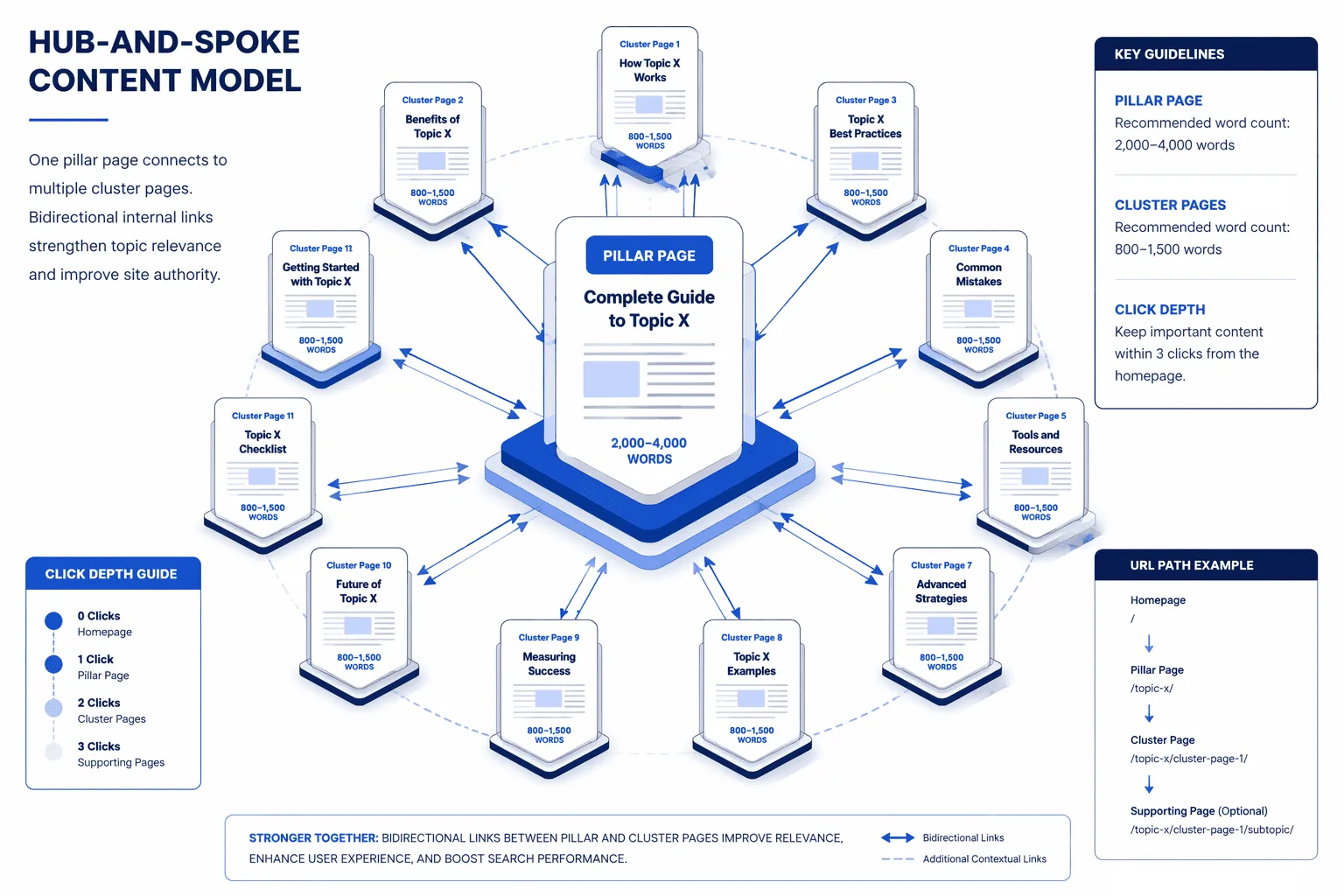
Pillar pages give the broad overview. Cluster articles handle one subtopic or long-tail question in focused detail. Together, they create a clear content hierarchy and a cleaner content structure for users and search engines. The hub-and-spoke model works better than a pile of disconnected posts.
A strong build usually has three parts:
- A pillar page that covers the main topic in about 2,000 to 4,000 words
- 10 to 20 cluster articles that go deep on related questions, use cases, or terms
- Bidirectional internal links that connect the pillar to each cluster article and send readers back to the hub
This linking pattern moves link equity through the cluster. Search engines read the topic as a connected body of expertise. Each page gets a clear job inside the content strategy. Content organization gets stronger as a result.
Topical hierarchy matters as much as page count. Broad topics should sit close to the home page, usually at click depth 1. From there, branch into two or three levels of subtopics.
Group keywords by semantic similarity at each level, with about 40% overlap. Mirror that path in the URL structure. A route like /smart-home/thermostats/nest-learning-thermostat/reset helps users and crawlers read the relationship fast.
The performance upside is measurable. Cluster-based content architecture has been associated with improved crawl efficiency and featured snippet performance compared to traditional site structures. Teams implementing pillar-and-cluster models should track crawl rate trends and snippet acquisition in Google Search Console to measure impact on their own sites. Pillar pages that cover subtopics thoroughly can rank for harder terms without depending as much on external backlinks.
A practical rollout works best when you build one silo at a time:
- Pick one topic family and stay focused until the cluster is complete.
- Expand related themes before moving to a new niche.
- Use AI-assisted drafting for speed. Keep the structure clear and the copy specific.
One strong silo around dogs and dog food usually builds more trust than scattered posts across unrelated topics. Topical coverage doesn’t replace backlinks or credibility signals. It helps the right pages earn trust, quote-worthy passages, and better citation odds. Clear, well-structured pages beat mass-produced volume every time.
What Clustering Methodologies Should You Use?
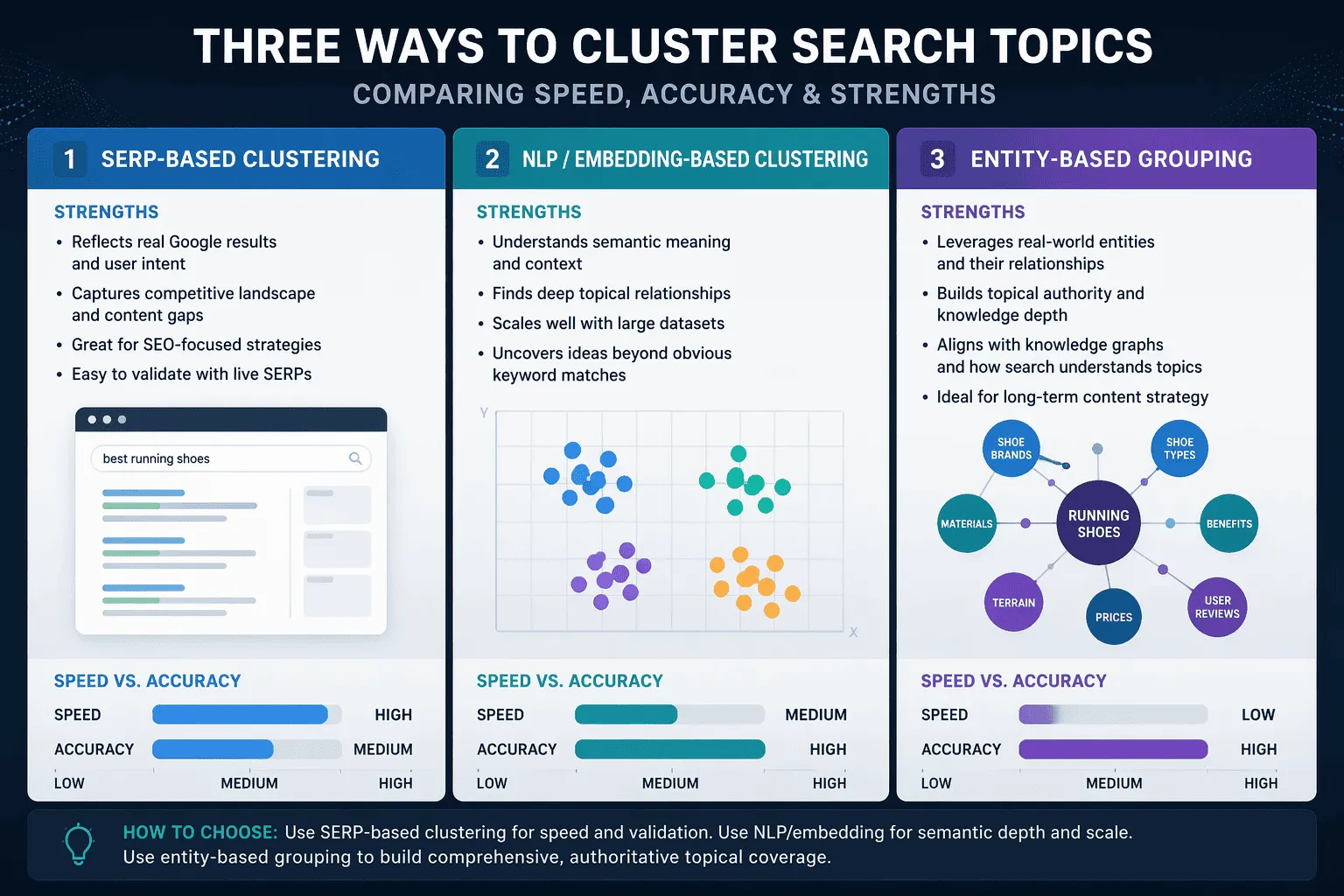
The best content clustering choice depends on whether you need accuracy, speed, or semantic depth. Teams may see stronger results when combining methods rather than relying on a single approach. Strong content clustering blends SERP clustering, semantic clustering, and entity analysis. Topics match search intent and still scale across large sites or multiple brands.
A practical comparison looks like this:
| Method | Best fit | Strength | Tradeoff |
|---|---|---|---|
| SERP-based clustering | Competitive topics and core pillars | Matches real search intent by grouping keywords from live results | Slower and more dependent on current SERP access |
| NLP and embedding-based clustering | Large keyword sets and fast expansion | Scales well with semantic similarity and search intent classification | Can miss SERP nuance if used alone |
| Entity-based grouping | Topical authority and coverage checks | Surfaces concepts, subtopics, and knowledge graph connections | Needs clean entity extraction to work well |
SERP-based clustering is the safest choice when precision matters most. It reads live search results. Clusters reflect how Google already groups related topics. The approach fits competitive markets where misalignment wastes content and weakens topical authority.
NLP keyword analysis is better when speed matters. Teams managing 5,000+ keywords often need a fast first pass. Embedding models can group terms by meaning without waiting on live SERP pulls. The approach is useful for rapid content scaling and SMB teams that want less tool sprawl.
Entity-based grouping adds a second layer of validation. It catches semantic relationships keyword clustering often misses: missing concepts, repeated entities, and coverage gaps against competitor pages or AI answers. The check exposes blind spots that would otherwise stay hidden.
The strongest workflow uses all three methods together:
- Start with SERP-based clusters for core pages and pillars.
- Use NLP clustering to expand into new topics quickly.
- Validate entities to confirm coverage and expose missing subtopics.
The layered approach gives you accuracy, speed, and completeness without adding unnecessary process.
SERP-Based Clustering — The Most Accurate Approach
SERP-based clustering is the most reliable way to group keywords because it follows what Google already ranks together. If 7 of 10 URLs overlap for two queries, those keywords share search intent and compete for the same ranking space. The cluster becomes useful in practice, not just similar on paper.
URL overlap usually beats embeddings or NLP alone. The SERP shows search intent and how the market is actually organized. Semantic models suggest related terms. Live results reveal which pages users expect to see and which content types win.
For SEO teams, the SERP becomes the source of truth for cluster boundaries.
A practical workflow looks like this:
- Fetch live SERP data for your keyword list.
- Compare URL overlap across keyword pairs.
- Set an overlap threshold, often between 20% and 90%, based on how strict you want the grouping to be.
- Group keywords that pass the threshold into one cluster.
- Pick a centroid keyword that best represents the cluster. Build the page around that target.
This approach reduces topical overlap and cuts down on guesswork. It keeps clusters tied to real search behavior instead of theoretical similarity. Live SERP data helps prioritize topics with clearer ranking potential and stronger audience demand. The content strategy stays focused on the pages most likely to earn visibility.
NLP and Embedding-Based Clustering — Speed and Scalability
NLP keyword analysis turns messy keyword lists into machine-readable data. Keyword clustering becomes faster, cleaner, and easier to scale across large accounts. For AI keyword research, the practical gain is semantic clustering that groups related intent without forcing a human to inspect every row.
The preprocessing layer usually starts with three steps:
- Tokenization splits a query into individual words or short phrases.
- Stopword removal filters filler terms such as “the,” “and,” or “of.”
- Stemming or lemmatization reduces word forms to a shared root, so “running” and “ran” can map back to “run.”
These steps normalize the data before vectorization begins. Cleaner input reduces noise and helps clustering logic produce fewer false matches.
Vectorization converts each keyword into a point in multi-dimensional space. Different methods shape that space in different ways.
| Method | What it captures | Best use |
|---|---|---|
| TF-IDF | Frequency and uniqueness | Fast baseline clustering |
| Word2Vec | Word relationships from context | Broader semantic grouping |
| BERT | Contextual meaning in a query | Ambiguous or complex keyword sets |
Keywords that land closer together in that space tend to share intent. Distance-based methods such as cosine similarity can assign clusters in milliseconds. The speed makes the approach practical for hundreds or thousands of terms. Large product catalogs and multi-brand workflows benefit more than manual SERP review.
BERT and other transformer models usually outperform older methods when context matters. They reduce false positives, keep clusters tighter, and improve the quality of semantic clustering even when the keyword set is messy. Libraries like spaCy and NLTK handle much of the NLP and embedding workflow. Teams can plug them into existing SEO tools and content platforms without building the pipeline from scratch.
Entity-Based Grouping — Semantic Relationships and Knowledge Graphs
Entity-based grouping helps you organize SEO around nouns and concepts instead of isolated terms. The process identifies people, organizations, products, locations, and ideas, then maps how those entities connect. The view shows where your cluster architecture is thin and where new cluster articles belong.
Knowledge graphs make those relationships visible. Each entity becomes a node. Each connection becomes an edge. Edge strength rises when two entities appear together across multiple sources, helping search engines and LLMs read both coverage and relationship depth.
Generative engine optimization depends on entity relationships, not just topic matches. AI systems need clear signals about how ideas relate, which pages matter most, and which supporting pages deserve citation. Entity-aware structures make content easier to parse for AI answers and GEO-ready topic maps.
A practical workflow looks like this:
- Extract entities from keyword research and existing pages with named entity recognition (NER).
- Build a filtered entity graph that only includes entities relevant to your site or client.
- Weight edges by co-occurrence frequency across briefs, URLs, and supporting sources.
- Identify high-degree nodes and use them to anchor pillar pages.
- Place secondary entities in cluster articles and supporting FAQs.
If a map covers machine learning but never surfaces supervised learning or neural networks, you’ve found a real content gap, not just a keyword miss. The gap points to a specific subtopic, a new supporting page, or a better internal link. GEO-ready topic maps work best when they combine entities, relationships, FAQs, and internal linking. AI systems can then parse the structure and cite the right source.
How Do You Implement Topical Mapping From Keyword Research to Content Briefs?
Building a topical map starts with real search data, not assumptions. The process only works when you anchor it in Google Search Console, competitor sitemaps, keyword platforms, and People Also Ask results. AI keyword research and automated content planning become far more useful once the raw dataset reflects actual search behavior.
The workflow moves through three stages before brief creation and review:
-
Data mining. Start with raw terms from these sources:
- Google Search Console
- competitor sitemaps
- Ahrefs, SEMrush, Google Keyword Planner, and Ubersuggest
- People Also Ask
This gives you a broad keyword base, surfaces content gaps, and reduces manual research time for teams managing multiple brands.
-
Clustering. Use NLP and SERP overlap to group terms by intent and result similarity.
- Keep keywords that trigger the same page types together.
- Split terms with different search goals into separate clusters.
- Use the result patterns to reduce topical overlap and cannibalization.
-
Mapping. Place each cluster into a pillar-and-cluster structure.
- Flag missing coverage.
- Assign intent at each level.
- Suggest internal-link anchor text.
Most sites need 2 to 4 levels, depending on niche breadth.
AI SEO tools can speed up the process. The structure still needs business validation. Check it against revenue priorities and audience fit before you publish. Validation points:
- Revenue priorities
- Buyer personas
- Competitor positioning
Narrow niches often work with 2 to 3 layers. Broader categories may need 4 to support authority building.
The handoff becomes easier when you export the map in a format the team can sort and scan:
| Stage | Main output | Best use |
|---|---|---|
| Data mining | Raw keyword set | Fast discovery across sources |
| Clustering | Intent-based groups | Reduce duplication and overlap |
| Mapping | Topical hierarchy | Plan publishing and internal links |
| Briefs | Draftable content specs | Speed up production |
Once the map is locked, generate briefs for each cluster with these elements:
- Target keywords
- Intent classification
- Title ideas
- Outline structure
Human editors should then trim, reorder, and refine the draft so it matches audience insight, brand voice, and business goals. We usually see the strongest results when that editing step stays tied to the same standards across client accounts and product lines, especially with a content brief workflow built on the topical map.
The map should stay live after launch. As content ships and performance data comes in, refine cluster boundaries, add seasonal or trending topics, and expand into adjacent silos where the site has earned enough authority to grow. The discipline keeps topical mapping tied to search demand instead of a one-time spreadsheet.
How Do You Prevent Keyword Cannibalization and Validate Cluster Quality?
Keyword cannibalization happens when multiple pages compete for the same query and the same intent. The conflict splits ranking signals, weakens topical authority, and makes it harder for Google to choose a clear primary page. Building your topical map first prevents that drift. Each topic gets one home before legacy content is audited.
Cluster quality starts with intent, not wording. If two keywords serve the same search need, they belong together even when the phrasing changes. Aim for 3 to 5 closely related keywords per cluster. Each page gets semantic depth and internal linking room without becoming vague or unworkable.
A simple validation routine helps you check alignment before publishing or reorganizing content:
- Compare the top 10 results for each target keyword.
- Confirm that the SERPs reflect the same user intent.
- Flag your own pages if more than one ranks for the same query family.
- Treat 70% or greater SERP overlap as a signal that the keywords belong in one cluster or that one should be deprioritized.
| Orphan page status | Best move |
|---|---|
| Strong SERP fit and clear intent | Add it to an existing cluster |
| Overlapping page with weaker value | Merge it into a stronger asset |
| Unique topic with demand | Create a new cluster around it |
| Thin or off-strategy content | Delete or redirect it |
Orphan pages are published URLs that don’t fit any cluster in your topical map. They scatter authority instead of reinforcing it. Map existing URLs against the new structure, then decide whether the orphan should be kept, merged, redirected, or developed into a new cluster.
Input quality matters just as much as structure. Before clustering, remove branded keywords that distort the set, merge duplicates, and flag terms with conflicting intent, like queries that rank for both how-to content and product review content. The cleanup keeps bad inputs from turning into bad clusters downstream.
Semantic stuffing is another quality risk. One target keyword plus 2 to 3 related terms is usually healthy. Ten or more close variations often looks manipulative.
About 23% of sites using topical maps drift into over-optimization. Cluster pages should read naturally and stay reader-first.
Topical maps also need maintenance. Re-run SERP analysis quarterly or at least semi-annually, and compare live rankings against the original map. If intent shifts or a page underperforms, tighten the cluster, split it, or consolidate pages. The structure stays aligned with search behavior.
What Internal Linking Strategy Maximizes Topical Authority?
A strong internal linking strategy starts with bidirectional links between pillar pages and supporting clusters. Pillar pages should point to the most relevant subtopics. Cluster pages should point back to the pillar. The two-way flow sends authority through the topic tree and helps search engines read your content organization more clearly.
Site architecture works best when it stays tight. Link related cluster pages at the same level when the topics are closely connected, such as one instrument page to another. Move only one step up or down when the relationship is clear. The discipline keeps topical signals clean and spreads link equity across semantically similar pages instead of scattering it across unrelated content.
The best internal links also live in the body copy. A paragraph link carries context a footer or sidebar can’t match. It guides readers to the next useful resource without interrupting the flow. Internal linking and cross-linking strategies for topical maps follow the same logic.
A practical workflow looks like this:
- Link each pillar page to the most relevant cluster pages.
- Link each cluster page back to its parent pillar.
- Cross-link sibling pages that share the same intent or entity set.
- Keep links one level up or down, not across distant branches.
- Place links in paragraph text where the surrounding copy supports the connection.
Anchor text should come from your topical map, not generic phrases. Descriptive wording gives each link a clear semantic signal, and varied phrasing avoids over-optimization. Grammar should still feel natural. The anchor needs to fit the sentence instead of sounding forced.
Automation makes this scalable for agencies. Semantic similarity tools can surface pages with 70% plus match rates and generate 500 plus internal link opportunities without manual audits. The automation saves research time, reduces missed connections, and makes it easier to grow topical authority across multiple brands.
Strong internal linking depends on repeatable rules, clear topic relationships, and disciplined content organization. When your links reflect how readers move through the subject, your pillar pages and clusters reinforce each other instead of competing for attention.
How Do You Optimize Topical Maps for Generative Engine Optimization (GEO)?
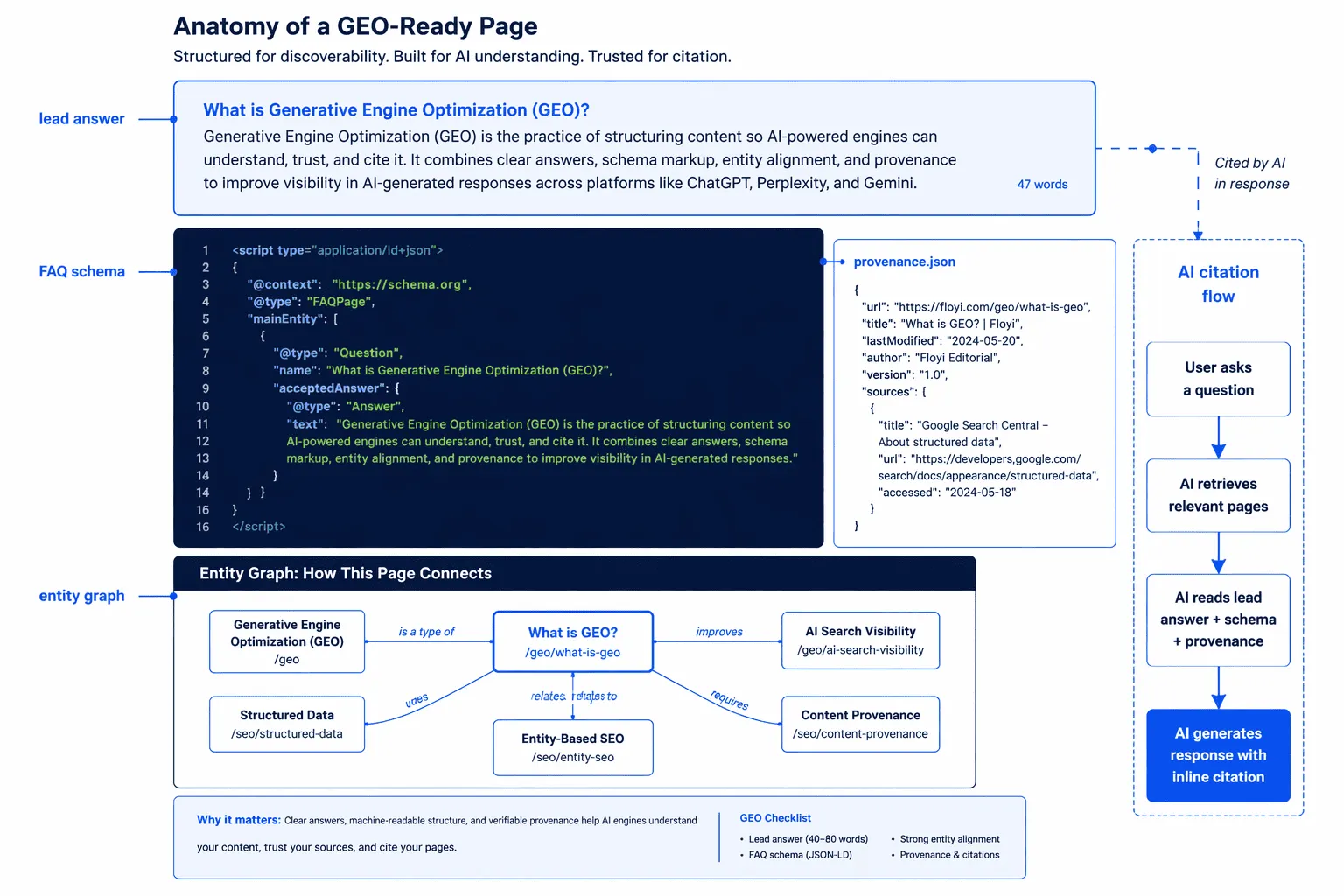
Optimizing topical maps for generative engine optimization means organizing content around entities, questions, and evidence instead of isolated keywords. AI systems read relationships between concepts, not just page-level terms. GEO-ready topic maps make those connections explicit. Search engines and Large Language Models (LLMs) parse, cite, and surface your content more reliably.
The strongest maps combine semantic SEO with entity-based grouping:
- Group pages by core entities and the relationships between them, not by keyword variants alone.
- Use node-based views in tools like Topical Map AI and Clumap to expose missing connections before you publish.
- Shape clusters so the architecture shows which concepts are primary, which are supporting, and which need deeper coverage.
- Build around EEAT criteria by adding clear authorship, evidence, and source signals that make each page easier to trust.
A GEO-ready page also needs evidence AI can extract cleanly. A concise lead answer positioned near the top of the page helps. A 40 to 80 word summary that directly addresses the user’s query helps AI systems extract and cite your content more reliably.
Add FAQPage and HowTo schema in JSON-LD. Tie each claim to on-page proof so the markup matches what a reader can verify. A /provenance.json file can map claim IDs to page URLs and anchors, giving AI systems a cleaner citation trail.
The page structure works best when it stays predictable:
- Lead with the answer and define the entity or process in plain language.
- Add question-answer pairs that reflect direct queries and the follow-up questions AI systems often generate.
- Use descriptive internal links that show how one entity relates to another, such as a pillar page pointing to a cluster page with relationship-based anchor text.
- Link each cluster page back to its pillar and sideways to related clusters so the topical hierarchy stays tight and easy to crawl.
- Keep claim IDs, URLs, and anchor text stable across updates, and version your dataset with date suffixes plus a methods file that records structural changes with timestamps.
The consistency helps generative systems trust your pages over time. The evidence trail stays stable between indexing and citation. When your map, schema, links, and update logs all point in the same direction, content gets easier for AI to quote with confidence and better aligned with GEO and semantic SEO goals.
How Do You Measure Topical Authority Success?
Topical authority success shows up as a pattern of signals, not a single vanity metric. Traffic, rankings, impressions, snippets, crawl behavior, and AI visibility should all move together before you call the strategy healthy. The mix reveals whether your topical moat is widening or whether the gains are still fragile.
Track these signals across the full topical map and by cluster:
| Metric | What it tells you | Where to measure it |
|---|---|---|
| Organic traffic growth | Whether a topic silo is producing real visits, not just rankings | Google Analytics 4 content groups |
| Ranking keyword count | Whether topical depth is expanding across primary and long-tail queries | Rank tracking and keyword maps |
| Impression trends | Whether search engines are surfacing more pages for the topic | Google Search Console |
| Featured snippets | Whether the structure is winning high-visibility SERP placement | SERP monitoring tools |
| Crawl rate | Whether search engines are finding and revisiting cluster pages faster | Log files and crawl reports |
Organic traffic growth should be isolated by topical cluster. The split separates topical authority from other SEO work. GA4 content groups show which silos drive value and which ones need stronger content, internal links, or better topical relevance.
The view also helps defend budget. The gains tie back to a specific content system.
Ranking keyword count matters because topical authority is broader than a few head terms. Healthy clusters earn visibility across primary queries and long-tail variations. Cluster-based structures have shown 2.3x higher crawl rates and far more keywords within the topic area. Rising impressions in Google Search Console are an early signal that often appears before traffic catches up.
Featured snippets and AI search visibility are your forward-looking markers. Clear, well-structured content is more likely to win featured snippets and earn citations in AI Overviews and ChatGPT Search. Those outcomes belong in the same dashboard as traditional rankings.
A simple Topical Authority Score keeps the picture readable:
- Content Authority: coverage and ranking performance of shipped pages
- Market Authority: your share of total ranking value versus competitors
- AI Authority: mentions and citations across AI search surfaces
Quarterly maintenance protects the gains you’ve built. Clusters can lose about 40% of their effectiveness within 12 months without upkeep. Refresh underperforming pages, update internal links as new topics are added, watch for cannibalization, and compare delta indicators since the last update. To validate ROI, compare organic traffic before and after implementation at the cluster level.
Frequently Asked Questions
Most workflows run into the same questions as topical maps move into production. The focus stays on setup, live search engine results pages (SERPs) validation, keyword cannibalization, topical authority, maintenance, and faster team alignment.
The recurring questions are:
- Automated clustering setup
- Cluster quality checks
- Unique article assignment
- Quarterly refreshes
- Content planning fit
1. Should You Map Topics Before or After Keyword Research?
Map topics first, then run keyword research. That order gives you a fuller topical map before old pages or past assumptions narrow the view. Set your content inventory aside on the first pass. Then audit it against the map for coverage gaps, overlap, and cannibalization.
The best sequence depends on your goals:
- Starting fresh or pivoting a niche: build the map first.
- Growing an established site: use keyword research to find adjacent topics, then check strategic fit.
- After both steps: use automation to spot content gaps and prioritize the next briefs.
Keyword research should validate and populate the map, not define it. When the map comes first, automation can surface what you haven’t written yet and show where adjacent topics belong. The map-first sequence keeps the hierarchy clean and helps avoid fragmentation.
2. How Do You Handle Overlapping Topics in Cluster Architecture?
Topic overlap appears when pages target the same semantic meaning, SERP set, or search intent. Left unchecked, it weakens topical authority and makes internal linking compete with itself.
Set a merge threshold with embedding similarity or SERP URL overlap. Clumap reports 98%+ accuracy with thresholds from 20% to 80%. The right setting depends on your content depth and audience specificity.
Use this split versus consolidate test:
- Merge when one core intent and one audience are clear.
- Split when user journeys, depth, or ranking competitors differ.
- Validate ambiguous keywords with live SERPs and search behavior, not similarity scores alone.
The split keeps cluster architecture clean and avoids duplicate briefs.
3. Can You Automate Topical Mapping for Existing Content?
Start with a fresh topical map that ignores your current library. The reset keeps legacy content from shaping the structure and makes gaps easier to spot.
Use a quick audit:
- Mark live articles in the map with icons, asterisks, or color codes.
- Scan pages with AI tools to extract entities, keywords, and topics.
- Compare coverage with Surfer SEO, MarketMuse, or Frase.
- Assign each URL to a pillar or subtopic node using search intent and LowFruits keyword data.
- Overlay the inventory on a Total Addressable Topic map to surface missing subtopics and cannibalization.
This turns manual review into repeatable gap analysis.
4. What’s the Difference Between Topical Maps and Content Calendars?
A topical map and a content calendar solve different problems. The map defines semantic structure, cluster relationships, URL slugs, page intent, internal linking, and anchor text. The calendar handles deadlines, publishing dates, workflow status, and ownership.
Use the split this way:
- Maps answer what topics matter, why they matter, and how pages connect.
- Calendars answer when each piece ships and who handles it.
- Maps reveal missing clusters.
- Calendars turn those gaps into scheduled work.
Validate the map against SERP data. Validate the calendar against team capacity, brand voice consistency, and editorial deadlines.
5. How Often Should You Refresh Your Topical Map?
Quarterly works well for refreshing your topical map. It helps you catch SERP shifts, ranking changes, and new competitor pages before they reshape your cluster priorities. Without quarterly maintenance, abandoned content clusters can lose 40% of their effectiveness within 12 months. Regular updates help protect topical authority.
Watch for stale clusters each quarter:
- Rankings slipping in Google Analytics 4 content groups
- Impressions or click-through rates dropping on core topics
- Cluster pages sitting below page 2 for target terms
- Competitors adding new subtopics, entities, or questions
- Map status lagging behind live production work
Use Google Alerts and social listening to balance evergreen coverage with emerging demand.
About the author

Yoyao Hsueh
Yoyao Hsueh is the founder and CEO of Floyi, the topical authority platform, and the founder of Main Heading, an SEO and AI search agency. He created Topical Maps Unlocked, a course studied by thousands of SEOs, content strategists and digital marketers, founded TopicalMap.com, a done-for-you topical mapping service for agencies and enterprise teams, and publishes the weekly Digital Surfer newsletter on SEO, content strategy and AI search.
About Floyi
Floyi is a closed loop system for strategic content. It connects brand foundations, audience insights, topical research, maps, briefs, and publishing so every new article builds real topical authority.
See the Floyi workflow