
Topic Cluster Strategy Guide for SEO and AI Search
Learn how to map entities, build pillar and cluster pages, measure performance, and scale topic clusters for SEO and AI search.
Topic cluster strategy for SEO and AI search helps brands organize related content around one core theme so search systems can read the site as a clear subject expert. For agencies and in-house teams, the usual tension is not whether the topic matters, but how to turn scattered keyword lists and mixed intent pages into a structure that earns rankings, citations, and internal alignment. A topic cluster is a connected set of pages with one pillar page and supporting pages that deepen the same subject, and the payoff is a site map that’s easier to publish, explain, and measure.
This article maps out why topic clusters matter, how to group entities and query fan-out, how to build pillar and cluster pages, and how to write sections that are easier for AI systems to cite. It also covers internal linking, JSON-LD, measurement, refresh cadence, and how the model shifts across enterprise blogs, SaaS sites, and e-commerce programs. Expect practical templates, audit steps, and a reporting framework that shows whether your content is building topical authority or just adding pages.
Heads of content, SEO agency leads, and growth teams managing multiple brands will get the most from the structure because it connects strategy to execution without adding process sprawl. A team could use the same framework to spot a missing cluster page, add a back-link from the pillar, and tighten passage-level answers before the next crawl. That kind of clarity makes it easier to defend the work, brief writers faster, and keep SEO and AI visibility pointed at the same business goals.
Topic Cluster Strategy Key Takeaways
- Topic clusters concentrate authority around one core subject.
- Pillar pages frame the theme, while cluster pages cover subtopics.
- Entity mapping and query fan-out improve semantic coverage.
- Bidirectional internal links help crawlers and users move through the cluster.
- AI-ready sections use answer-first blocks, tables, and concise support.
- Measure SEO and AI visibility together with one scorecard.
- Refresh high-priority clusters quarterly to keep facts and intent current.
Why Do Topic Clusters Matter for SEO And AI?
Topic clusters matter because they give search engines and artificial intelligence (AI) systems a clear map of what your site knows best. A strong topic cluster strategy organizes one business-critical theme into connected content clusters, so authority is concentrated instead of spread across disconnected pages. That structure also helps pillar page planning for topical authority by showing how each supporting page fits into a larger expertise model.
For traditional SEO, the payoff is practical. Well-linked pillar and cluster pages improve crawlability, help search engines index related content more efficiently, and strengthen internal linking across the site. Readers also move from one subtopic to the next with fewer dead ends, which can support longer sessions, lower bounce rates, and better conversions.
That pattern matters because engagement often follows structure. In semantic SEO, a connected page set tells search systems that your coverage is coherent, not random. It also signals that you are building topical authority around a real subject area, which is stronger than publishing isolated articles that never support each other.
Topical authority is the other half of the equation. Depth across a pillar page and its supporting pages shows sustained relevance and trust. But depth alone is not enough, because the strongest results usually come when you place authority on the right pages and reinforce it with credible mentions and backlinks.
The structure is easier to see when you break it into layers:
| Layer | What it does | Why it matters |
|---|---|---|
| Pillar page | Frames the main theme | Sets the central topic and intent |
| Cluster pages | Cover related subtopics | Expand relevance and capture long-tail demand |
| Internal links | Connect related pages | Improve discovery and reinforce meaning |
AI and SEO now overlap in a more direct way. By mid-2025, published studies and industry measurements suggested that AI Overviews were appearing in a meaningful share of Google searches, and some analyses reported lower organic click-through rates when they were present. That means your content cannot just rank in blue links. It has to be easy for AI systems to interpret, quote, and cite.
The brief for AI-powered search is different from classic ranking alone. AI surfaces reward information fulfillment and zero-click answers, so your pages need concise explanations, clear entity relationships, and reusable answer formats. In practice, that means topic clusters should answer the main question, support it with related proof, and make the page easy to lift into Google AI Overviews, AI Mode, Gemini, and ChatGPT Search. That is where AI visibility becomes a business issue instead of a vanity metric.
The measurement set should match the business goal:
- SEO performance: organic traffic, keyword rankings, and backlinks
- AI visibility: featured snippets, voice search responses, and AI citations
- Commercial quality: click-through rate and time on page
That mix shows whether your content clusters are capturing demand and earning shortlist presence. It also gives agency teams a cleaner way to prove that topic clusters support pipeline, not just page views.
How Do You Map Entities And Query Fan-Out?
The fastest way to map entities is to start with the business core and fan out into the people, places, products, and concepts that shape the topic space around it. That gives you semantic relationships instead of a loose keyword list. It also keeps the map aligned with search intent from the start.
A practical first pass looks like this:
- Core entity: the main brand, product, service, or problem you want to own
- Adjacent entities: the related subjects users expect to see near that core entity
- Intent layers: the informational, comparison, and action-oriented angles around each entity
- Query fan-out: the many ways people and AI systems ask the same question in different words
That structure is the backbone of semantic SEO. It shows how topics connect instead of treating every phrase as isolated keyword research.
The next step is to build from real demand, not assumptions. Mine long-tail keywords, natural-language modifiers, People Also Ask, AnswerThePublic, Reddit, Quora, and forum threads to see how the market actually talks about the entity. A mix of Ahrefs, Semrush, and Google Keyword Planner widens the demand view, while ChatGPT, Bing AI, and question tools help surface variant phrasing and question-led subtopics. HubSpot helps when you need a working inventory and a visual cluster view.
A simple research stack comparison keeps the process grounded:
| Tool set | Best use |
|---|---|
| Ahrefs, Semrush, Google Keyword Planner | Search volume, keyword ideas, competitive signals |
| ChatGPT, Bing AI, question tools | Query variants, language patterns, subtopic discovery |
| HubSpot | Inventory management and cluster visualization |
Once the map is drafted, validate it with content gap analysis. Pull entities from source pages and strong competitor winners, then compare them against your draft. Mark each item as covered, missing, or overused before you write a brief. That check is especially useful in keyword clustering because it shows where a page can add depth without drifting into cannibalization.
The final move is prioritization. Rank topics by business relevance, evergreen usefulness, and expansion potential. Favor pages that can support multiple subtopics, connect cleanly to a pillar page, and fill a real authority gap.
A publishable sequence makes the map usable:
- Group the query set into one core pillar.
- Assign supporting pages by intent depth.
- Place each page along the funnel stage that fits its search intent.
- Set the internal linking path before production starts.
That gives you a cluster inventory you can ship, measure, and refine without losing the original entity logic.
How Do You Build Pillar And Cluster Pages?
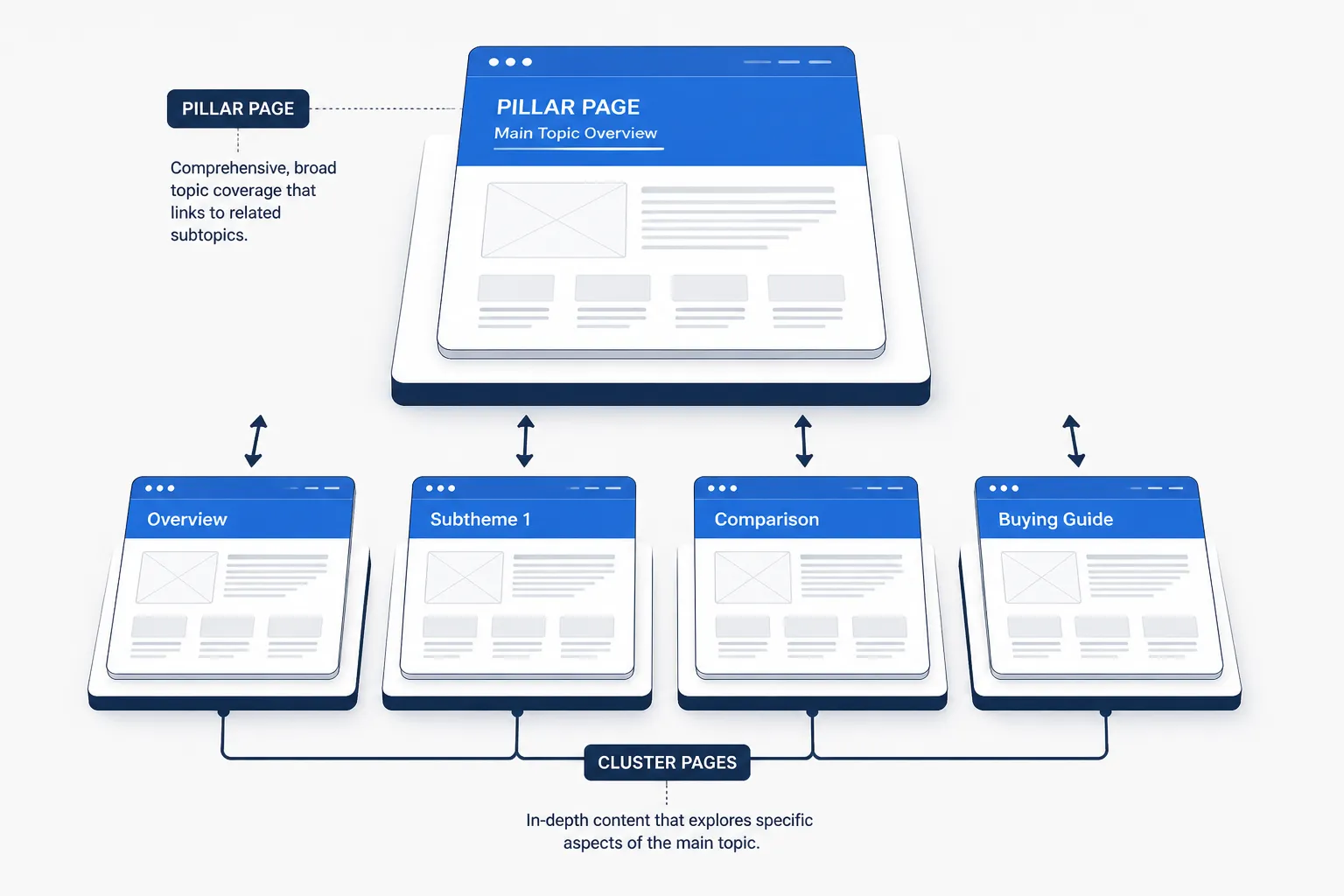
A strong topic cluster starts with one clear pillar topic. That pillar becomes the top-level hub in your site architecture, and it sets the blueprint for everything that sits underneath it. The cleanest way to choose it is to start with a broad commercial or informational theme, then break it into narrower subtopics that deserve their own pages. For deeper planning, a cluster-based content planning process gives you a useful way to sort ideas before you build.
The pillar page should work like a high-level briefing, not a catch-all dump of everything you know. It needs to define the topic, frame the major subthemes, answer the questions readers and AI systems expect, and send people deeper when they need detail. That means your pillar pages should feel complete at a glance while still leaving room for cluster content to do the heavy lifting.
A simple structure keeps the page focused:
- Core overview: explain the main topic in plain language and show why it matters.
- Major subthemes: group the topic into the main areas your audience searches for.
- Key questions: answer the most common intent patterns without burying the reader.
- Deep links: point to the most useful supporting subtopic pages so users can keep moving.
Each cluster page should own one narrow intent or one long-tail query set. The page should go deep on a single angle, avoid overlap with the pillar or neighboring cluster pages, and make that focus obvious in the title, headings, and body copy. When the topic stays tight, Search Engine Optimization (SEO) becomes easier to manage, and AI systems can read the page as a distinct signal instead of a partial repeat. That is where your cluster pages start to earn their keep.
Bidirectional interlinking is where the architecture starts to feel real. The pillar links to every cluster page, each cluster page links back to the pillar, and related cluster pages cross-link where the connection is natural. That internal linking pattern helps crawlers, models, and users move through the full topic ecosystem without dead ends. It also gives you a cleaner story when stakeholders ask how one page supports another.
URL structure should match the hierarchy instead of fighting it. Clean subdirectories or another clear parent-child structure make the map easier to report on, easier to expand, and easier to maintain as the program grows. When the path mirrors the topic tree, reporting stays cleaner and your site feels organized at scale.
A practical rollout keeps the work from scattering across too many themes at once:
- Launch the highest-priority pillar first.
- Publish the most valuable cluster pages before you branch into adjacent topics.
- Review performance data, seasonality, and emerging demand.
- Refine the map as the topic grows and search behavior changes.
That disciplined sequence helps the site read like a complete topic cluster instead of a pile of disconnected articles. It also gives you a clean way to expand pillar pages, connect cluster pages, and keep the full set of subtopic pages aligned with one strategic intent.
How Do You Write AI-Ready Cited Sections?
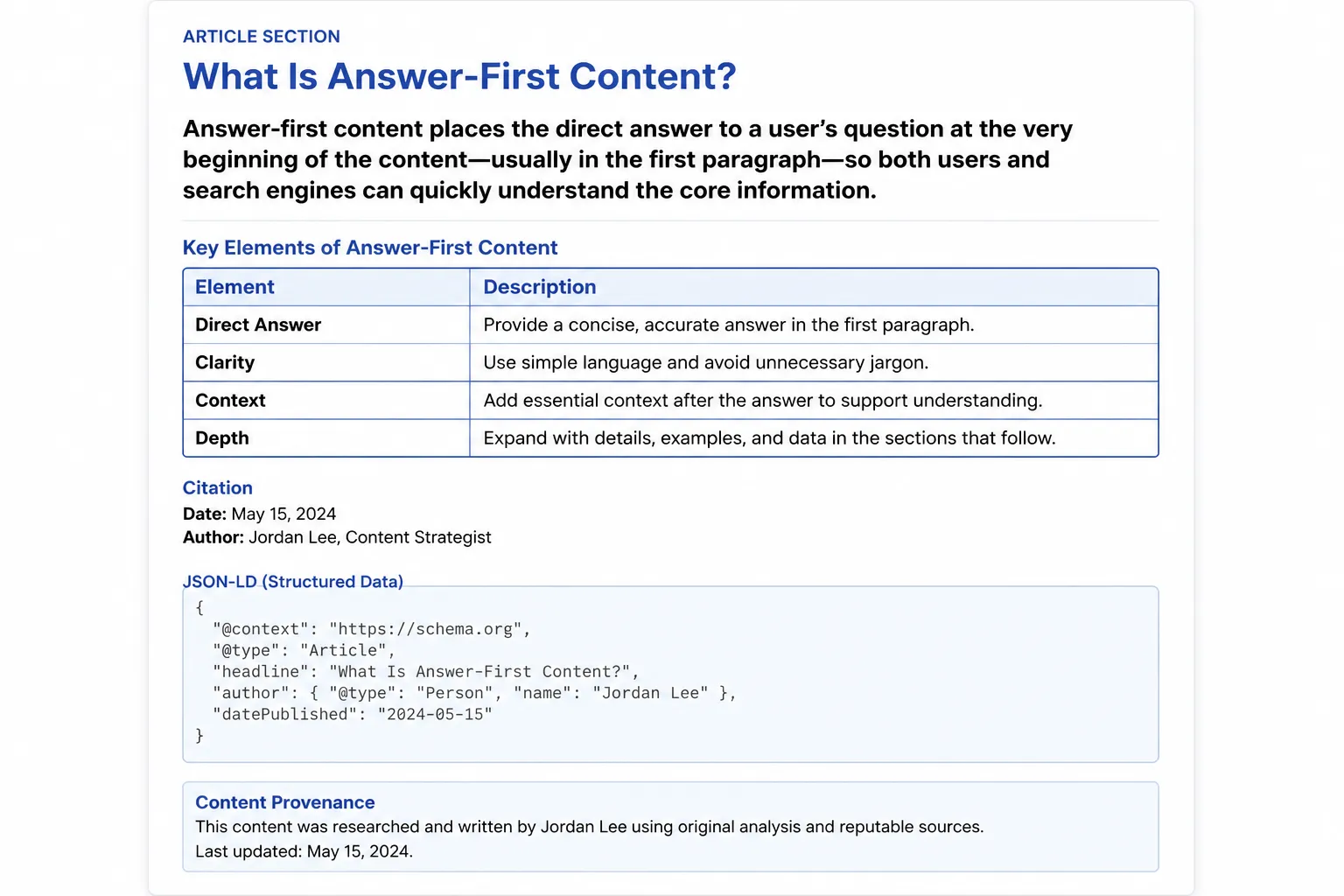
AI-ready sections work best when the first block answers one clear question fast. Open with a concise answer block, then follow with tight supporting detail so passage-level systems can more easily identify a self-contained excerpt. That same shape also helps your page surface for generative answers because the most useful fact appears before the explanation widens.
Your content structure should favor extraction, not just smooth reading. Short question-and-answer blocks, compact paragraphs, bullets, and tables make it easier for search systems to parse the page and easier for editors to keep each idea clean. Keep one idea per block, place the strongest proof point first, and use subheads that sound like real user questions rather than marketing copy.
Semantic range matters more than repetition. A strong answer block can mention search visibility, structured data, provenance, topical authority, and cluster content without sounding stuffed. That kind of variation gives LLMs and SEO systems more context while keeping the prose natural. It also supports E-E-A-T because the language shows breadth without losing focus.
A simple structure can help you keep the section citation-friendly:
| Section element | What it should do | Why it helps |
|---|---|---|
| Answer-first lead | Resolve one question in 40 to 80 words | Gives AI Overviews and AI Mode a clean excerpt |
| Tight support paragraph | Add context and a citation-friendly detail | Improves passage-level relevance |
| Bullet list | Compress steps, criteria, or definitions | Makes structured extraction easier |
| Table | Compare only the variables that matter | Supports answer-box summaries |
| JSON-LD | Mirror the visible page type and claim | Reinforces machine-readable intent |
Structured data should match both the page type and the passage type. Use JavaScript Object Notation for Linked Data (JSON-LD) for FAQPage, HowTo, or a canonical Claim block when the section is built around questions, steps, or a single verifiable statement. Keep stable IDs, aligned claim text, author, and date so the passage stays trustworthy across updates. That discipline matters because it gives readers and machines a consistent proof trail.
Tables need to be built for citation, not decoration. Compare only the variables the reader needs. Keep column labels clear and each cell short enough to quote or summarize. A table works best when you need side-by-side differences, decision criteria, or a scoped summary that can stand on its own inside a search result.
Treat every cited section as a self-contained unit. If you publish provenance artifacts such as a claim block or a provenance.json file, keep the canonical text, fragment IDs, and claim IDs stable over time. That makes the section easier to verify and helps AI systems map the passage back to one anchor instead of several competing ones.
For strategists working on LLMs and SEO, the real gain is consistency. You are building a page that can be read by humans, parsed by machines, and cited without confusion. Make each block specific, factual, and easy to trace, then keep the page’s evidence pattern stable as you refresh it.
How Do You Measure Cluster Performance Across SEO?
A useful measurement system tracks SEO and AI visibility together, or the story gets distorted fast. A cluster can win traffic and still miss AI citations. It can also earn mentions while weak pages drag down conversion.
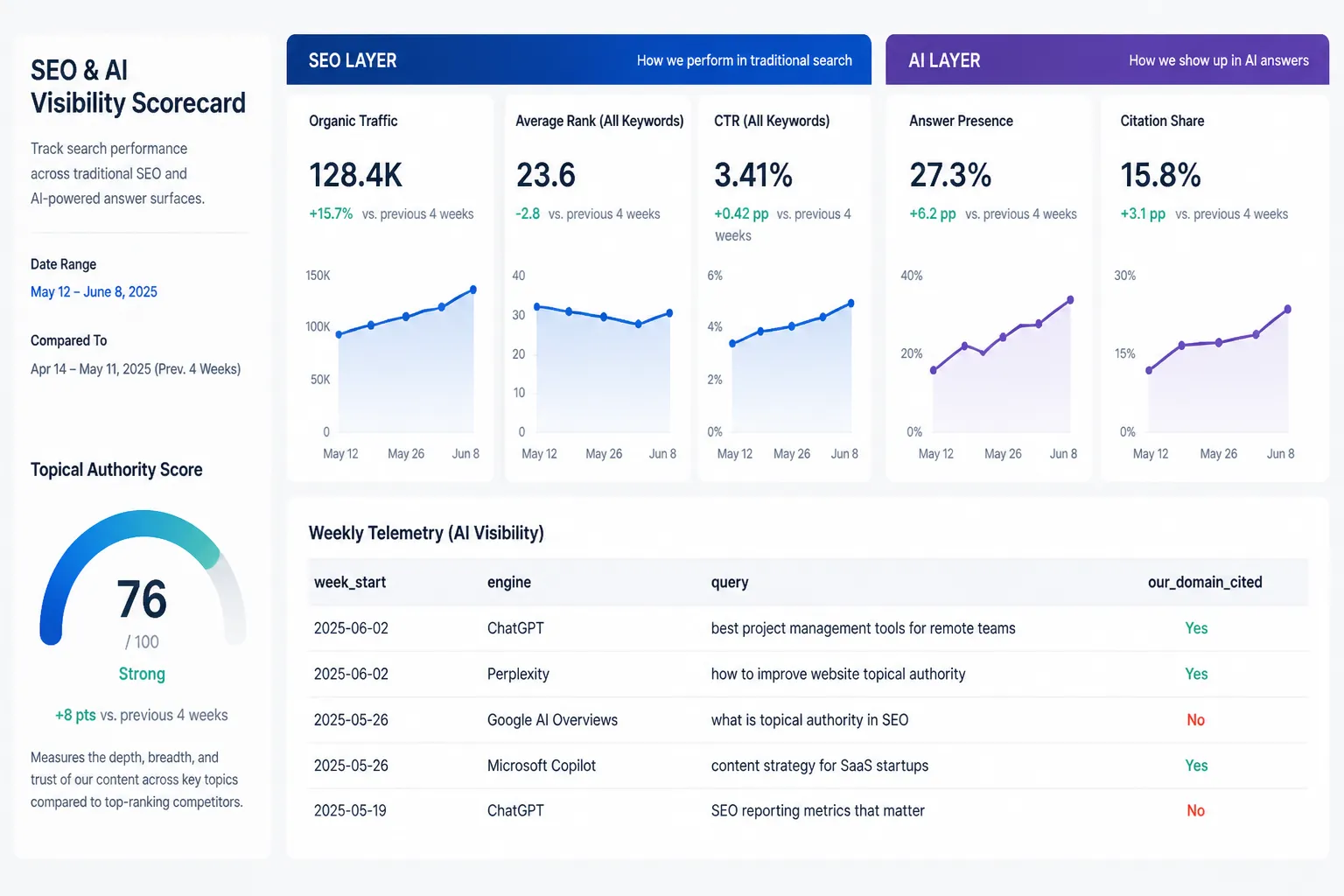
A practical starting point is a two-layer scorecard. The first layer tracks classic search performance. The second layer tracks how AI systems treat the cluster in answer surfaces. The structured content audit checklist for topical authority helps you separate coverage gaps from performance gaps.
| Scorecard layer | What to track |
|---|---|
| SEO layer | Organic traffic, keyword rankings, backlinks, CTR, engagement |
| AI layer | AI citations, answer presence, featured snippet inclusion, passage extraction rate |
That table gives you the first read on AI and SEO performance. The next step is to separate what you published from how the market responds.
A stronger executive view uses three authority lenses:
- Content Authority: shipped pages and cluster performance
- Market Authority: your ranking-value share versus competitors
- AI Authority: mentions and citations in AI Overviews, AI Mode, ChatGPT Search, and Google Gemini
Those inputs can roll into one Topical Authority Score for leadership reporting. It keeps topical authority visible without hiding the reasons a cluster is winning or stalling.
Weekly telemetry should stay rigid so trends beat anecdotes. Use fields like week_start, engine, query, page_url, variant, answer_present, our_domain_cited, cited_domains, ai_citation_share, sov, notes.
Then group results by cluster page and compare control versus variant. That makes content gap analysis much sharper and gives you a cleaner read on AI and SEO changes over time.
Page-level authority and passage-level extraction tell different stories. A page can rank on broad strength while AI systems lift only the tight, data-rich block inside it. If rivals earn more citations because they use shorter summaries, tables, or answer-first bullets, rewrite the passage structure to be more concise and more explicit.
Set benchmark targets against your own baseline for AI citations, answer presence, share of voice, CTR, and assisted conversions, then review the same measures on a fixed weekly and monthly cadence.
- AI-citation share: at least 10% above control for three straight weeks
- Answer presence: at least 50% of weeks
- Share of voice: up 5 percentage points by week 8
- CTR: up 5% versus baseline by week 8
- Assisted conversions: up 10% versus control by week 12
A dashboard that combines topical authority, AI visibility, CTR, and cluster-level outcomes shows where the work is compounding and where the next content gap analysis should start.
How Do You Adapt The Framework By Site?
The strongest cluster framework starts with one core topic that has clear search intent, steady evergreen demand, and enough subtopics to support a real content system. On larger programs, the better play is the pillar that can hold multiple intents together instead of chasing a single high-volume keyword with no depth behind it. Depth compounds. Thin breadth usually doesn’t.
For an enterprise blog, the pillar works best as an authority hub. Surround it with top-of-funnel how-tos, explainers, and research-led assets that can support multiple authors and multiple brands without muddying the message. That mix builds organic trust and strengthens E-E-A-T because the cluster shows lived expertise, not just keyword coverage.
SAAS teams should choose pillars by search intent, not by page length. A feature hub, use-case hub, or solution hub can be the right anchor depending on what buyers need next. The surrounding assets should map to the journey like this:
- Awareness: How-tos and educational explainers
- Consideration: Comparisons, reviews, and alternative pages
- Decision: Templates, checklists, demo pages, and implementation guides
E-commerce needs a different shape. Category pages, brand pages, collection pages, buying guides, comparison pages, and product pages all play a role, and the cluster should support commercial discovery first. A buying guide can move shoppers from curiosity to confidence. A comparison page can do the same without forcing every cluster into a blog format.
Cadence should match content-ops capacity and business priority. Larger, more mature teams can publish and refresh clusters more aggressively. Leaner teams usually do better launching fewer clusters with stronger depth, then revisiting them on a quarterly content audit rhythm to update stats, replace dead references, and add fresh examples.
The cleanest rule is to align the framework to both the buyer journey and the site’s job in the funnel. Awareness-first pages need broader education. Mid-funnel pages need intent-matched evaluations. Bottom-funnel pages should stay focused on transactional assets. That alignment keeps SEO and AI search coverage tight while reducing overlap and helping each cluster earn its place.
About the author

Yoyao Hsueh
Yoyao Hsueh is the founder and CEO of Floyi, the topical authority platform, and the founder of Main Heading, an SEO and AI search agency. He created Topical Maps Unlocked, a course studied by thousands of SEOs, content strategists and digital marketers, founded TopicalMap.com, a done-for-you topical mapping service for agencies and enterprise teams, and publishes the weekly Digital Surfer newsletter on SEO, content strategy and AI search.
About Floyi
Floyi is a closed loop system for strategic content. It connects brand foundations, audience insights, topical research, maps, briefs, and publishing so every new article builds real topical authority.
See the Floyi workflow