
How to Use Topical Authority to Increase CLV
Learn a repeatable topical authority system to boost client lifetime value through retention, upsells, and measurable content ROI.
Topical authority can raise CLV by helping your content drive retention, expansion, and repeat buying, not just traffic. For SEO agencies, content strategists, and growth teams, it turns search visibility into a repeatable revenue system.
The approach starts with mapping customer questions to lifecycle stages, then building topic clusters, internal links, and AI-assisted briefs around onboarding, adoption, expansion, and renewal. It also covers content research, SERP and AI search signals, refresh rules, and the outputs teams need, including topic maps, content plans, and briefing assets.
For Client Success and Growth Directors, and for Heads of Content at multi-location brands, the value is clear because better authority shortens time to value, supports upsells, and lowers churn. A support-led cluster can help a customer solve setup faster, then surface the next premium need before the account goes quiet. Keep going to see how to turn that system into measurable CLV lift.
Topical Authority CLV Key Takeaways
- Topical authority supports CLV by improving retention, upsell readiness, and repeat purchase behavior.
- Map content to acquisition, onboarding, adoption, expansion, and renewal stages.
- Build clusters around one outcome, then add guides, case studies, tools, and premium offers.
- Use internal linking to move readers from broad education to deeper post-purchase help.
- Measure content impact with cohorts, retention rate, upsell conversion, and expansion revenue.
- Agencies can package topical authority as a retainer-backed growth system tied to CLV.
- Multi-location brands need local topic clusters, shared service themes, and regular refresh cycles.
What Is CLV, And Why Does Authority Matter?
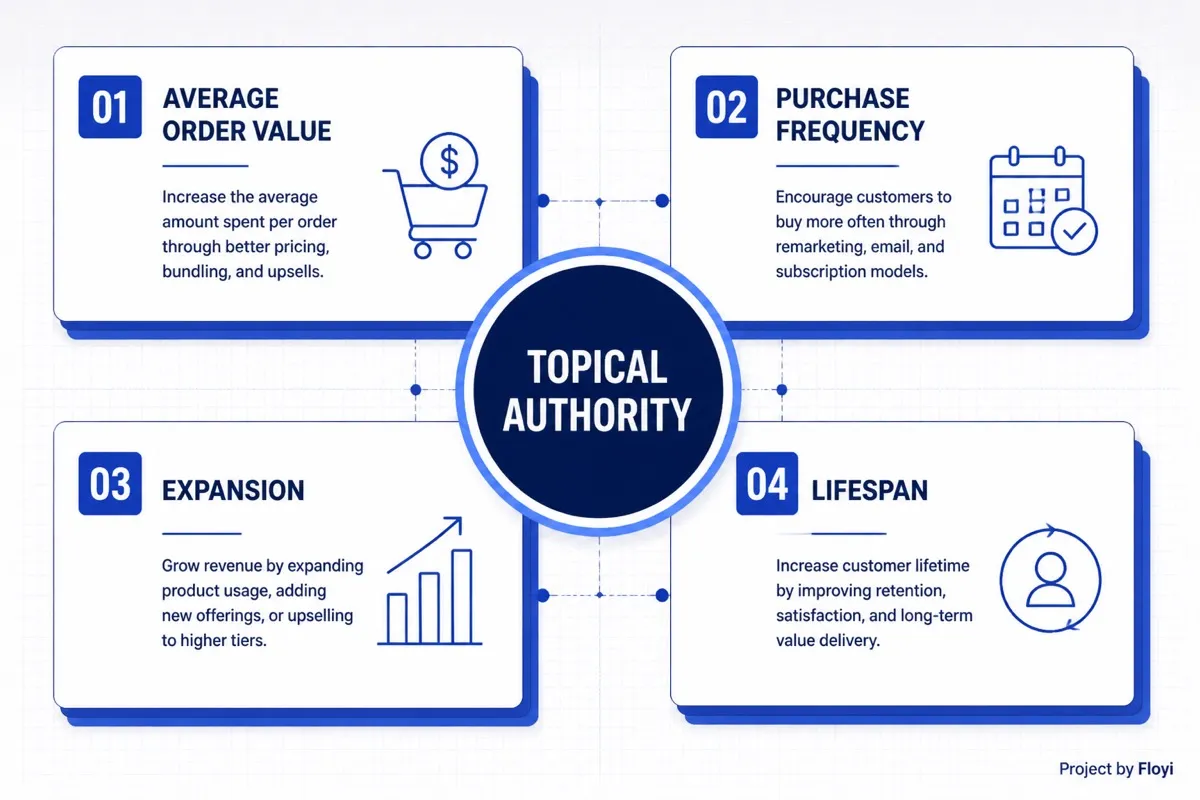
Customer Lifetime Value is the revenue you expect from a customer from the first purchase through the last one. It is a decision signal, not just a finance metric. When you use Customer Lifetime Value, or CLV, to guide acquisition, retention, upsell, and content investment, content strategy stops acting like overhead and starts working like a growth system.
Topical authority matters because it makes your brand the source people return to across the full buying cycle. When customers trust your guidance, friction drops, confidence rises, and your content stays visible for repeat buying moments, renewal decisions, and expansion conversations. That is where CLV, CLTV, and LTV start to connect directly to search performance.
Deep content builds that trust in artificial intelligence-driven search. Thin how-to posts rarely carry enough weight on their own. Whitepapers, case studies, advanced guides, templates, proprietary frameworks, and tools signal expertise better than a shallow content layer.
The economics support that move. Retention is often less expensive than acquisition, and the exact ratio depends on the business model and channel mix (source). That makes authority a margin-protecting asset, not a branding extra.
Authority also maps to the four core Customer Lifetime Value levers:
- Raise average order value: Publish comparison pages, bundles, and upgrade guidance that make larger purchases easier.
- Increase purchase frequency: Build education hubs, seasonal refreshes, and use-case content that bring customers back sooner.
- Increase purchase frequency through expansion: Use expert guides, ROI examples, and implementation content to move buyers toward higher-value services.
- Extend customer lifespan: Support onboarding, adoption, and renewals with content that answers the next question before it becomes a problem.
Trusted expertise creates a lock-in effect that copied features and price cuts cannot match. A brand that keeps solving the next problem feels safer, smarter, and more useful. That support drives cross-sell, upsell, and lower-risk renewals.
For agencies and content leads, the operating model is straightforward. Every adjacent problem your content solves creates another chance to retain, expand, and compound value without starting the relationship from zero. That is the practical link between topical authority, average order value, purchase frequency, and Customer Lifetime Value.
How Does Authority Map To The Customer Lifecycle?
Authority works best as a lifecycle system. When you map content to each stage of the customer journey, you stop treating SEO as a first-visit tactic and start using it to guide people from awareness to repeat buying. That is the core of a stronger retention strategy, because customer journey mapping shows what each audience needs before and after purchase.
A practical lifecycle map looks like this:
| Lifecycle stage | Content that fits | Authority signal that matters |
|---|---|---|
| Acquisition | High-intent explainers, comparison pages, problem-solution guides | Broad topic coverage, entity alignment, visible Search Engine Results Page presence |
| Onboarding | Setup guides, walkthroughs, checklists, implementation FAQs | Practical depth, step-by-step clarity, objection handling |
| Adoption | Advanced tutorials, use cases, case studies, tools and templates | Real-world application, outcome evidence, confidence-building detail |
| Expansion | Content that surfaces adjacent needs and premium options | Natural upselling and cross-selling paths |
| Renewal | Outcome reports, benchmarks, customer success stories, roadmap-led thought leadership | Proof of value, trust reinforcement, reduced churn risk |
In acquisition, the goal is to prove SEO relevance at the top of the funnel. Comparison content and problem-solution pages help searchers see that you understand the category, the entities around it, and the tradeoffs that matter. Strong search visibility at this stage signals category fluency before a prospect ever reaches out.
Onboarding and early adoption need a different kind of authority. Setup guides, walkthroughs, checklists, and implementation FAQs shorten time to value because they answer the questions people usually have right after signup or purchase. That kind of content removes friction, supports customer retention, and lowers the chance that early confusion turns into abandonment.
The adoption-to-expansion window is where content can create real revenue lift. Advanced tutorials, use cases, case studies, and tools or templates help customers get better results with the core offer. A deliberate path from beginner content to advanced guidance to case studies to tools can also expose premium consulting or software needs, which supports upselling and cross-selling.
Renewal content should prove that the relationship keeps paying off. Outcome reports, benchmarks, customer success stories, and roadmap-oriented thought leadership show progress and reinforce confidence. That is where customer loyalty becomes visible, because people renew when they can connect your work to better outcomes.
The customer lifetime value lens helps you prioritize where to invest most. If you want to increase purchase frequency, raise average order value, and extend customer lifespan, the biggest compounding gains often come from repeat usage and re-engagement. A good customer retention plan does not stop at first conversion. It keeps the topic ecosystem moving people toward the next best action.
How Do You Build Topic Clusters For Retention?
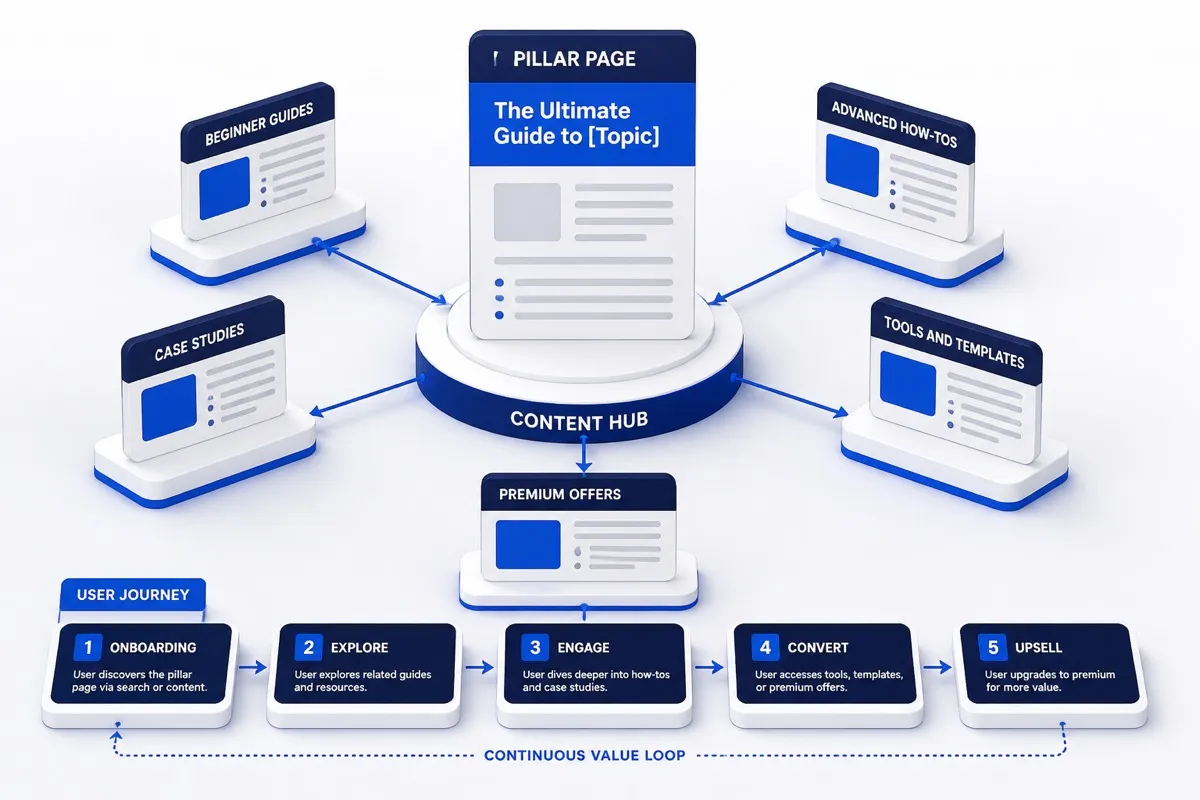
A strong content strategy for retention starts with a phased hierarchy, not a flat library. You want the cluster to move from broad problem-solving to niche expertise and then into post-purchase mastery, so the content hub supports a retention strategy, expansion, and Customer Lifetime Value instead of chasing acquisition alone. Each cluster should center on one outcome, then map the questions, use cases, and objections customers face after they buy.
A practical hub works best as a guided path:
- Beginner guides: onboarding, setup, and first wins
- Advanced how-tos: implementation, optimization, and troubleshooting
- Case studies: proof, benchmarks, and real-world decisions
- Tools and templates: calculators, checklists, and reusable assets
- Premium offers: consulting, services, software, or managed support
That progression shortens time-to-value. It also creates natural upsell and cross-sell moments because each stage answers a deeper need. The best clusters feel like a lifecycle journey, not a random archive of articles.
Pillar pages and supporting articles should build one silo at a time. Clear internal links between the broad topic and each subtopic keep SEO signals focused and help readers move from foundational content into more specific guidance. A content planning system for topical authority gives you the structure to map that progression without drifting into unrelated silos.
Useful assets belong inside the cluster, not outside it. Utility-driven tools can attract links and organic visits when they solve a real task for users (source).
The hub should also track customer maturity and adjacent needs. Start with onboarding, then move into implementation friction, method comparisons, and premium options only when the reader is ready. That sequencing keeps the cluster aligned with the buyer journey and makes the content feel intentional.
A simple refresh cadence keeps the map useful over time:
- Identify content gaps from support tickets, sales calls, and search queries.
- Add seasonal topics and emerging questions as they appear.
- Tighten internal links so every new piece strengthens the same retention path.
- Remove or consolidate weak pages with a content pruning workflow for topical authority.
That living blueprint keeps the cluster relevant, protects authority, and supports expansion as customer needs change.
How Do You Turn Content Into Upsells?
A strong upsell path starts with teaching, not pitching. Your educational content should move from basic problem framing to decision support, then into offers that solve the next obvious problem.
A practical progression looks like this:
- Foundational guides: build trust with beginner education and clear definitions
- Comparison posts and case studies: help readers weigh options and see proof
- Templates and calculators: make the next decision easier and more concrete
- Premium consulting or software: solve the follow-on problem once intent is high
That sequence makes upselling feel like the next logical step. A reader who starts with a broad content strategy article may later want an audit, a roadmap, or a strategy call. A reader who reaches a high-intent comparison page may be ready for premium services that reduce risk and speed up implementation.
Each topic cluster should map to a lifecycle stage. Pre-purchase content should point toward audits or strategy calls. Onboarding content should lead to setup or implementation help. Adoption content should support optimization retainers. Renewal content should open the door to cross-selling or expanded scopes.
The best bridge assets are gated only when the reader is ready for more depth. A strong guide can sit above a deeper template pack, benchmark report, or implementation checklist. Email capture or consultation booking works well here because the educational piece earns trust while the premium asset signals the next purchase step.
Authority-based content also shifts the pricing conversation. When the content proves deep expertise, the follow-on offer can move from one-off deliverables to retainers, advisory packages, or done-for-you support. That shift makes the value story about reduced risk, faster time-to-value, and stronger Customer Lifetime Value.
Your service ladder can come straight from the questions your content already answers:
- Audit the current state.
- Build the roadmap.
- Draft the briefs.
- Optimize the work.
- Report the results.
That ladder works especially well when a cluster keeps surfacing planning, execution, and reporting needs. It gives clients a clear path into higher-ticket work without making them start over.
Expansion content should introduce adjacent offers in context. A post on content strategy can naturally lead into content audits. An optimization guide can point toward AI-assisted brief generation. A measurement article can lead into reporting dashboards and executive reviews. That is how cross-selling feels useful instead of forced, and it is how you keep upselling tied to real buyer intent.
How Do You Measure CLV From Content?
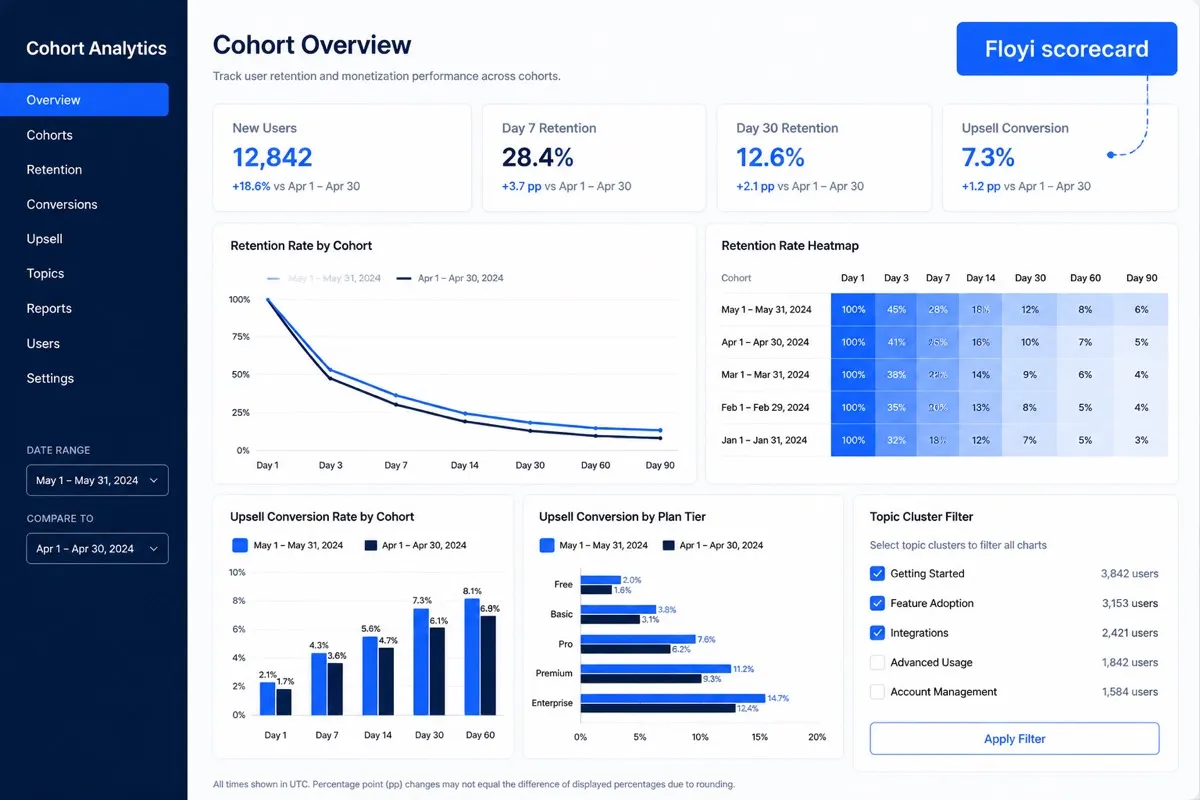
A usable model starts with segmented Customer Lifetime Value, then connects cohort data and revenue mapping so you can see which topics change buyer behavior after the first conversion. For the customer view, combine average purchase value, purchase frequency, and customer lifespan, then subtract acquisition cost. In B2B services, shift the frame to total revenue per client, average client lifespan, average fee income per client, and total contract value so different account sizes stay comparable across CLV, CLTV, and LTV reporting.
A lifecycle cohort view makes the signal much clearer than page traffic alone. Split accounts exposed to topical authority content from matched accounts that were not exposed, then compare these outcomes:
- Customer retention: how long customers stay active
- Repeat purchase rate: how often customers buy again
- Upsell conversion rate: how often accounts move to a larger offer
- Expansion revenue: added revenue from the same account
- Average revenue per account: the post-sale value created by content
That view also puts churn rate in context. Instead of treating content as a top-of-funnel asset, you can see whether it supports customer retention after the sale.
The strongest reporting setup maps engagement to revenue events at the topic-cluster level. Educational article views, return visits, downloads, and high-intent paths should connect to onboarding completion, product adoption, renewal probability, and expansion actions. A content refresh program for topical authority should sit in the same scorecard when you want to know whether updated content keeps influencing later-stage revenue.
A simple dashboard structure keeps the logic clean:
| Topic cluster | Lifecycle stage | Primary CLV lever | Revenue outcome |
|---|---|---|---|
| Acquisition | Pre-sale | Assisted pipeline and CAC efficiency | More qualified demand |
| Onboarding | Early post-sale | Activation and early retention | Faster time to value |
| Adoption | Mid-lifecycle | Usage depth and stickiness | Lower churn rate |
| Expansion | Mature accounts | Upsell and cross-sell | Higher expansion revenue |
Incremental lift is the proof point. Compare matched cohorts that received relevant content with control cohorts using the transaction and account data you already collect. If the exposed group renews more often, closes larger deals, or accepts cross-sell offers faster, you have evidence that content is improving CLV rather than just producing isolated page metrics.
Floyi’s scorecard should also include AI presence and content quality signals alongside performance, market authority, and AI authority. That lets you see whether the topics earning mentions and citations are also creating durable account value. When a cluster attracts engaged high-value clients, the gap often points to a premium package, a new service line, or a product feature you can sell back into the base.
How Do You Adapt This For Agencies?
You sell topical authority more easily when it sits inside premium services, not as a one-off SEO task. Clients fund what keeps producing value, so package the work as a retainer-backed growth system tied to Customer Lifetime Value (CLV), retention, and expansion. The business benefits of topical authority for agencies make that pitch easier to defend. That framing also fits omnichannel marketing, because one topic system can support search, email, social, and sales enablement without resetting the strategy every quarter.
Productized delivery keeps the offer scalable across SEO strategy, content marketing, CRO, analytics, and AI-assisted workflows. The strongest packages follow client lifecycle priorities, not just top-of-funnel visibility. That means one account can move from awareness content to conversion support and then into renewal or upsell assets. Marketing automation can route those assets into the right journeys, but the service model still needs to stay human-led and strategy-first.
A service menu makes the work easier to scope, sell, and fulfill. Standardized projects also cut revision churn and help your team quote faster.
| Offer type | What it covers | Why it matters |
|---|---|---|
| Content style guide | Voice, terminology, and page rules | Keeps multi-author content consistent |
| Thought leadership program | Expert themes and proof points | Builds authority in competitive categories |
| Content hub build | Topic clusters and internal linking | Improves coverage and navigability |
| Helpful Content audit | Quality, intent fit, and gaps | Clarifies what to refresh or retire |
Scope boundaries matter just as much as the offer itself. Add upgrade and change-order clauses so clients know what is included, what counts as a new request, and when broader topic expansion becomes a separate project. That structure protects margin and makes the engagement easier to renew.
Client-ready planning artifacts speed approval and reduce rework. Topic maps, briefs, site architecture, and authority plans should be easy to export, review in Google Sheets, and update in bulk for multi-account or multi-location delivery. Reporting should then prove CLV-linked progress by showing coverage gaps, Share of Voice movement, Search Console queries, and topic-level gains against plan.
The review cadence should be part of the sale. Use weekly SERP refreshes for fast-moving topics, monthly coverage reporting for active clients, and quarterly breadth reviews for under-covered pillars. Board-ready summaries should connect authority gains to retention, upsell readiness, and lower churn risk, so the work reads as a growth system instead of a content expense.
How Do You Adapt It For SaaS?
For SAAS, topical authority works best when you build around the post-purchase journey, not just acquisition terms. Start with customer journey mapping that traces the questions users ask from onboarding to renewal. Then shape content around faster setup, earlier first value, and stronger support for advanced use cases. That shift turns content into a retention asset instead of a traffic asset.
In-product education should sit where work happens. Contextual help, setup guides, feature walkthroughs, checklists, and release-note explainers answer real-time intent without pulling users out of the product. Strong customer experience depends on that kind of friction removal. Personalization also matters because users judge value faster when help matches their current task.
After activation, advanced mastery content helps you drive adoption and expansion revenue. Proprietary research, trend forecasting, optimization playbooks, and role-specific growth guides show customers how to use higher-tier features with confidence. That deeper path inside your platform also reduces the risk of competitor poaching.
Integration content matters just as much. SAAS buyers want proof that your product fits their stack, including CRM, analytics, CDP, and marketing automation workflows. Integration pages should show practical outcomes, reduce implementation friction, and reinforce that your platform belongs in the customer’s operating system.
A simple content model looks like this:
| Journey stage | Content type | Business effect |
|---|---|---|
| Onboarding | Setup guides and checklists | Faster time to value |
| Activation | Feature walkthroughs and help content | Higher feature usage |
| Expansion | Playbooks and research | More upgrades and upsells |
Track activation rate, feature usage depth, help-content engagement, trial-to-paid conversion, and upgrade velocity as SaaS performance metrics that can show whether post-purchase content is working (source, source). Those metrics show whether your topical authority is increasing customer lifetime value or just attracting visitors.
How Do You Adapt It For Multi-Location Brands?
You get better CLV when each location has its own topical system instead of a copied city page. The strongest setup starts with real local demand signals and ties every branch back to the same core service themes, so the brand story stays consistent. A broad footprint usually works best with a state to city to neighborhood hierarchy. A metro-focused footprint often works better with city to neighborhood, especially when service and location pages match the intent in the SERP.
A practical structure for multi-location brands looks like this:
- Local topic clusters: Build market-specific content around the questions, problems, and proof points that matter in each area.
- Shared service themes: Keep the same core offerings visible across every branch so authority compounds instead of fragmenting.
- High-intent page mapping: Pair service and location pages where booking or purchase intent is strongest.
- Ongoing refresh cycles: Update local FAQs, reviews, case studies, and service pages after rankings improve.
SEO should not sit apart from the rest of the journey. Local landing pages, Google Business Profile activity, email, SMS, and paid retargeting should carry the same offer, the same proof, and the same next step. That kind of omnichannel marketing reinforces customer service and keeps personalization consistent after every touchpoint.
A Customer Data Platform, or CDP, helps you unify location, purchase, and engagement data before you segment. A Single Customer View gives customer segmentation and behavioral segmentation more value because repeat visitors can be recognized across branches and channels. Once that happens, you can trigger local upsell content, service reminders, and recommendations that fit the customer’s history and nearest branch.
Content should keep working after rankings improve. The location that stays visible in search and stays useful in email or SMS becomes the education engine for repeat visits, cross-sells, and higher-value purchases. Prioritize the paths that create measurable CLV lift at the location level, especially repeat-purchase and cross-sell journeys.
Topical Authority for CLV FAQs
These FAQs focus on the practical side of using topical authority to support Customer Lifetime Value, from content structure to retention and expansion signals. They’re for teams that want clear, repeatable answers before turning strategy into execution.
How Long Until Content Impacts CLV?
You usually need 60 to 90 days to see early movement, while meaningful CLV impact often takes one or more purchase cycles. Watch assisted conversions, returning-user rate, engaged sessions on hub pages, email sign-ups, demo requests, add-to-cart activity, repeat site visits, and time spent on high-intent educational pages, then look for faster movement from informational content into comparison, product, or upsell pages. Keep publishing and refreshing content, because AI search favors current pages, and durable utility content like Shopify’s business name generator shows how topical assets can keep attracting users over time.
Which Topics Drive Repeat Purchases Fastest?
The fastest repeat purchases usually come from onboarding, reordering, and post-purchase how-to content. Setup guides, getting-started checklists, and first-use tutorials help buyers reach value quickly, while replenishment topics make the next purchase obvious and predictable. Content that answers common pain points before, during, and after purchase keeps your audience moving, and decision-moment pages add reassurance for shoppers who still need one clear reason to buy again.
Can Topical Authority Reduce Churn Directly?
Yes. Authoritative educational content reduces churn rate by closing time-to-value gaps, so customers reach a first meaningful win faster instead of stalling after purchase. It also builds mastery through setup guidance, best practices, and advanced playbooks, which lowers frustration, support dependence, and early drop-off. That matters because customer experience shapes retention, and onboarding, troubleshooting, and success content give customers and CSMs a shared source of truth for stronger renewal conversations.
How Do You Attribute Revenue To Content?
Start with a matched comparison between customers who saw the content and a similar control group that did not. Then use cohorts by first touch, theme, lifecycle stage, or account age to isolate timing effects and trace each renewal, upsell, add-on purchase, or upgrade back to the topic that shaped it. Track customer lifetime value, retention rate, expansion revenue, upsell conversion rate, average revenue per account, repeat purchase rate, and educational engagement together so you can report clear incremental lift.
About the author

Yoyao Hsueh
Yoyao Hsueh is the founder and CEO of Floyi, the topical authority platform, and the founder of Main Heading, an SEO and AI search agency. He created Topical Maps Unlocked, a course studied by thousands of SEOs, content strategists and digital marketers, founded TopicalMap.com, a done-for-you topical mapping service for agencies and enterprise teams, and publishes the weekly Digital Surfer newsletter on SEO, content strategy and AI search.
About Floyi
Floyi is a closed loop system for strategic content. It connects brand foundations, audience insights, topical research, maps, briefs, and publishing so every new article builds real topical authority.
See the Floyi workflow