
7 Content Brief Tools Compared for Brand Voice and Personas
Compare 7 content brief tools on brand voice capture, persona inputs and topic-plan links, with vendor pages checked in November 2026, then pilot one client.
Choosing content brief tools should hinge on whether brand voice and personas stay attached to each assignment, because disconnected context increases review work and weakens client consistency. For SEO agency operations managers, content strategists and freelance consultants, the comparison centers on how each platform carries approved context from planning into the writer’s brief. A client-specific brief translates voice, buyer needs, search intent, and topical scope into instructions a writer can execute.
Define the client’s voice rules, select the relevant personas and use the same topic and source materials across shortlisted platforms. Review whether the resulting brief shows audience questions, positioning boundaries, SERP inputs, internal-link guidance, and usable draft instructions. Compare Floyi’s separate client brands and four-level topical map with optimization-led, research-led and brand-aware drafting workflows.
Run the pilot through one active client and a representative page set. The tool-by-tool assessment that follows shows where each workflow preserves or loses that context, based on what each vendor documents as of November 2026.
Content Brief Tools Key Takeaways
- Floyi keeps each client’s Brand Foundation, Content Guide, personas, and four-level map in a separate brand.
- Floyi briefs start from a Planner topic or as standalone assignments, with up to two personas and five buyer prompts each.
- Frase, Surfer and Jasper document stored voice profiles, and Jasper also stores audience profiles.
- Content Harmony’s brief templates ask for the primary audience and the brand’s point of view.
- Test shortlisted platforms with the same client topic, voice guide, personas, and source materials.
- Measure strategist time, senior-review changes, clarification requests, and optimization conflicts during a pilot.
- Floyi exports briefs to TXT, DOCX and Google Docs without Floyi branding.
How Do the Leading Tools Compare?
The seven tools differ most in whether a client’s voice and personas stay attached from research to draft or sit in separate features. This comparison is one of our content strategy platform comparisons, narrowed to the brief. Floyi makes one of the seven tools, so weigh its entry with that in mind.
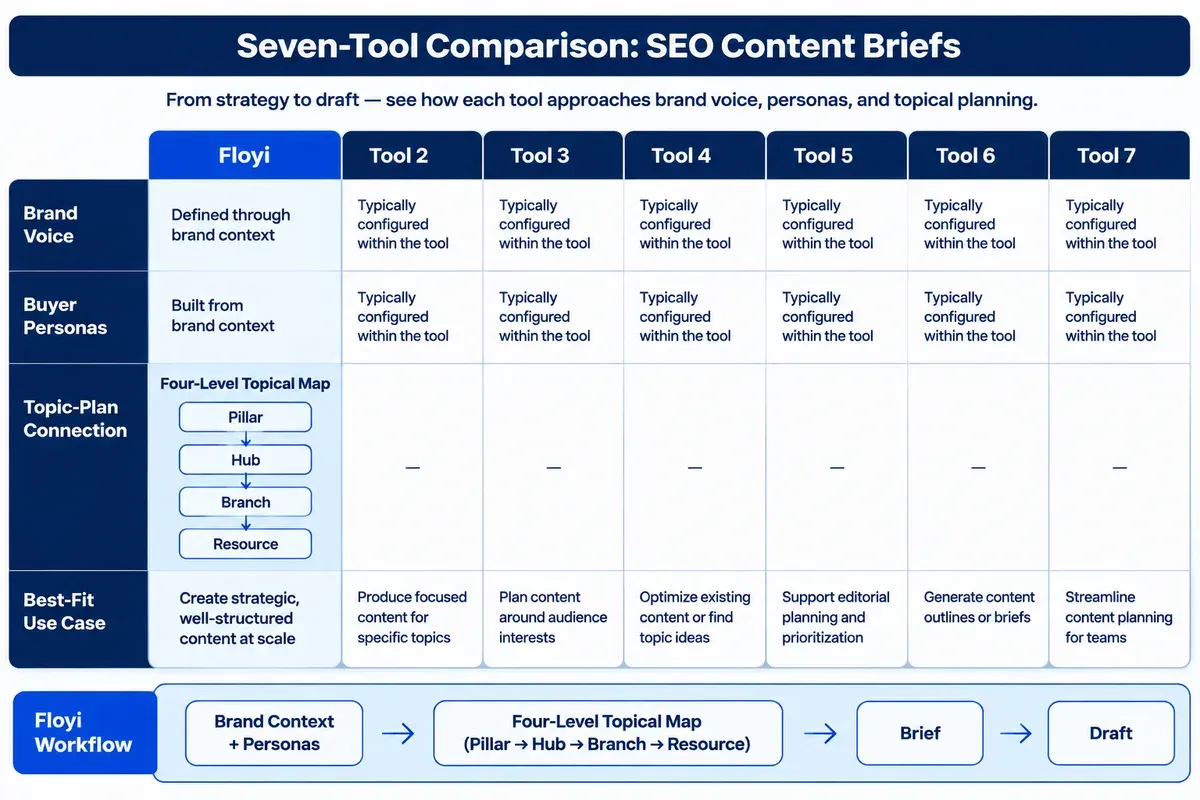
| Tool | How it captures brand voice | Persona or audience inputs | How briefs connect to a topic plan | Best for |
|---|---|---|---|---|
| Floyi | Brand Foundation, Content Guide and Brand Voice profile per client brand | Audience Insights personas, up to two per brief | Briefs from a Planner topic in a four-level Pillar > Hub > Branch > Resource map, or standalone | Agencies and consultants who want voice, personas and the topic plan in one brief |
| Frase | Voice profiles from writing samples, brand context and imported style notes | A target audience field in each voice profile | Maps each topic’s coverage and missing subtopics, then turns gaps into briefs | Teams that want topic coverage, drafting in a stored voice and GEO checks in one tool |
| MarketMuse (Siteimprove) | “Built-in governance for voice,” no stored voice profile | Not available | Content plans, briefs and topic clusters sit together in MarketMuse | Teams that start planning from topic and competitor research |
| Content Harmony | No voice profile, brief template asks for the brand’s point of view | Brief template has an Audience & Brand Overview section | Keyword report feeds the brief, no link to a topic plan | Teams that want standardized, shareable brief templates |
| Surfer | Custom Voice and Custom Knowledge in the Content Editor | Not available | Clusters from the feature Surfer calls Topical Map become article outlines | Writers who optimize inside a live-guideline editor |
| Clearscope | Drafts start “from the query’s intent and your tone” | Not available | Discover finds the queries, and each step hands off to the next in one click | Editorial teams that want a live content grade |
| Jasper | Brand Voices stored in Jasper IQ, 2 on the Pro plan | Audiences stored in Jasper IQ, 3 on the Pro plan | Turns keyword and competitor research into plans, no link to a brief | Teams producing brand-consistent content across channels |
Competitor cells reflect each vendor’s own pages as of November 2026: Frase, MarketMuse, Content Harmony, Surfer, Clearscope, and Jasper. “Not available” means the vendor’s public pages list no such feature as of November 2026.
Surfer and Clearscope fit optimization-led editorial workflows. Frase and MarketMuse start from research and topic coverage, while Jasper centers on brand-consistent generation. Floyi briefs bring together top search results, AI search sources, scoped Knowledge Base documents, internal-link and anchor-text guidance, and buyer prompts before drafting.
Test one representative client brief against the approved voice guide, persona, topical plan, research traceability, and resulting draft quality before standardizing any workflow.
If you’re choosing a whole stack and not only the brief tool, see the content strategy tools for agencies and small teams or the content strategy tools for freelance consultants.
1. Floyi: Connected Brand-to-Brief Planning
Floyi is the topical authority platform. Agencies and consultants use Floyi when client-specific content briefs need to carry approved brand context from planning through drafting, rather than treating every assignment as an isolated request. Floyi briefs start from a Planner topic, or as standalone briefs for one-off pages.
Each client sits in a separate brand with its own Brand Foundation, Content Guide, buyer personas, and four-level Pillar > Hub > Branch > Resource map. The Brand Foundation captures positioning, voice, market context, competitors, and unique selling proposition once. The Content Guide holds the client’s terminology, compliance, competitor, and brand messaging rules. A Brand Voice profile, built from 3 to 5 writing samples, applies to every brief and draft Floyi generates for that brand. The Brand Foundation setup guide covers each tab. That context follows research, briefs and drafts without writers pasting client instructions into each assignment.
Audience Insights makes each brief specific to the people a client needs to reach. Audience Insights generates personas from the Brand Foundation, each with a job title, goals, pain points, values, fears, information sources, objections, and representative quotes. Personas export to DOCX, XLSX, Google Docs, and Google Sheets. Each brief can use up to two buyer personas, giving the draft a defined buyer and decision context instead of a generic audience.
The four-level map connects approved context to publishing scope. Topical Research generates topics from the Brand Foundation and up to three selected personas, and SERP Clustering groups keywords that share ranking URLs. The Planner turns each topic into a page-level assignment with a funnel stage, search intent, URL slug, and internal-link suggestions.
A Planner-generated brief brings execution inputs together:
- Up to seven competitor pages and stored AI answers from AI Overviews, AI Mode, Gemini, and ChatGPT.
- Topic keywords, internal-link suggestions from the map and anchor-text options.
- Chosen Knowledge Base documents and Strategic Instructions.
- Up to five buyer prompts, with Buyer Prompt Coverage showing which section answers each one.
Standalone briefs run their own SERP and competitor analysis for one-off pages that don’t belong in the map. The Knowledge Base stores approved client materials by category, and each brief’s Knowledge Base Scope can use all documents, chosen categories, chosen documents, or none. Briefs export to TXT, DOCX and Google Docs without Floyi branding.
Prompt Tracking checks buyer prompts on ChatGPT, Gemini and Google AI Mode, each one linked to a topic in the map. When you generate a brief for that topic, its tracked prompts appear first in the Buyer Prompts step, so the brief answers the questions buyers ask AI engines. Authority scoring across Google and AI search then informs the next content plan.
Floyi has three plans: Free, Pro at $99 a month and Scale at $299 a month. Pro and Scale include briefs and drafts, Prompt Tracking and unlimited brands.
Floyi is best for agencies and consultants that need each client’s voice, personas and topical plan to remain connected from map to brief to draft across multiple contributors.
2. Frase: SEO and GEO Content Workflow
Frase is a credible choice when your immediate priority is SEO research and GEO around individual content opportunities. Its product navigation groups SEO Research, Topic Clusters, AI Agent, and Brand Voice under Create, with Content Optimization, GEO Optimization, AI Visibility, and Site Audit under Optimize.
Frase documents its voice capture in detail. Its Brand Voice page says you “paste a few pieces of your best writing and set the tone, formality, and audience.” Frase also stores your company, industry, audience, and value proposition once, and it can pull existing style notes from Notion or Google Docs. Frase lets you run a separate voice for a blog, a newsletter or a client account and assign each profile to a site or project, with profile limits set by plan.
Planning starts from coverage. Frase’s homepage says it “maps each topic you write about: what you have written, what is under way, and the subtopics you still owe a reader,” and that “every gap is a brief away.” Audience appears as a field in the voice profile, and Frase doesn’t describe buyer personas beyond it. The Brand Voice page says Frase “researches the query, then drafts the page in the voice profile you set,” without saying whether the brief itself carries voice or audience direction.
Frase’s pricing page starts at $39 a month billed yearly, or $49 month to month, for one site and one person. Professional, for teams or more than one site, costs $103 a month billed yearly or $129 monthly. The 7-day trial needs no credit card, as of November 2026.
Floyi differs in where client context sits. A Floyi brief carries the Brand Foundation, up to two personas and the map’s internal links in the brief itself, so the writer sees them before drafting.
Review one completed Frase brief for visible voice rules, persona targeting, competitor inputs, internal-link guidance, and instructions a junior writer can execute without senior rebuilding. Frase fits teams that want topic coverage, drafting in a stored voice and GEO checks in one tool.
3. MarketMuse: Research-Led Content Planning
MarketMuse, now part of Siteimprove, suits agencies that want topical planning to begin with subject coverage, competitor analysis and opportunity analysis. Its research-led approach earns its place in a pilot only if the resulting guidance stays useful when a writer receives the brief.
Siteimprove’s MarketMuse page covers topic and competitor research first, then briefs and planning, then search and AI visibility. It says teams can “turn a brief into an on-brand, publish-ready draft, with built-in governance for voice, quality, and search performance,” and that “your content plans, briefs, and topic clusters stay right where they are in MarketMuse.” The page doesn’t describe how voice is captured or any persona or audience input. It lists no pricing, only a demo request, as of November 2026.
Evaluate the finished brief, not only the research screen:
-
Persona transfer: Use two client topics with distinct audiences. Check whether each brief identifies the reader’s questions, objections, expertise level, conversion context, and exclusions.
-
Brand voice retention: Test whether approved terminology, proof standards, tone boundaries, and client-specific instructions persist at the individual-brief level.
-
Writer readiness: Assess whether the brief gives the writer a clear angle, content format, heading direction, evidence requirements, internal-link guidance, and persona-aware instructions.
-
Review burden: Count the material voice corrections senior reviewers make, and check whether each final brief preserves the client’s topical scope without manual rewriting.
In the demo, confirm research allowances, brief limits and workspace permissions. Those details decide whether a research-led workflow can support multiple client brands without adding another review layer.
Floyi grounds the same brief in the client’s Brand Foundation and selected personas, while Strategic Instructions and a chosen Knowledge Base Scope add assignment-specific context. MarketMuse fits teams that start planning from topic and competitor research.
4. Content Harmony: Standardized SEO Brief Workflows
Content Harmony gives agencies an end-to-end SEO workflow built around keyword reports, standardized briefs, shared review, and post-draft grading. Its homepage describes a sequence that runs from a keyword report to a content brief to a content grader. That structure supports consistent writer instructions across accounts, but a reusable format doesn’t automatically carry each client’s voice, buyer personas and topical scope into every brief.
Content Harmony’s brief tool page describes fully customizable brief templates, with “an unlimited set of templates” for different content types and client needs. Its recommended template includes an Audience & Brand Overview section covering the primary audience, the brand’s point of view and the call to action, plus a Visual Requirements section. Keyword Report data, such as reader questions, related searches and semantically related phrases from its Topic Model, can be inserted into the brief. The page doesn’t describe a stored voice profile, buyer personas or a link from briefs to a topic plan.
Collaboration is a documented strength. Briefs can be shared through public links with “writers, clients, team members, subject matter experts, and more,” or copied into Google Docs, Word or Notion. Brands with unusual approval paths or strict voice requirements should test how easily collaborators add feedback and adapt the format.
Content Harmony offers the first 10 Content Workflow credits for $10, or the same 10 credits free when you schedule a demo, per its homepage. The trial has no time limit. Paid plans start at Standard 5, at $50 a month or $42 a month billed annually for 5 workflows, according to the pricing page as of November 2026.
The brief tool page says users can “spend minutes reviewing keyword research and generating your basic content brief,” where each brief once took hours. A pilot should test that claim on your own accounts:
-
Research time: Track strategist minutes from keyword selection to a writer-ready brief.
-
Revision load: Count senior-review changes tied to missing client context, voice mismatches or unclear audience direction.
-
Writer clarification: Record questions about internal links, claims and persona fit after sharing the brief.
Floyi takes a broader brief-to-grade path. Brand Foundation and persona inputs shape the brief and the draft, and the Page Quality Scorecard grades the draft with clickable evidence quotes. Content Harmony fits teams that want standardized, shareable brief templates.
5. Surfer: Optimization-Focused Content Editor
Surfer fits teams that need content optimization recommendations close to the drafting environment. Its Content Editor builds guidelines from the pages ranking in the top 10 on Google for the chosen location, plus top-cited AI pages, and Surfer says “all guidelines are real-time and competition-based.” The Outline Builder structures a draft into headings and questions.
For voice, the Content Editor page lists Custom Voice, to “write in your unique tone and style,” and Custom Knowledge, which turns brand facts into content. The page doesn’t describe persona or target-reader inputs. On the planning side, the feature Surfer calls Topical Map starts from Search Console and groups keywords into clusters, and its topics “instantly become detailed article outlines.” Surfer’s pricing page lists Templates & Custom Voices and 5 Brand Spaces on the Pro plan, at $182 a month billed yearly, as of November 2026.
That strength doesn’t show that a client’s voice, audience priorities, prohibited claims, or product positioning will stay intact in the writer-facing guidance. Agencies managing distinct brands need proof that context survives each handoff rather than an assumption that a score-oriented workflow captures it.
A matched-brief pilot makes the distinction visible:
-
Use identical inputs: Build guidance for the same query in Surfer and Floyi using the same voice guide, persona description, approved product facts, and non-negotiable messaging rules.
-
Inspect writer guidance: Review the outline, suggested sections, terms, examples, calls to action, and writing guidance. Count each instance where client context appears accurately, disappears or conflicts with an optimization recommendation.
-
Change the brand, not the query: Repeat the exercise for a second client targeting the same query with a different audience, terminology, value proposition, and compliance boundaries. Brand-aware workflows should produce materially different framing and section guidance, not only different keyword coverage.
-
Keep the evidence: Retain both outputs for senior strategists and writers, and check whether exported or shared versions preserve the original client instructions after revisions.
Floyi carries each Brand Foundation and the selected personas into the brief before anyone opens an editor, along with the map position and internal-link guidance. Surfer fits writers who optimize inside a live-guideline editor, and it can complement an agency workflow when SEO coverage is the central need.
6. Clearscope: Editorial Content Optimization
Clearscope is a strong editorial content optimization option when your agency needs a visible content grade while a writer builds or revises a page. Its homepage describes four steps. Discover returns the questions people ask Google and AI, with search volume and what each asker wants. Track shows how often Google, ChatGPT, Gemini, and Claude mention you. Write starts “a draft from the query’s intent and your tone,” with term guidance and a live grade. Monitor watches each page’s grade, clicks and SEO value through Search Console.
The homepage doesn’t describe a stored voice profile or persona and audience inputs beyond that tone setting. Clearscope’s pricing page lists Essentials at $129 a month, with 50 tracked queries and 20 drafts, and Business at $399 a month, after a 14-day free trial, as of November 2026.
The grade gives strategists and junior writers a shared coverage target for a query. It shows whether a draft addresses themes that recur across ranking pages, which reduces senior review of basic coverage.
A high Clearscope grade doesn’t resolve the decisions that make a client brief specific to the brand. The grade can’t decide which claims match the client’s positioning, which buyer persona takes priority or where first-party evidence should replace generic consensus. Assess whether the recommendations leave room for those editorial choices rather than treating the score as the final standard.
The planning handoff works differently in Floyi. A Floyi brief carries the client’s Brand Foundation, buyer personas, SERP evidence, AI search sources, and internal-link guidance, and it lists SERP Consensus Claims beside Blocked Opportunities, the angles that need the client’s own data before a draft states them.
Use an existing client priority page to evaluate fit:
-
Build comparable guidance around a page with an approved topical map and documented persona requirements.
-
Compare Clearscope’s grade and term recommendations against the client’s positioning boundaries, proof requirements and planned internal links.
-
Check whether the guidance becomes explicit direction on claims, evidence, persona concerns, and internal-link choices without heavy senior-strategist rewriting.
-
Flag recommendations that reflect common SERP coverage but conflict with the brand’s original evidence.
Measure the pilot by the senior revision required before the brief is ready for client review. Clearscope fits editorial teams that want a live content grade.
7. Jasper: Brand-Aware Content Creation
Jasper is a strong fit for agencies producing client-facing copy that must keep a consistent voice. Jasper IQ stores brand voice, visual identity, audience personas, and approved source material, and Jasper says it “applies that context automatically across every agent, workflow, and team member.” Jasper’s homepage adds that teams can keep multiple brand voices for different audiences, sub-brands or regions, and that admins set the rules once for every generation.
Jasper also checks work against brand rules and flags off-brand language. For search content, Jasper’s SEO and AEO page says it “turns keyword and competitor research into actionable plans your team can execute instantly.” Jasper’s pages don’t describe what an audience profile contains or how a plan connects to individual briefs.
Jasper’s pricing page lists Pro at $69 per seat per month, or $59 per seat per month billed annually with a 12-month commitment, and offers a 7-day free trial, as of November 2026. Pro includes 2 Brand Voices, 3 Audiences and 5 Knowledge assets. Pro’s two Brand Voices cover two client voices. Business has custom pricing, with unlimited voices and audiences plus style guides. Weigh the annual commitment against how many writers need access to each client’s voice guidance.
Jasper fits the drafting stage once voice expectations are established. A brief still has to account for the audience, search intent and topical priorities that decide what the writer needs to say. Floyi connects those earlier decisions through the Brand Foundation, buyer personas and the map, and keeps them attached through production.
Choose Jasper when consistent voice across channels is the main production constraint.
What Inputs Make a Brief Client-Specific?
A client-specific brief needs evidence about the intended audience, buyer personas, language requirements, and brand voice, so writers can make informed choices instead of reverting to generic SEO patterns.
Define the audience the client wants to reach, not everyone who already visits the site. Evidence should capture the reader’s role, professional background, interests, values, preferred platforms, communication style, and favored content formats. That distinction changes the examples, objections and depth a writer uses. An operations manager may need a workflow example and risk controls, while a founder may need a tighter commercial case.
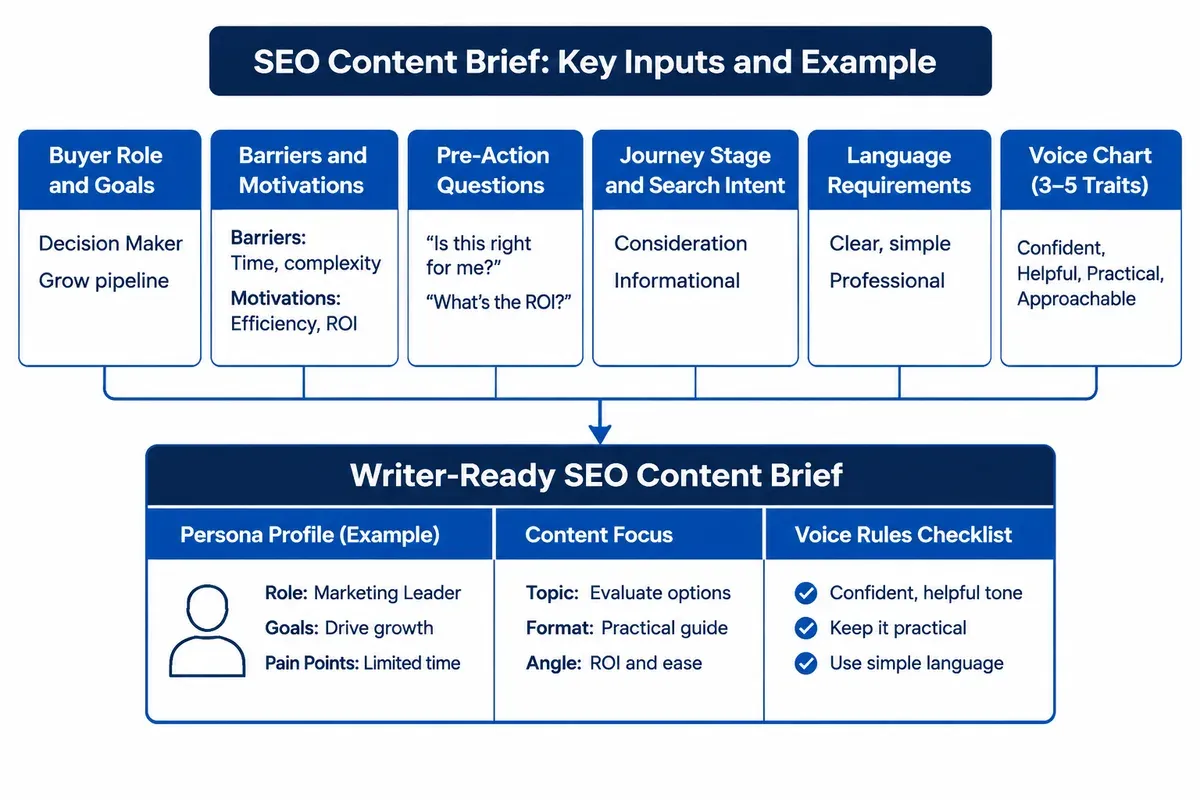
Turn each persona into a decision profile with these inputs:
-
Desired outcome and job: State what the reader needs to achieve and the task they’re trying to complete.
-
Barriers and motivations: Separate practical limits, such as limited time or missing expertise, from professional concerns like reputational risk, internal pressure and the trust signals that support a purchase.
-
Pre-action questions: Capture the objections, recurring questions and evidence the reader needs before acting.
-
Journey stage and search intent: Identify the buyer-journey stage and search intent so the article promise, proof and call to action fit the decision context.
Use the audience’s own language for pain points, including familiar terminology and repeated objections. Internal jargon can produce headings that make sense to a client but miss how prospects search and assess options. Briefs are stronger when writers recognize how readers describe a stalled workflow, an expensive error or a result they must defend internally.
Set language requirements at the start. Specify the target language, market, regional variant such as US or UK English, spelling conventions, protected terminology, and prohibited terms. Multilingual briefs also need local search phrasing, expected formality and cultural expectations built in before drafting, rather than treated as final copyediting.
A voice chart should contain three to five observable traits that guide headlines, explanations and recommendations:
-
Practical: Use concrete steps, constraints and examples. Avoid broad marketing claims.
-
Clear: Write direct sentences and define niche terms before relying on acronyms.
-
Confident: Make supported recommendations and state tradeoffs plainly. Avoid inflated promises.
-
Audience-aware: Match depth, tone and examples to the reader’s role, channel and decision stage.
In Floyi, a persona’s goals, pain points, objections, and quotes travel with every brief that uses it. Include the decision profile and voice chart in every brief, then use outline approval and revision patterns to spot where client context needs sharper definition.
How Can Teams Reduce Revision Cycles?
Teams reduce revision cycles by turning editorial judgment into visible, checkable brief rules before drafting starts. The stakes are high for agencies managing multiple brands, where unclear guidance creates avoidable senior review and delayed publishing.
A consistent template is only the foundation. Each client brief should carry the audience, search intent, brand voice, topical scope, sources, and internal-link plan. Floyi’s topic-anchored briefs bring the relevant persona, SERP analysis, competitor sources, Knowledge Base material, internal links, and anchor text into the starting assignment, so strategy doesn’t arrive as post-draft feedback.
Subjective requests such as “make it punchier” should become rules a writer can verify before submission:
- Active voice: Use active constructions unless the actor is unknown or irrelevant.
- Sentence length: Keep blog sentences to 25 words or fewer.
- Structure: Use descriptive headers every 200 to 300 words.
Keep active voice and jargon avoidance as separate rules rather than combining them into a vague style note. In Floyi’s Content Guide, each one becomes its own Brand Messaging rule, and Floyi sends every rule to the AI in full. Approved bios, calls to action and disclaimers stay as Approved Snippets that an editor inserts by hand, which keeps fixed language distinct from adaptable copy.
The brief should preserve strategy from assignment through drafting. Floyi generates briefs from a Planner topic or as standalone work, with Strategic Instructions, manual competitor pages and your own external links.
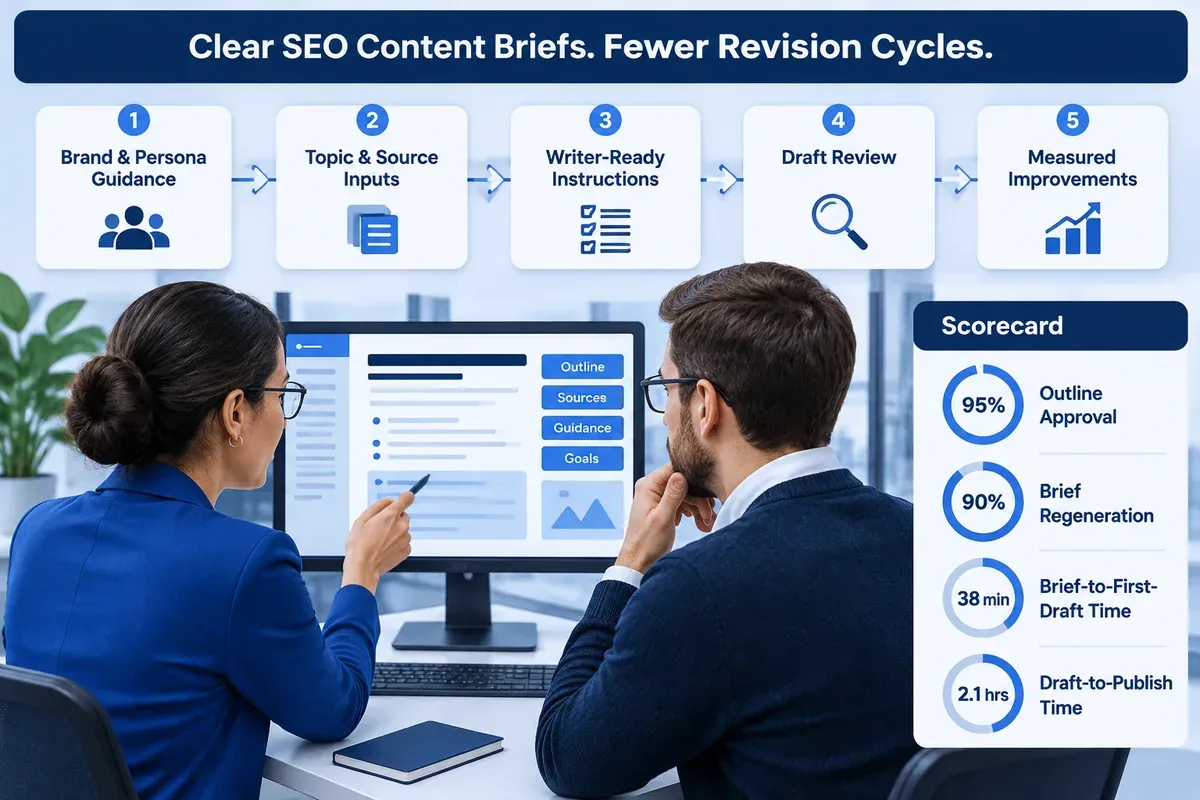
Instruction quality becomes easier to assess with a compact scorecard:
- Outline approval rate: Strong approval signals that editors have enough direction before drafting begins.
- Brief-regeneration rate: Repeated regeneration can reveal missing sources, unclear topical scope or incomplete constraints.
- Brief-to-first-draft cycle time: This shows whether writers can begin without waiting for clarification.
- Draft-to-publish cycle time: This separates drafting delays from editorial rework.
Repeated corrections for voice, links, format, or calls to action point to a missing or unclear brief rule. Update that client guidance before the next publishing queue, then compare the next cycle’s approval and timing data.
How Should You Pilot One Client First?
Pilot one active client before adopting a new brief tool, using a representative page set to test whether approved voice, personas, topical scope, and approval standards carry from research into an optimized draft.
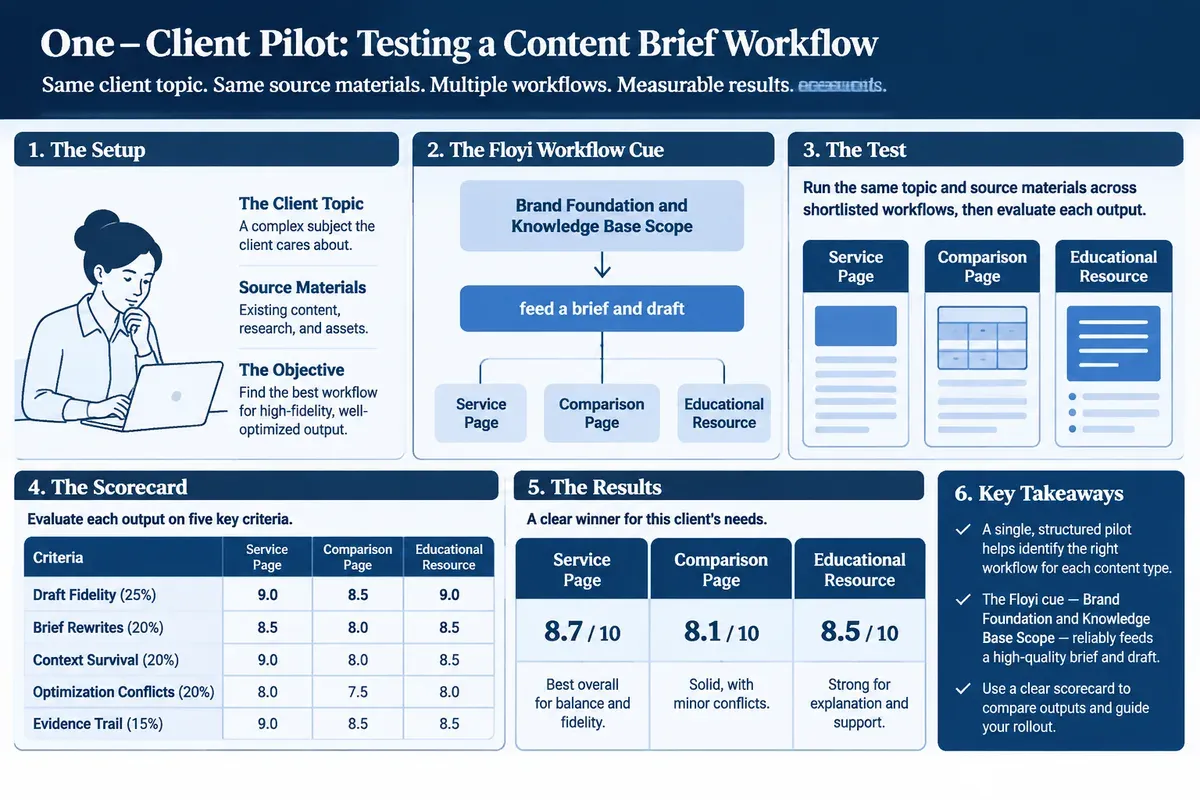
Choose planned pages with distinct search intent, such as a service page, a comparison page and an educational resource. An attractive outline can conceal a broken handoff, so use the same client topic and source materials in every shortlisted platform.
-
Test research-to-brief continuity. Check whether the brief separates SERP consensus from differentiated angles, turns persona intent into outline decisions and supplies usable internal-link and anchor guidance. In Floyi, confirm that the Brand Foundation, Knowledge Base Scope and Strategic Instructions show up in the brief writers receive.
-
Test the handoff with a writer, an editor and a client-facing reviewer. Collaboration becomes fragile when each role must restate voice rules or buyer priorities. Share the brief the way each tool supports, such as Content Harmony’s public links or Floyi’s DOCX and Google Docs exports, and record what each reviewer has to ask.
-
Test drafting and optimization together. Use a new page and, where a tool accepts one, an existing client draft. In Floyi, check how the draft applies Content Guide rules and persona targeting, then open the Page Quality Scorecard. It scores six dimensions: relevance, answer first, content quality, information gain, next step or call to action, and trust and authorship. Its evidence quotes jump to the passage behind each score.
-
Test the allowance against the full page set. Frase’s 7-day trial caps use at 5 articles, 50 audit pages, 25 AI prompts, and 3 seats. Jasper offers a 7-day trial of Pro, and Clearscope offers a 14-day trial, as of November 2026. Confirm that each allowance covers every planned page and reviewer, because a feature demonstration alone can’t show whether a tool reduces revision cycles across an active engagement.
Score the pilot against the client’s standards rather than a generic feature tally:
-
Final-draft fidelity: Measure adherence to voice, persona requirements and approved positioning.
-
Brief rewrites: Count clarification requests before drafting begins.
-
Context survival: Record whether feedback reaches the next version without restating source rules.
-
Optimization conflicts: Flag recommendations that weaken the approved market position.
-
Evidence trail: Confirm that publish-ready copy traces back to client inputs and brief requirements.
Reuse the winning scorecard for later client evaluations, and run the Floyi side of the pilot from one client’s Brand Foundation and personas.
Turn one client’s brand and personas into a writer-ready brief.
Start with Floyi Briefs & Drafts
Content Brief Tools for Brand Voice and Buyer Personas FAQs
These FAQs cover how content brief tools apply brand voice and buyer personas to SEO briefs, so you can judge fit for client work, review cycles and topical authority planning.
1. Which Tools Create Client-Specific Brand Briefs?
Floyi builds client-specific briefs from each client’s Brand Foundation, Content Guide and up to two buyer personas, then connects them to a Planner topic, competitor and AI search research, internal-link guidance, and selected Knowledge Base documents.
Among the other six tools, Content Harmony’s brief templates include an Audience & Brand Overview section. Frase stores a separate voice profile per client account, and Jasper stores brand voices and audiences in Jasper IQ, per vendor pages as of November 2026.
2. Which Tools Reduce Senior Brief Reviews?
Floyi’s topic-anchored briefs carry buyer personas, Content Guide rules, SERP Consensus Claims, information gain angles, and internal-link guidance into execution, which can support stronger first drafts and fewer rewrites. Content Harmony’s standardized, shareable brief formats give writers consistent instructions. Senior review cycles shrink when every writer receives the same approved coverage, audience direction and editorial expectations.
3. How Do Tools Learn Your Brand Voice?
Content brief tools learn brand voice from writing samples, stored rules or both. Floyi’s Brand Voice profile analyzes 3 to 5 writing samples into seven dimensions, including tone, vocabulary level and sentence patterns. Frase builds voice profiles from pasted writing samples and stored brand context. Surfer offers Custom Voice in its Content Editor, and Jasper stores brand voices in Jasper IQ.
Tone still changes with the audience, situation and channel, so the profile sets the personality and each brief sets the tone for its page.
4. Can Brief Tools Protect Buyer Persona Data?
Brief tools can store buyer persona data, but the product pages reviewed for this comparison don’t describe protection specific to persona data. Before entering client research, verify each vendor’s data-processing terms, retention and deletion practices, encryption commitments, model-training policy, and stored-data location. Also confirm workspace separation, access logs and role-based limits on viewing and exporting.
Floyi keeps each client’s personas inside that client’s brand, and persona exports to DOCX, XLSX, Google Docs, and Google Sheets are snapshots, so protect exported files through their storage and sharing lifecycle.
5. Do Brief Tools Need SEO Expertise?
Brief tools reduce research and optimization work, but they don’t remove the need for SEO expertise. Content Harmony can insert reader questions, related searches and related phrases from its keyword report into a brief, while a strategist decides what belongs in a client brief and what the page can add beyond competitors.
Floyi’s Planner briefs carry the map topic, up to two personas, internal-link suggestions, SERP Consensus Claims, and Competitor Content Gaps scored for information gain into the handoff. AI output still needs expert review because SERPs change and LLM knowledge can lag.
About the author

Yoyao Hsueh
Yoyao Hsueh is the founder and CEO of Floyi, the topical authority platform, and the founder of Main Heading, an SEO and AI search agency. He is an expert in topical authority and topical mapping. He created Topical Maps Unlocked, a course studied by thousands of SEOs, content strategists and digital marketers, founded TopicalMap.com, a done-for-you topical mapping service for agencies and enterprise teams, and publishes the weekly Digital Surfer newsletter on SEO, content strategy and AI search.
About Floyi
Floyi is a closed loop system for strategic content. It connects brand foundations, audience insights, topical research, maps, briefs, and publishing so every new article builds real topical authority.
See the Floyi workflow