
How to Apply Brand Voice to Your SEO Content Strategy
Apply brand voice to SEO content strategy from topical maps and briefs to drafts and review, while meeting search intent and using keywords naturally.
A keyword list and a polished brand guide can still produce SEO content that sounds like two different companies. The fix isn’t a final copy edit. Apply brand voice to your SEO content strategy before briefs are written, so topic selection, framing, drafts, and review all follow the same position.
Voice is the durable language and stance your brand keeps across pages, while tone adjusts to the query, format and stakes. The workflow below carries both through one loop, from brand context to the topical map, then the brief, the draft and review, and back into the next plan.
Brand Voice SEO Key Takeaways
- Define stable voice rules before keyword planning shapes content decisions.
- Keep brand voice consistent while adapting tone to intent, format and stakes.
- Filter topical map ideas through audience needs, searchable opportunity and credible brand positioning.
- Add a brand viewpoint and proof requirements to every content brief.
- Write voice rules for vocabulary, syntax, claims, formatting, and calls to action.
- Let search intent set the page’s job while voice shapes its language and framing.
- Review pages by intent and type, then feed the findings into the next round of topic planning.
Define Voice Rules Before Planning Content
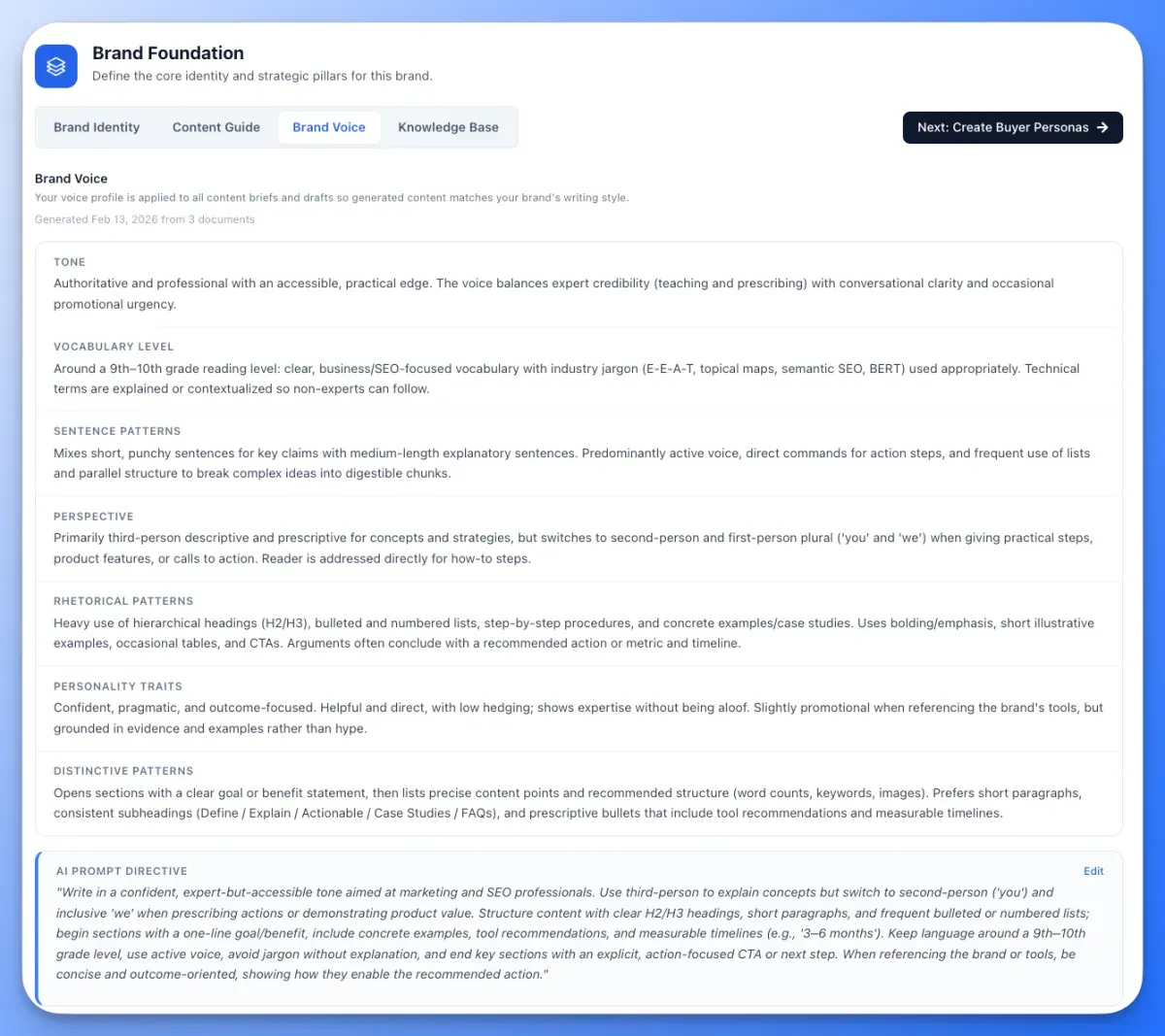
Define your brand voice before keyword research, because voice sets how your brand relates to readers before search opportunities start shaping the work. Start with a two-sentence core statement that names the audience, the stance and the relationship. For example: “We guide SEO practitioners toward defensible decisions with calm, credible advice. We speak plainly, take evidence-backed positions and respect the reader’s expertise.”
Then turn brand personality traits into three to five brand voice attributes. Write each one as a boundary, not a flattering label:
- Confident, not arrogant: State a position and support it. Write “Publishing volume without topical scope wastes effort.” Avoid “Only amateurs publish without a plan.”
- Pragmatic, not academic: Give the decision and its consequence. Write “Prioritize the resource that answers the commercial question.” Don’t turn a brief into a theory lecture.
- Precise, not jargon-heavy: Use SEO, GEO and SERP when each term adds meaning. Don’t stack technical vocabulary where plain language is clearer.
These become your brand voice pillars. To document your brand voice for writers, add the observable rules: preferred and avoided terms, reading level, active voice, sentence and paragraph length, grammatical person, and a few effective-versus-ineffective examples.
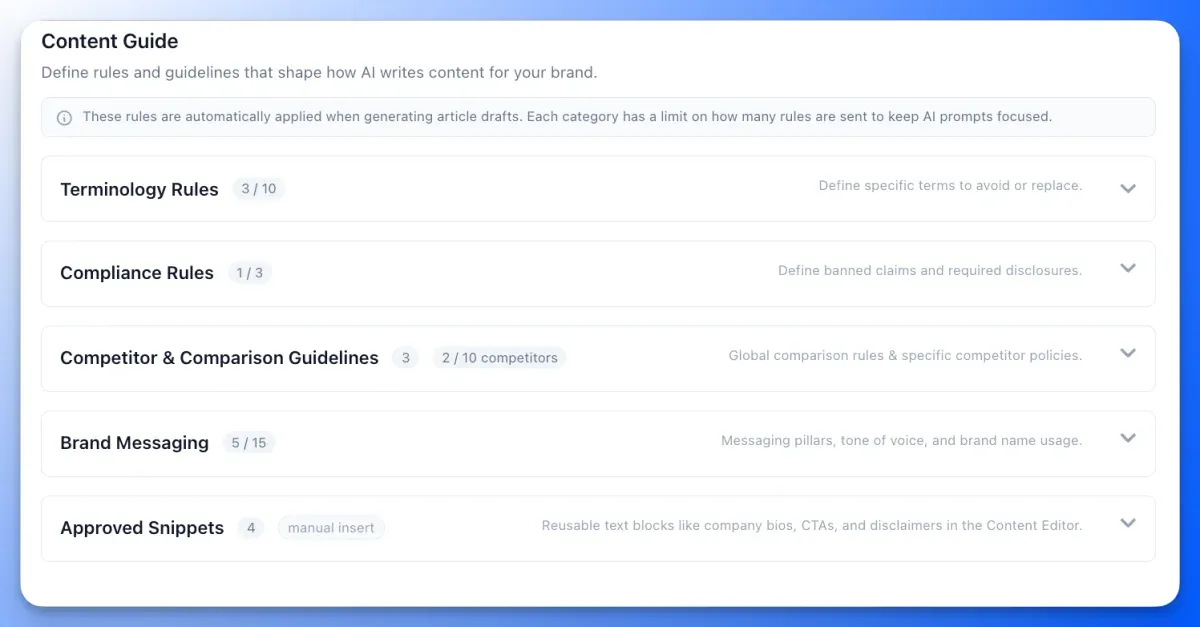
Keep each rule small and distinct. “Use Floyi as a proper noun” and “Don’t invent performance figures” are two rules, not one. Separate rules like these give in-house writers, freelancers, editors, and AI drafting tools clear constraints. In Floyi, Brand Foundation holds this context: mission, positioning, USP, and a Brand Voice profile built from three to five writing samples. The Content Guide holds the rules the AI must follow when drafting, and it can generate a starting set from Brand Foundation.
Carry the same rules into step-by-step topical map construction, briefs, drafts, and editorial review. One shared source keeps keyword pressure from diluting the voice readers should recognize.
Separate Stable Voice From Situational Tone
Brand voice is the durable identity readers recognize across channels. Tone is the situational adjustment to the reader, the query, the format, and the emotional stakes. Voice comes through in personality, values, vocabulary, and sentence patterns. The goal isn’t to make every page sound identical. It’s to make every variation sound like it came from the same company.
An airline shows the difference:
- Marketing page: Optimistic, welcoming language builds anticipation.
- Delay update: Direct, empathetic language gives passengers clear information.
- Safety instruction: Calm, precise language leaves no room for ambiguity.
The clarity, vocabulary and stance stay recognizable across all three. The brand tone serves the moment without replacing the brand identity.
Apply the same test to search content. A retirement-planning guide can sound authoritative while a debt-management article reassures an anxious reader. Both should keep practical expertise, respect for the reader and a consistent level of formality. If the copy could plausibly sit on a competitor’s site, the tonal shift has erased your distinct brand voice.
Format changes delivery, not identity. A guide explains step by step, documentation uses terse imperatives and product comparison page tone stays factual. Set the non-negotiable traits first. Then align tone with search intent and define an acceptable tone range for instructional, promotional and high-stakes messages. That’s how you inject personality into content without forcing it into every sentence.
Apply Voice to Your Topical Map
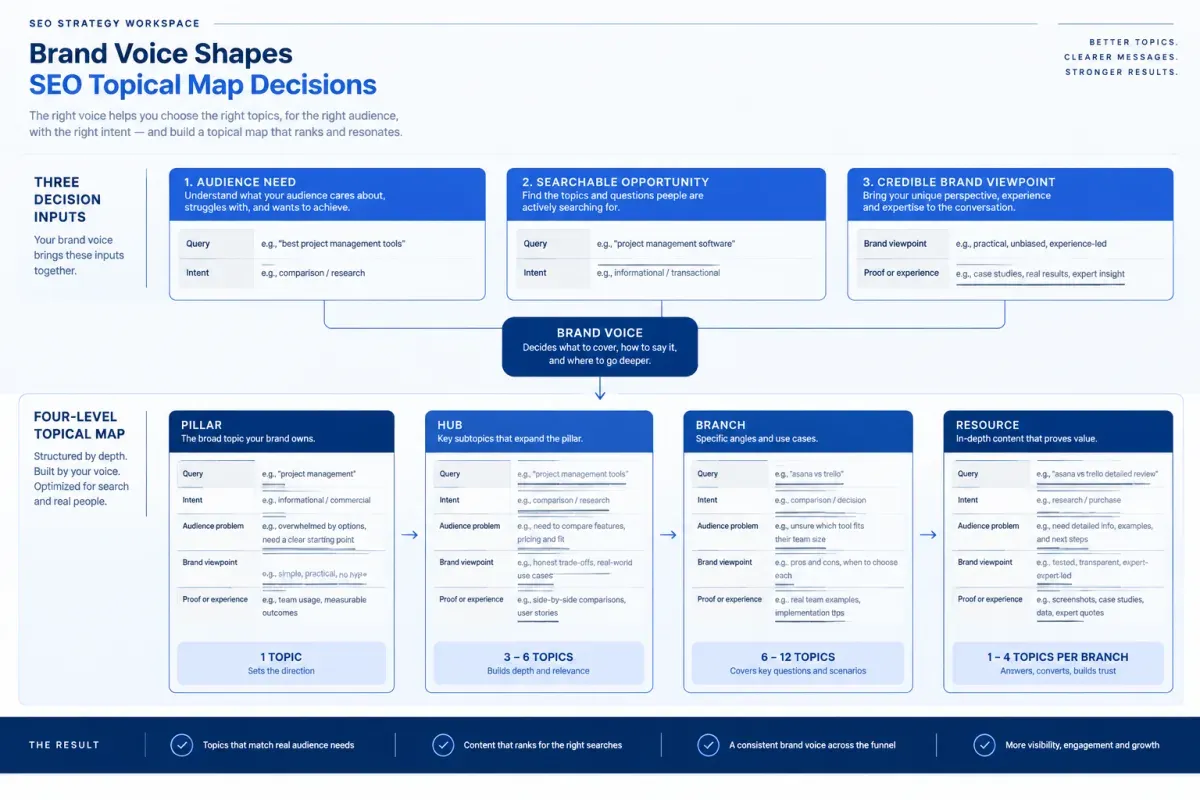
A topical map should admit a topic only where audience demand, searchable opportunity and a credible brand position overlap. That’s where brand voice in content strategy starts: before a brief fixes the page’s direction.
Use buyer personas as the filter. An agency head of content strategy can drop a high-volume marketing-trends topic that neither reduces planning friction nor supports client ROI. A SaaS head of content marketing can drop a high-volume AI news topic that doesn’t connect to product features or pipeline goals. Use persona-driven topic framing to keep those calls tied to real problems and journey stages. The map then becomes the blueprint that links brand identity, research and focused coverage.
Give every topic in the map an angle field:
- Query and intent: The target query and what the searcher wants done.
- Audience problem: The friction the persona needs resolved.
- Brand viewpoint: The perspective your brand can credibly own.
- Proof or experience: Product evidence, practitioner experience or data that backs the viewpoint.
This is how you map brand voice to search intent without forcing one framing onto every page. The same keyword can take a practical hook from one brand, opening with an implementation example, and a data-led hook from another, opening with decision criteria. Concrete benefits beat abstract claims about innovation in either case.
Intent sets the page’s job. Informational pages and top-of-funnel content educate through explanations and examples. Commercial pages compare options and trade-offs candidly. Transactional pages establish value and credibility before a clear next step. Navigational pages stay direct and helpful.
Bring editorial review into planning while each topic is still a hypothesis. Reviewers can test narrative fit, buyer journey, topical scope, and persona need before a search-led idea becomes an off-brand draft. That keeps the SEO content strategy coherent instead of a collection of keywords.
Build Voice Requirements Into Every Brief
A content brief joins keyword strategy and brand expression in one assignment, so writers don’t have to reconcile separate SEO and voice instructions. Build SEO content briefs around three decisions that prevent padding and topic drift:
- Search direction: The primary keyword, supporting terms, intent, audience, the pain point behind the search, the buyer-stage job, content type, and a flexible word-count range.
- Brand perspective: The practical argument the article makes beyond summarizing ranking pages. Add approved internal links with anchor text, the reader’s priority questions and the evidence or examples the piece needs.
- Conversion direction: The reader’s next action, and how the content supports it without forcing a sales message into an educational query.
Adding a brand voice brief template to your SEO content brief template turns broad preferences into observable writing choices. The pillars set personality and a tone range. The brand voice guidelines for writers record the decisions: point of view, preferred and banned vocabulary, opening and transition patterns, syntax, formatting, claim and evidence standards, and call-to-action style.
Brand voice prompts for AI writing need the same specificity. “Write an engaging, SEO-friendly article” leaves a model room to produce generic copy. A stronger instruction separates explanatory content from direct product recommendations, names the claims that need evidence and excludes phrases that conflict with the brand.
Put execution requirements at the section level: required headings, key facts, references, keywords, and entities, plus visuals that suit the format. Natural SEO headings should reflect the reader’s task rather than reproduce a competitor outline. Section-level limits also cut repetition in AI drafts.
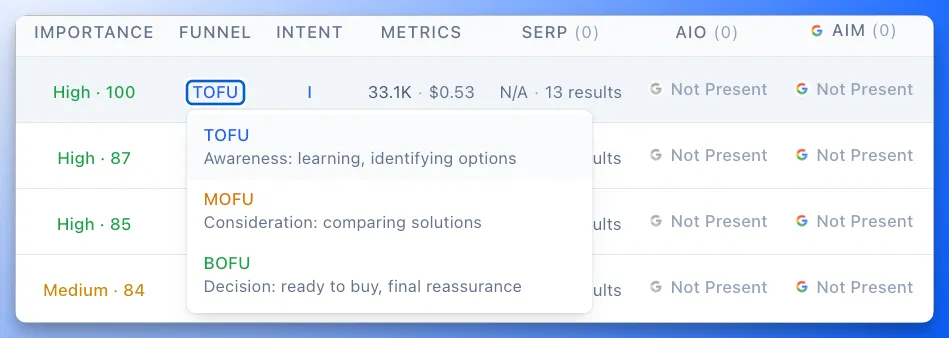
In Floyi, briefs generated from the topical map start in the Authority Planner. Each topic there carries its keywords, search intent, funnel stage, outgoing internal links, and incoming anchor text options. The brief also inherits Brand Foundation and your buyer personas, so the draft starts from the strategy your team already approved, not a recycled competitor outline.
Use a Copyable Voice-Rules Example
Specific behavioral rules make brand voice repeatable across briefs and AI prompts. Paste this brand voice cheat sheet into a brief or prompt, then edit it to fit:
- Personality and point of view: Write as a calm, evidence-led practitioner. Address the reader as “you.” Use “we” only for informed brand guidance.
- Rhythm and structure: Use active voice and medium-length sentences. Lead with the direct answer or a specific practitioner situation. Use a named, numbered workflow and close with a measurable next action.
- Vocabulary and mechanics: Use SERP, schema and entity when they improve accuracy. Write “hub,” not “cluster.” Write “topical scope,” not “topic boundary.” Avoid hype, exclamation marks, semicolons, em dashes, and en dashes.
- Do and don’t: Support opinions with evidence or a mechanism. Don’t open with a definition, industry throat-clearing, abstract capability claims, or explanations of familiar SEO terms.
- Before and after: Before: “Our platform helps teams create better content faster.” After: “The Authority Planner shows each topic’s intent and funnel stage, so every brief starts with a defined search job.”
- Search-quality guardrails: Match the query’s intent. Use a descriptive title, logical headings, a useful meta description, natural coverage of secondary topics, actionable examples, and relevant internal links. Qualify uncertain claims. Don’t invent statistics, customer outcomes or expertise.
Floyi sends at most 15 Brand Messaging rules to the AI per generation, and rules past the 15th are dimmed. So each rule should govern a choice a reader can see.
Draft Search-First Content That Sounds Human

Search intent decides what the page must answer. Brand voice decides how that answer sounds: the vocabulary, pace, point of view, and examples that carry it. Put the answer where readers find it immediately, then let personality make it recognizable instead of hiding it behind slogans or repeated keywords.
The search result and the page hierarchy are the first brand encounter. Keep the on-page SEO elements aligned with one promise:
- Title: Pair the topic with a credible benefit and set a realistic expectation. Brand voice in SEO titles shows in word choice, not in wordplay that hides the topic.
- Meta description: State the practical value in natural brand language, not a sales tagline.
- H1 and opening paragraph: Name the subject plainly, then answer the central question in the first sentences.
- H2 and H3 headings: Use descriptive phrasing that helps skimmers find the answer. Conversational, question-led or action-oriented SEO headings work when they still say what follows.
Titles and descriptions are signals, not fixed search-result copy. Google may rewrite a title link or snippet from the query and the page’s own text. That’s why the title, description, H1, and opening need to agree on what the page delivers. Floyi’s brief title agent drafts alternate candidates (exact-match, semantic variant, benefit-led, SERP-frame, and contrarian) and lets you switch between them in one click.
In the body, apply the documented choices for word choice, reading level, active voice, sentence length, and grammatical person. Concrete practitioner examples, comparisons, tables, and checklists give readers more than generic filler. That’s the standard Google sets in its guidance on creating helpful, reliable, people-first content.
Introductions need the most discipline, because they establish relevance before a reader commits. Lead question-shaped sections with a direct answer and read the draft aloud to catch robotic phrasing. When a natural synonym says it more clearly, use the synonym.
Rewrite Awkward Keywords Naturally
Rewrite an awkward exact-match phrase by recasting it as the reader’s question or a verb-led instruction. A heading that reads “Brand voice SEO strategy” becomes “How to build brand voice into your SEO strategy.” The topic stays, and the promise gets clearer.
Use this edit sequence when a keyword disrupts the sentence:
- Lead with the reader’s task: Replace a noun stack with an action, such as “Set voice requirements for every brief.”
- Frame the real question: Build the heading around the problem the searcher needs solved, not the wording in a keyword export.
- Add focused context: Use related terms and specific entities to clarify the subject without repeating one rigid string.
Conversational keyword variations keep copy precise without making it mechanical. A draft might say “voice requirements” in one paragraph, “brand language” in the next and “editorial standards” in the review section. Search engines connect related wording when the context stays focused, so you can avoid keyword stuffing without losing the topic.
Internal linking and anchor text need the same judgment. “Learn more about brand voice SEO strategy” is vague and overloaded. “See the voice-rules example for your next brief” tells the reader where the link goes. When an anchor sounds forced, rewrite the sentence around it.
Review, Measure and Refine Your Voice System
Run every page through a Voice-to-Authority Review Loop that ties the voice back to the topical map, from persona context and briefs through drafts and published pages. At each stage, confirm buyer-journey fit, the problem the page solves and adherence to the approved voice rules.
- Review the draft: Treat AI-generated SEO content as a first draft. Editors verify claims, add original expertise, check intent, and confirm the draft matches the approved voice.
- Score the published page: Run a content audit for brand voice alongside search usefulness. Compare each page against the voice pillars and five to 10 annotated on-brand examples from product pages, blog posts and customer stories.
- Check search execution: Review factual accuracy, readability, natural keyword use, SEO metadata, and headings. Then confirm the page answers its query directly. A page can sound on-brand and still bury the answer.
- Return findings to planning: Tie each finding to its hub, page type and intent, so it shapes the next brief instead of staying subjective feedback.
Compare performance like for like. Home, product and blog pages serve different audiences, so group results by page type, hub and intent. Read organic clicks, impressions, rankings, and conversions alongside the editorial findings. Voice can influence outcomes, but it shouldn’t get credit for every movement.
Measure Google and AI search separately. A mention in an AI answer shows recognition. A citation shows the engine used the page as a source. Direct answers, structured steps and evidence make expertise easier to quote.
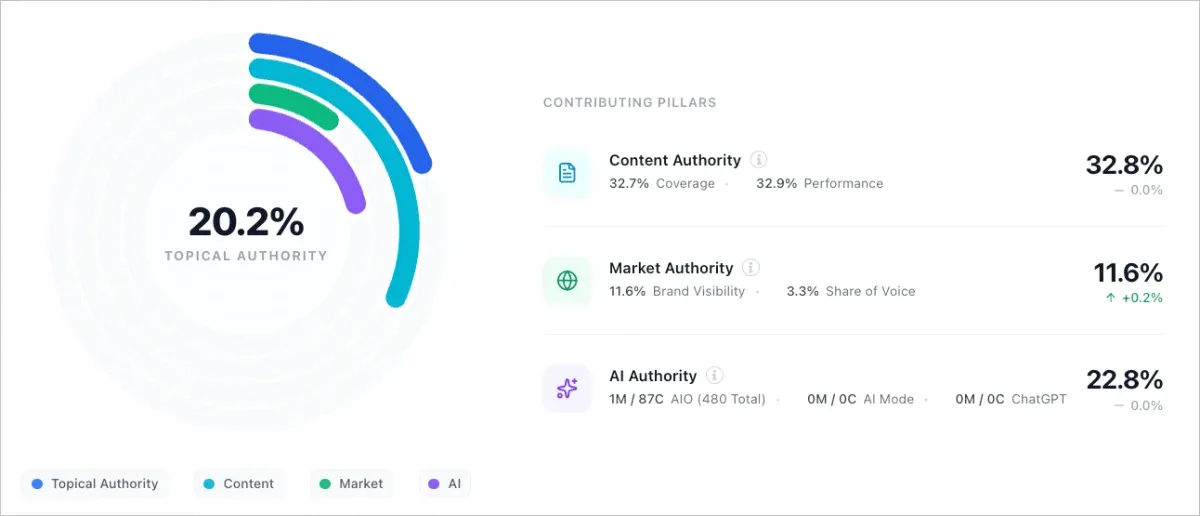
Floyi closes the loop with real data. The Organic Audit’s By Page view lists each URL’s clicks, impressions and position, and URL-to-topic matching ties that page to its topic in the map. The Topical Authority Score splits into Content Authority, Market Authority and AI Authority, which tracks mentions and citations across AI Overviews, AI Mode, ChatGPT Search, and Google Gemini. If Content Authority is strong but Market Authority stalls, the plan is executed but not yet winning. That points at page quality or credibility rather than missing pages.
Test voice-led updates on comparable pages, account for seasonality and other edits, then put the pages with the clearest constraint first in the next plan. That’s how a consistent brand voice at scale stays tied to measured results.
To set your voice rules once and carry them into every brief and draft, build your Brand Foundation in Floyi.
Brand Voice SEO FAQs
These Brand Voice SEO FAQs cover where brand voice and SEO meet: rankings, metadata, click-through rate, and product pages.
1. How Does Brand Voice Affect Search Rankings?
Brand voice isn’t a direct ranking signal in any guidance Google has published. Its SEO value is indirect: a consistent, credible voice can make useful content easier to trust and act on. Google’s guidance puts helpful, reliable content first, so accuracy, original insight and fit with the query come before promotional messaging. Awkward keyword repetition or personality that hides the answer works against that. Voice should make your answer recognizable, not replace the substance that earns rankings.
2. Should Meta Descriptions Match Your Brand Voice?
Yes, as long as it stays accurate. Lead with the practical benefit, keep the target topic clear and describe what readers will actually find. Brand voice in meta descriptions should shape vocabulary, rhythm and directness, never obscure relevance or overpromise.
3. Can Brand Voice Improve Organic Click-Through Rates?
It can help, but voice alone can’t guarantee a higher organic click-through rate. A recognizable voice can make a result more memorable. Whether that lifts CTR depends on the query, the competing results and the title itself, so test it rather than assume it.
Keep the searcher’s language in the title tag or meta description, lead with a concrete benefit, then use your natural register. A practical hook and a data-led hook can target the same keyword, as long as abstract jargon doesn’t bury the payoff.
4. Should Product Pages Follow the Same Voice Rules?
Yes. Keep vocabulary, confidence, evidence standards, and sentence style consistent so bottom-of-funnel content still sounds like you. Adapt the tone to transactional intent: lead with the product’s value and who it fits, then give decision-critical details such as specifications, pricing and credible proof.
Product comparison page tone should be direct and fair. Let personality shape the framing, not bury the offer. Close with a clear, low-pressure next step, such as viewing plans, starting a trial or contacting sales.
About the author

Yoyao Hsueh
Yoyao Hsueh is the founder and CEO of Floyi, the topical authority platform, and the founder of Main Heading, an SEO and AI search agency. He is an expert in topical authority and topical mapping. He created Topical Maps Unlocked, a course studied by thousands of SEOs, content strategists and digital marketers, founded TopicalMap.com, a done-for-you topical mapping service for agencies and enterprise teams, and publishes the weekly Digital Surfer newsletter on SEO, content strategy and AI search.
About Floyi
Floyi is a closed loop system for strategic content. It connects brand foundations, audience insights, topical research, maps, briefs, and publishing so every new article builds real topical authority.
See the Floyi workflow