
How AI Transforms Content Planning for SEO Teams
Learn how AI transforms content planning for SEO, GEO, and CMS workflows, from topical mapping to briefs, measurement, and ROI.
Content calendars built by guessing lose to calendars built on signals. AI content planning replaces intuition with a plan tied to demand, fit, and business impact. It uses AI to structure content decisions before drafting starts. SEO agencies, heads of content, and freelance strategists turn audience, search, and competitor data into prioritized topics, briefs, and calendars.
The coverage here focuses on research, semantic clustering, topical mapping, briefing, QA, and automation. It also shows where GEO, LLM, and CMS workflows change scheduling, personalization, and internal linking. Readers get outputs like topic lists, AI-assisted briefs, refresh rules, and a cleaner publishing path.
Content leaders need faster planning without losing brand voice, evidence, or ROI discipline. A head of content can turn one product theme into a cluster map, a brief set, and a publish sequence in minutes instead of days. Keep reading to see how AI reshapes planning without removing editorial control.
AI Content Planning for SEO Key Takeaways
- AI ranks topics by demand, fit, and business impact.
- Research, clustering, and briefing move faster with structured AI workflows.
- Semantic topic maps strengthen SEO and GEO coverage.
- LLM and SERP signals improve intent matching and angle selection.
- CMS-connected planning keeps publishing, linking, and scheduling aligned.
- Editors still own brand voice, nuance, and fact checks.
- Forecast accuracy and post-publish lift help prove ROI.
What Is AI Content Planning?
AI content planning uses artificial intelligence (AI) to turn audience, search, and competitor data into a structured content plan. It shifts your team from intuition-led brainstorming to evidence-first decisions. The benefits of an AI-powered content strategy become easier to see when opportunities are ranked by demand, fit, and business impact.
The workflow also becomes faster and more measurable. AI tools can speed up repetitive planning tasks. Structured AI processes help teams test ideas faster, with oversight intact (source). Keyword sorting, gap analysis, and calendar building all move faster when AI organizes topics by intent, format, and priority.
Tools can shape the plan in different ways:
- Google Analytics, HubSpot, Semrush, and MarketMuse help you analyze timing, channels, competitors, and format performance.
- ChatGPT, Jasper, Claude, Notion, and Trello can support outlines, headlines, hooks, draft copy, visuals, and video ideas.
- Generative AI can also support content repurposing by turning one source asset into social, email, and related follow-up content.
The human-in-the-loop role stays central. Editors still need judgment, brand style training, and a clear angle to protect differentiation. AI outputs are starting points, not final strategy, especially when you’re balancing search engine optimization (SEO) and Generative Engine Optimization (GEO).
The rest of the guide focuses on how AI handles repetitive planning work. Content strategy, topical mapping, measurement, and return on investment (ROI) oversight stay aligned to business goals. The balance keeps the workflow defensible and practical.
How Does AI Change Your Planning Workflow?
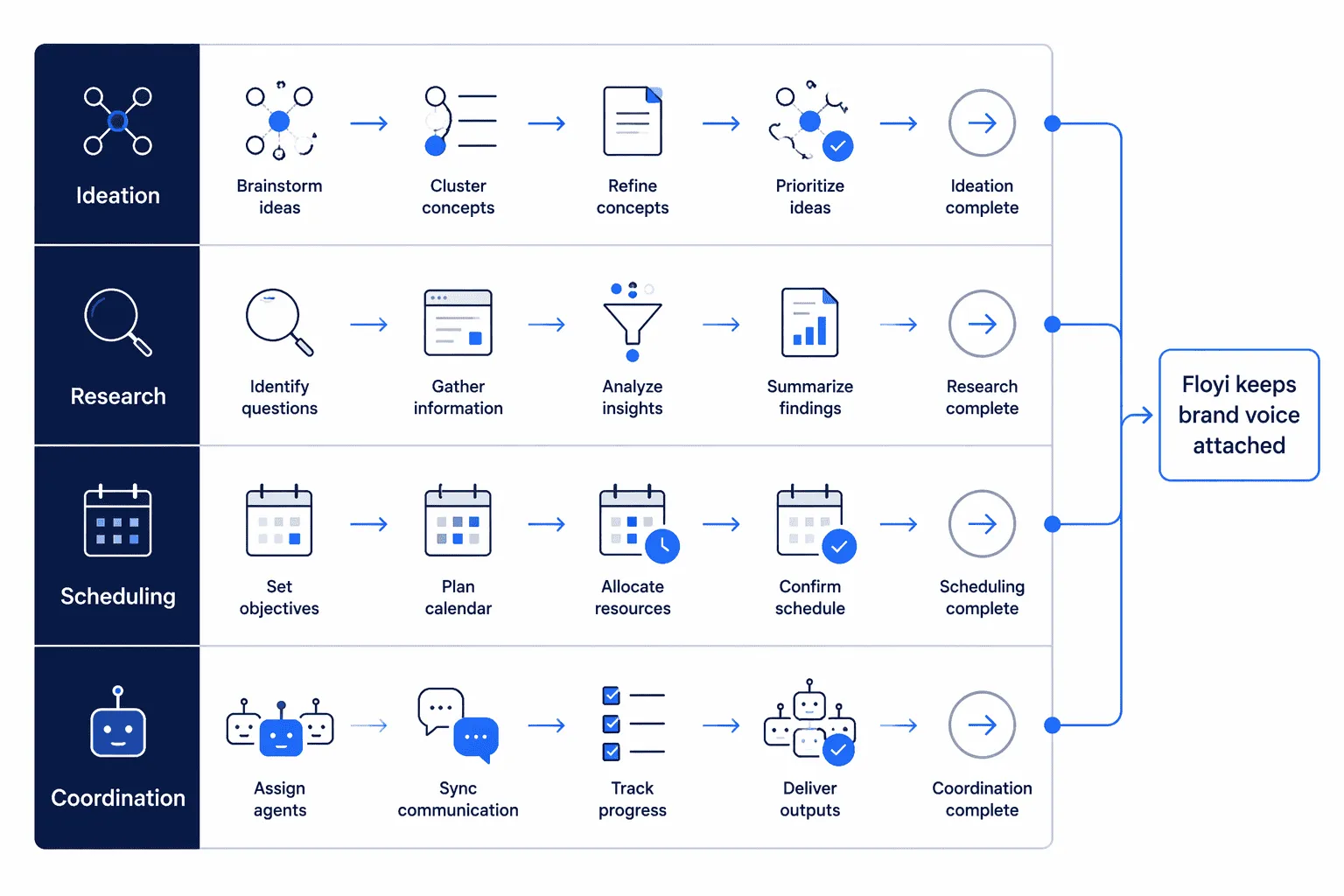
AI changes planning by turning SEO work from a linear handoff into a parallel system. Research, scheduling, drafting, and review can move together instead of waiting on one person to finish each step. The workflow starts to feel like an AI-powered content calendar instead of a spreadsheet queue.
The biggest shifts show up in four places:
- Ideation becomes more predictive. Multi-agent systems can scan past performance, trend prediction signals, persona inputs, and search engine results page (SERP) patterns. They generate several angles, then narrow them into a stronger editorial calendar with less manual brainstorming.
- Research becomes always on. AI replaces ad hoc Googling with structured briefs that pull in competitor context, supporting evidence, and current statistics. Specialist agents for web research, fact checking, and evidence integration refine the brief before writing starts.
- Scheduling becomes adaptive. Predictive scheduling lets an AI-managed hub reorder topics, sequence dependencies, and shift publication timing as signals change. Cross-platform orchestration keeps analytics, the content management system (CMS), social channels, and collaboration tools in sync.
- Coordination becomes orchestration-heavy. Writer agents can handle automated content creation, editor agents can tighten tone and keyword placement, and specialist agents can run quality checks and conversion improvements. Status updates show what is blocked, in progress, or ready to publish.
Audience segmentation also gets sharper. AI maps persona inputs to intent, supporting content personalization without rebuilding the plan for every channel. The detail matters when one topic needs different depth, proof, and format across search, email, and social.
Teams that want a fuller workflow view can pair this with a team guide to operationalizing AI-powered content strategy.
Floyi keeps brand voice, audience, SERP context, and internal linking intent attached from planning through drafting. Strategy stays intact at each handoff. Coordinated AI agents support smoother handoffs from planning to publishing (source).
What Does A Closed-Loop Planning System Look Like?
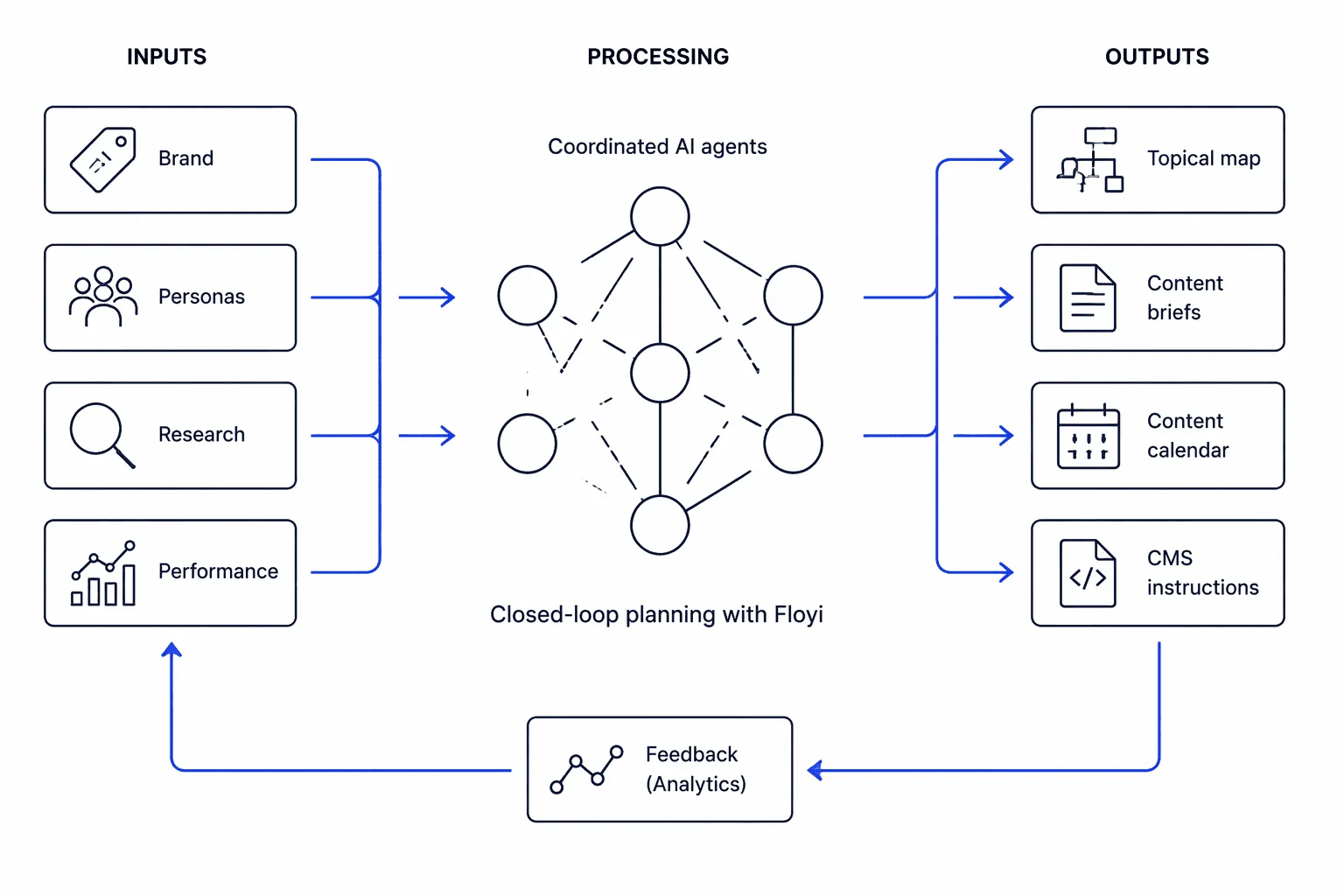
A closed-loop planning system is a connected workflow, not a straight line from plan to publish. Brand, audience, research, and performance data feed AI orchestration. The system turns those inputs into prioritized actions and learns from what happens after launch. SEO, GEO, and CMS work stay connected instead of splitting strategy, execution, and measurement into separate handoffs.
The loop gets dependable when the inputs are consistent and shared:
- A brand foundation approved for voice, offer framing, and message limits
- Shared persona guidance that captures goals, objections, and decision triggers
- Topical research paired with site architecture that shows where authority already exists
- Content audit signals that reveal thin pages, stale assets, and coverage gaps
- Performance history from organic search and AI visibility
- Live indicators such as topic demand and page-level trend shifts
Those inputs give the system enough context to make decisions that are specific instead of generic.
The processing layer works best as coordinated agents. One agent handles trend prediction and spots demand shifts. Another clusters topics by intent and maps them to the right stage of the journey.
A planning layer then uses performance forecasting, predictive scheduling, and cross-platform orchestration to place each theme into pages, formats, and publishing windows. The result is an AI-powered content calendar that lives and updates with ongoing feedback.
The outputs should be execution-ready. A strong loop produces a validated topical map, a prioritized editorial calendar, draft-ready briefs, internal link and anchor recommendations, and publishing instructions for the CMS. Clear URL alignment and node-level guidance matter, since teams shouldn’t have to rebuild context every time a brief moves forward. The strategy-to-first-draft system shows how that continuity holds up in practice.
After publish, content analytics closes the loop. Rankings, Google AI Overview and AI Mode visibility, click-through patterns, freshness, and conversions feed back into the next planning cycle. If a segment responds better to video, comparison copy, or a different headline angle, lightweight A/B tests on headlines, visuals, and calls to action should shift production fast. The system then re-ranks upcoming topics based on what worked.
Parallel work is the operating principle across the loop. Analysis, creation, optimization, and measurement happen together instead of in a line of serial handoffs. The pattern keeps strategy, publishing, and reporting aligned and makes every cycle more useful than the one before.
How Does AI Build Topical Authority And GEO Coverage?
AI builds topical authority by turning a loose keyword list into a connected map of topics, entities, and search intent. Semantic clustering is the starting point. Related queries get grouped by real SERP overlap. The site covers one subject in depth instead of publishing isolated pages.
That coverage usually spans:
- Pillar pages that define the main subject
- Cluster pages that answer related questions
- Supporting articles that fill out the topic in depth
Entity building extends that structure for both SEO and GEO. Core entities, attributes, and relationships are validated first, then used consistently across content. The consistency helps LLMs map your expertise to a defined domain. Topic clustering and missing-entity checks scale the map without losing clarity.
AI-powered content gap analysis makes planning more precise. Instead of waiting for rankings to expose weak spots, you can compare your coverage with competitors and prioritize pages that are thin, duplicated, or missing. The biggest opportunities usually fall into these buckets:
- Definition pages that answer first-time questions
- Comparison pages that support evaluation
- Use-case pages that match specific jobs to be done
- Localized variants that reflect regional search intent
- Supporting assets built for content personalization and multimodal integration
Predictive topic mapping can forecast emerging questions and organize content ahead of demand. AI trend analysis helps teams prepare coverage proactively (source). Automated content tagging keeps those clusters clean and usually groups content by topic, storytelling format, and user need.
Topical authority is still earned, not inflated. It depends on enough depth to answer the cluster well, a clear internal linking structure, and disciplined expansion that avoids bloat. When that system is in place, the map becomes legible to users, search engines, and AI systems at the same time.
How Do You Keep Quality, Measure ROI, And Improve?
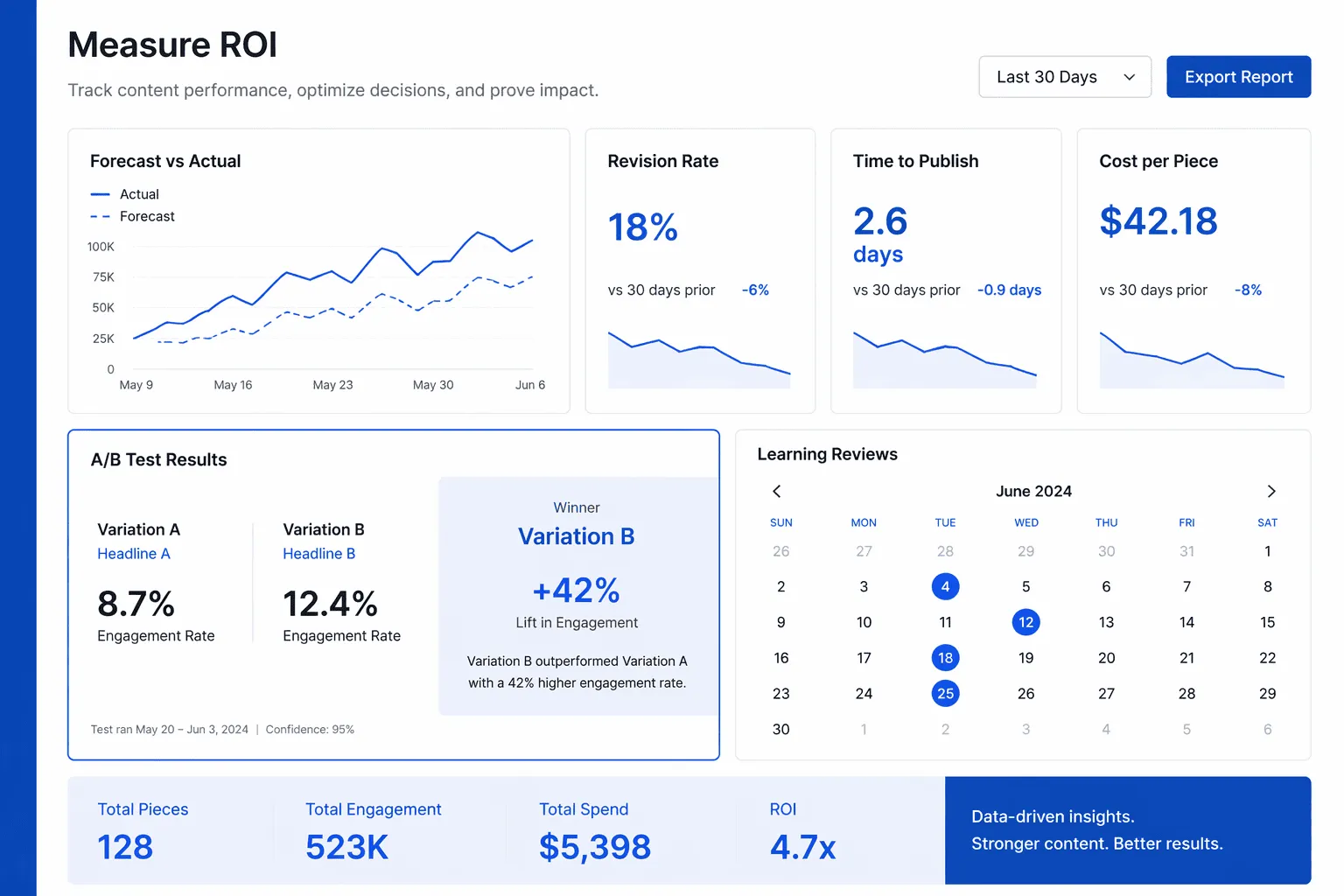
The measurement loop should start before publication and continue after the page goes live. Forecast versus actual results show whether AI improved planning accuracy or only sped up drafting. Content analytics and performance forecasting work best when they track both planning quality and live outcomes.
A balanced KPI set looks like this:
| KPI | What it tells you |
|---|---|
| Forecast accuracy | How close projected rankings, traffic, and engagement came to reality |
| Topic adherence | Whether the published page stayed aligned with the cluster and search intent |
| Content authority | Whether the page covered the topic deeply enough to earn trust |
| Revision rate | How much cleanup the draft needed before approval |
| Time to first draft | How fast the team moved from brief to usable draft |
| Time to publish | How fast work moved from idea to live page |
| Post-publish lift | Changes in clicks, rankings, assisted conversions, and AI citations or mentions |
A/B testing and forecast validation help prove impact before you scale:
- Match AI-assisted clusters against a human-only baseline.
- Keep the topic set similar so the workflow is the variable, not the subject.
- Measure brief quality, publish velocity, and downstream performance after launch.
- Compare forecasted results with actual results before you trust the estimate.
Closed-loop systems can track metrics like revision rates and performance lifts in near real-time to inform ROI. Content analytics help measure planning quality and live outcomes before scaling (source). For B2B teams, the SaaS content marketing growth blueprint maps these signals to acquisition, retention, and expansion targets.
Tracking cost per content piece after AI adoption gets easier when planning, briefs, and analytics share the same system. AI can help reduce content production costs when paired with quality checks. Governance practices like editorial oversight support efficiency without sacrificing standards (source).
Governance protects the work from formulaic or hollow output. Keep AI contribution bounded, require editorial refinement, and build in bias checks, compliance review, and localization for each market. Teams can set internal rules to limit AI contributions as a floor for human control and avoid shipping machine-written pages. Ethical AI practices emphasize bounded AI use with required editorial refinement to maintain quality (source).
Close the loop with a weekly or monthly learning review:
- Reclassify topics by what actually won in search and in AI surfaces.
- Separate citations and mentions from rank-only success.
- Update prompts, topic selection, and cluster priorities from the results.
- Feed the pattern back into the next round of briefs and forecasts.
The rhythm turns each campaign into a better planning system and keeps ROI tied to measured results.
AI Content Planning FAQs
These FAQs address the most common questions teams ask as they evaluate AI content planning, from workflow changes to measurement and tradeoffs. Use the answers below to scan the basics quickly before you decide what fits your strategy.
1. Which AI tools help content planning?
Most content planning tools fall into five groups: research, clustering, calendar and orchestration, drafting, and multimodal assets. Research tools like Frase, MarketMuse, Semrush, and Ahrefs speed up topic research, keyword analysis, and competitor scanning. Clustering tools turn those inputs into SEO and GEO coverage. Tools like Notion, Trello, ChatGPT, Claude, Jasper, Copy.AI, Runway, Midjourney, DALL·E, and Lumen5 support content tagging, automated content creation, Generative AI workflows, multimodal integration, and content repurposing. Human review still matters for brand fit and accuracy.
2. How do prompts improve content planning?
Structured prompts improve content planning by feeding AI the inputs that matter most, including past performance, audience segments, brand guidelines, and the planning context. A repeatable template with fixed fields for topic, intent, persona, scope, and output format makes briefs more consistent, speeds idea generation, and creates cleaner handoffs to writers. Prompts that ask for gaps, best-performing angles, and supporting evidence move planning beyond brainstorming. The first output is still a draft to sharpen through editorial feedback and human review.
3. Can AI plan content for SEO?
Yes. AI can plan SEO content by scanning search trends, competitor activity, industry news, social signals, and conversational queries to surface emerging topics, search intent shifts, and gaps before they peak. It can then cluster keywords and entities into topic maps, build outline-ready briefs, and shape GEO-aware headings and answers that LLMs and AI search engines can interpret more easily. Strong results come when you feed AI your brand rules, audience data, and performance history, then review the plan manually for nuance, freshness limits, and niche expertise it may miss.
4. How does AI group topics into clusters?
AI groups topics by meaning first. Semantic clustering can place pages about symptoms, treatments, and prevention in the same topic cluster even when the keywords differ. Entity graphs connect people, products, places, and concepts. Similarity scoring and thresholding help separate tight, medium, and weak matches against competitor coverage. Predictive topic mapping can then suggest the next cluster, format, and timing. A content planning cluster might group AI ideation, topical maps, briefs, and publishing workflows under one pillar.
5. How do teams use AI safely?
Teams stay safe with AI when humans keep the final editorial call and AI handles drafting and organization. A human-in-the-loop workflow works best: AI produces the first draft, then editors check facts, tone, nuance, bias, and localized fit before approval. AI ethics also means disclosing AI-assisted work when required and limiting sensitive inputs to reduce privacy, GDPR, and other regulatory risk. Originality and judgment stay with people.
About the author

Yoyao Hsueh
Yoyao Hsueh is the founder and CEO of Floyi, the topical authority platform, and the founder of Main Heading, an SEO and AI search agency. He created Topical Maps Unlocked, a course studied by thousands of SEOs, content strategists and digital marketers, founded TopicalMap.com, a done-for-you topical mapping service for agencies and enterprise teams, and publishes the weekly Digital Surfer newsletter on SEO, content strategy and AI search.
About Floyi
Floyi is a closed loop system for strategic content. It connects brand foundations, audience insights, topical research, maps, briefs, and publishing so every new article builds real topical authority.
See the Floyi workflow