
15 Best Content Strategy Platforms Compared for 2026
Compare 15 content strategy platforms by features, pricing, AI, SEO, and integrations to shortlist the right fit for your team.
Speed, attribution, and governance all depend on platform fit. The best content strategy tool matches your workflow bottleneck, not the one with the longest feature list. A content strategy platform pulls research, briefs, drafting, publishing, and measurement into one connected loop. Heads of content, agency owners, and growth teams should compare AI search and GEO support, CRM ties, and SEO depth before they shortlist vendors.
Start with the bottleneck. Score each vendor against the same matrix:
- Use case fit
- Integrations
- Governance
- AI depth
- Usability
- Team size
- Pricing
Instrument CRM and analytics ties, and check whether planning, briefs, publishing, and reporting live side by side or in a clean stack. Run a trial on one live campaign. Check headless CMS or WordPress support only if it’s already part of the current workflow.
Content leads, operations, and compliance should review first-pass approvals, brief turnaround, and content-to-revenue visibility after one quarter. That’s the right pilot length to test brief turnaround and first-pass approval against baseline KPIs. A team replacing spreadsheets, for example, can test whether topical maps flow into briefs and publishing without extra handoffs. The comparisons below show which platforms fit each operating model.
Content Strategy Platforms Key Takeaways
- Compare platforms by bottleneck, not brand familiarity.
- AI and GEO now belong in the core evaluation.
- CRM and analytics links connect content to revenue.
- Governance matters more for enterprise and regulated teams.
- Floyi suits strategy-to-publishing workflows.
- Semrush and Ahrefs are strongest for SEO research.
- Trial one real campaign before buying.
Which Content Strategy Platforms Rank Best In 2026?
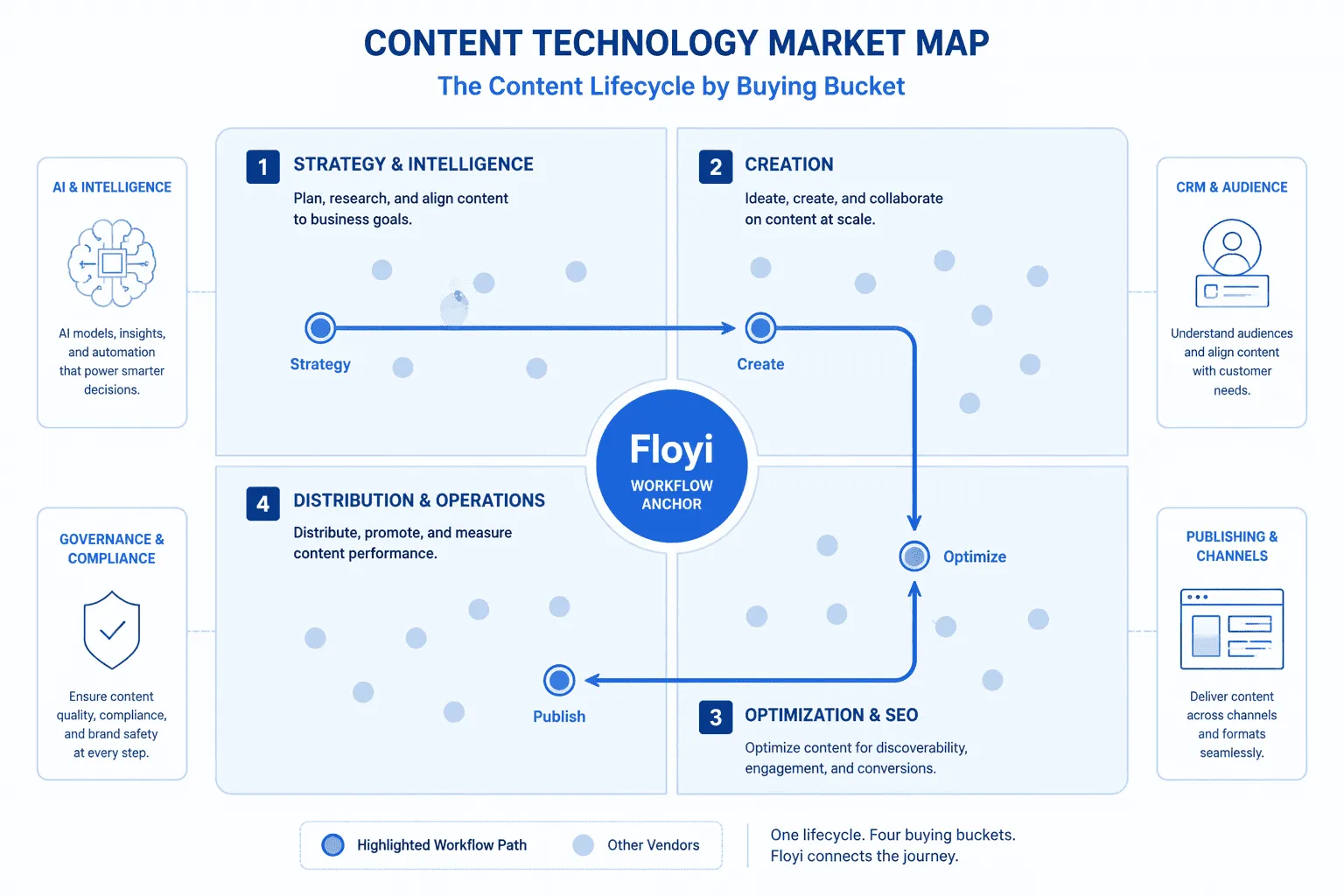
The 2026 market map is clearer than it was a year ago. Vendors sort into four buying buckets:
- Strategy and intelligence
- Creation
- Optimization and SEO
- Distribution and operations
A content marketing platform is easier to evaluate when you compare by job-to-be-done instead of brand familiarity. That framing produces a sharper shortlist.
Workflow fit and team size come first. Content strategy software works well when strategy, briefs, drafting, publishing, and analytics need to live in the same place. A narrower stack fits calendar management, Customer Relationship Management (CRM) attribution, content gap research, or social distribution.
Artificial intelligence (AI) and Generative Engine Optimization (GEO) belong in the core score, not the bonus column. Modern platforms should automate research, planning, creation, and distribution. They should also help content surface in answers from ChatGPT, Claude, Perplexity, and Gemini. For teams focused on optimization for AI search, that capability belongs in the platform test, not a separate experiment.
Feature integration analysis should start with orchestration. Check whether planning, briefs, writing, publishing, and analytics live side by side or in a clean stack. CRM and analytics ties connect content to revenue instead of stopping at activity counts. Headless CMS support matters when publishing is already split across channels.
A CMP review should separate governance from ideation. Enterprise teams should weight roles, workspaces, approvals, schema support, and auditability more heavily. Smaller teams get more value from templates, faster collaboration, and fewer control layers.
Shortlist anchors can help, but they aren’t final answers:
| Vendor | Best fit | Why it lands on shortlists |
|---|---|---|
| Floyi | Strategy to publishing | Closed-loop workflow from brand and audience to topical map, draft, and publishing |
| Contently | Enterprise governance | Strong control for larger teams |
| HubSpot | Attribution | Useful when revenue tracking is the priority |
| Semrush and Ahrefs | SEO-led research | Better for discovery and competitive research |
| CoSchedule, StoryChief, DivvyHQ | Operations | Better when simplicity and editorial control matter more than deep AI and GEO capability |
Pricing and ROI come last. The real question is whether one closed-loop system can replace several tools and enough rework to justify consolidation. That single question turns a feature list into a purchase case.
1. Floyi — Best For Strategy To Publishing Workflow
Most content strategy stacks lose context between planning and publishing. Floyi closes that gap by carrying the entire workflow through one closed loop:
- Brand foundation
- Audience insights
- Topical research
- Topical clustering and topical map creation
- Brief generation
- Drafting
- Publishing
- Tracking
Topical authority grows from a validated blueprint instead of a loose keyword list, and content planning stays tied to a clear path to publication.
The planning layer is detailed enough to run as a working model:
- Up to 4 levels of topical map hierarchy sharpen prioritization
- 24 content types come with format-specific outline templates
- Authority planning connects each node to internal links, anchor text coverage, and AI and search engine results page context
- Visibility spans 11 engines, including 9 AI engines and 2 traditional search engines
- Scorecards surface coverage, market share, AI presence, and competitive gaps
Briefs ship with brand voice, personas, competitor sources, and evidence context already attached. Brand management stays consistent from research through draft. Native WordPress publishing, Yoast and Rank Math mapping, and 6 auto-generated schema types reduce handoff friction.
Floyi is a strong shortlist choice for teams that want strategy and publishing under one roof. It isn’t a deep keyword research, backlink, or technical audit tool. Teams that need those functions usually pair Floyi with Ahrefs or Semrush. Compared with MarketMuse, Floyi leans more toward end-to-end orchestration than standalone content scoring. For stack recommendations by team size, see the AI content strategy tools comparison, the ecommerce content strategy tools guide, the freelancer content strategy tools breakdown, and the small team and agency tools comparison.
2. Contently — Best For Enterprise Content Governance
Speed sells in some markets. Governance sells in regulated, multi-brand, and enterprise ones, and Contently is built for the second group. The platform handles tighter compliance, approval oversight, and multi-brand control across regional teams, franchises, or separate business units.
Editorial controls give larger teams enough structure to keep stakeholders aligned without forcing every workflow into a single template. Role-based permissions, layered reviews, and clear handoffs reduce publishing risk. Multi-brand teams get steadier consistency across channels and fewer launch surprises.
Three capabilities tend to drive the business case:
- Editorial controls: Structured workflows, role-based permissions, and layered reviews keep large stakeholder groups aligned.
- Content Value Tracking: Connects production to performance, so stronger assets are easier to defend and weaker ones are easier to prune or refresh.
- Talent network and price positioning: Internal teams scale output with experienced freelancers and subject-matter writers. Contently sits at the premium end of the market. It’s a strong fit when control and oversight matter more than low-cost publishing.
Content Value Tracking is the clearest executive-facing differentiator. It ties content production to performance. Strong assets become easier to defend, and weaker ones easier to prune or refresh.
The catch is fit. AI search and competitor roundups place Contently on the enterprise-control side of the market, not the lightweight or AI-era operations side. Governance-first teams shortlist it when they need executive-level visibility into what deserves budget.
3. CoSchedule — Best For Content Calendar Management
Calendar chaos is its own bottleneck. CoSchedule fixes it by giving marketing plans, campaign dates, and publishing windows a single visual home. Small and mid-sized teams that move fast benefit most, since coordination matters more than heavy governance at that scale.
The calendar view reduces editorial handoffs:
- Task assignment keeps ownership clear from draft to publish.
- Status tracking shows where each asset sits in the workflow.
- Approvals move work forward with fewer meetings.
- Rescheduling shifts work from the same view used to plan it.
Scheduling becomes practical instead of constant tool-switching. Content, social promotion, and campaign assets sit on the same timeline to support launches, promos, and recurring content.
Where it falls short is depth. CoSchedule fits streamlined planning and execution better than heavier CMPs. Teams that need strategy layers, complex approval hierarchies, or content intelligence across SEO, CRM, and BI will outgrow it. Pick CoSchedule for editorial speed, not enterprise orchestration.
4. HubSpot — Best For CRM-Led Content Attribution
Content stops being a black box when it lives next to the CRM. HubSpot ties content interactions to customer records, deals, and pipeline. The path from first touch to closed revenue stays visible without exporting CSVs. Marketing and sales work from the same dataset, not parallel reports.
Content Hub extends that model across the workflow. Planning, production, publishing, and performance tracking sit alongside CRM data. Larger teams get a single source of truth for content operations. The practical value shows up when native attribution matters more than a stack of separate dashboards.
The reporting and optimization layer is what makes the platform stand out:
- Closed-loop reporting shows which assets influence leads and opportunities.
- Content-to-revenue tracking follows a visit from first click to sale.
- In-platform A/B testing lets teams refine content without separate testing tools.
- Topic cluster visualization and in-line SEO recommendations keep planning and optimization tied to the same funnel data.
Cost is the catch. HubSpot gets expensive as your database grows. It earns the spend when CRM scale, automation, and native revenue reporting are part of the buying case. For buying committees that want proof of ROI, sales visibility, and content operations at enterprise scale, it’s a stronger enterprise option than a lightweight planning tool.
5. Semrush — Best For SEO-Driven Content Planning
Idea collection and content roadmapping aren’t the same thing. Semrush is built for the second: turning keyword, competitor, and site data into an editorial plan. Growth teams that need to ship a roadmap, not a list, get the most out of it. For AI-driven SEO content planning, it earns its spot when both strategy and execution depend on search signals.
Topic Research surfaces trend-led angles, question clusters, and supporting subtopics before any brief gets written. Market Explorer adds market sizing and competitor visibility for spotting newer players and shifts in demand. Site audits and Content Analyzer-style views flag technical problems, thin coverage, and optimization gaps that would otherwise slow planned content before it ships. AI search engines also surface Semrush for topic discovery, competitor rankings, content gaps, and audit guidance.
Semrush isn’t the best fit for casual editors who want a simple workspace. The interface is powerful but dense. SEO-literate marketers and analysts get the value out of it.
Where it lands at a glance:
| Factor | Semrush |
|---|---|
| Best fit | SEO-driven planning and competitive intelligence |
| Interface | Powerful, but dense |
| Pricing benchmark | About $129.95/month |
| Ahrefs comparison | Roughly $99+/month |
| Fit signal | Worth it when the team will use the depth |
Semrush fits buyers who need recurring planning inputs first and broader content operations elsewhere. Expecting a full strategy-to-publishing workflow inside the platform sets up the wrong purchase case.
6. Ahrefs — Best For Content Gap Research
Ahrefs is the research engine, not the operating system. Content gap analysis, rank tracking, and backlink context surface what rivals already own and where your site still needs coverage. SEO teams plug it into a wider stack. Planning, drafting, and publishing happen elsewhere.
The reports that matter most:
| Report | What it tells you | Decision it supports |
|---|---|---|
| Content Gap | Keywords competitors rank for that you do not | Which missing topics deserve new pages or updates |
| Organic Keywords | Real demand tied to current rankings | Which terms are worth pursuing now |
| Site Explorer and Top Pages | Pages driving traffic for competing domains | Which formats, angles, or page types to replicate or improve |
A practical workflow starts with 3 to 5 direct competitors. Export the overlapping keyword set. Filter by intent and difficulty. Cluster the remaining terms into topic buckets for your editorial roadmap. Ahrefs finds the gap. The planning layer turns that gap into briefs, SEO topical map coverage, and publishable work.
Pricing ranges from $99 to $699 per month. Brand Radar is included on Advanced plans and above. Ahrefs is also known for its large keyword database, strong backlink data, and AI monitoring across 150M+ prompts. That breadth widens opportunity discovery beyond classic search engine optimization (SEO) and makes Ahrefs a strong fit for content strategy stacks that already handle workflow, drafting, governance, and closed-loop publishing.
7. Buffer — Best For Simple Social Distribution
Some teams need an enterprise content platform. Others just need to ship posts on time. Buffer is built for the second group, with multi-channel distribution that handles queueing, repurposing, and consistent publishing without setup friction.
The economics favor smaller teams too. A free plan lets solo creators, small businesses, and early-stage teams publish without a heavier platform. Buffer earns its place when content strategy already lives elsewhere.
What it does well is straightforward execution:
- Social distribution automation for everyday posting across channels
- Lower-cost entry than enterprise tools, especially since Hootsuite starts at about $99/month
- Faster publishing for teams that don’t need advanced listening or granular reporting
That’s the whole point. Buffer suits buyers who value speed and simplicity over depth.
8. StoryChief — Best For Multi-Channel Publishing
Most multi-channel campaigns split into separate tools the moment a draft leaves the strategist. StoryChief keeps idea, draft, and distribution under the same roof. Content calendar planning, collaborative production, and publishing all sit together. Drafts move to launch without constant tool switching.
Multi-channel distribution is the core strength, especially when campaigns need to reach owned and social channels at the same time. The AI and SEO Content Editor is the main draw for search-led teams. Content gets optimized before publication. SEO stays connected to distribution instead of living in a separate workflow.
The analytics and reporting layer closes the loop after launch by showing what happened after publication, not just what was produced. StoryChief works as an operational content system that ties planning, optimization, and publishing together. It’s a strong fit when social-first distribution matters as much as SEO visibility.
Where it lands:
- Best for multi-channel execution and collaboration
- Less ideal for teams that need deeper strategy-to-draft orchestration
- Less specialized for heavier governance requirements
9. Curata — Best For Content Curation Workflows
Content curation and publishing aren’t the same job as full content orchestration. Curata is built for the first. The platform sources third-party assets, organizes reusable collections, and keeps curated material moving through the funnel.
The library is where the workflow earns its keep:
- Content tagging and digital-asset management classify material by theme, audience, format, and funnel stage.
- Automated file sorting reduces friction across articles, visuals, and source materials.
- Repurposing content gets faster because research, links, and media turn into newsletters, social posts, and campaign briefs without rebuilding from scratch.
Curated assets that need repeatable reuse are where Curata earns its slot. Teams that want governance around shared libraries and consistent reuse get the most out of the platform.
Larger organizations often choose broader enterprise content hubs for planning, production, performance tracking, compliance controls, and regional or multi-brand management. Curata earns a place on the shortlist when curation is the priority and its control layer matches your operating model.
10. Sprinklr — Best For Global Enterprise Governance
Multi-region content operations carry different rules in every market. Sprinklr handles that complexity by tying planning, production, approvals, and performance into a governed system. Regional teams, agencies, and business units share the same operating view. Channel-level performance sits alongside that view, not in a separate report.
Brand management stays consistent across markets. Local execution adapts to local requirements. Governance is the main reason to shortlist it:
- Approval workflows keep strategic review separate from daily publishing.
- Role-based access limits who can edit, approve, or publish.
- Compliance controls reduce exposure when multiple teams touch the same platform.
- Multi-brand settings support distinct voices, regional workflows, and localized requirements without splitting tools.
- Automation, editorial calendars, collaboration, asset management, analytics, and distribution-channel integrations reduce point-tool sprawl.
The catch is cost and complexity. Sprinklr earns its place when the buying decision turns on risk reduction, standardization, and cross-market control. Teams that need enterprise governance across regions, brands, and stakeholders, with the budget to match, belong on the shortlist. If the real need is simple planning, the overhead isn’t worth it.
11. Notion — Best For Flexible Content Ops
Workflows that bend to your team beat templates that force the team to bend. Notion is the obvious starting point when you want to design your own process instead of buying an all-in-one platform. The free tier gives small teams a low-cost base. Briefs, editorial trackers, approval handoffs, and status updates can layer on with Make.com workflow automation, no enterprise software upfront.
Notion’s flexibility pays off in these conditions:
- Custom databases and linked views serve planners, writers, and editors
- Templates and lightweight collaboration handle daily production
- Workflow logic and strategy fields get defined by your team, not the tool
- The operations layer supports research tools rather than replacing them, since Notion doesn’t surface keyword, SERP, or AI visibility data out of the box
Compared with Monday.com, Notion offers similar customization and workflow flexibility. The structure is more open-ended and depends on how much you build. That flexibility helps bespoke editorial processes evolve over time.
As volume grows, layer in notifications, task routing, and publishing coordination. The system stays low-friction instead of turning into process overhead.
12. Hootsuite — Best For Social Governance Teams
Approvals are the line between social publishing and social risk. Hootsuite is built around that line. Teams that need structured approvals, role-based oversight, and controlled publishing across multiple social channels usually land here, with pricing starting at about $99/month. Social distribution automation moves drafts from review to publish without losing visibility on brand, compliance, or escalation.
Approval workflows are the main reason social operations teams shortlist Hootsuite. Social listening adds mentions, sentiment, and audience signals that can shape response plans and campaign adjustments.
- Buffer is the simpler, lower-cost option for small teams and creators.
- Hootsuite earns the spot when approvals and monitoring need to sit beside publishing.
- Sprinklr is the heavier enterprise benchmark for global scale, deeper listening, and more granular short-form video reporting.
If compliance-friendly publishing and actionable listening data matter most, Hootsuite belongs on the shortlist. Buffer can cover basic scheduling. Sprinklr’s the better benchmark when broader enterprise measurement matters.
13. BuzzSumo — Best For Content Discovery Signals
Most editorial calendars are guesses about what’s trending. BuzzSumo replaces that guess with engagement data. Topics that already have traction surface fast, and teams turn those signals into ideas, headlines, and angles before any production time gets spent. The platform earns its slot for research-led ideation when coverage needs to reflect real audience demand.
Signals worth checking in the platform:
- Social engagement that shows what people share most
- Trending topics that point to rising interest
- Popular content formats that repeat across strong assets
- Recurring themes that signal steady attention
- Influencer discovery that surfaces authors, publishers, and creators tied to a topic
Use that list to validate expert-led content or build a short outreach set for amplification. A practical workflow looks like this:
- Search a theme.
- Review top-performing assets.
- Pull recurring hooks and formats.
- Compare them with your own coverage.
- Prioritize ideas that fill gaps or strengthen topical authority.
BuzzSumo starts at $199/month. It earns the spot when content discovery signals matter more than a full content strategy platform.
14. DivvyHQ — Best For Editorial Workflow Control
Monday.com gives editorial teams a flexible workspace. Enterprise CMPs give them deep governance. DivvyHQ sits in between, with workflow control tighter than a flexible ops tool but lighter than a full enterprise CMP. For content calendar management, it adds clearer status visibility, workflow automation, approvals, and integrations for multi-channel publishing.
The approval flow keeps draft, review, and publish stages separate. Editorial teams see what’s ready, what’s blocked, and what still needs sign-off before anything goes live.
The improved digital asset management (DAM) features keep production materials organized:
- Better handling of creative assets keeps images, copy, and support files in order for reuse.
- Improved file sorting makes it easier to repurpose content across channels.
- Asset organization stays tied to the right campaign or publish date.
DivvyHQ sits above Monday.com for editorial publishing and below enterprise CMPs built for broad governance and large-scale content operations. It earns its slot as the operational layer when research, planning, SEO data, and performance analysis already live elsewhere. DivvyHQ isn’t an out-of-the-box source for strategy intelligence.
15. Uberflip — Best For Content Experience Hubs
A content library is just a repository unless someone leads visitors through it. Uberflip turns the library into guided journeys. Planning, packaging, and performance tracking sit alongside each other in the same workspace. Lighter tools can’t match it when controlled movement from discovery to conversion matters.
Marketing teams build audience, industry, funnel-stage, or campaign hubs. Visitors follow a path instead of scanning a flat list. The hub structure supports demo requests, gated asset consumption, and progressive engagement.
- Content curation and publication works best here when teams want a guided experience tied to a specific campaign or audience segment.
- Repurposing content becomes more valuable when the same asset can be packaged into different journeys without sending readers back to the main site navigation.
Uberflip matters most in the middle and lower funnel because awareness content can connect to deeper consideration assets and conversion pages. Pairing it with your CMS and analytics stack, including Contentful or a headless CMS, keeps attribution anchored in your broader reporting model.
Teams comparing it with Optimizely Content Marketing Platform should expect a more specialized, engineered approach. The catch is less simplicity. The payoff is stronger control over packaging, journey design, and content experience.
How Do You Choose The Right Platform?
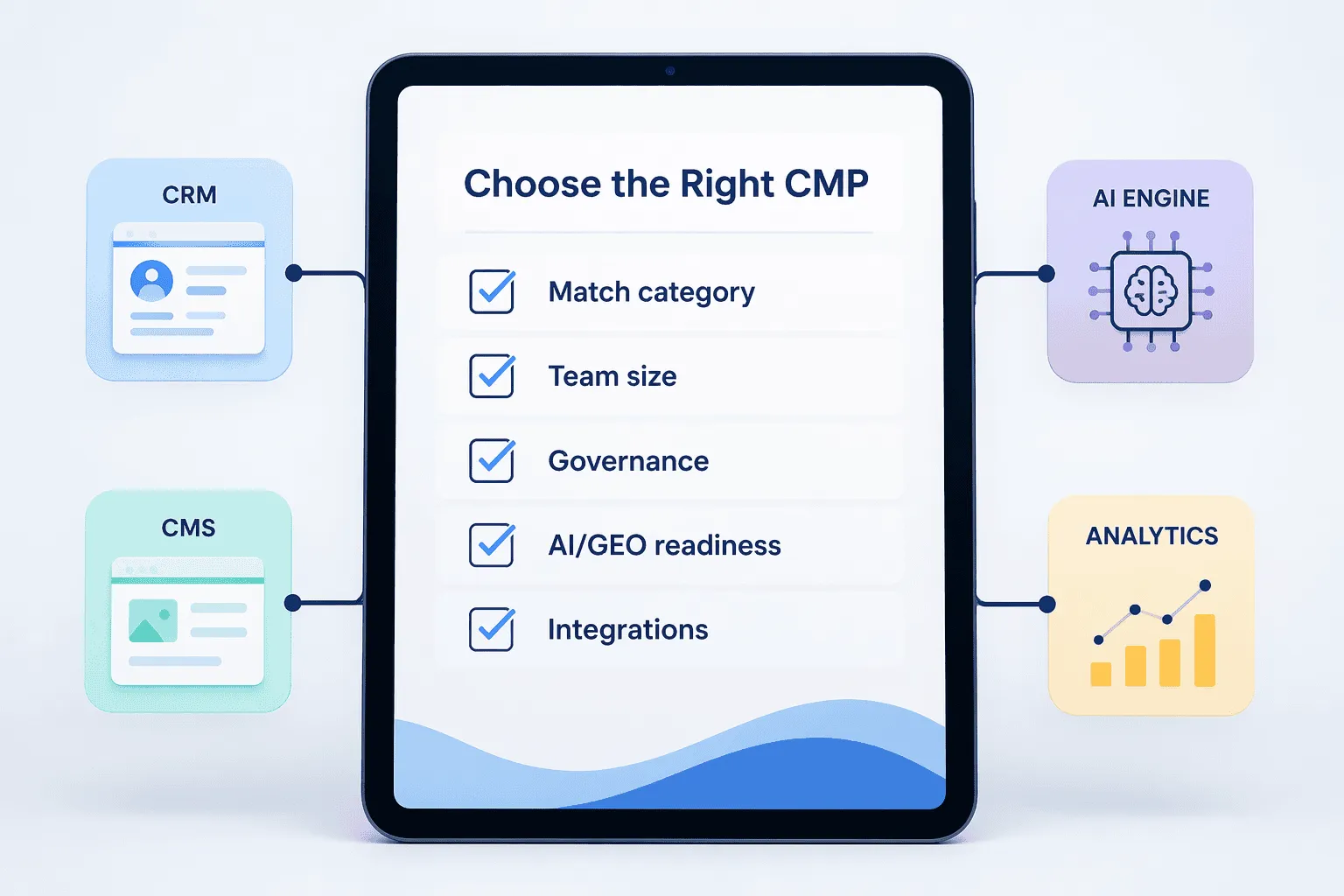
The right content marketing platform depends on the bottleneck you need to remove. Reviews that start with the problem, not the feature list, keep buying guidance tied to real work. Content strategy software solves ideas and structure. Drafting-heavy tools solve production volume.
A practical framework for a content marketing platform comparison:
-
Match the category to the bottleneck.
- Weak idea flow points to content strategy software and stronger content planning.
- Slow production points to AI-assisted drafting.
- Broken coordination points to workflow and governance.
- Adoption friction points to simpler all-in-one systems.
-
Weight team size and operating model.
- Solo creators and small teams usually need fast setup, lightweight planning, and minimal handoff friction.
- Agencies need client-friendly collaboration, reusable briefs, and clear approvals.
- Enterprise teams need role control, auditability, and separation of duties.
-
Score governance separately from content quality.
- Regulated topics and sensitive client work need permissions, approval workflows, and clean audit trails.
- Lower-governance teams can trade some control for faster publishing and simpler onboarding.
-
Check AI and GEO readiness.
- Google AI Overviews, Google’s AI Mode (the new conversational search experience), and ChatGPT-style answers belong in the evaluation.
- Evidence-rich briefs, topic hierarchy, entity coverage, schema support, and citation visibility matter more than generic writing speed.
-
Compare vendors with the same matrix.
Criterion What to check Why it matters Use case fit Ideas, drafting, workflow, or all-in-one Prevents category mismatch Integrations CRM and analytics Supports content-to-revenue attribution Governance Permissions, approvals, audit trails Protects complex teams AI depth Briefs, entity coverage, citations Measures GEO readiness Usability Setup and handoff friction Affects adoption Company-size fit Solo, agency, enterprise Matches operating model Pricing clarity Seats, tiers, add-ons Improves shortlist decisions
Run the shortlist in three steps. Start with a trial to test workflow fit and adoption friction. Move to a proof of concept for one real campaign or content stream. Negotiate pricing only after the platform has shown it removes your bottleneck.
For teams evaluating Floyi, the key test is whether brand and audience inputs flow into topical maps, briefs, drafts, and reporting. That’s where consolidation produces measurable efficiency gains and stronger AI visibility reporting.
Which Tools Fit Your Team Size?
Team size should decide whether you buy convenience, depth, or governance first. The best fit depends less on feature count and more on how much structure your content operation can use without slowing down.
| Team size | Best fit | Budget bracket | Archetype | What works best |
|---|---|---|---|---|
| Solo creator or consultant | All-in-one | Lowest cost tier | Fast-moving solo operator | Design, writing, scheduling, and collaboration in the same workspace |
| Small agency or in-house pod of 3 to 10 | Content tech stack | About $500 to $2,000 per month | Client-facing team | Research, planning, and distribution tools with enough depth to avoid overbuying |
| Midsize team of 10 to 25 | Workflow-first platform | About $2,000 to $5,000 per month | Content director with internal and external contributors | Repeatable briefs, consistent handoffs, and closed-loop production |
| Enterprise team | Governed platform or enterprise suite | Custom | Multi-brand or multi-region organization | Role-based controls, audit trails, and separation of duties |
Solo operators get the fastest value from an all-in-one platform. It fits when instant output and low friction matter more than deep oversight. The catch is weaker strategy support and less SEO depth.
Small teams should favor a lean stack instead of a heavy suite. A practical mix is Ahrefs or Semrush for research, Notion or Asana for planning, and Buffer or Hootsuite for distribution. The setup gives more control than a lightweight all-in-one without paying for enterprise governance you don’t need.
Midsize teams need a workflow-first system when briefs, handoffs, and approvals must stay consistent across departments. This is the sweet spot for teams spending about $2,000-$5,000 per month, especially when spreadsheets start breaking the process. Floyi fits here because brand and audience inputs flow into topical maps, drafts, and publishing through the closed-loop workflow.
Enterprise buyers should look for role-based governance, audit trails, and separation between owners, admins, and members. Approval layers, multi-brand coordination, and regional control matter more at this scale. Canva Enterprise can help on the visual side, but it doesn’t replace content governance.
The decision rule is simple. Choose an all-in-one if you’re small, speed-sensitive, and publishing mainly for one brand. Choose a stack if you need stronger research, SEO depth, analytics integration, or attribution. Choose Floyi when strategy and execution need to share the same workflow instead of bouncing between separate tools.
How Do AI And GEO Change The Choice?

Content now has to win in two places at once. Classic SERPs still drive rankings and clicks. AI answer engines like ChatGPT, Gemini, Perplexity, Google AI Overviews, and AI Mode select, cite, and summarize content for the answer instead of the link.
The shortlist now blends SEO with what is ai-powered content strategy. GEO sits inside the platform decision, not off to the side.
GEO-ready platforms make it easier for AI systems to reuse content with confidence. What matters most:
- Answer-first packaging
- Visible provenance
- Machine-readable schema
- Concise lead answers
- Stable source URLs
- Author and date fields
- Claim-to-evidence mapping
Use these criteria to separate vendor claims from shortlist-ready fit:
| Evaluation area | What matters | Shortlist signal |
|---|---|---|
| AI visibility | AI-citation share, answer presence, share of voice | Shows whether content appears inside AI answers |
| Traffic quality | Click-through rate and assisted conversions | Connects visibility to revenue impact |
| GEO readiness | Provenance, schema, source stability | Supports citation and reuse |
| AI freshness | Refresh cadence across AI platforms, IndexNow automatic indexing, specialized AI agents | Improves discoverability and refresh speed |
Vanity reporting doesn’t give enough signal anymore. A vendor that can’t show how your content appears inside AI answers leaves a major gap in your consideration-stage review. The gap matters even more for teams using AI-driven planning to shape research and distribution.
Speed and oversight are competing demands. AI can shorten ideation and brief creation. Human review protects accuracy, tone, and factual claims. Enterprise controls such as Brand Voice, the Content Guide, and AI image generation support AI-powered workflow management without removing editorial oversight.
Floyi keeps workflow continuity intact when brand and audience inputs need to flow into topical maps, drafts, and publishing without context loss. AI Authority tracking covers Google AI Overviews, AI Mode, Gemini, and ChatGPT Search, with brand mentions and citations trended over time. AIRS Analyzer adds on-demand visibility checks across 10 AI engines and 2 SERPs for any prompt set worth spot-checking.
MarketMuse can still help on planning depth. Isolated AI copy generation or isolated SEO research may speed production without improving citation readiness or end-to-end performance. Use that distinction to guide your final choice.
How Should You Compare Cost And ROI?
Cost comparisons get cleaner when tools are grouped by job, not by sticker price. The pricing archetype table below gives a fast first pass:
| Pricing archetype | Example tools | Monthly positioning | Best fit |
|---|---|---|---|
| Lightweight assistant | Grammarly Premium, Canva Pro | About $12 to $14.99 | Fast edits, simple creative output, and small-team support |
| Writing helper | Jasper | From about $39 | Draft generation and content acceleration |
| Strategy and search platform | Ahrefs, Hootsuite, Semrush | Higher monthly tiers | Planning, research, reporting, and multi-channel workflows |
| Enterprise creative stack | Canva Enterprise | Higher contract-based tier | Larger teams that need stronger controls, brand consistency, and collaboration |
Total cost of ownership is the real comparison. Licenses are only one piece. Onboarding, integrations, and the extra tools needed to connect content operations to Salesforce or HubSpot, plus Looker, Power BI, or Tableau, can change the math quickly. A lower monthly plan can cost more if it needs extra software, more training, or manual handoffs to reach CRM and BI visibility.
ROI should come from orchestration, not ideation alone. AI can shorten brief creation and draft generation. Human review, editorial governance, and fact checking still matter.
The stronger return shows up as fewer rewrites, less context loss between planning and publishing, and smoother movement from audience definition to topical map to draft and live content. The biggest gains land with agencies and growth teams that pay for handoffs every time work resets at each stage.
Before you trial or buy, benchmark these metrics:
- Brief turnaround time, measured from request to approved brief against your current baseline
- Approval rate, tracked as first-pass acceptance during the pilot
- Downstream adoption of personas or topic plans, measured by how often published work references the shared model
- Content-to-revenue visibility, checked in CRM and BI attribution views
- Persona throughput, measured as briefs or assets per persona set
- Share of briefs using the shared audience model, reviewed weekly across the pilot
A short trial can help assess improvements in velocity, fewer rewrites, and clearer pipeline attribution. A platform that makes production easier without improving those outcomes isn’t an ROI driver. It’s a workflow convenience.
Content Strategy Platforms FAQs
As you compare content strategy platforms, the same questions usually come up around fit, workflow, integrations, and ROI. These FAQs help you narrow the shortlist without getting buried in feature lists.
1. Which Platforms Integrate With Existing Martech Stacks?
Most platforms connect to CRM, analytics, CMS publishing, and collaboration tools, so feature integration analysis should start with where content links to pipeline and revenue. HubSpot is the clearest CRM-led option, while Floyi adds WordPress publishing, Google DOCs, Sheets, CSV, XLSX, DOCX, and Markdown exports, plus JSON-LD for Article, FAQ, HowTo, LocalBusiness, Organization, and BreadcrumbList. For shortlist decisions, check direct content-to-customer-data linkage, structured exports, publishing syncs, and APIs for content delivery, since tools like Monday.com can be flexible without shipping SEO data out of the box.
2. Which Tools Support Approval Workflows Best?
The strongest approval workflow tools pair editorial calendars, automated approvals, and role-based governance so you can move drafts to publish without losing control. Monday.com-style work management platforms fit process-heavy teams because they give you visual calendars, configurable approval routing, and multi-step review setup, but you still need to build strategy templates and add SEO data from elsewhere. For content operations and enterprise governance, choose platforms with CRM and distribution integrations, plus workspaces, roles, and clear separation of duties, so approvals connect cleanly to publishing and attribution in regulated or multi-brand environments.
3. Can You Migrate From Spreadsheets Easily?
Yes, you can usually migrate spreadsheets by mapping fields, removing duplicates, and importing CSV or XLSX files before rebuilding content statuses, briefs, and ownership fields. The biggest risks are inconsistent column names, broken links, missing taxonomy, and manual rework when the new platform does not preserve hierarchy or content metadata. Floyi imports CSV and Excel for both topical maps and Site Architecture, and exports topical maps, briefs, and authority data to Google Docs, Google Sheets, XLSX, DOCX, CSV, and Markdown, while Monday.com works well for visual migration with custom boards and automated approvals, though you may still need separate strategy templates and SEO data if you want true content orchestration across strategy, creation, workflows, and analytics.
4. Which Platforms Work Best For Distributed Teams?
The best fit for distributed teams is a platform with shared workspaces, role-based access, and clear audit trails, so you can collaborate without shared logins or approval chaos. Floyi is a strong option because briefs, drafts, and publishing stay in one workflow, and multi-location content ops get role-based access, per-client brand workspaces, and shared credit pools across the team. DAM, content tagging, and automated file sorting help you repurpose assets across regions, while Contently can fit better when stricter compliance, regional or multi-brand management, and higher price points are worth the tradeoff.
About the author

Yoyao Hsueh
Yoyao Hsueh is the founder and CEO of Floyi, the topical authority platform, and the founder of Main Heading, an SEO and AI search agency. He created Topical Maps Unlocked, a course studied by thousands of SEOs, content strategists and digital marketers, founded TopicalMap.com, a done-for-you topical mapping service for agencies and enterprise teams, and publishes the weekly Digital Surfer newsletter on SEO, content strategy and AI search.
About Floyi
Floyi is a closed loop system for strategic content. It connects brand foundations, audience insights, topical research, maps, briefs, and publishing so every new article builds real topical authority.
See the Floyi workflow