
How to Write an Effective Content Brief (With Examples)
Learn how to write an effective content brief: the decisions to lock before drafting, with weak vs strong brief lines for audience, intent, scope, and sources.
An effective content brief locks the audience, page purpose and scope before drafting, and it leaves the writer room to shape the prose.
When a writer has a topic but still has to guess at those decisions, the brief hasn’t done its job. Most content brief mistakes come from that guesswork, not from weak writing.
Content Brief Key Takeaways
- Briefs fail when writers must guess the audience, purpose or scope.
- State the intended outcome and a success measure that fits it.
- Describe the target audience’s needs, experience and journey stage.
- Match search intent, page purpose, format, and channel.
- Define the angle, scope boundaries, sources, and link requirements.
- Set observable acceptance criteria before drafting begins.
- Keep briefs concise, and ask writers where the last one left them guessing.
Why Do Content Briefs Fail Writers?
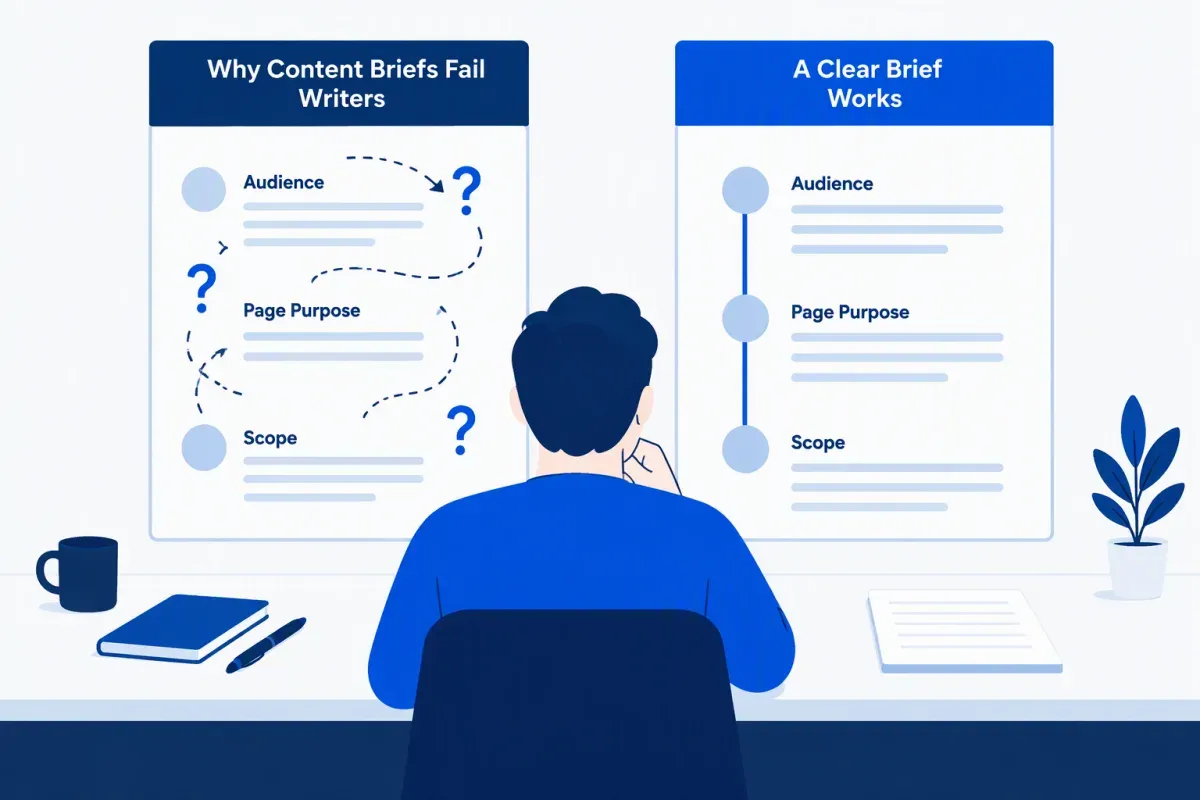
Content briefs fail writers when they leave key editorial decisions unresolved. A strong brief connects business objectives to reader needs, sets clear expectations and leaves writers room to use their expertise. When the purpose or audience is unclear, writers have to guess, and reviewers ask for avoidable revisions.
Three gaps cause most of that guesswork:
- No reader problem. A keyword or headline alone doesn’t say what the target audience needs or what the business wants the piece to do. State the intended outcome and how you’ll judge success. Otherwise the draft may answer the wrong questions or point readers to the wrong call to action.
- No page purpose. A topic without a goal forces the writer to choose whether to educate, compare options or prompt a next step. The reviewer may have expected a different choice, even if the draft is well written. That mismatch is a briefing problem, not a writing problem.
- A vague audience. A broad label such as “small business owners” can hide real differences in expertise, concerns and buying stage. Describe the reader’s actual problem so the writer can pick useful explanations and examples.
Here is the difference in one brief line:
- Weak: “Write about project management software for small businesses.”
- Strong: “Help owners comparing project management tools identify which features matter for a small team, then show how to assess options against their workflow.”
Most advice on how to create a content brief lists fields. The fields matter less than the decisions they record. A content brief for writers is a concise decision record, not a script. It sets the goal, audience, format, topical scope, sources, tone, and expectations, so writers can work independently without having the prose dictated to them. This article covers those decisions. For the full step-by-step build, see the SEO, GEO and AEO brief process.
Before drafting, align stakeholders on the deliverables, priorities, evidence, links, call to action, success measures, and approval requirements. Then name the decision-maker who settles disagreements. Without that agreement, writers get conflicting feedback after drafting and redo work that could have been settled upfront.
End each brief with a short content brief checklist. It should confirm readiness, not force every field into every assignment:
- Objective and audience: The writer can name the intended outcome and the reader’s needs.
- Search intent: The brief says what the reader needs from the page.
- Scope and format: The topical boundaries and deliverable fit the assignment.
- Approval: The decision-maker and acceptance criteria are clear.
Keep a concise content brief scannable. Ask writers where the brief left them guessing, then fix those gaps in the next one.
Lock the Audience, Search Intent, Page Job, and Format
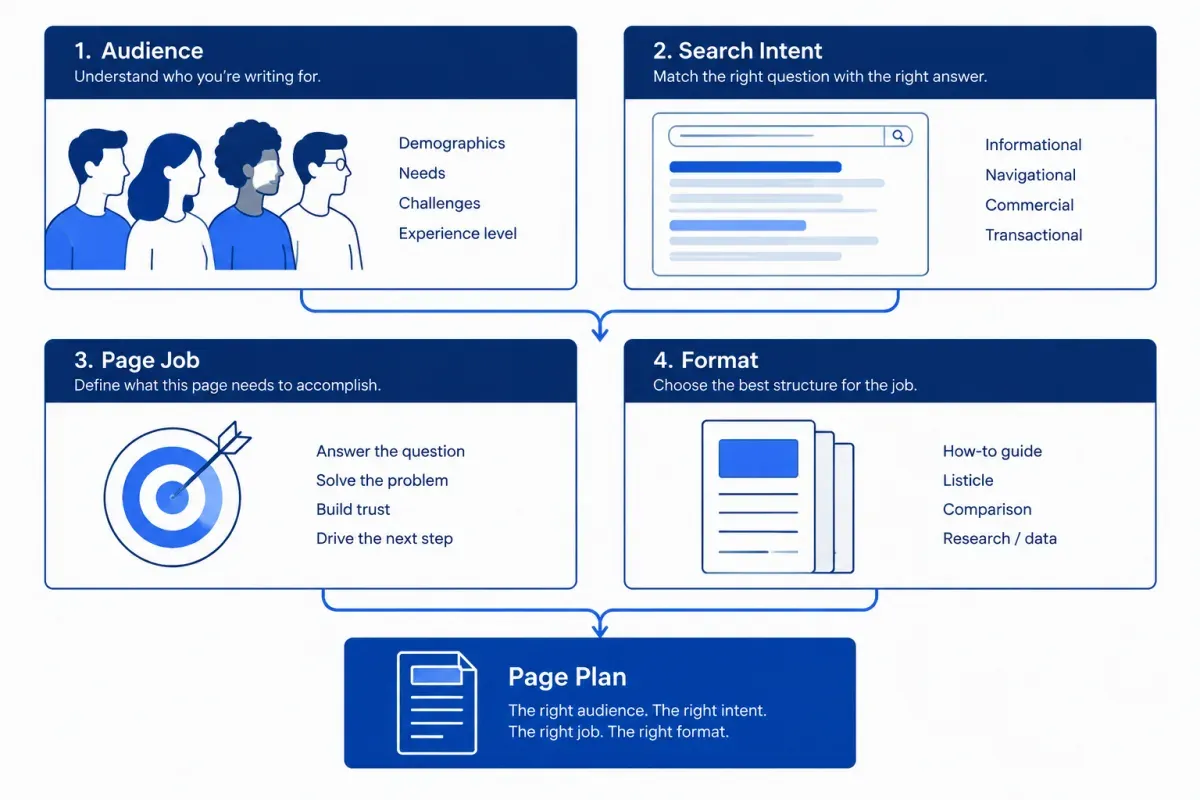
Knowing how to write an effective content brief comes down to four decisions you settle before drafting: the audience, the search intent, the page job, and the format. They work together. The reader’s needs shape the page purpose, and the purpose decides what the page helps them do.
Each decision should give the writer clear direction and still leave room for strong editorial choices.
-
Set the page purpose and success measure. Explain why the asset should exist, which business objective comes first and what should change after someone reads it. Among content goals, the priority might be organic discovery, qualified leads, brand awareness, product education, or a product announcement. Choose one measure that fits, such as qualified visits for discovery or leads for lead generation. If the baseline or target isn’t known yet, mark it as a placeholder instead of inventing a figure.
Weak: “Goal: Rank for the keyword.”
Strong: “Purpose: Help content managers settle key brief decisions before assigning a draft. Primary objective: Organic discovery. Success measure: Qualified visits, with the target set after baseline review.”
-
Name the audience and journey stage. An audience and persona note should capture the details that change how you write: role, experience, existing knowledge, audience pain points, and the task or decision at hand. User personas help when they clarify those details. A persona profile with no link to the assignment adds little. Specify which of the buyer’s journey stages the page serves (awareness, consideration or decision), then list the questions it must answer there.
Weak: “Audience: Marketers.”
Strong: “Audience: In-house content managers who brief freelance writers and keep getting drafts that miss the search intent. Stage: Awareness.”
-
Define the page job and takeaway. State what readers should know, remember, feel, or be able to do after reading. Connect their current situation to a useful next action, then give the writer one central argument. Add supporting messages only when they sharpen that argument, or they will compete with it.
Weak: “Cover content briefs.”
Strong: “Readers should leave able to fix one brief today. Argue that a brief works when it settles editorial choices before writing begins.”
-
Match search intent to format and channel. For an SEO content brief, set the keyword targeting: the primary keyword, relevant secondary terms and the reader need behind them. Search intent in briefs should reflect the live SERP and AI answers, not just a label attached to a keyword. Name one of the five intent types:
- Informational
- Navigational
- Commercial
- Transactional
- Generative
For non-search content, name the audience’s question instead of prescribing keywords. Then choose a content format, such as a how-to guide, checklist or comparison, that fits the page job and intent. Live SERP analysis shows the expected depth and presentation.
Weak: “Intent: Informational.”
Strong: “Intent: Informational. The top results are step-by-step guides, so this page is a how-to guide that answers the question in its first paragraph.”
Before drafting, confirm that the objective, measure, audience, journey stage, reader need, takeaway, format, and channel line up. If they conflict, resolve the conflict in the brief. Don’t leave the writer to settle strategy mid-draft.
Set the Angle, Scope, Sources, and Link Requirements
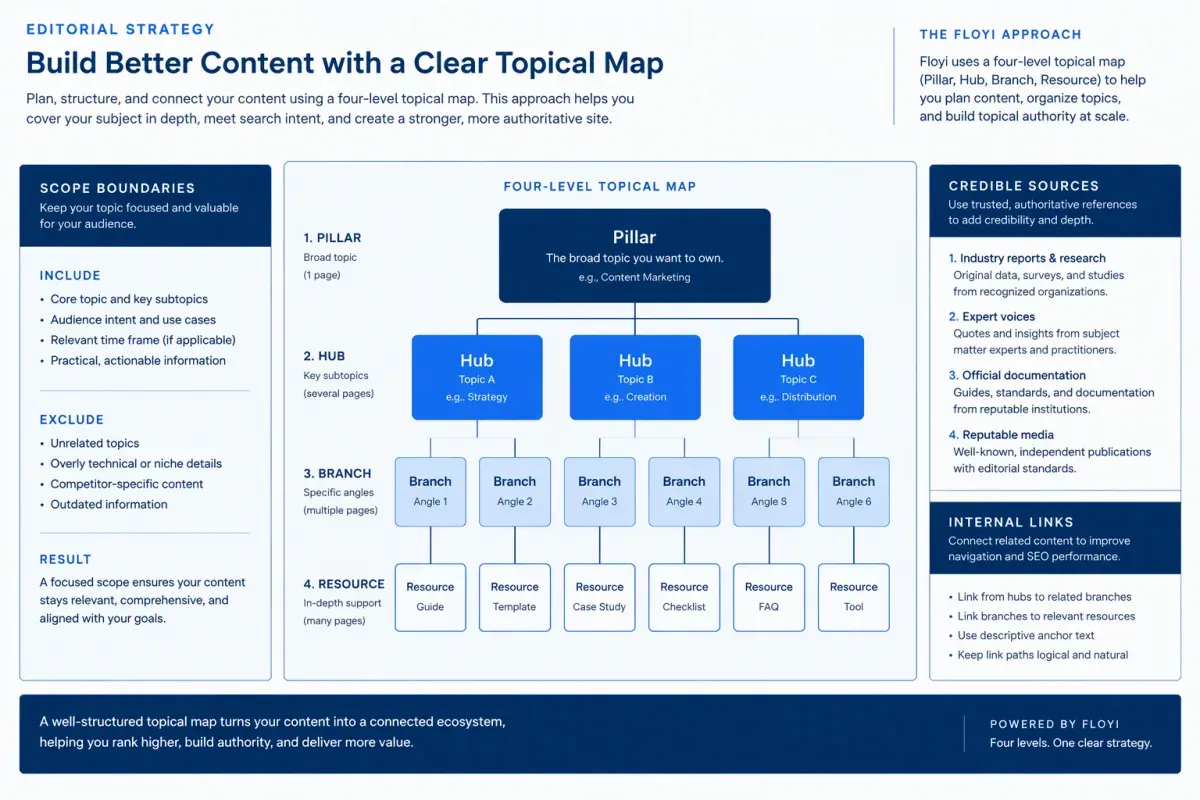
Once the audience, intent, page job, and format are set, the brief locks the content angle, scope boundaries, evidence standards, and link requirements. These writer instructions say what the page adds and where it stops.
Start with the angle in one line. Live SERP analysis shows what ranking pages and AI answers already cover. The brief then states what this page adds, such as an expert perspective, first-party evidence, a worked example, or a more useful approach. Flag any claim that needs company data or subject-matter input, so the writer doesn’t present it as fact without that evidence. Readers who want a ready-made layout for these fields can use a copyable SEO content brief template.
Tie the angle to the brand’s topical map, not a competitor’s outline. Name the page’s place in the map (in Floyi, a Pillar, Hub, Branch, or Resource level), define its scope and say how it supports neighboring pages. Then turn audience knowledge, pain points and brand voice into direction on assumptions, tone and examples. That way the brief encodes your content strategy instead of copying what already ranks.
A descriptive working title and suggested headings for the H2 and H3 levels give the writer a content outline without scripting every paragraph. Order headings around reader questions. Under each one, list the key points to cover, the claims that need evidence and any examples. Mark required coverage separately from optional suggestions, and state what the page excludes.
Set a word-count range rather than an exact target. Base it on topic complexity and the depth of the pages you’d compete with, then let completeness and reader value outrank the number. A range gives the writer room to explain without padding.
Give each research material a clear job:
- Reliable sources: Support factual claims and statistics.
- Customer questions: Reveal readers’ needs and concerns.
- Competitor examples: Set coverage or format benchmarks without dictating the outline.
- Company context: Explain products, differentiators and brand guidelines.
- Subject-matter input: Supply first-party evidence for claims external sources can’t verify.
A sources and claims policy says where first-party proof or expert input is required. Writers shouldn’t have to invent evidence that doesn’t exist.
Make link and metadata requirements specific. Name the internal link targets, give the anchor text and either set the section or leave placement to the writer. Internal links connect parent, sibling and child topics in the map, while external links support the claims beside them. If metadata guidelines apply, state your own meta title and description lengths. Google sets no maximum length for meta descriptions and truncates snippets as needed, according to its snippet documentation.
Weak lines leave writers guessing. Strong lines settle the decision without scripting every sentence:
- Angle, weak: Make it better than what ranks.
- Angle, strong: Walk through one real brief and show which lines caused revisions and how each was rewritten.
- Scope, weak: Write the complete guide to content briefs.
- Scope, strong: Cover the decisions a brief must lock. Exclude templates and tool selection.
- Links, weak: Add some internal links.
- Links, strong: Link to the parent guide in the first section with the anchor “content brief process.”
- Sources, weak: Use good sources.
- Sources, strong: Link every statistic to its original source. Use no figures from memory.
Define Acceptance Criteria Before Drafting

Acceptance criteria give writers and reviewers observable standards for deciding whether a draft is ready. Set them before work begins so the writer, editor, subject-matter reviewers, and approver share the same expectations.
For brand voice, cite your brand voice guidelines and describe how the writing should sound. “Direct and practical, with second-person instructions and no exclamation marks” is easier to check than “engaging.” Add a model line and list language to use or avoid. That level of detail is what fits a brief to a brand’s tone and persona.
Editorial guidance should be checkable in the draft. Set expectations for:
- Point of view and plain language.
- Paragraph length, heading structure and use of bullets or callouts.
- Jargon, generic advice, unsupported claims, and product mentions that don’t help the reader.
The CTA should support the content objective. Specify its placement, destination URL and exact anchor text so reviewers can verify it. For example: “End with one link to the product page using the anchor ‘see how briefs are built.’”
Name the writer, content owner, reviewers, and final approver, plus what each person reviews. Set draft, revision, approval, and publication deadlines. List dependencies that could hold up the draft, such as an interview or source materials.
Match the sources and claims policy to the article’s scope. Numerical or performance claims need traceable evidence. Remove or qualify anything the writer can’t substantiate rather than filling the gap with an invented figure.
Keep draft approval separate from measurement after publishing. Acceptance criteria confirm the draft meets the reader’s need and follows the agreed structure and scope. They also cover the required links and CTA, the word-count range and the evidence and voice review. Traffic belongs to later evaluation, not draft sign-off.
Use these content brief examples to audit your own briefs. Each row pairs a weak line with a strong one:
| Decision | Weak brief line | Strong brief line |
|---|---|---|
| Audience | “For customers.” | “Write for first-time buyers comparing options before speaking with sales.” |
| Intent | “Cover the topic.” | “Meet informational intent by explaining the decision and its tradeoffs.” |
| Page job | “Discuss the service.” | “Help readers decide whether this service fits their stated need.” |
| Angle | “Make it useful.” | “Focus on the overlooked cost of choosing before defining requirements.” |
| Scope | “Cover everything.” | “Include setup and maintenance. Leave pricing comparisons to the dedicated page.” |
| Sources | “Make sure it’s accurate.” | “Source every factual claim. Remove any assertion the writer can’t substantiate.” |
| Links | “Add internal links.” | “Link the setup guide in the setup section using its approved anchor text.” |
| Voice | “Tone: engaging.” | “Use direct, practical second-person phrasing. Avoid exclamation marks.” |
| CTA | “Add a CTA.” | “End with one product-page link using ‘see how briefs are built.’” |
| Acceptance | “Ready for review.” | “Approve when scope, structure, links, CTA, evidence, and voice meet the brief.” |
If you’d rather start from a brief that already records SERP consensus claims, information-gain angles and Planner internal links with their anchors, build your next brief in Floyi.
Content Brief FAQs
These FAQs cover how a brief differs from an outline, how long it should run, how much detail each writer needs, and what to do when a brief is unclear.
1. What Is the Difference Between a Content Brief and an Outline?
An outline sets the order of the headings, and a brief sets the decisions behind them. The outline is one part of the brief. The brief also records the reader, the search intent, the page job, the scope boundaries, the sources, and the acceptance criteria. Give a writer only an outline and they get the shape of the page without its purpose, so they still guess what each section should argue. Build the brief first, then write the outline from it, so every heading traces back to a decision someone already made.
2. How Long Should a Content Brief Be?
A content brief should be as long as its open decisions require and no longer. There’s no page count to aim for. Test each line by asking whether the writer would do anything differently without it. If not, cut it. A brief for an unfamiliar audience or a new format carries more lines because more is still undecided. A brief for a format your team publishes often can point to the standing guidelines and record only what changes for this page. Lines that settle decisions help. Lines that restate house rules bury them.
3. Should a Brief Be More Detailed for a New Writer?
No. The decisions stay the same, and only the context around them grows. Every writer gets the same audience, intent, scope, sources, and acceptance criteria, because those are the standards the draft is judged against. A writer new to the brand or the subject also needs the context an experienced writer already carries. That means a model line in the brand voice, a short product note, an approved past article, and the terms the audience uses. Drop that context once the writer’s drafts stop needing it. Keep the decisions in every brief.
4. What Should a Writer Do When a Content Brief Is Unclear?
Ask the decision-maker the brief names before drafting, not after. Read the whole brief first, then send every question in one message, each tied to the line that raised it. One person answering keeps the reply from turning into a debate between reviewers. The brief’s owner should write each answer back into the brief so the next reviewer works from the same document. If no answer arrives before the deadline, state the assumption at the top of the draft so the reviewer checks it first.
About the author

Yoyao Hsueh
Yoyao Hsueh is the founder and CEO of Floyi, the topical authority platform, and the founder of Main Heading, an SEO and AI search agency. He is an expert in topical authority and topical mapping. He created Topical Maps Unlocked, a course studied by thousands of SEOs, content strategists and digital marketers, founded TopicalMap.com, a done-for-you topical mapping service for agencies and enterprise teams, and publishes the weekly Digital Surfer newsletter on SEO, content strategy and AI search.
About Floyi
Floyi is a closed loop system for strategic content. It connects brand foundations, audience insights, topical research, maps, briefs, and publishing so every new article builds real topical authority.
See the Floyi workflow