
How to Automate AI Content Briefs and Outlines With Human Review
Automate AI content briefs and outlines with a repeatable workflow: structured inputs, research, human review gates, and a checked handoff to the writer.
AI can automate most of the research and assembly behind content briefs and outlines, but it can’t approve the angle, the evidence or the brand fit. A reliable AI content brief workflow starts with structured inputs, such as the query, audience, verified product facts, and internal-link targets. It then gives a human editor clear review gates.
Live SERP findings show what pages already cover. They don’t prove a claim or make a competitor’s framing right for your page. The workflow below runs in five stages, from intake to writer handoff, and keeps every editorial decision with your team.
Automating Content Briefs and Outlines with AI Key Takeaways
- Structured inputs give AI the query, audience and brand context it can’t infer on its own.
- Live SERP findings inform coverage but don’t prove claims or set the editorial angle.
- Label every brief statement as an observed finding, an assumption or a recommendation.
- Check that each source supports the exact wording and context of the claim it backs.
- Human editors approve the evidence, originality, brand fit, and final angle.
- Carry the approved brief’s audience, objective, links, and evidence needs into the outline.
- Track why briefs are approved or returned, then use those reasons to refine the workflow.
Set Up the Inputs for an AI Content Brief
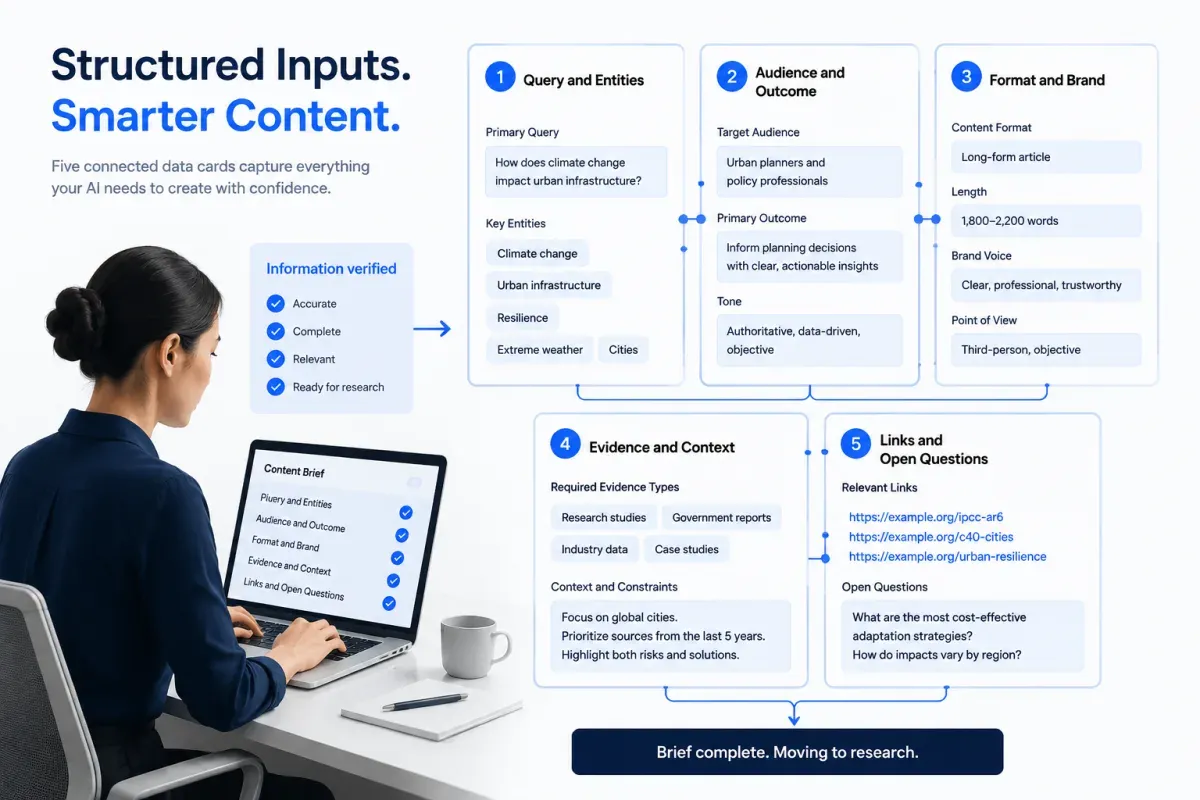
A useful AI content brief starts with structured assignment inputs, not an open-ended prompt. AI uses those inputs to guide research and generation. Human editors still judge the angle, check the sources and approve the final brief.
Content brief automation works best as a five-stage workflow, and each stage has its own section below:
- Capture the assignment and its required inputs.
- Research the topic and generate the brief from evidence and brand context.
- Review the brief’s angle, claims and sources.
- Turn the approved brief into an outline and draft.
- Check the outline and draft before writer handoff.
Complete inputs help AI read the task. They don’t make assumptions true or settle editorial decisions. Our guide to how AI changes content planning shows where this workflow sits in a wider content strategy.
Separate the searcher’s task from the words they use. The query package records the search terms and market. The assignment defines what the page has to accomplish. Include these fields:
- Query: One primary keyword, a few secondary keywords and related entities. Treat secondary keyword clusters as supporting context, not phrases to repeat.
- Search setting: Target language, location and one intent: Informational, Navigational, Commercial, Transactional, or Generative. Intent describes what the searcher needs to do. The query captures how they phrase it.
- Format: The content type, such as a how-to guide or a comparison, and any expected structure.
- Research inputs: Keyword data, trusted sources and relevant competitor or reference URLs. SERPs and AI answers, such as a Google AI Overview, show existing coverage. They aren’t instructions to copy.
A brief also needs a defined reader and outcome. Record the audience’s skill level, pain points, buyer stage, and the problem the content must solve. Then state the business goal and the reader action you want, separately from search intent. A page can answer an informational query and still support product consideration without turning into a sales pitch. That’s persona-based content targeting in practice: the reader’s situation shapes the coverage, and the business goal shapes the next step.
Brand guidance works best as reusable fields, not a vague request to “sound on-brand.” Include brand tone and voice guidelines, preferred and avoided terms, formatting rules, product positioning, and calls to action. Add delivery requirements, such as headings, internal links, a word-count range, or a deadline. Persistent brand and persona guidance keeps automated SEO content briefs consistent across assignments. The topic-specific angle stays open to research and editorial judgment.
Give AI verified context rather than asking it to infer product facts or business goals. Supply approved product information, positioning documents, campaign context, relevant personas, and selected internal resources. Mark each statement as a confirmed fact, an assumption or an open question. An open flag beside an unverified claim is safer than polished language that makes a guess look approved.
A reusable content brief template for intake can follow this order:
- Query and entities: Primary keyword, secondary keywords, related entities, language, location, and search intent.
- Audience and outcome: Reader, skill level, pain points, buyer stage, business goal, and desired reader action.
- Format and brand: Content type, brand voice, terminology, positioning, calls to action, and delivery constraints.
- Evidence and context: Verified product facts, internal documents, trusted sources, competitor URLs, and keyword data.
- Links and open questions: Internal-link targets with preferred anchors, plus labeled assumptions and unanswered questions.
The completed intake hands the assignment to research. It doesn’t approve claims or the outline. Start with one assignment, then check whether its brief keeps the intended audience, verified facts and editorial angle before it goes to a writer.
Generate a Research-Based Brief From Those Inputs
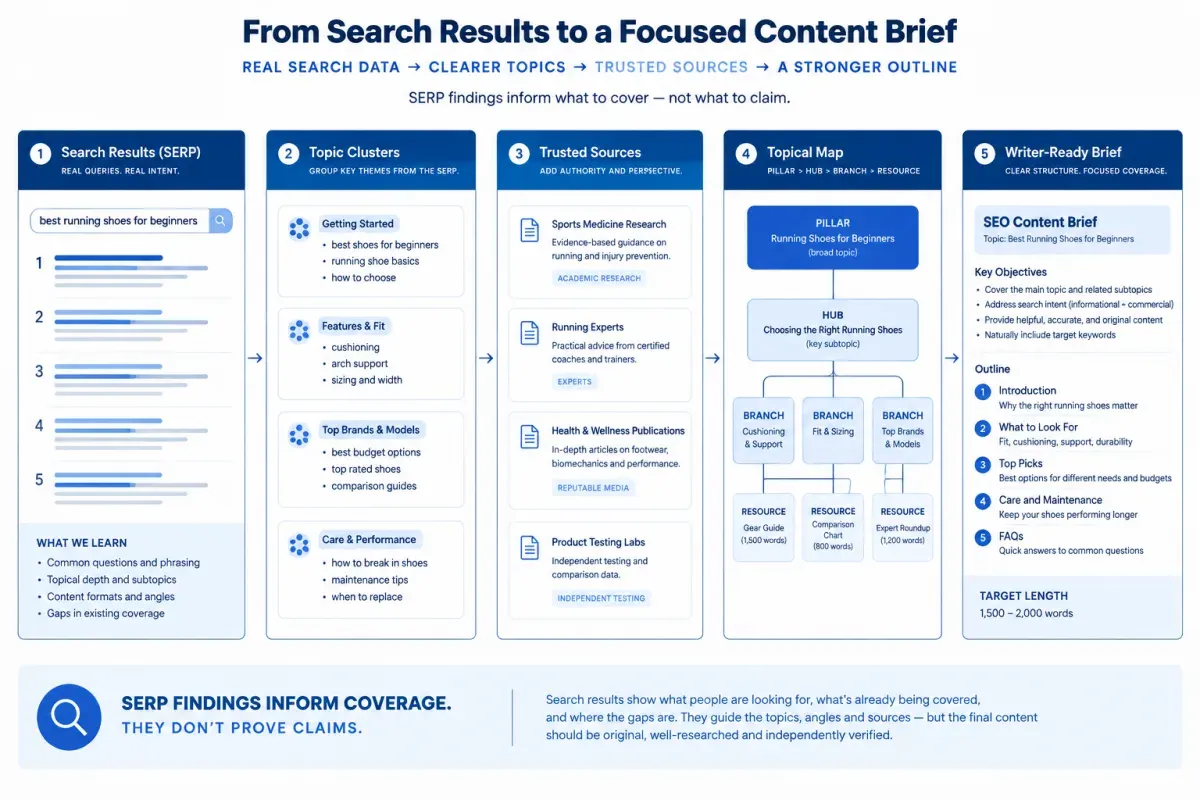
With those inputs in place, a research-based brief gives you a clear editorial angle, a reader-focused outline and evidence requirements grounded in current search results. Start from query data and trusted sources, then use AI to organize the evidence. Don’t lean on a model’s training memory. That’s where AI hallucinations and stale claims creep in.
A keyword plus a generic instruction can produce polished prose with no dependable angle or coverage plan. A stronger process connects the target query to its locale, audience, content type, keywords and entities, live search results, and source material. That connection is what makes a data-driven content brief possible.
Use this research-to-brief sequence:
-
Set the query context. Specify the target keyword and search intent, language, location, persona, and content type. Add the related keywords and entities that matter to the topic.
-
Review live search evidence. SERP analysis covers more than rankings. Look for recurring subtopics, headings, questions, formats, competitor titles, and gaps in coverage. Google Autocomplete, Reddit and People Also Ask questions show the language readers use. Treat AI search answers as context to assess, not instructions to follow.
-
Choose sources with care. Start from the search results, then pick a focused set of competitor pages and trusted references. Floyi’s brief setup, for example, recommends selecting 5 to 7 competitor pages from the top 20 results. Competitor pages show common coverage. They don’t replace reliable references or original evidence.
-
Build an original angle. Separate the coverage readers expect from competitor content gaps that could support a distinct treatment. Don’t copy competitor headings or wording. Ground the angle in expert insight, brand knowledge, customer evidence, or a useful framework.
-
Turn findings into a writer-ready brief. State the intended reader, search intent, topical scope, title, meta description, and an H2 and H3 content outline. For each section, add section-by-section writing instructions: what to explain and what evidence supports it.
-
Make evidence and brand context usable. List external references and their purpose, internal URLs with suggested anchors, persona concerns, and voice constraints. When a brand Knowledge Base is available, pick the documents or categories that fit the topic instead of supplying everything. Mark verified facts separately from claims that still need checking, especially time-sensitive ones.
-
Connect the page to the plan. Add a call to action that fits the reader’s stage. Show how the page relates to its parent, sibling and child pages so the brief supports the wider content program.
A topical map gives those relationships a structure. Floyi organizes topics as Pillar > Hub > Branch > Resource, so each brief sits at a known level of the plan. Its internal linking suggestions come from parent, sibling and child relationships, with anchors attached.
An existing map topic anchors a brief to the plan. If a new question falls outside that structure, add it to the plan before you brief it. That order keeps a useful query from turning into an isolated page.
An AI content outline generator can organize research, but you stay responsible for evidence and approval. Before the brief reaches a writer, review the angle, sources, topical scope, claims, internal links, and CTA. Floyi’s standalone briefs pause for outline review, so you can inspect and accept the outline before the full brief is generated. Resolve unsupported claims instead of letting the model fill the gaps.
Review the Brief Before Approving Its Angle and Claims
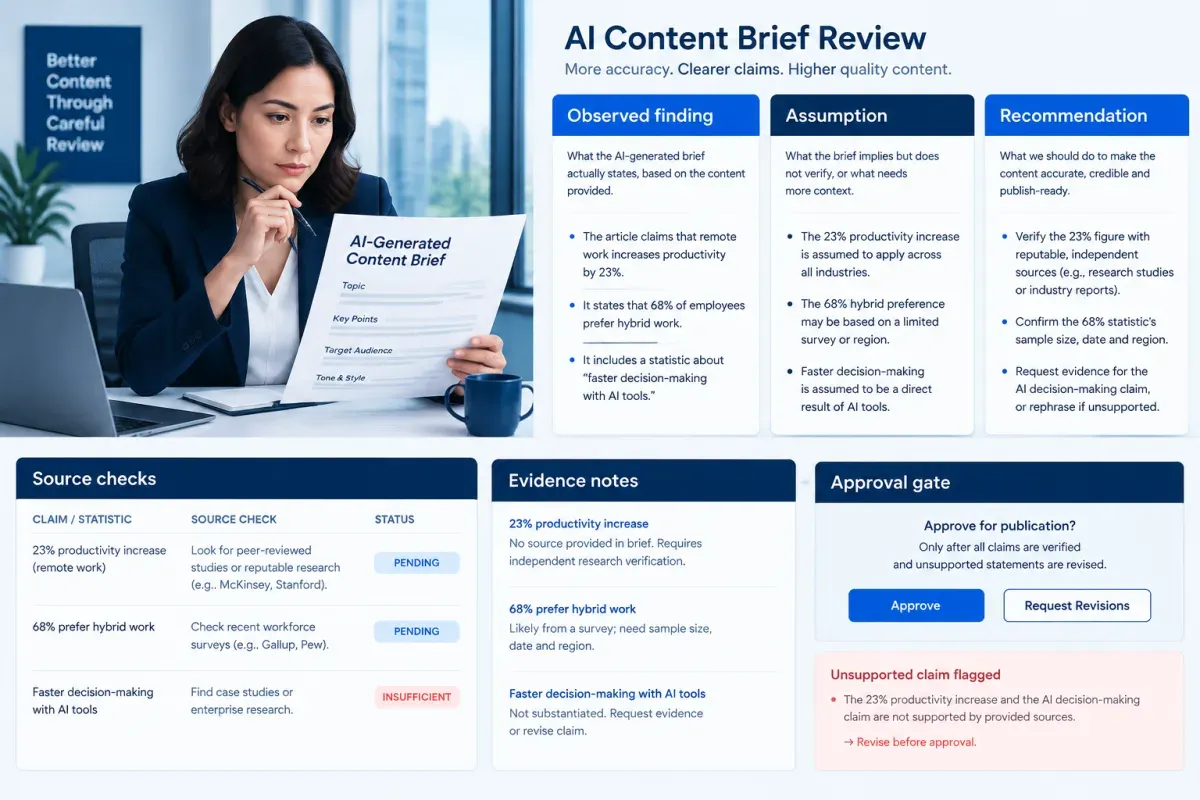
Human review should verify the brief’s evidence, reader value, originality, and brand fit before a writer sees it. Treat AI-generated content briefs as research and planning aids, not editorial approval. This is the human-in-the-loop gate, and it matters most for sensitive, technical or regulated topics. It’s also where the SEO, writer and AI handoff gets decided: who checks what before the work moves on.
Sort every important statement into one of three types:
-
Observed finding: A research-supported pattern, such as a point several ranking pages share. Keep the source details close so you or the writer can check them.
-
Assumption: An interpretation of a signal, or a filled gap. Mark it as unverified so confident wording doesn’t make it look established.
-
Recommendation: Advice on what the page should do. Tie it to reader needs, the page’s purpose and the brand’s perspective.
Open each source link and confirm it reaches the intended page. Check whether the page supports the brief’s exact wording, or only mentions the subject. Separate direct evidence from inferences drawn across sources. Several independent ranking pages can support a consensus point. One source can’t justify a universal claim. Treat machine-generated summaries as research leads, not proof.
Recurring coverage across ranking pages marks the table stakes. Compare it with the brand’s own source material, and what’s left is either a gap worth filling or a claim that needs first-party data. That keeps competitor content analysis useful without letting competitor headings dictate the page. A brief that rearranges top-ranking headings still needs a distinct reader benefit.
Strong information-gain angles offer a credible perspective or a useful outcome, not novelty for its own sake. Keep the core subtopics and cut repetitive sections. Flag unsupported differentiators as data gaps. A claim about customer results, for example, needs evidence from the brand, not polished wording built from general web coverage.
Content brief quality checks confirm that the brief answers the central question, covers the needed subtopics and presents them in a logical order. Google’s guidance on helpful content favors accurate, original pages over many pages that add little. Length and publishing volume don’t replace usefulness.
Brand and audience fit sit beside factual accuracy. A factually sound brief can still fail if it assumes too much of the reader, drifts outside the topical scope or repeats a competitor’s framing.
Use this content brief approval checklist before you sign off:
- Sources support the exact wording of each factual claim, and unresolved claims are flagged.
- The outline answers the main question without padding or repetition.
- Copied framing is gone, and the page’s own contribution is clear.
- Writers can tell verified findings from assumptions and open questions.
Send unsupported claims or angles back for revision. Approve the brief only when its evidence and direction give the writer a clear path to an accurate, useful page.
Turn the Approved Brief Into an Outline and Draft
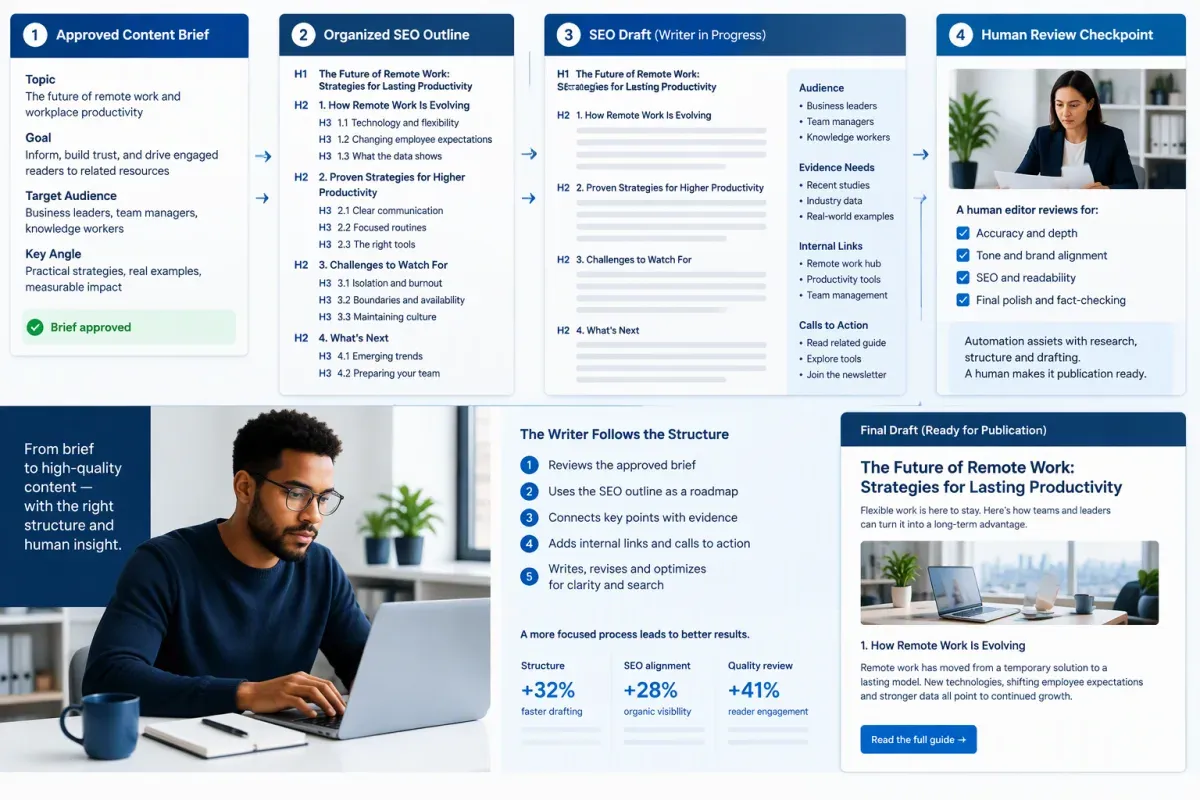
AI can turn an approved brief into a reader-first outline and draft, as long as you carry the brief’s decisions forward and check the structure against current research. The brief sets the strategy. The outline turns it into a structure a writer can follow.
That’s what makes a brief-to-draft workflow repeatable. Automation organizes material and flags gaps. You stay responsible for the angle, accuracy, originality, and approval.
Treat the approved brief as a set of constraints, not a loose prompt. Carry over its audience, objective, intent summary, angle, evidence needs, internal links, and call to action. Keep the working title, target length, format, tone, and topical scope too. Without those, a tidy outline can still drift from the assignment.
Build the SEO content outline around the searcher’s task, not the order in which research arrived. The H2 and H3 hierarchy should move from the reader’s problem to an explanation, practical guidance and a next step. Give each heading a specific job. Generic labels leave writers guessing.
A repeatable outline pass looks like this:
-
Set the reader’s path: Order H2s and H3s by what serves the reader, not by when a keyword or competitor turned up.
-
Define each section’s job: State its purpose, key points, reader questions, and likely follow-ups. Add evidence requirements wherever the section makes a factual claim.
-
Attach links and sources: Name the internal link targets and descriptive anchors. List the source types each claim needs, and separate verified findings from examples that still need confirmation.
-
Choose the format: Specify steps, bullets, a comparison table, or another scannable structure when the content type calls for it. Add FAQs only when real unanswered questions remain.
AI-generated outlines speed this up. They can group related topics, classify intent and flag gaps such as missing coverage, repeated headings or possible cannibalization. Treat those flags as review prompts, not decisions. Check them against current SERPs, AI answers, the approved brief, and your source material. Model memory can organize information. It can’t tell you what current search results support.
Floyi briefs list SERP consensus claims, the table-stakes points two or more ranking pages agree on. They also list Blocked Opportunities, which are angles no competitor covers that need your own data first. Keep a Blocked Opportunity out of the draft until you’ve added the evidence. Floyi also drafts several title candidates, but the approved angle and your judgment decide the final title.
Before drafting, confirm that each section has a clear purpose, the sequence is logical and no headings compete. Check that evidence requirements, links and format notes give the writer direction without scripting every sentence.
The approved outline becomes the draft’s working structure. Floyi drafts pull in your brand voice, personas and Content Guide rules, so you don’t paste that context into a prompt each time. As you review the draft, check its claims against the specified evidence and confirm each internal link fits its context. Then compare the piece with the brief’s objective.
Check the Outline and Draft Before Writer Handoff
Check both the outline and the draft against the assignment before they reach a writer, even when AI handled the research and first pass. Automation prepares the work. You decide whether its evidence, angle and scope are ready.
Start with claims. Trace each factual claim to its source and confirm that statistics reflect real data. Flag anything unsupported for removal or verification. Then check that the page type and outline serve the searcher’s goal, and that the draft adds something beyond what already ranks.
Review links in context, not as a list. Each suggested internal page should exist, support the nearby point and fit a real parent, sibling or child relationship. Anchor text should describe the destination. External references should be credible and support the claim beside them. Remove broken or irrelevant links rather than adding links to hit a quota.
Brand fit takes more than a topic prompt. Compare the work with your Content Guide, the target persona and your brand context. Examples, terminology, depth, and tone should suit the intended reader. Check required disclosures and competitor policies too. The writer can then refine the prose instead of rebuilding the strategy.
Compare the assignment with the topical plan and the pages you already have. Confirm it sits at the right level of that plan. Similar topics alone don’t mean cannibalization, but a near-identical angle and search goal deserve a closer look. If an existing page fits better, update it instead of publishing a competing copy.
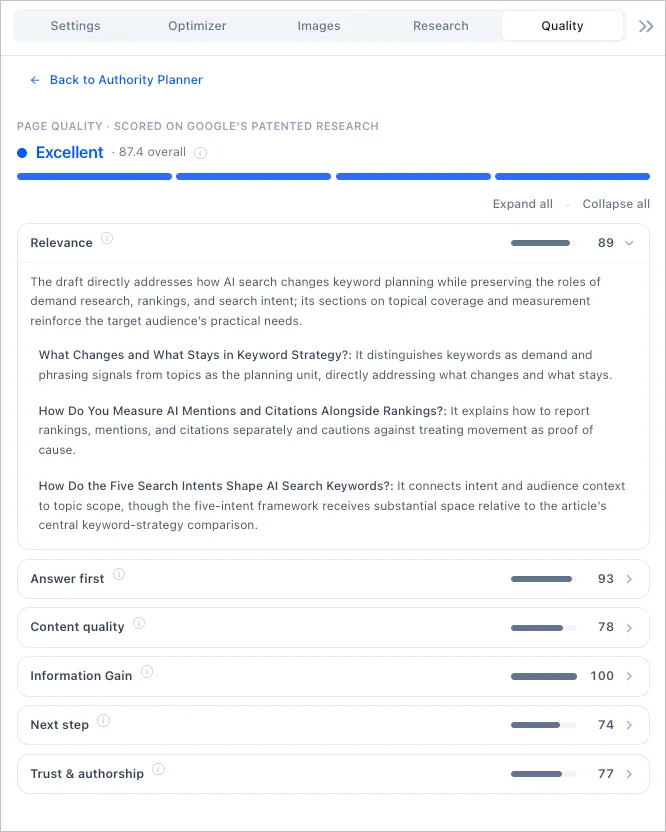
Keep generated work distinct from work that has passed editorial review. Mark unresolved claims, missing sources, scope changes, and required revisions so the writer sees what’s still open. The handoff package includes the approved brief, the outline, source context, and link guidance. An automated quality score can flag issues for the editor. In Floyi, the Page Quality Scorecard rates every draft and quotes the evidence behind each score. Treat it as a second opinion, not a replacement for editorial judgment.
Give each piece a clear status, such as Needs Editing or Approved, so generated work never looks publication-ready by default.
Pilot the workflow on a small batch before you scale it. Record why each brief is approved or returned, and use recurring reasons to refine inputs, prompts and validation rules. Faster generation isn’t the goal. Less avoidable rework is.
After publication, review visibility across Google and AI search. Feed weak coverage and recurring editorial issues into the next content plan, without assuming automation caused any change in performance. When you’re ready to run this workflow inside your topical map, automate briefs with human review gates in Floyi.
Automating Content Briefs and Outlines with AI FAQs
These answers cover syncing briefs with other tools, updating briefs when intent shifts and scaling one workflow across writers.
1. Can AI Briefs Sync with Project Management Tools?
Yes. A form or a spreadsheet, such as Google Sheets or Airtable, captures the topic, audience and instructions. Zapier or Make then passes those details and the research context to an AI model. The automation can save the brief to Google Docs, Notion or your CMS and notify an editor. A spreadsheet, a document template and a model are enough to start.
Project management integrations add the brief link and status to a task board, which makes handoffs repeatable. They handle the plumbing, not the approval. Your editor still reviews the evidence, brand fit and angle. Measure success by approved content quality, not brief volume.
2. How Do You Update Briefs When Search Intent Changes?
Refresh the evidence before you touch the brief. When rankings or query behavior point to a shift, rerun SERP analysis. Compare current result types, headings and query modifiers with the assumptions behind the original brief.
Keep research, generation and validation separate. Confirm the new evidence and revise the affected sections. Then have an editor approve the updated angle and claims. In Floyi, each brief edit saves a new version, so you can see what changed. If writers keep reworking the same sections, refine the prompt or template and test the change against the refreshed SERP.
3. Can One AI Workflow Create Briefs for Multiple Writers?
Yes. A shared prompt and brief template can standardize heading hierarchy, tone, formatting, audience, and brand rules across writers. Make each requirement explicit so neither the AI nor the writers have to infer it. A reusable AI prompt for content briefs is a practical start. Add automation once it reliably produces usable briefs.
Keep the structure consistent, not the substance. Each brief should still reflect its own SERP evidence, sources, internal links, and audience needs. That’s how standardized content briefs stay useful in agency content workflows across many clients. Before handoff, an editor verifies claims and sets the angle, so writers get a predictable starting point without losing human judgment.
About the author

Yoyao Hsueh
Yoyao Hsueh is the founder and CEO of Floyi, the topical authority platform, and the founder of Main Heading, an SEO and AI search agency. He is an expert in topical authority and topical mapping. He created Topical Maps Unlocked, a course studied by thousands of SEOs, content strategists and digital marketers, founded TopicalMap.com, a done-for-you topical mapping service for agencies and enterprise teams, and publishes the weekly Digital Surfer newsletter on SEO, content strategy and AI search.
About Floyi
Floyi is a closed loop system for strategic content. It connects brand foundations, audience insights, topical research, maps, briefs, and publishing so every new article builds real topical authority.
See the Floyi workflow