What to Look for in an AI Content Platform: A Buyer's Checklist
Test any AI content platform on brief quality, brand controls, SEO and AI search, publishing, data handling, and pricing, with demo questions and a scorecard.
A polished demo can make any AI content platform look ready for your team. What matters is whether brand context, live search evidence, editorial controls, and publishing status stay connected from brief to approval.
A draft can read cleanly while its claims have no visible source, its SEO advice has no SERP evidence and its workflow ends in a manual export. This checklist gives you AI content platform evaluation criteria that catch those problems during a trial. Each part of what to look for in an AI content platform comes with what good looks like, one demo question and the red flag that ends the conversation.
AI Content Platform Key Takeaways
- Run the same representative assignment and reviewers on every shortlisted platform.
- Inspect the brief before the draft, and trace its SERP and AI-answer evidence.
- Require brand rules, disclosures and personas to carry into drafts without re-prompting.
- Keep approved facts, sourced claims, generated assertions, and evidence gaps visibly separate.
- Test SEO and AI search features inside a working draft, not a product tour.
- Publish a staging page to prove integrations, permissions and version history work.
- Score with a weighted sheet, and treat factual accuracy and privacy as pass-or-fail gates.
Set Your Trial Requirements First
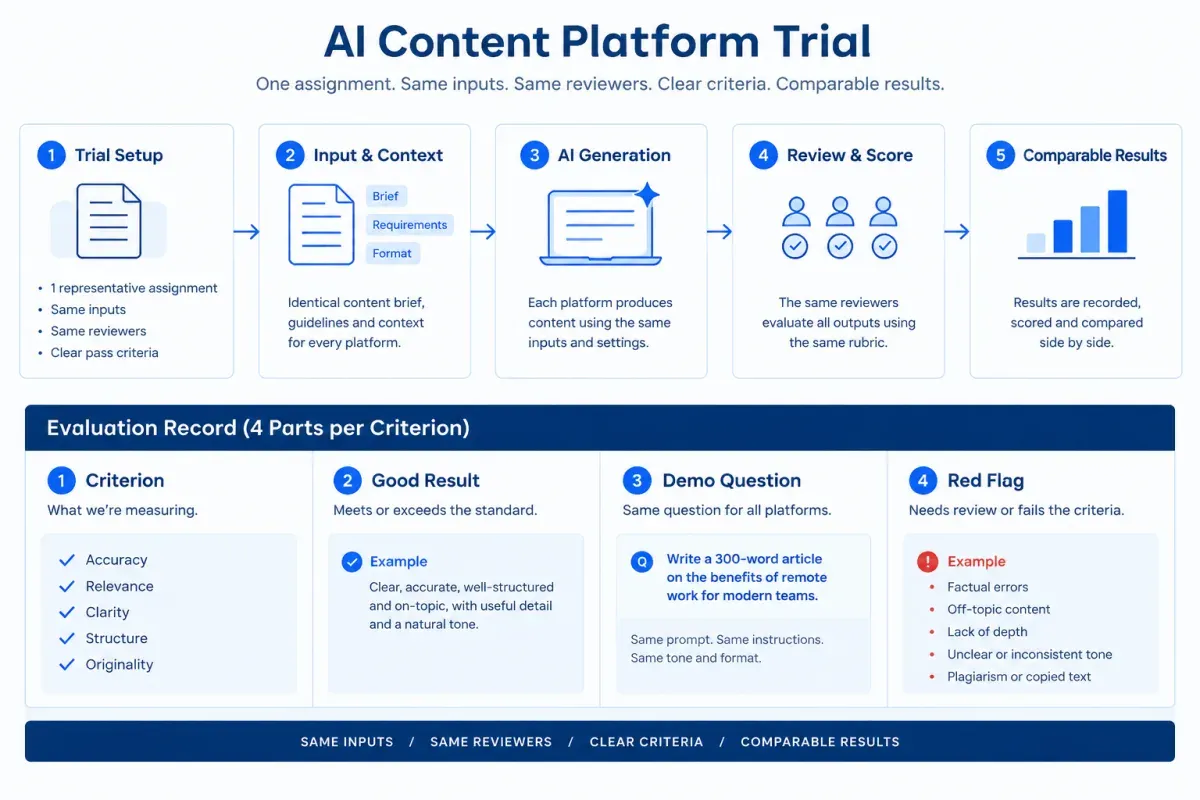
Write your pass criteria before the first demo. If you start evaluating an AI content platform without them, the best presentation sets them for you. Start with the work your team has to ship, such as SEO articles, briefs, product pages, localized pages, and whatever format is next on the roadmap. Then list the people and steps behind a typical assignment: writers, editors, subject-matter reviewers, client accounts, and approval stages.
Pick one representative assignment that touches all of those people and run it on every shortlisted platform. A net-new page, a commercial comparison and an update to an existing article make a fair mix. Each platform gets the same inputs, reviewers and success criteria.
Your AI content strategy has to survive the trip from plan to page. AI-powered content strategy basics covers what that strategy context includes. The trial tests whether a platform carries it into the work or makes your team retype it.
Record every criterion in the same four-part format so results stay comparable:
- Criterion: the capability you’re testing, such as brand rules carrying into drafts.
- What good looks like: the observable result that passes.
- Demo question: one request the vendor has to perform live, not describe.
- Red flag: the behavior that ends consideration.
Agree on weights and a total-cost ceiling at the same time, before anyone sees a demo. The sections below cover the features to look for in an AI content platform in that format, and the scoring sheet at the end turns them into a comparable total.
Test Strategy Inputs and Brief Quality
Judge the brief before the draft. The brief shows whether the platform turned research into an editorial plan, and a draft built on a weak plan can still read well enough to fool a reviewer.
Give each platform the approved audience, topical scope, business goal, and source material for your trial assignment. That way you measure strategy-to-draft execution, not prompt-writing skill. A strong brief names the reader angle, heading hierarchy, format, relevant entities, and internal-link direction. It also separates the coverage searchers expect from original angles that need your own evidence.
Have the writers and editors who’ll use the brief review it, and log what they had to fix:
- Missing coverage: sections, entities, links, or reader questions the brief didn’t identify.
- Evidence problems: claims with no traceable source.
- Editorial effort: whether the piece needed light refinement or a structural rebuild.
- Reader fit: whether an editor can name the intended buyer, argument and next step without reconstructing the strategy.
Use those notes to judge the criterion:
- What good looks like: a writer can start from the brief alone, and the draft follows its structure instead of drifting into generic prose.
- Demo question: “Show me how this brief was built: which sources, competitor pages and AI answers it used, and which angles it marked as needing our own data.”
- Red flag: an unranked keyword list, or evidence gaps filled with credible-sounding statistics nobody can trace.
How Does It Use Live Search Evidence?
A good platform uses live search evidence to change the next content decision, and it shows you the evidence behind each recommendation. Ask the vendor to research a commercially relevant query during the demo. The output should surface ranking pages, search intent, competitor coverage, and current AI answers. It should also date those findings so you can tell them apart from the model’s stored knowledge.
Then follow one finding through the workflow:
- Planning: Search demand, Search Console query data and competitor gaps should decide whether the platform recommends a new page, a refresh or no action. Good topical scope controls stop low-intent additions that cannibalize existing pages.
- Brief: The finding should become a specific requirement, such as an entity to cover, a claim to source or an internal link to add.
- Draft: Sources should survive every handoff between research, writing and editing agents, so a reviewer can check the claim later.
For AI search, look for gaps that become concrete requirements, such as a direct answer, a comparison table or a missing entity, rather than a single visibility score.
- What good looks like: an inspectable trail from a live query to a page decision, a brief requirement and a sourced passage in the draft.
- Demo question: “Show me the research queries and competitor pages behind this brief, and where each one appears in the draft.”
- Red flag: the platform can’t show the source or date behind its research or its generated claims.
Verify Brand Controls and Draft Review
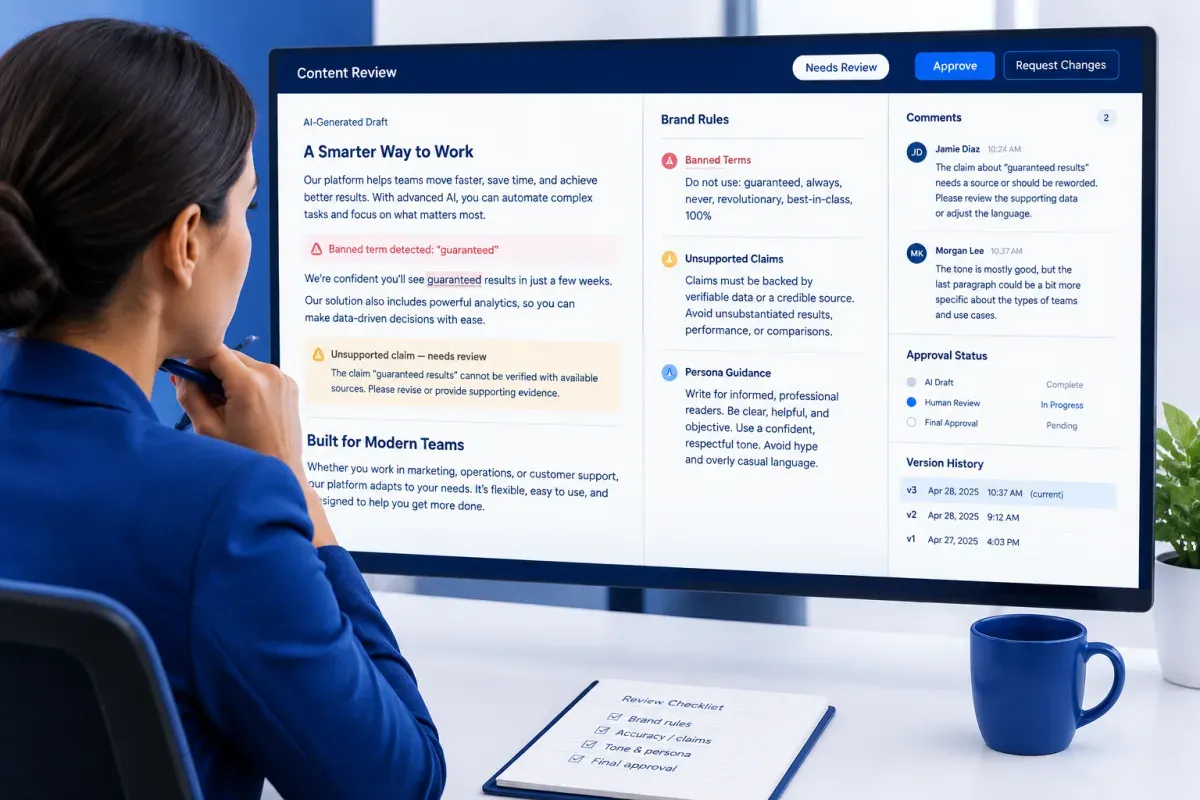
A platform passes this test when your brand rules apply to the draft by default and survive human edits. Start from an approved brief, not a blank prompt. Load your brand guidelines for AI content, including your style guide, controlled lexicon, buyer persona, required disclosures, and competitor policy. Then generate the same section on every shortlisted platform.
This tests the platform, not your governance. You need approved brand rules, approved claims and a human publishing gate in place first, and AI content governance for brand accuracy covers how to set those up.
Stress-test the controls the way an editor would:
- Ask for a term your style guide bans and see whether the platform flags, blocks or corrects it.
- Slip in an unsupported product claim and a paragraph aimed at the wrong persona.
- Edit the draft by hand, then ask the AI to expand one passage and rewrite another. Check whether the new copy keeps the voice and whether you can compare and restore earlier versions.
- Walk the draft through comments, permissions and approval status to see who can move it to publish.
Context should live beside the draft. Writers need the persona, approved terminology, research context, and internal-link guidance in the same workspace. If every revision starts with someone pasting that context into a chat, your AI content workflow depends on individual memory. Shared context is the starting point for operationalizing AI content across a team.
- What good looks like: banned terms and unsupported claims get caught before an editor sees the draft, and post-generation edits stay on voice.
- Demo question: “Generate this section, then show me what happens when I ask for a term our style guide bans.”
- Red flag: a free-text prompt box that every writer fills in differently.
How Does It Separate Supported Claims?
A credible platform keeps four kinds of statements visibly apart: what the SERP supports, what your company has approved, what the model generated, and what still lacks evidence. Fact-checking only improves AI content accuracy when a writer can see which is which.
Test it on a real topic in three ways:
- Trace the evidence: Open several research-backed statements in the brief or editor and check each source link and its context. Stored model knowledge can produce confident language that’s out of date.
- Seed difficult claims: Add a questionable statistic, an outdated assertion and a high-stakes statement to a draft. The platform should flag each one, say why it needs review and leave the decision to a human.
- Test proprietary angles: Add an angle that depends on internal performance data. The system should connect it to approved source material or mark the gap plainly. Plagiarism checks can support review, but they don’t tell you whether a claim is true.
Example from Floyi: Floyi won’t invent proof for a net-new angle that Brand Foundation and the Knowledge Base can’t back. It lists the angle as a Blocked Opportunity marked “needs your data”, and adding the missing fact routes it into the brief as a required point for the next draft.
- What good looks like: approved facts, sourced research, generated assertions, and unsupported ideas look different on the page.
- Demo question: “Trace this claim back to its source or our approved material, and show me one claim the system declined to make.”
- Red flag: uniform confidence. If every statement looks equally certain, your team can’t tell a verified proof point from an assumption.
Evaluate SEO and AI Search Workflows
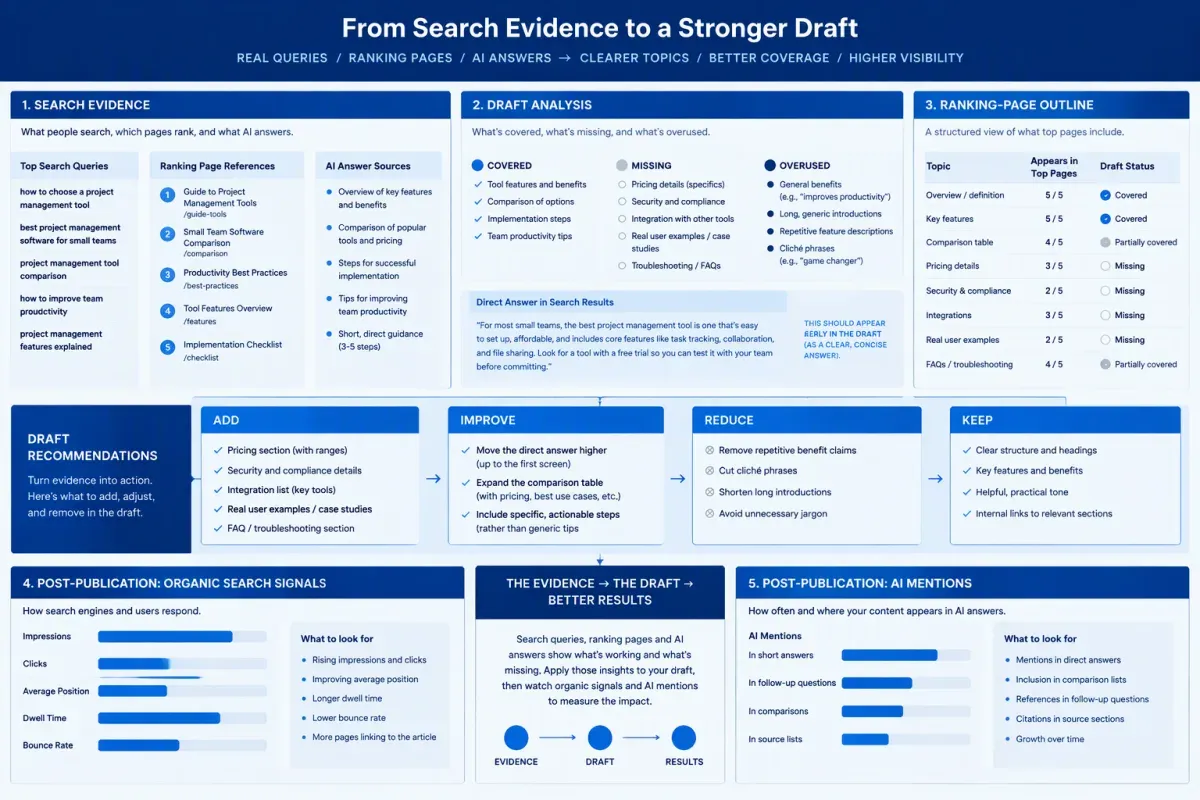
SEO content optimization and AI search features should turn search evidence into writer-ready decisions inside the draft, then show what changed after publication. Test them in a working draft, not a product tour.
- Optimize against visible evidence: The editor should compare the draft’s terms, entities and topics with ranking pages and AI answers, then mark each as missing, covered or overused. Every recommendation needs a reason you can see. For published URLs, check whether Search Console queries reveal terms the page no longer covers.
- Shape answer-ready structure: AI search optimization belongs in the outline, not the final polish. Look for a clean heading hierarchy, direct definitions, self-contained answers, and comparison tables where they help the reader. Passages that stand on their own are easier for answer engines to quote.
- Check metadata and schema against the draft: Title, meta description and schema suggestions should match what the page actually says. Ask to preview and validate the markup before publishing.
- Separate post-publication signals: Rankings and organic traffic belong in one view, and AI mentions and citations in another. A good platform also tells a coverage gap apart from an authority constraint, where backlinks, mentions and trust signals limit results more than another article would.
A term that shows up often in ranking pages can still be wrong for your page if it pulls the reader off course or conflicts with search intent.
- What good looks like: every recommendation explains itself, and overuse gets flagged as clearly as omission.
- Demo question: “Show me why this term is recommended, where it appears in ranking pages or AI answers and what you’d cut.”
- Red flag: one opaque content score with no route back to the evidence.
Test Collaboration, Publishing and Integrations

Test collaboration and publishing together, because a human-in-the-loop content workflow needs a clear owner at every handoff. An end-to-end content workflow moves a draft from assignment to a live page without exports, email threads or a separate status tracker. Run the handoff with real contributors, editors and approvers. Check assignments, comments, role-based permissions, and editorial approval workflows, and make sure a generated draft never looks the same as a reviewed or approved one.
Put those controls under pressure with a late legal edit or a subject-matter correction. Editors should see who changed what, compare or restore versions and read the AI content audit trail without digging through comment threads. Fact-check suggestions should inform reviewers, never publish on their own.
Then test AI content platform integrations where you actually publish:
- CMS publishing: Push a noncritical page to staging and check post type, author, categories, tags, featured image, SEO metadata, and block formatting. Edit or unpublish it in the CMS and confirm the status syncs back.
- Static-site publishing: If you publish through a Git-based static site, inspect the Markdown or MDX, frontmatter and image paths before production.
- Exports: Export a representative document and confirm headings, links, images, and metadata survive.
- Connected systems: Check analytics and asset-library connections the same way. Failed handoffs should be visible and recoverable, not silent.
Bulk publishing helps a planned queue only when it follows the same approval rules as a single page.
- What good looks like: one assigned draft reaches a published page without copy-paste, and every change, approval and status stays visible.
- Demo question: “Publish this draft to our staging site, then edit it there and show me the status change back in the platform.”
- Red flag: an “integration” that turns out to be a manual export or undisclosed custom development.
Check Data Handling and Pricing Models
Get data-use and pricing terms in writing before you upload anything sensitive or sign. Data privacy for AI content platforms is set by the contract, not by sales assurances.
Confirm whether prompts, uploaded brand documents, customer evidence, and generated drafts stay private, stay out of model training or get retained for service improvement. Check deletion timelines, processing locations and subprocessors. Then test the controls during the trial: SSO, role-based access and audit logs. A security page can’t show whether a contractor can open another client’s workspace, or whether a departing team member loses access the same day.
Ownership and portability need the same scrutiny. Your agreement should keep your rights to inputs and outputs. It should also give you usable exports of research, briefs, drafts, and brand material, so switching platforms later isn’t a manual recovery project.
AI content platform pricing gets comparable once you know the charging unit. Vendors bill by seat, article, credit, token, brand, or workspace, and the same editorial calendar can cost very different amounts under each. Price your expected month and your busiest plausible month against these drivers:
- Included allowance: what’s covered before charges start, and whether unused capacity rolls over.
- Growth triggers: extra seats, brands, workspaces, overages, onboarding, and support.
- Usage visibility: cost estimates before a run, plus a record of what’s been used.
Example from Floyi: plans are credit-based, with one credit pool shared across a team’s seats, so the unit to model is credits per brief and draft rather than seats alone. Check the current plan page before you budget.
- What good looks like: written data-use terms, a tested export, tested permissions, and a cost worksheet for both workload scenarios.
- Demo question: “Quote our expected month and our busiest month, including seats, brands, overages, and onboarding, and show me where usage limits appear in the product.”
- Red flag: limits, overage triggers or data-use terms that surface only after signing.
Spot Red Flags and Missing Requirements
Some warning signs don’t belong to a single criterion, and any one of them should end the evaluation:
- Activity-only reporting: reports count articles, words or tasks but say nothing about content quality, topic coverage or search outcomes.
- Hidden editorial cost: a production-like brief needs heavy restructuring, fact correction or voice repair before it’s publishable. The platform is missing context your team will keep supplying by hand.
- No realistic trial: the vendor won’t run your assignment end to end, or says key details will appear only after contracting.
Missing requirements are a different problem. A platform can pass every test above and still not cover something your operating model depends on. List those requirements before the trial and mark each one as a dealbreaker or a workaround. Then price each workaround in editor time, extra tools and client-facing effort. Common gaps include agency-branded reporting, an unsupported publishing destination and compliance controls for a regulated industry.
Example from Floyi: Floyi publishes directly only to WordPress and GitHub. A team on another CMS exports each draft as DOCX, HTML, Markdown, TXT, or Google Docs and moves it by hand. If direct publishing to a different CMS is a dealbreaker for you, Floyi won’t pass that gate.
Write every gap and its workaround cost into the scoring sheet, so it counts against the total instead of surfacing after launch.
Score Your Shortlist Consistently
Score each platform from 1 (poor) to 5 (excellent) on evidence from the same trial, not on what the demo promised. Multiply each score by its weight and add the results. Factual accuracy and privacy are gates, so a platform that fails either is out, whatever its total.
Copy this AI content platform scorecard and replace the example values with your own. The weights, scores and evidence notes below are illustrative examples for two anonymous platforms, not ratings of real products. In this example, a score below 3 on a gate row counts as a fail.
| Criterion | Example weight | Gate | Platform A (example score) | Platform B (example score) | Example evidence note |
|---|---|---|---|---|---|
| Brief quality and strategy inputs | 5 | No | 4 | 3 | B’s brief missed two reader questions the editor had to add |
| Live search evidence | 4 | No | 4 | 3 | A dated every source behind its recommendations |
| Brand controls and draft review | 5 | No | 4 | 2 | B accepted a banned term without a flag |
| Claim separation and factual accuracy | 5 | Yes | 5 | 3 | A flagged the seeded statistic for review |
| SEO and AI search workflow | 4 | No | 4 | 3 | A explained each term recommendation |
| Collaboration, publishing and integrations | 4 | No | 3 | 4 | B synced the staging page status back |
| Data handling and privacy | 5 | Yes | 5 | 2 | B wouldn’t confirm training exclusion in writing |
| Pricing and usage fit | 4 | No | 4 | 4 | Both quotes covered the busiest-month scenario |
| Missing requirements | 3 | No | 3 | 4 | A needs a workaround for one reporting requirement |
In this example, Platform A totals 159 out of a possible 195 and Platform B totals 118. B is out regardless, because it failed the privacy gate. Set your own weights before the first demo. A team that depends on organic search might raise the SEO row to 5, and an agency might weight missing requirements higher.
Use the total to keep the AI content platform comparison honest, then weigh it against each all-in quote to judge AI content platform ROI. When choosing an AI content platform, pick the one that leaves your editors refining informed drafts instead of rebuilding them. To see how Floyi connects brand context, briefs, drafts, and publishing in one workflow, start with the Floyi platform overview.
AI Content Platform FAQs
These questions cover who should run the trial, multi-brand setups, content formats, and when a general AI assistant is enough.
1. Who Should Join a Platform Trial?
The people who’ll use the platform every day should run the trial, not just the buyer. Your content lead owns workflow fit and the scoring sheet. An editor tests brand controls and rewrite effort. The SEO lead reviews briefs and optimization. A subject-matter reviewer checks factual accuracy, and security or procurement reviews data terms and pricing. Each person scores only the criteria they own, against the same trial assignment.
2. Can One Platform Serve Multiple Brands or Clients?
Yes, if each brand or client gets its own isolated workspace for brand rules, personas and source documents. Switch between two brands in one session and confirm that one client’s brief never pulls another client’s terminology or files. Then check how seats and credits are shared across brands, and whether client-facing deliverables can carry your branding or need rebuilding in your own templates.
3. Does It Support Multiple Content Formats?
Most platforms support several formats, so test only the ones your team publishes. Give the platform one approved article and ask for a social post, an email and a newsletter version. Each should have its own length, structure and call to action, not a shortened copy of the original. If visuals matter, check whether generated images fit your visual identity and each channel’s requirements, and keep human review in place before anything goes live.
4. When Is a General AI Assistant Enough?
A general AI assistant is enough for occasional, low-stakes content when one person owns the context and checks every claim. A dedicated platform earns its cost when brand rules, search evidence, review history, and publishing status have to carry across several contributors and many pages. Check whether drafts start from your style guide, personas and research, or whether someone has to paste and recheck that context in every chat.
About the author

Yoyao Hsueh
Yoyao Hsueh is the founder and CEO of Floyi, the topical authority platform, and the founder of Main Heading, an SEO and AI search agency. He is an expert in topical authority and topical mapping. He created Topical Maps Unlocked, a course studied by thousands of SEOs, content strategists and digital marketers, founded TopicalMap.com, a done-for-you topical mapping service for agencies and enterprise teams, and publishes the weekly Digital Surfer newsletter on SEO, content strategy and AI search.
About Floyi
Floyi is a closed loop system for strategic content. It connects brand foundations, audience insights, topical research, maps, briefs, and publishing so every new article builds real topical authority.
See the Floyi workflow