
6 Steps to Keep AI Content on Brand and Factually Accurate
Keep AI-generated content on brand and accurate with voice rules, approved claims, verified sources, claim-level fact checks, and a human publishing gate.
An AI draft can match your outline and still publish the wrong product detail, an unsupported statistic or language no one on your team would use. Keeping AI content on brand and factually accurate takes separate controls for voice, approved claims, source grounding, and human approval. Polished copy is not evidence that its claims are current.
Prompts alone don’t hold those controls. Start with approved writing samples, then turn preferred terminology, disclosures, competitor policies, and messaging boundaries into persistent AI content guardrails that apply before generation. Floyi’s Content Guide sends those rules to the AI with every generation. The Fact Checker agent flags possible inaccuracies, but a reviewer decides whether the evidence is enough.
The six steps below form one workflow that connects prevention, verification and correction, so recurring errors become better controls instead of repeated edits. The failure-type table at the end assigns each issue a generation control, a review check and a place for the fix.
AI Content Accuracy and Brand Key Takeaways
- Build AI brand voice guidelines from three to five approved writing samples and explicit do-and-don’t rules.
- Sort claims into approved, approval-required and prohibited before generation.
- Ground drafts in a current brief, a source pack and Knowledge Base documents.
- Fact-check every material claim in a dated claim ledger.
- Require a named human approver before content moves to Published.
- Route recurring errors to voice samples, Content Guide rules, briefs, or source documents.
- Match each failure type to a preventive control and a separate review check.
Step 1: Codify Voice with Rules and Samples
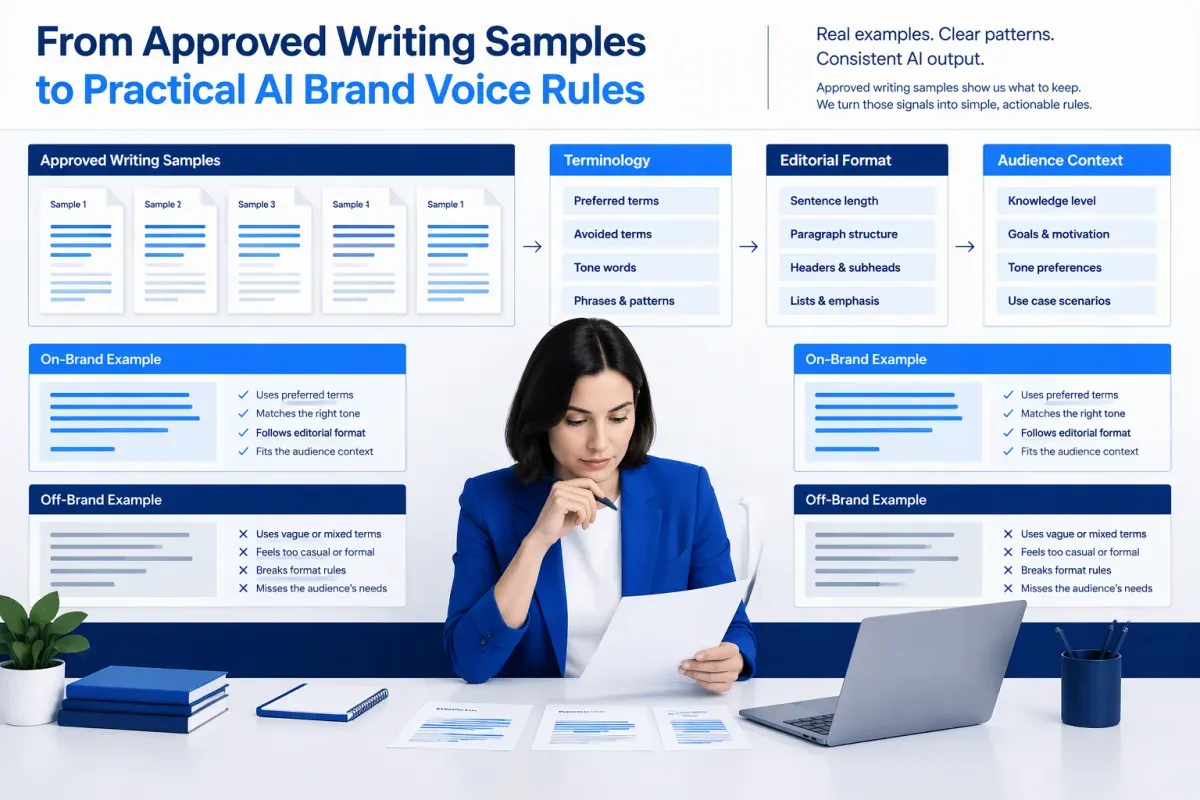
Codify your voice as written rules plus approved samples, because AI follows the source material and rules it receives. A compact, living AI content style guide is more dependable than asking a model to “sound like us” in every prompt. Capture your mission, positioning, audience knowledge level, messaging priorities, point of view, voice, tone, and separate do-and-don’t rules. Brand and accuracy controls are one part of what an AI content strategy covers, and voice is where they start.
Build the playbook from approved pieces drawn from channels you publish, such as blog openings, customer emails or video scripts. For each sample, note its opening pattern, sentence rhythm, technical depth, evidence style, perspective, and call to action. Pair every approved passage with an off-brand rewrite that shows vague corporate language, swapped terminology or a missing point of view. Brand style examples work when both writers and AI can see why one version fits and the other only sounds polished.
Floyi’s Brand Voice analysis turns three to five writing samples into a structured voice profile. Brand Foundation carries that profile, along with your mission, USP, competitors, and positioning, into every brief and draft.
Keep AI writing rules in separate groups and put the highest-priority guidance first:
- Terminology: Approved product names, preferred industry terms, required replacements, forbidden wording, and competitor-reference rules.
- Editorial format: Active voice, reading level, sentence and paragraph length, headings, punctuation, and emoji use.
- Audience context: What readers need to accomplish, what they already know and which messages come first.
Brand voice in AI content holds when the rules are concrete. For a practitioner audience, on-brand AI content means direct second-person instruction, precise terminology and real artifacts instead of polished reassurance.
Run a logo-swap test before approving a rule or sample. If a credible competitor could publish the passage unchanged after removing the logo, add a supported point of view, recognizable terminology, operational detail, or evidence. When a solid draft still slips section by section, fixing tone drift in AI drafts covers the repair.
Step 2: Set Approved Claims and Policies
Set approved claims and policies as persistent rules before AI content generation starts, not as reminders inside a one-off prompt. A stored rule applies to every generation, while a prompt reminder depends on whoever writes the prompt that day.
A compact matrix separates draftable statements from those that need review or cannot appear at all:
| Claim category | Drafting rule | Evidence or handling |
|---|---|---|
| Approved | Use only with supporting evidence | Keep the source tied to the claim |
| Approval-required | Pause for subject-matter or legal review | Promises, sensitive topics, customer treatment, and scope limits |
| Prohibited | Do not generate or paraphrase | Restricted terminology and forbidden words for AI |
Attach each conditional claim’s exact disclosure to the claim itself, because compliance depends on exact wording. A performance claim that requires “Results may vary.” must carry that precise text, not a general pointer to a disclaimer. Keeping the two together stops later edits from separating them.
Competitor references need a per-competitor policy rather than writer judgment. For Competitor A and Competitor B, pick one treatment:
- Neutral mention allowed: Verifiable, fact-based language only.
- Comparison articles only: References limited to direct comparison content.
- Positive or neutral framing only: Legitimate strengths acknowledged, no hostile framing.
- Never mention: The competitor stays out of generated content.
Floyi’s Content Guide stores terminology, compliance, competitor, and brand messaging rules as separate entries. Each generation sends the AI up to 10 terminology rules, 3 compliance rule sets, 10 competitor policies, and 15 brand messaging rules. Keep entries short, distinct and ordered by risk. AI content strategy for growing teams depends on controls like these holding across every writer.
Approved Snippets cover locked language such as disclosures, author bios and calls to action. You insert them by hand from the Content Editor toolbar. They are not sent to the AI during generation, so the wording you approved is the wording that ships.
Match AI style prompts and templates to the content type. A landing-page template fixes the audience, offer, approved claims, and call to action. An educational template sets search intent, evidence limits and tone, and it blocks clichés and restricted vocabulary.
Step 3: Ground Drafts in Verified Sources
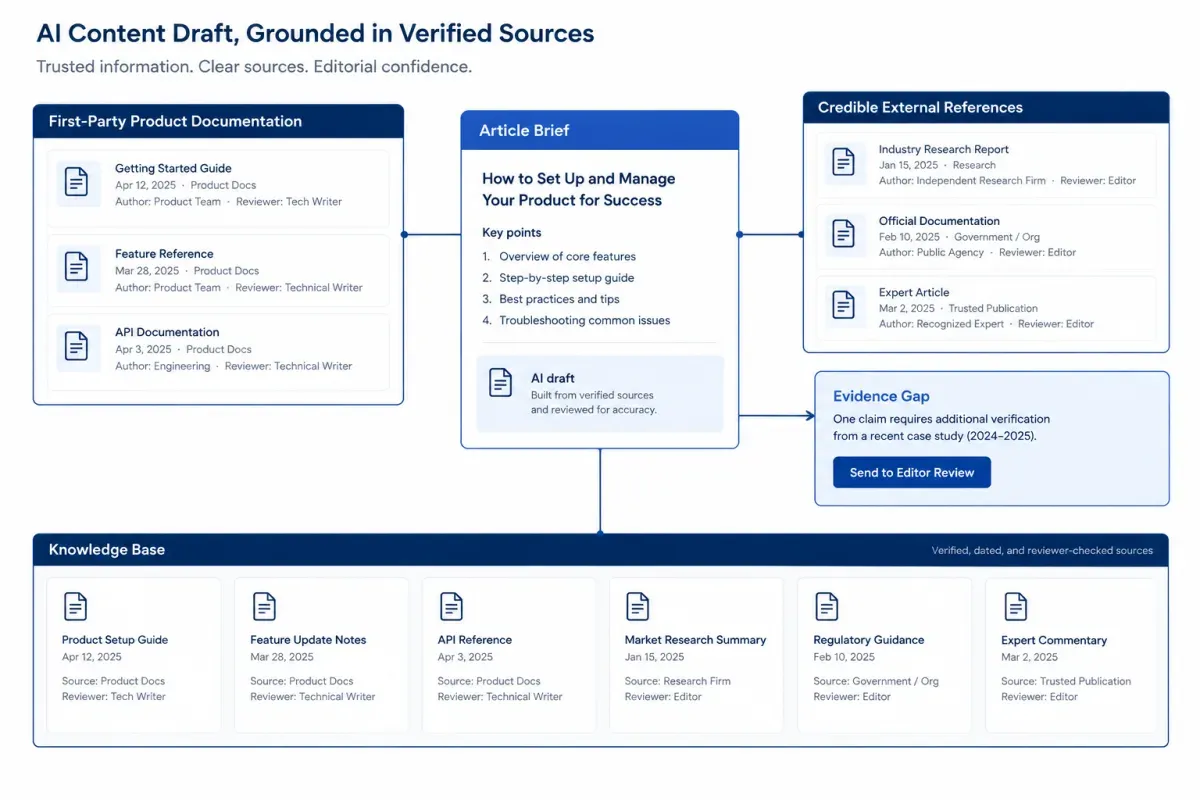
Ground every draft in an approved brief and a set of verified sources, so the writer works from supplied evidence rather than model memory. Give the model the audience, approved brand messaging, product specifications, required disclosures, and the source material behind the article. AI should make factual or product claims only from those sources. Where evidence is missing, the draft should flag the gap for an editor instead of letting AI hallucinations fill it.
Your Knowledge Base should work as brand memory for AI, not a folder of aging files. Keep product details, positioning, pricing, policies, research, and approved answers current. Give each entry a source of truth, an accountable subject-matter expert and a last-review date. Retire superseded material, because one pricing or policy change can turn a once-accurate claim into a wrong one.
A per-brief source pack makes grounding AI in source material work at the section level:
- First-party sources: Product documentation, approved policy pages, internal research, and finalized messaging.
- External references: Credible third-party material used for context or supporting evidence.
- Known gaps: Missing evidence, marked for an editor rather than guessed.
This supports source citations for AI claims without turning the draft itself into a ledger. That record belongs in Step 4.
A one-off chat does not reliably retain your documents from one assignment to the next. In Floyi, every brief and draft generation searches your Knowledge Base for relevant passages, so grounding doesn’t depend on someone pasting the right file.
Step 4: Fact-Check Every Material Claim
Fact-check every material claim one by one, not with a final read-through. A material claim could change a reader’s decision or invite a correction. Typical examples are statistics, dates, prices, product features, specifications, guarantees, quotations, customer stories, links, and attributed sources. Give niche facts and precise numbers extra scrutiny, because plausible wording hides AI hallucinations well.
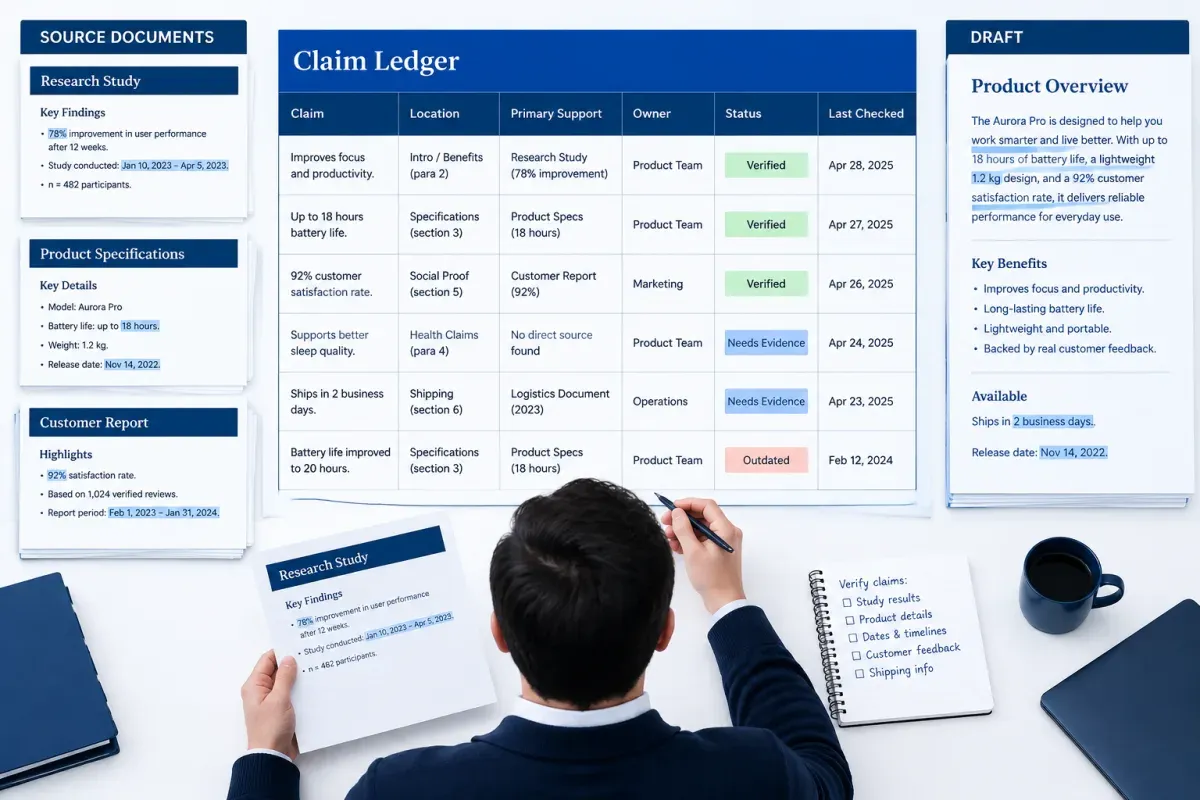
A claim ledger is the core of an AI content fact-checking workflow, because it makes each check traceable instead of dependent on reviewer memory. The rows below are examples:
| Example claim | Location | Primary support | Owner | Status | Last checked |
|---|---|---|---|---|---|
| “The plan includes feature X” | Feature section | Internal product specification, June 2026 | Product lead | Verified | October 2026 |
| “A customer lowered costs” | Customer story | No approved evidence | Account lead | Needs evidence | October 2026 |
| “The policy takes effect July 1” | Policy section | Official policy page, April 2026 | Policy owner | Outdated | October 2026 |
Record each claim’s exact wording and the publication or update date of its source. Use a fixed set of statuses: verified, needs evidence, conflicting evidence, outdated, and removed.
Evidence must support the claim’s exact wording, scope and timeframe. Product details, policies, pricing, and performance statements need first-party records. External dates, data and quotations need reputable, current sources, with independent confirmation when the claim could affect a decision. Verifying AI sources means testing the cited evidence against the sentence itself, including whether each AI-generated link opens the page it claims to cite.
Instruct the AI to separate verified facts from assumptions and to flag missing, conflicting or outdated information. It must not invent statistics, testimonials, quotations, features, or sources. Resolve conflicts against the newest primary evidence, then revise the claim, remove it or mark it unverified until proof exists.
Human review stays the decision point. In Floyi, the Fact Checker agent flags possible inaccuracies and suggests corrections after drafting, and the Content Editor’s Research tab shows the research behind the brief and draft. Treat both as inputs for the reviewer, who records the decision and check date in the ledger.
Step 5: Apply a Human Publishing Gate

No AI-assisted content is publish-ready until a named person approves it. Human review of AI drafts is the editorial quality gate between finished generation and published content. Automated checks can flag risks, but they cannot confirm that a claim is current, supported in context or safe to publish.
Split the AI content review process into two separate passes, one for brand and one for accuracy. Polished language can hide weak evidence, and well-sourced copy can still miss the brand. Brand reviewers check:
- Voice and positioning: Terminology, audience fit and point of view match your brand voice guide.
- Language quality: Robotic phrasing, generic transitions, prohibited language, and unsupported enthusiasm are gone.
- Clarity: Readers get the message without losing the intended meaning.
Accuracy reviewers work from the claim ledger and check numbers, dates, product details, quotations, guarantees, disclosures, and framing that misleads through omission. On-brand AI-generated content earns approval only when both passes clear.
Give the human-in-the-loop workflow visible statuses. In Floyi, Draft Done is a machine state that means generation finished. Awaiting Review, Needs Editing, Approved, and Published are editorial statuses that people set. Editors protect clarity and brand fit. Subject-matter experts validate specialist claims, and compliance review applies when claims or disclosures require it.
Financial, medical, legal, and regulated advertising content needs stricter scrutiny. Qualified experts should approve high-stakes advice and outcome claims. A caveat does not fix a flawed statement, so send unsupported material back for revision.
Use this AI content review checklist before anything moves to Published:
- Brief alignment: Audience, goal, key message, call to action, and required facts are in the draft.
- Claim status: Every material ledger entry is verified, qualified or removed.
- Brand controls: Voice, terminology and prohibited-language checks are complete.
- Required content: Disclosures and approved snippets are inserted.
- Publishing details: Links and accessibility elements are checked.
- Specialist approval: Subject-matter or compliance sign-off is recorded where the topic needs it.
- Final record: The approver’s name and approval date are logged.
That record is the starting point for corrections when a claim, policy or product detail changes later.
Step 6: Turn Corrections Into Better Controls
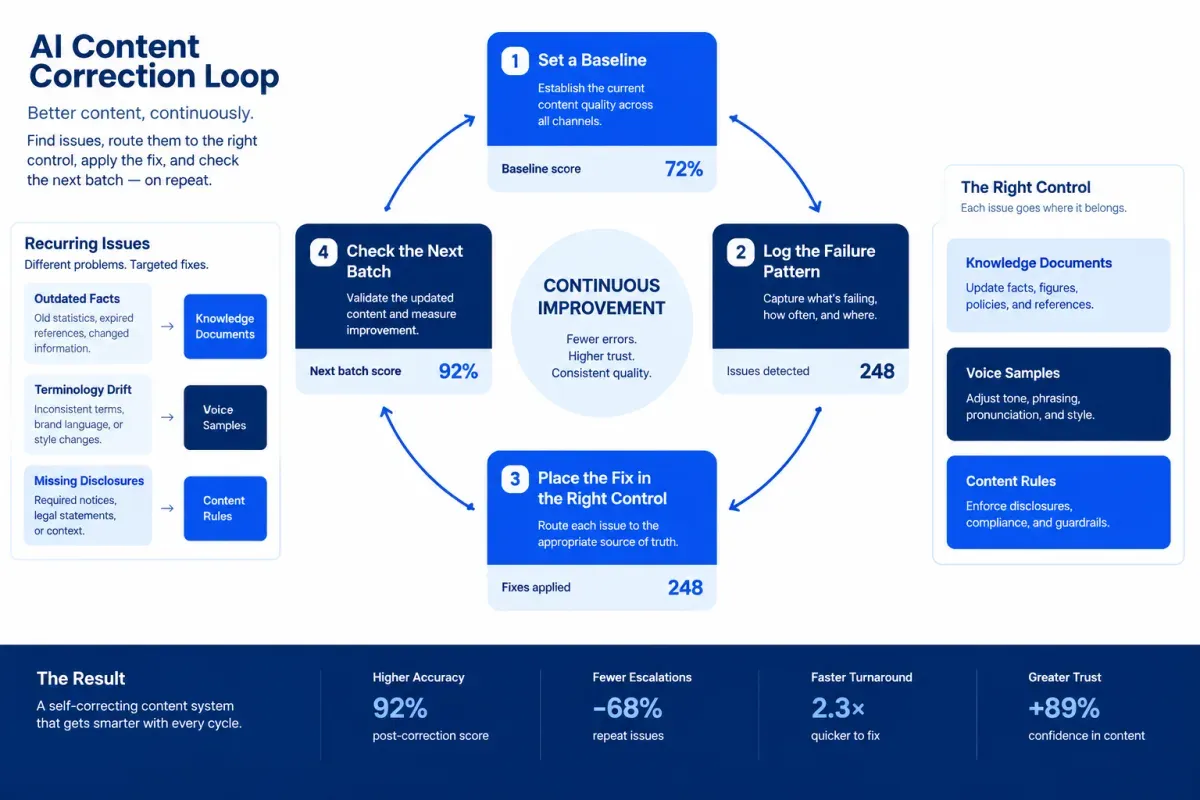
Treat each correction as evidence about which control failed, not as isolated cleanup. AI content brand consistency improves when an AI content feedback loop names the failure, traces the missing control and checks whether the next batch gets better.
Use the four-part Correction Loop:
- Set a baseline: Review a batch of AI drafts before changing guidance. Track brand-adherence rate, material factual-error rate, first-pass approval rate, reviewer time per draft, and correction recurrence. Define “material error” and “major rewrite” once so shifting expectations don’t skew the numbers.
- Log the failure pattern: Record the issue and the absent control, not only the edited sentence. Typical categories are wrong specifications, unsupported or outdated claims, missing disclosures, prohibited terminology, competitor-reference violations, and overenthusiastic tone.
- Place the fix where it belongs: Repeated terminology and banned-claim errors go into the Content Guide. Voice drift calls for better writing samples. Outdated facts need a Knowledge Base update with a review date. Recurring scope or structure problems belong in the brief.
- Check the next batch: Keep a new rule only if recurrence falls without adding review time. Retire rules that no longer earn their slot, since each generation sends a capped number of Content Guide entries.
A short before-and-after record shows the rule behind repeated edits:
- Before: “Our platform guarantees compliant reporting.”
- After: “Our platform supports reporting workflows with documented controls.”
- Missing control: A banned-claim rule covering guarantees and absolute compliance language.
Editors still decide whether a draft moves from Needs Editing to Approved. The loop makes sure they fix each recurring error once, upstream, instead of in every new draft.
Match Each Failure Type to a Control
Each failure type needs a generation control and a separate review check. Use this table to decide where each fix goes, so the same error doesn’t return in the next batch.
| Failure type | What it looks like | Preventive control (step) | Check that catches it | Where the fix goes |
|---|---|---|---|---|
| Generic or off-voice copy | Interchangeable brand language | Step 1 voice rules and samples | Brand review pass | Brand Voice samples |
| Wrong product names or terminology | Outdated or inconsistent terms | Step 2 approved claims and terminology | Terminology check | Content Guide terminology rule |
| Unsupported claim or invented statistic | Confident, uncited assertion | Step 3 source pack | Step 4 claim ledger | Source pack or Knowledge Base |
| Outdated product detail, price or policy | Superseded business fact | Step 3 current Knowledge Base | Step 4 source-date check | Knowledge Base document update |
| Banned claim or missing disclosure | Restricted wording or absent notice | Step 2 compliance rules | Compliance review | Content Guide compliance rule set |
| Competitor-reference violation | Prohibited or out-of-scope mention | Step 2 competitor policy | Brand review pass | Content Guide competitor policy |
| High-risk legal, medical or financial claim | Advice presented as fact | Step 5 expert or compliance approval | Named human approver | Needs Editing until cleared |
Read across a row before you add a new rule. If the preventive control already exists and the error still gets through, the review check is the weak point, not the guidance.
Set up your voice profile, Content Guide rules and Knowledge Base once in Brand Foundation so every brief and draft starts from the same controls.
AI Content Accuracy and Brand FAQs
These answers cover the questions teams ask most about AI content accuracy and brand rules, from what guidelines can prevent to how to keep published facts current.
1. Do Brand Guidelines Stop AI Hallucinations?
No. Brand guidelines govern style, not truth. Voice rules and terminology lists shape on-brand AI-generated content, but they do not prevent AI hallucinations. A draft can follow every approved term and still include an invented statistic or a wrong product specification.
Keep accuracy on a separate track. Ground the draft in current source material before writing, then check each material claim against that evidence afterward. Style approval cannot replace claim verification.
2. Can AI Fact-Check Its Own Drafts?
Not on its own. AI can flag unsupported, conflicting, outdated, or unverified claims, but it cannot confirm they are true or current. Treat its output as a list to verify, not a verdict. Fact-checking AI content still ends with a person checking each flagged data point, date, quote, and link against primary documents or reliable, current sources.
3. Why Does AI Repeat Outdated Product Details?
AI repeats outdated product details when it has no current source for them. It fills the gap from older public information or stale internal documents, usually without signaling uncertainty. Put the current specification in the source pack for any brief that mentions the product, and instruct drafts to flag any fact they cannot match to a current source. A flagged gap costs an editor one lookup, while a confident old detail can reach Published unnoticed.
4. How Do You Keep Published AI Content Accurate?
Recheck a published page whenever a source behind one of its claims changes. AI content accuracy depends on the claim ledger here: its sources and check dates show which pages rely on a changed price, feature, policy, or study. Revise or remove the affected claim, record the new check date and review higher-risk pages first. Repeated corrections feed the Step 6 loop.
About the author

Yoyao Hsueh
Yoyao Hsueh is the founder and CEO of Floyi, the topical authority platform, and the founder of Main Heading, an SEO and AI search agency. He is an expert in topical authority and topical mapping. He created Topical Maps Unlocked, a course studied by thousands of SEOs, content strategists and digital marketers, founded TopicalMap.com, a done-for-you topical mapping service for agencies and enterprise teams, and publishes the weekly Digital Surfer newsletter on SEO, content strategy and AI search.
About Floyi
Floyi is a closed loop system for strategic content. It connects brand foundations, audience insights, topical research, maps, briefs, and publishing so every new article builds real topical authority.
See the Floyi workflow