
Standardize AI Content Workflows Across Clients, Not Their Voice
Standardize AI content workflows across clients without blending brands, using a per-client setup kit, one brief template, approval stages, and a monthly audit.
Standardizing AI content workflows across clients doesn’t mean making every brand sound alike. Keep the production sequence, approval gates, editorial statuses, and quality checks the same on every account. Protect each client’s voice, claims, sources, and approvers. That boundary lets any strategist run one operating model without borrowing context from another account.
A shared brief template won’t stop voice bleed when client materials, competitor policies and source libraries sit in one pile. A per-client setup kit, an approval matrix and a monthly consistency audit turn the boundary into repeatable controls. In Floyi, each client is a separate brand workspace with its own Brand Foundation, Content Guide, Knowledge Base, topical map, and content pipeline.
Treat recurring edits as configuration signals, not one-off draft fixes. Revision rounds, approval delays and post-approval changes show whether the workflow holds across accounts.
AI Content Workflow Standardization Key Takeaways
- Standardize workflow stages, templates, checks, statuses, and reporting definitions across client accounts.
- Keep voice rules, claims, sources, approvers, and competitor policies specific to each client.
- Use separate client workspaces to prevent context, source and positioning bleed.
- Build each setup kit with voice samples, evidence, compliance rules, and review ownership.
- Separate coverage checks from quality review before content receives approval.
- Assign one accountable decision-maker to every approval gate.
- Audit recurring edits monthly and update the client configuration causing them.
Separate Shared Standards From Client-Specific Parameters
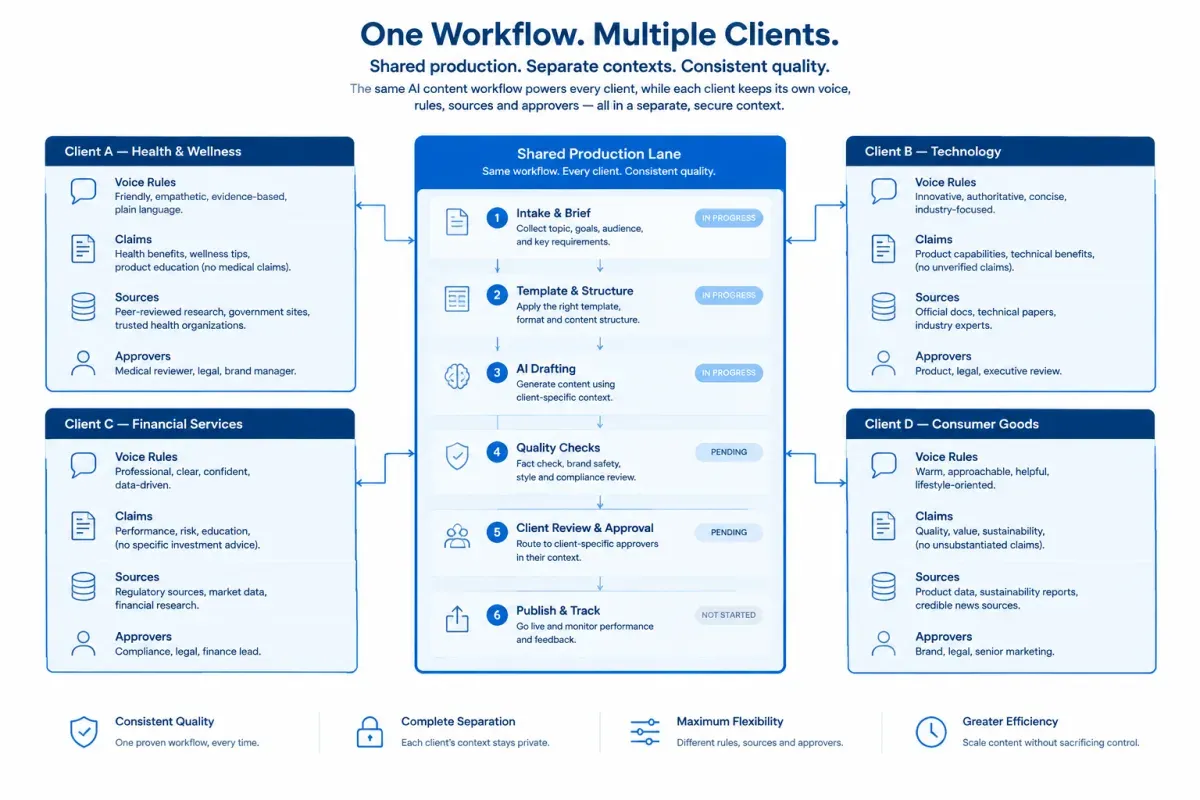
Standardize the production system, not the client’s voice. In agency content workflows, workflow stages, the brief template, quality checks, approval gates, editorial statuses, file naming, and reporting definitions stay the same on every account. Audience, positioning, approved claims, compliance rules, source materials, and approvers stay client-specific. Call it the shared-workflow, separate-context model.
| Standardize across every client | Keep client-specific |
|---|---|
| Workflow stages | Voice rules and writing samples |
| Brief template | Personas and topical scope |
| Quality checklist | Approved claims and required disclosures |
| Approval gates | Named approvers |
| File naming and statuses | Source documents and categories |
| Reporting definitions | Client goals and success signals |
The model runs on three layers, so standardizing content across clients never turns into copy and paste:
-
Agency-wide content standards: Shared templates, naming conventions, quality thresholds, editorial statuses, and reporting definitions. These make delivery consistent across accounts.
-
Protected client configuration: Each account’s positioning, audience, approved claims, compliance rules, competitor policies, permissions, source materials, and approvers. These client-specific brand parameters guide AI content workflows without crossing into another client’s work.
-
Deliverable record: Each assignment’s brief, selected sources, draft, review findings, revisions, approval, and live URL. This record explains why a piece changed without turning a one-off edit into an account rule.
A draft correction stays with its deliverable unless it reveals a pattern. When a client changes a terminology rule, a disclosure or an audience priority, update the protected configuration once. Future work inherits the change, and nobody patches the same problem draft by draft.
Voice bleed is a context-isolation failure. It isn’t a reason to drop shared standards. Your brief template can move between accounts, but client positioning, examples, competitor lists, and source libraries can’t. Keep each client’s materials inside that client’s workspace.
Our guide to how AI reshapes editorial planning shows where this control sits in the wider planning process. In Floyi, briefs and drafts inherit only their own brand workspace’s context, so one client’s rules and documents never feed another client’s generation.
Build a Per-Client Setup Kit
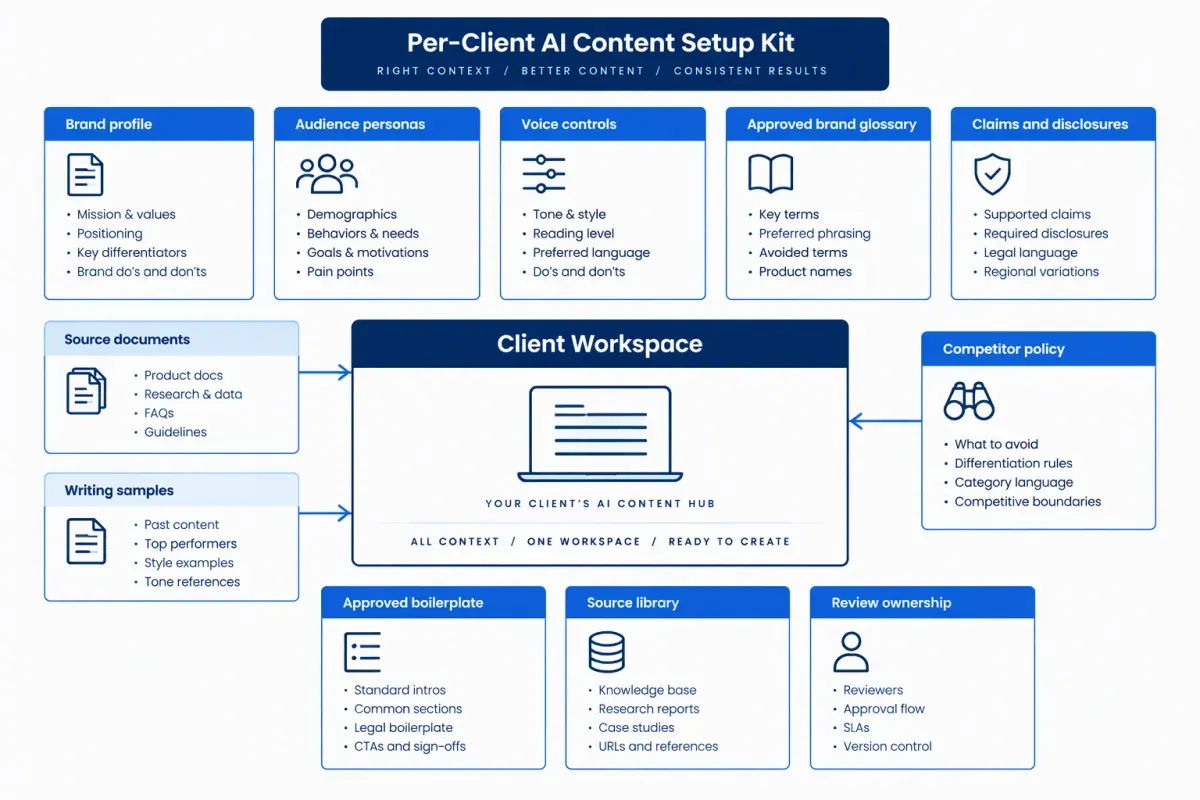
A per-client setup kit gives every account a testable source of truth before the first brief enters production. Build it once per client and update it whenever the client’s offer, rules or approvers change.
Each kit holds these assets:
-
Brand profile: Mission, positioning, unique selling proposition, products, offers, and competitor context.
-
Audience personas: Buyer roles, pain points, decision triggers, and the words the audience uses.
-
Voice controls: Three to five writing samples, vocabulary level, sentence and heading habits, and messaging priorities.
-
Approved brand glossary: Preferred and prohibited terms, required product names and term replacements.
-
Claims and disclosures: Approved claims, required disclosures and the source behind each factual statement.
-
Competitor policy: Which competitors can be mentioned and how comparisons are framed.
-
Approved boilerplate: Bios, calls to action, disclaimers, and other reusable copy blocks.
-
Source library: Product documentation, pricing pages, case studies, legal guidance, and cited research, sorted by category.
-
Review ownership: A named approver for brand, legal, product, and final editorial review.
Client-specific brand guidelines for AI content need testable rules, not adjectives. “Confident” gives a writer or a model nothing to check. Testable brand voice guidelines for AI name preferred and banned words, sentence patterns, structural habits, and message priorities. A contrast makes the rule enforceable. “We help operations teams cut manual reporting” fits a direct, practical client. “Our next-generation platform reinvents reporting” doesn’t. The rule isn’t “be confident.” It’s “name a specific operational outcome and skip inflated claims.”
Evidence should match the claim type. Product documentation supports capabilities. Pricing pages support commercial details. Case studies support customer outcomes. Legal guidance supports regulated wording, and cited research supports industry claims. An unsupported statistic, quote or capability gets a visible “source needed” note instead of plausible filler.
In Floyi, Brand Foundation stores the brand profile from URL analysis or manual input. Brand Voice analysis builds a voice profile from three to five writing samples. The Content Guide holds the glossary, compliance rules, competitor policies, brand messaging, and approved snippets. Each generation receives a capped set of rules, so keep each list to the rules that matter most:
-
Up to 10 terminology rules
-
Up to 3 compliance rule sets
-
Up to 10 competitor policies
-
Up to 15 brand messaging rules
Approved snippets work differently. They aren’t sent to the AI. You insert them by hand in the Content Editor, which keeps controlled boilerplate word for word.
The Knowledge Base works as a client knowledge base for AI content, kept inside that client’s workspace. Name categories such as Product Docs or Case Studies, then set Knowledge Base Scope per brief: All Documents, By Category, By Document, or None. A pricing article then draws on pricing material, not an unrelated case study library. Floyi searches the selected documents for relevant passages during brief and draft generation. That’s AI content grounding from the client’s own sources, not from whatever the model remembers.
Use One Brief Template and Quality Checklist
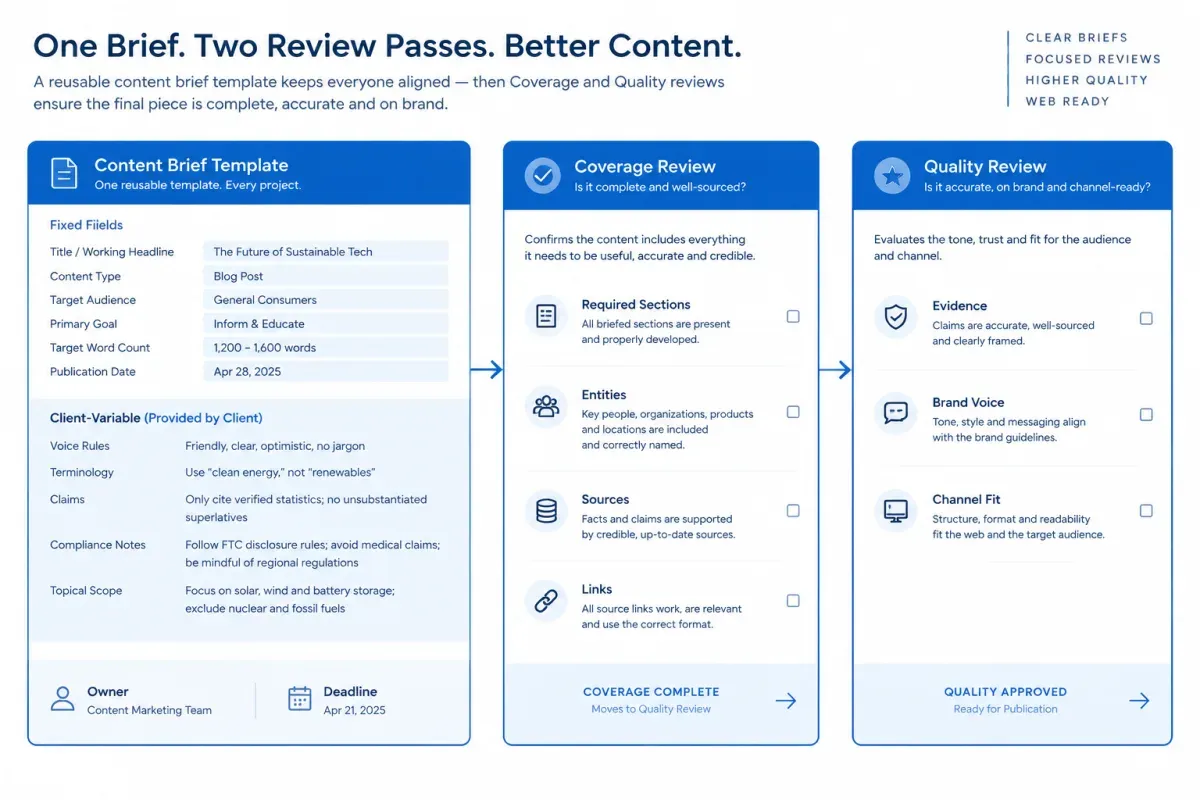
One brief template and one quality checklist let any strategist pick up any account. The fields stay fixed across clients. What goes into them changes. The field-by-field intake is covered in our guide to automating briefs and outlines with AI. For a multi-client team, the client brief template adds two blocks.
The first is a client-variable block that pulls from the setup kit: voice rules, terminology, approved claims, compliance notes, and topical scope. The second is an owner block with the deadline and the person who approves publication. Production doesn’t start until the required fields are complete. When proof is missing, the field reads Client input required, not a plausible guess.
Keep the instructions in two layers as well. The agency layer is version-controlled and covers task sequence, output format, required checks, and what to do when information is missing. The client layer comes from the approved setup kit. You can then standardize AI content workflows across clients without rewriting instructions for every account.
An AI-generated content QA checklist works best as two separate passes. Coverage confirms the draft contains what the brief asked for. Quality decides whether it’s good enough to publish.
| Check | Pass condition | Owner |
|---|---|---|
| Coverage pass | Required sections, entities, approved sources, internal links, and search intent are present. | Strategist |
| Quality pass | Claims have approved support, voice and terminology match the client, compliance wording is correct, and the format fits the channel. | Editor |
A draft can hit every entity and link and still fail. Thin evidence, an off-voice paragraph or the wrong format for the channel can each sink it. Coverage tells you what’s there. The quality pass tells you whether it ships.
After a draft exists, Floyi’s Fact Checker and Evidence Integrator agents add advisory findings. A human editor still decides whether the evidence holds and whether the piece sounds like the client. Store the brief version, checklist result and approval record with the deliverable, so revisions stay traceable when an account changes hands.
Assign Owners and Approval Stages
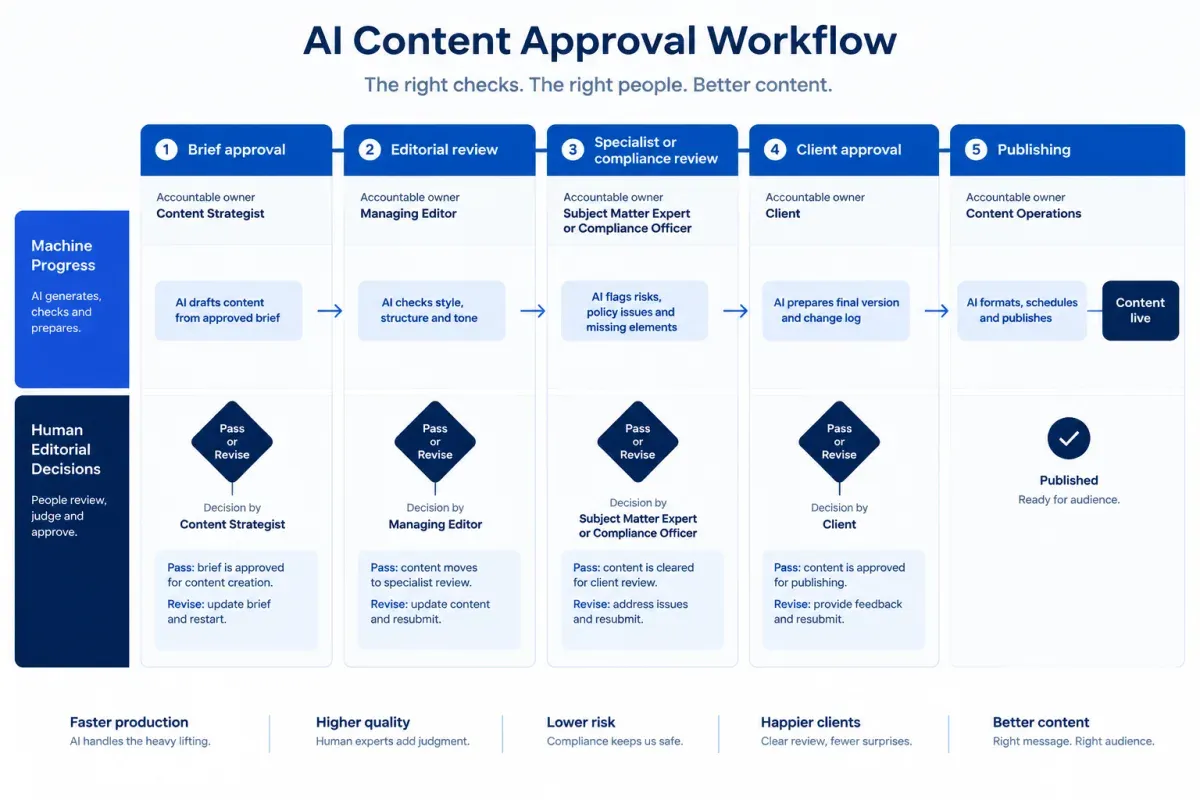
Every AI draft is review-ready, never publish-ready, so human-in-the-loop review sits at every gate. Your AI content approval workflow should move each client deliverable through brief approval, editorial review, specialist or compliance review when required, client approval, and publishing. A shorter path can suit low-risk work, but write it into the client’s setup kit before production starts.
Risk-based content review starts with the cost of an error, not the asset format. A routine blog refresh may need only an editor’s check for factual grounding and brand voice. Medical, financial, legal, and reputation-sensitive claims need specialist review and client sign-off. The same blog post can be low risk for one client and high risk for another. Each client’s tier rules set the review depth, so you get a multi-tier content review workflow without a separate process per client.
An approval matrix gives each gate one decision-maker:
| Gate | Accountable owner | Pass criteria | What happens on a fail |
|---|---|---|---|
| Brief approval | Account strategist | Scope, intent, audience, and claim boundaries are clear | The brief returns for revision before drafting |
| Editorial review | Editorial lead | Facts, brand voice, structure, and required checks meet the standard | The status moves to Needs Editing |
| Specialist or compliance review | Named subject specialist | High-consequence claims have adequate evidence and appropriate wording | Claims are revised or removed |
| Client approval | Client decision-maker | Content reflects approved positioning and business priorities | Feedback stays attached to the active version |
| Publish | Publishing approver | The approved version is the version scheduled to go live | Publication pauses until approval is restored |
One accountable owner per gate stops comment threads from turning into competing instructions. Contributors add context, but only the named owner passes or fails the gate. Our playbook on handoffs between SEO, writers and AI covers how each contributor feeds a gate.
Floyi keeps machine progress separate from human sign-off. Ready, In Progress, Incomplete, and Draft Done describe generation. Awaiting Review, Needs Editing, Approved, and Published record editorial decisions. Keeping those content lifecycle stages apart shows exactly where a human decision is pending. Draft Done means the system finished a first draft. It doesn’t mean the draft passed your AI content quality checklist.
Floyi Teams uses Owner, Admin and Member roles with a shared credit pool. Every active member can see all of the team’s brands, so your approval matrix, not workspace access, decides who passes each gate.
Version control keeps human oversight for AI content intact through publication. Label each revision, keep feedback attached to the version it addresses and publish only the approved version. A material change after approval, such as a new claim, source or required wording, goes back through the relevant gate.
Onboard Each Client Into the Workflow
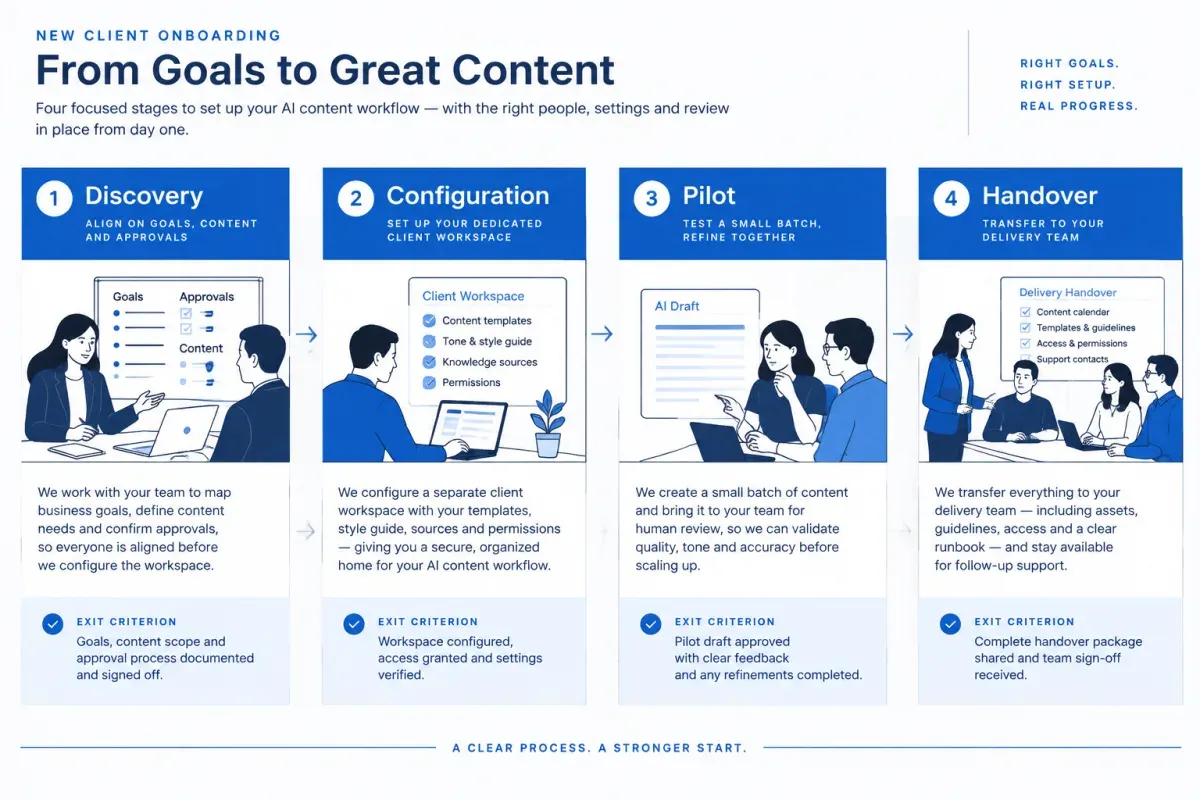
Onboard each client in four gated phases: discovery, configuration, pilot, and handover. Each phase ends on an exit criterion, not a date, so a client moves forward only when the work is ready.
-
Discovery: Turn the client’s business goals into content priorities. Record the audience, conversion action, topical scope, markets, publishing cadence, and the signals the client uses to judge progress. Map how briefs, drafts and approvals move today, including where versions get confused or reviews stall. Exit when the goals, scope and approval path are written down and the client has confirmed them.
-
Configuration: Create the client’s brand workspace in Floyi from your agency blueprint, with the same naming and status conventions as every other account. Load the brand profile, personas, Content Guide rules, and categorized Knowledge Base documents before any drafting. Resolve conflicting documents now, because no SOP can reconcile two sources that disagree. Exit when every setup-kit item has an owner and a verified source.
-
Pilot: Run a small batch through the full workflow. In this hybrid AI and human content production setup, an editor compares each draft with the voice rules, required terminology, compliance requirements, and checklist. If you’re moving existing accounts into multi-client AI content production, pilot with two clients whose voices or requirements differ sharply. Exit when the client approver accepts the work and recurring edits are written into the Content Guide or brief template.
-
Handover: Record account-specific exceptions in the SOP, brief the delivery team and add the account to the monthly audit. Exit when the account runs on the standard workflow with its own approvers.
This client intake process for content production doesn’t need integrations at the start. Shared documents and a stable brief template are enough to validate the manual process. Add automation only after the handoffs work.
Audit Cross-Account Consistency Each Month
Run the same cross-account audit every month and fix each issue in the workspace where it started. The audit turns standardization into a repeating AI content governance control, not a one-time setup.
| Check | What to look for | Where to fix it |
|---|---|---|
| Context isolation | References, examples, claims, or language carried over from another account | The client’s Brand Foundation, Content Guide or Knowledge Base |
| Source notes | Claims without an approved source or sufficient evidence | Knowledge Base documents and research notes |
| Checklist results | Controls that fail repeatedly in briefs, drafts or reviews | The shared checklist and the client’s configuration |
| Status trail | Content published without Approved status, or approved copy changed after review | Editorial records and version control |
| Recurring client edits | Repeated terminology, tone, factual, or structural corrections | Content Guide rules, Brand Foundation inputs or Knowledge Base updates |
| Stalled handoffs | Work delayed between brief approval, drafting, editing, client review, and publishing | The account’s workflow sequence and review owners |
Keep failure labels consistent across the portfolio. Factual errors, unsupported claims, voice mismatches, wrong terminology, and structural rewrites each get their own label, not one generic “revision” bucket. Editor notes and client comments explain the rework.
Floyi doesn’t detect or score voice drift. Human review notes stay the record for voice issues, especially when a draft follows the Content Guide but still misses the client’s cadence, formality or point of view.
Apply recurring edits at the source:
-
Terminology: A product term the client keeps replacing becomes a Content Guide terminology rule.
-
Tone: A repeated request to adjust phrasing or formality becomes a brand messaging rule.
-
Facts: A correction to company information goes into the Knowledge Base, so later drafts inherit it.
Track a short set of AI content quality metrics for each account. They show whether scaling AI content operations is putting pressure on quality:
-
Time from an approved brief to a review-ready draft
-
Revision rounds and the cause of each one
-
First-pass approval rate and what blocked approval
-
Publishing errors, including status exceptions and post-approval changes
-
Delays between internal editing, client approval and publication
Compare each measure with that account’s own baseline from before the new workflow. That keeps the continuous feedback loop for AI content focused on friction you can see, not on how many posts went out.
Then use the audit to change the next plan. In Floyi’s Planner, compare published and in-progress work with the client’s Pillar, Hub, Branch, and Resource map and its authority scores. Content Audit labels existing pages Keep, Optimize, Consolidate, or Prune, which tells you what needs attention before new work enters the core content pipeline.
Review the shared agency standard on a slower cadence than the monthly audit. Apply account-specific fixes as soon as a recurring cause shows up.
Copy This Agency AI Content SOP
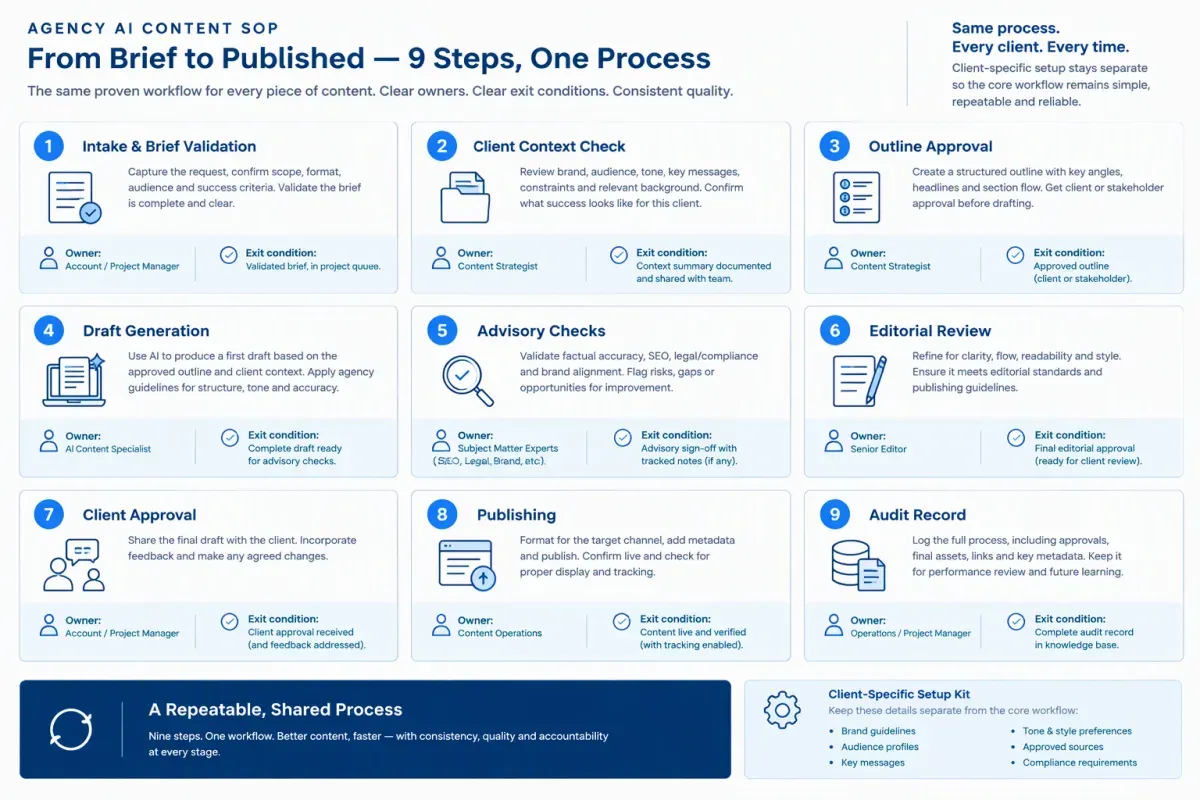
Copy this SOP into your documentation and change only the client-specific fields. The nine steps, their owners and their exit conditions stay the same on every account. That gives the agency one content production standard operating procedure for the AI content workflow from brief to publication.
-
Intake and brief validation. Owner: strategist. Input: content request and client brief. Done when: the client, content type, audience, objective, channel, angle, desired action, approved sources, and named approver are filled in. Missing details are flagged, never assumed.
-
Client context check. Owner: strategist. Input: validated brief and setup kit. Done when: the Brand Foundation and Content Guide are current, the persona is selected and the Knowledge Base scope is set for this piece.
-
Outline approval. Owner: editor. Input: brief, topical scope and source set. Done when: the angle, sections, sources, and search intent match the brief. This catches a bad direction before drafting turns it into polished copy.
-
Draft generation. Owner: editor, overseeing Floyi’s Writer and Editor agents. Input: approved outline, Brand Foundation and scoped Knowledge Base. Done when: a draft exists that follows the brief and the client’s inherited rules.
-
Advisory checks. Owner: editor. Input: first draft and agent findings. Done when: each Fact Checker, Web Research and Evidence Integrator finding is applied or rejected with a recorded reason.
-
Editorial review. Owner: editor. Input: revised draft and the two-pass checklist. Done when: coverage and quality both pass, and the status moves to Approved or Needs Editing.
-
Client approval. Owner: named client approver. Input: internally approved draft. Done when: the client signs off at the gate their tier rules require.
-
Publishing and URL capture. Owner: publisher. Input: client-approved version. Done when: only that version goes live, through WordPress, GitHub or the client’s own process, and the live URL is recorded.
-
Audit record. Owner: strategist. Input: live URL, client edits and performance notes. Done when: recurring edits and results are logged for the monthly audit.
One escalation rule applies throughout. A required claim with no approved source, a conflict with the brief or regulated wording pauses the step until the named owner decides. Neither AI nor a writer fills that gap with inference.
The setup kit, tier rules, Knowledge Base scope, and approvers change per client. Everything else in this AI content workflow for agencies stays fixed. See how Floyi for agencies runs this playbook with a separate brand workspace for every client.
AI Content Workflow Standardization FAQs
These answers cover the questions agency teams ask most when they standardize AI content workflows across clients.
1. How Do You Keep One Client’s Context Out of Another Client’s Drafts?
Give each client a separate brand workspace with its own voice rules, competitor policies and approved sources. In Floyi, Knowledge Base Scope limits a brief to that account’s selected documents, and shared templates carry no client-specific AI context. When the monthly audit finds a borrowed example, claim or competitor reference, fix the workspace configuration that let it through.
2. How Do You Handle Different Client Brand Voices?
Give each client its own voice configuration, not a broad tone label. In Floyi, the Brand Voice profile captures patterns such as sentence structure and vocabulary level from writing samples. The Content Guide holds approved and banned terms and messaging priorities. Briefs and drafts in that workspace apply only that client’s rules. Editors still make the final voice call, because no Floyi feature scores voice drift.
3. Can Small Agencies Standardize AI Content Workflows?
Yes. A small team needs the same four pieces as a large one: a setup kit per client, one brief template, one checklist, and a named approver for each gate. One person can hold several roles. Keep each gate a separate decision with its own record, even when one person makes several of those calls. The audit trail then still shows what was checked and when.
4. When Should Clients Review AI Content?
Clients should review AI content at the client approval gate, after internal editorial review and before publishing. That’s where they confirm voice, positioning and factual fit. Some clients also want to approve the brief, which catches a wrong angle before drafting. Record that choice in the setup kit. Regulated, legal and reputation-sensitive work always needs client approval before release. Give each client one accountable reviewer, so feedback arrives as a decision rather than conflicting comments.
About the author

Yoyao Hsueh
Yoyao Hsueh is the founder and CEO of Floyi, the topical authority platform, and the founder of Main Heading, an SEO and AI search agency. He is an expert in topical authority and topical mapping. He created Topical Maps Unlocked, a course studied by thousands of SEOs, content strategists and digital marketers, founded TopicalMap.com, a done-for-you topical mapping service for agencies and enterprise teams, and publishes the weekly Digital Surfer newsletter on SEO, content strategy and AI search.
About Floyi
Floyi is a closed loop system for strategic content. It connects brand foundations, audience insights, topical research, maps, briefs, and publishing so every new article builds real topical authority.
See the Floyi workflow