How to Fix Tone Drift in AI Drafts Without Changing Facts
Learn how to spot tone drift in AI drafts, trace its cause and fix each drifted section without changing facts, with a labeled before-and-after example.
A fluent AI draft can keep every fact intact and still stop sounding like your brand. Fixing tone drift in AI drafts means finding the first off-voice passage, revising its delivery and keeping the claim strength, qualifiers and intended action exactly as they were.
Stock openers, corporate diction and repeated transitions can make adjacent sections sound as though different writers produced them. A section-by-section tone audit against one approved voice anchor shows where formality, directness, vocabulary, or rhythm changed. Factual claims go to a separate fact review.
Minimal rewrites protect work that already matches the brief. Compare each revised passage with the original, and undo any edit that adds a promise, removes a condition or shifts the point of view.
Tone Drift in AI Drafts Key Takeaways
- Tone drift changes how a draft sounds without necessarily changing its facts or claims.
- Mark the first off-voice sentence before revising anything.
- Diagnose whether diluted context, generic defaults, source contamination, or vague instructions caused the shift.
- Audit each section against one approved voice anchor, not the paragraph before it.
- Use minimal rewrites that preserve qualifiers, limitations, terminology, and claim strength.
- Keep fact review separate from tone editing, and recheck claims after every revision.
- Compare before and after side by side, and undo edits that add promises or change perspective.
Step 1: Recognize What Tone Drift Looks Like
Tone drift is when a fluent, often accurate AI draft slides away from its intended voice partway through. A practical passage turns stiff, generic, corporate, overly enthusiastic, apologetic, or sentimental while the facts stay the same. Treat it as a delivery problem. Review facts, claims, limitations, and intended actions separately so a tone repair never changes what the draft says.
Drift is one failure inside the wider work of keeping AI content on brand. This guide stays narrower: spotting and repairing drift inside one draft.
The fastest diagnosis happens at sentence level. Formality and personality drift show up as academic abstractions, corporate nouns, hedged qualifications, inflated transitions, or internet-average phrasing. Hollow contrasts, adjective-heavy promises and three-part capability claims are signals too, because they sound polished while saying little. If a paragraph could run unchanged on any company’s site, it has lost the voice.
Common signs include:
- Formality drift: Plain language becomes academic, legalistic or vague business language.
- Personality drift: Direct guidance becomes generic reassurance or polished filler.
- Emotional drift: A restrained topic gets celebration, an unprompted apology, manufactured urgency, or false intimacy.
- Audience drift: Vocabulary becomes too basic for practitioners or too dense for the reader’s task.
- Consistency drift: Adjacent sections shift in point of view, sentence density, transitions, or the space given to minor caveats.
Emotional and audience drift are context failures, not grammar failures. Reader context and tone have to match. Clean prose can still strike the wrong emotional register when it ignores the reader’s stakes. A passage about correcting a client-facing claim shouldn’t sound triumphant. A workflow for experienced SEO teams shouldn’t explain familiar terms as if the reader were new.
Some variation is fine. An introduction may need orientation, while a repair example needs tighter language. The problem starts when changes have no clear purpose and the draft reads as though several strangers wrote it. Repeated transitions and filler caveats are easy to miss because each one sounds acceptable alone.
Before editing, mark the exact sentence where the voice changes. Name the drift type and note why it conflicts with the intended reader. Put inaccurate, unsupported or under-qualified statements on a separate list, because those go to fact review, not tone editing.
Step 2: Trace Why the Tone Changed
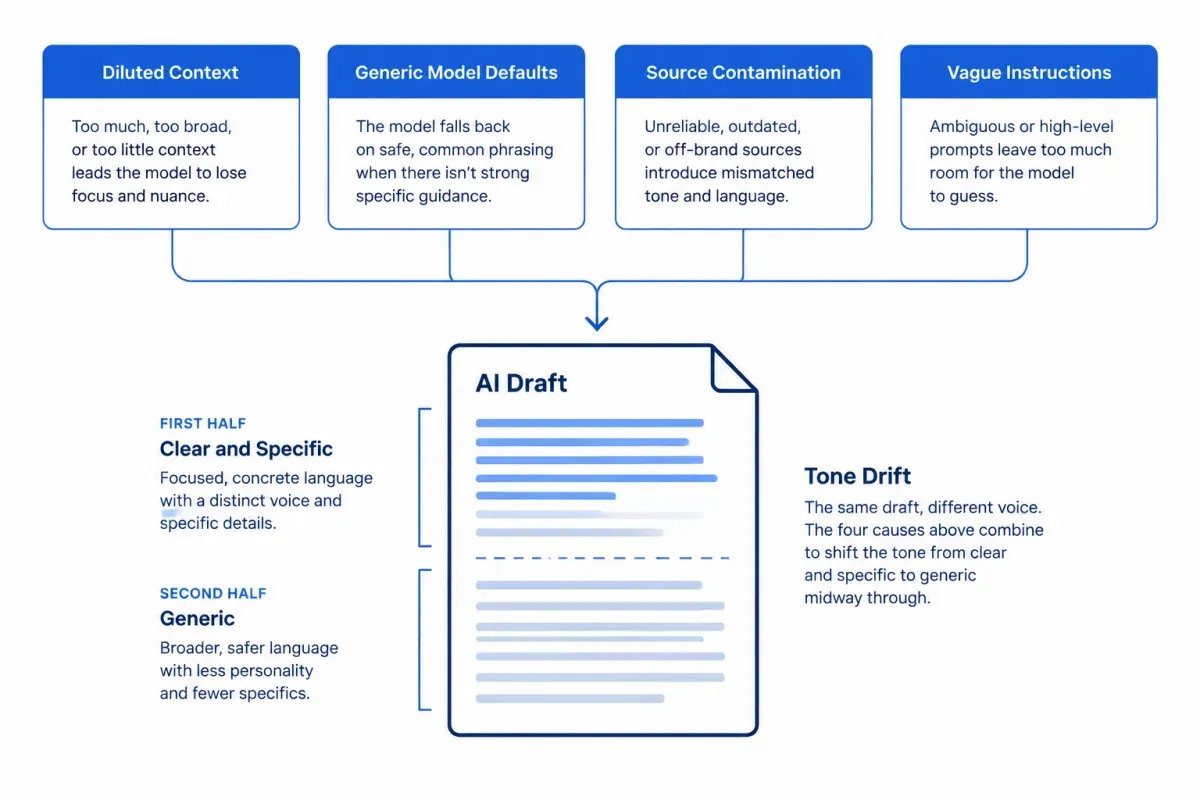
Tone usually changes for one of four reasons: diluted context, generic model defaults, source material, or vague instructions. Treat the cause as a working diagnosis, not a documented rule of model behavior. Drift tends to reflect the context around a passage rather than one bad sentence, and the cause tells you which fix to use.
- Diluted context: Task details, source excerpts and follow-up requests can crowd out early voice guidance, especially in long drafts. The signal is positional: the draft starts on-brand, then flattens midway through. Restate the relevant voice guidance next to the passage you’re revising, or generate long pieces section by section with a short voice reminder in each prompt.
- Generic model defaults: Without a concrete voice sample, copy can be accurate and grammatically clean while sounding publishable by any brand. A few representative passages give the model targets for cadence, vocabulary and paragraph rhythm. This is few-shot prompting for consistent voice.
- Source contamination: Client documents may sound sales-heavy, research notes academic and quotations deliberately casual. When a passage copies a source’s sentence shape or pacing, the source is pulling the register. Summarize source material in the target tone before drafting, or keep source text apart from the prose you want generated.
- Vague instructions: The full draft misses in the same direction. “Write professionally” names a preference but sets no boundary. Replace broad adjectives with observable tone constraints for AI.
| Weak instruction | Observable rule | Why it matters |
|---|---|---|
| “Sound natural and professional.” | “Use second person and short declarative paragraphs. Avoid promotional claims.” | The rule defines point of view, rhythm and prohibited language. |
AI writing style rules and prompt constraints for brand voice work best when they point to choices a reviewer can see on the page. In Floyi, the Brand Foundation voice profile, built from three to five writing samples, is applied to every brief and draft. The Content Guide sends terminology and brand messaging rules to the AI with each generation. That keeps the voice guidance attached to every generation instead of retyped into each prompt.
Use the likely cause to decide where the section audit should look first.
Step 3: Audit Each Section Against One Voice Anchor
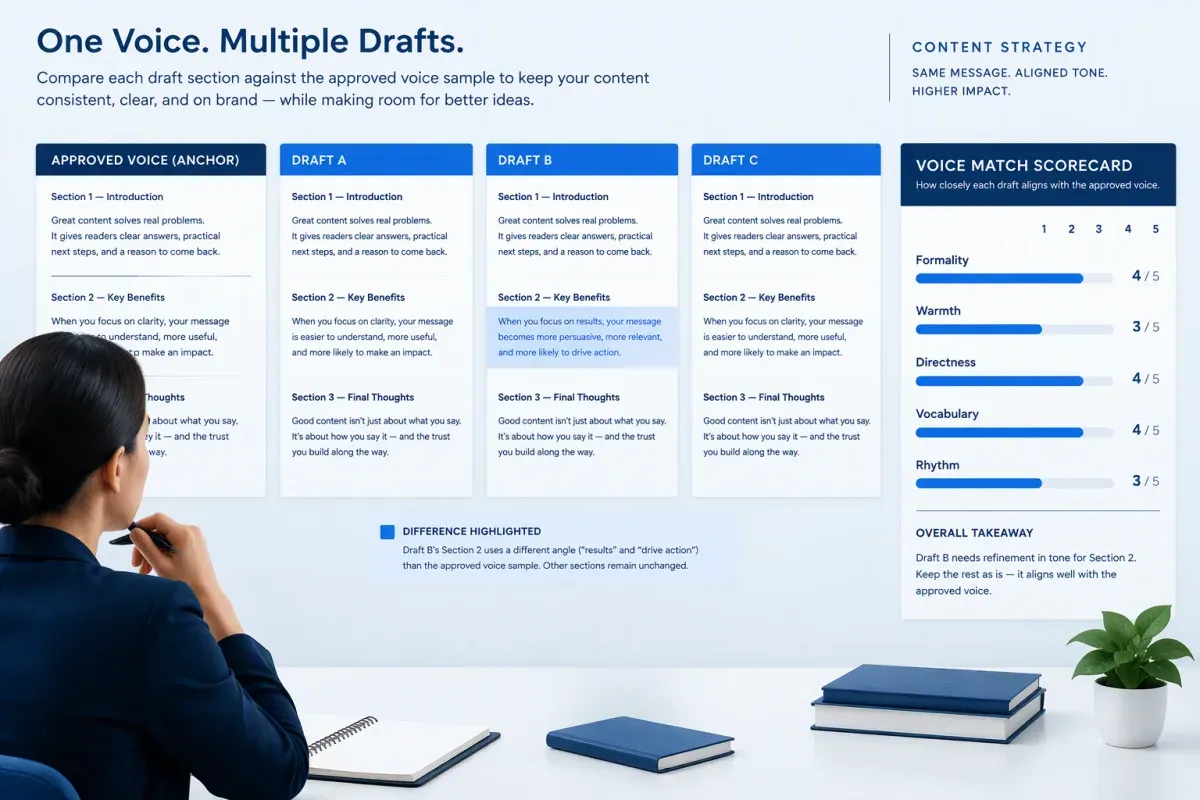
Audit every section against one fixed voice anchor, not the paragraph before it. The anchor can be an approved opening passage, a short voice sample or an example from your brand voice guidelines. Neighbor-to-neighbor checks miss gradual drift, because each paragraph can resemble the last while the full draft loses voice consistency.
Use the same order for every section: read the anchor, read the full section without editing, then compare formality, warmth, directness, vocabulary, and sentence rhythm. Your AI editing checklist should catch clusters of patterns rather than treat one awkward sentence as proof of a voice problem.
Common patterns include:
- Vague openings: The section delays its main point or starts with empty framing.
- Inflated language: Adjectives make a promise without naming the mechanism behind it.
- Repeated transitions: Similar connectors create a templated cadence.
- Uniform pacing: Sentences repeat the same length or structure.
Not every tonal change is drift. Technical instructions, cautions and audience-specific examples may need a more restrained register. Flag a change only when it has no reason tied to the reader, format or purpose.
Diagnosis comes before rewriting. The tone audit should quote the wording at issue, name the anchor signal it breaks and state the likely effect on the reader. That holds whether a human editor or a second model does the review. It keeps AI-generated content editing focused on necessary changes instead of broad polishing that alters a claim.
For example, “This solution delivers exceptional outcomes” breaks an anchor built on plain, mechanism-led language. The issue isn’t one adjective. The sentence swaps a specific explanation for generic praise and asks the reader to accept an unsupported promise. A minimal fix names the actual action, or sends the claim to fact review if nothing supports it.
An example scorecard makes sections and draft versions easier to compare. Rate formality, warmth, directness, voice consistency, and vocabulary fit on the same 1-to-5 scale:
| Example score | Meaning |
|---|---|
| 5 | The section consistently matches the anchor. |
| 3 | The section is uneven but repairable with targeted edits. |
| 1 | The section is clearly off-voice. |
The scorecard is an editorial aid, not an objective verdict on writing quality. Low scores that repeat across drafts show where your style guide for AI writing needs sharper examples.
Keep findings in an audit log you can copy into your own review doc:
| Section | Quoted passage | Drift type | Anchor signal it breaks | Proposed minimal fix | Facts unchanged? |
|---|---|---|---|---|---|
| Opening | “We offer a wide range of solutions for every need.” | Generic phrasing | Specific, direct openings | Name the actual offer | Yes |
| Process | “The process is important for success.” | Formality drift | Conversational instruction | State the action directly | Yes |
Floyi’s Page Quality Scorecard, in the Content Editor’s Quality tab, scores six dimensions such as relevance and trust. It doesn’t score brand voice, so the anchor comparison stays a human editorial check.
Step 4: Rewrite Drifted Passages Without Changing Facts
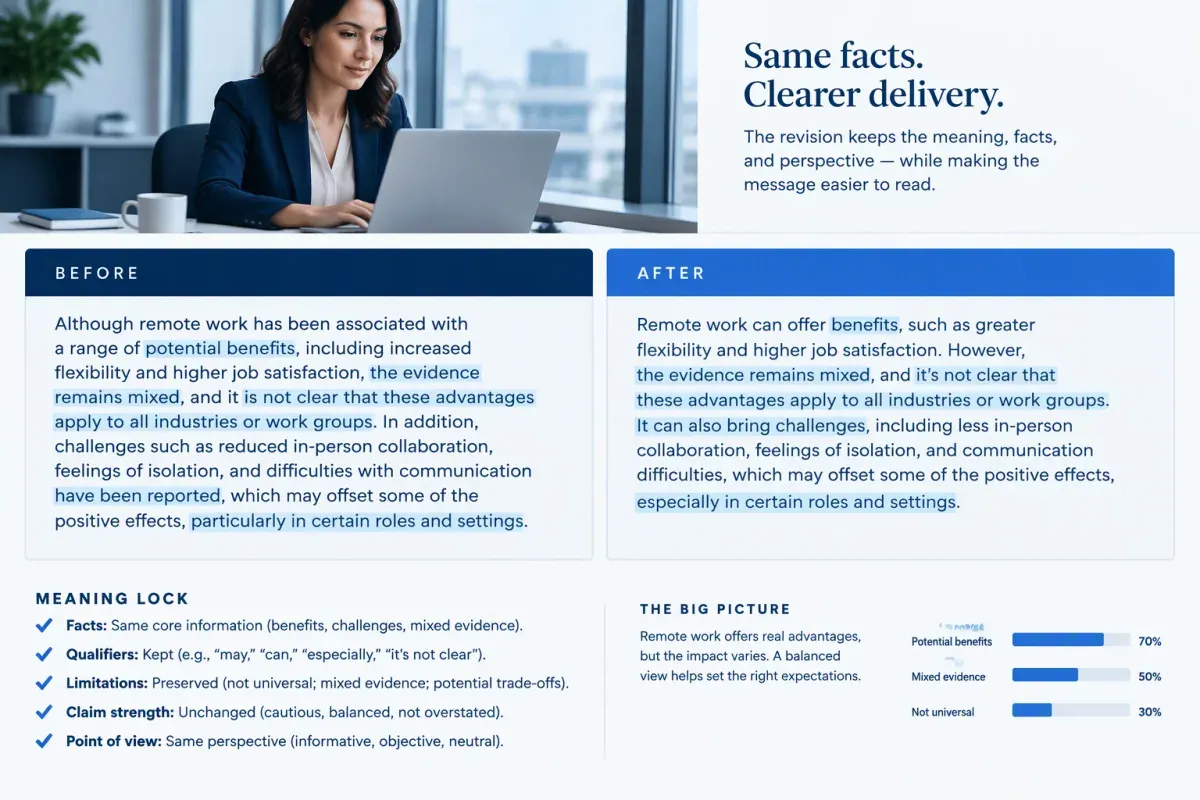
Repair the smallest passage where drift begins, and leave on-voice material alone. A meaning lock keeps the revision honest: facts, evidence, dates, terms, limitations, risks, disclosures, commitments, intended reader actions, claim strength, and point of view stay unchanged. Tone edits change delivery, not meaning.
That rule matters most when you’re tempted to regenerate. Regenerating the full draft can break a structure that already works, introduce factual errors, drop a necessary qualifier, or spread generic language into passages that were already right. In AI draft editing, keep the existing draft as the baseline and rewrite only where the shift is visible. Targeted editing of AI-generated text is how you separate tone correction from content rewriting.
A targeted pass usually comes down to three calls:
| Drift pattern | Before | After | Why it works |
|---|---|---|---|
| Corporate diction | “We utilize a thorough process to demonstrate which sections require revision.” | “We use a thorough process to show which sections need revision.” | Plain verbs reduce distance without changing the claim. |
| Lost qualification | “This may reduce review time when the voice guide is specific.” | Keep it as written. | “May” and “when” mark the evidence boundary. Removing either makes a stronger claim without support. |
| Overloaded rhythm | “The draft follows the brief and preserves the examples and then shifts into generic corporate phrasing that makes the conclusion sound detached.” | “The draft follows the brief and preserves the examples. Then the conclusion shifts into generic corporate phrasing that makes it sound detached.” | One idea per sentence makes the tonal break easier to spot. |
Technical, legal and regulated terms aren’t automatically tone problems. Replace formal wording only when the simpler alternative keeps the exact meaning. A disclosure shouldn’t become casual, and risk language shouldn’t disappear because a friendlier sentence reads more smoothly.
Use this reusable prompt to detect and fix tone drift when a draft needs a focused review rather than a replacement:
Read the full draft before editing. Use the opening passage and the voice guide as the baseline.
Find each passage where the tone drifts from the baseline. For each one, quote a short example and name the drift type, such as corporate diction, generic phrasing, detached rhythm, or inconsistent formality.
Return minimally edited replacements for those passages only. Preserve facts, evidence, dates, terminology, qualifiers, limitations, risks, disclosures, commitments, intended reader actions, claim strength, point of view, intentional stylistic choices, and section structure.
Do not revise sections that already match the baseline. Do not make every sentence equally polished, equally short or identical in rhythm.
The prompt asks for diagnosis and replacements, not a rewrite, so reviewers get a visible record of what changed and why. That matters when several writers work within one client voice.
In Floyi’s Content Editor, the AI Writing Assistant can rewrite a selected passage from a Custom instruction and shows the Original and Generated versions before you accept. If a repair reaches too far, you can review an earlier draft version in split view and restore it.
Reread each edited passage beside its original. The voice should be more direct, while every defensible claim and deliberate constraint stays in place.
Step 5: Verify the Fix with a Before-and-After Check
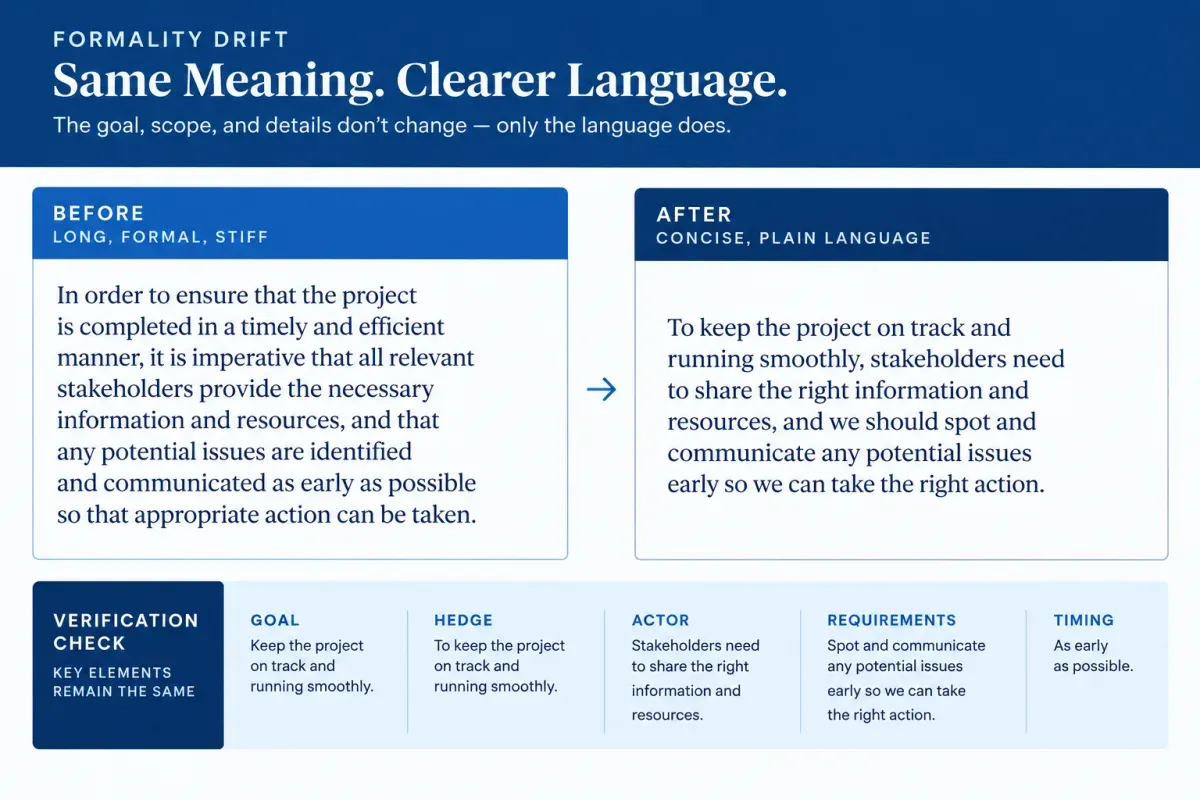
A tone fix is done only when a side-by-side check shows the wording now matches your anchor voice and nothing else changed. This catches the main risk of section-level rewrites: the generic language disappears, but the edit quietly strengthens a claim, shifts the audience or adds a promise. The revised passage should sound like the same writer and keep every factual and conditional element.
The example below was written for this guide, not taken from a client draft. It shows formality drift against an anchor voice that is plain, peer-level and specific.
Before (formality drift): “It should be noted that, in order to reduce the likelihood of revision requests, it may be advisable for your team to ensure that each brief specifies the target reader, the approved claims and the required sources prior to the commencement of drafting.”
After (minimal fix): “To lower the chance of revision requests, your team may want each brief to name the target reader, the approved claims and the required sources before drafting starts.”
The revision cuts the filler opener and the stacked formal phrases. It keeps the goal, the hedge, the actor, all three brief requirements, and the timing. Nothing is stronger or weaker than before.
| Element | Before | After | Status |
|---|---|---|---|
| Goal | Reduce the likelihood of revision requests | Lower the chance of revision requests | Kept |
| Hedge | “It may be advisable” | “May want” | Kept |
| Who acts | Your team | Your team | Kept |
| Brief contents | Target reader, approved claims, required sources | Target reader, approved claims, required sources | Kept |
| Timing | Prior to the commencement of drafting | Before drafting starts | Kept |
| New promises | None | None | Kept |
If a claim in the original lacks support, send it to fact review instead of quietly rewording it. Fact-checking a revised draft means reviewing claims after the language changes, not assuming a style edit is harmless.
Undo an edit when it does any of the following:
- Adds a promise: The rewrite claims an outcome the original didn’t.
- Removes a condition: A qualifier such as “can,” “may” or “for some teams” disappears.
- Changes the speaker: The passage shifts from peer-level brand voice into sales language, institutional language or an editor’s opinion.
- Upgrades the claim: Measured language becomes a guarantee, a superlative or a broader statement.
- Reworks sound copy: A passage that already matched the anchor got rewritten anyway.
Reread the repaired passage with the paragraphs around it. A clean sentence can still feel inserted when it breaks a transition, repeats a nearby point or changes the cadence.
Floyi doesn’t detect or score tone drift, so the anchor audit and this before-and-after check stay with your editor. What Floyi does is set the voice before the first edit, and the Fact Checker agent flags claims for a person to decide on. See how Floyi briefs and drafts carry your voice from brief to finished draft.
Tone Drift in AI Drafts FAQs
These answers cover the practical calls behind tone drift in AI-generated drafts, from spotting a voice shift to revising a passage without changing its facts, claims or intended audience.
1. Which Phrases Signal Tone Drift in AI Drafts?
Stock openers such as “In today’s fast-paced world” and “It’s important to note” signal drift. So do inflated verbs like “delve into” and filler transitions like “Furthermore.” One instance may be harmless. Clusters are the signal. Watch for repeated em dashes, identical paragraph openings, mechanical three-item lists, and same-length sentences, which create a robotic tone. Diagnose the pattern, then cut the opener or vary sentence length instead of rewriting the whole paragraph.
2. Should You Use Another Model to Edit Tone?
Use another model to diagnose drift, not to rewrite by default. Have it flag the exact passage, name the voice rule it breaks, quote a short example, and explain the conflict with your audience or purpose. This surfaces repeated habits without erasing intentional shifts.
Treat any suggested wording as an option. Before accepting it, confirm that meaning, factual precision, point of view, and deliberate stylistic choices are intact. Edit only the passages that drifted.
3. Can AI Editing Cause Tone Drift in Human Drafts?
Yes. Broad AI editing requests can turn a distinctive human draft into polished but generic prose, even when the grammar improves. The edit can also miss the reader’s context, risk level or emotional state.
Confine the request to grammar or clarity in named paragraphs. Keep wording that already works, then compare the revision with the original for factual precision, point of view and intentional phrasing before you accept it.
4. Can Prompts Prevent Tone Drift Entirely?
No. Explicit tone constraints and a short approved voice sample reduce drift, but they can’t remove it. Early guidance can fade during long generation, and source material can pull the register elsewhere. Generating long work section by section with a compact voice reminder in each prompt helps. Human review of AI-generated content still catches the shifts prompts miss.
About the author

Yoyao Hsueh
Yoyao Hsueh is the founder and CEO of Floyi, the topical authority platform, and the founder of Main Heading, an SEO and AI search agency. He is an expert in topical authority and topical mapping. He created Topical Maps Unlocked, a course studied by thousands of SEOs, content strategists and digital marketers, founded TopicalMap.com, a done-for-you topical mapping service for agencies and enterprise teams, and publishes the weekly Digital Surfer newsletter on SEO, content strategy and AI search.
About Floyi
Floyi is a closed loop system for strategic content. It connects brand foundations, audience insights, topical research, maps, briefs, and publishing so every new article builds real topical authority.
See the Floyi workflow