12 Best AI Content Strategy Tools
Compare the best AI content strategy tools for SEO, workflow, and budget, and see which stack fits your team, with Floyi as the closed-loop option.
A comparison of 12 AI content strategy tools helps buyers sort research, drafting, optimization, and publishing without overlap. Agency owners and SEO leads often stitch together keyword lists, briefs, and approvals across separate apps, then lose the brand context that keeps the work consistent. The right readout shows which platforms cover the workflow end to end and which ones fit a narrower job.
The review covers topical mapping, citation backed research, SERP analysis, brand voice control, on page tuning, repurposing, and AI visibility tracking. It also shows where Floyi, ChatGPT, Semrush, Perplexity, Jasper, and Surfer SEO fit in a 2 to 4 tool stack. Buyers get a feature matrix and a practical way to separate closed loop platforms from single task tools.
Heads of content, agency owners, and senior SEO strategists will get the most value from the comparison because they need fast onboarding, clear integrations, and evidence of ROI. One example shows why a team might use Perplexity for research, Surfer SEO for page tuning, and Floyi for strategy to publish flow. That makes the next section a useful shortcut for choosing the setup that matches budget, workflow, and reporting needs.
AI Content Strategy Tools Key Takeaways
- Most teams need a 2 to 4 tool stack, not one all in one suite.
- Floyi connects topical mapping, briefs, drafting, publishing, and AI visibility in one loop.
- Perplexity is strongest for cited research and fast source checks.
- Semrush and Surfer SEO cover SEO research and real time on page optimization.
- ChatGPT and Claude speed ideation and synthesis before drafting.
- Jasper, Copy.AI, Canva, and Descript support voice, automation, visuals, and repurposing.
- ROI improves when citations, visibility, CTR, and assisted conversions are tracked together.
Which Tools Rank Highest For Best AI Content Strategy Tools?
The strongest artificial intelligence (AI) content strategy stack is usually a 2 to 4 tool mix, not one giant suite. The best AI content tools cover research, ideation, optimization, drafting, distribution, and AI visibility without piling on duplicate spend. For that reason, you should rank AI content strategy tools by gap coverage, not brand familiarity.
| Rank | Tool | Best fit | Why it ranks here |
|---|---|---|---|
| 1 | Floyi | Strategy to publishing | It combines topical mapping, multi-agent briefs and drafts, Content Optimizer gap analysis, SERP Insights benchmarks, AIRS Analyzer visibility across 11 engines, and native WordPress publishing in one closed loop. |
| 2 | Perplexity | Research | It is strongest for citation-backed discovery and fast source gathering. |
| 3 | Semrush | Search engine optimization (SEO) planning | It supports keyword, competitor, and search engine results page (SERP) research, and MarketMuse belongs here when topic depth is the priority. |
| 4 | Claude | Synthesis | It handles long-context review before drafting. |
| 5 | ChatGPT | Ideation | It is one of the fastest content ideation tools for concept generation and early outlines. |
| 6 | Jasper | Brand voice | It helps larger teams keep tone consistent at scale. |
| 7 | Copy.AI | Workflow speed | It works best for short-form go-to-market automation. |
| 8 | Surfer or Clearscope-style tools | On-page optimization | They add structure and scoring during writing, but they do not replace research or publishing workflows. |
| 9 | Grammarly, Canva, Descript | Polish and repurposing | Grammarly tightens copy, Canva supports visuals, an AI image generator can fill creative gaps, and Descript turns audio or video into reusable assets. |
If research is already covered, fill the missing entity gaps, AI search visibility gaps, and handoff friction first. If it is not, build the stack around one research leader, one drafting assistant, and one optimization layer. That approach keeps AI tools for content creation focused on the job each product handles best.
1. Floyi — Closed-Loop Strategy-To-Publishing Stack
Floyi gives you a closed-loop strategy-to-publishing stack, so brand, audience, topic strategy, and SEO execution stay connected from planning through publish and measurement. That reduces the context loss that usually shows up when separate tools handle research, briefs, drafting, and reporting. For teams comparing top content strategy platforms, that continuity is a clear buying signal.
The data flow looks like this:
- Brand Foundation, Audience Insights, and Knowledge Base inputs feed topical research, briefs, drafts, and AI image generation.
- One setup captures mission, positioning, voice, personas, and approved reference docs, then reuses them across every asset.
- Core topics become SERP-driven clusters with validated topic maps, URL slugs, page intent, and content placeholders.
- Briefs inherit brand voice management, audience context, internal linking intent, competitor sources, AI visibility signals, and scoped Knowledge Base documents.
- Drafts keep that context alive with version history, autosave, and rewrite tools.
- Scorecards track coverage, visibility, market share, and AI Authority, while competitive visibility and AI visibility show SOV, domain rankings, and citations across Google AI Overviews, AI Mode, and ChatGPT Search.
That makes Floyi stand out among the best AI content tools for teams that need more than topic modeling for SEO. A fragmented stack usually means an LLM for ideation, a separate brief builder, and another layer for publishing. Floyi fits best when you want a brand-to-publish operating system, while Ahrefs or Semrush still make sense for narrower jobs like keyword tracking or backlink analysis.
2. ChatGPT — Fast Ideation And Drafting
ChatGPT is strongest when you need fast ideation, topic clustering, outline generation, and research synthesis, not a finished page ready to publish. For ChatGPT for agencies, that makes content drafting with AI a smart way to turn a rough prompt into a usable structure fast. One competitor test had ChatGPT produce a full article plus revisions in under 15 minutes, so teams often use it for brainstorming and first-pass drafts before deeper editing.
Most agencies use it to speed up research, repurposing, and early drafting. Then a human tightens the logic, adds subject-matter nuance, and fixes weak sourcing or generic phrasing.
A practical workflow looks like this:
- Draft fast: Use ChatGPT for the outline, section order, and rough copy.
- Refine with humans: Tighten claims, improve logic, and replace vague phrasing.
- Optimize next: Move the draft into Surfer SEO or a similar tool to close entity gaps and match search intent.
- Scale context: Use a paid plan for custom GPTs with brand and persona context.
- Collaborate easily: Export early drafts into Google Docs or your editorial workflow for review and approval.
ChatGPT works best as part of a stack, not as the only system for your content strategy.
3. Grammarly — Polishes Tone And Accuracy
Grammarly works best as the last-mile editor in an AI-first workflow. After ChatGPT or another drafting tool gives you the first pass, it helps smooth tone, tighten clarity, and make the copy feel ready to publish. That matters because AI drafts often carry uneven tone, awkward phrasing, factual slips, or small context mistakes.
The final review step is where it earns its keep:
- Tone cleanup: keeps the draft closer to your brand voice
- Clarity fixes: trims clunky sentences and vague wording
- Accuracy checks: flags factual or context issues before publication
- Lightweight QA: gives your team a fast pass before handoff
Research and ideation sit upstream, Grammarly handles the polish layer, and human judgment still owns credibility. You can use it daily for editing AI-generated text when you want a lightweight final check that improves sentence-level quality without turning the tool into a strategy system.
4. Perplexity — Research Backed By Citations
Perplexity AI works best as a research-first answer engine, not a drafting tool. For AI content research, it shines when you need cited answers fast so you can decide what belongs in the brief before drafting starts.
A practical workflow is simple:
- Verify product facts, pricing cues, feature claims, and recent updates before they reach your outline.
- Check definitions and market shifts with live sources so your brief reflects what changed.
- Separate signal from noise by weighing citation quality and source density.
- Carry only confirmed points into the draft so your strategy stays defensible.
The payoff is speed and cleaner evidence. It can save hours of manual Googling and give your team a source-backed brief with a clearer trail for content decisions.
The tradeoff matters too. Perplexity can miss newer or harder-to-scrape details, so treat it as a fast first pass and confirm critical facts with human review or primary sources.
5. Canva — Visuals For Content Teams
Canva is the fast-turnaround visual layer in your stack. It helps you ship quick graphics, thumbnails, social posts, and simple brand assets without slowing article production or pulling in a designer for every update.
That fit matters when one brief has to become several assets. Canva templates make repeatable outputs easier across blog and social channels, so a single idea can turn into quote cards, headers, and distribution creatives that keep publishing velocity high.
The practical fit shows up in three places:
- Planning support: it pairs with ideation, research, SEO, and drafting tools in a typical 2 to 4 tool stack.
- Visual creation: Canva AI and the AI image generator speed up image generation and simple assembly.
- Distribution support: it works well with social tools that automate scheduling and repurposing based on engagement data.
Canva is strongest when you need consistent branded visuals fast. It works best as part of a wider content system, not as a standalone strategy tool.
6. Descript — Audio And Video Repurposing
Descript fits best when you already have strong source material and want to turn it into more assets fast. If your team starts with podcasts, webinars, interviews, or founder videos, transcript-first editing lets you work from the words instead of rebuilding the cut from scratch.
Common repurposing wins include:
- Pulling short moments from transcripts for social posts
- Turning clips into email embeds or landing page proof
- Moving from raw audio and video to transcripts, highlight reels, and derivative snippets
That makes Descript a practical layer in content repurposing stacks, not a planning system. Teams often pair it with a strategy tool upstream, then add CapCut, OpusClip, or similar AI video creation tools when short-form clipping needs more speed or style options. For repurposing-heavy workflows, Descript helps you turn existing recordings into reusable content across channels without adding headcount.
7. Jasper — Brand Voice At Scale
Jasper is strongest when you need SEO-aware long-form marketing content that stays on-brand across a large asset mix. It is less compelling when your team needs deep research or a closed-loop strategy workflow. If your work is content drafting with AI, that tradeoff is easy to miss until production starts to stack up.
Brand IQ is the feature that anchors brand voice management. It keeps voice, terminology, and messaging steady across:
- Blog drafts: consistent tone from one writer to the next
- Landing pages: cleaner brand alignment for conversion pages
- Campaign copy: faster adaptation without tone drift
Jasper is also commonly positioned for blog writing, and pricing starts around $39/month, which makes it a practical mid-market option. The teams that benefit most are easy to spot:
- In-house content teams: keep long-form output consistent across multiple writers
- Agency writers: move faster on repeatable drafts and client-specific voice rules
- Marketing managers: adapt one core message into approval-ready copy across channels
The tradeoff matters. Jasper helps with drafting and voice control, but it is not a full content strategy system. Stronger setups usually pair it with 2 to 4 specialized tools for research, SEO validation, and distribution, because brand voice alone will not solve topic discovery or AI visibility.
8. Copy.ai — Short Form Workflow Automation
Copy.AI fits when you need fast, high-volume short-form content across social posts, ad copy, and email sequences. It generates rapid variations for GTM work, not deep long-form strategy.
It also reduces repetition by turning one campaign angle into multiple on-brand assets for different audiences, offers, and channels. That gives your team less rewriting and more launching. Typical ROI wins for agencies and growth teams show up in three places:
- Ad variants: Produce more creative options without slowing review cycles
- Social refreshes: Keep calendars moving with faster post updates and angle swaps
- Email personalization: Scale segmented messaging without adding headcount
Copy.AI works best as a focused, single-purpose tool when you want lightweight automation over a heavy suite. For broader AI content strategy, it pairs best with planning, SEO, and optimization tools. The strongest stacks usually combine specialized tools to cover ideation, refinement, and distribution.
9. Claude — Long Context Strategy Thinking
You get the most from Claude AI when inputs are messy, long, and spread across multiple sources. It can digest long PDFs, interview transcripts, research notes, and multi-document strategy decks without losing the thread. That makes it easier to turn scattered material into one coherent content strategy.
Before drafting, Claude helps you move from research into planning:
- Surface recurring themes across research
- Group repeated audience questions into clear clusters
- Shape a multi-month editorial direction from early discovery work
- Compare audience segments and their priorities
- Identify content gaps across a topic cluster
- Pressure-test whether a theme ladder is broad enough for several months of publishing
The strongest stack is usually split across drafting and research tools. Many teams pair Claude AI or ChatGPT for outlining, ideation, and research synthesis, then use Surfer SEO or Frase for on-page tuning. For strategy leaders, the payoff is faster movement from raw inputs to a defensible plan, with fewer missed connections between sources. That is why agencies often lean on it for brainstorming and first-draft support.
10. Semrush — SEO Research And Optimization
Semrush is the research-first choice when you want a broad data set plus AI layers in one place. It takes you from competitive gap analysis to topical clusters, SEO briefs, and ranking-potential scoring without bouncing between tools. For teams that need real-time SEO insights before a page is written, that edge matters.
The workflow is easiest to scan in this format:
| Capability | What it helps you do |
|---|---|
| Real-time SERP analysis | See search results, competitor page structures, and content openings before you brief or optimize |
| Keyword clustering | Turn raw lists into tighter topic groups, reduce overlap, and organize intent patterns |
| AI-assisted drafting speed | Compare an 833-word draft in 42 seconds with an SEO-boosted draft in 2 minutes 43 seconds |
| AEO/GEO fit | Pair content creation, AI search optimization, and SEO research for AEO/GEO tracking |
Semrush Content Toolkit, Keyword Magic Tool, and Site Audit give you a fast read on the SERP. That makes its AI content research and AI-driven content optimization useful when you need strong benchmarking as well as speed. Semrush works best when you want fast brief generation plus competitive coverage, but you should compare its optimization depth against more closed-loop platforms if you want strategy-to-publish execution in one place.
11. HubSpot — CRM Connected Content Ops
HubSpot is the strongest fit when your marketing already lives in the platform and you want AI to turn CRM signals into content decisions, not just draft generation.
HubSpot’s AI gives you planning context that generic tools miss. It can segment audiences by lifecycle stage, deal data, and engagement history, then use predictive analytics to shape topic clusters around real buyers. When you start from an ideal customer profile, SERP research can turn into actionable briefs, strategic topic maps, and keyword-targeted recommendations without the blank-page drag.
That context makes buyer-journey planning more precise inside HubSpot flows:
- New leads: Educational blogs and introductory emails
- Nurtures: Comparison content and objection-handling sequences
- Repeat buyers: Expansion, loyalty, or advocacy messaging
- Stalled opportunities: Landing pages and follow-up assets tuned to friction points
Content Assistant and ChatSpot add speed for ideation and workflow execution, but the bigger payoff is orchestration. One system connects audience data, planning, creation, and campaign activation so your content stays tied to CRM records and the lifecycle moments that matter most.
12. Surfer Seo — Real Time On Page Guidance
Surfer SEO is at its best when you need real-time SEO insights while you write. It reads the SERP, scores the draft, and flags missing headers, subtopics, and structural pieces that can help a page compete in a specific niche. Its AI-driven content optimization works best as a page-level tuning layer, not as a planning system.
That makes it a practical choice when you already have a draft or a refresh candidate. Common uses include:
- Refreshing existing posts: Tighten topical coverage, entity usage, and page structure without leaving the editor.
- Fitting a finished brief to live results: Align an article with what currently ranks when the strategy is already set.
- Sharpening one page fast: Improve one page’s odds in search and AI visibility before you expand the program.
Broader suites still matter when the job moves past the page. Semrush is a better fit for research, clustering, and search-dominance workflows. Floyi is the stronger option when strategy, briefing, drafting, publishing, and measurement need to stay connected in one closed-loop system.
Which Stack Fits Your Team And Budget?
The best stack should match the gaps you need to fill. That keeps coverage across research, SEO guidance, drafting, collaboration, content repurposing, and AI visibility tracking without paying for overlap you do not need.
Your stack should match team size and the output you need most:
- Solo operators and freelancers: ChatGPT or Claude handles drafting, Perplexity covers citation-backed research, and Surfer SEO gives you on-page guidance. The best content strategy tools for solo consultants and freelancers fit this profile because they keep the workflow lean and fast. Add another tool only after the first bottleneck is solved.
- Startups and small in-house teams: ChatGPT plus Grammarly works well for drafting and polish, then Floyi or Semrush adds topic selection, audience fit, and light workflow structure. This is the sweet spot when you want AI tools for content creation that speed publishing without drifting off brand.
- Small agencies: Floyi, Semrush, and Descript or Canva give you repeatable briefs, client-ready research, and repackaging across channels. Floyi is especially useful when you need strategy-to-publishing flow, while Ahrefs can be a strong alternate when competitive analysis matters more than workflow depth.
- Enterprise teams: Semrush or Ahrefs, Floyi, and a governance layer with role controls and shared credit pools work better when scale and attribution matter more than one-off speed. That setup also supports structured data, quarterly persona refreshes, content audits, and brand foundation work without turning into a reporting mess.
Budget should stay grounded in what agencies actually spend. The cost analysis of content strategy tools shows many teams landing around $500 to $2,000 per month, with Ahrefs or Semrush at about $399 to $499, Clearscope or Surfer at about $199 to $399, and optional brief tools around $99 to $499. The leanest stack that still fits your client load and publishing goals is usually the right call.
G2 reviews help you sanity-check usability, support, and setup friction before you commit. If you are stuck, use team size and business goal as the final filter: solo teams should optimize for instant value, startups for low-friction speed, agencies for repeatability and client collaboration, and enterprise teams for control, scale, and measurable adoption. Pick the stack that gets you from research to a publishable asset and a measurable return within 30 days.
How Do You Build A Repeatable Workflow?
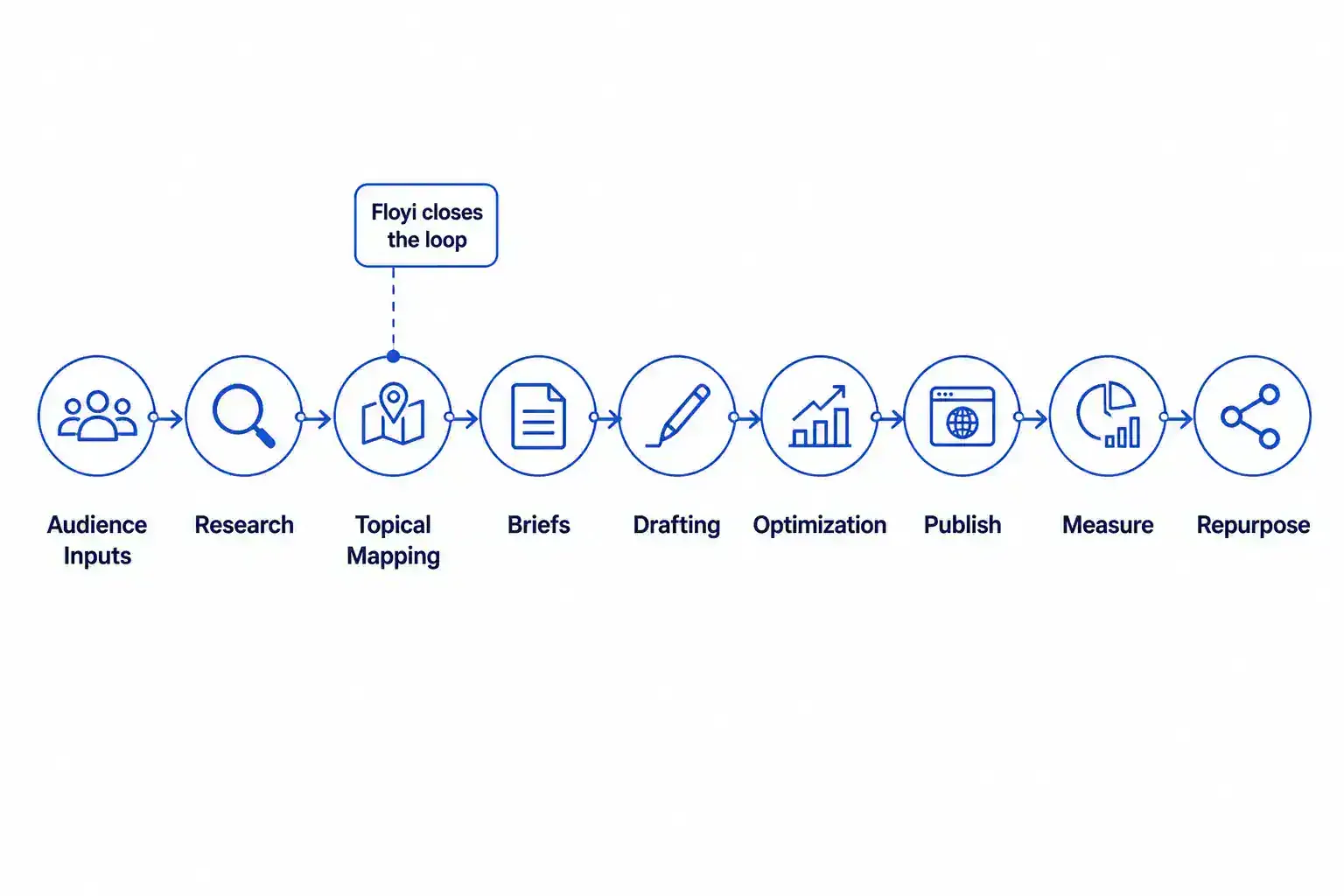
A repeatable workflow keeps strategy from fragmenting across tools and handoffs. The strongest editorial workflow for content teams starts with audience inputs and moves through research, topical mapping, briefs, drafting, optimization, publication, measurement, and repurposing.
The brief is the strategy handoff. Brand voice, audience pain points, SERP findings, internal linking targets, and evidence requirements travel with the draft. That gives every piece the right context and usually cuts down on revision churn. It also makes it easier to turn SERP research into an annotated topical map by grouping pages by intent, assigning each page a clear purpose, and separating hub pages, supporting articles, and adjacent FAQs before overlap creeps in. Keyword priorities and ICP recommendations belong in that same map.
A practical stack usually looks like this:
| Stage | What you use | What it does |
|---|---|---|
| Ideation and clustering | LLM-based topic clustering | Sorts raw ideas into usable topic groups |
| Research and briefs | Surfer SEO or Frase | Shapes search-driven coverage and brief structure |
| Drafting | Jasper or Copy.AI | Speeds up first drafts and variant testing |
| Planning | Notion AI | Keeps the calendar, notes, and status in one place |
| Visibility tracking | LLMrefs | Monitors AI search visibility across key surfaces |
The process works best when each tool feeds the next one. LLMs help with ideation, but the topical map still needs human judgment on intent, ICP fit, and page purpose. Floyi fits into that stack by turning brand voice and buyer signals into planning that stays connected from map to draft to publish.
Use this checklist for each piece:
- Confirm the audience and search intent.
- Select the right topic cluster.
- Gather source URLs and competitor notes.
- Draft against the brief.
- Optimize for missing entities and on-page depth.
- Publish with metadata.
- Repurpose into social posts, email, or short video clips.
The loop closes after publication, not before. Track visibility in Google AI Overviews, AI Mode, ChatGPT Search, Gemini, and Perplexity. Then feed the results back into your authority planner or content queue so the next round gets smarter.
The downloadable toolkit keeps the system repeatable and easy to scale:
- Topical map template: Standardizes hub, support, and FAQ coverage
- Brief template: Preserves voice, intent, links, and evidence needs
- Optimization checklist: Catches missing entities and thin sections
- Repurposing matrix: Turns one asset into multiple formats
- Visibility tracker: Keeps AI search performance visible over time
That package gives you a repeatable structure, a shared language, and fewer surprises when campaigns move from planning to production.
How Do You Measure ROI And AI Visibility?
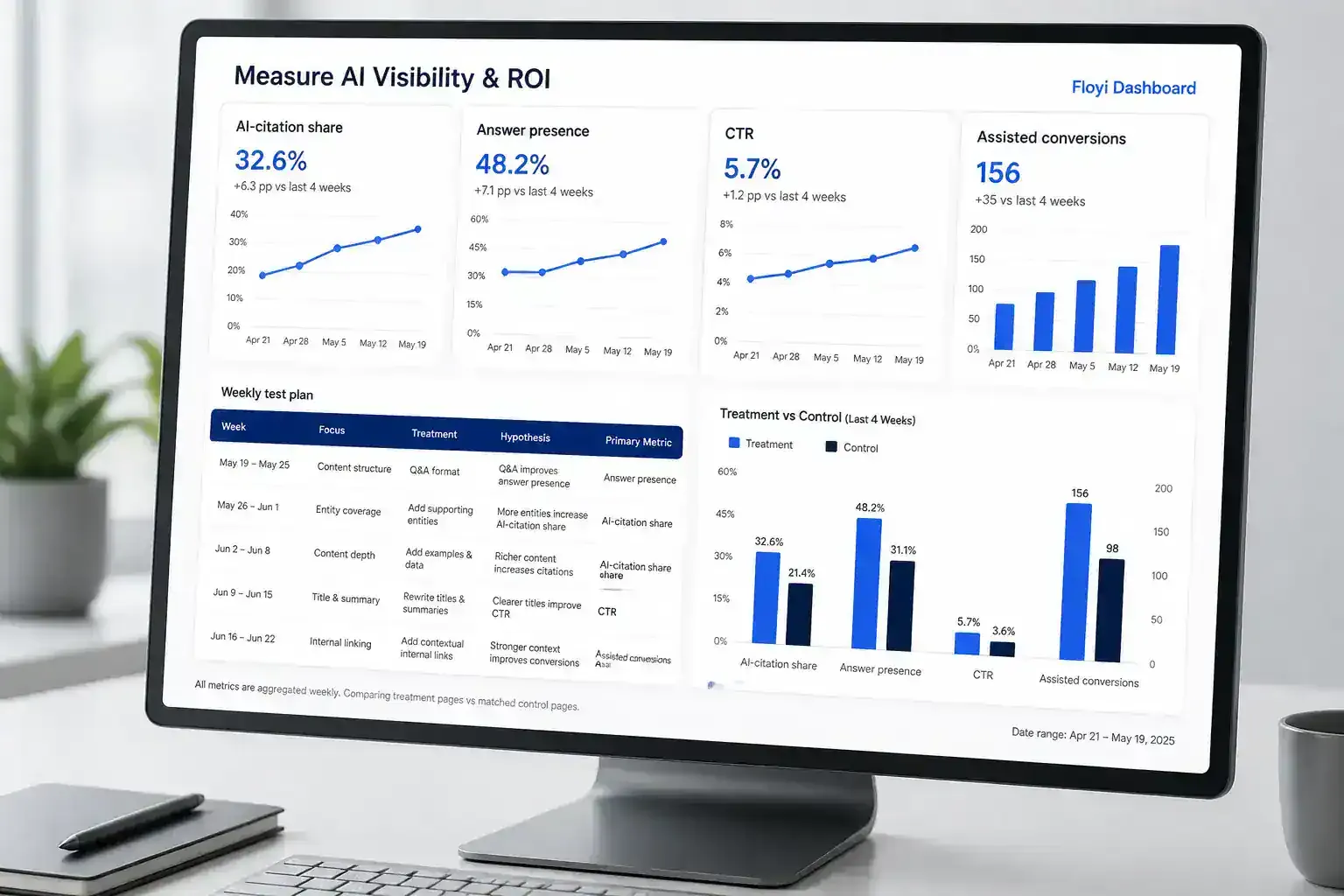
ROI measurement works best when business return and AI visibility are tracked side by side. SEO outcomes and AEO or GEO outcomes are linked, but they are not the same signal. A strong ranking does not prove that ChatGPT, Claude, Perplexity, or Google AI Overviews are surfacing your page.
Track these signals together:
- AI-citation share: how often your domain appears in AI answers
- Answer presence: whether your page shows up in the response at all
- Share of voice: how much visible answer space you own versus competitors
- CTR: how many users click after seeing your result or citation
- Assisted conversions: how often AI-visible pages support a later conversion
A weekly test plan keeps the readout clean:
- Capture a pre-change baseline for each page and query set.
- Split pages into Treatment and matched Control groups.
- Test one main variable at a time, such as lead answers, schema, or provenance.
- Run the test for 12 weeks so a one-week spike does not distort the result.
- Treat the test as successful when Treatment beats Control by at least 10% in AI-citation share for three straight weeks.
- Confirm that the lift also shows up in CTR and assisted conversions.
Keep the telemetry fields stable so your comparison stays valid across engines:
| Field | What it records |
|---|---|
| week_start | The start date for the test week |
| engine | ChatGPT, Gemini, Perplexity, or Google AI Overviews |
| query | The prompt or search query under test |
| page_url | The page being reviewed |
| variant | Treatment or Control |
| answer_present | Whether the answer includes your page |
| our_domain_cited | Whether your domain is cited |
| cited_domains | All domains cited in the answer |
| ai_citation_share | Your citation share for that query |
| share of voice | Your share of visible answer space |
| notes | Anything unusual that could affect the readout |
The tool stack should match the job you need done:
- Ahrefs Brand Radar: brand visibility and citations across web and AI-driven sources
- LLMrefs and similar tools: visibility and citation tracking across AI platforms
- OtterlyAI: brand coverage, mentions, top-cited URLs, and prompt ideas with estimated monthly intent volume
- Semrush Site Audit: crawlability checks when visibility shifts may be tied to technical issues, including 1,000-page scans, broken links, missing alt text, and thin content
A simple dashboard keeps the story readable at a glance:
| Dashboard area | What to show |
|---|---|
| Top row | AI-citation share versus Control, answer presence rate, share of voice |
| Second row | CTR and assisted conversions |
| Side panel | Top queries, cited domains, and the engines driving the most citations |
| Trend view | Weekly lines for each metric, so you can see steady gains versus one-platform spikes |
The ROI readout is straightforward. If Treatment pages earn more citations, show up in more answers, and improve CTR while assisted conversions rise, the stack is working. If citations rise but conversions stay flat, the content is visible but not persuasive enough. Start with the highest-gain pages, then tighten the claim, schema, and evidence before you scale the pattern.
How Do You Keep AI Content Safe And On Brand?
The cleanest setup treats AI as a drafting layer, not a decision-maker. It can speed up research, ideation, outlines, and repurposing, but every draft still needs human editorial review before it goes live. That matters even more when SEO, topical authority, and AI search visibility depend on claims people can trust.
A rule-based brand guide gives the model its limits. It should separate terminology rules, compliance rules, competitor policies, and brand messaging rules so the system can hold the line across a large generation run. A strong setup can enforce up to 10 terminology rules, 3 compliance rule sets, 10 competitor policies, and 15 messaging rules per generation.
The most useful guardrails are simple and explicit:
- Compliance language: Ban phrases like “100% risk-free” and “Guaranteed results.” Approved disclosures such as “Results may vary” and “Consult a professional before use” keep the copy safer.
- Editorial workflow: Move each draft through generation, fact-checking, brand-voice editing, and a final compliance pass. Readiness gates and status indicators help you keep momentum without publishing too early.
- Pre-publish checks: Catch factual inaccuracies, inconsistent tone, plagiarism or ethical risk, and cultural or contextual mistakes before launch. Those checks matter most when the content carries real business weight.
- Approved snippets: Reuse CTA, disclaimer, and bio blocks so the language stays consistent. Regeneration notes and fact verification can tighten weak sections without forcing a full rewrite.
- High-stakes policy: Keep policy copy explicit for regulated or sensitive content. Allow only source-backed claims, define when competitor references are permitted, and keep the content focused on strategic intent first.
That approach gives you faster output without losing brand control. It also makes approval easier because the editor is refining a draft, not rescuing a guess.
About the author

Yoyao Hsueh
Yoyao Hsueh is the founder and CEO of Floyi, the topical authority platform, and the founder of Main Heading, an SEO and AI search agency. He created Topical Maps Unlocked, a course studied by thousands of SEOs, content strategists and digital marketers, founded TopicalMap.com, a done-for-you topical mapping service for agencies and enterprise teams, and publishes the weekly Digital Surfer newsletter on SEO, content strategy and AI search.
About Floyi
Floyi is a closed loop system for strategic content. It connects brand foundations, audience insights, topical research, maps, briefs, and publishing so every new article builds real topical authority.
See the Floyi workflow