
12 Best Ecommerce Content Strategy Tools
Compare 12 ecommerce content strategy tools for SEO, workflow, AI search readiness, and ROI so your team can choose the right stack.
Ecommerce content strategy tools work best as a stack, not a single platform. Agencies, ecommerce managers, and SEO leads often end up stitching together keyword research, design, publishing, and analytics just to keep PDPs, category pages, and campaign content aligned. The right setup turns scattered inputs into topical maps, briefs, and measurable page updates.
The 12-tool comparison covers Floyi, Semrush, Ahrefs, Canva, HubSpot, GA4, Mailchimp, Google Ads, Optimizely, and other ecommerce-ready options, with attention to pricing, integrations, and where each one fits in the workflow. Expect side-by-side guidance on research, creative production, distribution, testing, and AI search visibility, plus practical notes on PDP and category page planning. The goal is a stack that saves time without breaking brand voice or measurement.
For Heads of Content, ecommerce teams, and agency strategists, the real value is a cleaner handoff from research to publishing and a clearer case for adoption. A category page can move from a keyword list to a brief with internal links, schema, and AI visibility checks before a writer starts. That kind of workflow keeps the stack practical, fast, and easier to defend in budget reviews.
Ecommerce Content Strategy Tools Key Takeaways
- Ecommerce strategy works better as a stack than a single tool.
- Floyi connects brand inputs, topical maps, briefs, and publishing.
- Semrush and Ahrefs lead for research and competitor analysis.
- Canva, HubSpot, and Mailchimp support creation and lifecycle marketing.
- GA4, Google Ads, and Optimizely help prove content impact.
- PDPs and category pages need distinct workflows and measurement.
- AI, GEO, and AEO monitoring now belong in the evaluation stack.
Which Tools Rank Highest For Ecommerce Content Strategy?
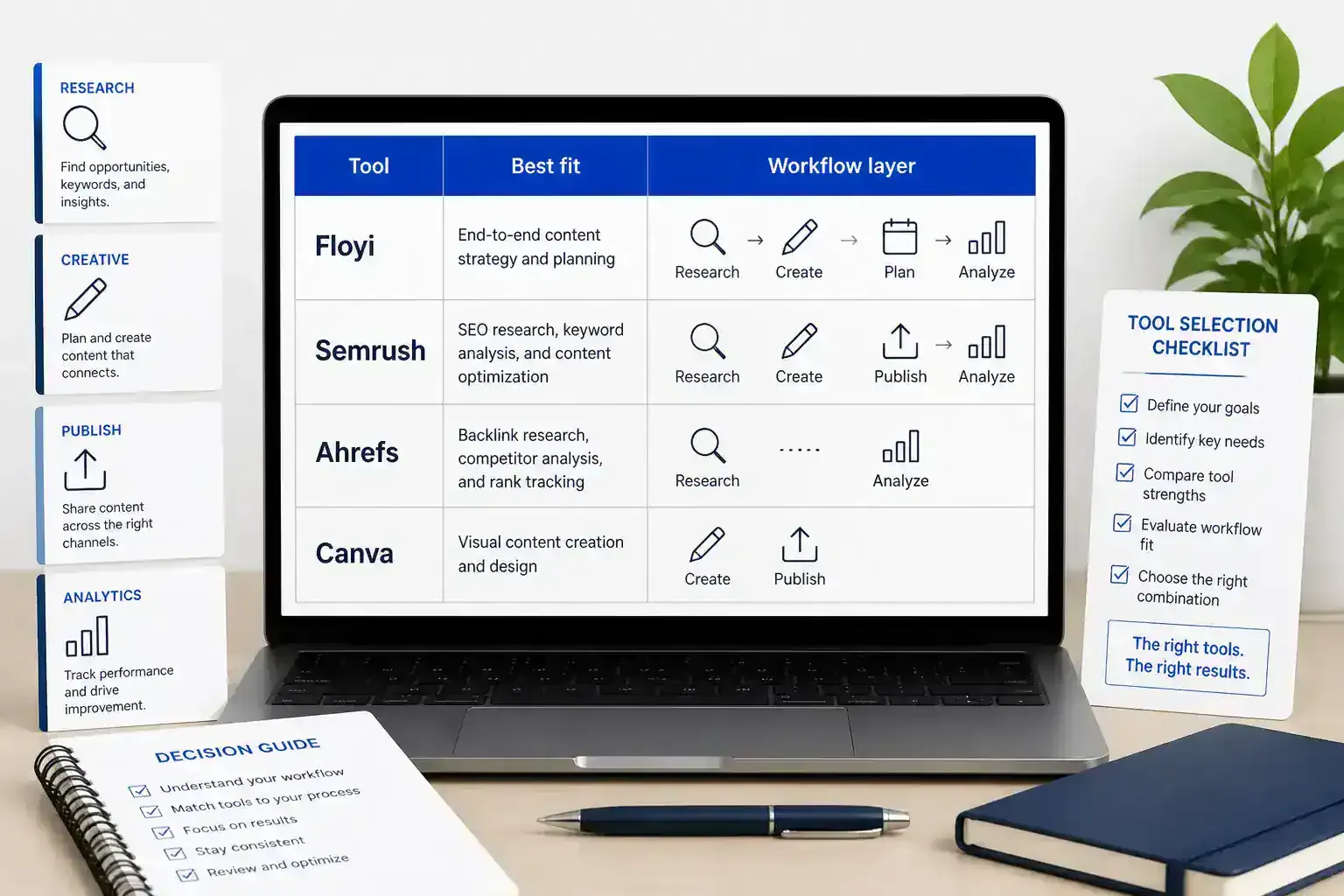
The strongest ecommerce content strategy setups are stacks, not single tools. If you’re building search engine optimization (SEO) for ecommerce, you usually get better results by pairing search, creative, distribution, and analytics so product storytelling for product detail pages, category pages, and campaign content stays connected.
The comparison below shows where each tool family fits best:
| Use case | Top tools | Best fit |
|---|---|---|
| Strategy and execution | Floyi | Teams that want a closed-loop workflow from brand inputs to topical maps, briefs, drafting, and publishing |
| Research-first SEO | Semrush, Ahrefs | Teams that need keyword discovery, gap analysis, and competitive search intelligence |
| Creative and activation | Canva, HubSpot, Hootsuite, Mailchimp | Teams that need faster visuals, customer relationship management, distribution, and email campaigns |
| Measurement and testing | Google Analytics 4, Optimizely, Google Ads | Teams that need proof, experimentation, and faster messaging tests |
The comparison of popular content strategy platforms is useful context, but Floyi is the best all-in-one strategy layer when you want closed-loop execution. Its content audit toolkit covers content audits and topical audits. SERP Insights, Content Optimizer, AIRS Analyzer, the AI Writing Assistant, structured data, and direct WordPress publishing cut handoffs and rework. Artificial intelligence (AI) for ecommerce content works best when it supports that workflow instead of replacing it.
Research-heavy teams usually split work between Semrush and Ahrefs. Semrush keyword research is stronger for keyword expansion and gap discovery, while Ahrefs is the better pick for competitive search intelligence and backlink-aware analysis. Both help you spot ecommerce keyword opportunities before production starts, which matters when your pages need to move quickly.
The activation layer matters just as much once the plan is set. Canva, HubSpot, Hootsuite, and Mailchimp are the content marketing tools that keep visuals, lifecycle marketing, cross-channel distribution, and repeatable email campaigns moving. Google Analytics 4 gives you baseline performance data, Optimizely adds experimentation, and Google Ads helps you test offers, angles, and landing-page variants when you need faster signal.
For a quick shortlist:
- In-house ecommerce teams usually need an integrated stack with strong SEO and analytics.
- Agencies usually get the most from Floyi’s briefing, benchmarking, structured data, and publishing workflow.
- Growth teams with heavier promotion needs may prioritize BuzzSumo, AnswerThePublic, or Google Ads for ideation and amplification.
The best ecommerce content strategy still comes from specialized tools working together, not one catch-all app.
1. Floyi — Best For Ecommerce Strategy And Workflow
Floyi works best when you need one closed-loop system that moves ecommerce strategy from brand and audience inputs to topical map, draft, and publishing without bouncing between tools. If you’re comparing best content strategy platforms with persona-driven topical mapping, this is the option that cuts translation work and keeps SEO, content collaboration, and launch timing aligned.
That shows up in a few practical ways:
- Catalog planning: The topical map reflects collections, product families, and category hierarchies, with page-level intent, URL alignment, and placeholders that keep coverage organized.
- SKU-linked scheduling: Your content calendar can connect launches, inventory-driven updates, campaign timing, and contributor handoffs to the same plan, much like an Airtable-style workflow.
- Brief quality: Each brief carries brand voice, persona context, SERP analysis, competitor sources, internal linking intent, and AI visibility signals, so writers spend less time guessing.
- Execution speed: Floyi supports product storytelling, bulk product descriptions, and commerce-platform planning when merchandising and editorial priorities need to move together.
That matters when your content audit toolkit surfaces gaps across category pages or product detail pages. Floyi helps you benchmark drafts against competitors and AI sources, then close gaps inline so your structure, schema, and strategy stay consistent.
2. SEMrush — Best For Keyword And Gap Research
Semrush is the strongest all-in-one pick when your ecommerce SEO program has outgrown basic keyword tools. Its Semrush keyword research goes deep enough for mid-size and enterprise catalogs, but it still helps you separate informational searches from transactional intent. That matters when category pages, buying guides, product pages, and FAQs each need a different job.
| Capability | What it gives you | Why it matters for ecommerce |
|---|---|---|
| Keyword research | Volume data, intent signals, and topic clustering | Helps you map the right query to the right page type |
| Gap analysis | Side-by-side comparisons against rival domains | Reveals missing topics and product-page opportunities |
| Content briefs | Structured direction for writers | Turns research into usable briefs instead of a blank page |
| AI visibility monitoring | Tracking across AI search environments | Helps you watch brand presence beyond traditional SERPs |
| Pricing | Commonly cited at $199 to $399 per month | Signals a professional-to-enterprise fit |
The real edge is competitor content analysis. You can compare your store against rival domains, spot missing topics and product-page opportunities, and turn those gaps into higher-converting category assets or guide pages. That makes long-tail keywords ecommerce teams want to capture easier to map without forcing every term into one template.
Semrush also works well for content briefs. It turns keyword research into target terms, intent notes, and competitive coverage, so writers start with direction instead of a blank page. For SEO for ecommerce teams, that kind of structure matters when you are scaling across a large catalog.
Its AI visibility monitoring adds another layer. You can track how your brand appears in AI search environments as well as in standard search results.
3. Ahrefs — Best For Competitive Search Intelligence
Ahrefs is the strongest pick when you need deep competitive search intelligence. It shows which competitor pages earn organic traffic, where that authority comes from, and which commercial keywords they win across product and category ecosystems. For Ahrefs competitive research, that mix is hard to beat.
A practical page-level workflow looks like this:
- Spot commercial gaps: Compare your domain with top rivals to find underserved intent, especially long-tail keywords ecommerce teams can build around.
- Map page expansion: Identify product or category pages that need expansion, consolidation, or a supporting article to strengthen relevance.
- Read backlink patterns: See which competitor pages attract the links that matter most, then shape stronger product-category targeting, internal linking priorities, and content angles.
- Tighten the stack: Pair Ahrefs with Semrush when you want a fuller view. Ahrefs is stronger for keyword and backlink depth, while Semrush helps separate educational queries from high-conversion transactional buying guides and sharpens competitor content analysis.
The site audit is worth a close look too. It surfaces technical and on-page issues that can suppress high-opportunity product and category pages. That makes it easier to prioritize fixes where ranking upside is greatest.
Pricing keeps Ahrefs in the premium tier. It starts at $99/month and scales to $699/month, with Brand Radar included on Advanced+ plans. That makes it a credible choice if you want competitive visibility and AI search tracking in one place.
4. Canva — Best For Fast Visual Content Creation
Canva fits ecommerce teams when you need visual assets for ecommerce without sending every request through a full design handoff. Non-designers can turn out Canva product graphics, product shots, social ads, and email headers quickly, and that matters when speed and consistency matter more than custom design depth. As one of the most practical content creation tools for lean teams, it keeps campaigns moving.
Canva Magic Studio adds AI image editing that saves even more time. You can generate or clean up imagery, remove backgrounds, and turn one master asset into on-brand variations instead of rebuilding each layout from scratch.
A few high-value ecommerce uses stand out:
- Channel resizing: Adapt one design for Meta ads, Instagram posts, PDP promos, and email headers.
- Visual consistency: Keep the same layout style across campaigns so your funnel looks cohesive from first click to purchase.
- Brand Kit control: Store logos, colors, fonts, and templates in one place so non-designers stay aligned with the brand.
- Workflow speed: Build new assets faster without needing advanced software skills or a full handoff cycle.
Canva sits in the same fast-visual-tool bucket as DesignWizard and Crello, but its strongest pull is the mix of template speed, AI help, and Brand Kit control. Compared with Adobe Creative Cloud, it’s far easier for everyday ecommerce content production.
5. HubSpot — Best For Content And CRM Alignment
HubSpot works best when your buyer journey content sits beside your CRM and automation. Blog posts, landing pages, forms, and email nurtures all connect to one record, so each asset supports a clear stage in the ecommerce funnel.
Lifecycle-based campaigns fit the moments that matter most in ecommerce:
- Welcome flows: greet new subscribers with product education and first-step offers.
- Abandoned-cart education: answer objections and reduce hesitation with content tied to the exact path.
- Post-purchase onboarding: show buyers how to use, care for, or get more value from what they bought.
- Replenishment reminders: time follow-ups around repeat purchase cycles with matching content.
- Win-back sequences: re-engage dormant contacts with fresh offers and trust-building assets.
Lead scoring and lifecycle stages make the handoff smarter. A subscriber who is browsing, comparing products, or nearing a first purchase can get the next best asset instead of a generic follow-up. Strong segmentation goes further by using browsing and purchase history to build cohorts like VIP buyers, repeat customers, and window shoppers, which fits the AI personalization bar set by Klaviyo and Omnisend automated flows.
The practical upside is simple. Campaign performance, contact behavior, and revenue attribution live in one place, so cross-channel attribution is easier to trust. HubSpot is strongest when you want one connected CRM and automation layer, not just standalone content production or SEO research.
6. Hootsuite — Best For Cross-Channel Distribution
Hootsuite is strongest when cross-channel distribution matters more than SEO research. It gives you one place to push ecommerce content across social channels without juggling a separate workflow for each network.
Its scheduling stack does the heavy lifting:
- Bulk imports: Load campaign posts in one batch.
- Calendar-based scheduling: Queue product launches and seasonal promos with less manual copy-pasting.
- Editorial coordination: Keep blog launches, product drops, and promo pages tied to the same content distribution plan.
That social-first setup works well when repurposed snippets and timed reminders need to land beside the original launch date. It keeps social, blog, and email promotion aligned as content rolls out. For AI search workflows, multi-channel distribution and unified marketing calendars also reduce repetitive publishing work.
At $599/month, Hootsuite is a higher-investment option. It makes sense for teams that need reliable scheduling at scale, but you should pair it with another tool if you want ecommerce-specific content strategy, keyword research, or deeper publishing workflow support.
7. Google Analytics 4 — Best For Content Performance Tracking
Google Analytics 4 is the best fit when you need to prove which ecommerce content pages influence revenue, not just traffic. It connects content KPIs to events, conversions, and purchase value, so your reporting moves past pageviews and into business impact.
The cleanest way to read performance is by funnel stage. With TOFU MOFU BOFU content, each layer needs its own scorecard:
| Stage | What matters most |
|---|---|
| TOFU | Traffic, engagement, click-through rate |
| MOFU | Traffic, CTR, revenue assist |
| BOFU | Traffic, revenue, conversion rate |
Event tracking makes the story sharper. Article views, scroll depth, product clicks, add-to-cart actions, and checkout starts can all be tied to specific pages and content clusters, so a category guide or comparison post becomes measurable ecommerce behavior.
Attribution analysis is where GA4 earns its keep. The GA4 page path explorations report helps you compare assisted conversions, last-click revenue, and conversion paths, so you can tell whether a guide, category article, or comparison page moved shoppers closer to purchase. Strong teams use that data to spot pages that lose buyers, reduce cart abandonment, and prioritize updates by revenue impact instead of vanity metrics.
GA4 also fits into a broader measurement stack. It gives you free traffic analysis and performance reporting, while heatmap and session-replay tools add the UX context numbers alone miss. Many teams pair Google Analytics with Hotjar, which starts at $99/month, for visual behavior insights before purchase. That combination makes it easier to decide which content deserves a refresh, a rewrite, or a better internal link path.
8. AnswerThePublic — Best For Question-Based Topic Discovery
AnswerThePublic gives you a fast TOFU starting point when you need real shopper language, not a full briefing suite. It works best for blog angles, FAQ modules, and short social scripts because it surfaces the questions people actually ask.
Question clusters are more useful than isolated queries:
- What and how prompts become discovery posts and how-to guides.
- Why prompts become objection-handling copy and buying guides.
- Comparison prompts become head-to-head pages and category content.
- Repeat questions become PDP upgrades for shipping, sizing, compatibility, ingredients, care, and returns.
That language should carry into on-page FAQs and schema-ready answers so the page matches search intent. For ecommerce teams, one research pass can feed PDP enhancements and new blog topics at the same time.
Pricing also helps the decision. AnswerThePublic is often cited at about $75/month billed annually, while BuzzSumo sits in the $99 to $499/month range. If you only need question discovery, AnswerThePublic is the leaner pick. Frase fits better downstream for SERP summarization, FAQ generation, AEO, outlining, and AI drafting.
9. BuzzSumo — Best For Trending Content Ideas
BuzzSumo works well for ecommerce because it shows what is trending and backs it up with social engagement signals before you spend on a blog, guide, or campaign asset. That helps you spot ideas with real traction, not just gut feel. It is especially useful when you need topics that can support a product launch, category page, or seasonal promotion.
You can use it to find the angles that already earn shares and clicks:
- High-share headlines: Adapt proven framing for product drops and sales pages.
- Winning formats: Reuse content shapes that perform well, like list posts, how-tos, and roundups.
- Consumer questions: Turn question mapping into shareable blog posts, FAQ content, and short social scripts.
It also shows what competitors, publishers, and niche creators are getting traction with. At about $99 to $499 per month, BuzzSumo fits teams that want ongoing trend tracking, not a one-time brainstorm tool. The strongest results come when you pair those signals with SEO and conversion goals so trending ideas still point to revenue-driving pages.
10. Mailchimp — Best For Email Content Automation
Mailchimp gives you an accessible starting point for ecommerce email content automation. At $14.99/month, it works well when you want recurring flows without a heavy CRM setup. For smaller teams, that balance of cost and simplicity is hard to beat.
The most useful ecommerce flows are:
- Abandoned cart reminders: recover intent after a shopper leaves.
- Post-purchase sequences: confirm the sale and nudge repeat orders.
- Lifecycle emails: keep product content moving after checkout.
- Simple segmentation: separate window shoppers, first-time buyers, and repeat customers by browsing behavior, purchase history, and customer status.
Mailchimp performs best when your store data is synced cleanly and your product feeds stay accurate. Your commerce platform also needs to pass customer and order events reliably so automation triggers at the right time. That makes Mailchimp a strong fit for precision marketing and ongoing campaign optimization without a complex stack, although deeper personalization and more advanced ecommerce messaging usually call for a more specialized platform.
11. Google Ads — Best For Paid Promotion And Testing
Google Ads gives you the quickest read on content-led landing pages and product campaigns before you invest in organic scaling. It helps you test search intent, offer fit, and click-through rates against real buyer queries instead of guesses.
Keep the test tight around one page or product theme. A simple A/B testing setup can compare:
- Headlines: value-led, benefit-led, and pain-point angles
- Descriptions: feature detail, proof points, and stronger calls to action
- Assets: images, extensions, and sitelinks tied to the same offer
- Audience splits: branded vs. non-branded queries, high-intent category terms, and remarketing segments
That structure shows which cohorts respond before spend grows. Research identifies the topic, Google Ads tests demand and messaging, and the winning angle feeds SEO and product-led optimization once the numbers prove traction. AI copy tools can speed up ad variation and localized versions, but Google Ads performance should make the final call.
12. Optimizely — Best For Experimentation And CRO
Optimizely works best after your content strategy is set. It gives you the testing layer that validates whether a page change improves ecommerce conversion or just feels right. That matters because content hypotheses should be proven, not guessed.
A simple testing plan usually starts with these page types:
- PDP experiments: Test benefit-first copy, stronger trust signals, review placement, clearer CTA language, and richer media blocks. Measure add-to-cart rate, scroll depth, and revenue per visitor so the result reflects real buying behavior.
- Category page experiments: Compare filtering copy, merchandising callouts, comparison tables, and intro modules. The goal is to learn which structure improves discovery and moves shoppers deeper into the funnel.
- Checkout-flow tests: Use shipping and returns reassurance, progress indicators, microcopy near form fields, and payment confidence cues. Track abandonment rate and completion rate so copy changes tie back to revenue impact.
The best experiments start with a content hypothesis grounded in search intent or behavioral insight. If a page attracts research-heavy traffic, the test can show whether educational content, tighter product messaging, or stronger proof points increases progression to purchase. Optimizely becomes even more useful when you pair it with heatmaps and session behavior data. Those signals help you focus on the pages and content elements most likely to move conversion.
How Do You Choose The Right Tool Stack?
The best stack matches your operating model, catalog scale, and data sources before it chases feature depth. A solo Shopify brand can stay lean with Frase, Surfer, and Ahrefs. Small ecommerce teams usually get more from Semrush and Clearscope because that pairing covers research, optimization, and review without extra bloat. For a broader comparison, best content strategy tools for small marketing teams and agencies is a useful starting point.
A quick comparison makes the tradeoffs easier to see:
| Team or use case | Best-fit pairing | Why it fits |
|---|---|---|
| Solo Shopify brand | Frase, Surfer, Ahrefs | Fast research, on-page tuning, and lightweight planning |
| Small ecommerce team | Semrush, Clearscope | Broader research and smoother content collaboration |
| Content-heavy DTC or larger retailer | Floyi plus GEO monitoring, Semrush One or seoClarity | Topical maps, AI search visibility, and multi-page planning |
Smaller catalogs can focus on quick topic discovery and page optimization. Larger assortments need brand foundations, topical mapping, and planning that can stretch across many PDPs and category pages without turning your ecommerce content strategy into a spreadsheet maze.
The strongest content marketing tools also connect your data stack. Shopify or Magento gives commerce context. GA4 handles performance tracking. Klaviyo and Omnisend automated flows tie content to lifecycle email. Meta adds paid distribution signals, so research, workflow, and shopping intent stay connected.
Build the stack in layers. Start with keyword and gap research. Add a content calendar and briefs, then move into production, measurement, and distribution. Budget should act like a boundary, not the first filter. A small agency stack often lands around $1,200-$2,500 per month across Ahrefs or Semrush, Clearscope or Surfer, Screaming Frog, reporting, and collaboration tools. If AI search matters, pair Search Engine Optimization research with GEO and answer-engine monitoring, and Floyi works best when brand and audience context need to move into topical maps, drafts, and publishing in one flow.
How Do You Implement The Stack In Ecommerce?
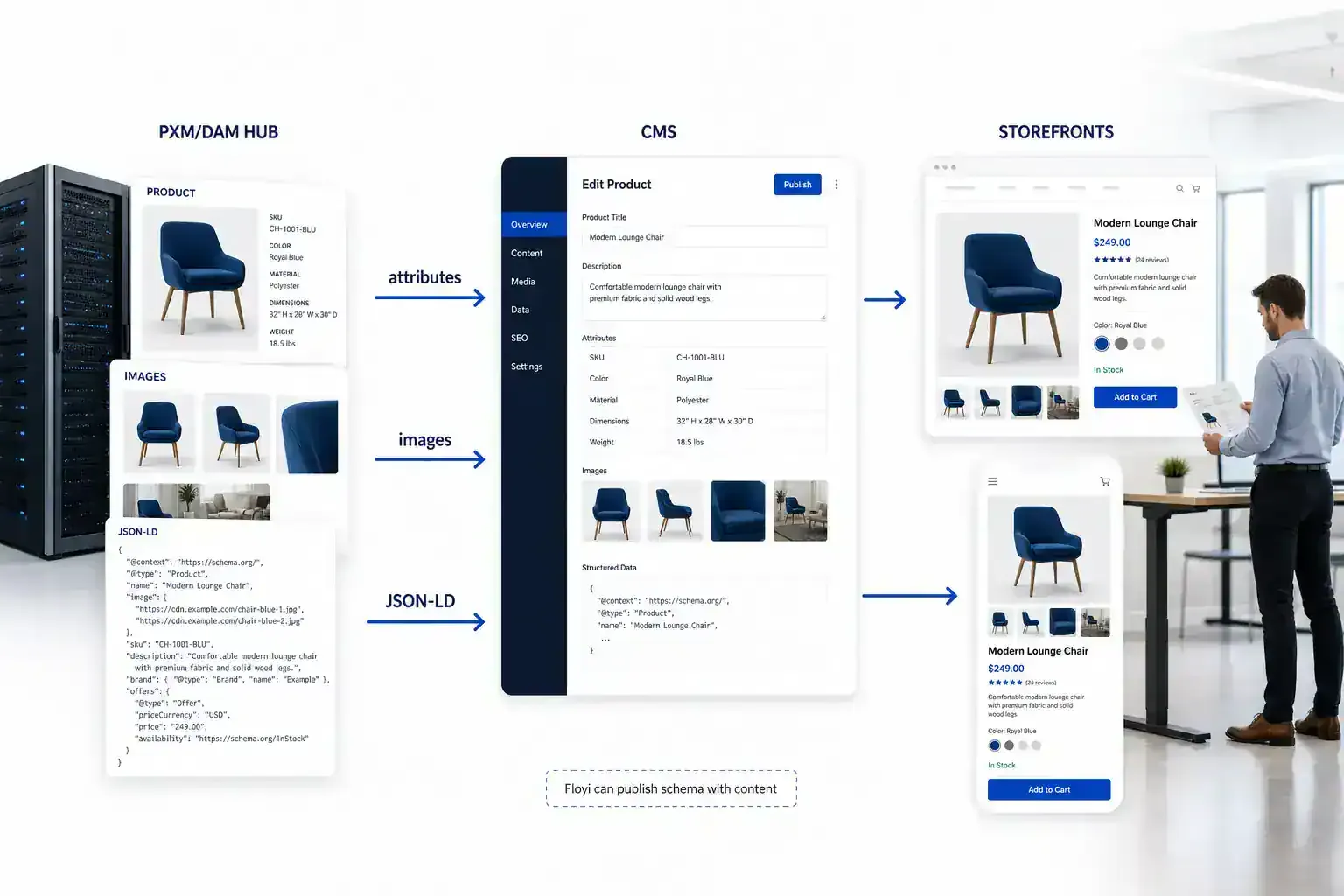
The stack works best when product data, content, and measurement move in one direction. Start with a PXM and DAM hub such as Salsify as the source of truth for attributes, imagery, specs, and enrichment. Then push structured data into your CMS and storefront so product detail pages and category pages stay aligned across Shopify or Magento.
A clean editorial pipeline keeps every asset tied to a live SKU, not just a topic idea. Each brief should map to the product, category, launch date, inventory tag, and commercial intent. Airtable or a similar relational calendar can connect contributors to release windows, which makes bulk product descriptions easier to manage without losing timing or message control.
The strongest teams also write for AI-readable discovery from the start. That means entity-rich copy, FAQ blocks, comparison tables, semantic clusters, structured data, and expert signals that help pages surface in AI Overviews, AI Mode, and ChatGPT Search. Search visibility improves when the page serves shoppers and the systems that summarize it.
A practical integration checklist keeps the stack from breaking at publish time:
| Layer | What to verify | Why it matters |
|---|---|---|
| Theme or template | JSON-LD is delivered correctly | Search engines can read product context |
| Schema | Product, FAQ, HowTo, and BreadcrumbList markup are present | Rich results and clearer entity signals |
| URL control | Canonical URLs stay stable | Duplicate pages do not dilute relevance |
| Crawl rules | Robots settings do not block key pages | Launch pages stay indexable |
| Internal links | Anchor links remain intact after updates | Category and PDP flow stays consistent |
Floyi can reduce manual markup work by publishing schema with the content, which helps your team move faster without handing every change to developers.
Measurement and lifecycle tools should connect as soon as the content goes live. Send content performance data into Google Analytics 4 for landing-page and assisted-conversion analysis. Sync audience and lifecycle triggers into Klaviyo so launch, replenishment, and nurture flows all carry the same SKU-level message.
Scale is the proof point, not the goal. Salesforce says Neolait used AI to create 1,300-plus search engine optimization optimized product descriptions, which shows how far repeatable workflows can take you. The smarter move is to pair that scale with personalization discipline and adjacent ownership content like product care guides, so your ecommerce program supports both top-of-funnel discovery and repeat purchases.
How Do You Measure ROI And Performance?
ROI gets clearer when you judge each page by the job it performs in the buyer journey.
| Funnel stage | What to measure | Why it matters |
|---|---|---|
| Top of funnel | Traffic, engagement, click-through rate | Shows whether discovery content earns attention |
| Middle of funnel | Traffic, click-through rate, revenue influence | Shows whether buyer journey content helps shoppers move closer to purchase |
| Bottom of funnel | Traffic, revenue, conversion rate | Shows whether the page drives sales or just attracts visits |
That split matters for TOFU MOFU BOFU content because a category guide and a product detail page support asset should not share one scoreboard. High traffic without revenue lift is noise, not proof.
Attribution gets more honest when you connect SEO research, workflow, and shopping intent across channels. Cross-channel attribution should tie Google Analytics 4 event data to conversion paths so you can see which pages assist product views, add-to-cart actions, email signups, and purchases. GA4 page path explorations add the path detail that basic landing-page reports miss.
The closed-loop view is where the stack earns its keep. Track content-level KPIs such as assisted conversions, organic revenue, conversion rate uplift, and repeat visits. If a page ranks but does not move revenue, it is not a strong asset.
Benchmarks should extend beyond your own site. Floyi’s SERP Insights helps you compare length, media, link structure, and feature coverage against pages already winning in search. AIRS Analyzer adds the AI layer by tracking which sources surface across Google, Bing, AI Overviews, AI Mode, ChatGPT, and other AI surfaces.
Quality signals matter before publish, too. Floyi’s Content Optimizer surfaces missing entities, topics, and keywords early, which helps reduce wasted production on product guides, category pages, and PDP support content.
A practical decision framework keeps the numbers usable:
- Channel fit: Compare performance across search, AI surfaces, and downstream conversion paths.
- Revenue impact: Separate vanity visits from pages that influence purchases.
- Content type: Judge guides, category pages, and PDP support content by their own job.
- Benchmark gap: Use SERP and AI visibility to spot weak coverage before scaling.
Because more than 50% of shopping journeys start on digital channels, your model should prove revenue impact across the full path, not just visits.
How Do You Monitor AI Search Visibility?
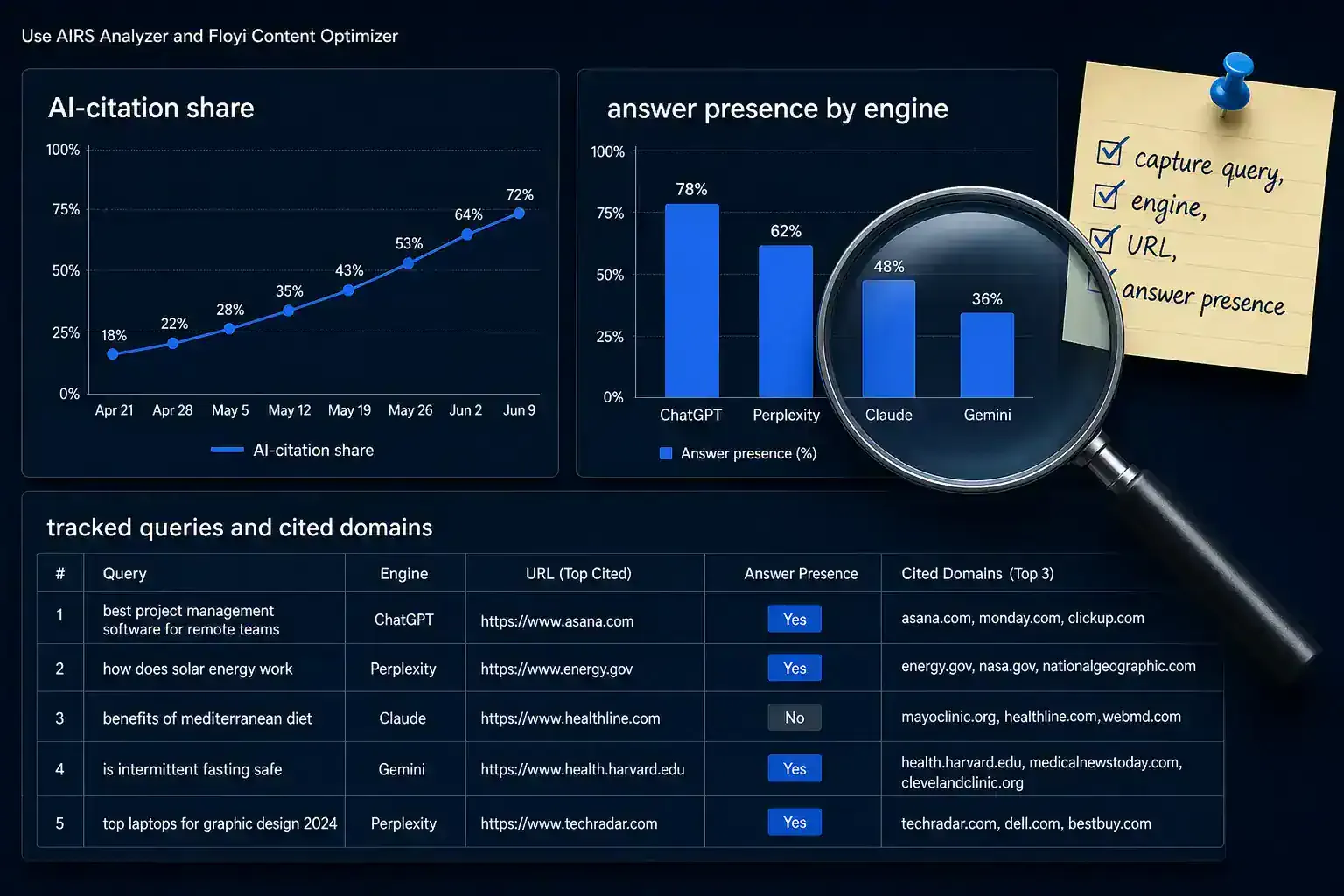
AI visibility needs its own scorecard because classic SEO metrics miss whether your page is actually cited inside answers.
Rankings and clicks still matter, but you also need AI-citation share, answer presence, share of voice, click-through rate, and assisted conversions to see whether Google AI Overviews and other generative surfaces are sending value. For AI for ecommerce content, that wider view shows whether product and category pages are getting pulled into the answers shoppers read.
A practical monitoring stack looks like this:
| Tool | Best fit | What it tracks well | Workflow strength |
|---|---|---|---|
| seoClarity | Large retailers and marketplaces | AI Overview tracking, GEO and AEO workflows, enterprise reporting, content intelligence | Strong when governance and scale matter |
| Floyi AIRS Analyzer | Ecommerce teams that want cross-engine AI monitoring | Google and Bing results plus AI Overviews, AI Mode, ChatGPT, Bing Copilot, Gemini Grounding, OpenAI Web, and Perplexity | Strong for fast diagnosis and action |
Weekly monitoring works best when the query set stays fixed and the telemetry stays clean:
- Capture the query, engine, page URL, answer presence, cited domains, AI-citation share, and share of voice.
- Compare each run against a baseline so gains and losses show up quickly.
- Review trend lines for PDPs and category content, not just isolated keywords.
- Act on pages that lost citations or slipped out of answer inclusion.
Visibility tracking gets stronger when the page can prove what it says. Publish JSON-LD schema markup, keep IDs stable through deploys, validate structured data before launch, and request indexing after the visible lead answer is live.
The label matters less than the result. GEO, GSEO, and AEO all point to the same goal, which is stronger semantic authority, better product answers, and citations in conversational discovery. Floyi’s Content Optimizer flags missing entities, topics, and keywords before publishing, while AIRS Analyzer adds raw results, query fan-out, entity analysis, report history, and exportable reports so you can move faster on PDPs and category pages.
About the author

Yoyao Hsueh
Yoyao Hsueh is the founder and CEO of Floyi, the topical authority platform, and the founder of Main Heading, an SEO and AI search agency. He created Topical Maps Unlocked, a course studied by thousands of SEOs, content strategists and digital marketers, founded TopicalMap.com, a done-for-you topical mapping service for agencies and enterprise teams, and publishes the weekly Digital Surfer newsletter on SEO, content strategy and AI search.
About Floyi
Floyi is a closed loop system for strategic content. It connects brand foundations, audience insights, topical research, maps, briefs, and publishing so every new article builds real topical authority.
See the Floyi workflow