Write One SEO, GEO, and AEO Content Brief in 6 Steps
Learn how to write SEO, GEO, and AEO content briefs with a six-step workflow for research, answer-first structure, quality checks, and AI visibility.
A single content brief can support SEO, GEO, and AEO without splitting research, drafting, and QA into separate workflows. The six-step process works when every page has one primary outcome, defined intent, and evidence that supports the answer search systems may extract. SEO measures qualified clicks and conversions, while GEO tracks AI citations and AEO targets direct-answer surfaces.
Keyword lists and competitor headings don’t tell a writer which buyer question matters most, what claims need proof, or where a page fits in the topical map. A writer-ready brief needs prioritized questions, required entities, source guidance, answer-first sections, internal links, schema requirements, and clear exclusions. Floyi’s Authority Planner carries brand context, SERP findings, AI context, and link recommendations into that shared scope.
After publication, rankings alone cannot show whether the page earned answer visibility or AI citations. Keep a stable weekly prompt set across Google AI Overviews, AI Mode, Gemini, and ChatGPT Search, then revise the brief field tied to the missed outcome.
SEO, GEO, and AEO Brief Key Takeaways
- Set one primary outcome for each query, including qualified clicks, citations, or direct-answer visibility.
- Combine SERP findings, buyer language, competitor gaps, entities, and approved evidence in one research layer.
- Prioritize questions using demand, authority gaps, evidence strength, and business value rather than search volume alone.
- Build one writer-ready brief with brand context, topical scope, exclusions, evidence, and answer-first section instructions.
- Place self-contained 40- to 80-word answers near priority questions and support claims with visible provenance.
- Specify internal links, schema, semantic HTML, crawlability, and accessibility requirements before drafting begins.
- Track rankings, answer appearances, citations, and share of voice with stable weekly prompts and brief versions.
Step 1: Define SEO, GEO, And AEO Outcomes
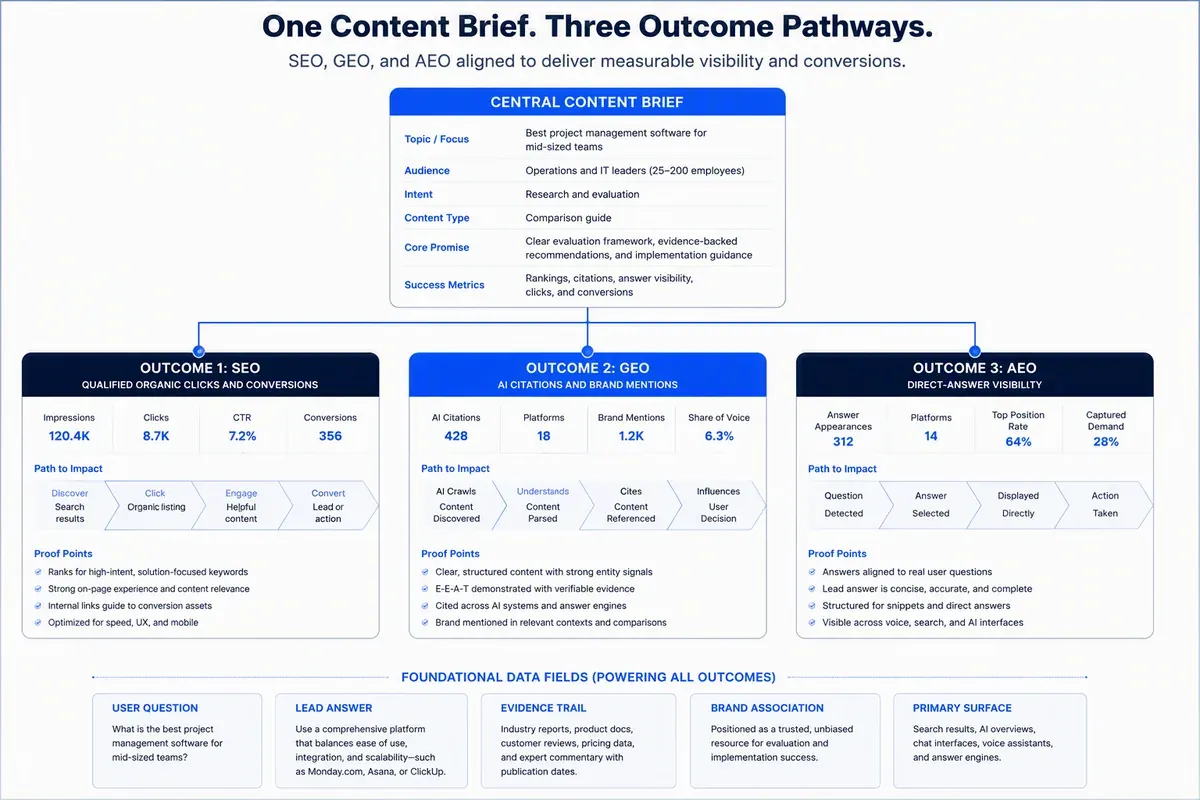
Start every brief with one outcome hierarchy: earn visibility wherever your audience searches, then turn that visibility into qualified demand. AI search optimization explained shows why a first-page ranking only matters when it matches intent and supports a meaningful business action.
Use three connected definitions to set the measurement standard:
- Search Engine Optimization (SEO): SEO improves traditional rankings, qualified organic clicks, and conversions. For each query family, capture the ranking opportunity, expected click quality, and intended action, such as a demo request, signup, purchase, or assisted conversion. Organic sessions can mislead when broad informational traffic produces little commercial value.
- Generative Engine Optimization (GEO): GEO prepares content for a Large Language Model (LLM) to understand, retrieve, select, summarize, and cite through content retrieval. ChatGPT, Gemini, Perplexity, Google AI Mode, and Google AI Overviews can answer a query without sending a visit. GEO measures answer inclusion, AI citations, accurate brand mentions, citation share, and share of voice alongside rankings.
- Answer Engine Optimization (AEO): AEO targets extractable answers in featured snippets, People Also Ask, FAQ results, Google AI Overviews, and Bing Copilot. It complements GEO by defining whether a priority question receives a direct answer on the intended surface.
Each query needs one primary outcome. A definition query may require a concise cited explanation, while a commercial comparison should favor qualified clicks and conversion assistance. This protects zero-click performance from being mislabeled as failure when a credible citation builds visibility, while preventing citation counts from masking weak demand capture.
Make the brief easy for search and AI systems to interpret with these fields:
- User question: State the question in the audience’s language rather than internal keyword shorthand.
- Lead answer: Place a concise answer near the top before expanding on it.
- Evidence trail: Include the source, visible author, publication date, and on-page evidence location.
- Brand association: Identify the brand fact or entity relationship that must remain intact in an extracted answer.
- Primary surface: Specify whether success is judged in traditional results, an answer feature, or an AI-generated response.
The outcome map keeps measurement consistent across accounts:
| Discipline | Primary outcomes | Brief measurement fields |
|---|---|---|
| SEO | Rankings, qualified organic clicks, conversions | Query family, intent, click quality, conversion action |
| GEO | Answer inclusion, AI citations, citation share, brand visibility | Tracked query, cited page or domain, answer presence, brand mention, share of voice |
| AEO | Extracted answers and answer-surface visibility | Priority question, lead answer, target surface, supporting evidence |
Floyi’s Topical Authority Scorecard and AIRS Analyzer track these signals by query alongside conventional search performance. Use the primary outcome to judge whether each brief created the authority signal and demand path it was designed to produce.
Step 2: Research SEO, GEO, And AEO Opportunities
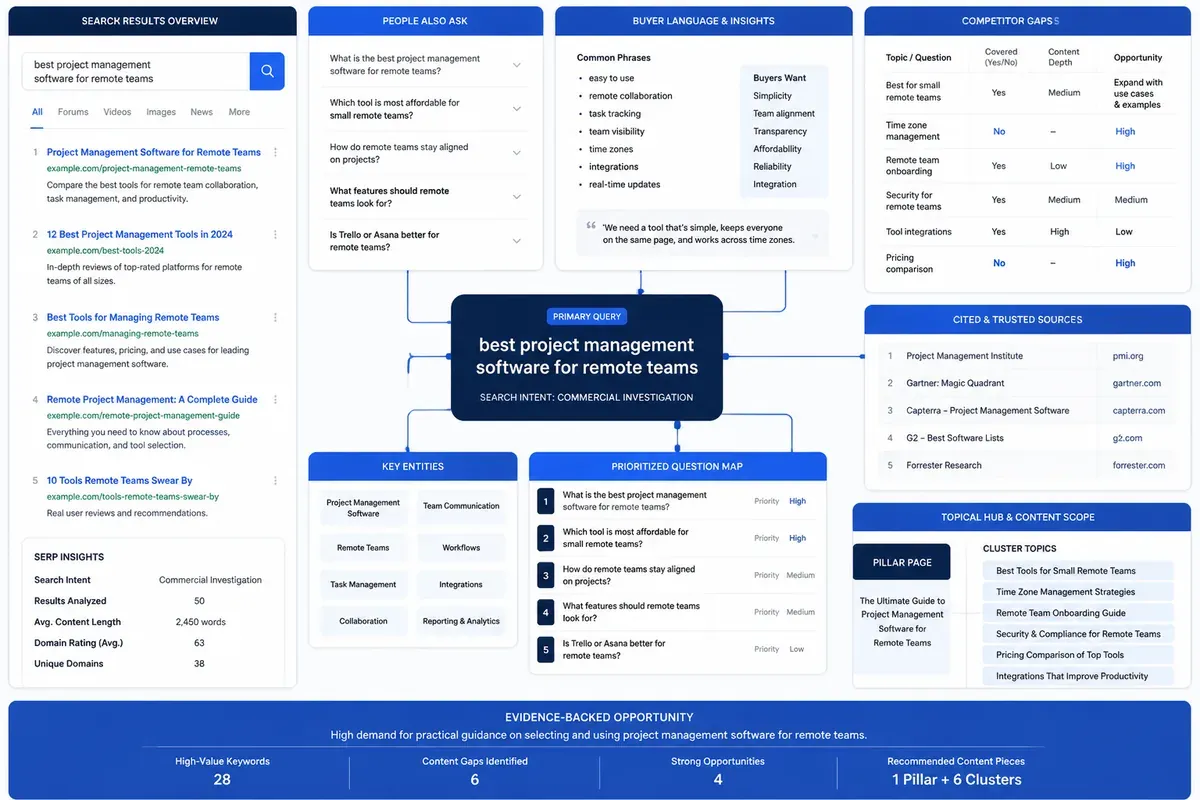
With those outcomes defined, build one evidence-backed opportunity set for SEO, GEO, and AEO instead of maintaining separate research tracks. This GEO content brief strategy ties buyer needs, live search results, and verifiable evidence to one defensible page plan.
Start with the primary query and inspect the live search engine results page (SERP), capturing ranking formats, recurring subtopics, People Also Ask questions, featured answers, cited domains, and artificial intelligence (AI) results. This review establishes search intent while showing where existing guidance is thin, outdated, unclear, or unsupported.
Buyer language belongs beside keyword data. Gather questions, objections, desired outcomes, and decision criteria from customer conversations, sales notes, site search, analytics, reviews, forums, and social discussions. Researching AI search demand adds AI result patterns to the evidence set without replacing firsthand audience research.
When first-party data is sparse, competitor reviews and active community threads can reveal unmet needs. Retain the wording people use when it captures a real concern, since those context phrases often make better question targets and direct answers than keyword-tool variations. Someone worried about approval bottlenecks needs a different answer from someone seeking a basic definition.
Turn the research into a topical hub rather than a disconnected term inventory. Put the central intent at the center, then group seed queries and audience questions by the answer required, buyer stage, and informational or transactional value. Teams may refer to early groupings as content clusters, but the final map needs a clear topical scope so adjacent subjects do not dilute the page’s purpose.
A useful research pass produces these inputs before outline review:
- Define conversational intent: Capture the reader’s job, including the uncertainty or decision behind the query.
- Prioritize answer opportunities: Select five to ten distinct secondary questions or context phrases that naturally follow the primary query. Each should support a concise answer before fuller evidence, examples, or tradeoffs.
- Specify entities and evidence: Identify the people, products, concepts, standards, and organizations the page must address. Pair planned claims with independently verifiable studies, reputable publications, analyst reports, expert commentary, reviews, or public coverage.
- Find information gain: Compare competitor claims, examples, freshness, source quality, and answer clarity against the question map. Resolve unanswered decision criteria or audience-specific nuance instead of copying heading structures.
- Validate AI-assisted synthesis: An LLM can summarize pages and suggest related entities, but its knowledge can lag behind live results. Check every recommendation against current SERPs and subject-matter expertise.
GEO is primarily strategic, not merely technical. Brand positioning, credible public coverage, reviews, analyst relationships, and recognizable entities affect whether AI systems have reliable material to cite. AI search platform options can inform your research stack, but no platform removes the need to verify claims and sources.
Consolidate primary intent, prioritized questions, the topical hub, competitor gaps, entities, approved evidence, brand context, and supplied links in the brief’s research layer. That record gives writers firm boundaries and keeps the finished page aligned with the buyer’s decision path.
Step 3: Prioritize Questions, Entities, And Evidence
Start by naming the page’s primary entity in its canonical form, the audience problem it solves, and the narrow boundary of the answer. That decision creates entity-based content planning instead of an expanded keyword list. A page about project management software for agencies, for example, should not drift into general productivity advice simply because related terms appear in the SERP.
Supporting entities should clarify a necessary relationship to the primary entity. Tangential concepts dilute relevance and make the brief harder to execute. Build the entity map in three passes:
- Compare the market context: Review recurring concepts across high-performing pages, AI answers, and People Also Ask questions. Treat AI Overview material as context, not as a competing result.
- Check site coverage: Compare those concepts with published URLs and active drafts. Mark each candidate as missing, covered, or overused. A covered entity may need a stronger internal link rather than another section or new page.
- Keep material gaps: Retain entities that help readers make a decision, complete a task, or assess a claim. This prevents content clusters from becoming loosely connected pages with no clear authority role.
Questions should reflect audience language, not SERP patterns alone. Combine follow-up queries and answer snippets with wording from sales calls, support tickets, reviews, win-loss interviews, and cancellation surveys. One core conversational intent should guide the page, with five to ten distinct secondary questions that each warrant meaningful coverage.
Map every retained question to search intent, buyer stage, and the evidence needed to answer it:
| Question type | Brief requirement | Evidence standard |
|---|---|---|
| Awareness | Explain the problem or process clearly | Direct explanation, first-party expertise, and relevant examples |
| Consideration | Compare options, compatibility, cost, or tradeoffs | Verifiable details, supported claims, and clear constraints |
| Decision-adjacent | Address implementation, policy, or proof concerns | Specific documentation, current details, and visible provenance |
This structure keeps one buyer journey in focus. A brief that mixes early education with purchase evaluation often fails both audiences. Comparisons, pricing, compatibility, and performance claims need support before they enter the outline, not after a draft is underway.
Prioritize opportunities with a transparent four-part score rather than raw search volume. We weigh observable demand, the site’s authority gap, available evidence strength, and business value. Floyi’s Authority Planner brings competitor strength, People Also Ask questions, matched-page Google Search Console clicks and impressions, AI context, and internal-link recommendations into one planning view.
A lower-volume question can outrank a popular term when it closes a meaningful gap without duplicating an existing URL. Topical authority grows at the hub level, not through theoretical completeness. Publish pages that address the largest authority gaps first, then remove ideas that are low-intent, redundant, weakly supported, or likely to create keyword cannibalization.
Expand into adjacent questions only when the core hub has sufficient coverage depth and internal-linking integrity. Capture the intended destination, reader intent, and anchor-text coverage while evaluating each question, then use matched-page clicks and impressions to assess whether the hub is gaining traction.
Step 4: Build Your Writer-Ready Brief
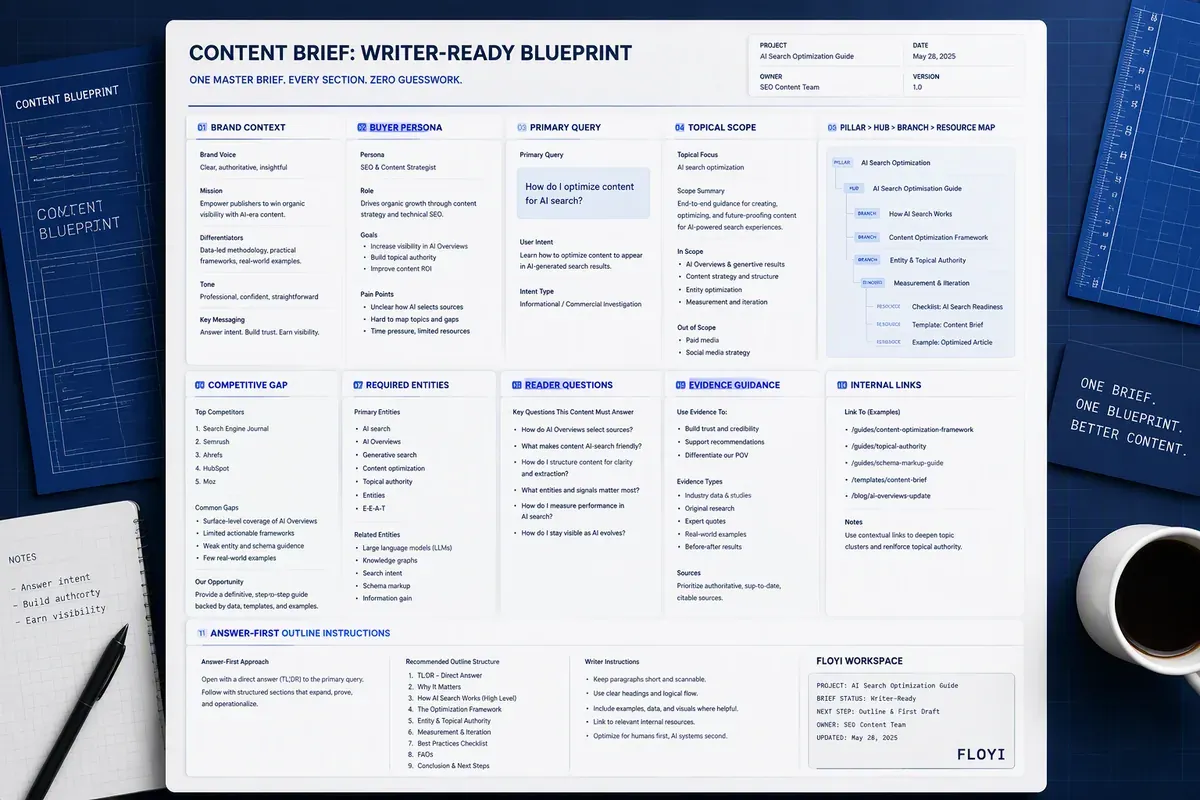
To turn the prioritized research into execution, a writer-ready brief should be one master blueprint, not separate SEO, GEO, and AEO documents with competing priorities. When audience need, target outcome, evidence standards, and optimization requirements sit in the same artifact, your human and AI-assisted drafts start from the same boundaries and require less rework.
A GEO content brief strategy should carry forward decisions made before SERP research. Place brand context and the primary buyer persona before competitive findings, rather than adding them as late style notes. That sequence keeps the page from copying ranking competitors while missing your voice, the buyer’s objections, or the outcome they need.
The framework connects research, production, and measurement:
-
Set the strategy header: Include the working title, primary and supporting queries, locale, language, content type, search intent, buyer-journey stage, conversion goal, and a flexible word-count range. A range gives writers room to answer the topic without padding thin sections to hit an arbitrary total.
Put brand context and the primary persona directly beneath those fields. Capture the reader’s role, immediate problem, objections, desired outcome, approved point of view, and voice guidance. An SEO operations manager handling several client accounts needs different examples and proof than a first-time site owner.
-
Turn research into topical scope: Record the authority anchor and the page’s Pillar > Hub > Branch > Resource location. Define the topical scope, competitive gap, and exclusions that prevent adjacent Resources from competing for the same intent.
Floyi’s Authority Planner carries approved brand and persona inputs into a topic-led brief while surfacing SERP and AI context, strategic gaps, internal linking suggestions, and available anchors. This is where content GEO becomes an editorial decision instead of an imitation of ranking headings.
The research-to-scope block includes:
- Topical scope: The problem, audience context, and depth the page must cover.
- Competitive gap: The missing explanation, evidence, or viewpoint the page can add.
- Required entities: People, products, concepts, standards, and tools that need accurate treatment.
- Reader questions: Questions ranked by importance, including direct-answer opportunities.
- Related concepts: Supporting ideas that make the main answer complete without repeating it.
- Exclusions: Topics assigned to other Resources to reduce cannibalization.
-
Specify evidence and information gain: For each substantive claim, identify the approved source or source type, exact fact, quote, statistic, case-study example, or expert perspective, plus its placement in the outline. Evidence may come from original data, a documented brand story, a case study, an expert, or current third-party research.
This supports E-E-A-T, but the operational benefit is more immediate. Writers receive a factual assignment instead of a vague request to add sources. AI-generated material can be outdated or flatten important distinctions, so it should not become the evidence plan. State the original data, current evidence, brand perspective, or distinct viewpoint that makes the page more useful while remaining accurate.
-
Build the production outline and completion check: Every H2 and H3 needs an objective, key points, required reader questions and entities, evidence inputs, relevant internal linking targets, and an approximate word range. Section instructions should also specify answer-first formatting, quote-ready definitions or steps, and technical requirements such as schema inputs where relevant.
Strong content structure tells the writer what each section must accomplish, not merely what the heading says. Parent-level fields preserve strategy, while section-level instructions direct execution. That separation reduces generic outlines, repeated points, and drafts that drift from intent.
Draft completion means the page fulfills intent, addresses the defined persona in the approved voice, uses entities precisely, supports claims with evidence, answers priority questions directly, and follows the planned structure. Review query and semantic coverage, direct-answer passages, freshness signals, source quality, and technical requirements in the same workflow.
After publication, measure rankings, organic traffic, conversions, and mentions or citations in Google AI Overviews, AI Mode, Gemini, and ChatGPT Search. Feed the findings into the next Authority Planner decision so future briefs reflect published performance rather than restarting research from scratch.
Specify Answer-First Content Architecture
An answer-first architecture turns planned topical scope into AI-readable content by making every heading, answer, and evidence reference understandable on its own. Begin with a descriptive working title and a one-sentence intent statement that identifies the audience, the problem, and the expected outcome.
Translate the conversational query into one canonical answer the article must substantiate. Set a word-count range rather than a fixed quota, giving the writer enough room to cover the topic without padding. Those fields should reflect the approved authority map, brand voice, and buyer personas. Competitor pages can reveal SERP conventions, but they should not dictate what your brand becomes known for.
Build the content structure in this sequence:
- Set the title, intent, and canonical claim: Frame the title around the reader’s job to be done. The intent explains the page’s purpose, while the claim answers the query in language close to the searcher’s wording and gives the draft one defensible position to support.
- Convert priority questions into the heading structure: Give each H2 a major task, decision, or outcome. Use H3s for five to ten secondary questions and context phrases that help the reader complete that task. “What evidence supports an answer-first claim?” works without surrounding copy. “Key considerations” does not.
- Place the answer before the explanation: Add a 40 to 80-word lead answer beneath the introduction or each priority question. It should resolve the question in plain language before qualifications, promotion, or background. This is content extractability in practice because the passage still works in a search result, AI response, or cited excerpt.
- Define each content chunk: Use that direction to connect each section’s claim to its supporting evidence. Support may include a definition, first-party example, data point, named method, or cited source. This keeps research attached to the claim it validates instead of leaving proof stranded elsewhere in the brief.
The presentation should fit the decision the reader needs to make:
| Reader need | Best format | Brief direction |
|---|---|---|
| Complete a sequence | Numbered steps | State the order and the condition for moving forward. |
| Evaluate criteria or options | Bullets | Use explicit labels that stand on their own. |
| Compare responsibilities or alternatives | Table | Make each cell understandable outside its row. |
| Locate a major question in a long guide | Table of contents | Match the language used in the H2 questions. |
Place evidence beside the statement it supports. A visible provenance line can identify the source, author, date, and evidence location immediately after a lead answer. Separate verified facts from editorial interpretation, and avoid performance claims the available evidence cannot support. Stable on-page anchors also connect answer text with sources and schema, while technical indexing requirements belong in the later implementation review.
For HowTo pages, identify each visible step before considering schema. The same sequence applies to Answer Engine Optimization: readers need clear copy first, then markup should reflect claims and steps they can verify on the page.
Close with a compact summary that restates the canonical answer, key actions, and any material limitation. Authority Planner carries the approved title, intent, question hierarchy, evidence guidance, and format choices into the writer-ready brief, keeping the published draft aligned with your planned topical scope and brand context.
Assign Links, Schema, And Technical Checks
To carry that answer-first architecture into publication, put a technical-requirements block in every brief so discoverability is set before drafting rather than repaired at publication. The block should capture:
- Metadata: Proposed title tag, meta description, canonical URL, primary query, intended URL slug, conversion goal, and publication or update date.
- Intent alignment: The title, meta description, H1, and opening answer should address the same search task without repeating the same wording.
That gives SEO, GEO, and AEO a single publishing standard instead of separate late-stage checks.
Internal linking belongs in the same brief block. Identify each destination, its placement on the page, and descriptive anchor text. Include a contextual link to the parent authority anchor, relevant sibling and child resources where they help the reader, and an inbound link from a thematically close existing page after publication. Generic anchors such as “learn more” hide the destination topic from readers and systems. Floyi Authority Planner can suggest parent, sibling, and child links with locale-aware anchors that match the planned topical map.
Schema markup must reflect visible content and the page’s actual search task:
- Article or BlogPosting: Use this markup for the page’s publishing context.
- HowTo: Reserve HowTo for pages with genuine, visible sequential instructions.
- FAQPage: Use FAQPage only when the published page contains visible questions and answers.
- Direct answers and claims: For direct answers and claims, include JSON-LD with author and date fields plus a real evidence reference on the page (source). Markup must match the published answer, and claim identifiers should remain unchanged through updates.
Content extractability depends on semantic HTML as much as strong copy. Require one H1, a logical H2 and H3 hierarchy, and a direct 40 to 80 word answer near the top. Use meaningful <main>, <article>, <nav>, and heading elements rather than generic containers styled as headings. Concise paragraphs, lists, tables, and numbered steps give answer engines clearer material to quote.
Every section that supports a claim needs a stable ID so schema, internal links, and visible provenance point to the same evidence.
Media requirements should also be explicit. Each screenshot, diagram, video, or comparison graphic needs a defined purpose, file name, nearby explanatory copy, and concise alt text that conveys its informational value. Captions clarify non-obvious visuals, while decorative images use empty alt text. Keep key instructions, figures, and evidence in the text layer for mobile readers and crawlers.
Technical crawlability requires a final publisher check before indexing:
- Index access: The page returns a successful HTTP status, remains indexable, uses HTTPS, and declares the preferred canonical URL.
- Sitemap accuracy: The XML sitemap includes the URL with an accurate
lastmodvalue. - URL hygiene: No accidental noindex directive, blocked resource, redirect chain, or duplicate URL variant remains.
- Mobile and JavaScript delivery: Text is readable, links are tappable, media is compressed, layouts stay stable, and the primary answer, headings, links, and schema appear in crawlable rendered HTML without delayed interaction.
These requirements preserve the page’s meaning from brief through publication, citation, and future updates.
Step 5: QA SEO, GEO, And AEO Brief Requirements
Use a five-gate QA pass before a brief becomes a draft. It protects topical relevance, makes evidence usable across SEO, GEO, and AEO, and keeps generic AI search content out of editorial review.
- Confirm intent and topical scope: Make sure the page completes the primary search task in the format searchers expect and answers priority questions without drifting into adjacent subjects. Include entities only when they clarify meaning. Remove duplicate subtopics, keyword stuffing, tangents, and overlap with existing pages. A page that tries to address every related query usually loses semantic focus and offers little information gain.
- Test the answer-first structure: When the intent calls for a direct response, begin with a self-contained 40- to 80-word answer before adding detail. The lead should state a specific canonical claim, not delay the answer with a broad introduction. Descriptive H2 and H3 sections, explicit entity relationships, and focused follow-up detail help search systems and AI Overviews interpret the page. AI search algorithm fundamentals show why visible claims and machine-readable signals must agree for AI search visibility.
- Verify evidence and E-E-A-T: Support every material claim, statistic, recommendation, and comparison with reputable external sources, first-party data, or documented experience. Keep the evidence close to the claim it supports. Visible provenance should identify the author or team, publication or update date, evidence anchor, and a relevant real-world example. AI citations are more credible when readers can inspect the source material on the page instead of encountering conclusions with no visible basis.
- Check links, schema, and publishing readiness: Internal links need relevant destinations and descriptive anchor text, while external references should support consequential claims. FAQPage, HowTo, and Claim schema must match visible wording, connect each claim to a real evidence anchor, include applicable author and date fields, and retain stable identifiers across updates.
A final technical and accessibility pass should confirm the following:
- Referenced anchors: Every cited section ID opens the intended evidence.
- Crawl signals: Canonical URLs, robots directives, sitemap updates, and indexing readiness match the intended page.
- Rendered schema: Structured data is valid and reflects content readers can access.
- Accessible presentation: Visual and multimedia assets include meaningful alternative text or transcripts, headings follow a logical order, links describe their destination, and tables remain clear without surrounding design.
- Visible evidence: Lead answers, provenance labels, and source links appear on the rendered page rather than only in schema or inaccessible interface elements.
- Reject weak AI output and confirm brand fit: Remove invented examples, stale facts, filler FAQs, repetitive phrasing, and unsupported assertions. Distinguish documented experience from opinion, use approved terminology, and add insight that ranking pages have not already exhausted. The AI search measurement framework connects this standard to AI visibility measurement, including AI search visibility and zero-click performance.
Approve the brief only when its intent, visible page experience, evidence trail, technical markup, and brand perspective support the same claim.
Step 6: Measure AI Visibility And Improve Briefs
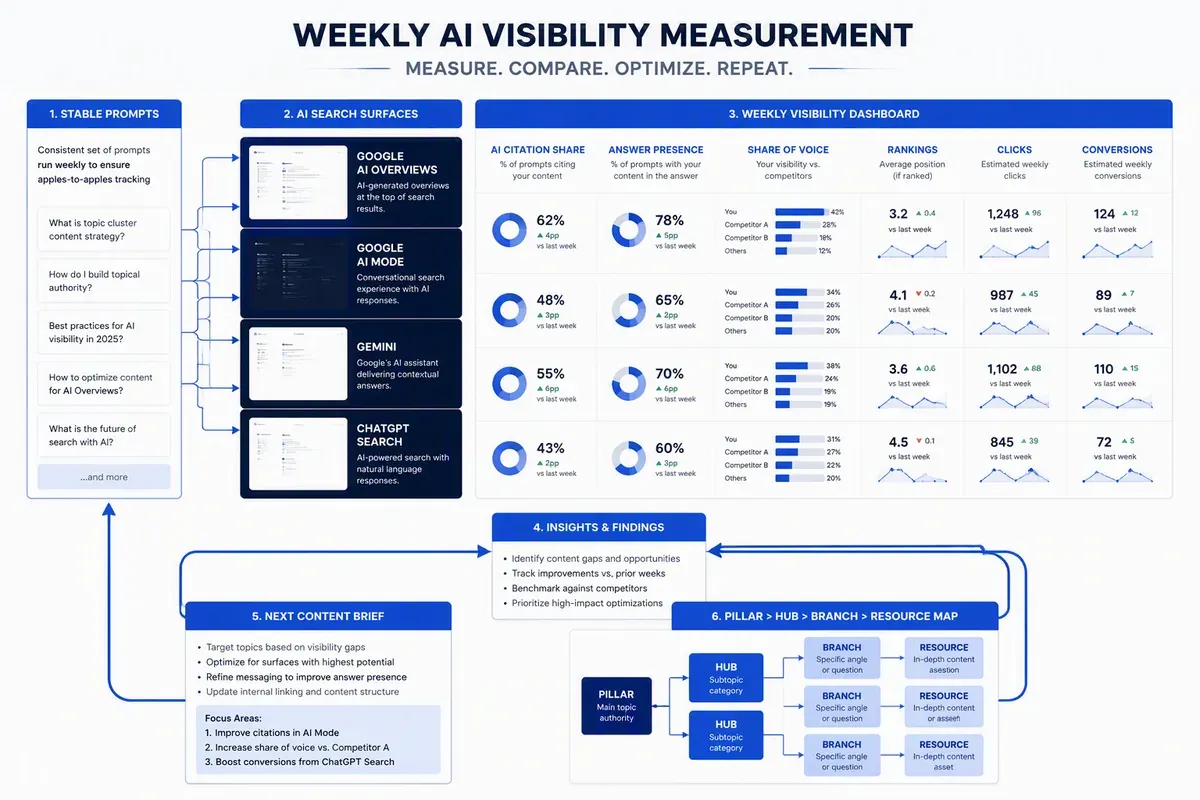
After a brief clears those QA gates, measure each published brief across SEO, answer-engine, and GEO outcomes. Higher rankings alone do not equal complete search visibility when a page is absent from featured answers, AI responses, or cited sources.
Use three outcome tracks for every page:
- SEO performance: Compare rankings, impressions, clicks, and click-through rate with the intent and query set recorded in the brief.
- Answer-engine visibility: Capture featured answers and other extracted-answer appearances where the page provides a direct response.
- GEO presence: Track unlinked brand mentions and linked citations in AI-generated answers. Strong rankings without citations signal an AI visibility gap, while citations without qualified visits do not establish commercial value.
Build a fixed, intent-matched weekly prompt set from the questions captured in each brief, keeping the page URL, target query, country, language, location, and brief-version identifier stable. Test the same prompts across Google AI Overviews, AI Mode, Gemini, and ChatGPT Search, retaining the full response, cited domains, brand mention or link status, and the ChatGPT Search query when available.
Comparable metrics make cross-engine results useful:
- AI citation share: The proportion of tracked answers that cite your domain.
- Answer presence: The proportion of answers that name or cite your brand or domain.
- Share of voice: Your citations divided by all cited domains in the tracked answers, also called share of model.
Segment these measures by page, query theme, engine, and brief version. A page can earn Gemini citations while remaining absent from AI Mode, and blended reporting can hide the specific brief field that needs revision.
Pair AI-surface results with commercial evidence. Review rankings, clicks, click-through rate, assisted conversions, extracted-answer appearances, citations, and unlinked mentions together. The resulting diagnosis is more useful when it distinguishes between common patterns:
- Cited page with few qualifying visits: Intent alignment may be off, or the page may need a clearer next step.
- Organic performer without AI citations: The lead answer may be too indirect, or the page may lack strong evidence, original statistics, expert quotations, or a clear structure.
- Frequent brand mentions without links: The wider information ecosystem may recognize the brand while the page lacks a source-worthy asset or corroborating third-party coverage.
Floyi’s authority views connect page-level findings to your Pillar > Hub > Branch > Resource map. Content Authority shows whether planned resources shipped and ranked. Market Authority shows the ranking value your domain owns relative to competitors. AI Authority measures importance-weighted presence across tracked AI engines and grades topics as Not Present, Mentioned, or Cited. Keep AI search deltas separate from SERP ranking changes so a gain in one channel does not conceal a loss in another.
Diagnose misses against the original brief, not a general sense that the page underperformed. Compare surfaced answers and cited domains with the recorded intent, direct answer, entities, source quality, original evidence, structure, internal links, structured data, and topical scope. AirOps found that 85% of AI brand mentions originate on third-party pages, so investigate corroboration and ecosystem gaps alongside on-page copy.
Keep a stable weekly record for every prompt test:
| Field | What it preserves |
|---|---|
| Week and engine | The timing and AI surface tested |
| Query and page URL | The exact prompt-to-page relationship |
| Brief version | The specification behind the page |
| Answer presence and cited domains | Whether the brand appeared and which domains earned citations |
| AI citation share and share of voice | Comparable visibility across tracked answers |
| Change notes | Revisions, model shifts, or source changes affecting results |
Log the baseline, latest result, winning competitor sources, and the specific brief field to revise. Turn that evidence into the next-brief action, whether that means adding a missing question, strengthening provenance, expanding an entity explanation, or rewriting the lead answer.
Floyi’s Authority Planner carries brand context, SERP findings, and link recommendations straight into the next brief, so each revision starts from measured performance. Generate a writer-ready brief.
SEO, GEO, And AEO Brief FAQs
These FAQs cover the practical choices behind an SEO, GEO, and AEO brief, including research inputs, brand context, topical scope, and measurement after publication.
1. Who Should Create SEO Content Briefs?
No single role owns an SEO, GEO, and AEO brief. Your content strategist or SEO lead should interpret SERP patterns and gaps, then set intent, topical scope, audience, brand context, entities, and answer engine optimization method requirements without copying competitors. SMEs validate claims, terminology, evidence, and perspective. Writers can assemble briefs when they know the brand and research process, while technical SEO and analytics partners inform schema, internal links, measurement, and AI-search visibility. The final brief gives writers one clear source of direction before drafting.
2. Can One Brief Target SEO, GEO, AEO?
Yes. A unified brief can support SEO, GEO, and AEO when shared search intent, audience need, topical scope, entities, and evidence guide the page. SEO sets relevance and ranking targets. AEO defines the direct question and answer-first FAQ response, while GEO adds a 40 to 80 word canonical claim, visible provenance, and claim-to-evidence schema. The result is one page that can earn organic clicks while supplying AI systems with an accurate, citable answer.
3. How Detailed Should Content Briefs Be?
A useful brief removes avoidable ambiguity without scripting the article sentence by sentence. It makes the audience, search intent, primary and supporting questions, entities, and topical scope clear, while leaving room for expert judgment. Include answer-first heading architecture, section guidance, evidence requirements, designated internal and external links, schema recommendations, and QA checks. Flexible word-count ranges keep AI-assisted drafts focused without forcing filler or repetition.
4. Do AI Citations Require Original Research?
No. AI citations can rely on stable claims supported by primary sources, official documentation, authoritative publications, and accurately attributed expert quotations. Clear provenance and citation requirements make the evidence easy to verify.
Original research carries more weight for disputed, fast-changing, niche, or experience-led questions. When existing coverage repeats the same conclusion, use distinctive data or firsthand expertise and state the collection date, methodology, scope, and limitations.
About the author

Yoyao Hsueh
Yoyao Hsueh is the founder and CEO of Floyi, the topical authority platform, and the founder of Main Heading, an SEO and AI search agency. He created Topical Maps Unlocked, a course studied by thousands of SEOs, content strategists and digital marketers, founded TopicalMap.com, a done-for-you topical mapping service for agencies and enterprise teams, and publishes the weekly Digital Surfer newsletter on SEO, content strategy and AI search.
About Floyi
Floyi is a closed loop system for strategic content. It connects brand foundations, audience insights, topical research, maps, briefs, and publishing so every new article builds real topical authority.
See the Floyi workflow