
AI Search Opportunity Discovery: An Evidence-Based Framework
Use AI search research to find, validate, and prioritize opportunities, then build topical authority plans and govern AI search visibility.
A rising AI citation count isn’t an opportunity by itself. AI search opportunity discovery turns changes in answers, citations, competitor framing, and buyer questions into a decision you can support with evidence.
A competitor may appear repeatedly in ChatGPT while Google’s SERP shows different sources and a different explanation of the same need. Floyi’s AIRS Analyzer records answer framing, cited-source frequency, query fan-out, and entity relationships, then tests those findings against approved brand and persona scope. That keeps a promising topic from entering the queue when first-party proof cannot support its strongest claim.
Prioritize business fit, audience value, urgency, authority potential, and source confidence, then subtract uncertainty. The resulting verdict should move a topic into a brief, hold it for validation, or mark it as blocked until better evidence exists.
AI Search Opportunity Discovery Key Takeaways
- Treat AI search findings as provisional until sources, brand fit, and decisions are clear.
- Set brand and persona scope before researching topics, competitors, or market signals.
- Use fixed query sets and consistent conditions to compare AI answers with SERPs.
- Capture answers, citations, mentions, framing, follow-up queries, and source types for every observation.
- Validate material claims through human review of cited pages and underlying evidence.
- Score opportunities by fit, value, urgency, authority potential, source confidence, and uncertainty.
- Measure AI visibility by citation share, answer presence, share of voice, and brand framing.
What Is AI Search Opportunity Discovery?
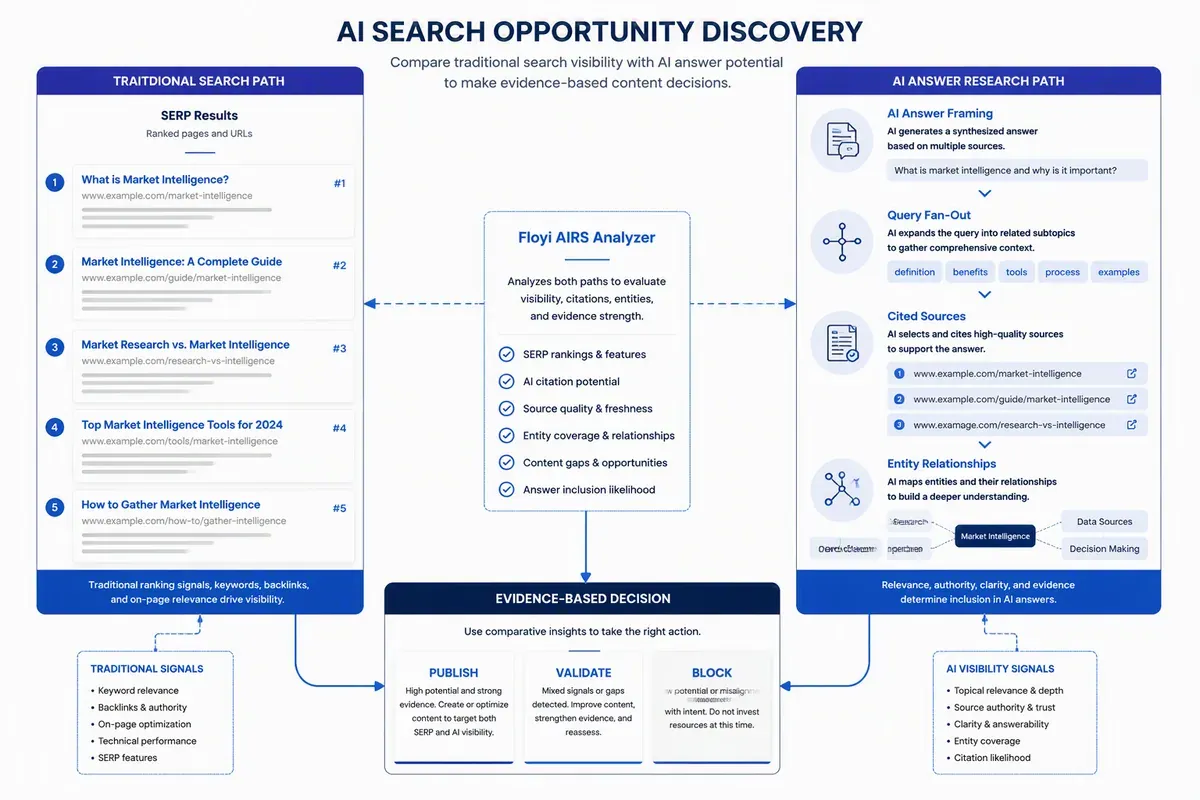
Artificial intelligence (AI) search opportunity discovery is an evidence-backed method for turning shifts in audience intent, competitive coverage, brand perception, and market questions into a defensible content or growth decision. An AI search opportunity is more than a query with traffic potential or a possible page. It establishes whether you should publish, adjust positioning, collect more evidence, or deliberately hold back.
Traditional search remains essential because it retrieves indexed pages and ranked links that show what appears for a query. AI search adds an intent-aware layer, using large language models (LLMs), natural-language processing, and machine learning to interpret context, assess unstructured information, synthesize direct answers, and carry context across follow-up questions. AI search and discovery can span text, voice, and image journeys without replacing conventional search.
The decision model separates retrieval from action:
- Search shows what exists: Ranked pages, keyword results, competitor uniform resource locators (URLs), and search engine results page (SERP) features reveal the visible information set.
- Research shows what is known: Citations, customer language, entity relationships, market evidence, and recurring claims establish what the available evidence supports.
- Opportunity discovery establishes what changed and what follows: The assessment connects evidence to audience needs, topical scope, brand fit, and a specific next action.
AI search optimization requires more than a polished model response. What is AI search optimization explains why visibility depends on how search systems and AI answers frame a brand, cite its sources, and connect it to the buyer’s question.
Keep the evidence inspectable by comparing:
- SERPs and AI-generated answers: Identify where the answers, framing, and cited sources differ.
- Cited domains and follow-up queries: Check which publishers repeatedly appear and how the question expands across a search journey.
- Entity relationships, customer wording, and market signals: Test whether the language and associations fit the audience and brand.
AI can process diverse inputs and surface cross-source patterns, which can speed literature review, corporate innovation, consumer-market tracking, and technology scouting. For content strategy, however, the output must remain narrow: a priority supported by underlying results, not a confident summary that cannot show its work.
A competitor cited repeatedly for a buyer question represents a finding, not an opportunity by itself. The opportunity emerges when recurring claims withstand review, your brand is absent or weakly represented, the subject belongs within its topical scope, and you can add a credible contribution. When first-party evidence or knowledge-base material cannot support the strongest angle, Floyi marks it as a blocked opportunity that needs data rather than inventing a claim.
This is where artificial intelligence search supports strategic judgment. Floyi’s AIRS Analyzer compares conventional results with AI-search evidence, including cited mentions, source frequency, answer framing, query fan-out, and entity relationships. Treat each finding as provisional until its sources, brand relevance, and intended decision are clear.
How Do You Define Brand And Persona Scope?
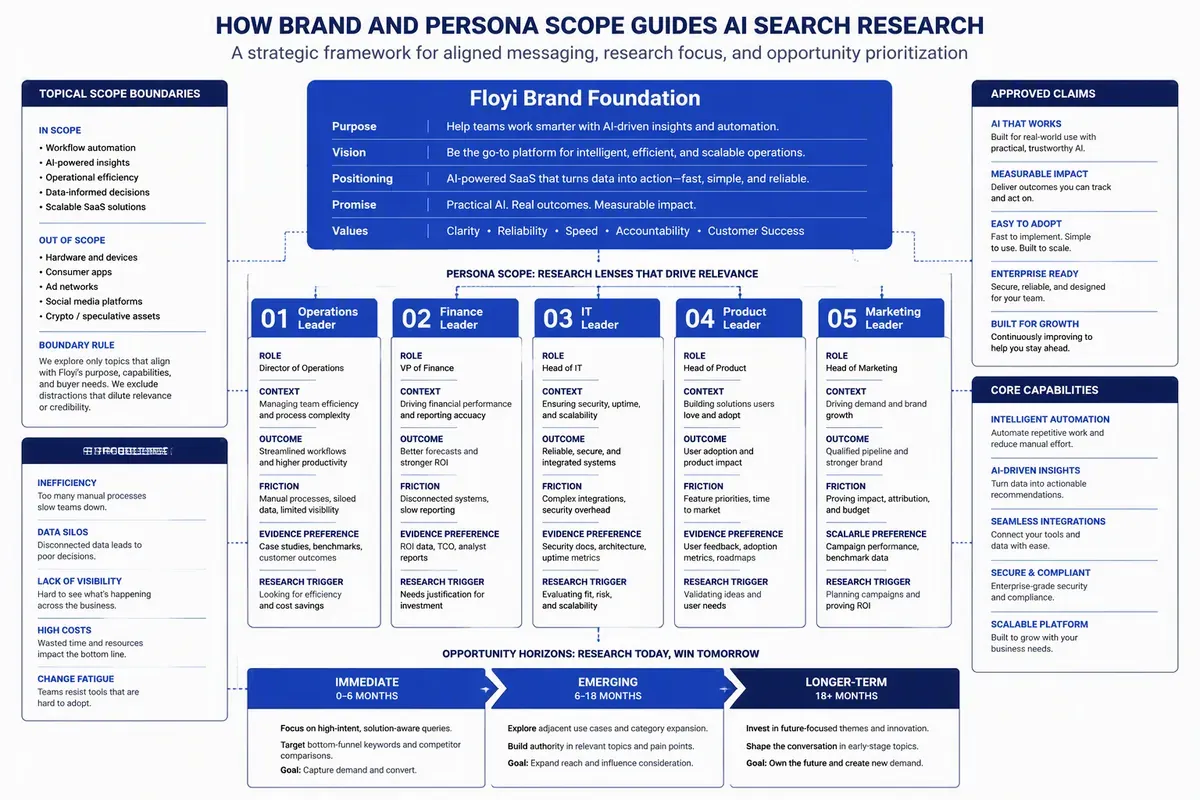
To turn AI search findings into defensible decisions, brand and persona scope sets the commercial boundary for artificial intelligence (AI) search research. It keeps findings tied to what you can credibly discuss, sell, and support, rather than pulling the plan toward adjacent topics with no business value.
Start with a concise brand boundary that captures positioning, differentiated capabilities, approved claims, competitors, voice, and relevant products or services. Where a proposition, regulation, or search vocabulary changes by country or language, use a separate definition. A global version can blur meaningful differences and produce research that fits no market well.
Floyi’s Brand Foundation turns those inputs into a versioned source of truth for topical research, briefs, and planning. When positioning or messaging changes, we recommend updating the foundation before generating new work so outdated assumptions do not carry into the publishing queue.
A useful persona set is small enough to change a research decision. Broad labels such as “marketing leaders” do not establish what an answer must accomplish. Capture the decision context for each persona:
- Role and context: Industry, seniority, geography, income where relevant, and operating conditions.
- Outcome and friction: Desired results, pain points, objections, fears, and level of expertise.
- Evidence preferences: Trusted sources, unfamiliar terms, and the proof required before a recommendation earns confidence.
- Research trigger: An urgent problem, option evaluation, purchase planning, or market monitoring.
Identical queries can require very different answers. A consultant comparing platforms needs tradeoffs and constraints, while an in-house leader responding to a visibility decline needs diagnosis, evidence, and a practical course of action. Floyi’s Audience Insights generates one to five personas by geography, income, and role, preserving approved guardrails while giving topical research a clearer view of buyer intent.
Map only capabilities you can substantiate to the customer problems and outcomes they address. Structured inputs, such as product specifications and market segments, gain context from unstructured evidence including customer reviews, support conversations, research literature, and market reports. Together, these sources can expose recurring pain points, unanswered questions, underserved needs, and credible intersections between demand and your offer.
Each authority anchor should expand into a semantic, intent-led question space rather than a fixed keyword list. Long-tail discovery with AI helps turn vague conversational language into needs, comparisons, constraints, desired outcomes, follow-up questions, and unfamiliar terms. AI search can then connect multiple variables across the full decision journey.
Opportunity horizons prevent urgent demand from being buried beneath distant possibilities:
- Immediate opportunities: Customer questions and search engine results page (SERP) gaps with direct persona and capability fit.
- Emerging opportunities: New use cases and adjacent fields worth monitoring or testing.
- Longer-term signals: Technology and innovation developments that may inform consumer-market tracking, corporate innovation, technology scouting, or research discovery.
Prioritize only the opportunities with a clear connection to a buyer and a substantiable offer. Keep the approved brand-and-audience context as the inherited input for every topical map and brief, then test each research output against that version before it enters the plan.
How Do You Collect AI Search Evidence?
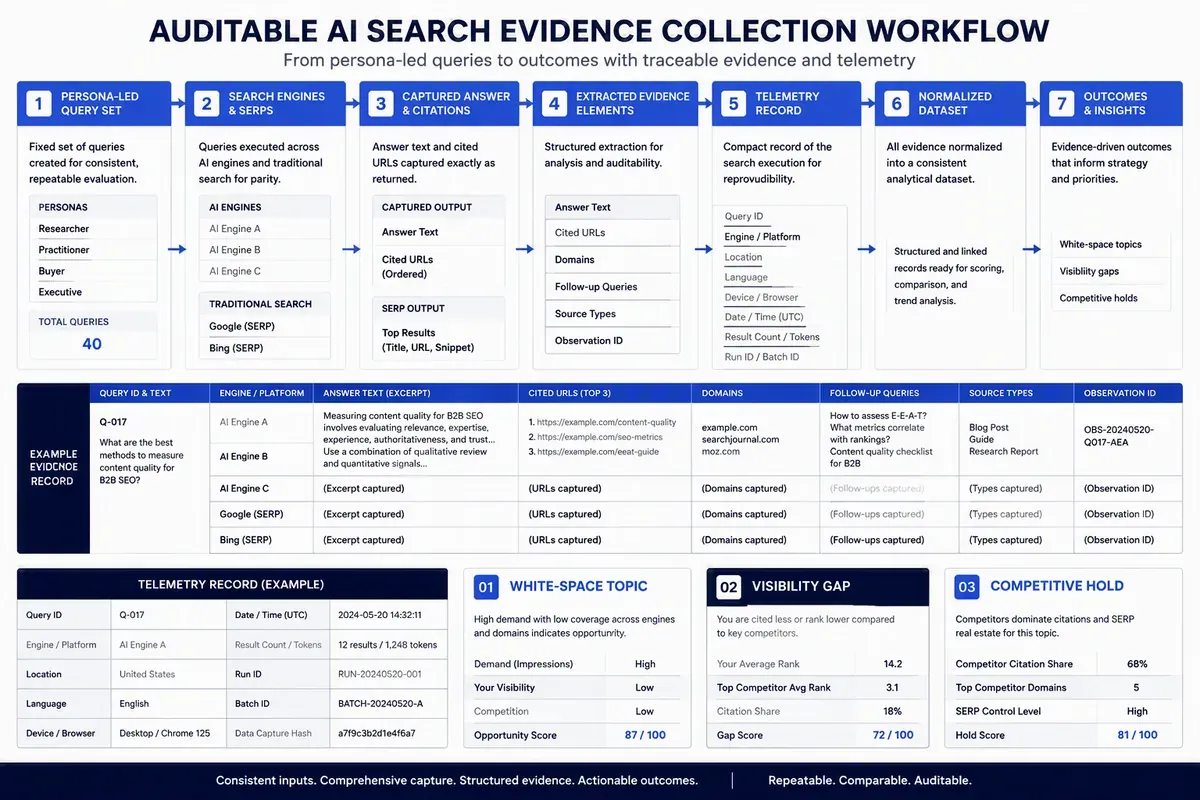
With brand and persona scope defining the research boundary, comparable AI search evidence starts with a fixed, persona-led question set, consistent search conditions, and a record of what each system answered and cited. This structure lets you compare AI-powered search engines with conventional SERPs without mistaking a model, locale, device, or wording change for a market shift.
Build the set around priority journey stages and topical scope. Capture discovery, comparison, troubleshooting, and proof-seeking questions in customers’ language. Preserve exact wording, locale, language, device context, and collection date, because small changes can affect how large language models retrieve sources and frame answers.
Use the same workflow for every query:
- Fix the query set: Give each question a stable query ID and connect it to a persona, journey stage, and topic. Reuse the set as AI search and discovery changes so movement is measurable.
- Search consistent environments: Run every question through the same AI engine set and conventional SERP view. Generative search can resolve a question without a site visit, while Google still supports service discovery, reviews, comparisons, and lead generation.
- Capture complete outputs: Save direct answers, response formats, follow-up suggestions, cited URLs and domains, organic results, AI summaries, and the framing used by brands, competitors, publishers, affiliates, communities, and user-generated sources.
- Preserve the observation: Record the raw answer and material changes, not rankings alone. A ranking cannot show whether AI answer engines selected your brand as evidence.
A stable telemetry record makes repeat checks auditable:
week_start, engine, query, answer_present, our_domain_cited,cited_domains, ai_citation_share, sov, notesAdd an observation ID, cited URLs, and answer text. AI-citation share is the portion of tracked answers citing your domain, while share of voice measures your citations against all cited domains in the same answer set. Optimize for snippet and answer engines when a relevant answer appears but omits your page.
A citation is evidence to inspect, not proof that an answer is sound. Check the claim each source supports, its type and date, cross-engine selection, and whether the generated response reflects it accurately. Owned sites may account for only 5 to 10% of AI-referenced sources, so include publishers, affiliates, communities, and user-generated content. Flag thin or missing public evidence rather than turning uncertainty into a confident claim.
Classify each observation by the decision it supports:
- White-space topic: A persona need receives weak, incomplete, or conflicting answers across AI and SERPs.
- Visibility gap: Useful content exists, but AI systems do not select or cite your brand.
- Competitive hold: A competitor repeatedly supplies the cited explanation, comparison, or proof.
- Emerging signal: A research paper, patent, startup, funding event, researcher, open-source project, or corporate announcement could reshape topical scope.
For every emerging signal, capture its source, date, observed change, likely persona relevance, and next question. Early signals are not validated demand until query behavior and citation patterns support them.
Generative Engine Optimization (GEO) focuses on content AI systems can interpret, synthesize, and cite, rather than conventional rankings alone. Recheck the fixed set regularly, then use answer presence, AI-citation share, and share of voice to identify the query theme that merits a deeper content brief.
Compare Answers, Citations, And Brand Framing
Answer-level comparison matters because AI-generated answers can shape discovery, option evaluation, and brand trust before a visitor reaches a website. McKinsey’s AI discovery survey found 44% of AI-search users name AI search as their primary or preferred insight source, compared with 31% for traditional search. Conventional rankings cannot show whether an engine recommends your brand, frames it cautiously, or excludes it during that earlier decision stage.
Compare the same query in Google’s SERP and across AI answer engines instead of reducing results to one AI search visibility score. ChatGPT, Perplexity, and Claude may differ in answer structure, source visibility, citation behavior, competitor order, and recommendation strength. As a result, AI-powered search engines can change digital visibility while conventional rankings hold steady.
Use one evidence record for each query and engine:
- Answer and placement: Preserve the direct answer, visible ranking or placement, and highlighted brand language so later reviews rely on the original response.
- Citation evidence: Capture cited URLs, domains, citation count, cited-domain share, and whether an owned domain appears. Because third-party sources often dominate AI citations, a namecheck does not prove the engine used your evidence.
- Brand presence: Record answer presence, brand mention, citation share, and share of voice. A citation is evidence supporting an answer, while a mention can be a passing reference.
- Framing and recommendations: Note whether the engine positions each brand as an authority, category option, specialist, alternative, or absent entity. Capture the precise sentiment and qualifiers, including positive, neutral, conditional, or critical language, plus whether it gives a direct recommendation, a shortlist, “best for” guidance, or no choice at all.
Classify cited domains consistently to identify the evidence an engine treats as credible:
- Official brand sites: First-party product information, claims, and documentation.
- Publishers and trade publications: Editorial reporting and expert analysis.
- Review platforms and affiliates: Comparative coverage that can influence recommendation language.
- Community discussions and user-generated content: Practical customer experience, particularly for use-case queries.
- Academic sources and directories: Research support, institutional references, and entity validation.
This source mix can connect customer behavior, market signals, and subject-matter evidence that otherwise sit in separate datasets. It can also expose a brand reputation gap when third-party reviews shape the answer more than a brand’s own materials.
Recommendation language deserves its own review because AI answer engines can act as trust gatekeepers without sending a click. Compare which brand receives the strongest endorsement, which user need triggers it, and whether the cited evidence supports that conclusion.
Floyi’s AIRS Analyzer compares Google and Bing SERPs with AI sources, highlights mentions within answer text, and separates citations from passing references. Use the record to find evidence gaps, improve brand framing, and measure whether your next authority plan changes how engines present you.
Validate Sources Through Human Review
Human review should validate each material claim rather than approve or reject an AI answer as a whole. Open every cited page to confirm that it exists, is current, and supports the assertion’s exact wording and scope. Reject citations that lead to irrelevant passages, replace available primary evidence with a secondary summary, fabricate a source, or mistake correlation for causation.
Scholarly AI research systems are discovery aids, not final evidence. Elicit, Consensus, Semantic Scholar, scite, and ResearchRabbit can surface papers, citation relationships, and cross-domain connections, while AI research assistants can investigate large scholarly repositories in natural language. The underlying study still needs review for its publication date, methods, population, limitations, and original findings. Repository coverage can also exclude papers, grey literature, or non-English research, creating a misleading sense of completeness.
A decision-ready evidence record separates verified facts from interpretation. For each approved claim, retain:
- Source details: The URL, publication date, source type, and relevant passage or page anchor.
- Evidence status: Whether the material is primary, secondary, incomplete, contested, or no longer current.
- Claim connection: The precise assertion supported by the evidence, including any qualification needed to keep it accurate.
A machine-readable claim index can connect every published assertion to its on-page evidence anchor and underlying dataset. This creates a narrower evidence trail for AI retrieval and makes later corrections more defensible when a source changes.
Uncertainty should remain visible instead of being replaced with plausible AI language. Thin public data, inaccessible full text, missing methodology, conflicting findings, stale figures, and unverifiable claims are data gaps, not recommendations. In Floyi, an unsupported angle can remain a Blocked Opportunity marked “needs your data” rather than becoming an invented benchmark or confident content recommendation.
Input quality deserves the same scrutiny as output quality. Duplicate records, inconsistent entity names, poor labels, missing dates, conflicting metadata, and an unclear topical scope can produce polished conclusions that do not match the evidence. Audit the structured data and compare AI-generated brand framing against the source material before using it for market assumptions, customer claims, or positioning.
Keep sensitive corporate and personal information outside unapproved AI research environments. Final judgment belongs with a qualified human reviewer, especially when the answer could influence published evidence or brand decisions. The resulting recommendation should distinguish what the verified record supports, what remains unresolved, and where first-party data is required before brand action proceeds.
How Do You Prioritize Opportunities With Evidence?
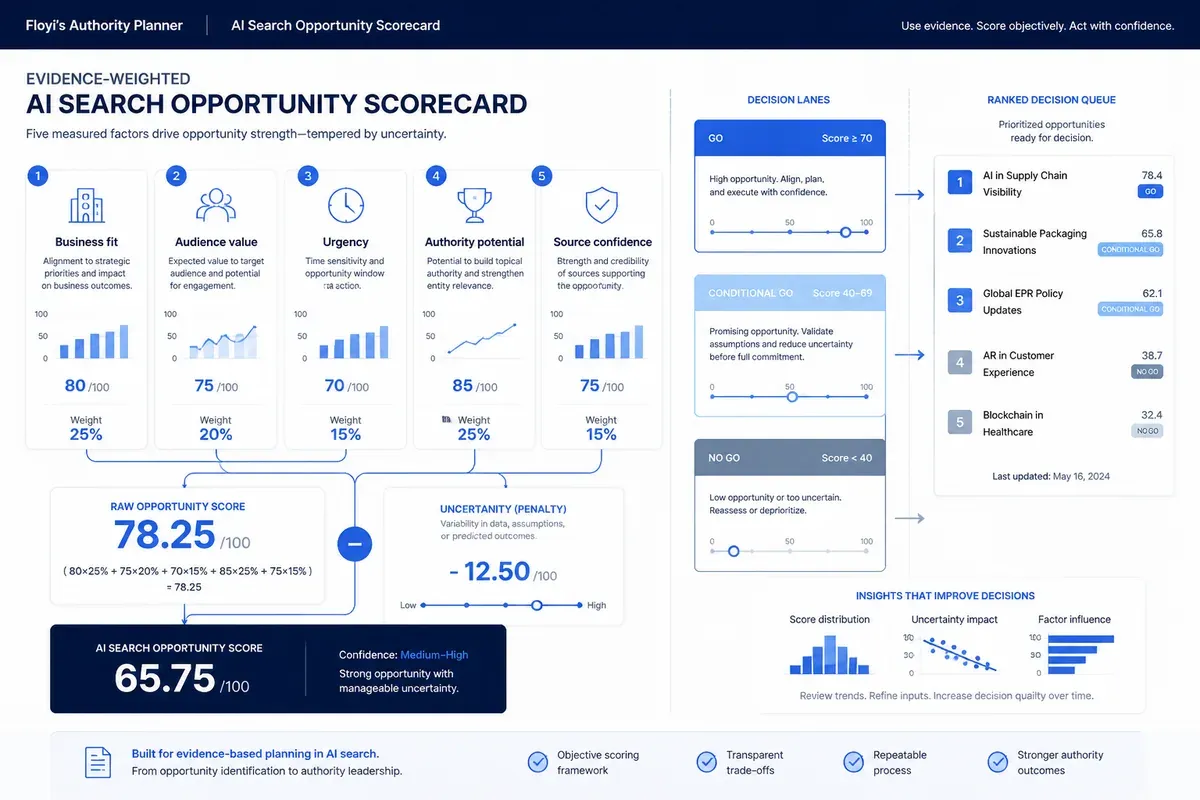
After human review establishes what the evidence can support, a validated evidence set becomes a ranked decision queue, not a backlog of interesting signals. The queue can include companies with likely problems and visible buying triggers, along with adjacent markets, partnerships, emerging technology, research funding, grants, requests for proposals, and procurement opportunities that fit your brand and persona scope.
An evidence-weighted scorecard makes each decision defensible. Rate every opportunity from 1 to 10, giving business fit and audience value more weight than search volume. Generative Engine Optimization topics may have zero or untracked volume because their language is new or conversational, so volume is a secondary demand signal rather than the deciding factor.
A practical scorecard includes:
| Factor | What the score reflects | Relative weight |
|---|---|---|
| Business fit | Alignment with brand positioning, revenue model, and topical scope | High |
| Audience value | Whether the topic addresses a meaningful buyer need | High |
| Urgency | A buying trigger, market shift, deadline, or active demand | Medium |
| Authority potential | The likelihood of building content, market, or AI authority | Medium |
| Source confidence | The quality and agreement of SERP, competitor, AI, and first-party evidence | High |
| Uncertainty | Material gaps, conflicts, stale sources, or assumptions | Penalty |
A consistent formula can be: (Business fit + Audience value + Urgency + Authority potential + Source confidence) − Uncertainty. Record the rationale alongside the score and rate each data gap by its likely effect on the decision. A high-volume query that misses the intended buyer stage or duplicates an existing page should rank below a modest-demand AI search opportunity with a clear authority gap.
Opportunity appeal and confidence are different measures. Confidence increases when live SERP patterns, competitor coverage, AI mentions and citations, and first-party performance signals agree, but declines when evidence is stale, indirect, conflicting, or too thin to support a decision.
AI search brand visibility requires more than counting mentions. Review how the AI answer frames the brand and which sources it cites. These brand authority signals indicate whether the engine treats the company as a credible source, a passing example, or omits it altogether.
Use the verdict to determine the next action:
- GO, 8 to 10: Move the topic into a content brief, draft, optimization, or evaluation workflow. Check cannibalization before creating a URL when an existing page already receives most relevant impressions.
- CONDITIONAL GO, 5 to 7: Validate the uncertainty through buyer interviews, a concept paper, a prototype, or a market-positioning test.
- NO GO, 0 to 4: Park topics with weak fit, unsupported assumptions, or redundant coverage. A documented rejection prevents the same idea from returning in the next planning cycle.
Grant and procurement work needs an extra qualification check. Before responding to an RFP, SBIR/STTR topic, or grant program, confirm that your organization can demonstrate every stated capability. A grant discovery workflow can reduce initial review time when it is tied to clear filters, but the time saved should be measured against a documented baseline before publication. Faster discovery does not establish eligibility.
Floyi’s Authority Planner filters opportunities by strategic importance, intent, funnel stage, competitive strength, and performance signals. Topic details add Google Search Console impressions, clicks, query trends, URL matches, and cannibalization risk. That distinction matters for AI search optimization because traditional search engines and AI answers can reveal different patterns of demand and authority.
Keep a small opportunity radar focused on only a few material weekly changes, such as competitor reframing, buyer triggers, AI citation shifts, funding themes, or relevant procurement activity. Refresh the queue as coverage, competitive strength, impressions, clicks, and query trends move, then measure whether selected GEO topics improve their authority position over time.
How Do You Build a Topical Authority Plan?
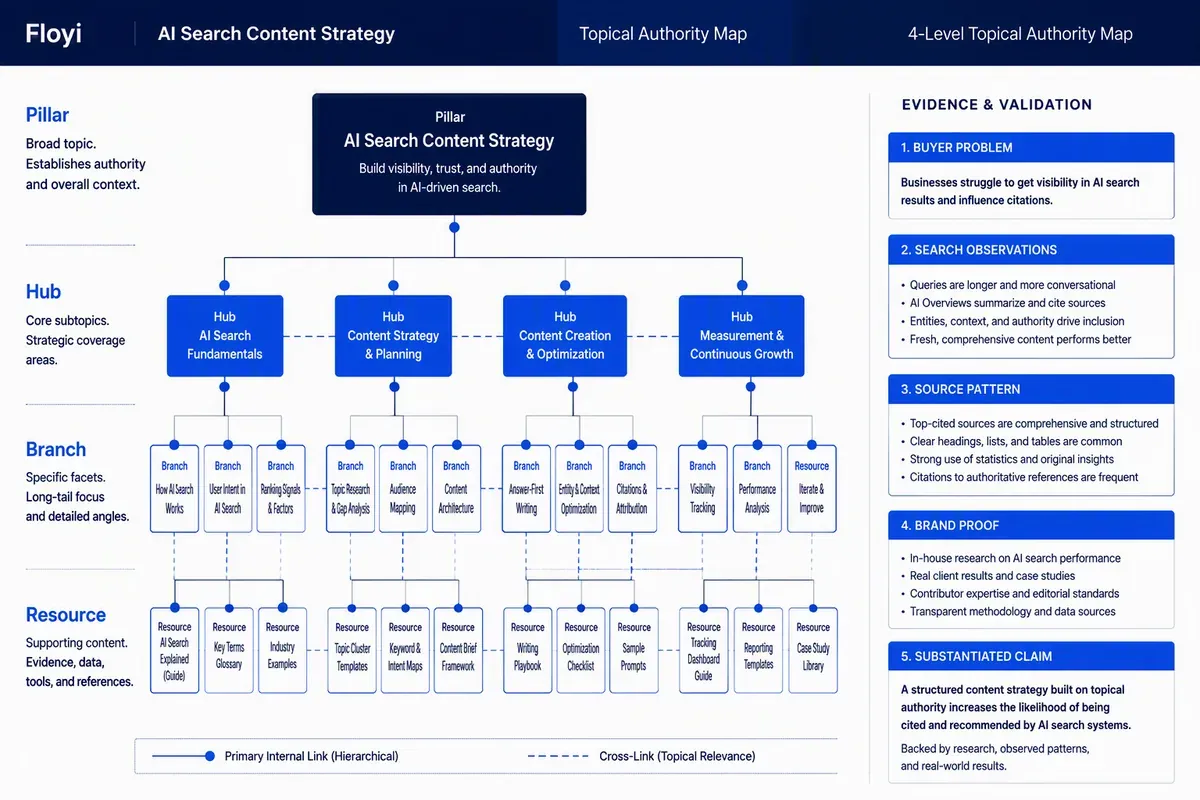
From the ranked decision queue, prioritization becomes an execution plan when you choose one authority anchor: the highest-value opportunity your brand can answer with credible depth. Set its topical boundary, target buyer, commercial relevance, and evidence threshold before adding pages. That anchor creates a decision chain from changes in AI answers, SERPs, or market conditions to buyer implications and the credible answer your brand can publish.
Use a connected Pillar > Hub > Branch > Resource map to carry that chain into publishing. The Pillar is the durable guide for the anchor. Hubs address major buyer problems or decision stages. Branches answer focused questions, comparisons, and objections. Resources provide quotable proof through original research, templates, checklists, terminology, or documented examples.
Every child page should link purposefully to its parent. A comparison Branch strengthens the Hub that frames the buyer’s decision, while a Resource supplies the methodology, product knowledge, or data behind its recommendation. This prevents a publishing queue from becoming a collection of disconnected posts.
Discovery signals become content lanes when each signal has a clear page role:
- Unanswered questions: Build explanatory Branches when AI answers and SERPs leave a recurring buyer question incomplete, unclear, or weakly sourced.
- Recurring pain points: Create problem-solving Hubs from patterns in reviews, forums, Reddit, search behavior, job postings, and customer conversations.
- Early technology signals: Develop emerging-topic Hubs when papers, patents, startups, funding, researchers, open-source projects, or corporate activity point to a developing capability.
- Market-specific changes: Shape Branches around regulations, government programs, procurement notices, requests for proposals, and competitor launches that alter how buyers evaluate a solution.
An evidence card belongs behind every proposed page. Compare answer summaries, brand mentions, cited sources, and competitor framing across major AI engines, Google, and Bing. Frequency matters, but citation context matters too. A source that names a brand as a generic option does not demonstrate authority on a specific buyer problem.
Each evidence card should capture:
- Buyer problem: The decision, risk, or desired outcome behind the search.
- Search observations: What AI answers and SERPs consistently state, omit, or contradict.
- Source pattern: The publications, experts, and primary sources that recur in citations.
- Brand proof: First-party data, customer research, product knowledge, subject-matter expertise, or a transparent methodology.
- Substantiated claim: The precise point the page can support without stretching the available evidence.
Classify an opportunity as blocked when its strongest claim requires proprietary proof your team does not have. Clear demand does not justify an unsupported claim, especially where it could weaken trust.
Match the format to intent and available proof. Repeated informational questions need direct explainers. Evaluation friction calls for decision guides and comparison tables. Practical problems need implementation frameworks, while differentiated claims belong in original research or expert-led Resources. Clear definitions, structured procedures, and evidence that is easy to quote matter more than publishing volume.
A 90-day sequence keeps the map tied to execution:
- Days 1 to 30: Set scope, audit and consolidate cannibalizing pages, establish SERP and AI visibility baselines, and choose the first Hub set.
- Days 31 to 60: Publish connected priority pages, resolve overlap, and strengthen internal links across the map.
- Days 61 to 90: Expand into adjacent Hubs using entity gaps, performance, competitive shifts, and AI citation patterns.
Autonomous monitoring can surface changes in technology, competitors, and user behavior between planning cycles. Reassess evidence cards when those signals shift, then measure coverage and visibility against the baseline before setting the next publishing queue.
How Do You Measure and Govern AI Visibility?
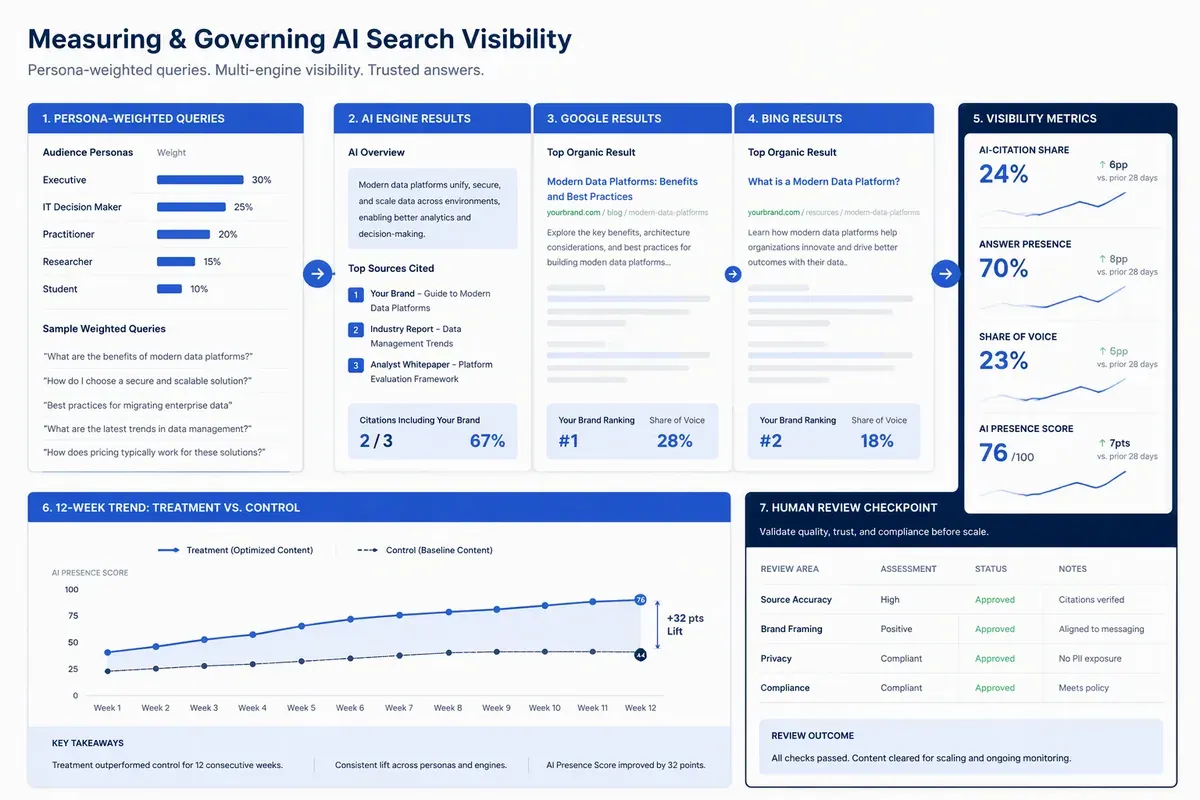
AI search visibility is an early trust and discovery signal, not a replacement for SEO reporting from traditional search engines. AI-generated answers can frame recommendations before a prospect visits your site, so measure whether priority personas see your brand, its citations, and accurate descriptions. AI search algorithm behavior shows why each engine’s selection and framing deserve separate review.
AI search brand visibility depends on comprehension, authority, and evidence, not clicks alone. Clear claims, transparent sourcing, logical page structure, and brand authority signals help models interpret and cite information. Click-through rate (CTR) and assisted conversions remain useful validation metrics, but they should not hide how digital visibility can begin in an AI response.
A fixed, persona-weighted query panel creates an auditable record of category discovery. Preserve stable query and page IDs with the engine, query, intent, persona, topical scope, capture date, full answer text, cited domains, brand and competitor mentions, and page URL. Side-by-side captures from AI engines, Google, and Bing retain differences that a blended score can conceal.
Consistent measurement relies on four core metrics:
- AI-citation share: The percentage of tracked answers that cite your domain.
- Answer presence: Whether the brand appears in an answer, including an uncited mention.
- Share of voice: Your citations divided by all cited domains in the same answers.
- AI Presence Score: An importance-weighted value of 0 for absent, 0.5 for mentioned, and 1.0 for cited.
Segment each metric by engine, persona, intent, and authority anchor. A blended average can hide an important weakness, such as strong citations for implementation queries but no representation when executive buyers evaluate strategic options.
Citation volume alone is not enough, so classify brand framing as positive, neutral, negative, or absent, and retain the descriptors and claims associated with each mention. Recommendations should match approved product, service, and policy facts before they influence content or market decisions.
Source review also needs context, so assess relevance, evidence strength, recency, provenance, and source type for every cited domain. Review publishers, affiliates, communities, and user-generated content alongside brand-owned pages. That mix means authority work extends beyond the company website.
Weekly snapshots make movement easier to evaluate. Retain model versions, prompt wording, source lists, answer revisions, major site changes, and raw answer captures in tidy telemetry. Compare matched treatment and control pages across 12 weeks with difference-in-differences:
lift = (Treatment_week12 - Treatment_week1) - (Control_week12 - Control_week1)
Sustained treatment outperformance in AI-citation share is the primary signal, with CTR and assisted conversions serving as confirmation where available. Temporary gains can reflect model volatility rather than a durable content effect.
Governance protects both the evidence and the decision. Non-sensitive approved prompts, redaction of personal, customer, and confidential data, compliance with each engine’s collection terms, and retained raw captures support defensible analysis. Human review of data quality, source accuracy, brand framing, and brand-safety issues keeps the next planning cycle tied to persona impact and priority content or authority actions.
Floyi’s AI Search Gaps queries the engines through your buyer personas and returns the recommended topics your plan is missing. Find your AI search gaps.
AI Search Opportunity Discovery FAQs
These FAQs address the judgment calls that turn AI search findings into defensible decisions, including how discovery differs from keyword research and what to do when a topic has no measurable volume.
1. How Is AI Search Opportunity Discovery Different From Keyword Research?
Keyword research shows what exists. Opportunity discovery separates three questions. Search shows what exists, through ranked pages, competitor URLs and SERP features. Research shows what’s known, through citations, customer language and entity relationships. Discovery establishes what changed and what follows from it. A competitor cited repeatedly for a buyer question is a finding, not an opportunity. It becomes one when the recurring claims survive review, your brand is absent or weakly represented, the subject sits inside your topical scope, and you can add something credible.
2. Does Zero Search Volume Mean a Topic Isn’t Worth Covering?
No. GEO topics often carry zero or untracked volume because the language is new and conversational. Volume is a secondary demand signal, not the deciding factor. Weight business fit, audience value and source confidence above it. A high-volume query that misses the buyer stage or duplicates a page you’ve already published should rank below a modest-demand topic that answers a real persona need inside your topical scope.
3. Which AI Engines Should You Compare?
Run the same question through your engine set and the conventional SERP view in one pass, holding locale, language, device context, and collection date steady. ChatGPT, Perplexity and Claude can differ in answer structure, source visibility, citation behavior, competitor order, and recommendation strength. A single blended visibility score hides where you’re actually absent. Preserve the raw answer alongside the cited URLs and domains. Record the framing used by brands, competitors, publishers, affiliates, and community sources.
4. How Do You Decide Whether to Act on a Finding?
Score each opportunity from 1 to 10 on business fit, audience value, urgency, authority potential, and source confidence, then subtract a penalty for uncertainty. Eight to 10 is a GO that moves into a brief, draft or optimization workflow. Five to 7 is a conditional GO that needs validating first, through buyer interviews, a concept paper or a positioning test. Zero to 4 is a NO GO. Record the rationale either way, and rate each data gap by its likely effect on the decision. A documented rejection is what stops the same idea coming back next planning cycle.
Sources
- source: https://www.nim.org/en/research/projects-overview/detail-research-project/a-new-era-of-online-search-a-large-scale-study-of-user-behavior-and-personal-preferences-during-practical-search-tasks-with-generative-ai-versus-traditional-search-engines
- source: https://www.cjr.org/tow_center/we-compared-eight-ai-search-engines-theyre-all-bad-at-citing-news.php
- source: https://dimewiki.worldbank.org/Difference-in-Differences
- source: https://pubmed.ncbi.nlm.nih.gov/21499134/
About the author

Yoyao Hsueh
Yoyao Hsueh is the founder and CEO of Floyi, the topical authority platform, and the founder of Main Heading, an SEO and AI search agency. He created Topical Maps Unlocked, a course studied by thousands of SEOs, content strategists and digital marketers, founded TopicalMap.com, a done-for-you topical mapping service for agencies and enterprise teams, and publishes the weekly Digital Surfer newsletter on SEO, content strategy and AI search.
About Floyi
Floyi is a closed loop system for strategic content. It connects brand foundations, audience insights, topical research, maps, briefs, and publishing so every new article builds real topical authority.
See the Floyi workflow