
AEO Workflow for Auditable, Citation-Ready Answer Assets
Learn how to do answer engine optimization by auditing AI search visibility, building citation-ready answer assets, and measuring AEO results.
Ranking pages in Google doesn’t make them citation-ready answer assets. AEO organizes evidence-backed responses so AI systems can retrieve, summarize, mention, and cite a precise claim.
Pages often lose selection because the answer sits below background copy or the evidence is detached from the claim. CXL found that 55 percent of citations in its sample of 100 Google AI Overviews came from the top 30 percent of the page. An auditable workflow sets a prompt baseline, maps each priority question to one asset, and pairs a direct answer with visible provenance, stable anchors, and matching schema.
Weekly scorecards must separate a brand mention from a domain citation and retain the engine, query, page URL, and cited competitors. Floyi’s Topical Authority Scorecard can track answer presence, share of voice, and AI citations by business importance, while Authority Planner turns verified gaps into the next publishing queue. Measure revisions against unchanged control pages before crediting any gain to AEO.
AEO Citation-Ready Assets Key Takeaways
- AEO improves how AI systems retrieve, summarize, mention, and cite evidence-backed answers.
- Track mentions and citations separately across fixed prompts, engines, dates, and page URLs.
- Map each high-value audience question to one purpose-built answer asset.
- Place a qualified 40 to 60-word answer near the relevant question heading.
- Keep evidence, dates, authorship, and stable anchors beside the claim they support.
- Ensure schema matches visible HTML and canonical pages remain crawlable and fully rendered.
- Compare revised pages with unchanged controls to measure citation lift accurately.
What Is Answer Engine Optimization?
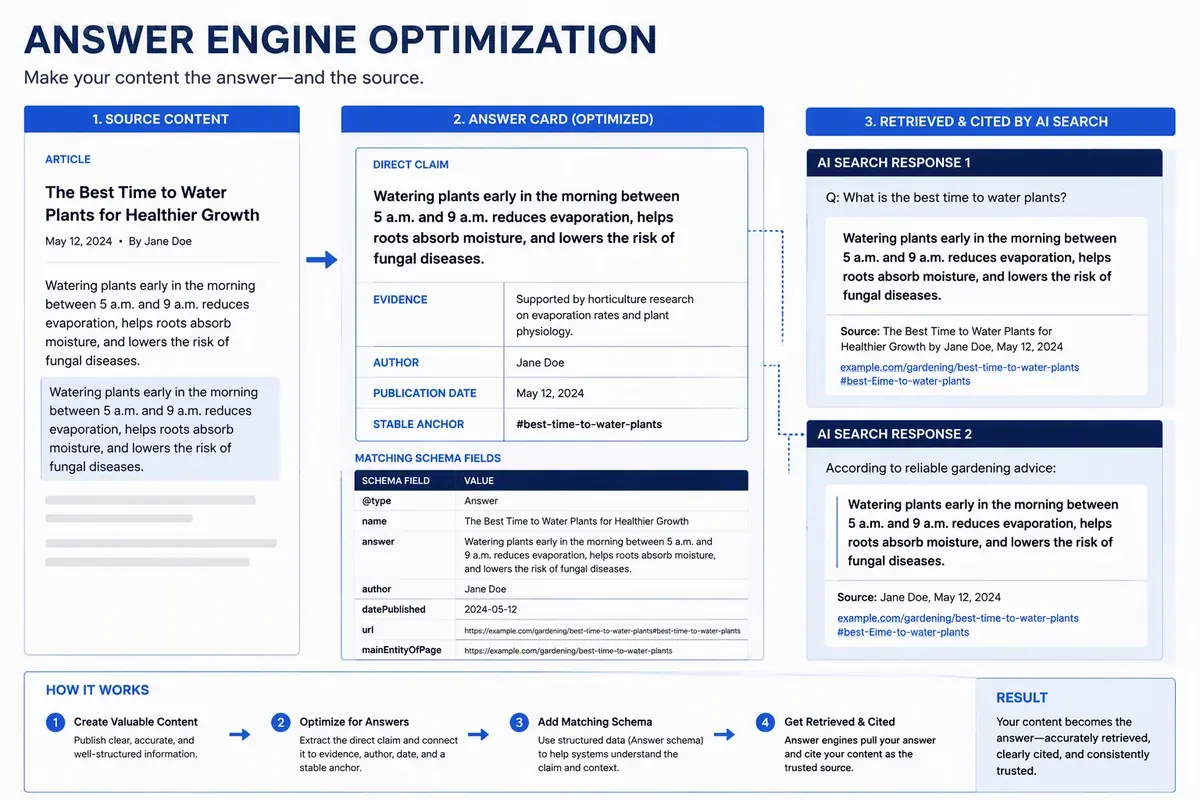
Answer engine optimization (AEO) makes evidence-backed answer units easy for artificial intelligence (AI) systems to retrieve, summarize, mention, and cite in response to a question. When stakeholders ask what is answer engine optimization, the practical answer is accurate brand inclusion in AI-generated summaries across Google AI Overviews, ChatGPT, Gemini, and Perplexity, not just visibility on a conventional results page.
The unit of optimization is not a whole page made generally AI-friendly. It is a self-contained asset that resolves one query, such as a definition, fact, comparison, recommendation, step sequence, or substantiated claim. It should retain enough context to stand alone and point clearly to the evidence behind it.
Effective answer assets share several traits:
- Direct opening: It gives the answer before background, caveats, or brand framing.
- Clear entities: It names products, people, places, concepts, and terminology precisely rather than relying on vague references.
- Visible substantiation: It places sources, data, methodology, or other evidence near the claim being made.
- Dated claims: It states when time-sensitive information was accurate.
- Descriptive structure: It uses headings that make the question and subject easy to identify.
Structured data and machine-readable provenance reinforce these signals, but neither guarantees answer inclusion. Their value is in connecting a claim to its author, date, evidence, and stable on-page location. A consistent claim ID, for example, can map an anchored passage to a supporting dataset or source record, giving an AI system a basis for selection beyond polished copy.
AEO vs SEO is an extension of established search engine optimization (SEO), not a replacement for it. Crawlability, indexability, relevant site structure, topical authority, and rankings in search engine results pages remain the discovery foundation. If systems cannot find or assess a page, a well-written answer asset has little opportunity to be selected.
AEO adds an extractability and citation-selection layer for conversational, voice, zero-click, and generative experiences. Although traditional SEO emphasizes rankings and organic sessions, answer engine optimization also evaluates answer presence, accurate brand mentions, and AI citations that point to your content.
Generated responses tend to draw from a limited set of sources. A page can rank well yet be passed over if its answer is buried in a long introduction, lacks context, or makes an unsupported claim. Direct answers with clear evidence are easier to represent faithfully, though they still need the site-wide authority signals that SEO builds.
Related labels include Generative Engine Optimization (GEO), large language model optimization (LLMO), and AI search optimization. The labels differ by channel emphasis, but the operating model is consistent:
- Identify audience questions: Focus on the decisions, comparisons, and factual needs your buyers bring to search.
- Publish citation-ready assets: Build high-quality content with clear entities, evidence, and answer-first structure.
- Check answer representation: Review whether engines mention your brand, cite your pages, and preserve the intended meaning.
- Improve gaps and errors: Update missing, unclear, or misrepresented answers before expanding into lower-priority topics.
Core AI search optimization practices provide the broader workflow behind this approach. Treat each answer asset as an accountable publishing object with a defined question, a precise response, and evidence that remains credible when an engine condenses it into a few sentences.
Audit Your AI Search Visibility
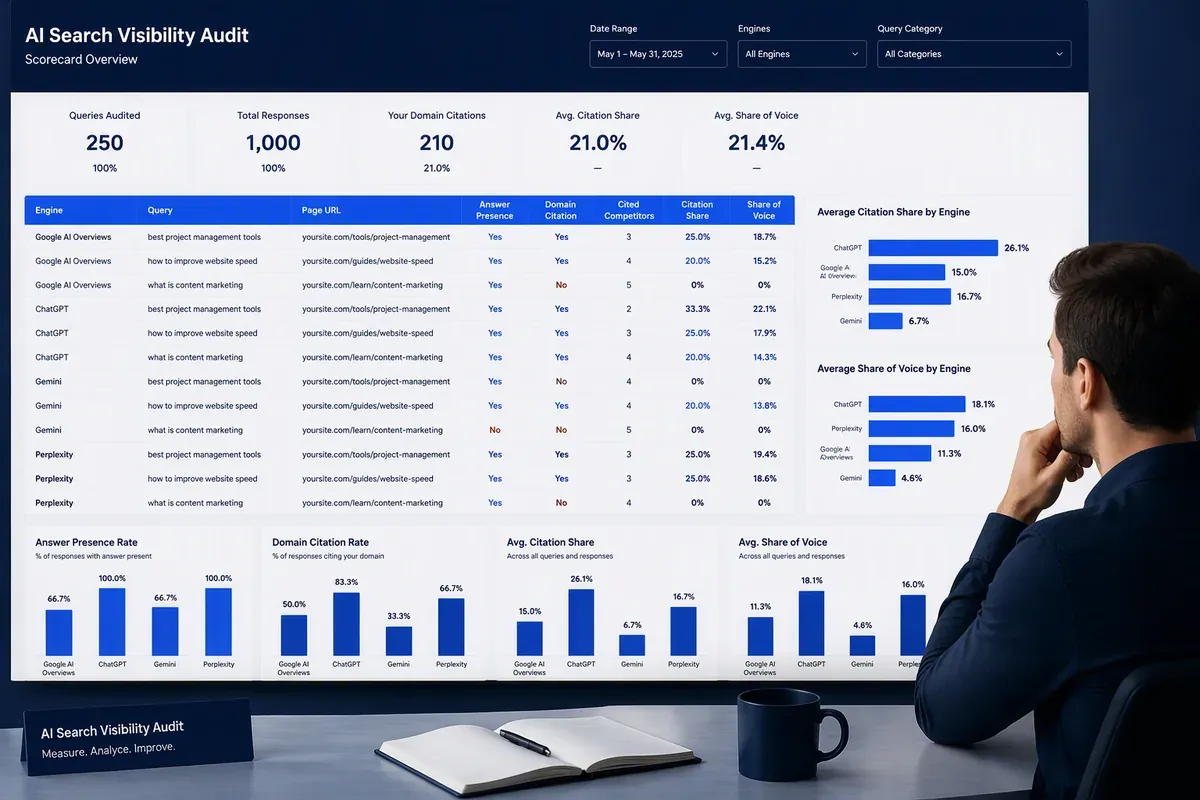
To turn accountable answer assets into measurable priorities, a reliable AI search visibility baseline shows where your brand appears, where it earns source citations, and where strong SEO rankings fail to appear in AI-generated summaries. Audit before you change pages. Without a control point, normal variation between answer engines can look like an AEO gain.
Build a prompt set around commercial value rather than a generic keyword export. Keyword research provides demand signals, while audience questions, user intent, and search intent determine which phrasings belong in the audit. For each priority topic, test a concise question, a problem-led query, and a “best option for” comparison.
A useful prompt set includes:
- Direct question: “What is answer engine optimization?”
- Problem-led query: “How can a SaaS company improve AI search visibility?”
- Comparison query: “What are the best answer engine optimization tools for an agency?”
- Category query: “Best option for tracking citations in AI search results”
Tag every prompt with its topic, target page or answer asset, business importance, and intent. This prevents low-value informational queries from crowding out commercially meaningful visibility gaps.
Run each query under consistent conditions and retain the complete response, not only a screenshot of the opening paragraph. Record the audit date, location, signed-in state when it affects results, engine, and exact prompt wording. Google AI Overviews and Google AI Mode require separate records because their sources and response formats can differ from standalone large language model experiences such as ChatGPT, Gemini, and Perplexity.
Use a visibility tool that can compare responses across multiple AI engines and traditional search results pages, then review each query one by one before making changes. Selecting AI search tooling should focus on the evidence each platform captures, not just the number of surfaces it lists.
Capture evidence at both the domain and uniform resource locator (URL) level. An unlinked brand mention is not the same as a source citation, so record whether your domain was named, linked, or cited, along with the cited page, its response position when visible, and every competing domain cited. Those distinctions make answer presence, AI-citation share, and share of voice useful measures instead of inflated counts of any appearance.
Review what each answer says about your brand and competitors, preserving the relevant excerpt and source URLs. Classify the language consistently:
- Positive: The answer associates the brand with an accurate strength or relevant use case.
- Neutral: The brand appears without a meaningful value judgment.
- Mixed: The response contains both favorable and limiting statements.
- Negative: The response includes inaccurate, outdated, or damaging positioning.
Repeated claims, missing qualifiers, incorrect entity associations, stale positioning, and competitor-owned use cases all point to a fixable gap. The underlying issue may be a missing definition, insufficient evidence, or a page that never gives a direct answer to the prompt.
Maintain the baseline weekly with stable fields such as week_start, engine, query, page_url, answer_present, our_domain_cited, cited_domains, ai_citation_share, sov, and notes. Use an importance-weighted presence score where absence equals 0, an unlinked mention equals 0.5, and a citation equals 1.0. Weight each result by business importance before you prioritize citation-ready content.
Your first baseline should produce a ranked record of priority prompts, target pages, cited competitors, and evidence gaps. Treat it as the control for ongoing measurement, not a one-time visibility report.
Map Questions to Answer Assets
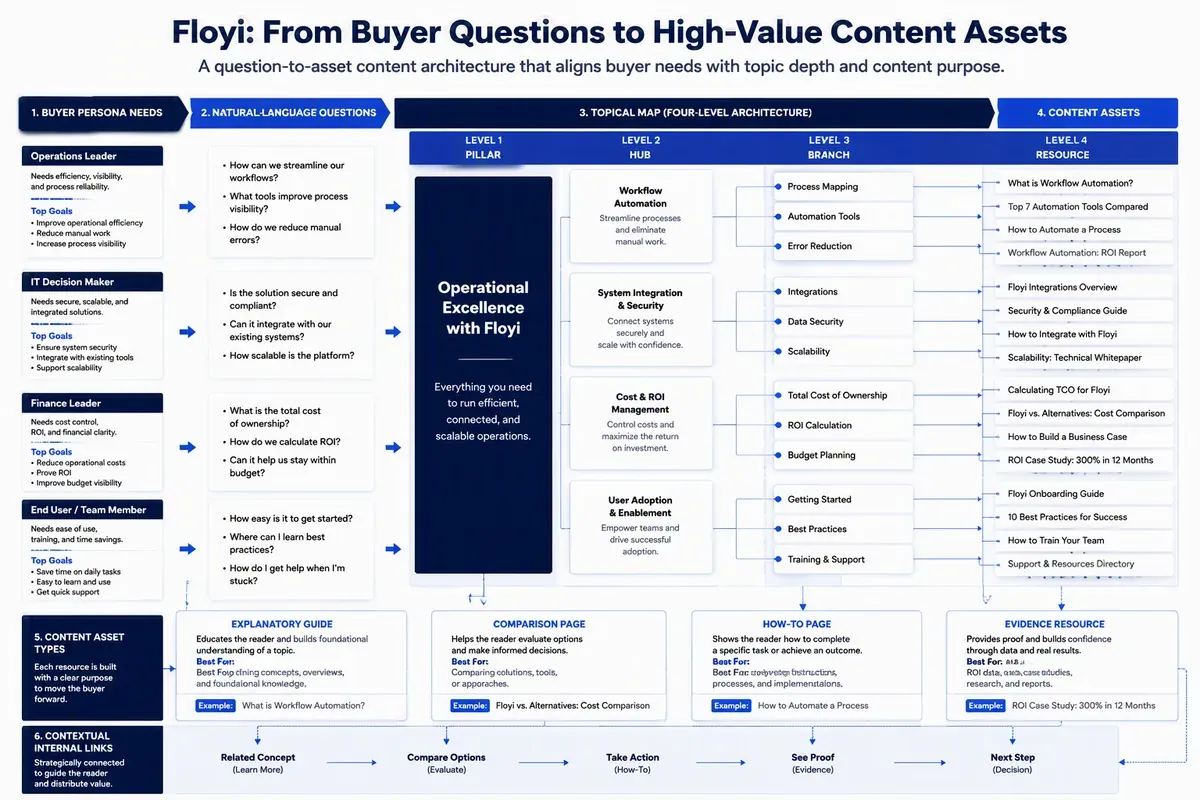
Using that visibility baseline, a question-to-asset map ties a defined buyer persona’s real needs to the page best equipped to answer them. Build from the person’s pain points, job to be done, vocabulary, journey stage, and desired outcome, then turn those inputs into natural-language question-based queries rather than a disconnected keyword research export.
Persona fit matters more than search volume when the signals conflict. A first-time evaluator may need concise answers in a plain-language guide, while an SEO operations manager assessing platforms needs implementation constraints, proof, and commercial context. That difference should shape the depth, format, tone, and intended next action in your AEO strategy.
Build the initial question set from search behavior and direct audience evidence:
- Organic and site signals: Review Google Search Console queries, internal site searches, and pages already generating qualified traffic or conversions.
- Customer language: Capture recurring phrasing from interviews, sales objections, support tickets, and onboarding conversations.
- Question patterns: Prioritize who, what, how, why, when, and versus phrasing, along with use-case language that clarifies user intent.
Longer conversational searches deserve particular attention. Pew Research Center recorded AI summaries on 53 percent of searches with ten or more words and 60 percent of searches beginning with a question word. Question wording is therefore a useful research signal when a short query leaves search intent ambiguous.
Expand each high-value question through query fan-out. Related searches and controlled AI prompt exploration can reveal definitions, prerequisites, steps, comparisons, exceptions, proof requests, and likely follow-up paths. Every branch should remain connected to the original audience need.
A simple removal test keeps the map focused. If removing a subquestion would not weaken the parent answer, it is likely adjacent rather than necessary. Adjacent terms can dilute topical scope and make the site’s subject expertise less clear to readers and answer engines.
Match each question to an answer asset according to its journey stage, search intent, and evidence standard:
| Question signal | Best-fit answer asset | Intended next action |
|---|---|---|
| What is, how does, when should | Explanatory guide, FAQ, or how-to page | Learn a concept or complete a task |
| Which, versus, alternatives | Comparison or alternatives page | Evaluate options against defined criteria |
| Is it effective, what proof exists | Original research, statistics roundup, expert perspective, or use-case page | Review citation-ready evidence |
| Can I use this for a use case | Focused use-case page | Confirm fit for a specific situation |
This classification prevents a common content organization failure: a broad guide and a comparison page both attempt to resolve the same parent question. Give each asset one clear purpose, then connect related pages through contextual links that lead readers to the appropriate level of detail.
The map should also function as a topical architecture blueprint. A Pillar establishes the broad authority topic, a Hub resolves a major subquestion, a Branch addresses a narrower decision or task, and a Resource supplies evidence, examples, or supporting data. Record the proposed or existing URL, parent question, intent, hierarchy position, and bidirectional contextual-link path for every asset.
AI search opportunity research helps prioritize questions your site can credibly answer. The completed map gives users and answer engines a clear path through the subject hierarchy.
Review existing pages against the complete fan-out before creating new content. Flag assets to refresh, consolidate, redirect, or replace, and identify overlapping intent alongside unanswered high-value questions. Sites assembled from isolated low-competition articles often carry hidden coverage gaps because no shared topical structure shaped publishing.
Build one coherent Hub before moving into another subject area. A writer-ready record should capture the persona, journey stage, question, asset format, evidence requirements, page status, and Pillar-to-supporting-page relationship. Writing AI-ready content briefs carries those decisions into drafting while preserving the audience language, page purpose, and evidence standard established during research.
Create Citation-Ready Answer Pages
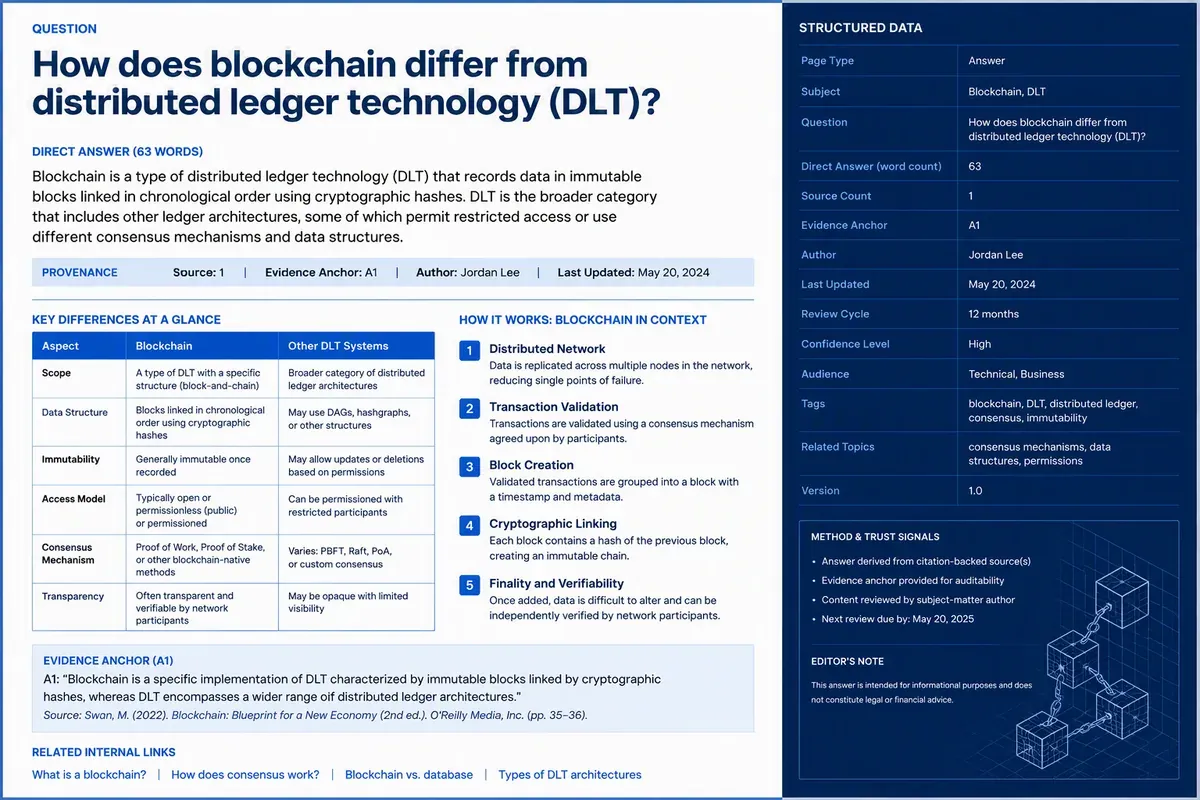
For the questions and assets identified in the map, citation-ready answer pages put the claim, its limits, and its proof in one place, so AI systems can select and cite direct answers without reconstructing context from scattered copy. To optimize content for answer engines, build each page around one searcher question and make the answer, evidence, author, date, and scope immediately visible.
Turn the target query into the exact H2 or H3 wording used in natural language search. Place a self-contained 40 to 80-word response directly below it. The paragraph should state the canonical claim plainly, include material qualifications, and remain understandable when quoted alone. CXL found that 55 percent of those citations came from the top 30 percent of the page, which makes early placement consequential.
A repeatable page pattern keeps each answer extractable:
- Match the query: Frame the heading as the reader’s question, such as “How do you add provenance to an answer page?” rather than “Provenance.”
- Give the answer: Write concise answers that resolve the question without forcing readers or AI systems to assemble caveats from later paragraphs.
- Show the evidence: Place the primary source, dataset, method, or clearly labeled first-party evidence immediately after the lead answer.
- Use an extractable format: Apply numbered steps to processes with one outcome per step, bullets to requirements or options, and tables to comparisons with consistent criteria.
- Mirror visible copy in markup: Use structured data for the rendered question, answer, author, publication date, and supporting evidence.
The evidence block belongs beneath the lead answer, not at the bottom of a long page. A visible provenance line identifies the responsible author or team, the publication or update date, and an on-page evidence anchor. For example: “Source: Research Team, updated August 2026. Evidence: #methodology.” The anchor must support the precise claim, rather than lead to a general resources section.
Keep every subsection focused on one complete question. Requirements work well as bullets, while comparisons need matching fields and explicit qualifiers, especially when applicability changes by CMS, market, or technical configuration. This arrangement keeps the answer, context, and proof together as one usable unit.
Contextual internal links establish the page’s place in your topical map. Link to each new answer page from an established, thematically close page with anchor text that signals the next question. Crawling and indexing for AI is relevant when technical accessibility determines whether an answer page can be found and processed.
Links from the new page should lead only to deeper guidance that advances the reader’s task. AI search trust signals gives source quality, provenance, and authorship the context they need.
Schema markup must match rendered copy, not fill gaps in the page. For genuine visible questions and answers, use FAQ schema, formally FAQPage, while HowTo markup fits visible task steps with corresponding anchors. This JSON-LD pattern keeps the markup aligned with the page:
{ "@context": "https://schema.org", "@type": "HowTo", "@id": "PAGE_URL#howto", "name": "Task question", "description": "Lead answer summary", "step": [ { "@type": "HowToStep", "name": "Define the claim", "text": "Visible action and outcome", "url": "PAGE_URL#step-1" }, { "@type": "HowToStep", "name": "Add evidence", "text": "Visible action and outcome", "url": "PAGE_URL#step-2" } ], "author": { "@type": "Organization", "name": "Brand" }, "citation": { "@type": "CreativeWork", "url": "PAGE_URL#evidence" }, "datePublished": "YYYY-MM-DD"}For discrete, evidence-backed assertions, Claim markup can include a permanent claim ID, matching author and date fields, an evidence anchor, and the supporting dataset or method. Where site capabilities allow, a machine-readable /provenance.json file can connect each claim ID to its page URL, anchor, author, date, dataset, and checksum. Stable identifiers matter because changed anchors break the evidence trail behind reproducible citations.
Before publishing, verify the following:
- Query match: The heading uses the target question, and the first paragraph provides a qualified 40 to 80-word answer.
- Section quality: Each subsection stands alone and uses a scannable format that fits the information.
- Evidence and links: Proof is current, directly supports the claim, and internal anchors describe the next question.
- Markup fidelity: All schema markup and structured data reflect visible page content exactly.
Strengthen Technical and Authority Signals
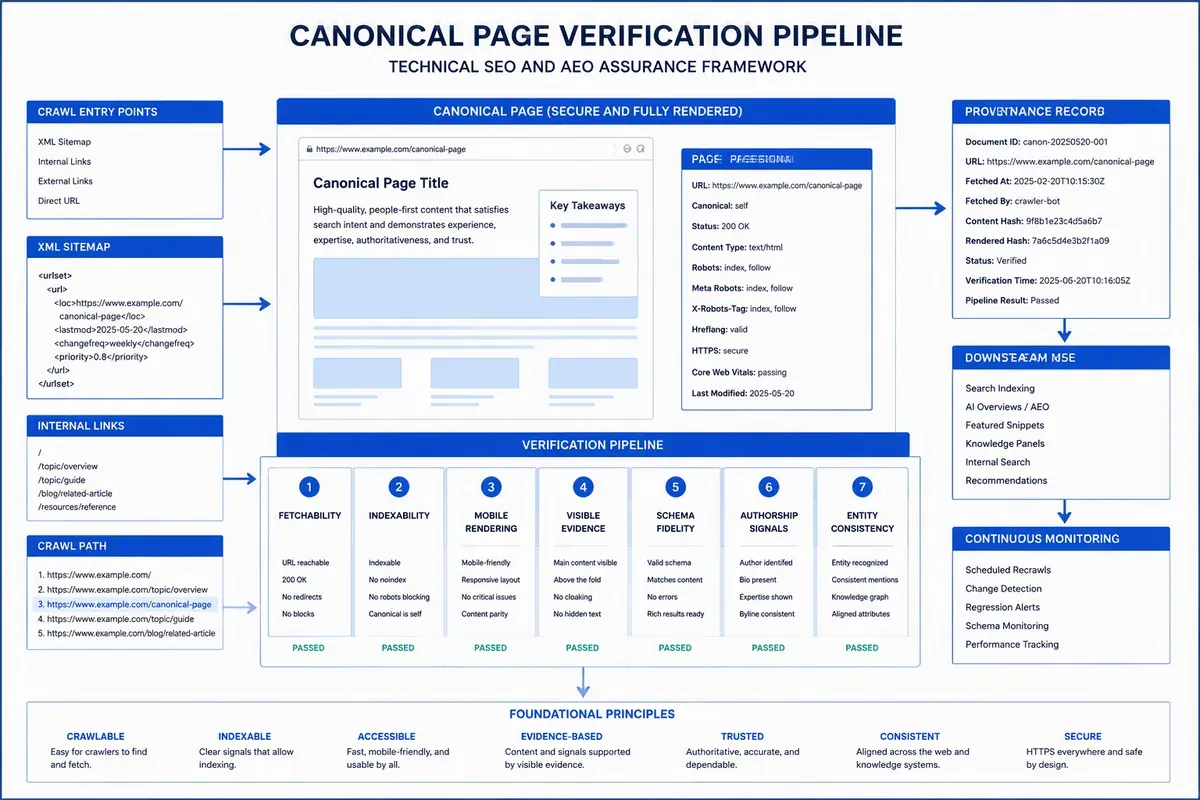
To ensure citation-ready pages can be selected, your page must be retrievable, fully rendered, and supported by evidence a system can inspect. Citation eligibility starts before copy quality. If an AI system cannot fetch the canonical page, parse the answer, or identify the source behind a claim, even high-quality content may not qualify for selection.
Assess the published URL rather than a development preview. Keep the direct answer, supporting evidence, author details, and tables in initial HTML or output that crawlers render consistently. Indexability, robots directives, canonical URLs, XML sitemaps, redirect behavior, and internal links all need to point to the same retrievable asset. A canonical that resolves elsewhere, or a page accessible only through a broken internal link, leaves systems without a dependable source.
Page experience affects retrieval, too. Fast loading, stable layouts, and complete mobile rendering help both readers and crawlers access the full page. Test the rendered result, not source code alone, when JavaScript loads copy, tables, schema markup, or author information after the initial response. The answer and its proof should be visible without an accordion click, login gate, or infinite scroll. Readability optimization supports this work because a concise answer followed by clear evidence is easier to quote than a dense page that buries its conclusion.
The technical baseline for AEO best practices includes:
- Fetchability: The canonical page loads successfully and is not blocked by robots directives, authentication, or conflicting redirects.
- Rendered completeness: Mobile and crawler-rendered pages contain the same answer, evidence, tables, author details, and structured data available to visitors.
- Clear purpose: Titles, headings, and the lead answer establish the question or task the page addresses.
- Stable discovery paths: Relevant internal pages use descriptive anchor text to reach the canonical resource, while XML sitemap entries reflect the preferred URL.
Structured data should remain consistent throughout the technical implementation. When visible content qualifies, use Article, FAQ, HowTo, or Product schema, and ensure publisher, author, dates, entities, and page purpose align across the copy and markup. Every schema field should support a reliable interpretation of the page.
Claim-level provenance helps systems verify evidence as pages evolve. Give each material statement a permanent claim ID that connects the statement to its canonical page URL, stable on-page anchor, author, publication or update date, and supporting dataset or methodology. A small machine-readable provenance index can be linked from the page head with rel="alternate". Its role is to point back to real, visible evidence, not to create a private layer of unsupported assertions.
Google E-E-A-T should be apparent within each asset, not confined to an author bio. Identify qualified authors and reviewers, disclose firsthand experience or methodology, date meaningful updates, and separate sourced evidence from editorial interpretation. Transparent limitations also strengthen trust. In a product comparison, for example, identify the evaluation criteria and note when a feature could not be independently verified.
Entity consistency reinforces those page-level signals. Organization details, expert identities, and factual business information should match across your site and public profiles. For local brands, names, addresses, phone numbers, hours, categories, photos, and reviews need consistent treatment across Google Business Profile, Yelp, Apple Maps, Bing Places, Yahoo Local, Yellow Pages, and Angi. Conflicting entity information can weaken confidence even when the page itself is accurate.
Third-party authority matters most when your topical coverage is strong but trust remains the constraint. Relevant mentions, links, expert appearances, and reviews from Reddit, YouTube, LinkedIn, podcasts, industry publications, forums, niche sites, partners, and review platforms can support the pages and hubs that need credibility. AI search performance benchmarks distinguish AI mentions from citations, because appearing in an answer differs from being selected as its source.
Floyi can score AI presence by topic as not present, mentioned, or cited, weighted by business importance. That separation helps you identify whether the limiting factor is technical access, evidence quality, entity consistency, or external trust.
Measure and Improve Your AEO Workflow
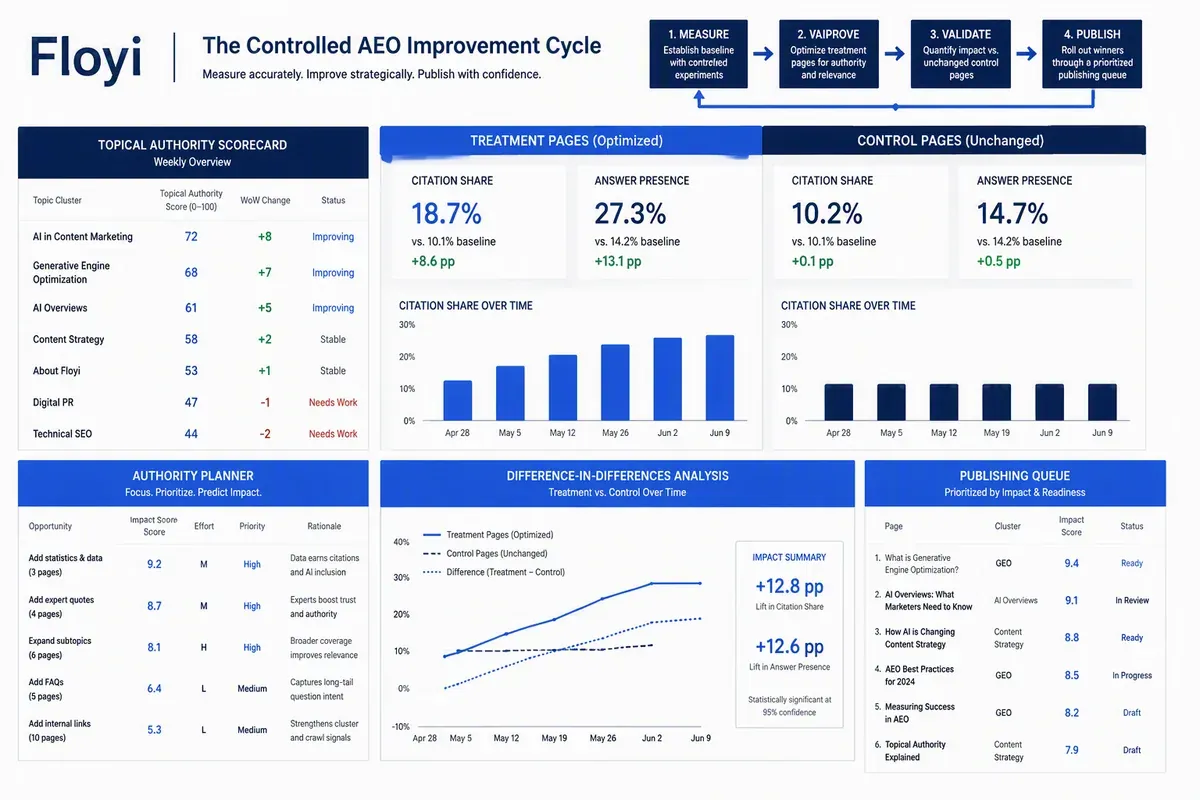
A measurable AEO strategy treats AI search visibility as evidence in a controlled improvement cycle, not a standalone dashboard metric. Track selection and citation signals alongside referral quality and demand, then use the findings to set the next publishing priorities.
Clicks alone do not represent answer engine optimization performance. A large share of Google searches end without an external click, so weekly monitoring should include AI search visibility and referral quality as well as traffic. This reveals whether answer engines select and cite your assets even when organic traffic stays flat.
Use a query-, engine-, and page-level scorecard with fields that remain stable after revisions:
week_start,engine,query,page_url,variant,answer_present,our_domain_cited,cited_domains,ai_citation_share,sov,notesEach row should capture the same query under the same conditions each week. AI citation share is the portion of tracked answers that cite your domain, while share of voice is your citations divided by all citations shown. Include unlinked brand mentions because an engine can name your brand without creating a referral path.
The weekly review should distinguish these signals:
- Answer presence: Whether your domain appears among the sources for a tracked query.
- Domain citation: Whether the engine identifies your page as evidence for its answer.
- Cited domains: Which publishers appear alongside your brand, including competitors and source types.
- AI citation share and share of voice: How often your domain is selected relative to all citations in the tracked answer set.
- Brand mention and sentiment: Whether the mention is positive, neutral, negative, or qualified by a limitation.
Visibility and citation quality are different measures. Check whether the cited page directly supports the query, whether its evidence remains accurate, and whether the referral reaches a relevant conversion path. Pair that review with referral engagement, conversions, and assisted conversions. Track AI-search referrals separately from organic search referrals because conversion behavior may differ by channel, and validate the gap with your own analytics before making planning decisions.
Branded demand can corroborate a result, but it cannot prove AEO caused it. Compare branded queries, direct visits, branded impressions, and branded conversion paths with pages gaining citation share. Campaigns, launches, seasonality, PR activity, and paid media changes can move those measures independently. Some buyers now use AI search during evaluation, so AEO can be part of the research mix for product and software categories.
Provenance needs the same discipline as visibility measurement. Maintain the provenance record through each measurement cycle. A machine-readable provenance.json file at the site root can hold this record and connect from the site head with a rel=“alternate” tag.
A minimum record includes the following fields:
{ "claim_id": "claim-001", "page_url": "https://www.example.com/page", "anchor": "#evidence", "author": "Your Brand", "review_date": "YYYY-MM-DD", "dataset_url": "https://www.example.com/dataset.csv", "dataset_version": "v1", "methods_log": "https://www.example.com/methods"}Verify that each referenced anchor resolves and that visible copy still matches the evidence described in provenance.json. A heading-ID change can quietly break reproducibility even when the page continues to appear in search results.
Use a treatment-versus-control comparison to make improvements auditable. Compare revised pages with similar unchanged pages, retaining the exact query wording, engine, date range, page version, and variant. Measure changes in citation share, answer presence, share of voice, referral quality, and branded demand for both groups.
Calculate lift with difference-in-differences:
lift = (Treatment_week12 - Treatment_week1) - (Control_week12 - Control_week1)This guards against crediting broad engine behavior changes to a page revision. When citations rise across treatment and control pages alike, the cause may be external. A larger treatment gain provides stronger evidence that the revision contributed.
Floyi’s Topical Authority Scorecard tracks brand visibility, share of voice, and AI citations, while Authority Planner turns those findings into a prioritized publishing queue. Focus first on valuable questions with missing answer presence, falling citation share, negative sentiment, stale evidence, or referrals that fail to convert. The response may be a stronger self-contained answer, refreshed sources and provenance, a clearer Pillar, Hub, Branch, and Resource relationship, or a missing asset that closes a topical scope gap.
Use each weekly scorecard to select the next revision, then measure the result against its control.
Answer Engine Optimization FAQs
These FAQs address common Answer Engine Optimization questions, including how AEO fits alongside SEO, measurement, and citation-ready publishing. They help you identify where to begin within your existing search workflow.
1. How Does AEO Differ From Traditional SEO?
AEO vs SEO differs by the outcome you optimize for. SEO focuses on SERP rankings, click-through rate, and organic sessions. AEO makes answer-first passages, semantic clarity, and visible evidence easy for AI systems to extract, summarize, mention, and cite in AI Overviews, AI Mode, and zero-click answers. Strong rankings alone do not ensure selection. Track answer presence, AI citation share, brand mentions, and share of voice alongside SEO metrics. Where AI search is heading explains why both disciplines support trust and downstream conversions.
2. Which Answer Engines Should You Optimize For?
Prioritize the answer engines your audience already uses: Google AI Overviews for SERP questions, Google AI Mode and Gemini for Google-led research, ChatGPT for broad exploration, and Perplexity for source-conscious queries. ChatGPT’s reported 900 million weekly users makes it worth testing, but your market and query set should determine the order. Treat voice search optimization as a targeted channel for local availability, hours, compatibility, and hands-free how-to questions. Compare the same high-value prompts across engines, then focus on repeatable answer presence, AI citations, and share of voice.
3. Can Small Businesses Implement AEO?
Yes. Start AEO with five existing pages that already convert or meet high-value intent, including service, FAQ, how-to, comparison, and location pages. Use Search Console to identify focused who, what, how, and versus questions, then place a 40 to 80 word evidence-backed answer near the top of each page with scannable headings.
Keep business details consistent across Google Business Profile, Yelp, Apple Maps, Bing Places, Yahoo Local, Yellow Pages, and Angi. Capture baseline answer presence and citations, then review them weekly for four weeks alongside click-through rate and assisted conversions.
4. How Soon Does AEO Show Results?
Expect early movement in answer inclusion and citation quality within 3 to 6 weeks when priority pages use evidence-backed lead answers, structured data, and visible provenance. Optimizing content for AI answer generation supports that foundation. Check a fixed query set weekly, but treat isolated citations as directional.
Referral traffic, branded demand, authority, and conversions need a 12-week view. Track AI-citation share, share of voice, CTR, and assisted conversions against a control to separate durable lift from normal engine variation. Semrush reports AI search visitors can be 4.4 times as valuable as traditional organic visitors.
5. Do Featured Snippets Support AEO?
Yes. Featured snippets favor the same extractable format that supports AEO: a question-led heading followed by a self-contained answer of roughly 40 to 80 words. Use steps, lists, or tables only when they improve clarity. This structure can also support People Also Ask, voice results, and AI-generated answers. Position Zero is a useful visibility signal, not a citation guarantee. AI systems also assess prompt relevance, claim clarity, freshness, provenance, and visible evidence, so technical SEO and helpful content still matter.
What Are Practical AEO Playbooks And Case Studies?
Practical AEO playbooks work when each change has a baseline, a visible on-page answer, and a measurement window that separates real gains from normal volatility.
- Quick Win: Use this one-week workflow for a single high-intent page. An SEO lead reviews answer-panel impressions and maps one query to one intent. A content editor writes a canonical answer near the opening, adds evidence and stable anchors, then updates metadata and internal links. A developer validates rendered schema and indexability. Search Console, Analytics, Rich Results Test, and Floyi support the research, QA, and weekly review.
- Enterprise Lift: Use this 90-day workflow for a priority set of authority pages. A strategist ranks pages by business intent, demand, evidence availability, and technical effort. Subject matter experts verify claims, while content, development, and analytics teams align visible answers, canonical metadata, schema, and contextual internal links. Floyi can turn brand context and live search signals into a prioritized topical queue. Review results at 30, 60, and 90 days against matched control pages.
Record your own numbers rather than borrowed benchmarks. Each cell below shows the unit that column expects:
| Metric | Baseline | 30 Days | 60 Days | 90 Days | Absolute Delta | Percentage Change |
|---|---|---|---|---|---|---|
| Answer-panel impressions | impressions | impressions | impressions | impressions | +/- count | +/- % |
| Click-through rate | % | % | % | % | +/- points | +/- % |
| Organic sessions | sessions | sessions | sessions | sessions | +/- count | +/- % |
| Conversions | conversions | conversions | conversions | conversions | +/- count | +/- % |
| AI-citation share | % of queries | % of queries | % of queries | % of queries | +/- points | +/- % |
Track time to impact separately from this table. Answer inclusion typically moves in 3 to 6 weeks, while traffic and conversion effects need the full 12-week window against a control set.
A Quick Win case study fits a useful page with organic rankings but no concise, attributable response. Its audience seeks a direct informational answer. The constraint is limited development time. Week one covers intent mapping, answer revision, and evidence anchors. Week two checks rendered HTML and JSON-LD. Weeks three through twelve compare citation visibility with unchanged pages.
An Enterprise Lift suits brands whose product, service, and educational pages contradict one another. The audience has mixed commercial and informational intent, while the constraint is cross-team consistency. Weeks one through two establish claim IDs, sources, authors, dates, methods, and datasets. Weeks three through six update priority pages. Weeks seven through twelve measure treated pages against controls.
Lessons learned:
- Visible content matters: Schema must reflect the HTML readers can see.
- Evidence needs context: A claim without a source, method, dataset, or qualification is fragile.
- Rollouts need controls: Test incrementally when templates, traffic, or intent differ.
Use the same claim fields in your content brief, handoff checklist, and post-launch measurement sheet. A sprint QA pass covers schema rendering, metadata, internal links, evidence, indexing, and analytics annotations.
{ "@type": "HowTo", "name": "Task", "step": {"@type": "HowToStep", "text": "Visible step"}}<ol><li>Visible step</li></ol>WordPress and Shopify can place matching markup through theme or app controls, while headless implementations typically add it through the component or API layer. Apply the pattern to FAQPage, HowTo, Speakable, and QAPage only when the page visibly supports that schema type.
Calculate ROI as incremental conversions × conversion value − content, development, and review costs. Verify material claims before publishing, refresh volatile information on a defined cadence, and investigate alerts when cited text no longer matches its supporting evidence.
Floyi’s Authority Planner ranks which answer assets to build first, using your topical map, live search signals, and current AI visibility. Plan your AEO queue.
About the author

Yoyao Hsueh
Yoyao Hsueh is the founder and CEO of Floyi, the topical authority platform, and the founder of Main Heading, an SEO and AI search agency. He created Topical Maps Unlocked, a course studied by thousands of SEOs, content strategists and digital marketers, founded TopicalMap.com, a done-for-you topical mapping service for agencies and enterprise teams, and publishes the weekly Digital Surfer newsletter on SEO, content strategy and AI search.
About Floyi
Floyi is a closed loop system for strategic content. It connects brand foundations, audience insights, topical research, maps, briefs, and publishing so every new article builds real topical authority.
See the Floyi workflow