
A 42-map study of the brands AI answers mention and cite.
The Topical Authority Report Part 1 showed that websites ranking for more of a topical map get cited more by AI answers. But the raw data still had a lot more to say, so we went back for Part 2.
This time we focused on two things Part 1 left mostly unexplored: brand mentions and search intent.
Mentions matter because searchers read the AI answer itself, but they don’t always check its sources. A brand mentioned in the answer gets seen. A website that’s only cited may not.
Mentions matter most on commercial queries. Brands with a product or service want AI answers to recommend them, and a recommendation always comes as a mention.
This report looks at what is consistent with more brand mentions in AI answers, and what isn’t. We used the same 42 topical maps, the same top-20 rankings and the same AI answers as Part 1.
We looked at the data from different angles. We counted the websites each answer cites and the ranking websites it mentions, and compared the two by Google position, whether a website ranks for that exact query, topic coverage, Domain Rating, and search intent. We also looked at what AI answers mention when they cite nothing at all.
Key Findings
Every number below is for the typical topical map, unless a finding says otherwise. Each range runs from the lowest AI engine to the highest in AI Overviews, AI Mode, ChatGPT, and Gemini.
- Top-ranked websites get cited far more often than they get mentioned. A website ranked 1st was cited in 24.9%-65.3% of the AI answers that cite a website. It was mentioned in only 8.6%-17.2% of the answers that mention a ranking website.
- Most of the ranking websites AI answers mention don’t rank for the query. Only 23.0%-43.2% of them were in the query’s own top 20. That share was lower than for cited websites on every AI engine.
- Ranking for more of a topical map goes with more mentions, but the link is much weaker than for citations. Ranked coverage lined up with citations at 0.29-0.50, on a correlation scale from -1 to 1. It lined up with mentions at only 0.15-0.20.
- Tourists get most of their mentions on queries they don’t rank for. A Tourist ranks for under 5% of a map’s topics, and 65.4%-80.8% of its mentions came on queries it doesn’t rank for. Picture a website that ranks for 3 of a map’s 600 topics. Each answer on the other 597 topics has only a small chance of mentioning it, but 597 small chances outweigh the 3 better chances it gets where it ranks.
- A Tourist in the query’s own top 3 gets mentioned nearly as often as a Specialist. A Specialist ranks for 5%-25% of a map’s topics. A Tourist’s mention rate in the query’s own top 3 was within 2.7 points of a Specialist’s on every AI engine.
- AI answers rarely mention the websites they cite, and most mentions come without a citation. AI answers mentioned only 4.6%-7.6% of the ranking websites they cited in the same answer. 59.7%-92.5% of the ranking websites they mentioned weren’t cited in that same answer.
- AI answers mention higher-DR websites than they cite on three of the four engines. The websites AI answers mentioned on AI Overviews, ChatGPT and Gemini had an average Domain Rating 10.2-17.1 points higher than the ones they cited. On AI Mode the two were about the same, at DR 52.7 per mention and DR 49.2 per citation.
- Far fewer websites get mentioned than cited, and a few of them get most of the mentions. AI Overviews mentioned 11.5 websites for every 100 they cited. 50% of a map’s mentions went to only 9.6%-11.5% of the websites mentioned in it, depending on the AI engine.
- Brands get mentioned far more on commercial queries. Commercial answers carried 2.0-2.6 times as many brand mentions per answer as informational answers. They carried more in every map on all four AI engines.
- Search intent changes little on how often top-3 websites get cited, except on Gemini. A top-3 website’s citation rate moved 3.9 points or less between informational and commercial queries on AI Overviews, AI Mode and ChatGPT. On Gemini it fell from 29.5% on informational queries to 22.6% on commercial ones.
- AI answers mention a website in the query’s own top 20 far more often on commercial queries than informational, though most of the websites they mention still don’t rank for the query. 28.5%-43.1% of all commercial answers mentioned a website in the query’s own top 20, against 7.8%-15.8% of all informational answers. Up to 43.8% of the websites AI answers mentioned were in the query’s own top 20, even on commercial queries.
- AI answers that cite nothing still mention brands, mostly ones that don’t rank for the query. Only 14.9%-25.4% of the websites mentioned in citation-free answers were in the query’s own top 20, on AI Mode, ChatGPT and Gemini. AI Overviews had no citation-free answers.
What This Report Covers
- How often do AI answers cite or mention brands at each Google position, from 1 to 20?
- How many of the brands AI answers mention rank for the query?
- Does ranking for more of a topical map go with more brand mentions, as it does with citations?
- How often does one website get mentioned on queries it doesn’t rank for?
- Does broader map coverage still matter for mentions once a website is in the top 3?
- How many websites does one AI answer cite and mention?
- How often do citations and mentions go to the same website in the same answer?
- Do AI answers mention higher-DR websites than they cite?
- Do brand mentions spread across as many websites as citations do?
- Do commercial-intent queries get more citations or brand mentions than informational ones?
- When an AI answer cites no sources, does it still mention websites that rank on Google?
Sections 1-4 below answer them in this order, and the Key Findings above follow the same order.
The Dataset at a Glance
- 42 topical maps across six industries, the same maps as Part 1
- 27,122 topics labeled by search intent
- 38,723 AI answers (AI Overview, AI Mode, ChatGPT, Gemini)
- 114,584 possible mentions checked one by one across 42 maps
Terminology
Part 1’s terms still apply. Here are the ones this report uses, along with the new ones.
Ranked coverage, from Part 1, is the share of a map’s topics where a website holds a top-20 Google position. A website ranking for 100 of a map’s 500 topics has 20% ranked coverage.
A ranking website ranks in a map’s top 20 for at least one of its topics. This report never counts the platforms or the map’s own brand as ranking websites.
The query’s own top 20 is the top 20 Google results for the exact query an AI answer responds to. A ranking website is either in the query’s own top 20 or ranks elsewhere in the map, for other topics in the map but not that query. Part 1 called a citation of a website that ranks elsewhere in the map an off-query citation. When this report says a website doesn’t rank for a query, it means the website isn’t in that query’s own top 20.
The four tiers, from Part 1: a Tourist ranks in the top 20 for less than 5% of a map’s topics, a Specialist for 5%-25%, an Authority for 25%-50%, and a Giant for 50% or more.
A mention is a brand mentioned in the answer’s own words, like “Consumer Reports recommends checking the filter every month.” The small source labels that AI engines show next to an answer, like “Consumer Reports +2,” are citations, not mentions. The titles of cited pages are also considered citations and not mentions. We checked every possible mention one by one to keep those out. The Methodology explains how.
Being mentioned isn’t the same as being recommended. A mention counts praise, a passing reference and a criticism alike, because this study detects the mention, not the tone around it.
A citation is one URL cited in one AI answer, as in Part 1. A cited website is one website domain cited in one answer, no matter how many of its URLs that answer uses.
Citing and mentioning answers. A citing answer cites at least one website. A mentioning answer mentions at least one ranking website.
A citation-free answer is an AI answer that cites no website at all.
Informational and commercial queries. A query is informational when the searcher wants to learn something, like “how long does creatine take to work.” It’s commercial when the searcher is comparing or buying, like “best creatine for men.” Every topic got its label from the same intent classifier Floyi uses in the product.
A branded query names a brand, like “dyson v15 vs shark stratos.” When a table leaves out branded queries, it leaves out the answers that mention a brand their query already names.
The platform group, also from Part 1, is a fixed list of 20 large websites that rank across almost any topic, like YouTube, Reddit, Facebook, Wikipedia, Amazon, and Yelp. Citation numbers include them, except the ones that count ranking websites only. Mention numbers never include them, because the mention scan only looked for the other websites ranking in each map. The full list is in Part 1’s Appendix B.
Domain Rating (DR) measures the strength of a website’s backlink profile, on a scale from 0 to 100. A higher DR usually means more and stronger backlinks. It doesn’t always mean a bigger brand.
A correlation isn’t a percentage. It works as in Part 1. It asks whether two lists of websites line up in the same order. It runs from -1 to 1. A correlation of 1 means the two lists match perfectly, 0 means they don’t match at all and below 0 means they run in opposite orders.
1. A Website Ranked 1st Was Cited in 24.9%-65.3% of Citing AI Answers and Mentioned in 8.6%-17.2% of Mentioning Ones
A website ranked 1st is cited in 65.3% of the AI Overviews that cite a website, inside the typical map. On AI Mode it’s 54.0%, on Gemini 29.1% and on ChatGPT 24.9%.
Position 1 sites are mentioned far less often. A website ranked 1st is mentioned in 17.2% of the AI Overviews that mention a ranking website. On AI Mode it’s 14.2%, on ChatGPT 8.7% and on Gemini 8.6%.
Most of the ranking websites AI answers mention don’t rank for the query they answer.
How Often Is a Website Cited and Mentioned at Each Google Position?
A website’s citation rate and mention rate both fall from 1st to 20th place on Google, on all four AI engines. A website ranked 20th on AI Overviews is cited in 7.5% of the answers that cite a website and mentioned in 1.5% of the ones that mention a ranking website, inside the typical map. The mention rate stays below the citation rate at every position.
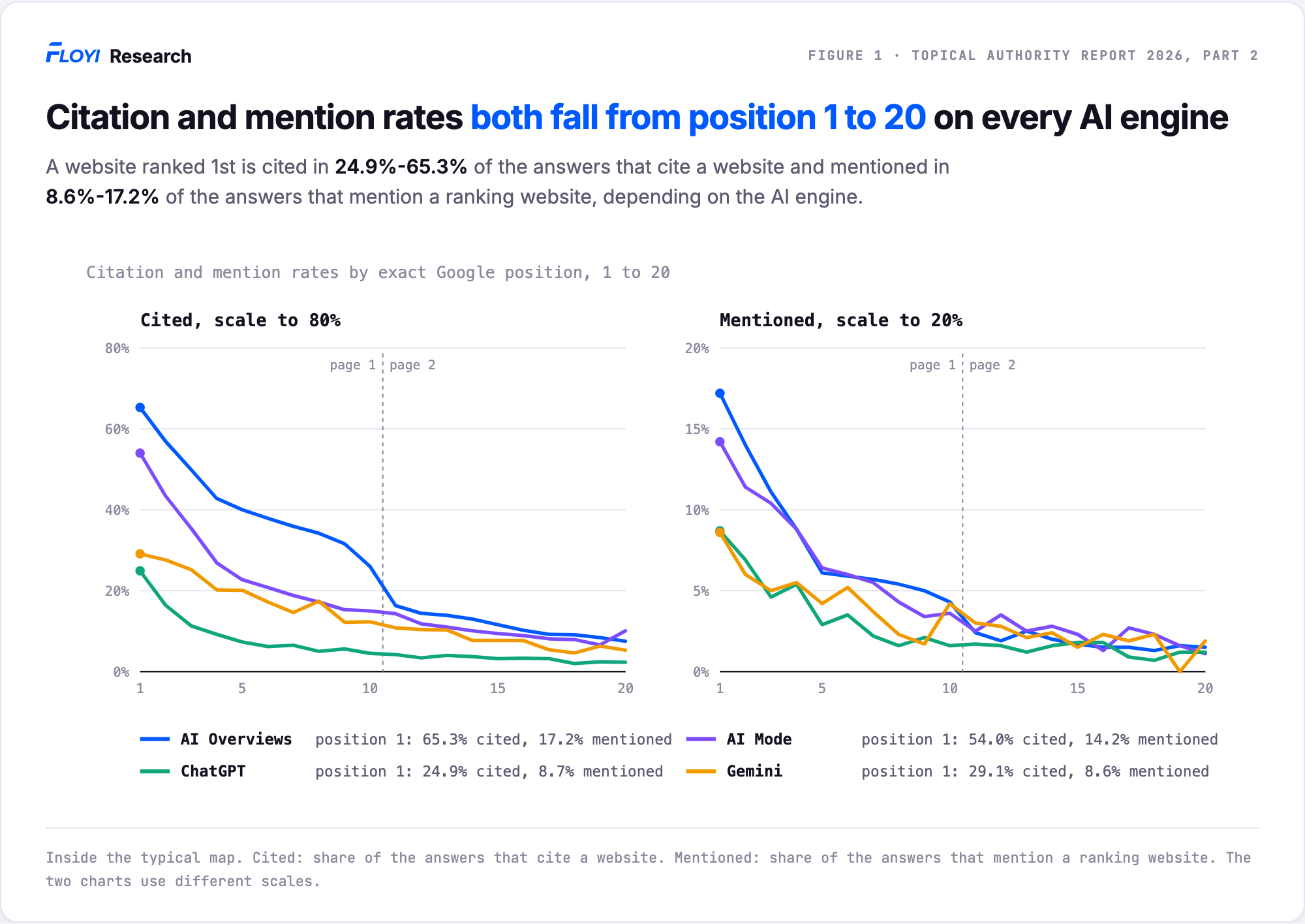
Figure 1. Citation and mention rates by exact Google position, 1 to 20.
| Google position | AI Overviews, cited / mentioned | AI Mode, cited / mentioned | ChatGPT, cited / mentioned | Gemini, cited / mentioned |
|---|---|---|---|---|
| 1 | 65.3% / 17.2% | 54.0% / 14.2% | 24.9% / 8.7% | 29.1% / 8.6% |
| 2 | 56.9% / 14.0% | 43.4% / 11.4% | 16.4% / 6.9% | 27.6% / 6.0% |
| 3 | 49.9% / 11.1% | 35.4% / 10.4% | 11.3% / 4.6% | 25.2% / 5.0% |
| 4 | 42.8% / 8.8% | 26.9% / 8.8% | 9.2% / 5.4% | 20.2% / 5.5% |
| 5 | 40.0% / 6.1% | 22.7% / 6.4% | 7.3% / 2.9% | 20.1% / 4.2% |
| 6 | 37.9% / 5.9% | 20.8% / 6.0% | 6.2% / 3.5% | 17.2% / 5.2% |
| 7 | 35.9% / 5.7% | 18.8% / 5.5% | 6.5% / 2.2% | 14.6% / 3.7% |
| 8 | 34.2% / 5.4% | 17.2% / 4.3% | 5.0% / 1.6% | 17.4% / 2.3% |
| 9 | 31.6% / 5.0% | 15.3% / 3.4% | 5.6% / 2.1% | 12.2% / 1.7% |
| 10 | 26.0% / 4.3% | 15.0% / 3.6% | 4.5% / 1.6% | 12.3% / 4.2% |
| 11 | 16.3% / 2.4% | 14.3% / 2.5% | 4.2% / 1.7% | 10.8% / 3.0% |
| 12 | 14.4% / 1.9% | 11.8% / 3.5% | 3.4% / 1.6% | 10.4% / 2.8% |
| 13 | 13.9% / 2.5% | 11.0% / 2.5% | 4.0% / 1.2% | 10.3% / 2.1% |
| 14 | 13.0% / 2.0% | 10.1% / 2.8% | 3.7% / 1.6% | 7.7% / 2.4% |
| 15 | 11.6% / 1.7% | 9.4% / 2.3% | 3.2% / 1.8% | 7.7% / 1.5% |
| 16 | 10.2% / 1.5% | 8.9% / 1.3% | 3.3% / 1.8% | 7.7% / 2.3% |
| 17 | 9.2% / 1.5% | 8.1% / 2.7% | 3.2% / 0.9% | 5.4% / 1.9% |
| 18 | 9.1% / 1.3% | 7.9% / 2.3% | 2.0% / 0.7% | 4.6% / 2.3% |
| 19 | 8.4% / 1.6% | 6.6% / 1.6% | 2.4% / 1.2% | 6.3% / 0.0% |
| 20 | 7.5% / 1.5% | 10.1% / 1.1% | 2.3% / 1.2% | 5.3% / 1.9% |
Read the position 1 row this way, for AI Overviews, inside the typical map:
- A website ranked 1st is cited in 65.3% of the AI Overviews that cite a website.
- It’s mentioned in 17.2% of the AI Overviews that mention a ranking website.
What the citation rates show:
- ChatGPT has the sharpest drop from 1st to 2nd place. A website ranked 2nd on ChatGPT is cited 66% as often as one ranked 1st. It’s cited 80%-95% as often on the other three engines.
- Gemini’s citation rate changes the least across the top 3. A website ranked 3rd on Gemini is cited 87% as often as one ranked 1st. It’s cited 45%-76% as often on the other three engines.
- AI Overviews drop the most at the end of Google’s first page. Their citation rate falls from 26.0% at 10th place to 16.3% at 11th. That’s the biggest drop between two neighboring positions on AI Overviews. No other engine has its biggest drop there. This suggests AI Overviews lean on Google’s first page of results more than the other engines do.
What the mention rates show:
- Mention rates fall fastest inside the top 3 on AI Overviews, ChatGPT and Gemini. The drop from 1st to 3rd place makes up 47%-82% of the whole drop from 1st to 10th place on those engines. AI Mode’s mention rate falls from 14.2% to 10.4% in the top 3, then about as fast again to 6.4% at 5th place.
- Mentions fall faster than citations on AI Overviews. A website ranked 10th is cited 40% as often as one ranked 1st, but mentioned only 25% as often.
- Mentions fall about as fast as citations on AI Mode and ChatGPT, and more slowly on Gemini. A website ranked 10th on AI Mode is cited 28% as often as one ranked 1st and mentioned 25% as often. On ChatGPT it’s 18% and 18%, and on Gemini it’s 42% and 49%.
- Mentions are rare below 10th place on every engine. The highest mention rate from 11th to 20th place is 2.5% on AI Overviews, 3.5% on AI Mode, 1.8% on ChatGPT, and 3.0% on Gemini.
How Many of the Brands AI Answers Mention Rank for the Query?
Most of the brands AI answers mention don’t rank for the query, on all four AI engines. Only 23.0%-43.2% of them are in the query’s own top 20, depending on the AI engine, inside the typical map. 36.7%-70.0% of the ones they cite are there.
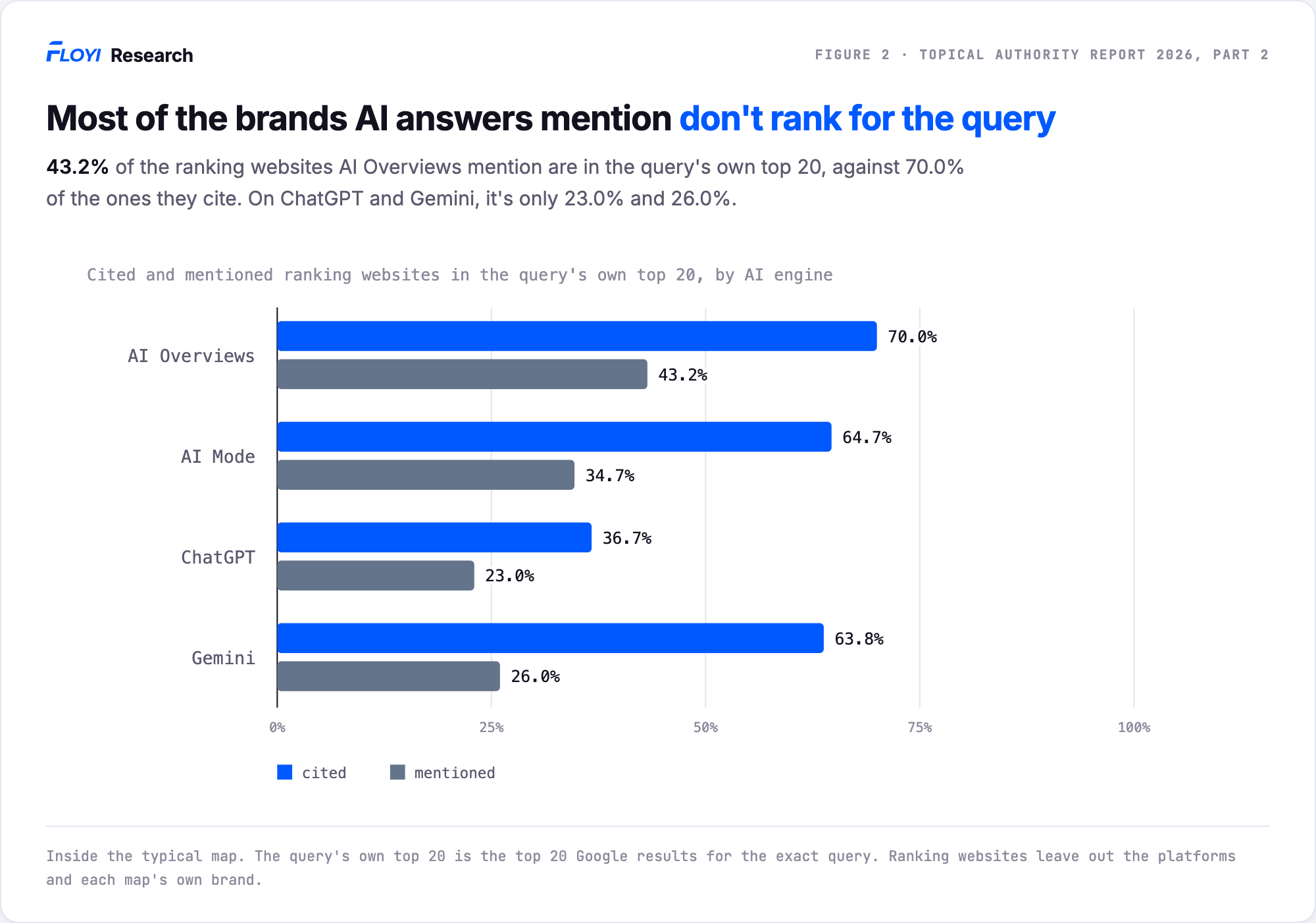
Figure 2. Cited and mentioned ranking websites in the query’s own top 20, by AI engine.
| AI engine | Cited / mentioned ranking websites in the query’s own top 20 | Answers citing / mentioning one of the query’s own top 20, of answers citing / mentioning a ranking website |
|---|---|---|
| AI Overviews | 70.0% / 43.2% | 97.2% / 54.4% |
| AI Mode | 64.7% / 34.7% | 89.0% / 48.3% |
| ChatGPT | 36.7% / 23.0% | 64.0% / 33.8% |
| Gemini | 63.8% / 26.0% | 88.9% / 37.6% |
Read the AI Overviews row this way, inside the typical map:
- 70.0% of the ranking websites AI Overviews cite are in the query’s own top 20, and so are 43.2% of the ones they mention.
- 97.2% of the AI Overviews that cite a ranking website cite one in the query’s own top 20, and 54.4% of the ones that mention a ranking website mention one there.
What the table shows:
- AI Overviews stay closest to the query’s own top 20, for citations and mentions alike. They’re the only engine where most answers that mention a ranking website mention one there. AI Mode is next, at 48.3%.
- ChatGPT’s citations stray furthest from the query, so they differ least from its mentions. Only 36.7% of the ranking websites it cites are in the query’s own top 20, against 23.0% of the ones it mentions. That’s the smallest gap of the four engines.
- Gemini shows the widest gap between the websites it cites and the ones it mentions. 63.8% of the ranking websites it cites are in the query’s own top 20, against only 26.0% of the ones it mentions.
- About 3 in 4 of the ranking websites ChatGPT and Gemini mention don’t rank for the query. They rank for other topics in the map instead.
Keep a separate list of the brands that get mentioned for each query, on each engine. Don’t copy it from the websites the answers cite or from the query’s own top 20. Most mentioned ranking websites rank elsewhere in your map, most of all on ChatGPT and Gemini.
Do Websites That Rank for More of a Topical Map Get Mentioned More?
Websites that rank for more of a map get mentioned more on all four AI engines, but only weakly. Ranked coverage lines up with mentions at a correlation of 0.15-0.20, against 0.29-0.50 for citations, inside the typical map.
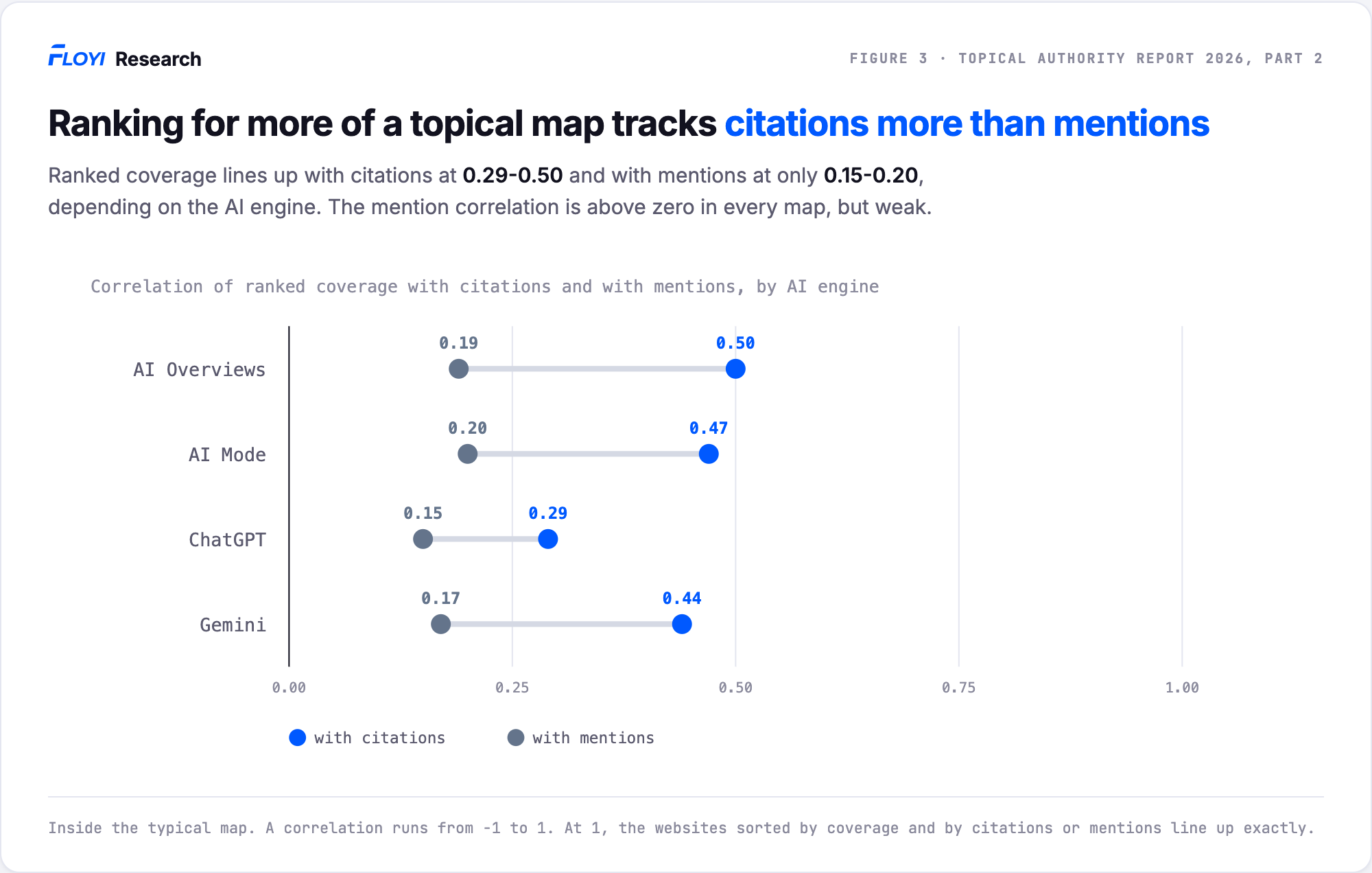
Figure 3. Correlation of ranked coverage with citations and with mentions, by AI engine.
| AI engine | Correlation of ranked coverage with citations | Correlation of ranked coverage with mentions |
|---|---|---|
| AI Overviews | 0.50 | 0.19 |
| AI Mode | 0.47 | 0.20 |
| ChatGPT | 0.29 | 0.15 |
| Gemini | 0.44 | 0.17 |
Read the AI Overviews row this way, inside the typical map:
- Ranked coverage lines up with citations at a correlation of 0.50.
- Ranked coverage lines up with mentions at a correlation of 0.19.
What the numbers show:
- The link holds in every map. The correlation between ranked coverage and mentions is above zero in every map on all four engines, not just on average.
- Coverage is only a loose guide to who gets mentioned. Sort a map’s websites by coverage and by mentions, and the two lists match only loosely. A website can rank for many topics in a map and still never be mentioned.
- Mentions follow coverage about as weakly on every engine. The four mention correlations are within 0.05 of each other.
- The gap between citations and mentions is widest on AI Overviews. Citations follow coverage most closely there. The four citation correlations are 0.21 apart, highest on AI Overviews and lowest on ChatGPT.
Use ranked coverage to forecast citations, not mentions. Covering more of your map still goes with more mentions, and Specialists get mentioned far more widely than Tourists (Figure 7, in Section 2). But two websites with the same coverage can get very different mention counts.
How Often Does One Website Get Mentioned on Queries It Doesn’t Rank For?
AI answers rarely mention a website on queries it doesn’t rank for, compared with the queries it does rank for. Part 1 calls a website that ranks for under 5% of a map’s topics a Tourist, and one that ranks for 5%-25% a Specialist. A Tourist is mentioned in 2.37%-4.48% of mentioning answers when it’s in the query’s own top 20, depending on the AI engine, inside the typical map. That falls to 0.10% or less on queries it doesn’t rank for.
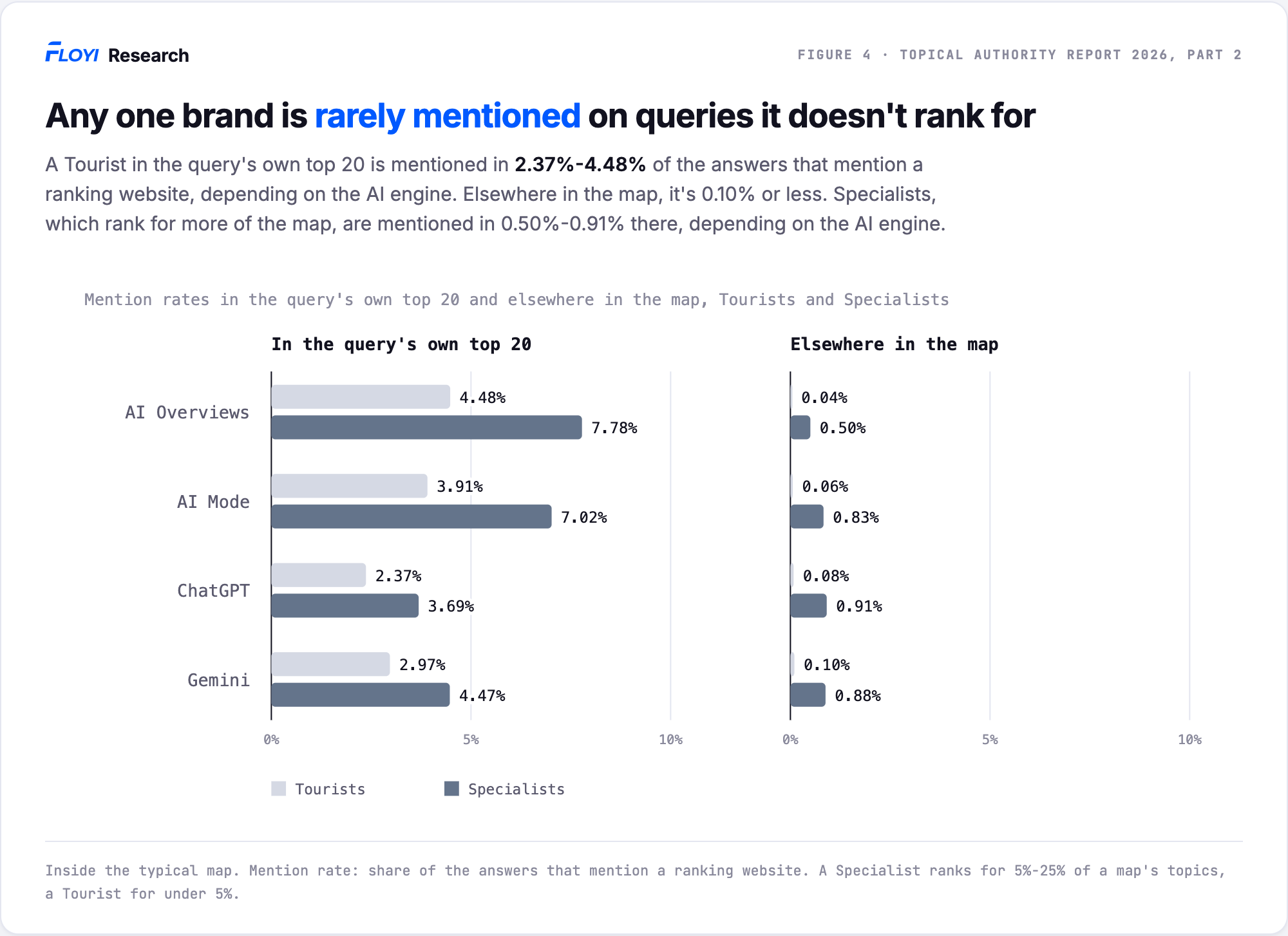
Figure 4. Mention rates in the query’s own top 20 and elsewhere in the map, Tourists and Specialists.
| Tier, in the query’s own top 20 / elsewhere in the map | AI Overviews | AI Mode | ChatGPT | Gemini |
|---|---|---|---|---|
| Tourists, mentioned | 4.48% / 0.04% | 3.91% / 0.06% | 2.37% / 0.08% | 2.97% / 0.10% |
| Specialists, mentioned | 7.78% / 0.50% | 7.02% / 0.83% | 3.69% / 0.91% | 4.47% / 0.88% |
| Tourists, cited | 24.78% / 0.08% | 15.13% / 0.06% | 3.84% / 0.05% | 13.58% / 0.06% |
| Specialists, cited | 34.43% / 1.25% | 26.99% / 1.74% | 12.86% / 2.07% | 20.01% / 1.11% |
Read the Tourists rows this way, for AI Overviews, inside the typical map:
- A Tourist in the query’s own top 20 is mentioned in 4.48% of the AI Overviews that mention a ranking website. A Tourist that ranks only elsewhere in the map, for other topics but not this query, is mentioned in 0.04%.
- A Tourist in the query’s own top 20 is cited in 24.78% of the AI Overviews that cite a website. One that ranks only elsewhere in the map is cited in 0.08%.
What the numbers show:
- Most of a Tourist’s mentions still come on queries it doesn’t rank for. That’s 65.4%-80.8% of them, depending on the AI engine, inside the typical map. A Tourist ranks for so few of a map’s topics that nearly every query in the map is one it doesn’t rank for. A tiny mention rate across that many answers adds up.
- There are far more Tourists than spots in a query’s own top 20. Each Tourist is rarely mentioned on a query it doesn’t rank for. Together, though, they get far more chances than the websites in the query’s own top 20. That helps explain why most of the ranking websites AI answers mention don’t rank for the query.
- Specialists get mentioned more often than Tourists on queries they don’t rank for, but still rarely. A Specialist that ranks only elsewhere in the map is mentioned in 0.50%-0.91% of mentioning answers. It’s cited in 1.11%-2.07% of citing answers, against 0.08% or less for a Tourist. This matches Part 1, where websites that covered more of a map got more citations on queries they didn’t rank for.
- Ranking for the exact query makes the least difference to a Specialist on ChatGPT. A Specialist that ranks only elsewhere in the map gets higher mention and citation rates on ChatGPT than on any other engine. A Specialist in the query’s own top 20 gets lower ones there than anywhere else, at 3.69% mentioned and 12.86% cited.
Check every AI answer in your map for your brand, not only the answers to queries you rank for. If your website is a Tourist, those other answers will likely bring you most of your mentions.
Does Broader Map Coverage Still Matter for Mentions Once a Website Is in the Top 3?
AI answers mention a website in the query’s own top 3 about as often whether it ranks for under 5% or 5%-25% of a map’s topics. Tourists’ and Specialists’ mention rates are within 2.7 points of each other on all four AI engines, inside the typical map. The widest gap is on AI Mode, at 10.2% for a Tourist against 12.9% for a Specialist.
| Tier, in the query’s own top 3, mentioned / cited | AI Overviews | AI Mode | ChatGPT | Gemini |
|---|---|---|---|---|
| Tourists | 13.1% / 53.7% | 10.2% / 38.3% | 5.4% / 10.8% | 6.4% / 29.9% |
| Specialists | 15.6% / 59.2% | 12.9% / 49.9% | 6.2% / 22.0% | 6.1% / 33.0% |
Read the AI Overviews column this way, inside the typical map:
- A Tourist in the query’s own top 3 is mentioned in 13.1% of the AI Overviews that mention a ranking website, and a Specialist in 15.6%.
- A Tourist in the query’s own top 3 is cited in 53.7% of the AI Overviews that cite a website, and a Specialist in 59.2%.
What the numbers show:
- Specialists keep only a small lead in mentions once both are in the top 3. A Specialist on AI Overviews is mentioned 1.7 times as often as a Tourist across the query’s own top 20 (Figure 4), but only 1.2 times as often in the top 3. Their lead shows on AI Overviews, AI Mode and ChatGPT. Tourists come out a little ahead on Gemini.
- A Tourist in the top 3 is mentioned far more often than one anywhere in the query’s own top 20. A Tourist in the top 3 is mentioned in 13.1% of the AI Overviews that mention a ranking website, against 4.48% for one anywhere in the query’s own top 20.
- Specialists in the top 3 get cited far more than Tourists on AI Mode and ChatGPT, even though they’re mentioned about as often. A Tourist in the query’s own top 3 is cited in 38.3% of the AI Mode answers that cite a website, against 49.9% for a Specialist. On ChatGPT it’s 10.8% against 22.0%. The two are within 5.5 points on AI Overviews and Gemini. So broader coverage goes with more citations for a top-3 website on AI Mode and ChatGPT, not more mentions.
Don’t wait for broader map coverage before you go after mentions. Pick the queries you most want to be mentioned for and push those pages into the top 3.
2. 59.7%-92.5% of the Websites AI Answers Mentioned Weren’t Cited in the Same Answer
Most of the ranking websites an AI answer mentions aren’t cited in that same answer. The share runs from 59.7% on AI Overviews to 92.5% on Gemini, inside the typical map. An answer also mentions fewer ranking websites than it cites, 2.0-2.3 when it mentions any against 2.6-6.2 when it cites any. The websites AI answers mention also have a higher average DR than the ones they cite, on three of the four engines. And far fewer websites get mentioned than cited. A map has 11.5 mentioned websites for every 100 cited ones on AI Overviews.
How Many Websites Does One AI Answer Cite and Mention?
An AI answer cites 2.6-6.2 ranking websites on average when it cites any, depending on the AI engine, inside the typical map. It mentions only 2.0-2.3 when it mentions any. The query’s own top 3 gets cited far more often than it gets mentioned. Most of the ranking websites that get cited or mentioned are Tourists.
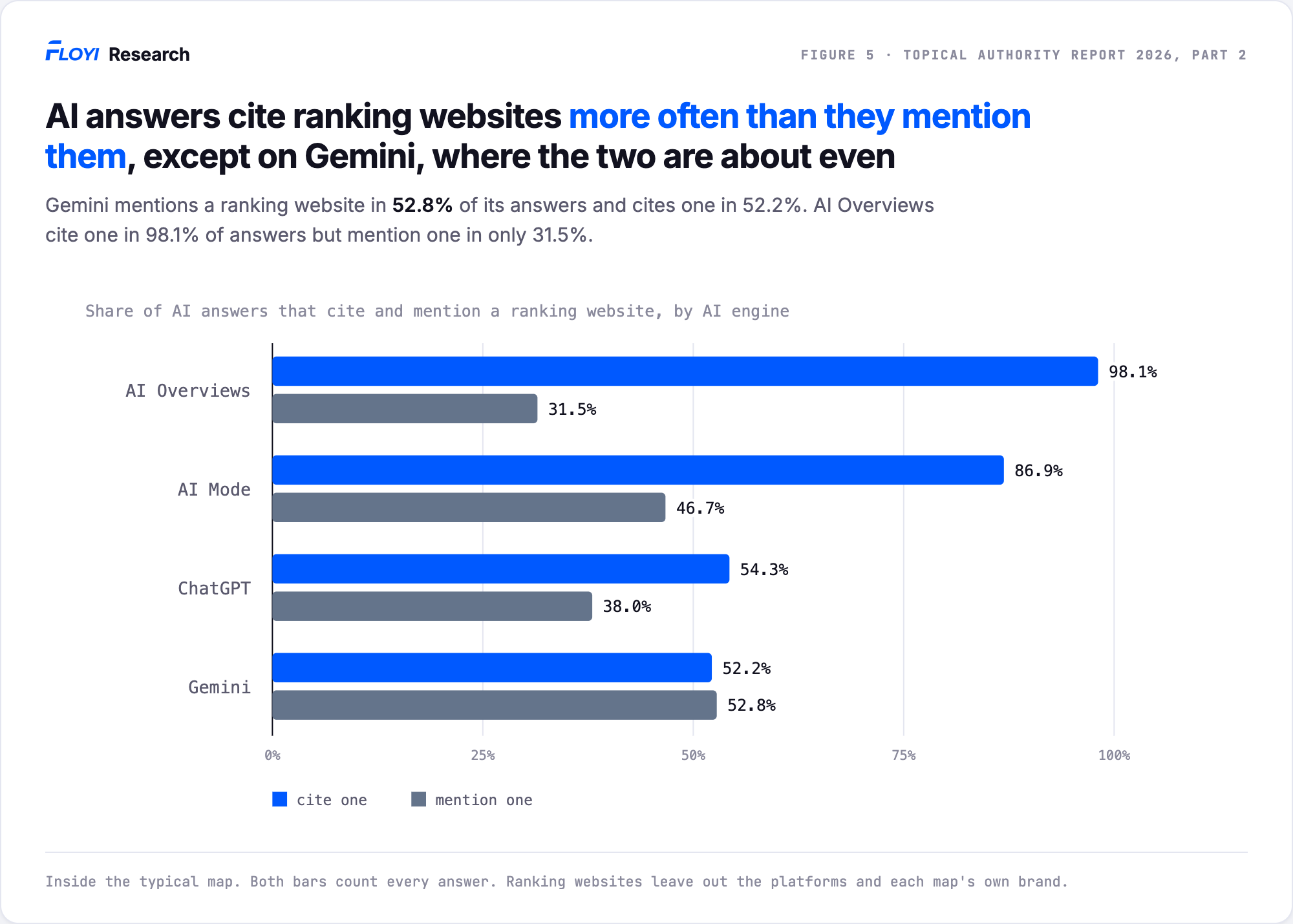
Figure 5. Share of AI answers that cite and mention a ranking website, by AI engine.
| Measure, cited / mentioned | AI Overviews | AI Mode | ChatGPT | Gemini |
|---|---|---|---|---|
| Ranking websites per answer that cites / mentions one | 6.2 / 2.0 | 4.9 / 2.2 | 2.6 / 2.1 | 3.6 / 2.3 |
| Answers that cite / mention a ranking website, of all answers | 98.1% / 31.5% | 86.9% / 46.7% | 54.3% / 38.0% | 52.2% / 52.8% |
| Answers that cite / mention one of the query’s own top 3, of those that cite / mention a ranking website | 83.4% / 30.7% | 70.8% / 24.2% | 34.9% / 14.9% | 57.5% / 14.0% |
Read the AI Overviews column this way, inside the typical map:
- An AI Overview cites 6.2 ranking websites on average when it cites any, and mentions 2.0 when it mentions any.
- 98.1% of AI Overviews cite at least one ranking website, and 31.5% mention one.
- 83.4% of the AI Overviews that cite a ranking website cite one of the query’s own top 3. 30.7% of the AI Overviews that mention a ranking website mention one of the top 3.
What the numbers show:
- Every engine cites more ranking websites per answer than it mentions. The gap is small only on ChatGPT, 2.6 against 2.1.
- AI Overviews and AI Mode cite a ranking website in most answers but mention one far less often. AI Overviews cite one in almost every answer. 86.9% of AI Mode answers cite one, and 46.7% mention one.
- Gemini mentions a ranking website about as often as it cites one. 52.8% of Gemini answers mention one, against 52.2% that cite one. Many Gemini answers cite no website at all, but they can still mention one.
- The query’s own top 3 gets cited far more often than it gets mentioned, on every engine. Its citation rate is 2.3-4.1 times its mention rate, depending on the AI engine. Gemini’s ratio is the highest, 57.5% against 14.0%.
Figure 6 shows which tiers those cited and mentioned websites come from.
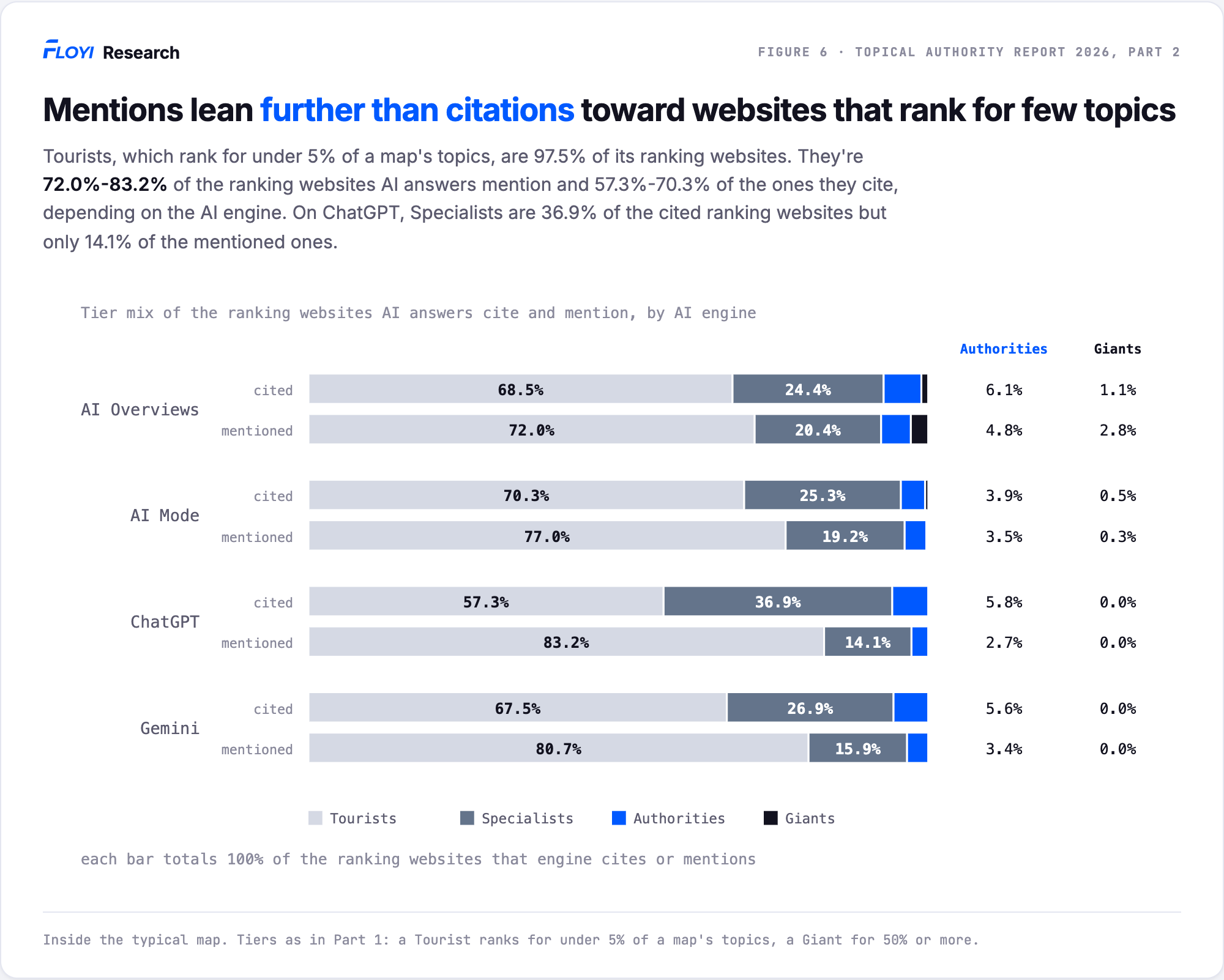
Figure 6. Tier mix of the ranking websites AI answers cite and mention, by AI engine.
| Tier and its ranked coverage, share of cited / mentioned ranking websites | AI Overviews | AI Mode | ChatGPT | Gemini |
|---|---|---|---|---|
| Tourists, ranking for under 5% of a map’s topics | 68.5% / 72.0% | 70.3% / 77.0% | 57.3% / 83.2% | 67.5% / 80.7% |
| Specialists, 5%-25% | 24.4% / 20.4% | 25.3% / 19.2% | 36.9% / 14.1% | 26.9% / 15.9% |
| Authorities, 25%-50% | 6.1% / 4.8% | 3.9% / 3.5% | 5.8% / 2.7% | 5.6% / 3.4% |
| Giants, 50% or more | 1.1% / 2.8% | 0.5% / 0.3% | 0.0% / 0.0% | 0.0% / 0.0% |
Read the AI Overviews column this way, inside the typical map:
- 68.5% of the ranking websites AI Overviews cite are Tourists, and so are 72.0% of the ranking websites they mention.
What the numbers show:
- Most cited and mentioned ranking websites are Tourists because most ranking websites are Tourists. 97.5% of the ranking websites are Tourists, inside the typical map. Each Tourist is cited and mentioned far less often than a website in any other tier.
- Mentions lean further toward Tourists than citations do, on every engine. Specialists and Authorities make up a bigger share of the ranking websites each engine cites than of the ones it mentions. The gap is widest on ChatGPT. Tourists are 83.2% of the ranking websites it mentions, against 57.3% of the ones it cites. Specialists are 36.9% of the ones it cites, against 14.1% of the ones it mentions.
Check whether AI answers mention you on each query where you rank in the top 3, not only whether they cite you. When they mention other websites instead, expect most of them to be Tourists, websites that rank for only a few of your map’s topics. Check beyond the competitors that rank across your map.
How Often Does an AI Answer Cite and Mention the Same Website?
AI answers rarely mention the websites they cite. An AI answer mentions only 4.6%-7.6% of the ranking websites it cites, depending on the AI engine, inside the typical map. And most of the ranking websites it mentions aren’t cited in that answer.
| AI engine | Cited ranking websites, also mentioned / not mentioned | Mentioned ranking websites, also cited / not cited |
|---|---|---|
| AI Overviews | 4.6% / 95.4% | 40.3% / 59.7% |
| AI Mode | 7.6% / 92.4% | 24.1% / 75.9% |
| ChatGPT | 6.1% / 93.9% | 9.8% / 90.2% |
| Gemini | 6.1% / 93.9% | 7.5% / 92.5% |
Read the AI Overviews row this way, inside the typical map:
- 4.6% of the ranking websites AI Overviews cite are also mentioned in the same answer, and 95.4% aren’t.
- 40.3% of the ranking websites AI Overviews mention are also cited in the same answer, and 59.7% aren’t.
What the numbers show:
- A mention comes with a citation far more often on AI Overviews and AI Mode than on ChatGPT and Gemini. A website mentioned in an AI Overview is about 5.4 times as likely to be cited in that answer as one mentioned in a Gemini answer. A website mentioned in an AI Mode answer is about 2.5 times as likely to be cited as one mentioned in a ChatGPT answer.
- Our best explanation is how many websites each engine cites (Figure 5). All four engines mention a similarly small share of the websites they cite. But AI Overviews and AI Mode cite more websites per answer than ChatGPT and Gemini. So a website they mention is more often among their sources. ChatGPT and Gemini also cite no website at all in many answers, and a mention in those answers can’t come with a citation.
Do AI Answers Mention Higher-DR Websites Than They Cite?
Yes, the websites AI answers mention have an average Domain Rating 10.2-17.1 points higher than the ones they cite on AI Overviews, ChatGPT and Gemini, inside the typical map. AI Mode is the exception, with about the same DR for both.
| Measure, average (median) | AI Overviews | AI Mode | ChatGPT | Gemini |
|---|---|---|---|---|
| DR per citation / per mention | 39.9 (35.2) / 50.1 (44.5) | 49.2 (52.8) / 52.7 (50.5) | 53.6 (56.3) / 70.6 (76.6) | 47.6 (51.6) / 64.7 (66.1) |
| Citations / mentions to DR 60+ websites | 24.3% (19.1%) / 38.2% (31.2%) | 38.5% (41.5%) / 40.6% (32.9%) | 47.6% (56.5%) / 67.0% (80.8%) | 37.2% (39.6%) / 57.6% (64.9%) |
| DR 60+ websites, of a map’s ranking websites | 19.3% (16.4%) | 22.8% (21.5%) | 22.9% (21.0%) | 24.6% (25.9%) |
| Ranking websites mentioned at least once in their map, DR 60+ / under 60 | 2.6% (1.9%) / 2.3% (1.8%) | 4.5% (3.2%) / 3.0% (2.8%) | 2.6% (2.8%) / 1.5% (1.3%) | 4.6% (5.7%) / 2.7% (3.2%) |
| Mentioned websites mentioned in 2 or more answers, DR 60+ / under 60 | 43.9% (47.7%) / 22.8% (22.4%) | 52.3% (51.3%) / 29.5% (32.7%) | 62.7% (68.8%) / 35.7% (33.3%) | 59.6% (55.8%) / 29.2% (30.5%) |
| Mentions per mentioned website, DR 60+ / under 60 | 4.1 (3.2) / 1.8 (1.4) | 4.2 (2.7) / 2.4 (2.1) | 6.9 (2.5) / 2.6 (1.9) | 6.7 (3.6) / 1.7 (1.4) |
Read the AI Overviews column this way, inside the typical map:
- The average DR is 39.9 per citation and 50.1 per mention.
- 24.3% of citations and 38.2% of mentions go to DR 60+ websites.
- DR 60+ websites are 19.3% of a map’s ranking websites. This row depends only on the maps each engine was tracked on, not on the engine.
- Only 2.6% of DR 60+ websites are mentioned at least once in their map, against 2.3% of lower-DR websites.
- 43.9% of the DR 60+ websites that get mentioned are mentioned in 2 or more answers, against 22.8% of the lower-DR ones.
- A mentioned DR 60+ website gets 4.1 mentions on average, against 1.8 for a lower-DR one.
What the table shows:
- ChatGPT and Gemini show the widest gap. ChatGPT’s mentions average 17.0 points more DR than its citations, and Gemini’s average 17.1 points more. AI Overviews’ gap is smaller, at 10.2 points.
- AI Mode’s mentions and citations go to websites of about the same DR. Its gap is only 3.5 points. DR 60+ websites get 40.6% of its mentions and 38.5% of its citations.
- Most of ChatGPT’s and Gemini’s mentions go to DR 60+ websites, but under 50% of their citations do. 67.0% of ChatGPT’s mentions go to DR 60+ websites, against 47.6% of its citations. Gemini’s split is 57.6% against 37.2%.
- DR 60+ websites get far more than their share of mentions. They’re 19.3%-24.6% of a map’s ranking websites but get 38.2%-67.0% of its mentions, depending on the AI engine.
- Yet almost no DR 60+ website gets mentioned. 95% or more of them are never mentioned in their map, on every engine. They’re more likely than lower-DR websites to be mentioned at least once on AI Mode, ChatGPT and Gemini, and about as likely on AI Overviews.
- The few DR 60+ websites that get mentioned get mentioned again and again. That’s how they get so many of the mentions. The pattern is strongest on Gemini, where a mentioned DR 60+ website gets 6.7 mentions on average, against 1.7 for a lower-DR one.
DR on its own barely lines up with how often a website is cited or mentioned. DR lines up with citations at 0.04 on AI Overviews, and with mentions at 0.03. Neither correlation is above 0.08 on AI Mode, ChatGPT and Gemini. Most high-DR websites are never mentioned, so DR can’t sort websites by their mentions.
Don’t use DR to pick the competitors you measure your mentions against. Most high-DR websites in your map never get mentioned. List the ones that do, because they’re the brands AI answers come back to.
Do Mentions Spread Across as Many Websites as Citations?
AI answers mention far fewer websites than they cite. A map has 11.5 mentioned websites for every 100 cited ones on AI Overviews, inside the typical map. Among the websites that do get mentioned, 50% of the mentions go to about a tenth of them, which is about as concentrated as citations, or more.
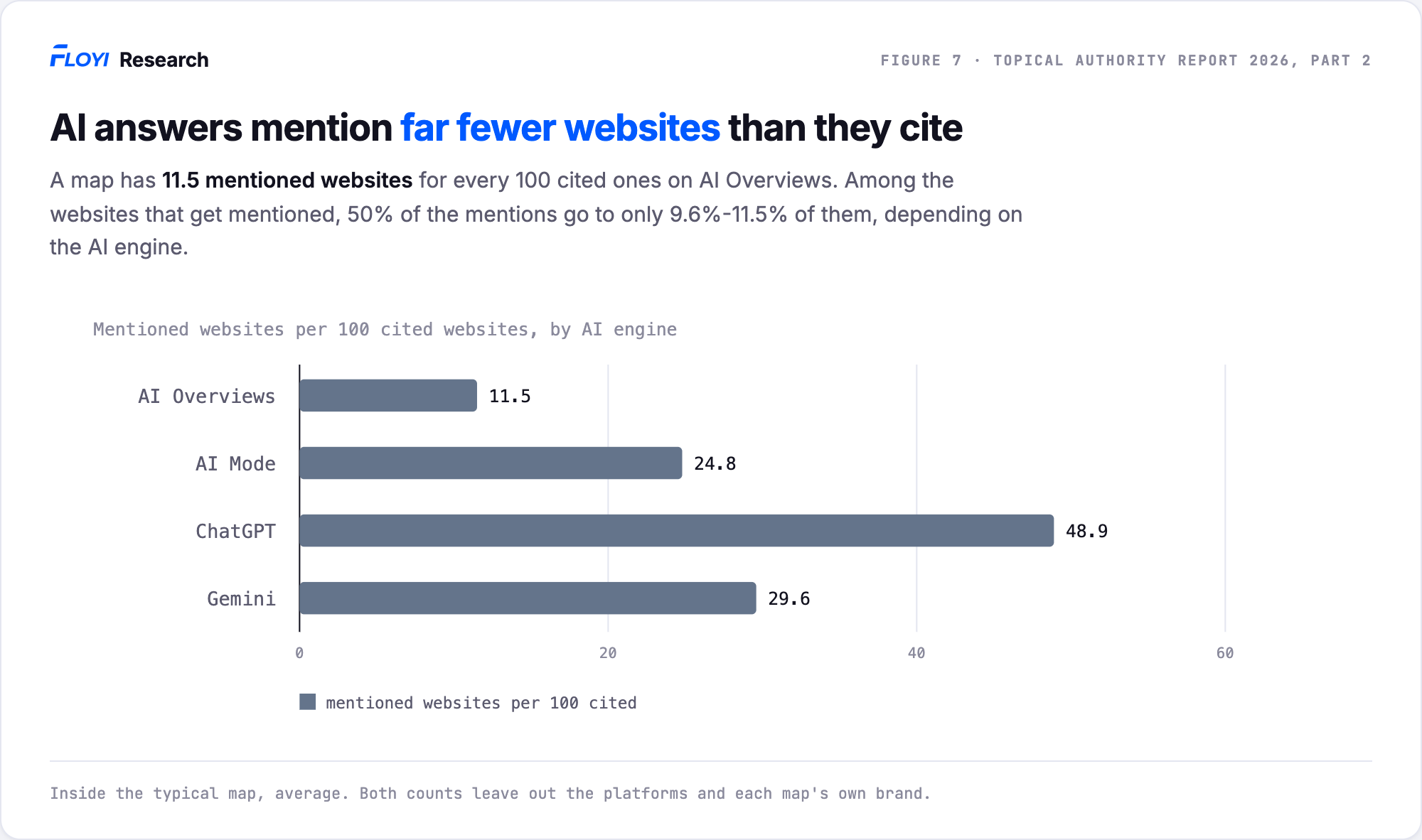
Figure 7. Mentioned websites per 100 cited websites, by AI engine.
| Measure | AI Overviews | AI Mode | ChatGPT | Gemini |
|---|---|---|---|---|
| Mentioned websites per 100 cited websites, average (median) | 11.5 (10.8) | 24.8 (21.8) | 48.9 (34.6) | 29.6 (31.3) |
| Websites that get 50% of mentions / citations, of the websites mentioned / cited, average (median) | 11.5% (10.7%) / 11.5% (9.8%) | 10.7% (7.6%) / 15.1% (14.7%) | 11.5% (8.3%) / 9.7% (7.5%) | 9.6% (6.6%) / 19.9% (19.3%) |
| Giants mentioned / cited at least once in their map | 56% / 89% | 100% / 100% | - | - |
| Authorities mentioned / cited at least once in their map | 58% / 96% | 88% / 100% | 62% / 100% | 57% / 100% |
| Specialists mentioned / cited at least once in their map | 30% / 93% | 37% / 92% | 20% / 66% | 20% / 83% |
| Tourists mentioned / cited at least once in their map | 3% / 38% | 4% / 32% | 2% / 7% | 4% / 20% |
A dash means that engine’s maps have no Giants. These counts leave out the 20 platforms, like Reddit and YouTube, which the mention scan doesn’t cover.
Read the AI Overviews column this way:
- A map has 11.5 mentioned websites for every 100 cited ones, inside the typical map.
- 50% of the mentions go to 11.5% of the mentioned websites, and 50% of the citations go to 11.5% of the cited websites.
- 56% of Giants are mentioned in at least one AI Overview in their map, and 89% are cited in at least one, with all maps combined.
What the table shows:
- Far fewer websites get mentioned than cited on every engine. AI Overviews show the widest gap, with 11.5 mentioned websites for every 100 cited. It’s 24.8 on AI Mode, 29.6 on Gemini and 48.9 on ChatGPT.
- Among the websites that get mentioned, mentions are about as concentrated as citations, or more. 50% of the mentions go to 9.6%-11.5% of the mentioned websites, depending on the AI engine. Mentions are more concentrated than citations on AI Mode and Gemini, and about the same on AI Overviews and ChatGPT.
- Giants are too rare to compare across engines. The maps tracked on ChatGPT and Gemini have no Giants, and AI Mode’s maps have very few. AI Overviews mention fewer of their map’s Giants than they cite.
- Every tier below the Giants is cited more widely than it’s mentioned, on every engine. The gap is widest for Specialists. AI Overviews cite 93% of Specialists at least once in their map but mention only 30%, with all maps combined. No engine mentions more than 37% of them.
- Tourists are the least likely to be mentioned, on every engine. Only 2%-4% of Tourists are mentioned at least once in their map, depending on the AI engine. Their citation reach changes far more by engine, from 38% on AI Overviews to 7% on ChatGPT.
List the websites that get 50% of your map’s mentions on each AI engine. They’re the brands AI answers already mention most. Measure your mentions against them, not against every website that ranks in your map.
3. Commercial Queries Got 2.0-2.6 Times as Many Mentions as Informational Queries, but Top-3 Citation Rates Changed Far Less
Commercial answers carry 2.6 times as many mentions of ranking websites as informational answers on AI Overviews, inside the typical map. On AI Mode and ChatGPT they carry 2.2 times as many, and on Gemini 2.0 times as many.
A website ranked in the top 3 is cited about as often on both kinds of query. Its citation rate moves 3.9 points or less on AI Overviews, AI Mode and ChatGPT. On Gemini it falls from 29.5% to 22.6%, even as Gemini’s mentions rise.
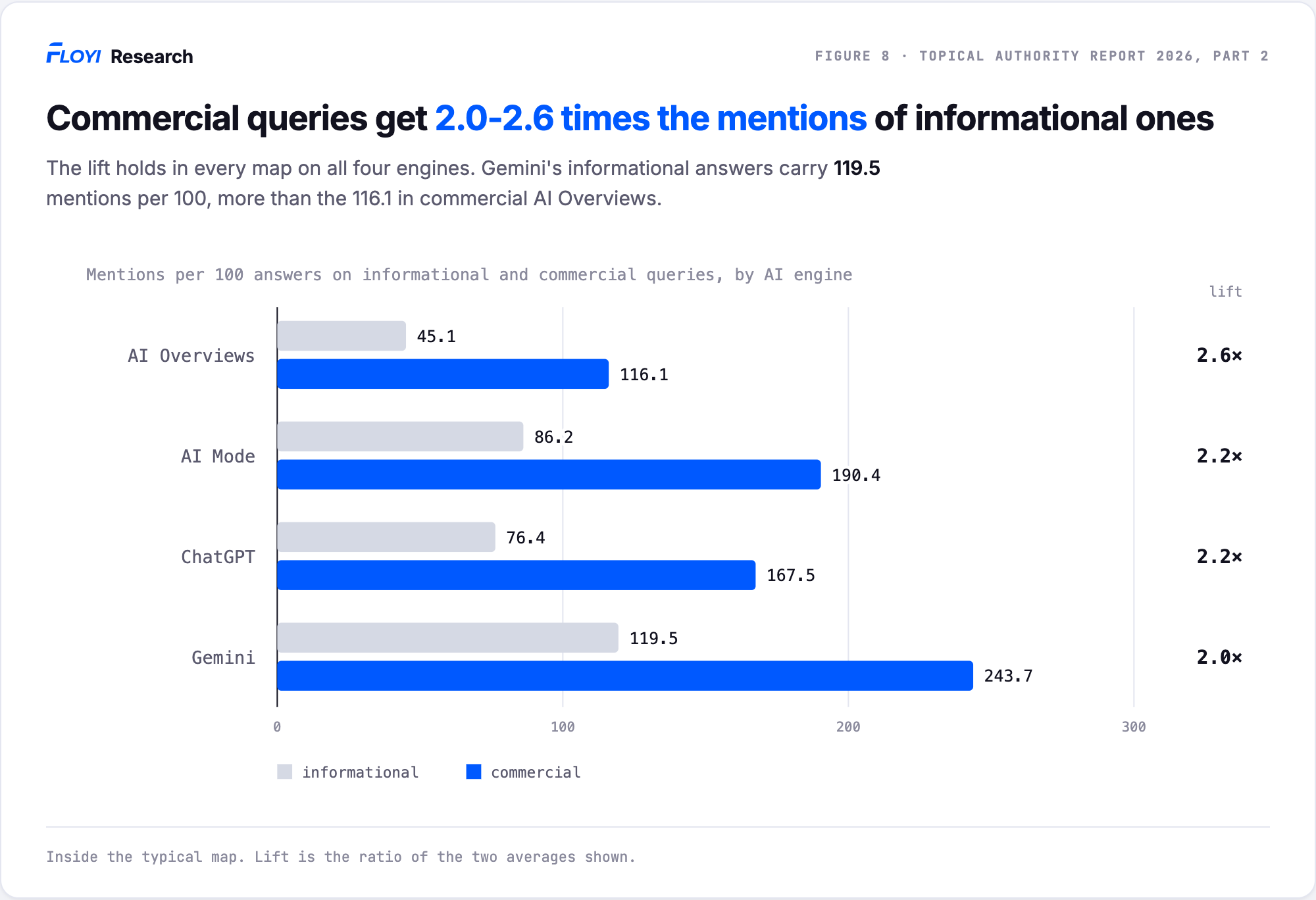
Figure 8. Mentions per 100 answers on informational and commercial queries, by AI engine.
| AI engine | Mentions per 100 answers, informational / commercial | Top-3 ranking cited, informational / commercial |
|---|---|---|
| AI Overviews | 45.1 / 116.1 | 58.4% / 56.1% |
| AI Mode | 86.2 / 190.4 | 45.4% / 41.5% |
| ChatGPT | 76.4 / 167.5 | 17.2% / 17.5% |
| Gemini | 119.5 / 243.7 | 29.5% / 22.6% |
Read the AI Overviews row this way, inside the typical map:
- 100 informational AI Overviews carry 45.1 mentions of ranking websites, and 100 commercial AI Overviews carry 116.1.
- A website ranked in the top 3 is cited in 58.4% of informational AI Overviews and 56.1% of commercial ones.
What the numbers show:
- The mention lift holds in every map. Commercial answers carry more mentions than informational answers in every map on all four engines, not just on average.
- AI Overviews get the biggest lift from the fewest mentions. They carry the fewest mentions of the four engines on both kinds of query.
- Gemini gets the smallest lift from the most mentions. Its informational answers carry 119.5 mentions per 100, more than commercial AI Overviews carry. So on Gemini, informational topics earn mentions too.
Does a Website Ranked 1st Get Mentioned More on Commercial Queries?
A website ranked 1st gets mentioned 2.5-3.4 times as often on commercial queries as on informational ones, on all four AI engines, inside the typical map. Its citation rate barely changes on AI Overviews, AI Mode and ChatGPT, but falls from 30.2% to 23.6% on Gemini.
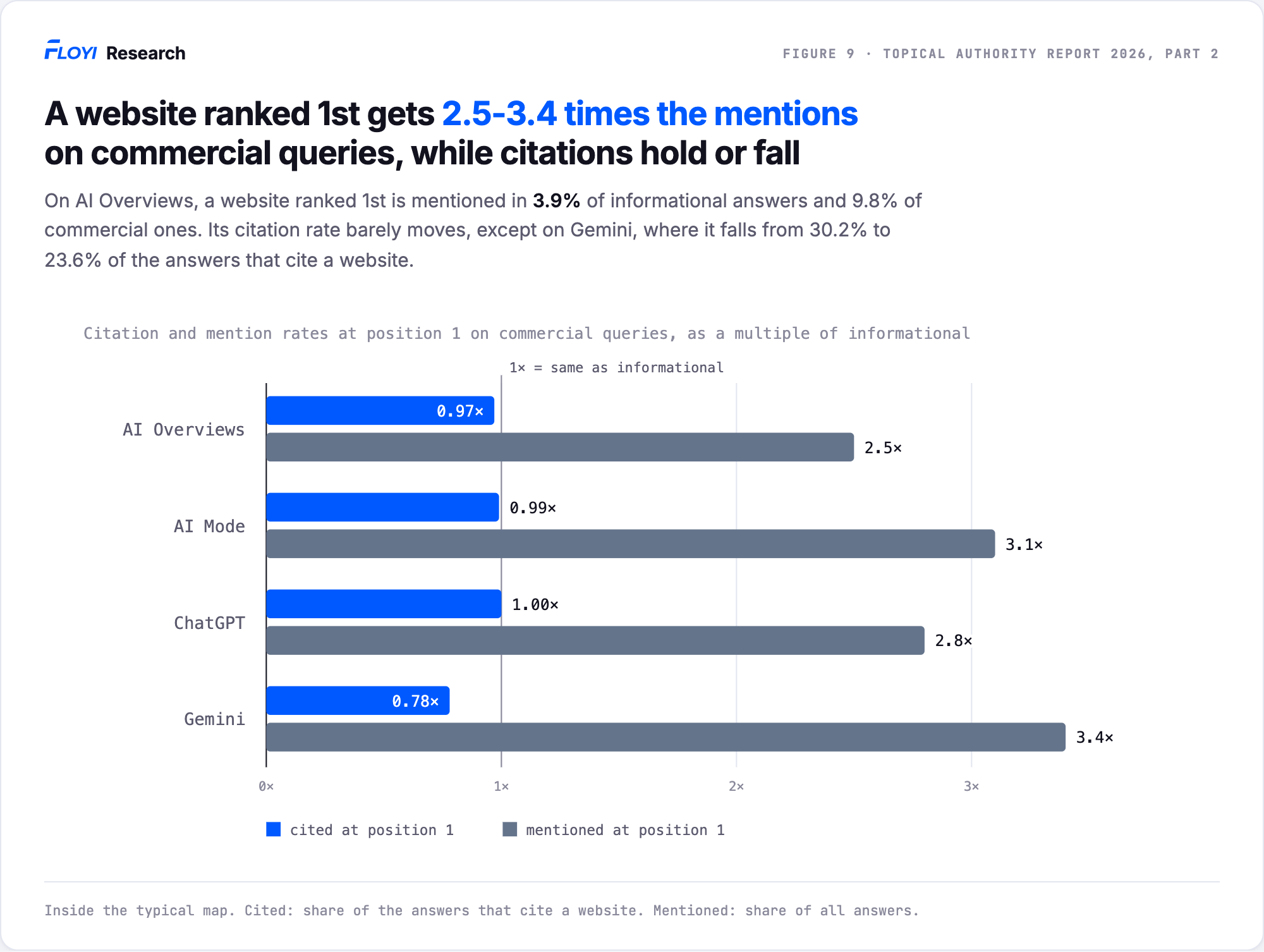
Figure 9. Citation and mention rates at position 1 on commercial queries, as a multiple of informational.
| AI engine | Websites cited per citing answer, informational / commercial | Cited at position 1, informational / commercial | Answers mentioning a ranking website, of all answers, informational / commercial | Mentioned at position 1, of all answers, informational / commercial |
|---|---|---|---|---|
| AI Overviews | 8.5 / 8.3 | 69.3% / 66.9% | 24.9% / 48.2% | 3.9% / 9.8% |
| AI Mode | 7.1 / 6.8 | 54.5% / 53.7% | 41.1% / 66.8% | 4.7% / 14.5% |
| ChatGPT | 4.7 / 4.5 | 24.2% / 24.3% | 32.6% / 56.1% | 2.2% / 6.1% |
| Gemini | 4.6 / 4.4 | 30.2% / 23.6% | 47.0% / 66.9% | 2.1% / 7.2% |
These mention rates count every answer, not only the answers that mention a ranking website. Compare them with the all-answer rates in the Methodology, not with Figure 1. The first column counts every website an answer cites, including platforms and websites outside the map.
Read the AI Overviews row this way, inside the typical map:
- An informational AI Overview cites 8.5 websites, and a commercial one cites 8.3.
- A website ranked 1st is cited in 69.3% of informational AI Overviews and 66.9% of commercial ones.
- 24.9% of informational AI Overviews mention a ranking website, against 48.2% of commercial ones.
- A website ranked 1st is mentioned in 3.9% of informational AI Overviews and 9.8% of commercial ones.
What the table shows:
- Citations barely change on commercial queries, except at position 1 on Gemini. The number of websites cited per answer moves 0.3 or less on every engine. The citation rate of a website ranked 1st moves 2.4 points or less on AI Overviews, AI Mode and ChatGPT.
- Commercial answers mention a ranking website more often on every engine. On AI Overviews the share is 1.9 times as high. It rises from 41.1% to 66.8% on AI Mode, from 32.6% to 56.1% on ChatGPT and from 47.0% to 66.9% on Gemini. Gemini rises the least, from the highest starting point of the four.
- A website ranked 1st gains even more. Its mention rate grows by a bigger multiple than the share of answers that mention a ranking website, on every engine. So commercial answers don’t just mention more brands. A bigger share of the answers that mention a ranking website name the one ranked 1st.
Do AI Answers Mention the Query’s Own Top 20 More on Commercial Queries?
Commercial answers are 2.3-3.7 times as likely as informational answers to mention a website in the query’s own top 20, on all four AI engines. 28.5%-43.1% of all commercial answers mention one, against 7.8%-15.8% of all informational answers, depending on the AI engine, inside the typical map.
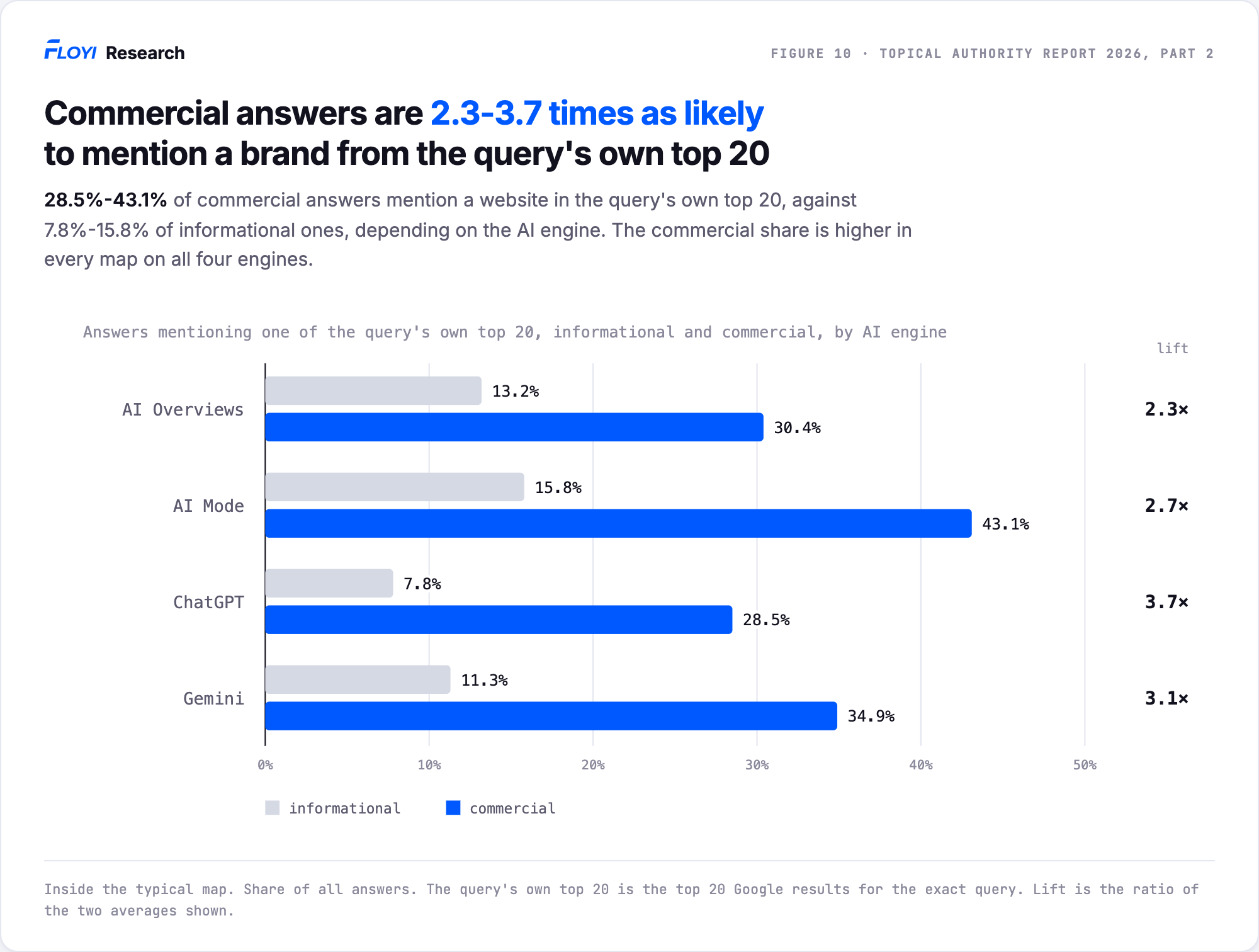
Figure 10. Answers mentioning one of the query’s own top 20, informational and commercial, by AI engine.
| AI engine | Answers mentioning one of the query’s own top 20, of all answers, informational / commercial | Answers mentioning one of the query’s own top 20, brands the query names left out, informational / commercial | A website in the query’s own top 3, mentioned, of answers mentioning a ranking website, informational / commercial | Mentioned ranking websites in the query’s own top 20, informational / commercial |
|---|---|---|---|---|
| AI Overviews | 13.2% / 30.4% | 12.7% / 28.3% | 12.6% / 17.6% | 41.8% / 43.8% |
| AI Mode | 15.8% / 43.1% | 14.8% / 37.8% | 8.3% / 18.0% | 26.8% / 38.2% |
| ChatGPT | 7.8% / 28.5% | 6.9% / 23.7% | 5.9% / 10.1% | 14.6% / 21.3% |
| Gemini | 11.3% / 34.9% | 10.2% / 29.4% | 3.2% / 12.7% | 14.7% / 23.7% |
Read the AI Overviews row this way, inside the typical map:
- 13.2% of informational AI Overviews mention a website in the query’s own top 20, against 30.4% of commercial ones.
- It’s 12.7% and 28.3% when brands the query names are left out.
- A website in the query’s own top 3 is mentioned in 12.6% of the informational AI Overviews that mention a ranking website and 17.6% of the commercial ones.
- 41.8% of the ranking websites informational AI Overviews mention are in the query’s own top 20, and so are 43.8% of the ones commercial AI Overviews mention.
What the numbers show:
- The rise holds in every map. Commercial answers mention a website in the query’s own top 20 more often than informational answers in every map on all four engines, not just on average.
- ChatGPT rises the most, from the lowest informational share. Its commercial answers are 3.7 times as likely to mention a website in the query’s own top 20. Gemini’s are 3.1 times as likely, AI Mode’s 2.7 times and AI Overviews’ 2.3 times.
- Branded queries explain only part of the rise. 23.7%-37.8% of commercial answers still mention a website in the query’s own top 20 after we leave out brands the query names. Only 6.9%-14.8% of informational answers do. The commercial share stays higher in almost every map.
- A website in the query’s own top 3 gets mentioned more on commercial queries, in most maps on every engine. The rise is biggest on AI Mode and Gemini. Gemini’s rate goes from 3.2% to 12.7% of the answers that mention a ranking website.
- Most of the ranking websites AI answers mention still don’t rank for the query. 43.8% or less of them are in the query’s own top 20, even on commercial queries. The share rises on AI Mode, ChatGPT and Gemini. It barely changes on AI Overviews, which starts highest.
Prioritize the commercial queries where you rank 4th to 10th, and work them into the top 3. A website in a commercial query’s own top 3 is mentioned in 10.1%-18.0% of the answers that mention a ranking website, against 4.3%-7.8% for one ranked 4th to 10th, depending on the AI engine, inside the typical map.
Do AI Answers Mention More of the Websites They Cite on Commercial Queries?
AI answers mention more of the websites they cite on commercial queries, on all four AI engines. They mention 8.6%-17.5% of them on commercial queries, against 2.5%-4.8% on informational queries, depending on the AI engine, inside the typical map.
| AI engine | Cited ranking websites also mentioned, informational / commercial | Cited ranking websites also mentioned, branded queries left out, informational / commercial | Answers mentioning none of the ranking websites they cite, informational / commercial |
|---|---|---|---|
| AI Overviews | 2.9% / 8.6% | 2.8% / 8.0% | 87.8% / 70.7% |
| AI Mode | 4.8% / 15.8% | 4.5% / 13.7% | 86.4% / 63.5% |
| ChatGPT | 2.5% / 17.5% | 1.7% / 14.5% | 95.0% / 75.4% |
| Gemini | 3.6% / 15.8% | 3.2% / 16.4% | 90.2% / 70.7% |
Read the AI Overviews row this way, inside the typical map:
- AI Overviews mention 2.9% of the ranking websites they cite on informational queries and 8.6% on commercial queries.
- They mention 2.8% and 8.0% when branded queries are left out.
- 87.8% of the informational AI Overviews that cite a ranking website mention none of them, and so do 70.7% of the commercial ones.
What the numbers show:
- ChatGPT rises the most, from the lowest share to the highest. ChatGPT’s share is 7.0 times as high on commercial queries as on informational ones. It’s 4.4 times as high on Gemini, 3.3 times on AI Mode and 3.0 times on AI Overviews. ChatGPT names the smallest share of its cited websites on informational queries and the biggest share on commercial ones.
- Branded queries explain only a small part of the rise. Commercial answers still mention 8.0%-16.4% of the ranking websites they cite when branded queries are left out, against 1.7%-4.5% for informational answers. The commercial share stays higher in every map on every engine.
- Most answers still mention none of the ranking websites they cite, even on commercial queries. 63.5%-75.4% of commercial answers that cite a ranking website mention none of them, and so do 86.4%-95.0% of informational ones. AI Mode answers most often name at least one ranking website they cite, and ChatGPT answers least often, on both kinds of query.
How Often Do AI Answers Cite Nothing on Informational and Commercial Queries?
Gemini cites nothing in 47.4% of informational answers and 36.8% of commercial ones, inside the typical map. ChatGPT cites nothing in 41.8% and 36.6%. AI Mode almost always cites a website, and every AI Overview in the study cites at least one.
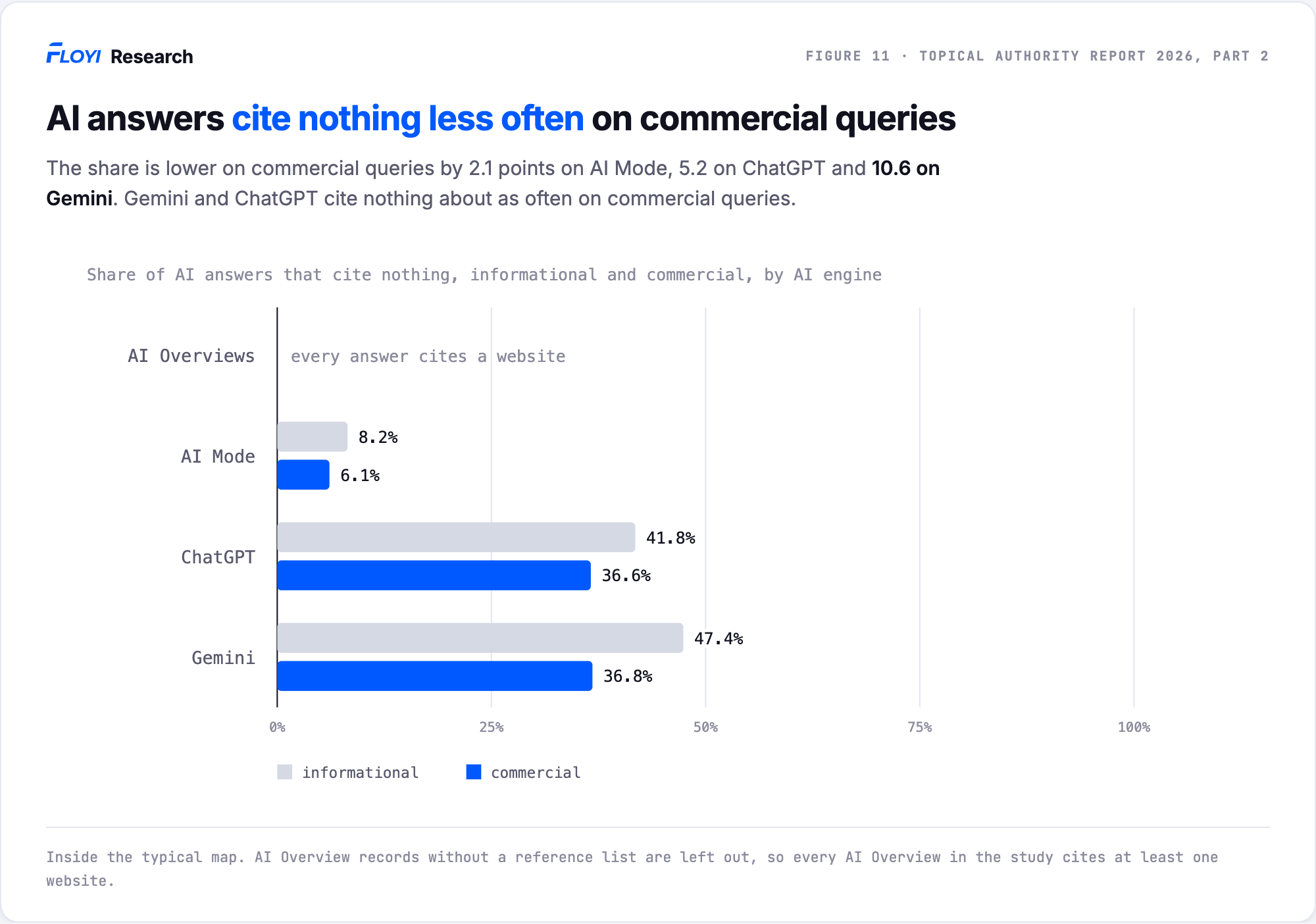
Figure 11. Share of AI answers that cite nothing, informational and commercial, by AI engine.
| AI engine | Answers citing nothing, informational / commercial |
|---|---|
| AI Overviews | 0.0% / 0.0% |
| AI Mode | 8.2% / 6.1% |
| ChatGPT | 41.8% / 36.6% |
| Gemini | 47.4% / 36.8% |
Read the ChatGPT row this way, inside the typical map:
- 41.8% of informational ChatGPT answers cite no website.
- 36.6% of commercial ChatGPT answers cite no website.
What the numbers show:
- AI Mode rarely cites nothing, on either kind of query. It cites nothing in 8.2% of informational answers and 6.1% of commercial ones.
- The share is lower on commercial queries on all three engines. Our best explanation is that questions about products and prices send the engine to the web, where it finds sources to cite. The data doesn’t show this directly.
- Gemini and ChatGPT cite nothing about as often on commercial queries. Gemini cites nothing 5.6 points more often than ChatGPT on informational queries, but only 0.2 points more on commercial ones.
4. 35.9%-47.9% of AI Answers That Cited Nothing Still Mentioned a Ranking Website
47.9% of Gemini’s citation-free answers still mention a ranking website, inside the typical map. ChatGPT’s share is 42.2%, and AI Mode’s is 35.9%.
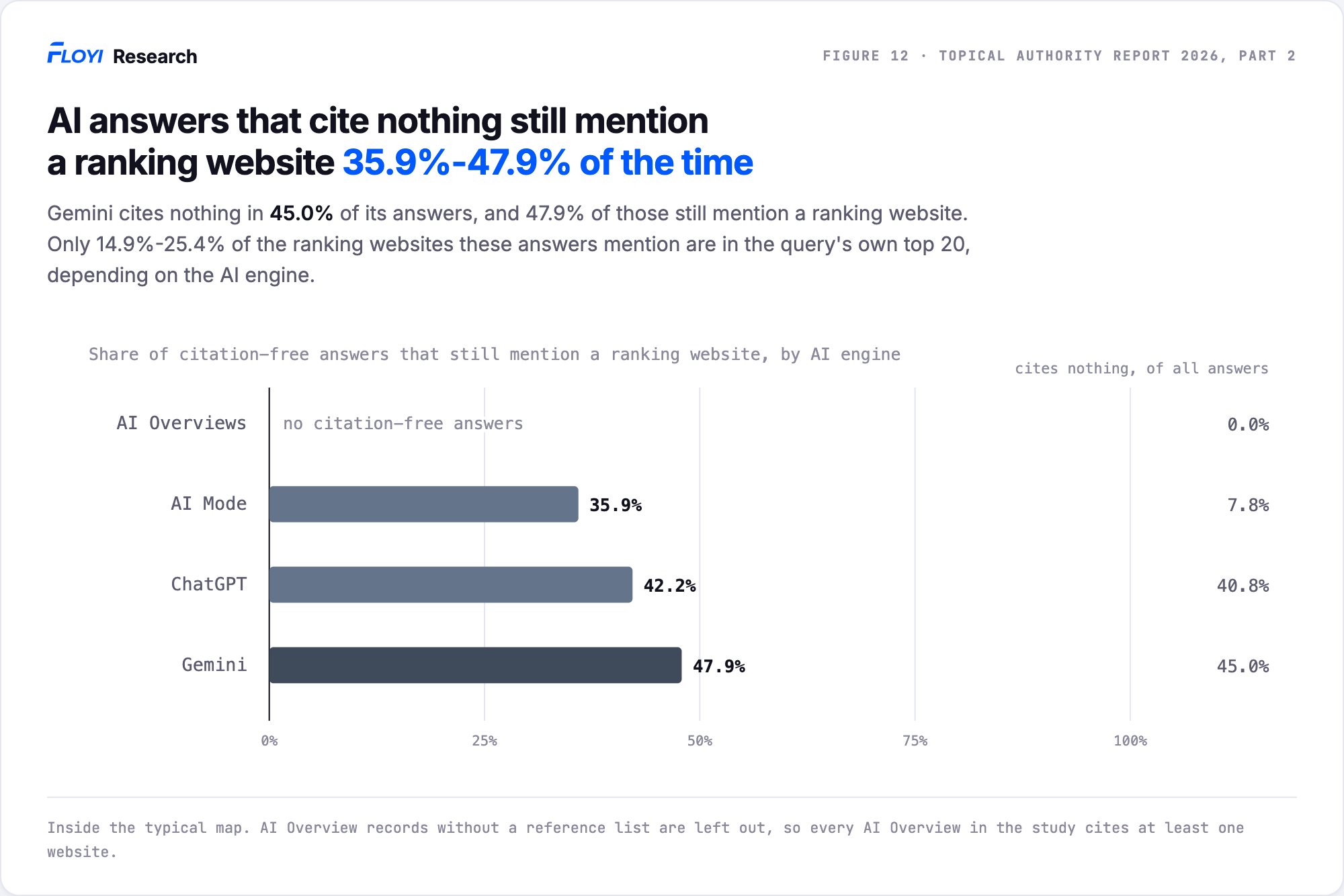
Figure 12. Share of citation-free answers that still mention a ranking website, by AI engine.
| AI engine | Citation-free answers, of all answers | Citation-free answers mentioning a ranking website, of citation-free answers |
|---|---|---|
| AI Overviews | 0.0% | - |
| AI Mode | 7.8% | 35.9% |
| ChatGPT | 40.8% | 42.2% |
| Gemini | 45.0% | 47.9% |
Part 1 reported that 54% of ChatGPT answers and 61% of Gemini answers cite no website, with all maps combined. This report works out each map’s share first, then averages across maps, so its numbers differ.
Read the ChatGPT row this way, inside the typical map:
- 40.8% of ChatGPT answers cite no website.
- 42.2% of the ChatGPT answers that cite no website mention at least one ranking website.
What the numbers show:
- Gemini’s citation-free answers are the most common, and they mention ranking websites most often. Gemini cites no website in 45.0% of its answers, against 40.8% on ChatGPT.
- Most citation-free answers mention no ranking website either, on every engine. 52.1% of Gemini’s, 57.8% of ChatGPT’s and 64.1% of AI Mode’s have no citation and no mention of a ranking website.
- AI Mode’s mentions without a citation mostly come from answers that cite other websites. Only 7.8% of AI Mode answers cite nothing, but 75.9% of the ranking websites it mentions aren’t cited in that answer.
- Most of the ranking websites these answers mention don’t rank for the query. Only 14.9% of the websites mentioned in ChatGPT’s citation-free answers are in the query’s own top 20. Gemini’s share is 17.3%, and AI Mode’s is 25.4%.
Read the citation-free Gemini and ChatGPT answers when you audit your topics. Check their text for your brand and for every website that ranks in your map, not only the query’s own top 20. A tracker that only counts citations shows nothing for those answers. Start with Gemini’s citation-free answers, because they’re the most common and mention a ranking website most often.
What This Means for SEO and AI Search
To Earn More Mentions
The data shows what goes with more mentions, not what causes them. These are the bets it supports.
- Reach the top 3 on the queries you most want to be mentioned for, and push for 1st. A website ranked 1st on AI Overviews is mentioned in 17.2% of the answers that mention a ranking website, against 11.1% at 3rd, inside the typical map. The top 3 pays off even if you rank for few of your map’s topics. A Tourist’s mention rate in the query’s own top 3 is within 2.7 points of a Specialist’s on every engine. A Tourist that ranks only elsewhere in the map is mentioned in 0.10% or less of the answers that mention a brand.
- Start with commercial topics. Commercial answers carry 2.0-2.6 times as many brand mentions per answer as informational answers, depending on the AI engine, inside the typical map.
- Move commercial queries where you rank 4th to 10th into the top 3. A website in a commercial query’s own top 3 is mentioned in 10.1%-18.0% of the answers that mention a brand, against 4.3%-7.8% for one ranked 4th to 10th, depending on the AI engine, inside the typical map.
- Don’t count on Domain Rating for mentions. Only 2.6%-4.6% of brands with a DR of 60+ get mentioned even once in their map, depending on the AI engine, inside the typical map.
- Rank for more of your map’s topics to widen your reach. 20%-37% of Specialists get mentioned at least once in their map, against 2%-4% of Tourists, depending on the AI engine, with all maps combined.
To Measure Them
- Track mentions and citations as two separate results on every engine. 59.7%-92.5% of the brands AI answers mention aren’t cited in that same answer, depending on the AI engine, inside the typical map. Make sure your AI visibility tools track them separately.
- Check the AI answers for every topic in your topical map, not only the queries you rank for. Tourists get 65.4%-80.8% of their mentions on queries they don’t rank for, depending on the AI engine, inside the typical map. That’s why you need a complete topical map: it lists every query where your brand can show up. A tool-generated keyword list or your competitor’s keyword list doesn’t mean those are all the queries important to your brand and audience.
- List the brands that get mentioned for each query, not only the ones that rank for it. Only 23.0%-43.2% of the brands AI answers mention are in the query’s own top 20, depending on the AI engine, inside the typical map.
Methodology
Where the data comes from. Part 2 uses Part 1’s data: the same 42 topical maps created in Floyi, the same Google rankings and the same stored AI answers, with the same exclusions. We collected the AI answers through providers that scrape each engine’s web interface, not through an LLM API. No customer is identified or identifiable. Stored AI Overview records that carried answer text but no reference list, a gap in the SERP provider’s capture, are excluded from every AI Overview count.
How we matched positions to answers. Every number by Google position, like Figures 1 and 9, uses the answers whose query we could match to its recorded top 20.
How we worked out rates. Citation rates count answers that cite at least one website, as in Part 1, and every website counts, platforms included, except the numbers that count ranking websites only. Mention rates count answers that mention at least one website ranking in the map, or every answer where a table says so. We call these citing answers and mentioning answers. Mentions leave out the 20 platforms and each map’s own brand. Every number by Google position still counts each map’s own brand at its position, so its mention rate runs slightly low.
Rates across every answer. A website ranked 1st is cited in 65.3% of all AI Overview answers, 52.5% of all AI Mode answers, 17.6% of all Gemini answers, and 14.9% of all ChatGPT answers, counting the ones that cite nothing, inside the typical map. It’s mentioned in 6.3%, 7.0%, 3.7%, and 3.0% of them, in the same order. ChatGPT’s and Gemini’s citation rates drop the most, because many of their answers cite no website at all.
How we labeled intent. All 27,122 topics got a search-intent label from the same classifier Floyi uses in the product, run with the same prompt and model. It reads each topic’s name and keywords. We left out the 6% of all topics labeled something other than informational or commercial, with all maps combined. The typical map’s topics are 68.8% informational and 27.8% commercial.
Inside the typical map. We worked out the number inside each map first, then averaged across maps, so every map counts the same. Most numbers in this report work this way, because maps differ in size and in how many commercial queries they have. A map counts only when it has at least 30 of whatever the number divides by: answers of each intent, answers that cite a website or mention a ranking website, mentioned ranking websites, website-and-answer pairs, or rankings at a position. Section 3 needs 30 on both the informational and the commercial side, so it uses fewer maps than Section 1. That’s why a Section 3 number can sit outside the matching all-queries number in Section 1.
With all maps combined. We put every topical map’s data together first, then worked out the number, so bigger maps count for more. Each table’s reading line or note says which of the two it uses.
When a table shows “39.9 (35.2),” the first number is the average across maps and the number in parentheses is the median.
Why we compare inside each map. Maps differ in size. Some have far more topics than others, and some have a far bigger share of commercial topics. If we put every map’s answers together first, the biggest maps would decide the result, and a gap between commercial and informational queries would partly be a gap between maps.
How we counted mentions. A scanner looked for each ranking website’s brand name in the answer’s own text, leaving out the 20 platforms. Links, ads and the source cards some AI engines print into their text didn’t count. A name that’s also an everyday word only counted when it was used as a name. A name shared with a country, region or large city never counted. Then every match, 114,584 in all, was checked in context. Two separate AI checks decided whether each one was the answer’s own words or the engine’s source label. They agreed on 98.0% of matches, and a third check settled the rest. Only the answer’s own words count. That check found that 37% of the matches the name rules alone would have counted on AI Overviews, 52% on AI Mode, 17% on ChatGPT, and 33% on Gemini were the engine’s own source labels, not the answer’s words.
Which cited websites we could check for mentions. AI Overviews cite 925.4 websites per 100 answers that cite a website, and 676.4 of those are ranking websites, 73.1%, with all maps combined. The same counts are 649.4 of 918.9 on AI Mode, 259.8 of 484.1 on ChatGPT and 375.3 of 473.0 on Gemini. Only those websites can be checked for mentions.
How we counted a website cited and mentioned in the same answer. We counted this two ways. The first is the share of the ranking websites an answer cites that the same answer also mentions in its text. If an AI Overview for “cordless vacuum comparisons” cites 7 websites that rank in the map and mentions 1 of them, that answer counts 1 mentioned out of 7 cited. The second is the share of the ranking websites an answer mentions that the same answer also cites. If that answer mentions 2 ranking websites and cites 1 of them, it counts 1 cited out of 2 mentioned. The rest are mentioned without a citation. A website counts once per answer, so a website cited in 10 answers counts 10 times. We add these up across a map’s answers, then average across maps. Section 3 splits the first share by commercial and informational answers.
How we checked branded queries. When a query names a brand, an answer that mentions that brand may only be repeating the query. So we also worked out the share of cited ranking websites that get mentioned without those answers. Leaving them out lowers the commercial share on AI Overviews, AI Mode and ChatGPT, so branded queries account for part of the rise there. On Gemini it raises the commercial share slightly, from 15.8% to 16.4%, because when a query names a brand, Gemini’s answer mentions fewer of the other websites it cites. We ran a similar check on the query’s own top 20, leaving out mentions of a brand the query names. The tier rates leave out the queries that name the website. A Tourist in the query’s own top 3 is still mentioned within 3.2 points of a Specialist on every engine with those queries left out, against 2.7 points with them in.
How we counted Figures 5 and 6. Both figures count only ranking websites, on the citation side as well as the mention side, so citations and mentions are counted on the same websites. They use every answer on the maps we scanned for mentions. The top-3 row also needs the query’s own top 20, so it uses only the answers whose query we could match to it and that have a website other than a platform in their top 3.
How we split the query’s own top 20 from the rest of the map. A ranking website is in the query’s own top 20 when it holds a top-20 position for that exact query. Otherwise it ranks elsewhere in the map. These numbers use only the answers whose query we could match to its top 20, and they count the same websites on the citation side as on the mention side: ranking in the map, not a platform, not the map’s own brand. So the share of cited ranking websites in the query’s own top 20 isn’t the same as Part 1’s share of citations from the query’s own top 20, which counted every cited website, platforms and websites outside the map included. Because these numbers use only matched answers, they can’t be compared with Figures 5 and 6, except Figure 5’s top-3 row.
Which websites the Domain Rating and spread numbers cover. Both count only websites that rank in the map, not the platforms or the map’s own brand, and the Domain Rating numbers also need a Domain Rating on record. Each website counts once per answer. The Domain Rating averages are worked out map by map, then averaged across maps. The second Domain Rating table also works map by map. Its two rows on mentioned websites use every map with at least one mentioned website in each DR group, because a map has too few of them for the usual minimum of 30.
How these correlations compare with Part 1. Part 2’s correlations count only websites that rank in the map, leaving out the 20 platforms and each map’s own brand, and they apply this report’s per-map minimums. Part 1’s main correlations kept the platforms in. So the two reports’ correlations don’t match exactly. Among the ranked-coverage correlations, the largest difference is on Gemini, 0.44 here against 0.36 in Part 1. Ranked coverage stays far ahead of Domain Rating on every engine in both.
Limitations
- Part 1’s limits all apply. The study sees up to 20 Google results per query, so a website that ranks elsewhere in the map may still rank below 20th for the query. The 42 maps are curated, not a sample of the web.
- Every mention count is a floor. We only looked for websites that rank somewhere in the map, by their brand names, not their product names. We left out the 20 platforms and each map’s own brand.
- A mention isn’t a recommendation. We didn’t measure tone.
- Intent comes from one classifier. Every topic got its label from the same model, so some labels could be wrong.
- This shows what goes together, not what causes what. Nothing here shows that ranking higher, ranking for a query, covering more of a map, or targeting commercial topics would earn you more citations or mentions.
About This Study
Floyi is the topical authority platform. The topical maps, the Google rank tracking, the AI answer records, and the intent labels in this report all came out of it.
The same split this report measures is in the product. Floyi’s Authority Planner shows whether AI Overviews, AI Mode, ChatGPT, and Gemini cited you, mentioned you, both, or neither, for every topic in your map.
See where AI engines cite and mention you, topic by topic, in Floyi.