
Content Length for AI Citations: Density Over Word Count
No word count earns AI citations. Size a page by its scope in your topical map, cut what sibling pages own, then run a density pass to cut repeats and filler.
Competitor word counts are easy to turn into length targets, especially when a client asks why a draft runs shorter than the pages already ranking. For AI citations, that’s the wrong standard. A page’s length should follow the topical scope it owns. What matters inside that length is how much of the copy adds a fact, condition, reason, or action.
This guide covers the pages you publish, not the answers AI systems generate. It sets length from a page’s place in your topical map, then runs a density pass that cuts repeats and filler. Competitor word counts come last, as a range check.
Content Length and Information Density Key Takeaways
- No word count reliably earns AI citations.
- Set page length from topical scope, not competitor averages.
- AI Overview answer length says nothing about how long a source page should be.
- Cut detailed material that a sibling page owns, and link to it instead.
- Tag each paragraph as consensus, net-new, repeat, or filler, then cut repeats and filler.
- Keep the conditions, evidence and reasoning your scope needs after cutting.
- Read competitor word counts as a range check, never a target.
How Long Should a Page Be to Earn AI Citations?
No word count on its own earns a page a citation in Google AI Overviews, AI Mode or ChatGPT. Content length for AI citations should be the minimum sufficient length for the scope the page owns. That means long enough to answer its query and the subtopics no other page on your site covers, and no longer. A page for a simple factual query may need only a direct answer, while one for a complex analytical query may need reasoning, evidence, examples, and clear limits.
Figures on how long AI Overviews or chatbot replies run measure the answer shown to a searcher. They don’t tell you how long a cited page should be.
Length and information density are related but separate. Length is how much a page says. Density is how much of it is useful and not repeated. A long page can still have high information density, and a short page can be padded with restated definitions and vague transitions.
Two checks, run in order, find that length:
-
Set length from the page’s scope in your topical map, then cut material a sibling page owns.
-
Tag each paragraph as consensus, net-new, repeat, or filler. Keep consensus and net-new material that serves the scope, and cut repeats and filler.
Answer-first blocks, supporting proof and citation testing belong to the AI answer citation workflow. This guide covers the step before them: deciding what the source page needs to say at all.
Set Page Length From Its Scope in the Topical Map
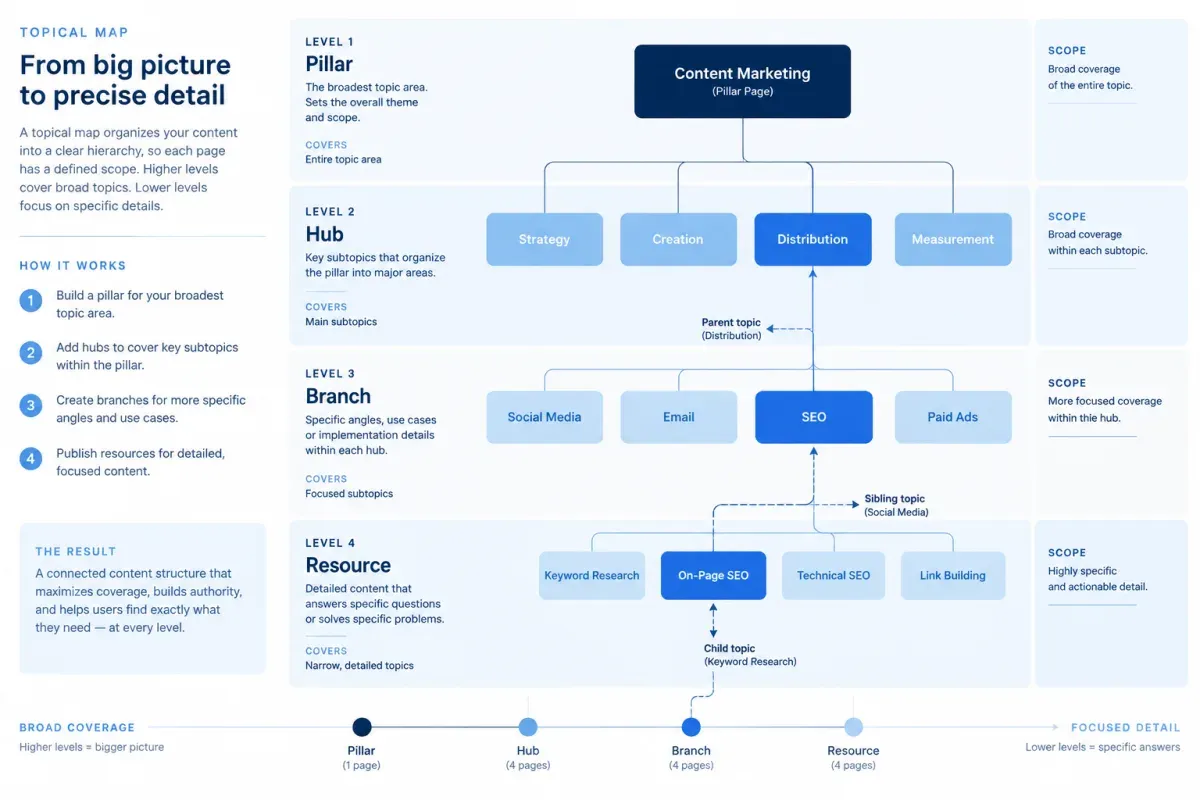
A page’s length is an output of its topical scope, not an input. Before drafting, write the page’s scope list from its position in the topical map. The list holds the one query it answers, the subtopics without pages of their own and the questions a reader must resolve before acting. The minimum sufficient length is whatever it takes to answer that list once.
The map sets the page’s boundary in three directions:
-
Parent page: The broader page owns the overview and the decisions that span topics. Summarize that context in a sentence and link up rather than rebuilding the parent’s argument.
-
Sibling pages: Each sibling owns its own query. Mention one only where the reader needs a distinction or a pointer.
-
Child pages: A child owns the deep treatment of a subtopic. The broader page introduces the subtopic, says why it matters and links down.
Map level changes a page’s shape, not its word count. A page near the top covers several subtopics briefly and sends readers to supporting pages, so it runs wide. A lower-level page answers one narrow question through its assumptions, evidence, exceptions, and implications, so it runs deep. Either can end up short or long.
The page type adds items to the scope list too. A definition needs an example. A comparison needs decision criteria and a recommendation when the evidence supports one. Troubleshooting needs a diagnosis, ordered steps and a way to verify the fix.
Ranking pages help here as scope signals. A subtopic most of them cover is a candidate for the scope list, but only if your map hasn’t given it a page of its own.
Stop expanding when the page meets these conditions:
-
Every scope item has a direct answer.
-
Each answer explains the conditions that change the recommendation.
-
Claims carry evidence or clear reasoning.
If a complete page still doesn’t earn rankings or AI citations, check its evidence, trust signals, internal links, and answer clarity before adding copy. More coverage can’t stand in for authority or credibility.
Cut What a Sibling Page Owns and Link to It
A passage belongs on a sibling page when it could stand as the main answer to a query that page owns. Cut the full treatment, keep a one- or two-sentence bridge for the point the reader needs here and link to the page that owns the rest. The scope stays clear, and the reader still gets the point.
Here’s that test on this guide’s own cluster:
-
How long a section or content chunk should be is a structure decision. This page needs one sentence on it, and self-contained sections AI systems can extract covers the full decision.
-
The length of answer-first lead blocks belongs to the parent guide linked above, so this page leaves it there.
-
Keeping long pages accurate in AI summaries and keeping FAQ answers from going thin each have a sibling page. This guide gives each one a one-sentence bridge where it comes up.
Two pages that answer the same query compete with each other, and neither gives the reader a distinct destination. A reader who wants the deep version is better served by a link than by a half-length copy. That’s reasoning about clarity, not a measured ranking or citation effect.
A bridge and its link should meet four conditions:
-
Context: The bridge states the point in this page’s terms.
-
Anchor: The anchor names what the destination covers.
-
Relevance: The link appears only where the destination answers the reader’s next question.
-
Frequency: Each sibling gets one link.
Run a Density Pass: Consensus, Net-New, Repeat, or Filler
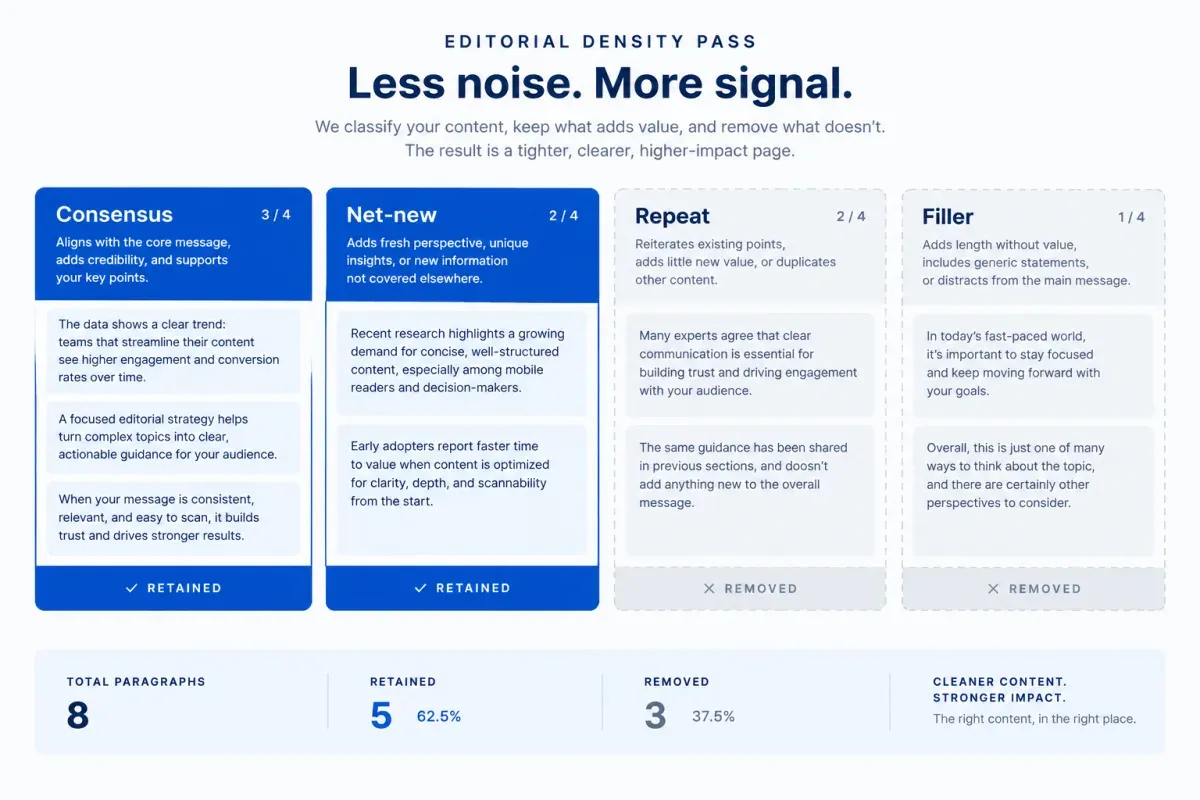
Run the density pass by reading the scoped page one paragraph at a time and giving each paragraph exactly one of four tags: consensus, net-new, repeat, or filler.
| Tag | Test | Action |
|---|---|---|
| Consensus | A point most ranking pages and AI answers already make, which readers expect and need for context. | Keep it once and state it briefly. |
| Net-new | Something this page adds: your own data, a worked example, a method, a firsthand observation, or a condition other pages miss. | Keep it and give it room. |
| Repeat | It restates a point made earlier on the page, or covers a point a sibling page owns. | Cut it, or fold its one new detail into the original passage. |
| Filler | It adds no fact, reason, condition, or action. Scene-setting, generic background and recap transitions fit here. | Cut it. |
A few edge cases keep the pass from turning mechanical:
-
Mixed paragraphs: Split a paragraph that holds a repeat and a useful condition. Keep the condition and cut the rest.
-
Necessary consensus: Keep a familiar point when a net-new point depends on it. Context isn’t filler if it makes the instruction usable.
-
Hidden conditions: Keep a sentence that looks disposable but limits a recommendation, names an exception or explains where the standard approach fails.
-
FAQ answers: They’re a common hiding place for repeats, because an answer often restates a body section. FAQ pages without thin or duplicate answers covers writing ones that add something.
Read the tag count as a diagnosis, not a score. A page that’s still mostly consensus after the pass has an information gain problem, not a length problem. More prose only adds familiar material unless it brings a specific observation, reason, condition, or action.
A page that loses a large share of its paragraphs to repeat and filler was padded. Cutting them doesn’t leave it underdeveloped, as long as the scope check that follows still passes.
Example: A Density Pass on One Section
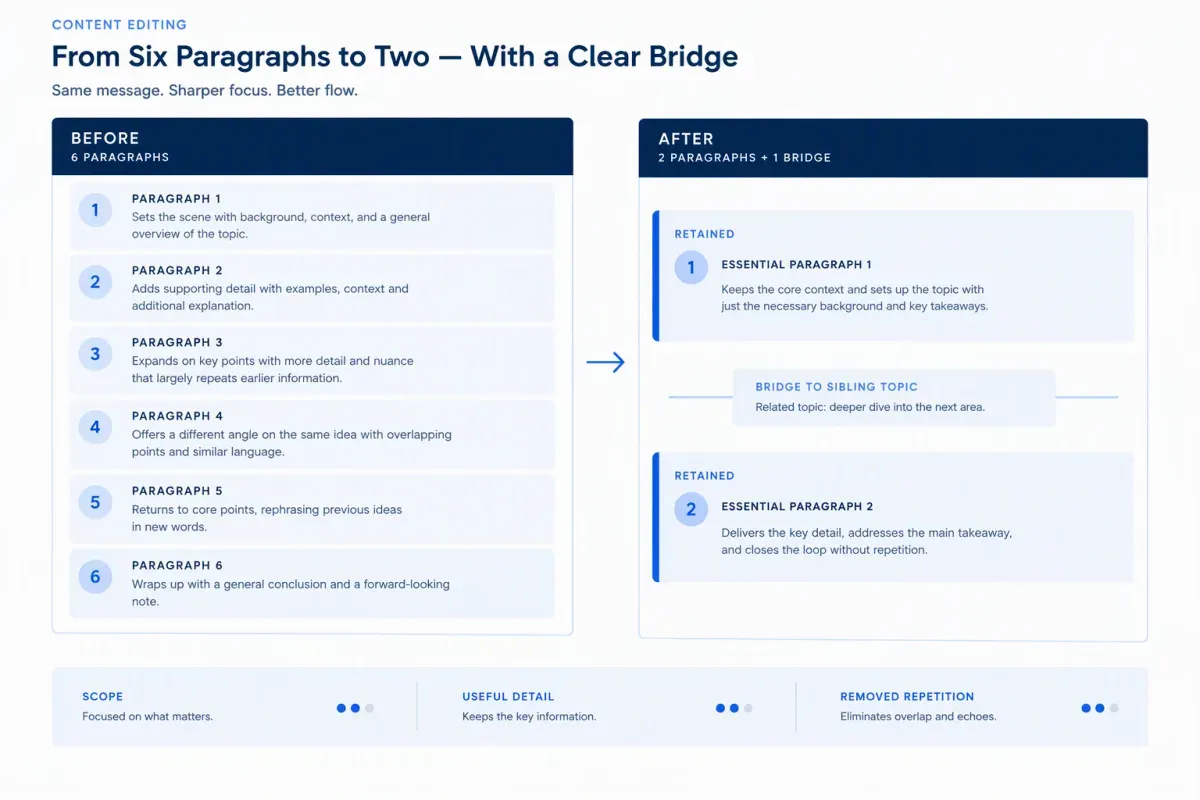
A density pass on a hypothetical six-paragraph section titled “What Goes in a Content Brief?” keeps two paragraphs, turns one into a one-sentence bridge and cuts three. The section comes from a page about writing content briefs. On the example site, keyword research has its own page in the topical map, so a detailed keyword research walkthrough sits outside the section’s scope.
| Paragraph | Tag | Action |
|---|---|---|
| An opening says AI has changed content creation and made briefs more important. | Filler | Cut it. It doesn’t answer what belongs in a content brief. |
| A content brief is defined as a document that gives a writer direction for producing a page. | Consensus | Keep it to one or two sentences. Readers need the definition, even though ranking pages give a similar one. |
| The definition is repeated in different words, calling the brief a blueprint for content. | Repeat | Cut it. Rewording adds no information. |
| A detailed walkthrough covers finding keywords, evaluating intent and choosing terms. | Repeat (sibling-owned) | Replace it with one sentence pointing readers to the site’s keyword research page. |
| The team explains that the fields a brief needs depend on the page’s place in the topical map, contrasting a pillar page with a supporting resource. | Net-new | Keep it and expand it with a concrete example from the team’s work. |
| The closing returns to the claim that AI makes strong briefs necessary. | Repeat | Cut it. It restates the opening without adding a decision or detail. |
The two paragraphs that stay are the short definition and the team’s rule for choosing fields. The section gets shorter and still covers everything on its scope list without doing a sibling page’s job.
The net-new paragraph gets the room those cuts free up, because it gives readers a decision that a generic definition can’t.
Check the Shorter Page Still Covers Its Scope
Re-read the shortened page against its scope list before publishing. Restore anything the density pass removed that supplied needed reasoning, evidence or reader action.
Use this scope check:
-
Main answer: The opening answers the page’s query directly and accurately.
-
Supporting detail: Evidence, explanations, examples, and needed caveats remain wherever the task requires them.
-
Reader completion: A visitor can act without opening another tab, apart from the sibling links you placed on purpose.
Check each claim once more for a missing condition, exception or source. Cutting a caveat can turn a qualified statement into a universal claim, even when the paragraph reads more cleanly. AI summaries can drop caveats the same way, and long-form content that AI summarizes accurately shows how to keep them beside their claims.
Content length for AI search matters only when it changes completeness, clarity or the evidence behind a claim. A page is too short when readers must leave it for something on its scope list. It’s too long when passages remain that add no answer, reasoning, evidence, or useful next step.
Minimum sufficient length is whatever remains after this check. The scope list decides what stays, and the density pass decides what goes.
Use Competitor Word Counts as a Range Check, Not a Target
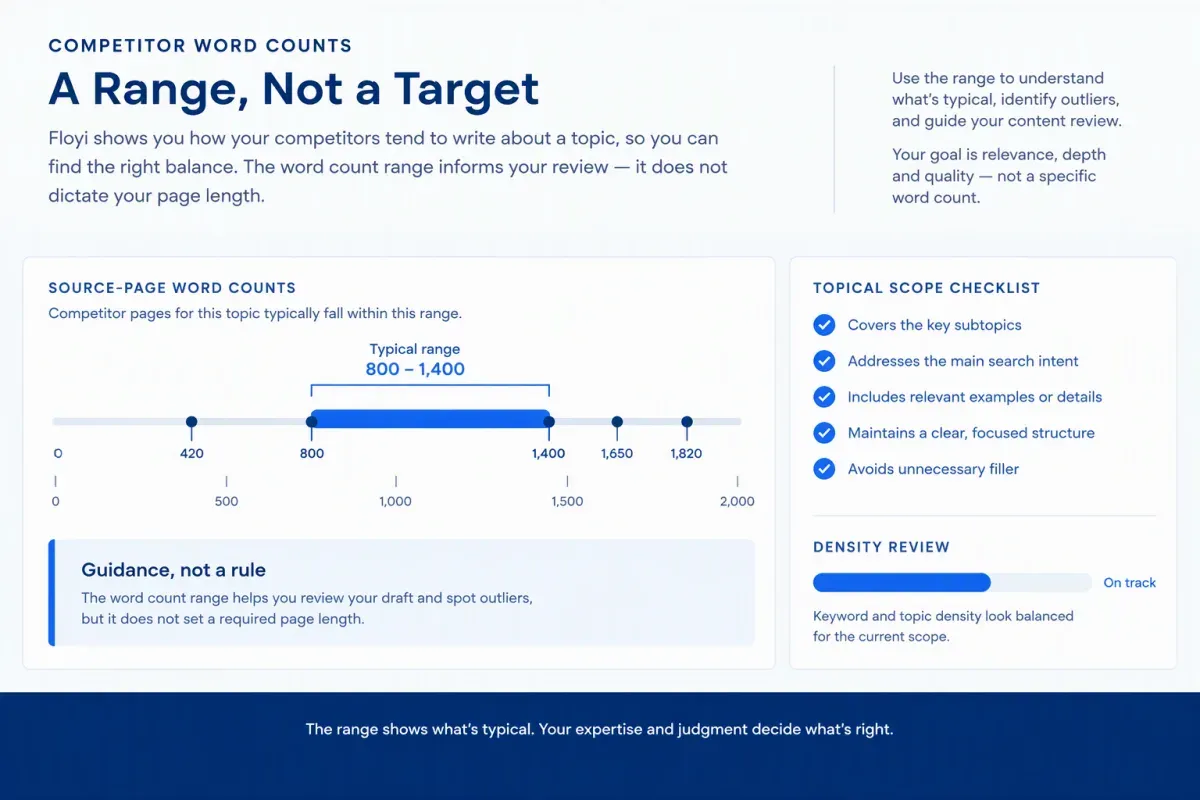
Competitor word counts belong at the end, as a range check on a page you’ve already scoped and cut. Floyi’s Content Optimizer reads the top 20 ranking pages for the query and keeps the 7 most relevant, plus AI answers from AI Overview, AI Mode and ChatGPT. Its Source Overview lists each source with its word count.
The AI rows show how long each answer ran, which says nothing about how long a cited page should be. Read the range from the ranking pages:
-
Below every source: Recheck the scope list for a missing subtopic, qualification or explanation the reader needs.
-
Above every source: Look for sibling-owned material, repeated explanations or filler that survived the pass.
-
Different by design: Keep the gap when your topical map gives a subtopic its own page and a competitor covers it inside one URL.
Don’t pad a page to reach the range or cut a needed section to fit under it.
Floyi’s Page Quality Scorecard grades the draft itself on six dimensions: relevance, answer first, content quality, information gain, next step, and trust and authorship. Whether the page earns citations shows up only when you test its target queries across AI engines over time, which the parent guide covers.
When your next draft clears the scope and density passes, check its range in Floyi’s Content Optimizer.
Content Length and Information Density FAQs
These questions cover what happens to scope, source-page length and density once word count stops being the target.
1. How Does Information Density Affect AI Citations?
Information density doesn’t earn a citation on its own. A passage is worth citing when it answers the query clearly and accurately, and density helps by stating that answer with less repetition and filler around it. It isn’t a facts-per-word quota either. A dense page that only restates the consensus gives an AI system nothing it can’t find elsewhere. Net-new paragraphs carry the case for citing one source over another.
2. Can Short Pages Earn AI Search Citations?
Yes, when the page’s scope is one narrow question and it answers that question completely. The narrow scope is what keeps it short. Brevity isn’t an advantage on its own, though. A short page that drops a condition, an exception or its evidence is thin, not dense. The query’s intent sets the scope list, and the scope list sets how much the page needs.
3. Should You Split a Long Page Into Several Pages?
Split a page only when parts of it answer different queries that deserve their own pages in your topical map, not because the page is long. A long page that answers one query in depth stays one page. If two sections would be searched for separately and a reader arriving for one doesn’t need the other, they’re candidates for separate pages. Compare the search results for the two queries. If they share most of the same ranking pages, keep them on one page. After a split, the original keeps a one-sentence bridge and links to the new page once.
4. Does Keyword Density Improve AI Answers?
No. Repeating a target phrase doesn’t make a page more useful to a reader or a better source for an AI answer. Keyword density counts how often a phrase appears, while the density pass judges what each paragraph adds. Use the target term where it names the subject, then spend the words on facts, conditions, definitions, named entities, and practical steps.
About the author

Yoyao Hsueh
Yoyao Hsueh is the founder and CEO of Floyi, the topical authority platform, and the founder of Main Heading, an SEO and AI search agency. He is an expert in topical authority and topical mapping. He created Topical Maps Unlocked, a course studied by thousands of SEOs, content strategists and digital marketers, founded TopicalMap.com, a done-for-you topical mapping service for agencies and enterprise teams, and publishes the weekly Digital Surfer newsletter on SEO, content strategy and AI search.
About Floyi
Floyi is a closed loop system for strategic content. It connects brand foundations, audience insights, topical research, maps, briefs, and publishing so every new article builds real topical authority.
See the Floyi workflow