
4 Steps to Optimize Long-Form Content for Accurate AI Summaries
Keep AI summaries of long-form content accurate: write the intended summary first, give each section one claim, keep caveats beside claims and test the page.
Clear prose alone doesn’t keep AI summaries accurate. To optimize long-form content for AI summarization, write the summary you want before drafting, then keep each claim’s evidence and conditions beside it.
Pages can be cited and still be described poorly. Floyi’s Topical Authority Report 2026, Part 2 studied AI answers across 42 topical maps. Inside the typical map, those answers mentioned only 4.6% to 7.6% of the ranking websites they cited, depending on the AI engine. A citation doesn’t mean the answer says what your page says.
The four steps below give each section one claim, keep names consistent and put limits next to the claims they qualify. Then you test the published page with fixed prompts, score each answer against your intended summary and fix the passage behind each error.
Optimizing Long-Form Content for AI Summarization Key Takeaways
- Write the intended summary before drafting the body.
- Give each section one main claim.
- Keep evidence, sources and caveats beside the claim they qualify.
- Use one name for each metric, entity and concept.
- Report associations as associations, never as causes.
- Test the same prompts across AI engines and search surfaces.
- Revise the passage behind each error, then rerun the same test.
Step 1: Write the Intended Summary First
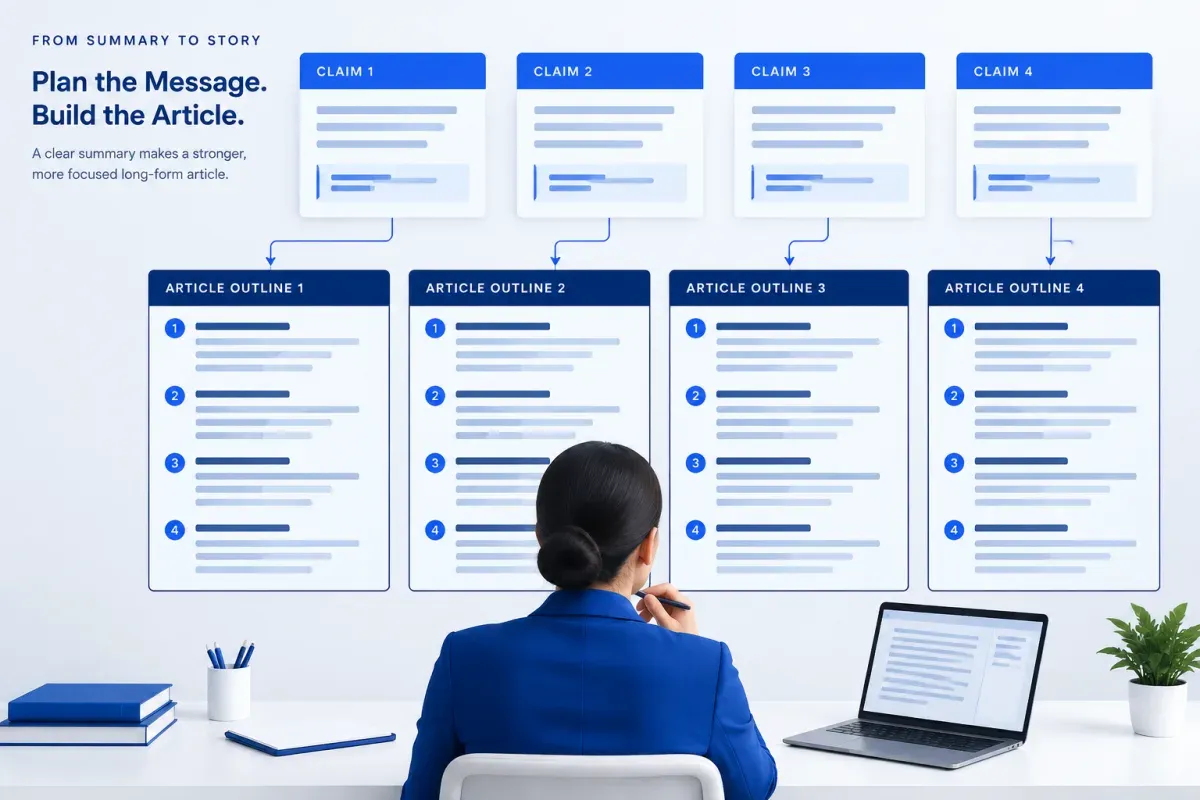
Write the intended summary before you draft the body: the short list of claims you want any summary to repeat, each with the condition that keeps it true. An AI summary can only repeat what your page states clearly.
That list becomes the reference for the Step 4 test. Without it, you have nothing to compare an AI-generated summary against except a sense that it “sounds right.”
A topic list isn’t a claim list. Topics say where the page is headed. Claims give readers and AI systems a conclusion they can repeat. Here’s the difference, as an example:
| Form | Example |
|---|---|
| Topic list | This guide covers pricing models, customer onboarding and support options. |
| Claim list | Usage-based pricing suits teams with uneven monthly demand, but a flat plan may cost less when usage stays stable. |
The claim version carries a recommendation and the condition that limits it. A summarizer that lifts it keeps both.
Turn the claim list into a key takeaways block near the top of the page. It works like an executive summary. Each takeaway states one main claim, not a teaser such as “Learn how pricing works.” A reader who stops after the opening should still know the page’s position.
Keep the opening and the body in agreement. One AI system may draw on the first paragraphs and another on a comparison table further down. Both summaries should land on the same claims. A body section that widens or reverses an opening claim creates ambiguity that no formatting can fix.
When a claim only holds for a certain audience, market or time window, the condition belongs in the same takeaway. Stress-test each takeaway with this fill-in pattern:
- For: the audience and situation
- Claim: what the page recommends or concludes
- Because: the key evidence
- Applies when: the condition
- Doesn’t apply when: the exception
If a claim can’t fill the pattern, it isn’t ready to be summarized. “A self-service onboarding flow reduces implementation effort” is incomplete. “A self-service onboarding flow can reduce implementation effort for experienced users when setup needs no account-specific configuration” keeps the audience and the condition.
Fix the exact wording of key terms here as well. Choose one name for each product, method, metric, and audience. If the opening says “qualified demo requests” and the evidence section says “sales-ready conversions,” a summarizer may treat them as two metrics or merge them wrongly. Step 2 holds the rest of the page to those names.
The answer-first opening itself isn’t new. The guide on optimizing pages for AI-generated answers covers that page structure. This step adds the intended summary that makes the opening testable.
Step 2: Build One Claim Per Section
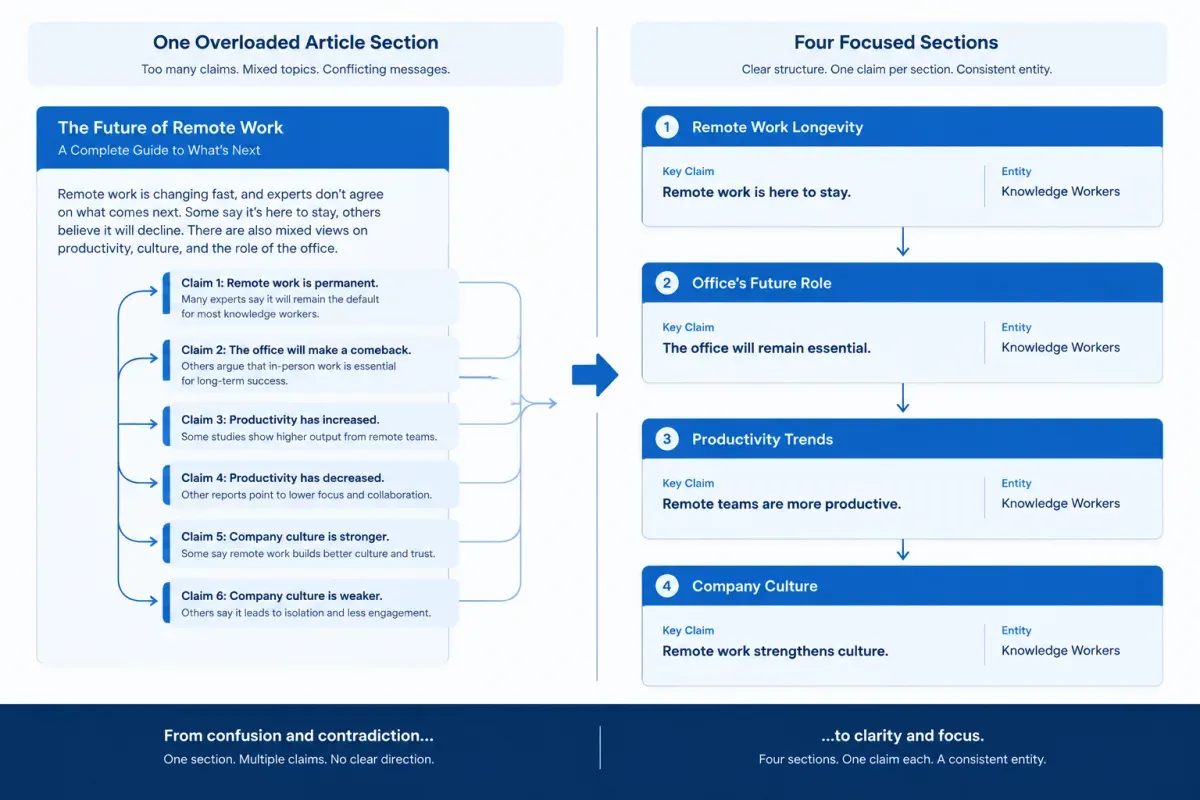
When a section carries two or three competing claims, a summarizer has to pick one, and it may not pick the one you meant. So map each claim from the intended summary to exactly one section, and give each section one main claim.
Write that claim as the section’s first sentence and make the heading point at it. A reader skimming clear headings and subheadings should see the page’s argument in order. That content hierarchy also gives AI systems context when they read a passage apart from the rest of the page.
Most structure advice stops at formatting. The guide on passage structure AI engines can lift covers that layer: headings, chunk length, lists, tables, and standalone paragraphs. This step works one level up, across the whole page.
The difference is clearest when one section tries to do too much. Here’s an overloaded example: “Support articles should lead with the account-recovery rule, except for enterprise users, recommend live chat and measure changes in support requests.” It packs four ideas with different roles into one sentence, and a summarizer has to guess how they connect.
Split into one claim each, the same material holds together:
- Recovery rule: Account recovery starts with the documented verification step.
- Enterprise exception: Enterprise users follow a separate recovery path when their account agreement requires it.
- Escalation recommendation: Offer live chat after the required recovery steps fail.
- Measurement approach: Judge the revised guidance by changes in support requests.
Now a whole-page summary can keep the rule, its exception, the recommended action, and the measurement as related but separate points, in the right order.
Hold one name for each entity and term across every heading, paragraph, table, and caption. Don’t rotate synonyms for variety. “Topical map,” “content plan” and “site structure” may feel interchangeable to an editor. A summarizer that meets them in different sections can read them as three different things. The guide on entity clarity for AI search covers how to define and mark up those entities.
Introduce an acronym once, then use it the same way every time. Consistent names stop a summary from merging separate concepts or inventing distinctions the page never makes.
Implied follow-up questions get the same claim test. Give a question its own section only when its answer carries a separate claim the summary must keep. If it only adds a condition or a clarification, answer it inside the section it qualifies. For planning those questions before you draft, see the guide on answering follow-up questions in content.
Close with a section-level check. Summarize each finished section in one sentence, then read the sentences in page order. They should match the intended summary from Step 1. Merge sections that repeat a claim, and rewrite any section whose one-sentence summary adds a relationship the section doesn’t state.
Step 3: Keep Evidence and Caveats Together
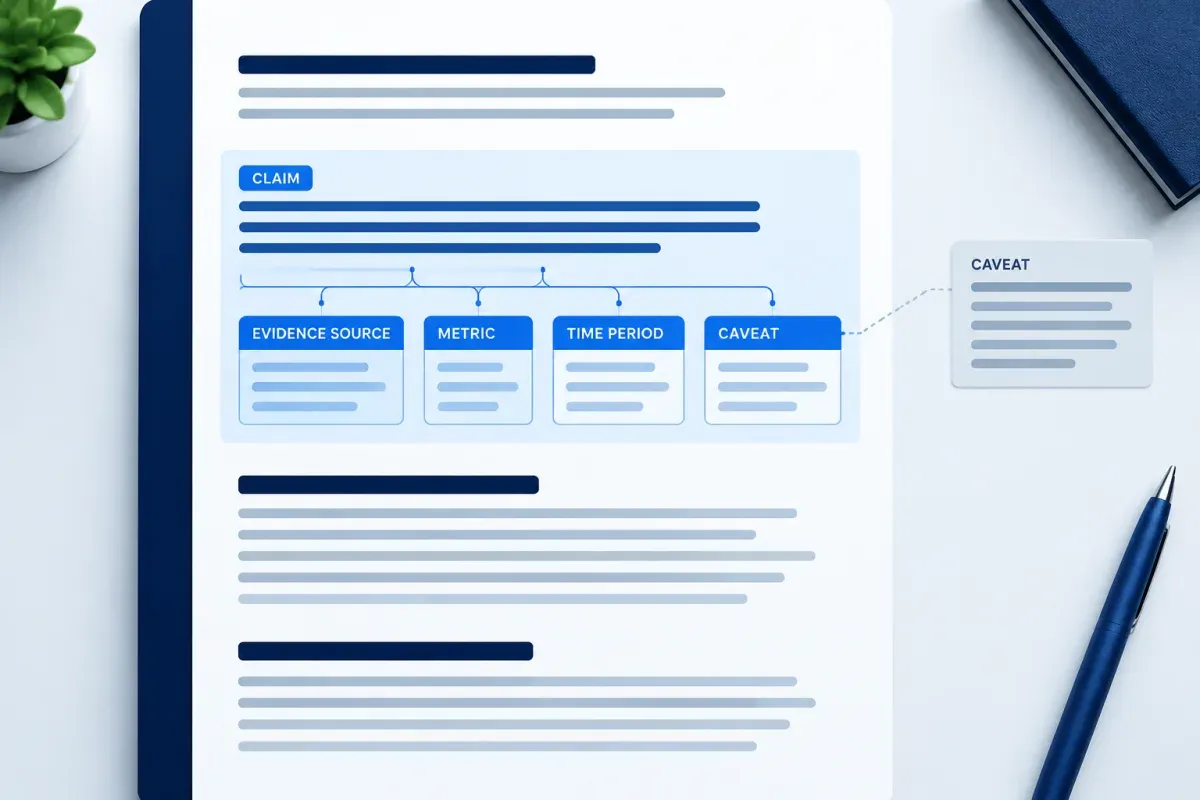
Keep each caveat in the same sentence or paragraph as the claim it limits, and each number next to its source. Summaries compress, and the details most likely to fall out are the ones that sit away from their claim: a caveat in a closing disclaimer, a source in a footnote. That’s an observed pattern of compression, not a published rule of any AI engine.
Treat every material statement as one unit of claim, evidence and condition. Use this fill-in pattern when a finding needs clear limits:
- Source: the named organization or study
- Finding: the metric, for a defined population, during a stated period
- Applies to: the condition
- Doesn’t show: what the finding can’t support
Written out, it reads like this: “Organization X found this metric for this population during this period. This applies to this condition and doesn’t show that.” A summary that lifts the claim lifts its boundary with it. Proving the claim itself is a separate job, so this step stays on placement.
Numbers need the same treatment. Put the figure, unit, measure, period, and publisher in one sentence. A percentage whose source sits two paragraphs later can be summarized as your own finding. It can also end up attached to the wrong claim.
Causal language needs a careful read, because summaries drop the words that separate sequence from proof. Take this hypothetical example:
Customer support requests fell 14 percent in the first month after the new onboarding process launched, compared with the preceding three months. The comparison doesn’t show that the onboarding process caused the drop.
The first sentence reports timing and a measured difference. The second stops a summary from reporting the onboarding process as the cause. Other changes in that period could explain the drop.
Vague references cause a quieter version of the same problem. “This approach,” “the study” and “they found” lose their meaning once a summary pulls the sentence out of the page. Swap them for the named method, report or population whenever the sentence has to stand alone.
Two more habits keep evidence attached to the right claim. Name the exact group a number describes, because “customers” could mean trial users, enterprise accounts or survey respondents. And give the observed finding before your reading of it, so a summary can’t report the interpretation as a measured result.
Before the Step 4 test, read each section as if an AI system will quote one sentence and drop everything around it. Every claim should carry its condition, and every number should carry its source. Rewrite any sentence that could be misread on its own before you publish.
Example: Rewrite a Poorly Summarized Paragraph
Rewriting one vague paragraph shows how a named claim, its evidence and its limit keep a summary accurate. The same finding can summarize well or badly depending on how the paragraph states it. This hypothetical example shows which wording invites distortion and how a rewrite protects the intended meaning.
Hypothetical example, before: Our recent analysis shows that clearer product pages drive stronger results. Brands that added detailed explanations saw meaningful gains, proving that AI prefers longer content. This approach also improves visibility across search.
A likely summary follows the implication, not the evidence:
Hypothetical example, poor summary: Detailed product pages make AI prefer your brand and improve search visibility.
That summary changes the claim in three ways. It reports a correlation as cause. It assigns a preference to AI that nobody tested. And it repeats a visibility benefit with no evidence at all.
The vague references made those errors easy. “Our recent analysis” names no publisher or dataset. “Brands” has no comparison group, and “stronger results” has no defined metric. “This approach” could mean clearer writing, detailed explanations, page design, or several changes at once. Specific wording gives a summary stable facts to keep instead of gaps to fill.
The rewrite names the publisher, page type, change, comparison group, and measured outcome. Company A and every detail below are invented for illustration:
Hypothetical example, after: Company A analyzed 200 of its product pages between January and June. Pages that added a step-by-step setup section had fewer returns than pages without one. The analysis shows an association, not proof that the setup section caused the difference, and it didn’t measure AI summary accuracy.
That version supports a narrower summary:
Hypothetical example, supported summary: Company A found that product pages with a setup section were linked to fewer returns over six months. The analysis didn’t establish cause or test AI summary accuracy.
The caveat survives because it sits in the same paragraph as the claim. Named entities say who ran the analysis and on which pages. The comparison group stops the result from turning into a broad success claim.
Where a source can’t support a number, state the evidence qualitatively or cut the claim. A precise-looking statistic with no source misleads a summary as easily as a broad promise.
Run both versions through the Step 4 prompts and compare each output with the intended claim. The rewrite should keep the actor, the finding and the limit.
Step 4: Test and Revise AI Summaries
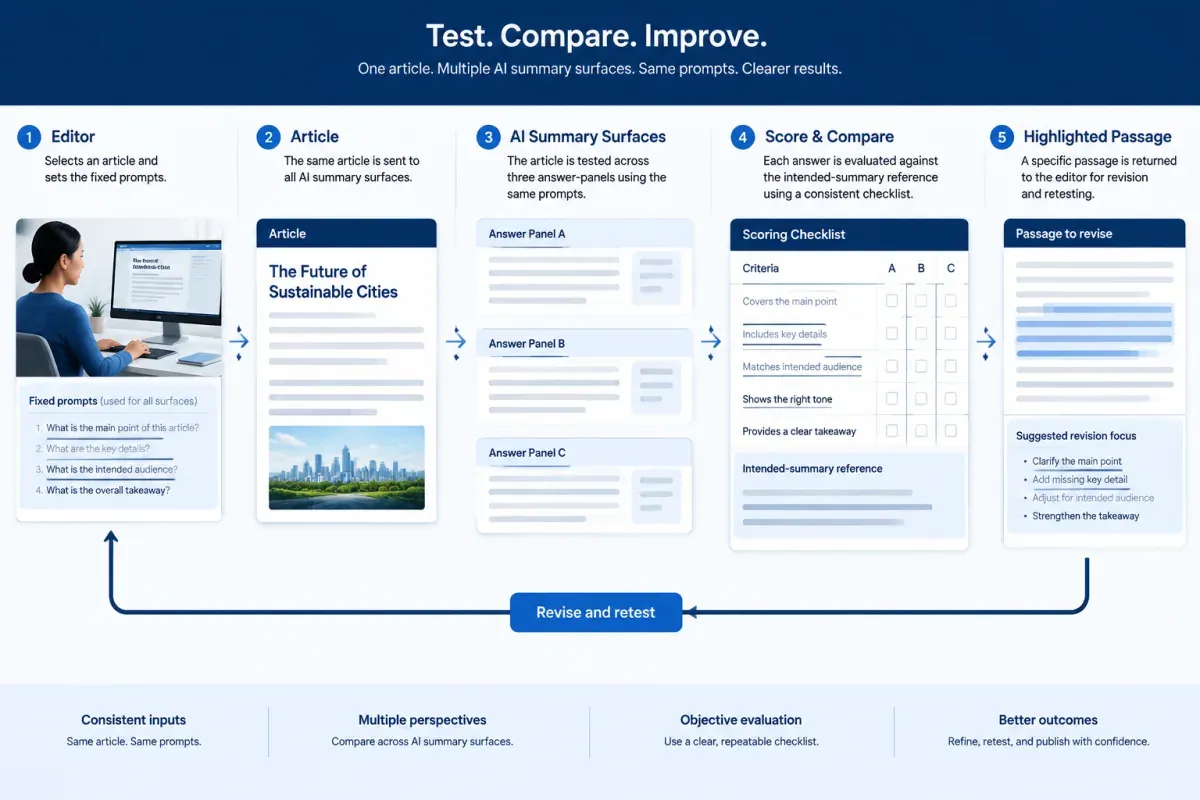
The only way to know how AI engines summarize a page is to ask them and compare the answers with the summary you intended. Use the Step 1 reference: its main claims, conditions, named entities, and sourced numbers.
A polished page can still produce a distorted answer. A summary may drop the condition that makes a claim valid, attach a number to the wrong source or turn correlation into cause. Testing shows what actually happens, engine by engine.
Use a fixed prompt set so runs stay comparable:
- “What is this page’s main conclusion?”
- “What evidence does the page use to support that conclusion?”
- “What limitations, exceptions or conditions does the page include?”
- “Who is the advice on this page for?”
Run the same prompts in assistants that can read a URL, such as ChatGPT, Gemini and Perplexity. For Google AI Overviews and AI Mode, search the page’s target query. When the answer draws on your page, record how it describes the page’s claims. Keep those search results apart from direct URL summaries, because each surface can frame the same content differently.
Log each response with:
- Date: when you collected it
- Page URL: the exact version tested
- Engine and surface: the assistant, AI Overviews or AI Mode
- Prompt or query: the wording, unedited
- Full response: the complete answer, not an excerpt
Score each response against the reference on a 0 to 5 scale. This editorial scorecard isn’t an industry benchmark or a visibility forecast.
| Check | 0 means | 5 means |
|---|---|---|
| Main claim preserved | The response changes, omits or contradicts the central conclusion. | The central conclusion matches the intended summary. |
| Conditions and caveats kept | Important exceptions or limits disappear. | Qualifications stay attached to the right claim. |
| Numbers and sources correct | A figure, date or source is wrong, missing or mismatched. | Figures, dates and attribution match the page. |
| Entities named correctly | People, brands, products, or concepts are confused or swapped. | Named entities are accurate and specific. |
| No added cause or claim | The response adds an explanation or conclusion the page doesn’t support. | The response stays within the page’s evidence. |
A high average can’t offset a critical error. A wrong number, a wrong entity or an invented cause fails the summary, whatever the other rows score.
Each failure points back to a passage, not the whole page. A dropped caveat usually sits too far from its claim. A wrong figure has drifted from its source. A merged idea usually comes from a section with two claims. Revise that passage with Steps 1 to 3, then rerun the same test.
Technical SEO still supports AI summary accuracy, but it isn’t a summarization switch. Crawlable content, a logical heading hierarchy and schema markup that matches visible content help engines read the page. None of them controls what a summary says.
Retest after each revision with the unchanged reference and identical prompts, and compare scores with the first run. Report the result as summary fidelity, not visibility. An accurate summary doesn’t prove the page will be cited or shown.
The reverse holds too. As the figures in Floyi’s Topical Authority Report, Part 2 show, being cited isn’t the same as being described.
AIRS Analyzer shows that framing for one query on demand. It runs the query across 11 surfaces (9 AI engines plus Google and Bing SERPs), with your brand’s mentions highlighted in place and the stance each engine took. It doesn’t track results over time, so each run is a snapshot of one query. To see how AI engines describe your brand for a query that matters to you, run a query in AIRS Analyzer.
Optimizing Long-Form Content for AI Summarization FAQs
These questions cover why AI-generated summaries lose detail, how much of that a writer controls and when to test a long page again.
1. Why Do AI Summaries Drop Caveats?
A summary keeps the claims it judges central and shortens or drops the rest. A caveat placed paragraphs away from its claim reads as a separate, minor point, so it’s often the first thing cut. That’s an observed pattern, not a documented engine rule. Put the condition in the same sentence or paragraph as the claim, then test whether the summary keeps both.
2. Can You Control How AI Engines Summarize a Page?
No. AI engines don’t publish how they summarize pages, and the same page can be summarized differently by different engines and prompts. What you control is the page: a stated main claim, one claim per section, caveats and sources beside their claims, and one name per term. That narrows the room for misreading, but it can’t guarantee a particular summary.
3. Why Do Different AI Engines Summarize the Same Page Differently?
Engines use different models, may read different parts of the page and respond to the prompt’s wording. Many also blend your page with other sources. A summary can change even when the page doesn’t.
Test the same prompts across several engines. If every engine gets the same claim wrong, the page likely needs clearer wording. One engine’s error may be a quirk of that engine.
4. When Should You Retest a Page’s AI Summary?
Retest after any edit that changes a main claim, a number, a source, or a caveat. Retest as well when the page’s topic or its underlying sources change. Engines and models change too, so a passing result is a snapshot, not a permanent status. Rerun the same prompts against the same reference so the results stay comparable.
About the author

Yoyao Hsueh
Yoyao Hsueh is the founder and CEO of Floyi, the topical authority platform, and the founder of Main Heading, an SEO and AI search agency. He is an expert in topical authority and topical mapping. He created Topical Maps Unlocked, a course studied by thousands of SEOs, content strategists and digital marketers, founded TopicalMap.com, a done-for-you topical mapping service for agencies and enterprise teams, and publishes the weekly Digital Surfer newsletter on SEO, content strategy and AI search.
About Floyi
Floyi is a closed loop system for strategic content. It connects brand foundations, audience insights, topical research, maps, briefs, and publishing so every new article builds real topical authority.
See the Floyi workflow