
How to Create Content for Conversational Follow-Up Queries
Learn how to create content for conversational follow-up queries: classify the next questions, map the conversation journey and test it in AI engines.
Follow-up queries aren’t a list of related keywords. Content for conversational follow-up queries works when each page keeps the original subject, audience and constraint, then answers the one decision the next question changes. A comparison, an implementation request or an edge case needs a different destination than the entry question.
A buyer might start by choosing project management software for a small agency, then ask whether Option A handles client approvals. That shift keeps the agency workflow and changes the decision criterion. Real question data, from People Also Ask results to sales calls, shows which narrowing questions, comparisons, next steps, and exceptions belong in the journey map.
Loose internal links and inconsistent entity names break that path when readers enter through a later page. The five steps below assign each question to a live or planned destination and record the inherited constraints. They then test the chain in AI engines and Search Console against the questions people actually ask.
Conversational Follow-Up Content Key Takeaways
- Treat follow-up queries as changes to a prior answer, not separate keyword ideas.
- Classify follow-ups as narrowing, comparison, next-step, or edge-case questions.
- Preserve the subject, audience, constraints, and desired outcome across each conversation turn.
- Assign every likely question to a specific Pillar, Hub, Branch, or Resource destination.
- Answer brief refinements in place and link distinct workflows or comparisons to dedicated pages.
- Keep entity names and approved terms consistent across connected pages.
- Test complete question chains in AI engines and check demand with Search Console.
Step 1: Classify Likely Follow-Up Questions
A follow-up changes the prior answer rather than starting a new keyword search. The reader keeps the original subject, audience and constraints, then asks to adjust one variable. When a page answers only the opening question, the next turn can lead to another site.
This guide picks up where content built for AI answer generation leaves off. Once the first answer is in place, the next job is planning the pages that answer what people ask next.
Separate explicit follow-up queries from implicit ones. An explicit turn adds a stated condition, such as a five-person team or no developer support. An implicit turn, such as “What about smaller sites?” or “Which is better?”, depends on the earlier exchange. The page that answers it has to name that earlier context itself, or the answer turns too broad to help.
Four patterns translate conversational queries into distinct content needs:
| Follow-up type | Example turn | Content it needs |
|---|---|---|
| Narrow it down | “How does this work for a five-person content team?” | A focused answer for the named segment that keeps the original topic. |
| Compare options | “Is Option A or Option B better for a small site?” | Shared decision criteria, such as effort, fit and constraints. |
| What next | “What should I do after choosing Option A?” | A concrete action, template, decision point, or usable next step. |
| Edge cases | “What if Option A does not work for our site?” | Limits, exceptions, likely failure conditions, and an alternative path. |
A refinement should change only the dimension the reader asked to change. If the first page covers topical maps for B2B software companies, a question about smaller teams shouldn’t restart with a generic definition. Keep the industry, audience and publishing use case in view, then adapt the recommendation to team size.
Longer questions carry more of that context. “Topical map for a small ecommerce team without a developer” names an audience, a constraint and an expected format in one turn. A short keyword would hide all three, which is why follow-up mapping starts from full sentences.
Step 2: Map a Conversation Journey From One Topic
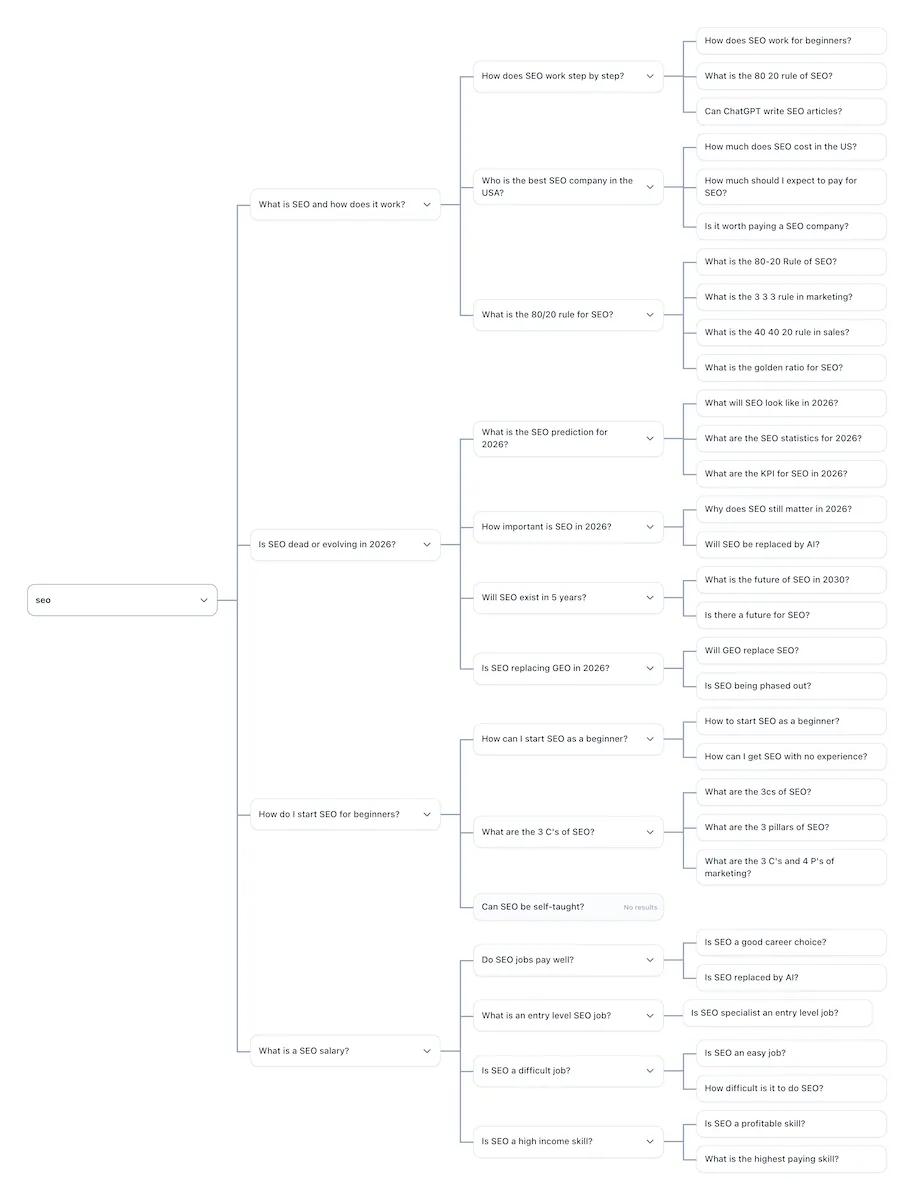
With the follow-up types defined, map the conversation, not a keyword list. Start with one entry question a real buyer would ask, then record the context that should survive every later turn: the subject, the audience, the constraint, and the desired outcome. That context keeps every later page tied to the same buyer as the conversation moves past the first answer.
A good map anticipates how a buyer narrows a decision without forcing a fixed sequence. Multi-turn search is directional, not linear. A buyer may jump from the entry question straight to a comparison, then come back to a practical limit after reviewing options. Branch the entry question by the four types from Step 1, write each turn in the buyer’s own words and note what changes and what stays.
Use real question data to confirm these follow-ups rather than guessing what comes next. People Also Ask results expose them. So do sales and support conversations, along with the follow-ups AI engines suggest at the end of their answers.
In Floyi, the Authority Planner sidebar shows People Also Ask questions for each topic. PAA Explorer expands People Also Ask questions recursively up to five levels deep, which mirrors how one question produces a more specific next turn.
Each follow-up needs a destination in the topical map. The Pillar, Hub, Branch, and Resource levels give broad questions and narrow answers a defined home. An entry question usually belongs at a higher level, while a focused comparison or edge case often fits a Branch or Resource page. Treat that placement as a planning pattern, not a rule. An existing page may already answer the question, while an uncovered need becomes a planned page.
Record the journey in a simple table before drafting, with one row per turn:
| Column | What to record |
|---|---|
| Turn | The entry question, then each follow-up in order |
| Follow-up type | Narrow it down, compare options, what next, or edge case |
| Buyer’s wording | The question as the buyer would type or say it |
| What carries over | The subject, audience and constraints that stay the same |
| What changes | The one variable the turn moves |
| Destination | This page, an existing page or a planned page |
This table is the input for Step 3. The example below fills it in for one chain.
Example: Map a Follow-Up Chain
This illustrative example shows how a conversation journey guides page planning for a site that publishes project management software guides for agencies. It uses placeholder questions and products, not real query data.
Context carries across the chain. A small agency’s marketing workflow, approval requirements and appetite for setup effort stay relevant until the buyer changes them. That continuity turns query chains into a content structure instead of a set of disconnected keywords.
| Turn | Type | Buyer wording | What carries over | What changes | Destination |
|---|---|---|---|---|---|
| 1 | Entry question | “What project management software works for a small marketing agency?” | Small agency, marketing work and a need for a shortlist | The buyer introduces the category need | A Hub-level guide answers the question directly. |
| 2 | Narrow it down | “Which ones handle client approvals?” | Agency size and marketing workflow | Client approval capability becomes the deciding requirement | A brief answer fits the Hub guide. A deeper explanation belongs on a Branch page about client approval workflows. |
| 3 | Compare options | “Option A or Option B for client approvals?” | Approval needs, team size and setup effort | The buyer moves from category research to two options | A comparison Resource page evaluates Option A and Option B against those criteria and restates them at the top. |
| 4 | What next | “How do we run a two-week trial?” | The shortlisted options and approval use case | The buyer needs a usable next step | A short trial checklist sits on the comparison page and links to a setup guide when one exists. |
| 5 | Edge case | “What if our clients won’t log in to another tool?” | The agency still needs approvals without extra client friction | Client participation becomes a constraint | An edge-case section states the limitation plainly and offers an alternative approval path. |
The table shows which turns already have a page and which ones need one.
Step 3: Answer the Next Question on the Page or Link to It
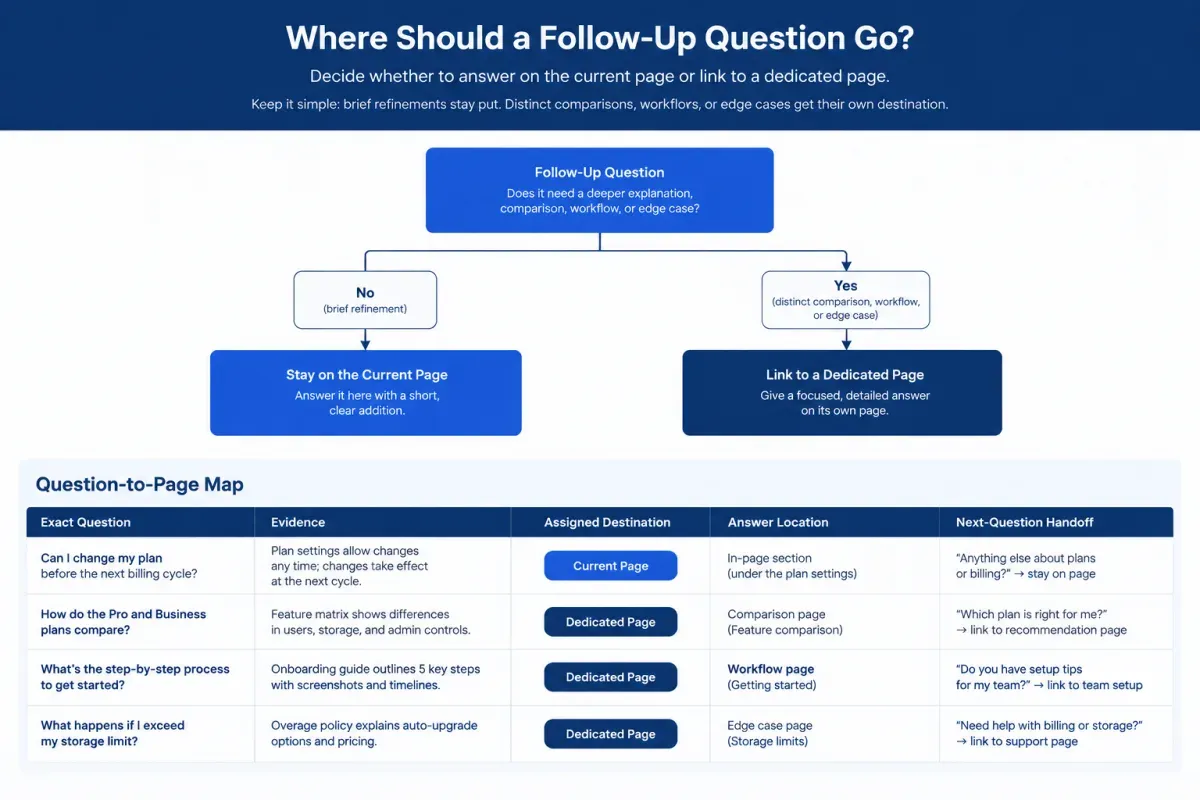
Answer a follow-up on the current page when a short passage finishes the reader’s current task. Send it to another page when it brings a distinct intent, needs real depth or would pull the page off its topic. The right destination is the page that resolves the question fully, not the page with the closest keyword match.
Use this decision rule:
| Follow-up type | Answer on the page when | Link out when |
|---|---|---|
| Narrow it down | A brief clarification helps readers make a choice within the current task. | The choice needs a dedicated evaluation framework. |
| Compare options | One distinction gives enough context for the main answer. | Readers need a full option-versus-option analysis. |
| What next | The action follows directly from the page’s primary answer. | The action begins a separate workflow or intent. |
| Edge case | The issue is common and needs only brief guidance. | Exceptions, diagnosis or alternatives need depth. |
This boundary keeps each page useful without forcing competing intents into one URL. The same rule works for existing pages: add the brief answers in place and link the rest.
Check demand before you create a new page. Compare the mapped questions with Search Console queries for the published page, then check sales-call notes, support tickets and site-search terms. Repeated wording confirms that a branch is worth a page. A follow-up nobody asks can stay a sentence or leave the map, which keeps the Hub free of filler pages.
Internal links to related answers work as handoffs in the conversation. Answer the immediate question first, then say in one sentence why the next page matters before linking with anchor text that names the reader’s next task. Place the handoff where the next question naturally comes up, not in a generic related-posts block. Handoffs can run upward too: a detailed Resource page can send readers back to the Hub when they need the larger frame.
This step doesn’t cover how to format the answers themselves. For headings and self-contained sections, see the guide to structuring sections for AI extraction. For question-and-answer blocks, see Q&A pages built for AI search. When one page has to hold several follow-ups, the guide to long-form pages AI can summarize shows how to keep that page accurate in AI summaries.
Keep a question-to-page map with these fields:
- Exact question: The reader’s wording, not a keyword fragment.
- Evidence: The Search Console query, call note, support ticket, site-search term, or other source.
- Assigned destination: The live URL or planned page that owns the answer.
- Answer location: The heading or section where the question is resolved.
- Next-question handoff: The link that carries readers to the next distinct task.
Review the map on a regular schedule and merge questions that lead to the same answer. That way two URLs don’t compete for one follow-up, and each page stays tied to a clear reader task.
Step 4: Keep Entities and Terms Consistent Across Pages
Pages in one journey should read like consecutive turns of the same conversation. Readers and AI engines can enter through any follow-up page, so each page has to name the subject, audience and decision context set up earlier. The journey breaks when a comparison refers only to “the tool” or “this approach.”
Passage-level structure keeps one section readable on its own. This step covers the layer above it: keeping the same context across every page in the journey.
Build a shared context sheet before drafting the journey. Every page in the journey uses it as the same reference point. Include these details:
- Audience: The buyer role, situation and need the pages address.
- Core entities: The products, methods, page types, and named concepts used across the journey.
- Approved terms: One name for each concept, plus any abbreviation or defined variant.
- Carried-over constraints: Conditions that stay relevant, such as budget range, team size, industry, publishing target, or comparison criteria.
- Map location: The page’s Pillar, Hub, Branch, or Resource level, so its role in the journey is clear.
Keep entity names stable from page to page. If Option A is introduced as a content planning platform, don’t call it a content tool on the next page and a solution later. Near-synonyms read smoothly in isolation, but they blur the relationship between pages. Define any legitimate variant once, then use the approved term rather than vague references such as “the platform” or “this method.”
Open each follow-up page with one sentence that carries forward the decision constraints. A comparison between Option A and Option B might state that it evaluates both for an in-house SEO team that needs a shared approval workflow. The page then answers the narrower choice without sending readers back to rebuild its criteria. That one line keeps the context intact for a reader who skipped the earlier pages.
In Floyi, every brief and draft inherits your Brand Foundation context. Buyer personas shape brief generation, and each brief created from the Planner is tied to its topic’s place in the Pillar, Hub, Branch, and Resource map. That gives the pages in one journey a shared starting context.
Before publishing, compare the page’s entities, approved terms and inherited constraints against the context sheet. Consistency keeps every page on the same conversation, even when readers enter halfway through it.
Step 5: Run the Conversation Yourself in AI Engines
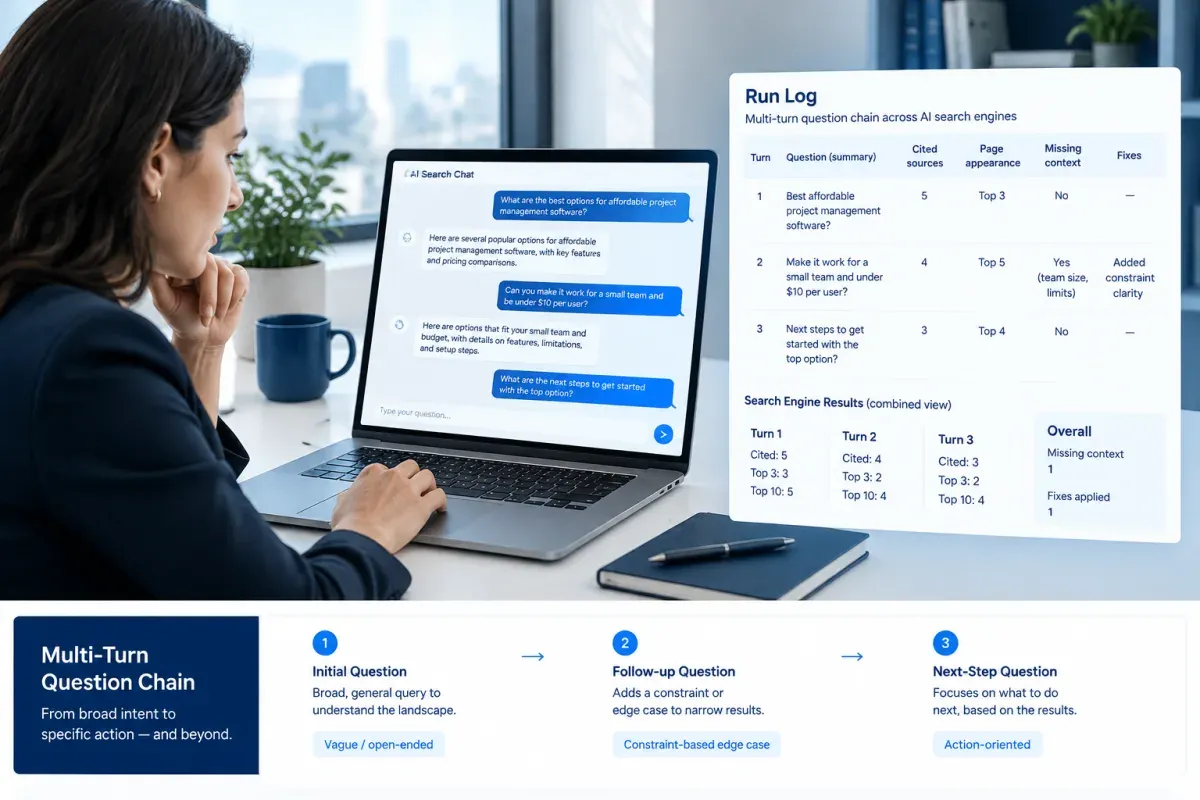
The journey map is a hypothesis until you run it. Enter the opening question in ChatGPT, Gemini, Google AI Mode, and Google Search, then ask every mapped follow-up in the buyer’s own wording within the same conversation. In Google Search, also note whether an AI Overview appears for the opening question and which sources it cites.
A strong first answer proves little on its own. Multi-turn testing shows whether AI engines keep earlier constraints, read vague replies correctly and connect each answer to the right next page. Answers and citations vary between runs, and AI engines don’t publish how they pick sources. Treat each result as an observed pattern rather than a ranking report.
Keep a run log that makes breaks easy to compare. The rows below are examples:
| Chain | Turn | Engine | Date | Cited sources | Did your page appear? | What was missing? | Fix |
|---|---|---|---|---|---|---|---|
| Option A vs. Option B | 2 | Gemini | Date | Sources | No | Comparison criteria | Add a comparison resource |
| Option A vs. Option B | 3 | Google AI Mode | Date | Sources | Yes | Budget constraint lost | State the constraint on the page |
At every turn, record what the answer says, which sources it cites and whether your page is among them. Flag replies that drop a constraint from an earlier turn, answer a different question or leave the searcher without a next step. Those patterns show which details the destination page has to state outright.
Include messy turns, not only the ideal path:
- Vague follow-up: Ask something like “What about the cheaper one?” to see whether the engine keeps the options under discussion.
- Misspelled query: Add a realistic typo to see whether the follow-up still reaches the right topic and page.
- Edge-case request: Add a constraint that changes the recommendation and that your site doesn’t cover yet.
- Unsupported request: Mark turns where no cited source gives a useful answer. That is an open coverage gap, not a reason to force an unrelated page into the journey.
When a competitor page handles an edge case well, it shows the decision criteria, terminology or handoff your next page needs. When an answer reaches the wrong page, the cause is often the internal connection between pages rather than a missing topic.
Search Console is the second check for published pages. Group each page’s natural-language queries by follow-up type, then compare them with the mapped chain. Queries with no matching answer, handoff or exception path become the next update. This keeps updates tied to real demand instead of assumed questions.
Sort run-log breaks into four fix categories:
- Missing answer: No page in the journey answers the question.
- Wrong destination: A relevant page exists, but the engine or searcher reaches another page.
- Lost context: The destination drops a constraint set earlier in the chain.
- No edge-case path: The standard answer works, but a meaningful exception has nowhere to go.
Fix recurring breaks that affect several chains before isolated ones. After publishing changes, rerun the same chains in the same engines. Then compare cited sources, context retention and unresolved turns with the earlier log.
Floyi helps you find the follow-ups your plan is missing. AI Search Gaps queries ChatGPT, Gemini and AI Mode as your buyer personas, then surfaces gap topics you can add with one click. The Pillar, Hub, Branch, and Resource levels give each new follow-up a page to land on. Start mapping the next questions with Floyi’s Topical Research.
Conversational Follow-Up Content FAQs
These FAQs cover how follow-up queries relate to People Also Ask and topic clusters, which follow-ups to prioritize and how voice search changes the wording.
1. Are Follow-Up Queries the Same as People Also Ask Questions?
No. A follow-up query depends on the turn before it and carries its subject, audience and constraints. People Also Ask shows related questions that people search for on their own. The two overlap, which makes PAA a useful source of likely next questions.
Treat each PAA question as a journey-map candidate, then rewrite it as a follow-up in your buyer’s context.
2. How Is a Conversation Journey Different From a Topic Cluster?
A topic cluster groups pages by subject. A conversation journey puts those pages in the order a person asks about them, carrying context forward and linking each answer to the most relevant next page.
The two work together. Your topical map supplies the pages, and the journey decides which page answers each follow-up and where readers go next. Related pages then support the same research path instead of competing for attention.
3. When Should Follow-Up Content Take Priority?
Prioritize follow-up content when the questions people ask show a decision that depends on the prior answer. “What does a CRM cost for a five-person sales team?” carries budget and team-size constraints a short keyword misses. Move these pages up when an audit finds content that answers the opening question but not the next choice. Sales and support hearing the same unanswered follow-up is another signal. Start with gaps tied to your audience and offer, not theoretical completeness.
4. Do Voice Queries Need Separate Follow-Up Content?
Usually not. Spoken and typed follow-ups tend to follow the same journey, so the same connected pages can answer both. The difference is wording: spoken follow-ups are often longer and lean more on the previous question.
Record spoken phrasing next to its typed version in your journey map. When a follow-up asks only “what about the cheaper one?”, the answering page should name the product or option under review so it still makes sense without the earlier turn. Treat this as an observed pattern, not a rule.
About the author

Yoyao Hsueh
Yoyao Hsueh is the founder and CEO of Floyi, the topical authority platform, and the founder of Main Heading, an SEO and AI search agency. He is an expert in topical authority and topical mapping. He created Topical Maps Unlocked, a course studied by thousands of SEOs, content strategists and digital marketers, founded TopicalMap.com, a done-for-you topical mapping service for agencies and enterprise teams, and publishes the weekly Digital Surfer newsletter on SEO, content strategy and AI search.
About Floyi
Floyi is a closed loop system for strategic content. It connects brand foundations, audience insights, topical research, maps, briefs, and publishing so every new article builds real topical authority.
See the Floyi workflow