
AI Content Detection vs Quality Evaluation: What Google Judges
AI detectors estimate writing patterns. Google judges the finished page. Learn how detection and quality evaluation differ and how to review AI drafts.
A high AI detector score can look like a publication stop when drafts move through several brands and reviewers. It isn’t. AI content detection estimates writing patterns, while quality evaluation judges whether the completed page is relevant, accurate, useful, and supported by credible evidence.
Cheng et al. found that human raters achieved 19% accuracy across five authorship conditions, while detector results can also conflict or flag human work. Google’s February 2023 guidance has a section headed “Rewarding high-quality content, however it is produced.” An authorship estimate is not a ranking judgment or a publishability decision.
A defensible review sets the detector flag aside and judges the page itself. Floyi’s Page Quality Scorecard scores the finished draft across six dimensions, not its origin. Claim checks are a separate job, and Floyi’s Fact Checker specialist agent flags possible inaccuracies in claims, sources and data points for an editor to decide. Publication decisions should rest on the evidence behind the page and the value it adds for the intended query.
AI Content Evaluation Key Takeaways
- AI detection estimates writing patterns and cannot prove who authored a passage.
- A detector score does not establish accuracy, usefulness, originality, or publication readiness.
- Detectors can disagree with each other and rate human writing as AI-generated.
- Google’s spam policies target automation used mainly to manipulate rankings, not AI use itself.
- Evaluate relevance, answer-first structure, content quality, information gain, next steps, and trust and authorship separately.
- Verify consequential claims, quotations, figures, dates, and sources before publication.
- Use detector findings as review prompts, not as quality verdicts or accusations.
What Does Each Evaluation Actually Measure?
AI authorship detection estimates whether prose resembles human, AI-generated or mixed writing. Content quality evaluation asks whether a page achieves its purpose with accuracy, relevance, usefulness, clarity, evidence, and editorial effort. A low AI-likelihood score does not establish quality, and an AI-assisted draft can meet a high editorial standard after careful review.
Most AI content detectors work from probability signals, not an authorship fingerprint. Perplexity measures how predictable each next word is in context, and burstiness measures how much sentence length and structure vary. Highly predictable wording and uniform phrasing can suggest model output. Polished human copy, templated brand language and edited AI-assisted prose can show the same patterns.
Text origin and claim credibility need separate review methods. Source trust in AI search answers depends on the evidence behind a claim, not on whether a detector estimates AI involvement.
Other detection methods add context, but none proves origin alone:
- Machine learning classifiers: These systems compare a draft with patterns learned from labeled human and AI examples. Results can shift when the language, domain, model, or writing style differs from the training data.
- Stylometric analysis: Stylometry reviews recurring vocabulary, syntax, punctuation, and sentence habits. Paraphrasing, multiple editors and a strong house style can obscure those signals.
- Watermarks and provenance records: Watermark checks work only when a compatible model embedded a detectable signal. Version history, draft records and metadata may show how a document changed, yet records can be incomplete or lost as text moves between tools.
Detector reliability also changes with the model behind the text. Elkhatat, Elsaid and Almeer’s 2023 study in the International Journal for Educational Integrity tested five detectors on 15 paragraphs each from ChatGPT 3.5 and GPT-4, plus five human-written control responses. The researchers found the tools “more accurate in identifying content generated by GPT 3.5 than GPT 4.” That result reflects the material in one study, not a universal accuracy rate.
Scores from different detectors are not interchangeable. Cheng et al. tested three detectors in their 2025 Advances in Simulation study, “Ability of AI detection tools and humans to accurately identify different forms of AI-generated written content.” Two of the three agreed very closely, with an intraclass correlation coefficient (ICC) of 0.96. The third agreed only moderately with each of them, with ICC values of 0.60 and 0.57.
Different models, thresholds, scales, languages, and editing conditions produce different estimates.
How Should You Interpret Detector Results?
An AI detector score signals statistical writing patterns. It does not prove authorship or determine whether a draft is ready to publish. Cheng et al. put it plainly: even the most accurate detectors “are not designed to determine the originality or accuracy of content.”
A detector can’t establish that a page is accurate, useful, original, on-brand, or supported by credible sources. Detecting AI-written text and judging whether a page is publishable are separate editorial tasks. Claims about detector accuracy often blur that line by treating an uncertain pattern match as a quality judgment.
Both kinds of errors affect review decisions. A detector may miss machine-written material, which is a false negative, or flag legitimate work, which is a false positive. A low score does not clear a draft, and a high score can wrongly cast doubt on a contributor’s work. Drafts that mix AI generation and human editing are harder still, because the final copy may not resemble either source cleanly.
The same Elkhatat study illustrates the problem. Three GPT-4 paragraphs received “Very unlikely AI-Generated” ratings from three of the five tools tested. At least one tool also rated two of the five human-written controls “Likely AI-Generated.”
A misread score can pull attention away from the questions that affect readers and search performance. Reviewers still need to establish whether a claim is supported, an answer fits the query and the page contributes information the site has not already published. A detector answers none of those questions, even when it displays a confident-looking percentage.
Conflicting scores indicate uncertainty, not a reason to accept the harshest result. Detection systems infer different statistical signals and apply different thresholds. When results diverge, assess the passage in context, especially if it has been substantially edited.
Use these three checks when a passage is flagged:
- Read the passage in context: Check whether its wording, examples and claims work within the full draft rather than judging an isolated excerpt.
- Review available draft history: Contributor notes and version history may clarify how the passage developed when that evidence is relevant.
- Verify claims and citations: Confirm that factual statements have support and that cited sources substantiate the specific point.
A detector result is a prompt for closer review, not a substitute for editorial judgment.
What Does Google Judge in AI-Assisted Content?
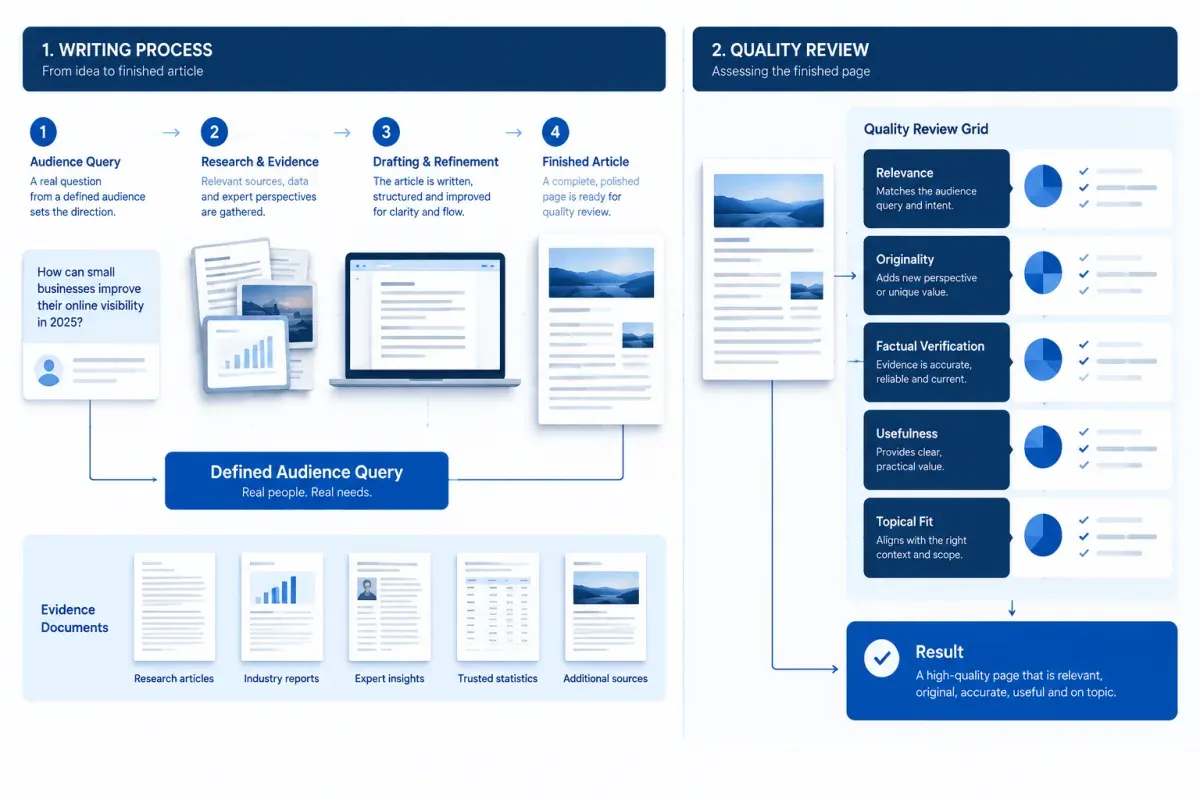
Google judges the quality of the finished page, not how it was produced. Google’s guidance about AI-generated content, published in February 2023, has a section headed “Rewarding high-quality content, however it is produced.” Its FAQ adds, “Appropriate use of AI or automation is not against our guidelines.” Google does not penalize content simply because AI contributed to the draft.
The line is intent. Google says using automation, including AI, “to generate content with the primary purpose of manipulating ranking in search results is a violation of our spam policies.” For rankings, the completed page matters more than who wrote its first sentence.
Quality comes down to relevance, accuracy, originality, clarity, and usefulness. Helpful content answers a defined query for its intended audience rather than chasing adjacent traffic with a broad summary that only partly meets the reader’s need. A concise synthesis can still be useful. An experienced practitioner may translate a complex policy into plain guidance for a specific buyer and add implications a general summary misses.
A page also needs to fit the site’s established subject areas. Publishing connected work within topics your brand can credibly cover reinforces topical authority. Even an accurate article can weaken editorial focus when it sits outside the site’s topical scope.
Low-effort rewriting presents a separate risk. Pages stitched together from other sources or created at volume with little original contribution can count as scaled content abuse under Google’s spam policies. That holds whether a person or a model wrote them.
Relevant experience should be visible wherever a claim calls for it. Named expertise gives readers a reason to trust an interpretation, because polished phrasing is not evidence. Expertise and trust signals in AI search examines those signals in more detail.
How Do You Evaluate Publishable Content Quality?
A publishable page serves its intended audience and search intent with accurate, useful and credible material. Leave the detector score out of this review. These five criteria decide whether a page is ready:
- Purpose and relevance: Match the draft to the intended reader, query and page goal. A detailed product comparison can still miss the mark if the searcher needs a straightforward informational answer. Fluent language is not proof of quality.
- Accuracy: Accuracy is a publication gate. Claims, dates, figures, named entities, quotations, and causal statements must stand up to authoritative sources. Fact-checking should catch hallucinations, outdated statistics, fabricated references, unsupported assertions, and internal contradictions. A serious factual error blocks publication, even if the rest of the draft is well structured.
- Information gain: The page needs to add material readers will not find by opening several ranking results. Firsthand experience, proprietary data, original examples, or a defensible synthesis can create information gain. Lightly reworded ranking content fails this test, no matter how polished it sounds.
- Answer-first structure: Each section should begin with a direct response to its heading, then supply the context, limits and examples readers need to act. This structure helps visitors who arrive mid-page and AI systems that extract a single passage.
- Named expertise and sourcing: Readers should be able to identify who wrote or reviewed the page, what experience supports consequential claims and where figures and quotations originated. Primary sources should support numerical claims and direct quotations.
Sourcing can also affect whether an AI answer cites your page or only names your brand. Our guide to why mentions and citations differ explains what each outcome means.
Integrity checks sit beside quality review rather than inside one blended score:
- Originality: Screen for copied or near-duplicate passages that contribute little beyond existing material.
- Safety: Flag advice that is overconfident, incomplete or unsafe given the topic’s consequences.
- Brand fit: Identify conflicts with approved voice, promises and editorial policy.
Publish when purpose, evidence, originality, structure, and integrity point to the same editorial decision.
How Do You Review an AI-Assisted Draft?
Review an AI-assisted draft for accuracy, usefulness and fit with its reader, not for whether AI helped write it. Keep publication quality separate from authorship signals, particularly when brand voice, creativity or high-stakes claims need editorial judgment.
A consistent workflow makes those decisions easier to defend across writers, brands and product lines. Use this six-step review:
- Set the evaluation context before reading. Define the content type, audience, search intent, brand voice, language, and success criteria. One standard for every asset breaks down quickly. A product comparison, a regulated service page and an informational resource each need different evidence, structure and calls to action.
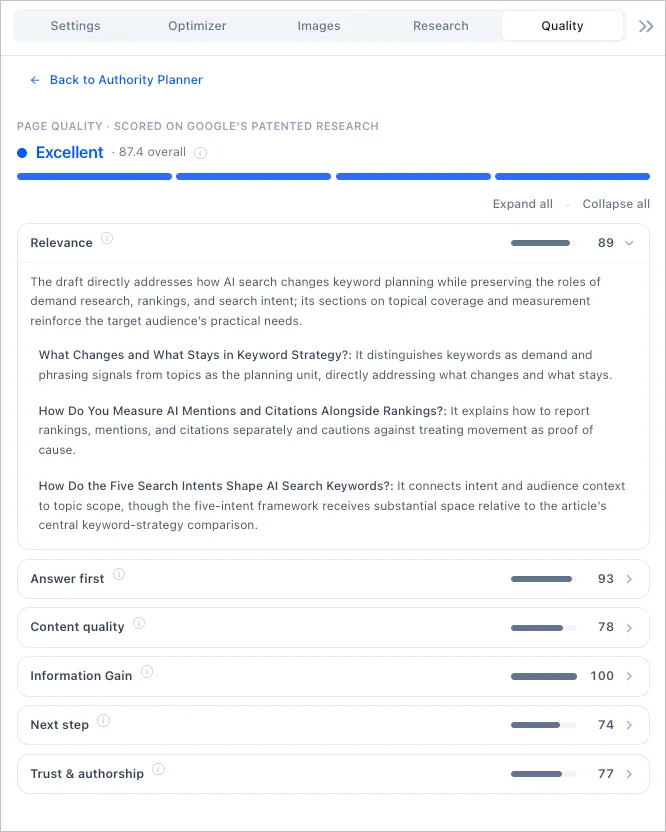
- Score the full draft before line editing. Floyi’s Page Quality Scorecard in the Content Editor’s Quality tab uses an AI judge to score the complete draft from 0 to 100. It covers six dimensions: relevance, answer first, content quality, information gain, next step or call to action, and trust and authorship. Scores fall into four bands: Excellent from 85 to 100, Good from 65 to 84, Average from 40 to 64, and Poor from 0 to 39. Clickable evidence quotes lead you to the passages behind each judgment. New drafts receive a score automatically, and you can re-analyze after revisions.
- Verify claims that shape a reader’s decision. Floyi’s Fact Checker specialist agent reviews claims, sources and data points, flags possible inaccuracies and suggests corrections. Open the underlying source for consequential claims. A favorable score cannot establish that a statistic remains current, that a source supports the precise wording or that a claim meets a client’s compliance requirements.
- Check topical fit and planned originality. Confirm whether the page belongs at the Pillar, Hub, Branch, or Resource level of the topical map, and check overlap with pages the site already owns. The brief’s Information Gain pass plans net-new angles from Brand Foundation and the Knowledge Base. An angle with nothing there to back it is listed as a Blocked Opportunity marked “needs your data” instead of being invented. The Page Quality Scorecard then shows which planned angles reached the draft.
- Use detectors only for a defined concern. A specific worry, such as a passage that may be copied, can justify a similarity or authorship check. Treat the result as a screening signal, not a quality verdict. Record the tool, score, threshold, known limitations, and reviewed passage. Read flagged text in context alongside available drafting evidence, and keep authorship findings separate from the quality decision. Floyi does not detect or score whether text was AI-generated, and its quality scores are not authorship verdicts.
- Make and record the human decision. Expert review matters most for ambiguous, regulated or high-stakes work. Capture the evidence and rationale behind Publish, Revise or Escalate, then move the draft through Awaiting Review, Needs Editing, Approved, and Published. After publication, with Search Console connected, the Content Optimizer lists the Search Console queries that bring traffic to the page, so the next revision starts from real search demand.
Automation can surface weak areas, but an editor decides whether a page earns publication. Floyi’s briefs and drafts start every page from your brand and buyer personas, so each review begins from the plan the page was built on.
AI Content Evaluation FAQs
These FAQs cover what detectors can prove, why they flag human writing, how AI judges score drafts, and whether editors can spot AI text.
1. Can AI Detectors Prove Content Was AI-Generated?
No. An AI detector estimates whether language patterns look human-written, AI-generated or mixed. It can’t prove who wrote a passage or which tool was used, and edited hybrid drafts are especially hard to classify.
Before making an authorship claim, look for evidence a score can’t supply, such as version history, source notes and the writer’s own account of how the draft was made.
2. Do AI Detectors Flag Human Writing?
Yes. Detectors can flag fully human-written work, including academic prose, technical or legal writing and concise professional copy, because those styles can share the predictable patterns detectors look for. Non-native English writers may also be flagged when clear, standardized phrasing triggers a high estimate. Treat a flag as a cue to review context, sources, factual support, and author input, not as an accusation.
3. What Is an LLM-as-a-Judge Evaluation?
An LLM-as-a-Judge evaluation uses an AI model to assess a draft against an explicit rubric or approved reference examples. It supports repeatable, high-volume review of named criteria, such as query coverage and supporting evidence. Floyi’s Page Quality Scorecard is one example, with evidence quotes tied to each judgment.
A judge score is not an objective publishing verdict. Rubric gaps can miss factual errors, originality concerns and nuanced brand judgment. Check its results against your editors’ decisions on a few representative drafts, and trust the editor where they differ.
4. Can Human Editors Tell AI Text From Human Writing?
Not reliably, even with subject expertise. In Cheng et al.’s 2025 Advances in Simulation study, five blinded raters sorted article introductions into five authorship conditions, from fully human-written to fully AI-generated. The authors report, “The overall accuracy of human rating across 5 conditions was 19%,” which they call indistinguishable from chance.
Guessing authorship is a poor quality test. Point editors at what they can verify: accuracy, sources, original information, and whether each section answers its heading.
About the author

Yoyao Hsueh
Yoyao Hsueh is the founder and CEO of Floyi, the topical authority platform, and the founder of Main Heading, an SEO and AI search agency. He is an expert in topical authority and topical mapping. He created Topical Maps Unlocked, a course studied by thousands of SEOs, content strategists and digital marketers, founded TopicalMap.com, a done-for-you topical mapping service for agencies and enterprise teams, and publishes the weekly Digital Surfer newsletter on SEO, content strategy and AI search.
About Floyi
Floyi is a closed loop system for strategic content. It connects brand foundations, audience insights, topical research, maps, briefs, and publishing so every new article builds real topical authority.
See the Floyi workflow