
Expertise and Trust Signals in AI Search: A Brand Audit Guide
Audit the expertise and trust signals AI search uses to judge your brand, from entity facts and named experts to proof, customer reviews and structured data.
When AI answers name competitors but omit your brand, it’s easy to assume a hidden trust score is the cause. Public evidence does not show that AI search applies a universal increase in weighting for expertise and trust signals. Clear identity, named expertise, inspectable evidence, and accurate third-party references still help people and systems assess whether a source is credible.
Google’s Search Quality Rater Guidelines treat trust as central to page quality, but they do not reveal an AI ranking formula. A brand-level audit checks whether your site, public profiles, reviews, author pages, structured data, and source citations describe the same organization. The placement map and yes-or-no triage list focus that review on entity consistency, independent validation, first-party proof, sourcing, and meaningful updates.
AIRS Analyzer can inspect one query on demand across 11 surfaces, including nine AI engines plus Google and Bing SERPs. Record whether the brand is named, cited, recommended, or mischaracterized, then resolve the evidence gaps behind the result. The Topical Authority Scorecard then trends AI mentions and citations over time, so you can watch the pattern after each fix.
AI Search Trust Signal Key Takeaways
- No public evidence proves AI search universally increases expertise or trust signal weighting.
- Consistent entity facts help systems connect references to one legitimate organization.
- Independent mentions and specific reviews provide stronger validation than self-authored claims.
- Named authorship works best when claims link to inspectable evidence and relevant experience.
- Schema can corroborate accurate facts but cannot repair conflicting public information.
- Audit trust signals across owned pages, third-party profiles, reviews, sourcing, and freshness.
- Measure AI visibility by query, including brand stance, citations and description accuracy.
Has AI Search Increased Trust Signal Weighting?
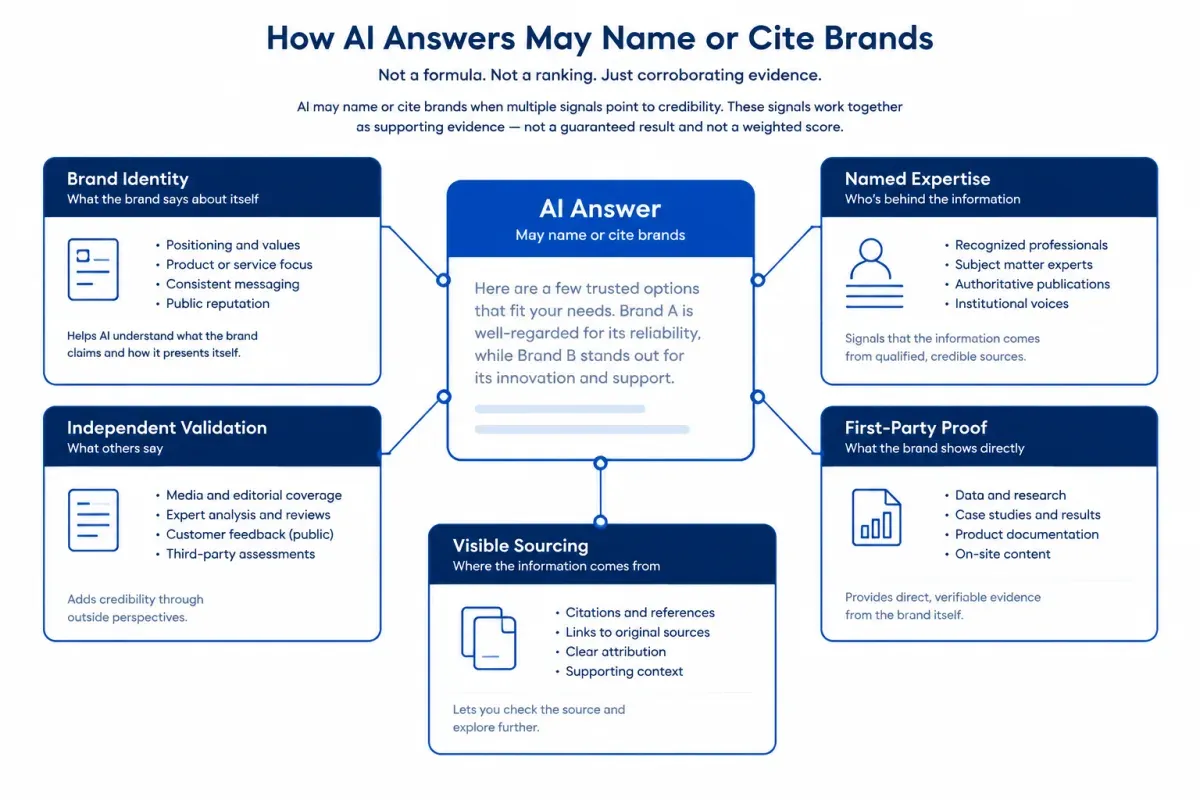
AI search makes source and brand selection more visible, but public evidence does not establish a universal increase in how heavily expertise or trust is weighted. What you can observe is whether AI-generated answers name or cite your brand. The formula behind that outcome isn’t public, so don’t treat E-E-A-T as a score that every AI system assigns.
Google’s own documentation points to continuity, not a new expertise multiplier. Its guidance for appearing in AI features tells site owners to apply the same foundational SEO best practices as for Search overall, including helpful, reliable, people-first content. Clear authorship, demonstrable knowledge and verifiable evidence still help people and systems assess a source. No single signal guarantees inclusion.
The stakes changed even without a documented weighting shift. A lower-ranked result on a traditional results page can still earn clicks. An AI answer to a recommendation or comparison query may name only a short list of brands and cite a few sources or none. A brand left off that list is absent, not ranked lower. Incorrect associations, stale descriptions and conflicting entity details add a second risk: the answer names you but gets you wrong.
AI search engines appear to assess sources in context rather than apply a pass-or-fail trust test. The right evidence depends on the query and the page’s purpose. An official government site is the right authority for passport renewal, while a product-use review needs firsthand experience to be credible. Claim-level provenance checks are covered in how AI engines judge source trust. This guide stays at the brand level.
Five brand-level signals work as corroborating evidence:
- Consistent entity facts: Your brand name, offerings, leadership, and public details match across owned properties and third-party profiles.
- Independent validation: Relevant reviews, reputable mentions and outside references support claims your brand makes about itself.
- Named expertise: Identifiable authors and contributors show why they have direct knowledge of the subject.
- First-party proof: Original research, product documentation, case evidence, and demonstrated experience add substance beyond recycled commentary.
- Visible sourcing and freshness: Readers and systems can inspect consequential claims and see whether important information is still current.
Being named and being cited are related but separate outcomes, and brand mentions versus AI citations covers the difference in detail. Floyi’s Part 2 research found 59.7% to 92.5% of the ranking websites AI answers mentioned weren’t cited in the same answer, inside the typical map. That is an observed pattern, not evidence that any one signal caused inclusion or exclusion.
Treat this work as brand risk management, not ranking-theory chasing. The rest of this guide shows where each signal lives and how to audit it.
How Do AI Answers Verify Brand Identity and Reputation?
AI answers verify brand identity by connecting references to the same organization, people, products, and claims across the web. This is an observed behavior, not a published formula or confirmed weighting model. The goal is for systems to recognize one legitimate entity rather than several conflicting versions.
A practical identity check has four parts:
- Establish a business-fact baseline: Keep your exact brand name, logo, company description, and website aligned across owned pages and public profiles. Do the same for your address or service area, contact details, services, pricing, leaders, and author identities. A spelling variation may be harmless alone, but a stale address combined with a different service description or price raises a more serious doubt. Search systems and prospective customers may not be able to tell whether every reference represents the same business.
- Compare public identity surfaces: Check your About, contact and organization pages against your Google Business Profile where relevant, LinkedIn page, social accounts, directories, podcast biographies, and news coverage. Entity consistency means visible facts match across channels, including how you describe the business. This check often exposes old positioning from a previous market, acquired brand or discontinued service that is still indexed.
- Align machine-readable and visible facts: Organization structured data and sameAs links point search systems toward canonical profiles. The machine-readable name, logo, description, and URLs should match what people see on the page. Schema can corroborate accurate information, but it cannot correct an outdated address, a stale profile or conflicting service claims elsewhere.
- Connect named people to the organization: Founders, executives and subject-matter experts should carry the same employer, role and basic description on owned pages and relevant external profiles. When an affiliation changes, update your owned profile and date the change. Older biographies then read as accurate history rather than a contradiction.
Reputation also depends on what independent sources say when they have no reason to repeat your copy. Your site can describe its capabilities, but mentions in relevant publications, partner pages, expert citations, podcasts, and industry discussions are stronger evidence because someone else wrote them. LinkedIn, Reddit and Quora can add useful context when discussions are accurate and topically relevant.
Source quality matters more than mention volume. A niche publication that correctly identifies your product, audience and specialty supports brand credibility better than broad coverage that misstates your offer. This mismatch can explain why an AI answer hesitates to recommend a brand: the brand looks visible, but available references disagree about its category, customers or core service.
Reviews belong in the same audit because they can serve as independent evidence of customer experience. The most useful reviews are specific and recent, name the product or service, explain the customer’s need, and describe an outcome. They also use brand details consistent with your owned pages. Respond where the platform permits it, particularly when a factual correction or resolution improves the public record.
Neither review volume nor star ratings are documented AI search ranking factors, and fake or incentivized reviews are a credibility risk, not a shortcut. Correct identity conflicts first, then recheck whether independent sources describe the same brand you want AI systems to recognize.
What Proof Makes Brand Expertise Easier to Verify?
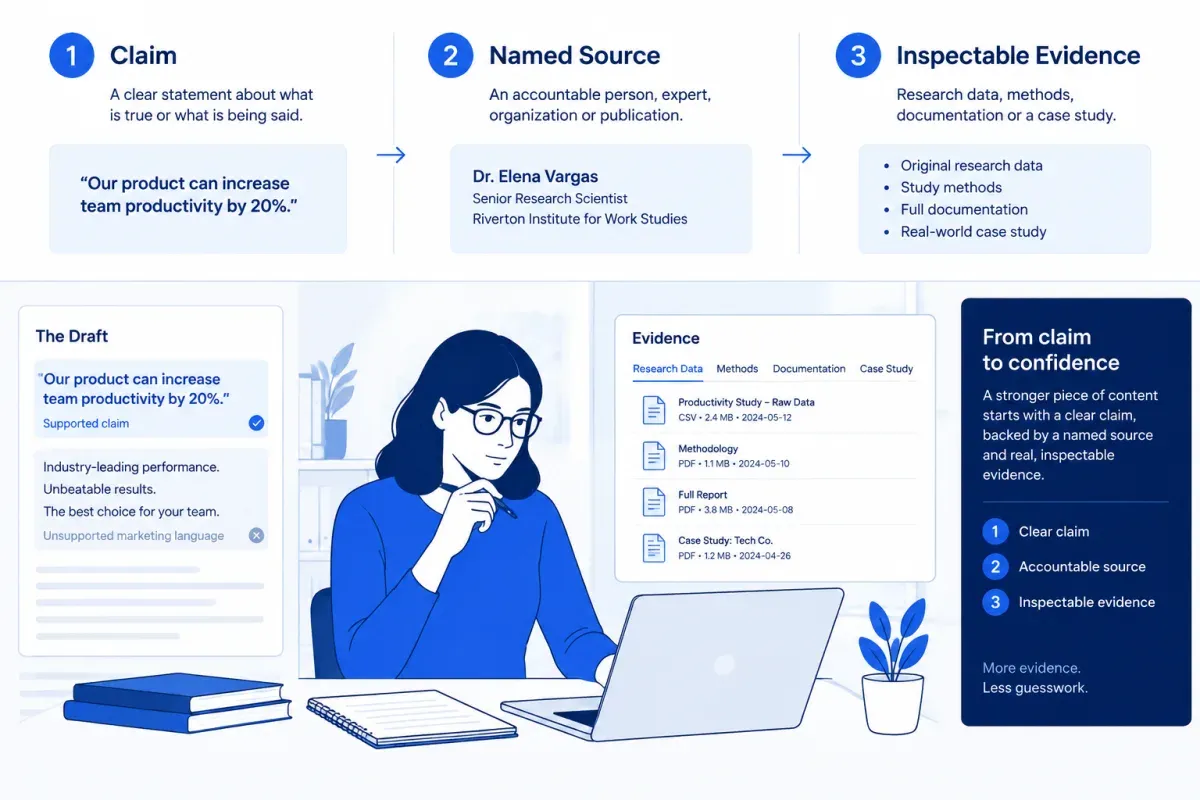
Brand expertise is easier to verify when each meaningful claim leads to a named person or brand, and to evidence readers can inspect. A polished About page or biography provides context, but it does not show that a recommendation, result or interpretation is supported.
A reliable proof chain has three parts:
- Clear claim: State what your brand found, tested, observed, or concluded without vague superlatives.
- Accountable source: Name the company, practitioner, researcher, or customer responsible for the claim.
- Inspectable evidence: Connect the claim to data, methods, documentation, project records, or other supporting material.
Third-party recognition, such as citations from knowledgeable organizations, can reinforce that chain. It can’t replace it. Thin or generic pages also undercut brand-level proof, and page-level quality has its own guide on how AI quality checks judge content.
Author credentials should support a page, not become its central argument. Name the author and link to a stable author page that describes their topic-relevant role and experience. When someone has reviewed material claims, name that reviewer as well. That’s what verified expertise looks like on the page: a person readers can identify and check.
First-party data becomes persuasive only when the surrounding context makes it testable. Useful evidence can include:
- Original research: Findings from your own data collection, with the relevant population and timeframe.
- Customer research: Survey responses, interviews or observed patterns that show how customers made a decision.
- Experiments: A documented test with conditions, measurements and the limits of what the result can establish.
- Case studies and project examples: Specific work that identifies what changed, what was measured and which constraints affected the outcome.
- Authentic visuals: Screenshots or field photos that record the real environment, process or result.
For every asset, state the decision context, timeframe, conditions, method, and limitations. A client story that reports an outcome without explaining what changed or how it was measured is marketing copy, not evidence. If a number is illustrative rather than observed, label it as an example.
Original insights separate your work from material AI can reproduce from standard web text. That difference often comes from proprietary data, a documented testing process, practitioner knowledge of exceptions and tradeoffs, or an evidence-based interpretation that reaches a less obvious conclusion. Build this proof across related pages so the site shows topical expertise rather than isolated credential pages.
Visible sourcing keeps factual statements close to the evidence behind them. Place citations to primary research, official documentation or an original dataset beside the statement they support. Include the publication date when it changes the interpretation.
Content freshness is a review practice, not a date stamp. Recheck time-sensitive facts such as prices, product versions, policies, and team members on a set schedule. Show an update date only after meaningful changes, and make material corrections visible when earlier information could mislead readers.
Floyi keeps brand-owned proof in your content workflow without manufacturing it. Brand Foundation codifies your mission, voice, USP, competitors, and positioning once, and every brief and draft inherits it. The Knowledge Base brings your case studies, research and documented methods into brief and draft generation.
When a promising angle depends on evidence only your company has, the brief lists it as a Blocked Opportunity marked “needs your data” instead of inventing support. Use that flag to gather the missing proof before the claim enters your publishing queue.
Where Should Each Trust Signal Live?
Each trust signal should sit where readers and systems can verify it in context. Entity facts need to agree across owned pages and external profiles. Evidence belongs beside the claim it supports, and reputation lives mostly on sites you don’t control.
This placement map ties a brand trust audit to signals you can verify:
| Signal | Where It Lives | What to Check |
|---|---|---|
| Consistent entity facts | Your site and third-party profiles | Brand name, logo, official domain, descriptions, and ownership details match |
| Organization structured data with sameAs | Your site | Organization markup points only to verified external profiles |
| Named experts and author pages | Your site and your content | Byline, biography, credentials, and profile links identify the same person |
| Third-party mentions and coverage | Third-party sites | Mentions accurately describe the brand, offering and official website |
| Reviews | Third-party sites, with relevant reviews on product or service pages | Reviews address concrete needs, delivery details or outcomes rather than generic praise |
| First-party evidence, such as original data and stated methods | Your content | Data source, method, scope, and limits appear near the related claim |
| Visible sourcing | Your content | Citations and source links are specific enough for readers to verify |
| Update dates and corrections | Your content | Publication dates, meaningful revisions and corrections stay visible |
| Accountability pages, such as editorial policy, contact details and disclosures | Your site | Policies identify the publisher and show readers how to make contact |
A few placements are easy to get wrong:
- Identity pages: Treat the About page, footer, contact page, and Organization structured data as the canonical record, then fix third-party profiles to match. A real contact route, clear ownership details and a physical address where relevant make the entity easier to verify. Local businesses should keep their Google Business Profile in line with the same facts.
- Author pages: Put a visible byline on authored content that links to an author page. Person markup can add sameAs links, but only to profiles that verifiably belong to that author.
- Accountability pages: Link the editorial policy, methodology, corrections process, commercial-relationship disclosures, and contact details from the footer. Surface material disclosures in articles near the affected claim.
- Markup: Keep JSON-LD matched to visible, crawlable content. It should describe facts the page already shows.
A complete audit gives each important claim a visible home, a verifiable source and an entity record that agrees across the web.
How Do You Audit and Measure Trust Signals?
An AI search trust signal audit manages brand risk by testing whether your public identity, evidence and third-party validation line up. It isn’t a hunt for a hidden trust score. Claim-level citation audits and provenance records belong to the source-trust guide linked above.
Use this yes-or-no triage list to find the most urgent gaps:
- Identity consistency: Do the brand name, description, contact information, and service information match across your site and major third-party profiles?
- Organization markup: Does Organization schema match visible site facts, with sameAs links limited to verified profiles of the brand?
- Named expertise: Do identifiable experts with author pages stand behind material expertise claims?
- Category recognition: Do independent publications, communities or partners name the brand in the category where you want recognition?
- Independent reviews: Are recent, specific reviews available on independent platforms relevant to that category?
- First-party evidence: Do high-value pages include original evidence and state how it was gathered?
- Primary sourcing: Do consequential claims link to a primary source beside the statement?
- Freshness and corrections: Do time-sensitive pages show meaningful update dates and visible corrections when facts change?
Build a fixed query set around the category where you want to be named. Include category, comparison, recommendation, and informational queries. AI engines can describe the same company differently by query, engine and date, so a fixed set keeps results comparable from one check to the next.
For each query, record the brands named, whether yours appears and the language used to describe it. A mention is not a recommendation. If ChatGPT presents a competitor as the default choice while positioning your company as an alternative, that difference matters. The same applies when Perplexity cites your research without naming the brand in its answer.
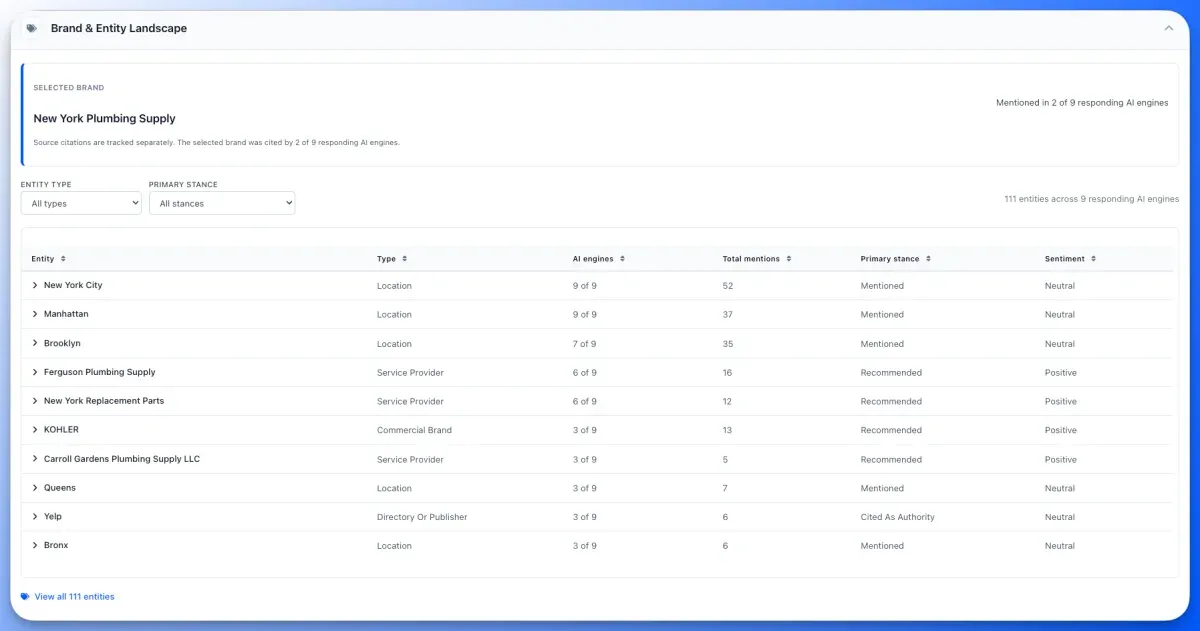
AIRS Analyzer supports one-off investigation when a query needs closer inspection. It runs one query on demand across 11 surfaces, covering nine AI engines plus Google and Bing SERPs, but it does not track or monitor results over time.
Its Brand & Entity Landscape ranks every entity named in answers by the number of responding engines that named it. It also records each engine’s stance, including recommended, conditionally recommended, compared, mentioned, cited as authority, or criticized, along with sentiment and an evidence quote. Read the stance and quote before treating brand mentions as a win. They show whether an answer endorses your brand, names it in passing or favors a competitor.
For trends over time, use the Topical Authority Scorecard, a Pro and Scale feature. Its AI Authority view trends AI mentions and citations across AI Overviews, AI Mode, Gemini, and ChatGPT. Compare that trend with your own rankings, qualified visits and conversions where you have them.
Movement after a trust-signal fix is an observed pattern, not proof of cause. Model updates, query changes and competitor activity can all shift visibility, so repeated comparisons across topics and engines tell you more than a few favorable prompts.
Prioritize remediation in this sequence:
- Strengthen high-value pages: Fix weak claims and surface proof on pages already ranking, converting or earning citations.
- Reinforce corroboration: Resolve identity mismatches and strengthen credible third-party recognition in the category you want to own.
- Create original evidence selectively: Publish research only where a real evidence gap remains.
Use the audit findings to set the publishing queue, then check whether AI answers describe your brand more accurately across the same query set. The Authority Planner turns Scorecard findings into prioritized work and briefs, so each fix feeds the next plan. Track your AI visibility trend in Floyi.
AI Search Trust Signal FAQs
These FAQs cover trust signals for brands in AI search: how E-E-A-T fits in, which queries to fix first, how to prove expertise, and what schema can do.
1. Is E-E-A-T a Ranking Factor in AI Search?
Not as a score. E-E-A-T is the framework Google’s Search Quality Rater Guidelines use to assess page quality, not a number Google or AI engines publish or assign. The guidelines treat trust as the most important part. Apparent experience or expertise can’t make an untrustworthy page trustworthy.
Treat E-E-A-T as a checklist for verifiable proof, not a ranking lever. Verifiable identity, evidence and reputation help people and systems judge a source, whatever the ranking formula.
2. Do Trust Signals Matter More for Some Queries?
Yes. The trust standard depends on the query. Google’s rater guidelines hold Your Money or Your Life topics, such as health, finance and safety, to a higher standard than everyday topics.
AI answers also name brands far more often on commercial queries. Floyi’s Part 2 research found commercial answers carried 2.0 to 2.6 times as many brand mentions per answer as informational answers, inside the typical map. That’s an observed pattern, not proof of cause. It still makes pages that serve commercial and comparison queries a sensible place to start trust-signal fixes.
3. How Do You Prove Expertise Without Sharing Client Data?
Publish evidence at the level you’re allowed to share. Use anonymized or aggregated first-party data, and state the method, sample, timeframe, and limitations. Show what you tested and what changed, even when exact client numbers stay private. Get written permission before naming a client in a case study.
Stated methods make anonymized evidence checkable, while a vague claim with no method reads as marketing copy. Store approved case studies and methods in Floyi’s Knowledge Base so briefs and drafts can draw on them.
4. Can Schema Markup Make a Brand Look Trustworthy?
Not by itself. Organization, Person and Article schema describe brand facts in a form machines parse easily, and sameAs links connect a brand to its official profiles. That helps only when the visible page and third-party sources already say the same thing.
Markup that contradicts visible facts, or claims credentials no one can check, adds doubt instead of removing it. Fix the facts first, then mark them up.
About the author

Yoyao Hsueh
Yoyao Hsueh is the founder and CEO of Floyi, the topical authority platform, and the founder of Main Heading, an SEO and AI search agency. He is an expert in topical authority and topical mapping. He created Topical Maps Unlocked, a course studied by thousands of SEOs, content strategists and digital marketers, founded TopicalMap.com, a done-for-you topical mapping service for agencies and enterprise teams, and publishes the weekly Digital Surfer newsletter on SEO, content strategy and AI search.
About Floyi
Floyi is a closed loop system for strategic content. It connects brand foundations, audience insights, topical research, maps, briefs, and publishing so every new article builds real topical authority.
See the Floyi workflow