
How AI Search Changes Keyword Strategy and What Stays the Same
See how AI search changes keyword strategy and what stays the same, and how to plan keywords as topics with intent, coverage and AI citation tracking.
A first-place ranking for one keyword no longer captures the full visibility picture. The implications of AI search for keyword strategy start with the planning unit, which shifts from isolated terms to the topic, questions, entities, and buyer task behind them. Keywords still matter because they record demand and the language people use to describe a need.
Google’s guidance keeps the core SEO basics in place, but AI Overviews and AI Mode may use query fan-out across related subtopics and data sources. That means a CRM software page must address decision criteria, implementation concerns and relevant comparisons when those needs belong to the same answer. Floyi’s SERP Clustering groups terms by shared results rather than similar wording, so you can tell one broad page apart from a distinct topic.
Measurement has to expand without blending unlike signals. Floyi research covered 42 topical maps. Across the four AI engines studied, 40.2% to 71.9% of citations went to websites outside the top 20 for the query being answered. Track rankings, Search Console performance, AI mentions, and citations separately at the topic level before assigning cause.
AI Search Keyword Strategy Key Takeaways
- Keywords remain demand and phrasing signals, not standalone publishing plans.
- Plan topics around buyer problems, related questions, entities, and answer requirements.
- One broad search can fan out into many related subtopics.
- Group keywords when one page can give the same answer and evidence.
- Split clusters when audience, intent, depth, or action differs.
- Prioritize coverage, business relevance and credible evidence alongside search volume.
- Report rankings, AI mentions and citations separately before inferring cause.
What Changes and What Stays in Keyword Strategy?
Keywords still show demand and the words buyers use. What changes is the planning unit. A keyword strategy for AI search starts with the problem a page must solve and the topic it must cover, not a phrase to repeat.
Search volume, query patterns, ranking evidence, and audience language remain the best record of what people ask and how they phrase it. Traditional keyword research keeps that job. Google’s guidance on AI features says no special optimizations are needed for AI Overviews or AI Mode, and the fundamental SEO best practices still apply. Generative engine optimization (GEO) and answer engine optimization (AEO) extend SEO for AI search rather than replace it.
The impact of AI on keyword research shows up in planning. AI answers draw on related searches rather than one string match. A page is judged on whether it resolves the problem, its sub-questions and the entities involved. Map the related terms and concepts a complete answer needs, and cover them in enough depth to hold up.
A practical planning review covers three layers:
- Demand signal: Queries and phrasing show what the market wants to know.
- Problem scope: Related questions and entities show what the answer must address.
- Content fit: Format, evidence and depth decide whether the page serves the likely task.
Exact-match repetition can make copy awkward without proving that a page resolves the need. Floyi’s Content Optimizer benchmarks a draft against top SERP competitors and AI sources, then flags missing and overused entities, topics and keywords. That turns “cover the topic” into a list you can check. The wider process of researching opportunities for AI search starts earlier, before any brief exists.
Reporting changes too. Rankings stay, but AI mentions and citations become separate visibility signals reported beside them.
How Does Query Fan-Out Turn One Keyword Into Many Questions?
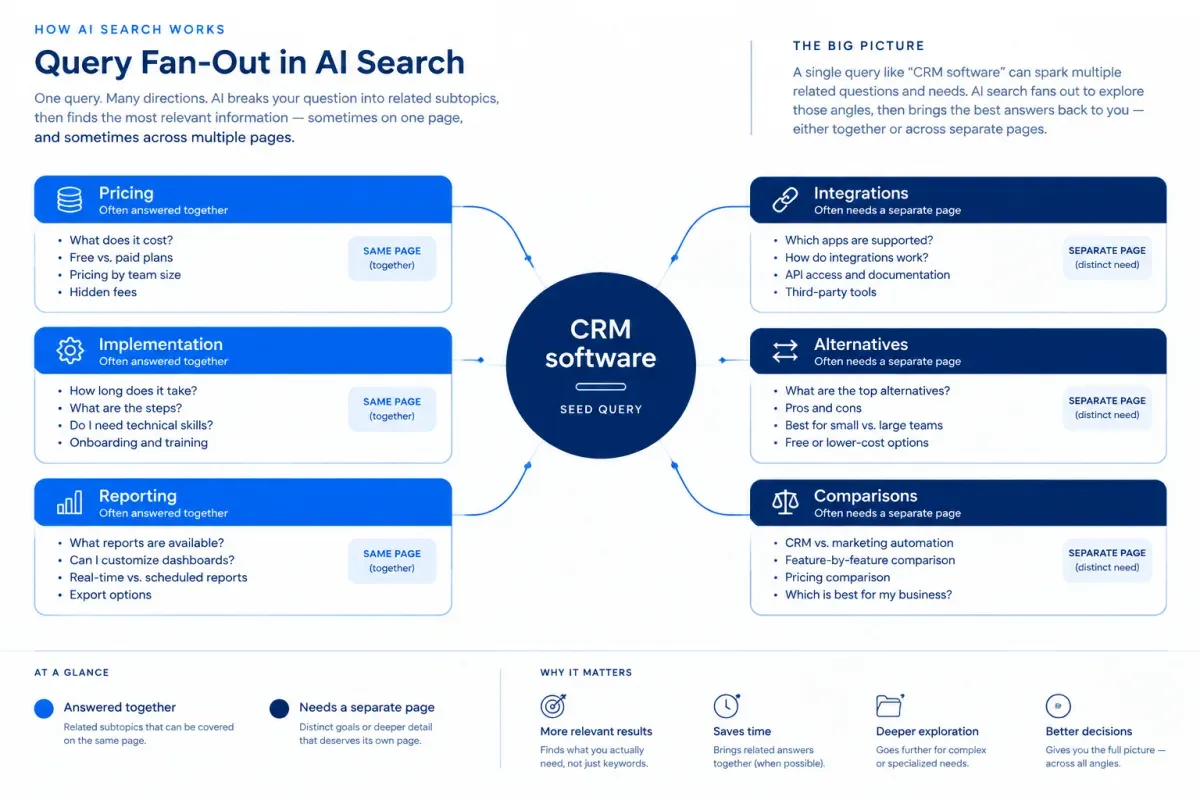
Query fan-out turns one broad search into several related searches. Google’s page on AI features and your website says AI Overviews and AI Mode may use it, issuing multiple related searches across subtopics and data sources. It doesn’t guarantee that any page gets used, and Google’s description covers only its own features. It still changes what a head term stands for during planning.
A keyword such as CRM software stands for a set of sub-questions: the underlying problem, the audience, constraints, decision criteria, and likely follow-ups. A page that repeats the head term without resolving those branches leaves them to other sources. Plan one coherent topical scope instead of publishing near-duplicate pages for slight keyword variations.
For example, a B2B software team might start from the question “Which CRM fits a 20-person B2B sales team with a limited budget?” It carries several information needs:
- One decision page can answer: Per-seat pricing, pipeline reporting, implementation effort, and core integrations.
- Separate pages can answer: Detailed CRM alternatives, platform-specific integration guidance and head-to-head comparisons of two products.
Conversational phrasing tends to run longer and more specific. People type and speak full questions with qualifiers into AI search, and multi-sentence AI prompts carry context a short category label leaves out. Google describes AI Mode as particularly helpful for queries that need further exploration, reasoning or complex comparisons. AI-assisted long-tail keyword discovery covers how to find those longer phrases and group them instead of treating each variation as its own page.
Floyi’s Topical Research grounds subtopics in live Google and YouTube autocomplete. The PAA Explorer expands a seed query into a People Also Ask question tree up to five levels deep, so follow-ups are visible before you create a brief. Validate each branch against the buyer persona and the original problem, then drop duplicates and tangents.
How Do the Five Search Intents Shape AI Search Keywords?
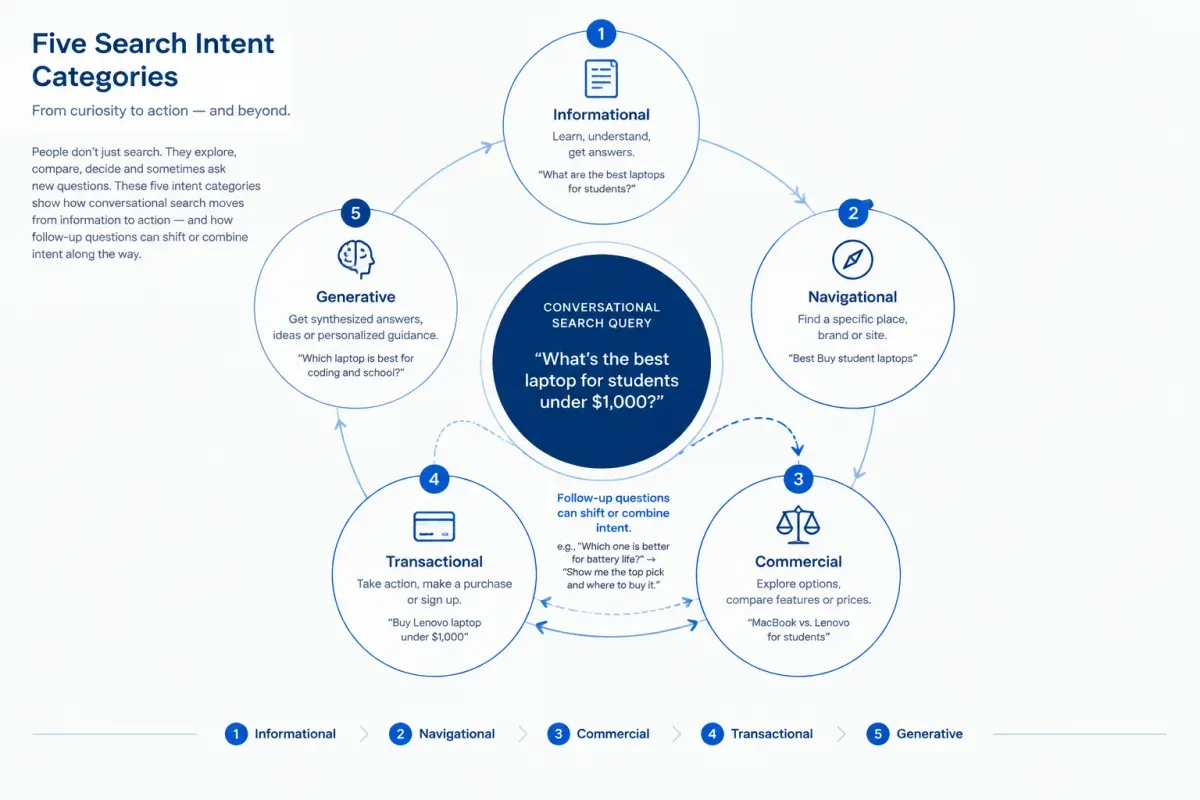
The five search intents tell you which task a topic must serve, but conversational prompts can combine tasks or shift them through follow-up questions. A searcher may ask how a platform works, then ask which option suits a specific budget. That makes conversational search intent less stable than a one-keyword, one-label model.
The five search intents are:
- Informational: The searcher wants to learn a fact, concept, process, or solution.
- Navigational: The searcher wants to reach a specific site or page.
- Commercial: The searcher wants to compare or assess options before deciding.
- Transactional: The searcher wants to take action, such as requesting a demo or making a purchase.
- Generative: The searcher expects the engine to produce a finished output, such as a plan, summary, comparison, or draft, rather than point to a page.
Generative intent can sit alongside another intent. A request for a comparison and a recommendation is both commercial and generative. Follow-up prompts can also change the task. So plan each topic for a primary intent and, where it applies, a secondary one, instead of forcing every keyword into one category.
Search intent is the task the query expresses. Search context is who is asking and what makes the answer useful to them, including role, expertise, buying stage, goal, location, and device. The same keyword theme needs different coverage for a first-time evaluator than for an experienced practitioner handling implementation.
That distinction shapes which questions a topic must answer. Early-stage informational queries need explanations and definitions. Queries closer to a purchase extend into comparisons, alternatives, use cases, decision criteria, and implementation questions. Setup, troubleshooting and integration questions remain informational needs, even after purchase.
Floyi’s Authority Planner labels each topic with up to two of the five search intents and a TOFU, MOFU or BOFU funnel stage. Briefs generated from the Planner follow those values, which keeps topical scope aligned with both the task and the audience context. Matching pages to answer types covers the separate decision of which format fits each need.
How Do You Plan Keywords as Topics Instead of Single Terms?
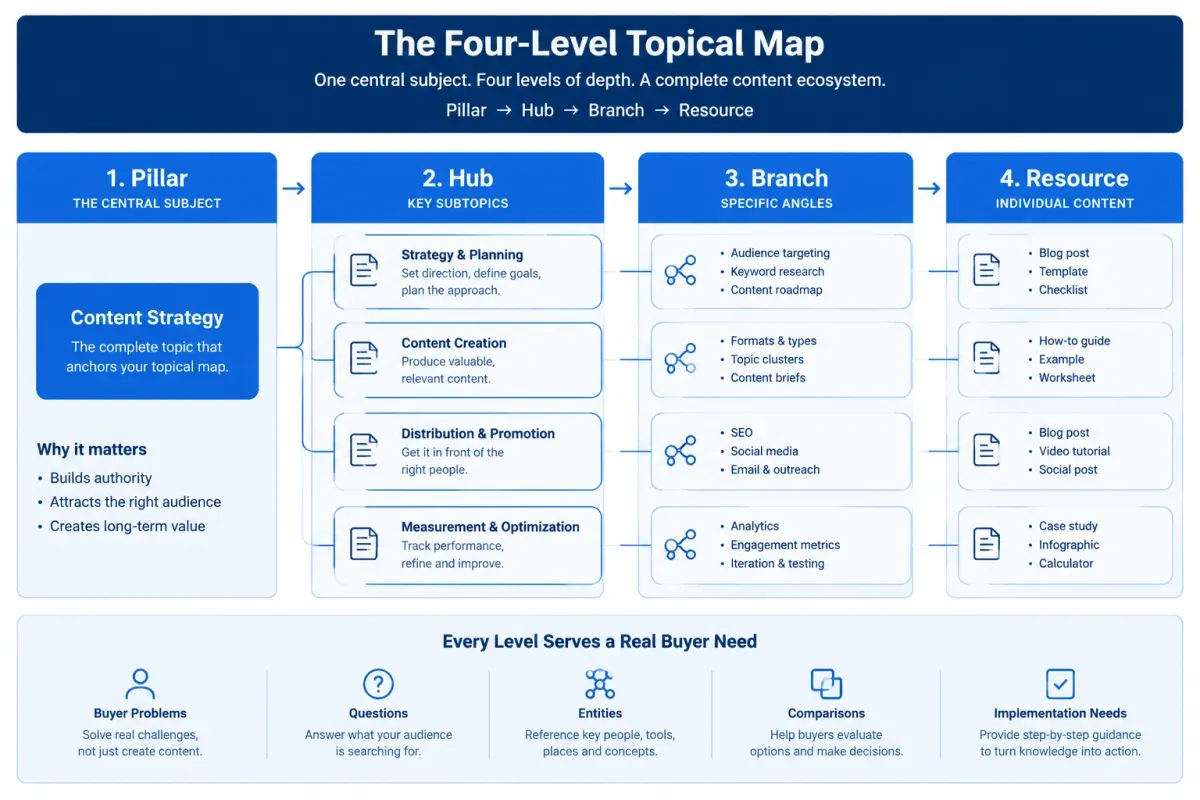
Plan keywords as topics by grouping the keywords, sub-questions and entities a page must address to resolve one customer need. That set is the topic. Keywords still supply the demand and phrasing, and the topic decides what the page must include.
Build each topic by expanding a core term through the decisions behind it:
- Problems: Identify the friction, risk or trigger behind the search.
- Outcomes: Define what the searcher wants to achieve or avoid.
- Questions: Capture the follow-up questions that change the answer.
- Comparisons and alternatives: Account for the options a buyer may assess before choosing.
- Use cases and implementation: Cover fit, adoption concerns and decision criteria.
- Objections: Address hesitation around cost, complexity, compatibility, or change.
The expansion gets more reliable when customer language guides it. Support tickets, sales calls, community threads, and People Also Ask can surface phrasing a keyword database misses. AI tools can group queries by intent and spot gaps quickly. An AI-suggested relationship is still a hypothesis until live search results and subject-matter expertise confirm it.
Each topic also needs an entity layer: the products, methods, standards, and related concepts a credible answer must connect. Broad terminology alone can look complete while leaving out the relationships an expert expects to see.
Floyi’s Topical Research places topics in a Pillar > Hub > Branch > Resource hierarchy. The hierarchy makes coverage gaps visible. It also separates queries one strong page can satisfy from needs that require distinct pages.
Group Keywords by Shared Answers, Not Shared Words
Group keywords by the answer a searcher needs, not the words they type. One well-scoped page can serve many long-tail phrasings when its headings, examples, evidence, and next step resolve the same question set. That gives AI systems one clear answer to cite instead of a separate URL for every variation.
Apply the shared-versus-different-answer test:
- Combine keywords: One page can satisfy each query with the same answer, evidence and next step.
- Split keywords: The audience, intent, comparison set, or required depth changes enough that one page would lose focus.
- Keep customer phrasing: Put natural language in headings, examples and FAQ sections when it helps clarity.
- Avoid near-duplicate URLs: Similar pages split relevance signals, cause keyword cannibalization and add little coverage.
Floyi’s SERP Clustering groups keywords by shared search results rather than surface wording. When two queries return enough of the same ranking pages, they land in one cluster. Similar-sounding terms can still need separate pages when their results point to a different expected answer.
A cluster works when related questions form a useful path without forcing every question onto its own page. Several definition queries may fit one resource. A buyer comparing options needs a separate page with different evidence and a different decision path.
How Do You Choose Topics by Coverage Instead of Volume?
Choose topics for topical coverage, business relevance, AI visibility opportunity, and competitive differentiation, not search volume alone. Volume counts demand for one phrasing. AI answers draw on the related questions around it, and many conversational or newer queries show little or no recorded volume.
High-volume keywords still signal real demand. They just don’t decide the plan alone. A modest-volume page can deserve more investment when it closes a gap, supports a commercial decision or answers the follow-up question that completes a hub. Broad terms with weak buyer relevance can attract attention without building the subject depth your brand needs.
Assess each prospective page by its contribution to coverage:
- Hub completion: Does it fill a necessary part of a subject where your brand needs credible coverage?
- Question depth: Does it answer a specific sub-question raised in search results or AI answers?
- Commercial support: Does it help buyers compare options, assess fit or take action at a real decision point?
- Distinctive evidence: Can your team add first-hand experience, original data, expert analysis, or implementation detail that generic sources lack?
Commercial evaluation, original data and implementation detail are harder for an AI answer to assemble from generic sources. A brand with first-hand expertise has room to add something credible there. That is an observed pattern, not a rule. Informational pages still build familiarity and answer early questions, even when AI answers resolve some of them without a click.
Floyi’s Authority Planner keeps the coverage decision visible in your publishing queue. Each topic shows its importance, search intent, funnel stage, and publish status. Filters isolate the high-importance topics that aren’t published yet.
Coverage doesn’t replace trust signals. If a well-covered hub stalls, backlinks, mentions and credibility may be the limiting factor.
What Does Floyi’s Citation Research Show About Keywords?
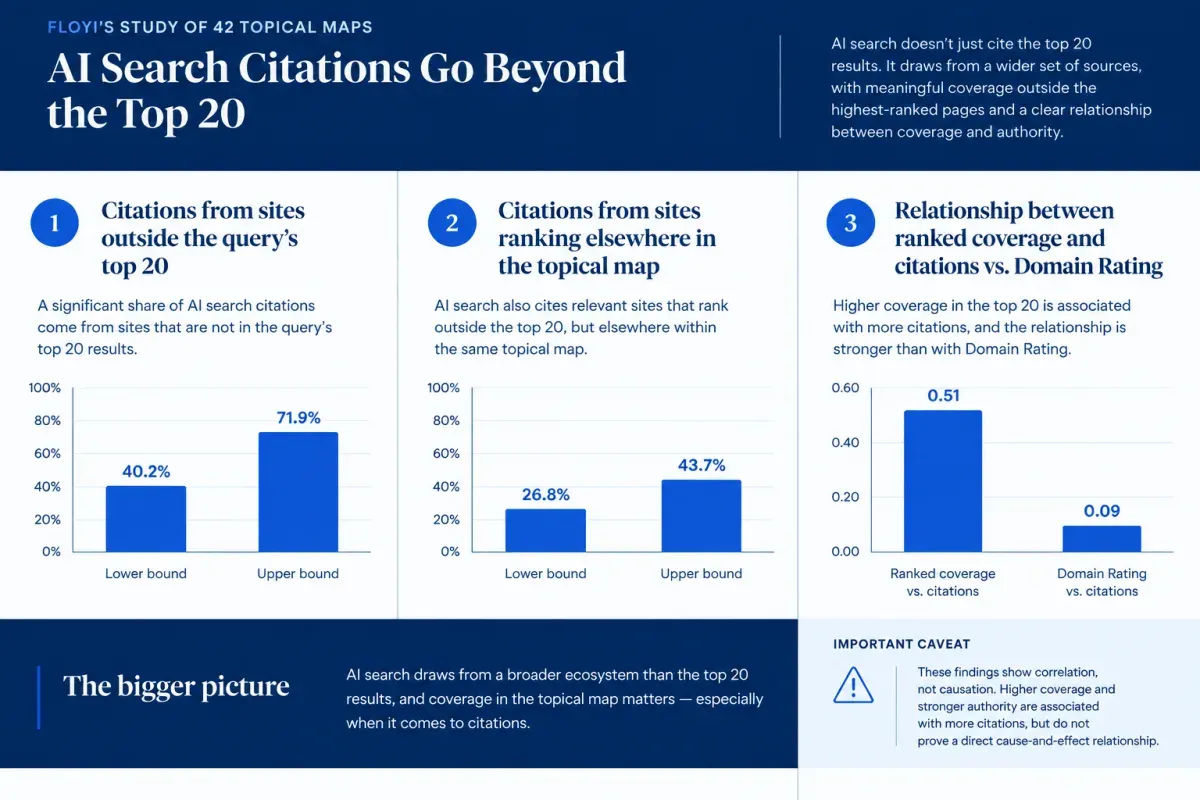
Floyi’s Topical Authority Report shows that one keyword’s ranking is an incomplete proxy for AI citations, the sources an AI answer references. The report studied 42 topical maps built in Floyi, their top-20 Google rankings and stored answers from AI Overviews, AI Mode, ChatGPT, and Gemini. Its findings are correlations, not evidence that broader coverage causes citations.
Three findings change how keyword performance should be read:
- Ranking gaps: Across the four AI engines studied, 40.2% to 71.9% of citations went to websites outside the top 20 for the query being answered. A website can be cited without ranking for that exact query.
- Map-level relevance: 26.8% to 43.7% of citations went to websites that didn’t rank for that query but ranked elsewhere in the same topical map. Coverage across the subject, not only the exact query, goes with being cited.
- Coverage over Domain Rating: Inside the typical map, ranked coverage tracked citations more closely than Domain Rating, 0.51 against 0.09 on AI Overviews. That is a correlation, and it doesn’t make coverage a replacement for links.
Plan and measure across a defined topical scope rather than one keyword at a time, and keep rankings in view. Most citations still went to websites ranking somewhere in the map, even when the cited website didn’t rank for the exact query.
When ranked coverage is strong but citations stall, trust may be the constraint. Extractable content also helps. Clear answers, visible expertise, concise definitions, and sourced evidence make a page easier to verify and quote.
How Do You Measure AI Mentions and Citations Alongside Rankings?
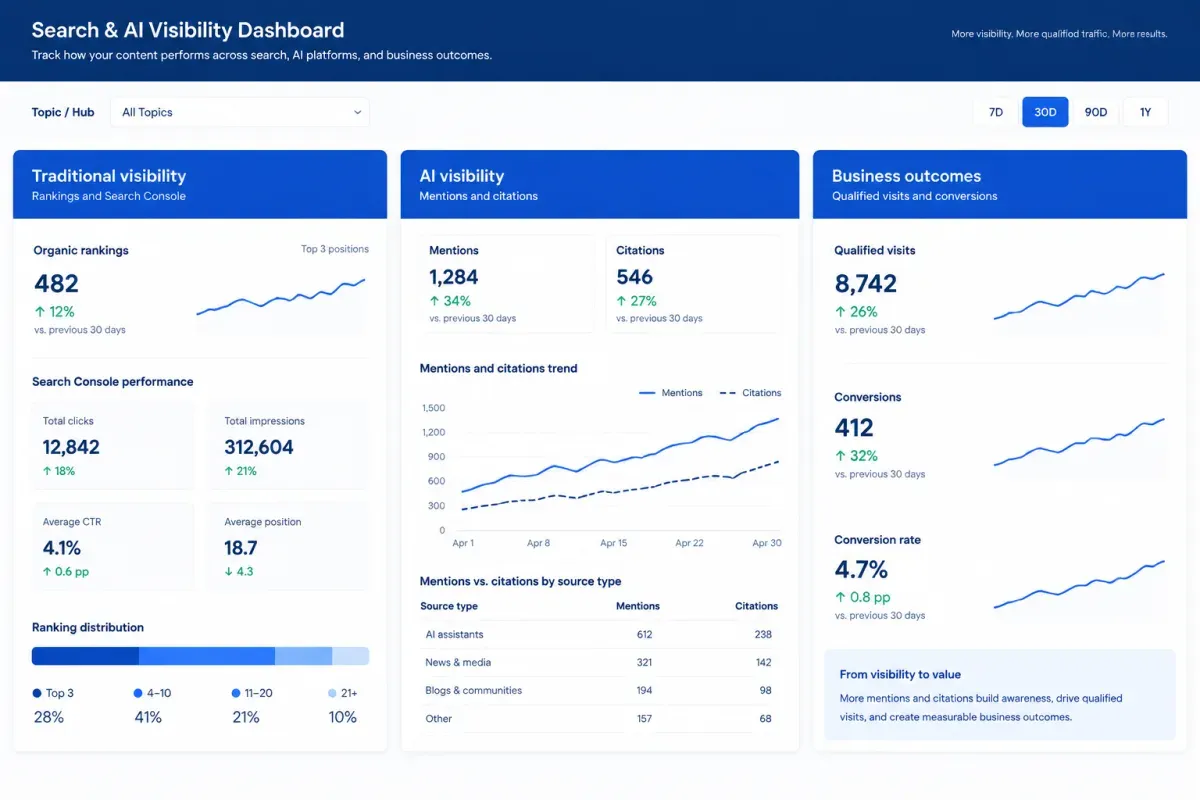
Keep rankings and Search Console data, then report AI mentions and AI citations beside them as separate visibility signals. A mention happens when an AI answer names your brand. A citation happens when the answer lists one of your pages as a source. Neither belongs in a blended score with rankings, clicks or revenue.
Floyi’s Topical Authority Report Part 2 found that, inside the typical map, ranked coverage lined up with citations at 0.29 to 0.50 but with mentions at only 0.15 to 0.20. A brand can appear in answer text without attribution. A cited page can support an answer without the brand being named. That gap is why mentions and citations need separate lines in your report.
Report at the topic or hub level, then segment by intent and engine instead of judging isolated keywords. A useful view includes:
- Traditional visibility: Rankings, Search Console impressions, clicks, and click-through rate.
- AI visibility: Mention frequency, citations, cited pages, query themes, and share of voice.
- Business outcomes: Qualified visits, conversions, assisted conversions, and branded demand connected to cited pages.
Keep AI visibility out of revenue reporting until it connects to outcomes. Being named in an answer without a click can raise brand exposure, but business impact needs evidence from qualified traffic and conversions.
Floyi’s Topical Authority Scorecard, on Pro and Scale plans, trends AI mentions and citations over time across AI Overviews, AI Mode, Gemini, and ChatGPT. Organic Audit connects Search Console to show which topics earn organic traffic. For a point-in-time check, AIRS Analyzer runs one query on demand across 11 surfaces: nine AI engines plus Google and Bing SERPs.
Compare changes against a baseline, then look at the affected hub, cited pages, engine, and intent before assigning cause. Movement is a signal to investigate, not proof that a keyword change caused it.
Track Coverage Across the Topic, Not One Keyword
For AI search, the useful question is how much of a priority subject you have published and ranking, not where one keyword sits.
Importance-weighted coverage keeps low-value pages from inflating progress. Each planned topic carries an importance value, and coverage is the share of total importance held by published pages.
An illustration with made-up numbers shows why raw page counts mislead:
- Raw page count: A map has 10 planned pages, and five are live. Progress looks like 50%.
- Importance-weighted view: Those five pages hold 20 of the map’s 100 importance points. Coverage is 20%, because the priority work is still unpublished.
Content Authority in the Topical Authority Scorecard uses this method. It combines importance-weighted coverage of published pages with their ranking performance. That Coverage measure is separate from the ranked coverage in the research above.
Coverage measures execution, not search success. A published page can still miss the audience’s intent, lose visibility to stronger pages or fail to appear in AI answers. Pair coverage with rankings, AI mentions, citations, Search Console clicks, and conversions.
How Do You Turn a Keyword List Into an AI Search Plan?
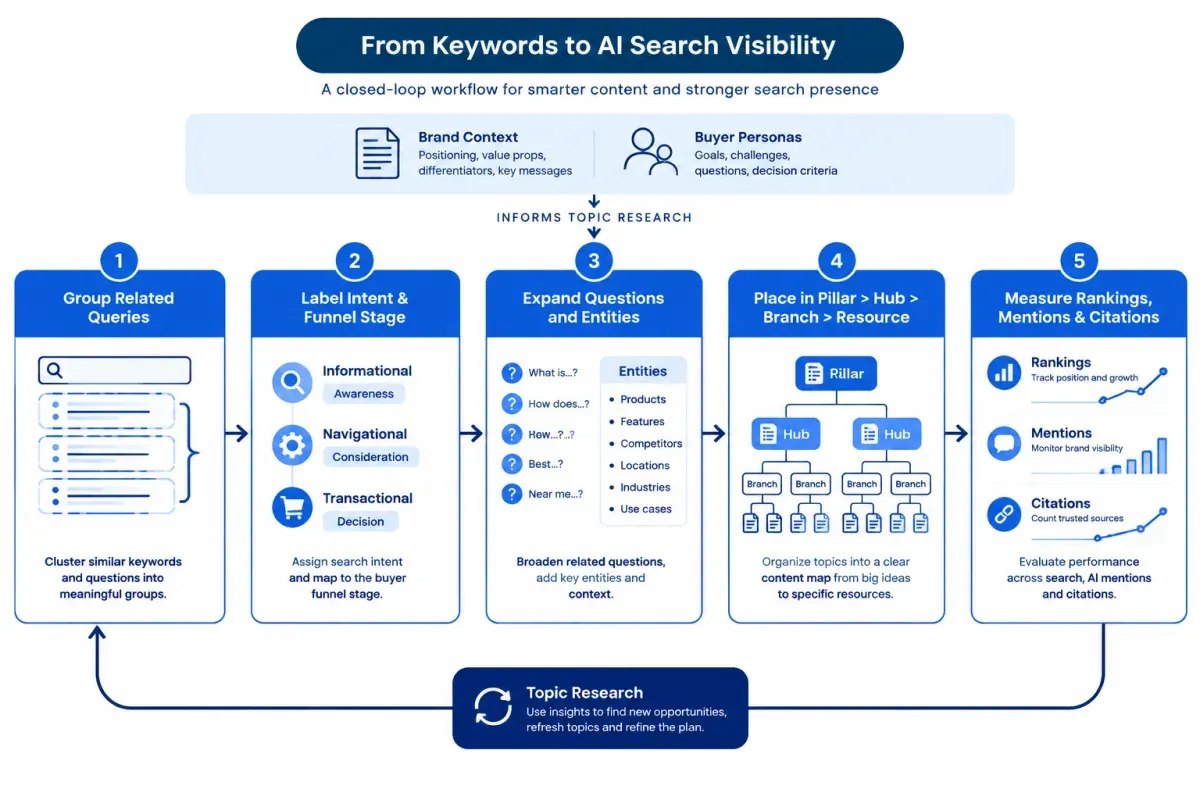
Keep the keyword list, but stop treating it as the plan. Use it as evidence of demand and phrasing, then turn it into topics with the sequence below.
- Group related queries: Merge terms that need the same answer and share search results into one cluster. Split a cluster when its audience, intent or required depth changes.
- Label each topic: Apply up to two of the five intents (Informational, Navigational, Commercial, Transactional, Generative) and a funnel stage. The Authority Planner then tells an awareness explainer apart from a commercial comparison.
- Expand the answer space: List the sub-questions an AI answer is likely to fan out into and the entities it must connect. Mark each one as covered, missing or better suited to its own page. AI Search Gaps queries ChatGPT, Gemini and AI Mode as your buyer personas to surface topics your research missed.
- Place the topic: Set its Pillar, Hub, Branch, and Resource position. Thin hubs, duplicate angles and likely cannibalization become visible before you publish.
- Measure by topic: Compare rankings, Search Console clicks and impressions, AI mentions, and AI citations. Track mentions apart from citations, because appearing in an answer doesn’t mean your page was used as a source.
Revisit the map when coverage or AI answers change, then use the Authority Planner to pick the next page by the gap it closes.
To turn the keyword list you already have into that map, start your topic research in Floyi.
AI Search Keyword Strategy FAQs
These questions cover the practical decisions behind keyword strategy for AI search, from rankings and exact-match terms to clustering and page scope.
1. Should You Still Track Keyword Rankings?
Yes. Rankings still show visibility in traditional results and help you diagnose demand capture and competitive movement. Across the four AI engines studied, Floyi’s Topical Authority Report found that most citations went to websites ranking somewhere in the same topical map. Rankings across a map still matter.
A strong position for one keyword is no longer a full visibility verdict, though. AI answers can resolve a question before a click. Track rankings beside AI mentions, citations and business outcomes instead of replacing them.
2. Do Exact-Match Keywords Matter in AI Search?
Not as a requirement. Google says AI Overviews and AI Mode need no special optimization, and AI answers generally match a passage on meaning, entities and context rather than one exact string. Treating one wording as the only route to coverage no longer holds.
Keep keyword research as a demand and phrasing signal. Use the real questions people ask as clear headings and put the direct answer early. Make definitions, steps, examples, and comparisons easy to lift out, with enough context around them to stand alone.
3. Is Query Fan-Out the Same as Keyword Clustering?
No. Query fan-out happens at answer time inside the search system. Google describes AI Overviews and AI Mode issuing multiple related searches across subtopics and data sources to develop a response. Keyword clustering happens at planning time, when a content team groups the keywords one page can answer.
Fan-out shows which sub-questions an answer pulls in. Clustering decides which of those one page covers and which need their own page. Floyi’s SERP Clustering groups keywords by shared search results, so the grouping follows how Google already answers them.
4. Can One Page Rank for Multiple AI Queries?
Yes. One well-scoped page can serve several closely related AI queries when the audience, intent and required answer substantially overlap. AI systems may retrieve passages for specific use cases. Organize the page with descriptive headings, direct answers and supporting detail rather than building a separate page for every variation.
Create distinct resources when a query serves a different audience, task, decision stage, or evidence format. Consolidated pages still need crawlability, a clear heading hierarchy and relevant schema markup, so systems can parse the content and attribute passages accurately.
About the author

Yoyao Hsueh
Yoyao Hsueh is the founder and CEO of Floyi, the topical authority platform, and the founder of Main Heading, an SEO and AI search agency. He is an expert in topical authority and topical mapping. He created Topical Maps Unlocked, a course studied by thousands of SEOs, content strategists and digital marketers, founded TopicalMap.com, a done-for-you topical mapping service for agencies and enterprise teams, and publishes the weekly Digital Surfer newsletter on SEO, content strategy and AI search.
About Floyi
Floyi is a closed loop system for strategic content. It connects brand foundations, audience insights, topical research, maps, briefs, and publishing so every new article builds real topical authority.
See the Floyi workflow