
How Poor Topical Hierarchy Hurts AI Visibility and How to Fix It
See how a weak topical hierarchy can cost AI citations, how to diagnose it with a page audit and how to repair links and competing pages before you measure.
Stable rankings can mask weaker AI visibility when your site gives answer systems no clear page to retrieve or cite. Poor topical hierarchy contributes by splitting one intent across competing URLs, isolating Resources or sending links toward the wrong parent. A four-level Pillar, Hub, Branch, and Resource map gives each page a defined role and a clear relationship to the pages around it.
Google AI Overviews, Gemini and ChatGPT Search can name a brand without citing its domain, so mentions and citations need separate baselines. A page audit classifies intent, finds orphans and competing pages, traces link paths, and checks crawlability before you restructure anything. Floyi’s Topical Authority Scorecard measures those AI mentions and citations over time, so you can see whether they move after a repair.
Topical Hierarchy and AI Visibility Key Takeaways
- Poor hierarchy can weaken AI citation eligibility, but it doesn’t prove a penalty or explain every visibility decline.
- Give each page a distinct Pillar, Hub, Branch, or Resource role.
- One page per intent removes the ambiguity of competing URLs targeting the same question.
- Link Resources and Branches to their parent pages with descriptive contextual anchors.
- Audit orphan pages, broken paths, weak hubs, and technical retrieval barriers before restructuring.
- Track brand mentions and domain citations separately across AI search surfaces.
- Rerun identical prompts and log site changes so before-and-after comparisons hold up.
How Can Poor Hierarchy Limit AI Visibility?
Poor hierarchy limits AI visibility by leaving answer systems without a clear representative page to retrieve or cite. That’s a plausible mechanism, not proof of a penalty or the only reason citations decline. When Pillar, Hub, Branch, and Resource pages don’t establish a clear topical scope, AI systems have weaker evidence of site-wide expertise.
Traditional SEO can still surface an isolated page through relevance, backlinks and other signals. AI answer systems also have to interpret how concepts relate and retrieve enough context to build an attributable answer. So organic rankings can hold steady while AI search visibility falls.
A poor topical hierarchy creates ambiguity in four ways:
- Overlapping pages: Several URLs partly answer the same question, so no single page is the clear answer.
- Detached resources: Detailed supporting content sits outside its Hub and can’t reinforce the broader Pillar.
- Misdirected links: A Branch page points to an unrelated parent, which weakens the path between the page and its subject.
- Mixed intent: One URL tries to answer several questions instead of one intent directly.
Topical authority content planning sets the Pillar, Hub, Branch, and Resource sequence that gives each page its role. Topic clusters built for AI search explain the topic cluster strategy that lets supporting pages reinforce that structure without competing for the same intent.
Citation visibility isn’t ranking visibility. A retrievable page still needs a direct answer, clear definitions, evidence, or comparisons a system can quote. Content quality, crawlability, query fit, competition, and trust signals all sit alongside topical hierarchy for AI search as possible causes.
Coverage and authority are different constraints. Good coverage directs relevance toward the right Hubs, but it doesn’t replace backlinks, credible mentions or earned trust. When coverage is already sound, publishing more pages adds bloat instead of fixing the cause of AI search visibility loss.
Document Your AI Visibility Baseline
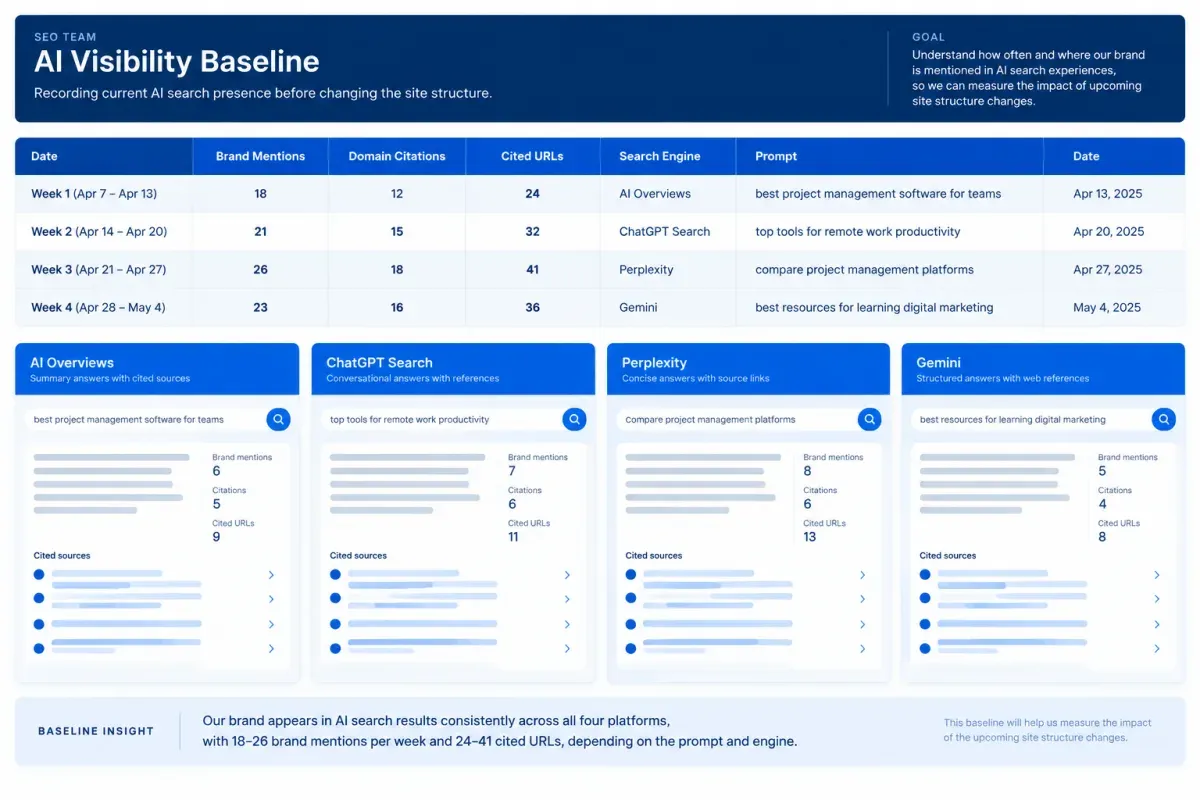
Record a baseline before you touch the hierarchy, so you can measure AI visibility by topic and compare it after the repair. Map every Pillar, Hub, Branch, and Resource page in the topical scope, then pick representative informational, comparison and problem-solving prompts. Save the exact prompt wording, engine, search context, and date, because a small wording change can change the answer set.
Run each prompt in Google AI Overviews, ChatGPT Search, Perplexity, and Gemini, and run it more than once. A University of St. Gallen study found that the sources AI engines cited for the same prompt overlapped by only 34% to 42% between consecutive days. One snapshot can mislead, so record how often your domain is cited across runs, not whether it appeared once.
Each observation should keep what you need for a like-for-like comparison:
- Full response: Save the complete generated answer, not only the linked sources.
- Brand evidence: Record whether the answer mentions your brand and whether it cites your domain.
- Citation evidence: Capture every cited page URL and competitor domain.
- Query context: Keep the engine, exact prompt, date, search context, and notes.
Use stable weekly fields such as week_start, engine, query, page_url, answer_present, our_domain_cited, cited_domains, ai_citation_share, sov, and notes. Keep historical rows intact when you change page relationships or links. That keeps the pre-repair snapshot valid for each topic and engine.
The Topical Authority Scorecard measures mentions and citations separately across Google AI Overviews, AI Mode, Gemini, and ChatGPT Search. An engine can name your brand while citing another site, and that split often exposes the real hierarchy issue: your mapped pages aren’t picked as the evidence.
Repeated competitor citations show which page types AI systems pick for definitions, procedures, comparisons, and proof. Note whether those URLs are hubs or deeper resources. High-ranking pages may overlap with AI citations, but that overlap is context, not proof that rankings cause citations.
Set these observations beside Search Console impressions, clicks and referral sessions for each topic and mapped page. A click decline can come from lower demand, ranking changes or new result layouts rather than lost citations, so leave technical checks for the page audit.
Diagnose Hierarchy Problems with a Page Audit
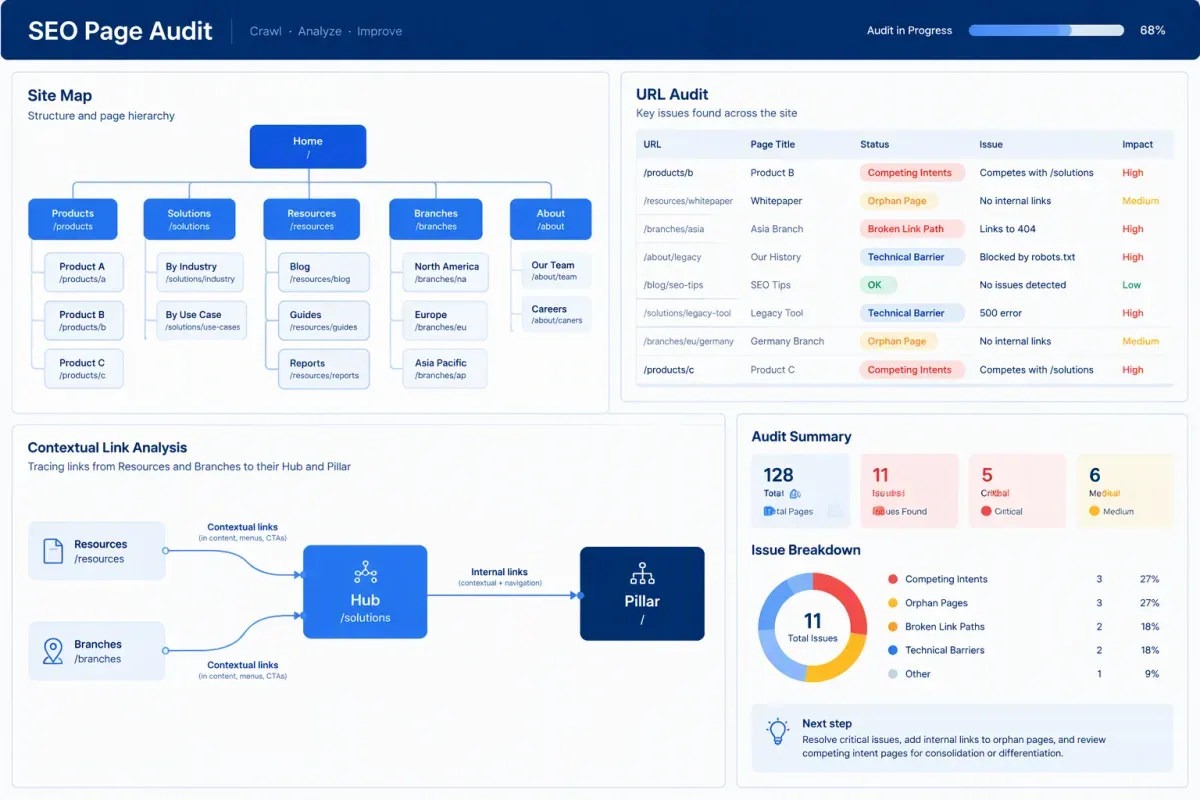
A page audit is how you diagnose AI search visibility decline at the structural level: it tests whether poor hierarchy is actually contributing, instead of assuming it is. For each indexable URL, capture the title tag, H1, slug, meta description, and opening paragraph. Strip navigation, footers, cookie notices, and repeated sidebars before you assign a plain-language subject and search intent. Shared template text makes unrelated pages look alike and blurs entity clarity.
Then compare the structure with your baseline. Segment lost queries, mentions and citations by product category and informational subject, and map each subject to its intended landing page. That separates a hierarchy problem from a decline limited to one product area or query set.
Work through the AI visibility audit in this order:
- Classify each page: Record its subject, search intent, topical scope, and intended Pillar, Hub, Branch, or Resource role. Leave out utility pages, author profiles and off-theme one-offs so they don’t distort the map.
- Find competing intent: Compare titles, H1s, slugs, metadata, and opening answers across similar URLs. Shared keywords alone don’t mean duplication, but conflicting subject signals point to competing pages. Pick the primary page by topical fit and its role as a section index, then mark the others as keep, optimize, consolidate, or prune.
- Trace link paths: Follow contextual links from supporting pages to their Pillar, Hub and service pages. Anchors should describe the destination, and link direction should lead readers and crawlers up toward the broader parent. Flag orphan pages, broken links, weak hubs, missing parents, and important pages buried deep in the click path.
- Verify technical eligibility: Check indexability, crawl access, canonical URLs, duplicate versions, rendering, and heading hierarchy. A clean content structure for AI crawlers can’t help a page they can’t retrieve. If ChatGPT visibility matters, confirm that robots.txt doesn’t block OAI-SearchBot.
Floyi’s Content Audit runs this check against your topical map. It classifies each page as Keep, Optimize, Consolidate, or Prune, and its cannibalization workflow resolves competing pages with Make Primary, Redirect, Reassign, or Keep Separate.
Map Pages to Pillar, Hub, Branch, and Resource
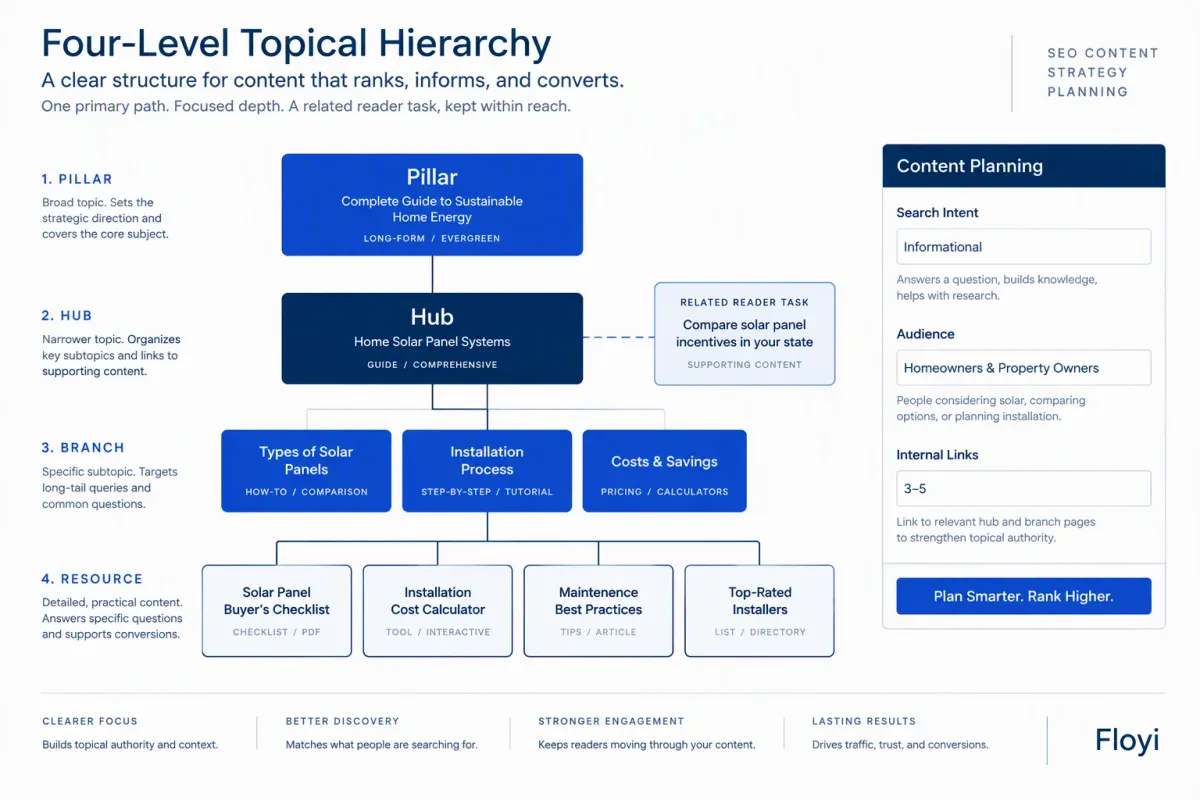
Map each page to one level of a Pillar, Hub, Branch, and Resource model, and treat that model as a set of decisions rather than a rigid URL tree. It makes content organization for AI search legible to readers and AI systems, and it still lets a Resource support more than one area when the reader’s task overlaps.
Start with authority anchors grounded in your expertise, offerings and topical scope. Each Resource gets one primary home, because one page per intent stops pages from competing to answer the same question.
Each level has a distinct job:
- Pillar: Sets a broad subject area and its business relevance.
- Hub: Works as one of the topic hubs that introduce a sub-area and route readers toward the right decision.
- Branch: Groups closely related choices, use cases or service paths.
- Resource: Answers a focused question, provides evidence or supports a specific task.
Define each Resource before you place it: its primary audience, search intent, job to be done, unique question, and logical next step. An implementation guide for practitioners shouldn’t compete with a service-evaluation page for buyers. Its title, H1, slug, meta description, and opening copy should state that role instead of leaning on shared navigation.
At the top level, pillar pages that AI engines can parse give readers an entry point that hub pages and focused Resources build on.
Contextual links can run sideways when tasks genuinely overlap. A comparison Resource can support a related use-case Branch without becoming its second parent. Forced trees hide those connections in site architecture for AI search, which is why the map needs both parent-child content relationships and sideways links.
Connect educational Resources to commercial pages only when that path helps the reader. A guide can lead to a relevant service or solution Branch, and service pages can link back to explanatory proof.
In Floyi’s Authority Planner, each topic carries its search intent, funnel stage and internal links. When you generate a brief, the Internal Links step lets you lock in the exact anchors before the draft agents run, so the planned hierarchy reaches the draft. Compare AI Authority in the Topical Authority Scorecard before and after structural changes, then use what gets named and cited to refine the next map.
Compare a Before-and-After Site Structure
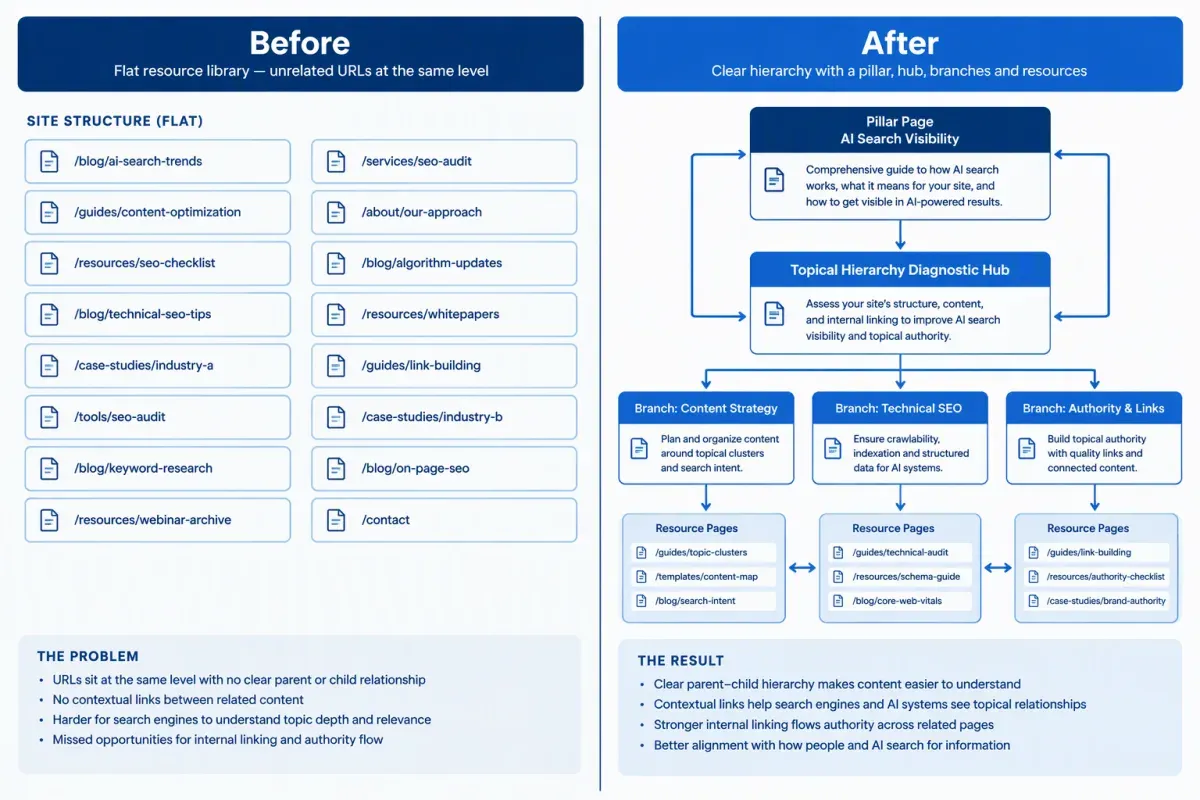
Side by side, a flat resource library hides which page holds authority and where each task belongs, while a mapped SEO site structure makes both visible. In the flat version, guides to AI search visibility, visibility audits, citation tracking, and unrelated product content all sit at the same level, with no topical path between them.
- Before:
/resources/ai-search-visibility/,/resources/visibility-audit/and/resources/citation-tracking/sit beside unrelated pages with no framing page or logical next step. - After:
/ai-search-visibility/is the Pillar, and/ai-search-visibility/topical-hierarchy/is the diagnostic Hub. Branches under that Hub cover the topical audit, link repair and citation measurement. Contextual links send readers back to the Hub or on to the next task.
This is information architecture for SEO applied to topics. Pillar pages and topic clusters only help when each page has a distinct job. A flat library makes every URL look equally important. A clear content hierarchy for SEO and AI search shows how narrow questions support the broader subject, so no single guide has to answer everything.
More URLs don’t create complete topical coverage, but don’t collapse distinct intents either. Keep a conceptual overview separate from a step-by-step repair workflow, and keep pages that serve different audiences, questions or buying stages.
Record the target structure in a table like this one, so the repair is measurable:
| Page | Level | Parent | Primary intent | Link path |
|---|---|---|---|---|
| AI search visibility | Pillar | None | Conceptual overview | Linked from the homepage and main navigation |
| Diagnosing hierarchy | Hub | AI search visibility | Diagnose hierarchy | Up to the Pillar, down to each Branch |
| Topical audit | Branch | Diagnosing hierarchy | Audit workflow | Up to the Hub, sideways to link repair |
| Link repair | Branch | Diagnosing hierarchy | Repair links | Up to the Hub, sideways to measurement |
| Citation measurement | Branch | Diagnosing hierarchy | Measure citations | Up to the Hub |
Floyi’s Topical Audit shows the topical structure your site has now. It groups up to 5,000 pages into a pillar, hub and branch hierarchy, identifies the main page for each topic and names the topic a weak topic competes with. Set that discovered structure beside your intended map before you repair links and competing intents.
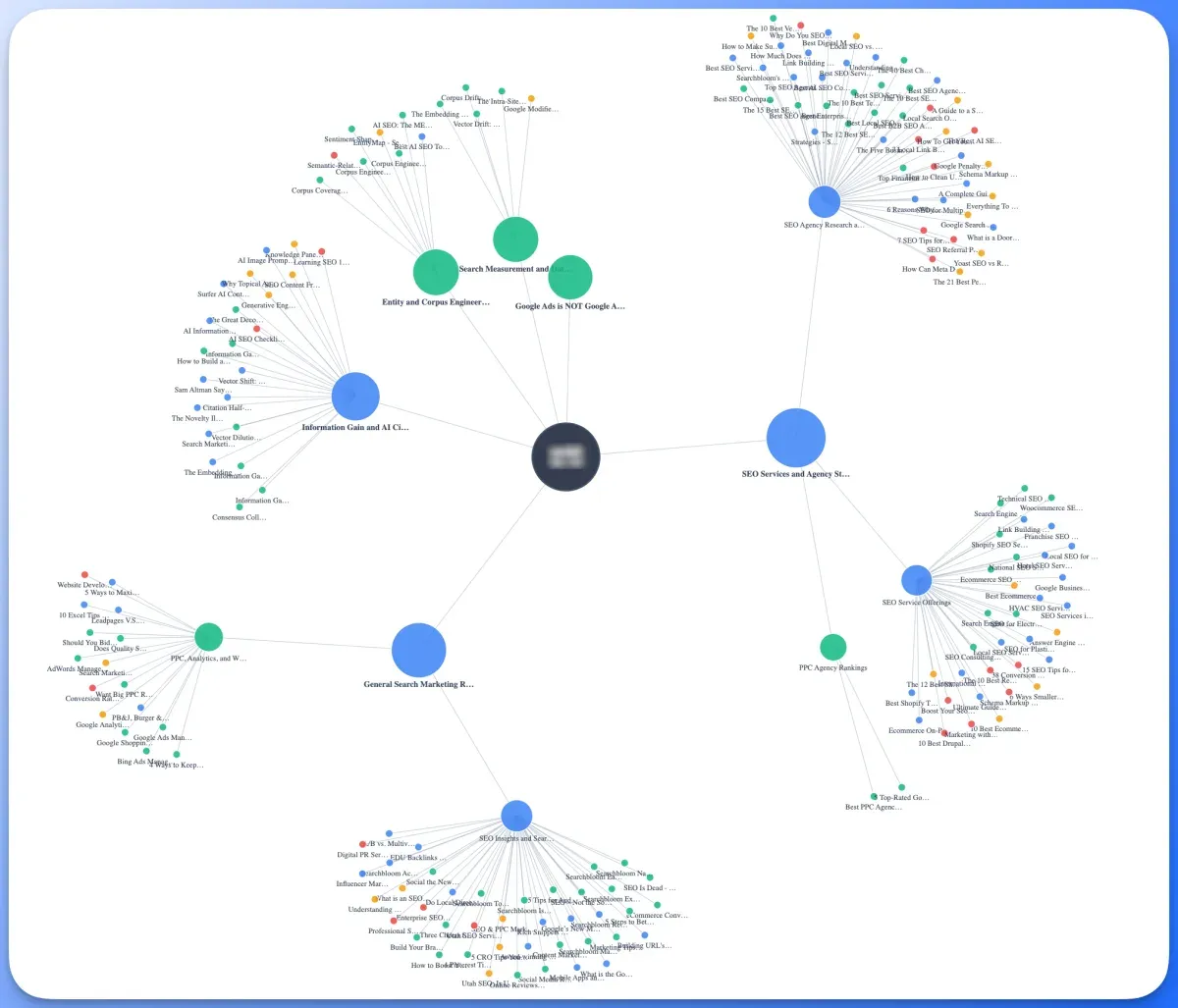
Repair Links and Competing Page Intents
Repair broken links first, then resolve competing page intents, so readers and search systems reach one right page for each question.
Broken paths, orphaned priority pages and buried URLs weaken an otherwise sound internal linking strategy.
Work through repairs in this order:
- Fix broken paths: Point links to removed, redirected or irrelevant URLs at the most useful live page.
- Surface priority pages: Add contextual internal links to orphaned or buried Hub and Branch pages that serve a defined reader task.
- Name the destination: Use anchors such as “technical SEO audit workflow” instead of vague calls to action.
- Reinforce the hierarchy: Link Resource and Branch pages up to their Hub or Pillar when that route helps readers continue the task. Add a return link only when it has a clear purpose.
Keyword cannibalization is an intent conflict before it’s a consolidation decision. Two URLs can rank for related queries without competing when one serves an informational need and the other a commercial or navigational one. The problem starts when both pages try to answer the same question with nearly identical positioning.
Compare overlapping pages on the signals that define their role:
- Page definition: The title, H1, URL, meta description, and opening answer.
- Query fit: Whether they target distinct query sets or the same search intent.
- Conversion role: Whether one is a product page and the other an educational guide, even on the same subject.
- Existing evidence: Which URL has clearer query fit, stronger performance and more relevant supporting links.
One page per intent is search intent alignment at the site level, and it keeps relevance signals from splitting across near-duplicates. When one URL is clearly the stronger page, keep it, point contextual links at it and use a canonical tag where it fits. When neither page has a distinct role, merge the strongest material into one focused URL and redirect the weaker page.
To check the result, switch the Authority Planner’s search to URL mode. It lists the ranking and cited URLs from your hierarchy data, so you can see whether rankings and AI citations now land on the page assigned to each topic. Use what you find to pick the next repair.
Measure Mentions and Citations After Repair
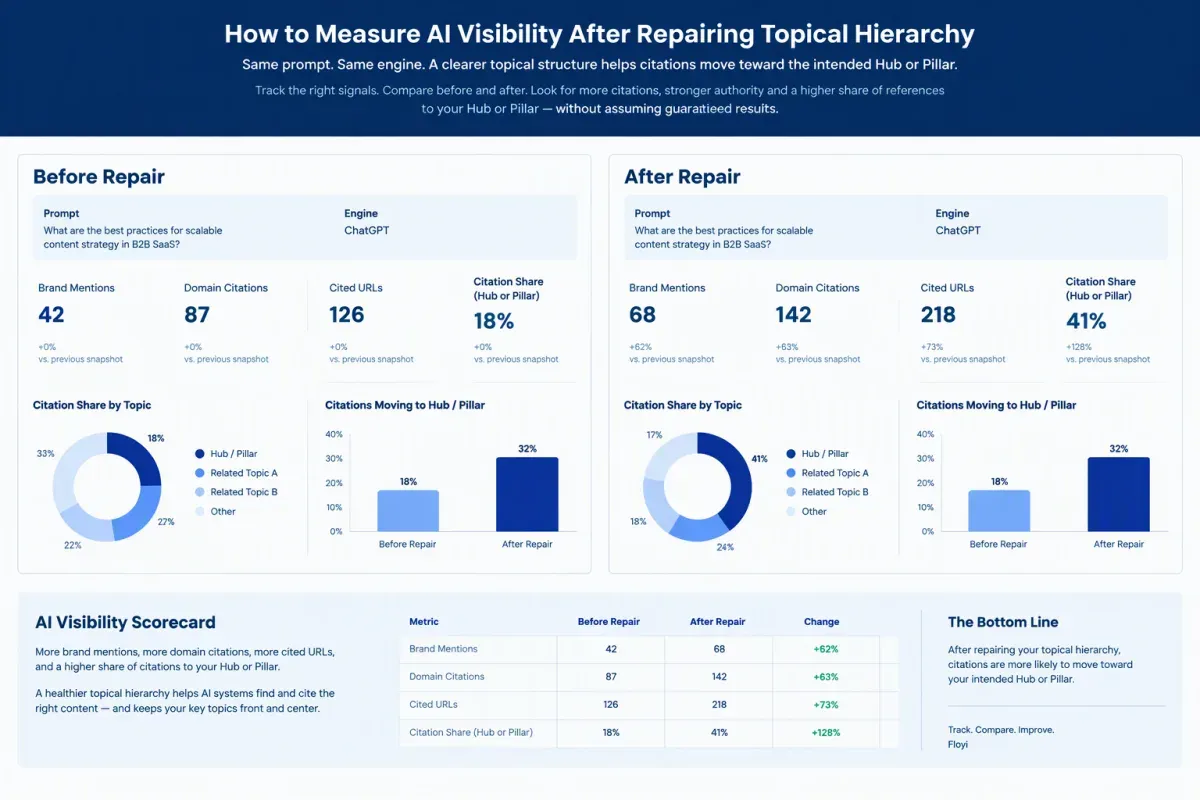
Rerun the identical prompt set after each repair, so changes in AI search citations rest on comparable evidence rather than screenshots. Use the same engines, the same prompts and the same number of runs per prompt. Record brand mentions, domain citations, cited URLs, and competitor domains in separate fields.
Floyi’s AIRS Analyzer gives you an on-demand snapshot of one query across 11 surfaces: nine AI engines plus Google and Bing search results. It doesn’t track visibility over time, so run it before the repair and again after, with the same prompt wording, and compare the two snapshots. Treat a change in citations as a reason to investigate, not as proof the repair worked.
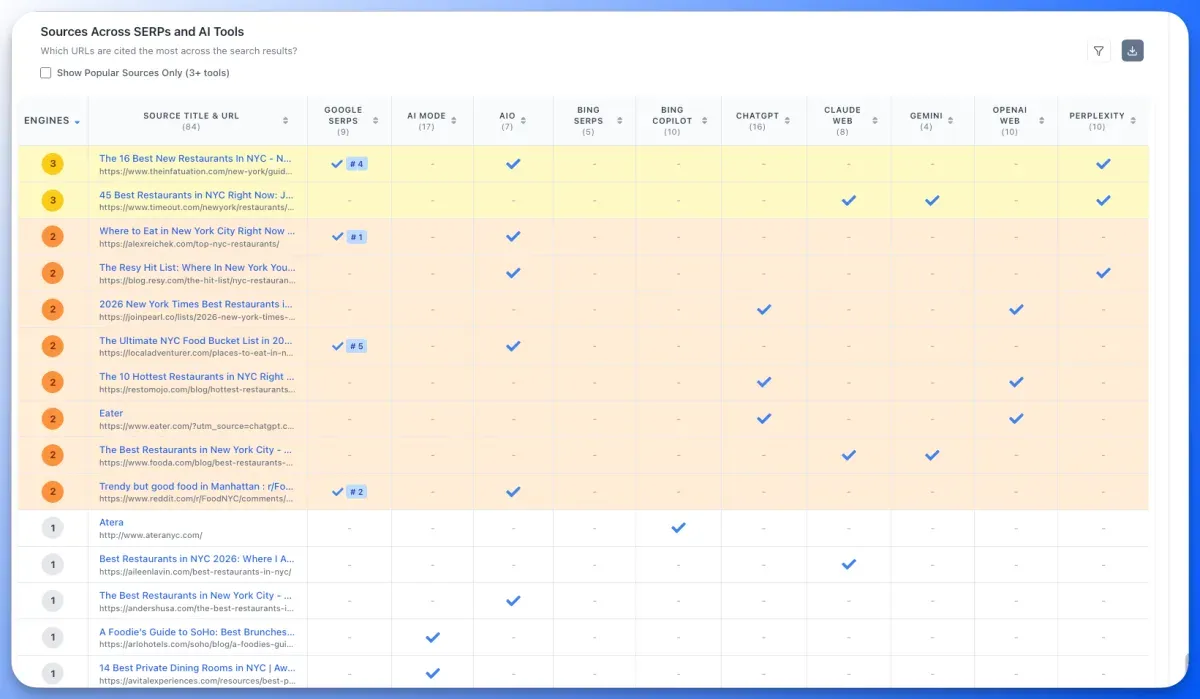
Keep the repaired Pillar, Hub, Branch, and Resource relationships in each record of a topic-level scorecard:
- Check details: The week, engine, query, and topical scope.
- Answer evidence: The intended page URL, answer presence, brand mention, domain citation, cited domains, citation share, and share of voice.
- Change context: Dated notes on model updates, content releases, seasonality, and site changes.
Compare that citation evidence with topic-level Search Console impressions and clicks, referral traffic and assisted conversions. A rise or fall in organic clicks doesn’t establish a matching citation change. The stronger pattern is alignment: citations move to the intended Hub or Pillar while organic visibility and conversions move with them.
Set the observation window before you collect follow-up data, then recheck on a fixed cadence. Similar unrepaired pages with the same intent and audience make useful controls, especially when a model update or seasonal shift could explain early movement.
Schema markup for AI search supports the hierarchy but doesn’t replace it. BreadcrumbList and CollectionPage markup can state parent-child relationships, and Article or TechArticle markup can state a page’s role. Clear copy and structured content still carry the hierarchy, so check markup, page role and link direction together when cited URLs change.
Your next repair needs a target structure. Plan your target hierarchy in Floyi by mapping every Pillar, Hub, Branch, and Resource before you change a link, then rerun your prompt set to see whether citations follow.
Topical Hierarchy and AI Visibility FAQs
These questions cover how poor topical hierarchy affects AI search visibility in specific cases: competing pages, orphan content and unclear links between levels.
1. Can Google Rankings Hide AI Visibility Loss?
Yes. A page can rank well in Google and still earn little AI visibility, because search position and selection as answer evidence are different decisions. An AI system may also mention your brand without citing your page.
Disjointed pages can still rank on relevance and authority signals. AI retrieval also weighs page quality, crawlability, query fit, source authority, and competing sources. Repairing hierarchy can improve citation eligibility, but it can’t guarantee inclusion in an AI answer.
2. How Do You Tell a Hierarchy Problem From an Authority Problem?
Check whether the right pages exist and connect. If they exist but cannibalization, orphan pages, weak links, or unclear parent-child relationships keep them from supporting the Hub, it’s a hierarchy problem, so fix the structure first. If the site is clean and connected but its pages still aren’t named or cited in AI answers, it’s an authority problem. Put evidence and external trust signals ahead of more restructuring.
3. Do Orphan Pages Reduce AI Citations?
They can. Orphan pages are harder for crawlers and AI retrieval systems to find and interpret, because no internal path connects them to a relevant Hub, parent page or supporting context. That isolation also weakens the page’s contribution to your topical scope.
Orphan status alone doesn’t prove why a page lacks an AI citation. The page still needs a direct, well-evidenced answer and enough trust signals. Link it from its most relevant parent and supporting pages with anchor text that describes its subject.
4. Can Duplicate Intents Split AI Mentions?
They can. Duplicate intent, or keyword cannibalization, happens when pages target the same query and audience without a clear distinction. Impressions split between them, and AI systems are left without one unambiguous page to mention or cite.
Before you consolidate, compare each page’s primary question, audience segment and buyer stage. Keep a beginner explainer separate from an advanced implementation guide when their purposes differ, then make the relationship clear through positioning and links.
About the author

Yoyao Hsueh
Yoyao Hsueh is the founder and CEO of Floyi, the topical authority platform, and the founder of Main Heading, an SEO and AI search agency. He is an expert in topical authority and topical mapping. He created Topical Maps Unlocked, a course studied by thousands of SEOs, content strategists and digital marketers, founded TopicalMap.com, a done-for-you topical mapping service for agencies and enterprise teams, and publishes the weekly Digital Surfer newsletter on SEO, content strategy and AI search.
About Floyi
Floyi is a closed loop system for strategic content. It connects brand foundations, audience insights, topical research, maps, briefs, and publishing so every new article builds real topical authority.
See the Floyi workflow