AI Search vs. Traditional SERP Performance: Diagnose the Gaps
A page can rank on Google and never get cited in AI answers, or get cited without ranking. Compare both sets of metrics, see why they split and fix each case.
A page can hold a top organic position and never get cited in an AI answer, while another page gets cited and ranks nowhere. Measuring AI search performance vs. traditional SERP performance means comparing two different events. Rankings show whether a page earns exposure and clicks. AI answers show whether an engine names your brand or cites your URL.
Adding those signals into one visibility total hides the fix. Keep named mentions apart from citations, then sort each query into one of four cases: ranks and cited, ranks but not cited, cited but doesn’t rank, or neither. Each case points to a different edit, and the diagnosis protects what already works.
AIRS Analyzer handles the per-query read. It runs one query on demand across 11 surfaces (9 AI engines plus Google and Bing SERPs) and counts AI citations apart from organic rankings.
AI Search vs. SERP Performance Key Takeaways
- Traditional SERP metrics record rankings, impressions and clicks, while AI search metrics record named mentions and cited URLs.
- Keep mentions and citations separate, because an engine can name your brand without linking to you.
- Sort every tracked query into one of four cases before you edit anything.
- A page that ranks but isn’t cited usually lacks a quotable answer or misses a sub-question the engine generated.
- A page that’s cited but doesn’t rank has retrieval value for a narrower question, not the head query.
- Mentions without clicks are hypotheses to check, not proof that an AI answer caused a traffic change.
- Record the ranking URL and the cited URL first, then edit additively so you don’t trade one signal for the other.
How Do SERP and AI Search Metrics Differ?
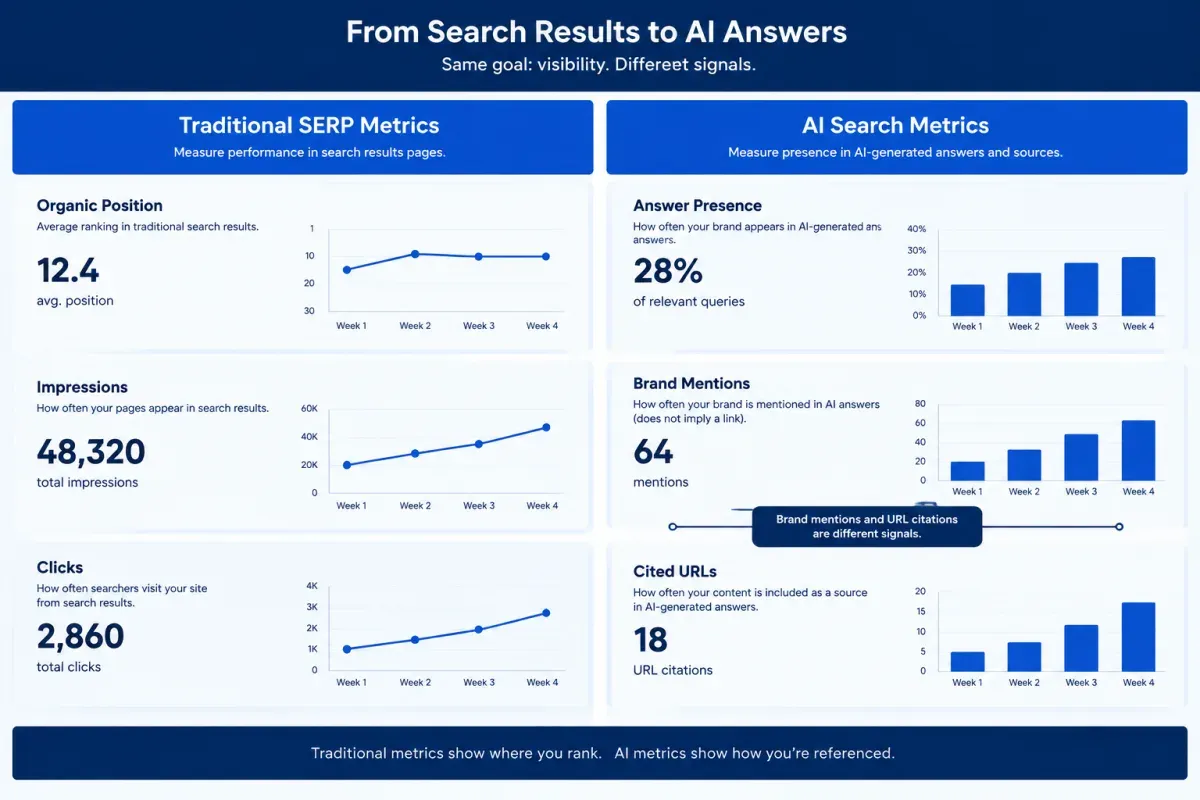
Traditional SERP metrics measure whether a ranked page earns exposure and clicks for a query. AI search performance metrics measure whether an engine names your brand or cites your URL inside a generated answer. They record different events, so one can’t be converted into the other, and a gap between them is a diagnostic signal rather than a reporting error.
| Question | Traditional SERP | AI search |
|---|---|---|
| Are you visible? | Organic position and impressions | Answer presence by engine |
| Who gets credit? | The ranking URL | The cited URL, which can be a different page from the one that ranks |
| Is the brand named? | Branded queries and SERP features | Named mentions in the answer text, with or without a link |
| Competitive share | SERP share of voice | AI share of voice among named or cited brands |
| Does it produce visits? | Organic clicks and click-through rate | Identifiable AI referral sessions |
| Where does the data come from? | Search Console, Bing Webmaster Tools and rank tracking | Sampled answers recorded by engine |
Brand visibility in AI answers comes in two forms. A mention names your brand without crediting a source. A citation links a specific URL. Keep the two apart, and never merge SERP positions and AI search citations into one “visible in N places” figure, because a strong ranking can hide a missing citation.
The two sets split because they score different things. A ranking evaluates a whole page against one query. An AI engine often rewrites a prompt into several sub-queries (query fan-out), retrieves passages for each and picks a source claim by claim. Engines don’t publish citation rules, and each runs its own retrieval, so Google AI Overviews, AI Mode, ChatGPT, Gemini, and Perplexity can cite different sources for the same prompt.
This article diagnoses where the two sets disagree. Prompt-set building, sampling and benchmarking belong to the full AI search measurement framework. Turning these signals into SERP KPIs and AI-search KPIs belongs to AI search ROI and KPI planning.
How Do You Find Where Rankings and Citations Diverge?
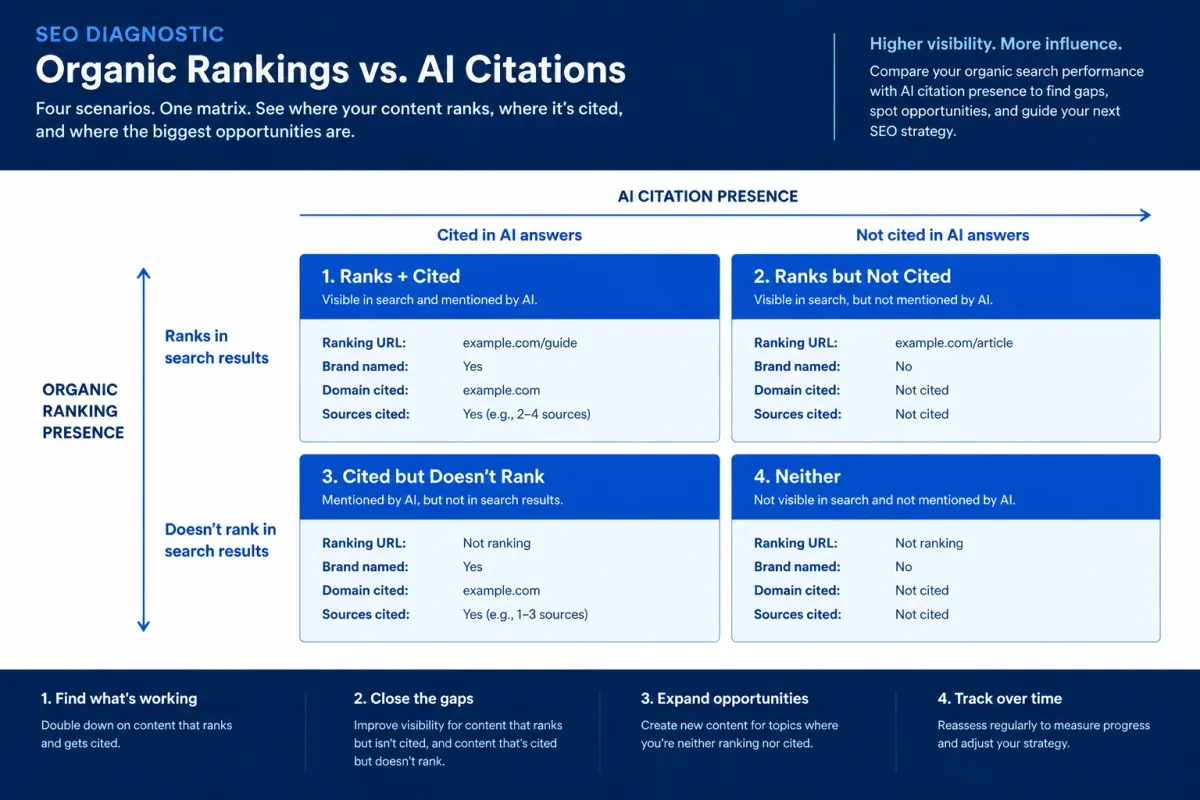
Pair each query’s organic position with what each AI engine did with your brand and URLs, then sort the query into one of four cases. Work from the query or prompt set you already benchmark rather than building a new one.
Match intent before you pair. A tracked keyword and a conversational prompt can use different wording, but they must test the same buyer need. A commercial keyword about content planning software should pair with a prompt asking which platform fits that purchase, not with a broad content marketing question.
Record these fields per query and per engine, each in its own column:
- Organic position and ranking URL: Your Google and Bing positions and the page that ranks.
- Brand named: Whether the answer text names your brand.
- Domain cited: Whether a URL on your domain is cited, and which one.
- Sources cited instead: The domains the engine chose over yours.
Search Console confirms organic search visibility through clicks and impressions, but it can’t show whether an AI answer named or cited you.
| Case | What you see | What it usually points to | First check |
|---|---|---|---|
| Ranks and cited | The page ranks and an AI answer cites it. | Organic relevance and AI sourcing align. | Protect the ranking page and the cited passage. |
| Ranks but not cited | The page ranks, but AI answers cite other sources. | A citation gap. The page is relevant but isn’t the source engines quote. | Compare the cited pages’ evidence, structure and entity coverage with yours. |
| Cited but doesn’t rank | An AI answer cites your page, but it ranks low or not at all. | A ranking gap. The content is useful, but the page isn’t competitive for the head query. | Decide whether the cited page should target the query or support it. |
| Neither | No meaningful ranking or citation appears. | A coverage gap. The page may be missing, off-intent or too thin. | Confirm the query belongs in your topical scope. |
One split looks like a gap but isn’t. An engine may cite a different page on your domain from the one that ranks. Record the cited URL before you change either page, because the fix is deciding which page should own the query, not rewriting both.
AIRS Analyzer gives you this read one query at a time. It counts AI citations apart from organic rankings, lists Most-Cited URLs with your own pages flagged and shows Citation Patterns that pair an observed pattern with a recommended action. Each run is an on-demand snapshot, not tracking over time. At topic level, the Organic Audit’s Priority view lists topics that rank in Google but aren’t present in AI Overviews, AI Mode, ChatGPT, or Gemini.
AI answers vary between runs, so confirm a split repeats before you act on it.
Why Does a Page Rank but Not Get Cited?
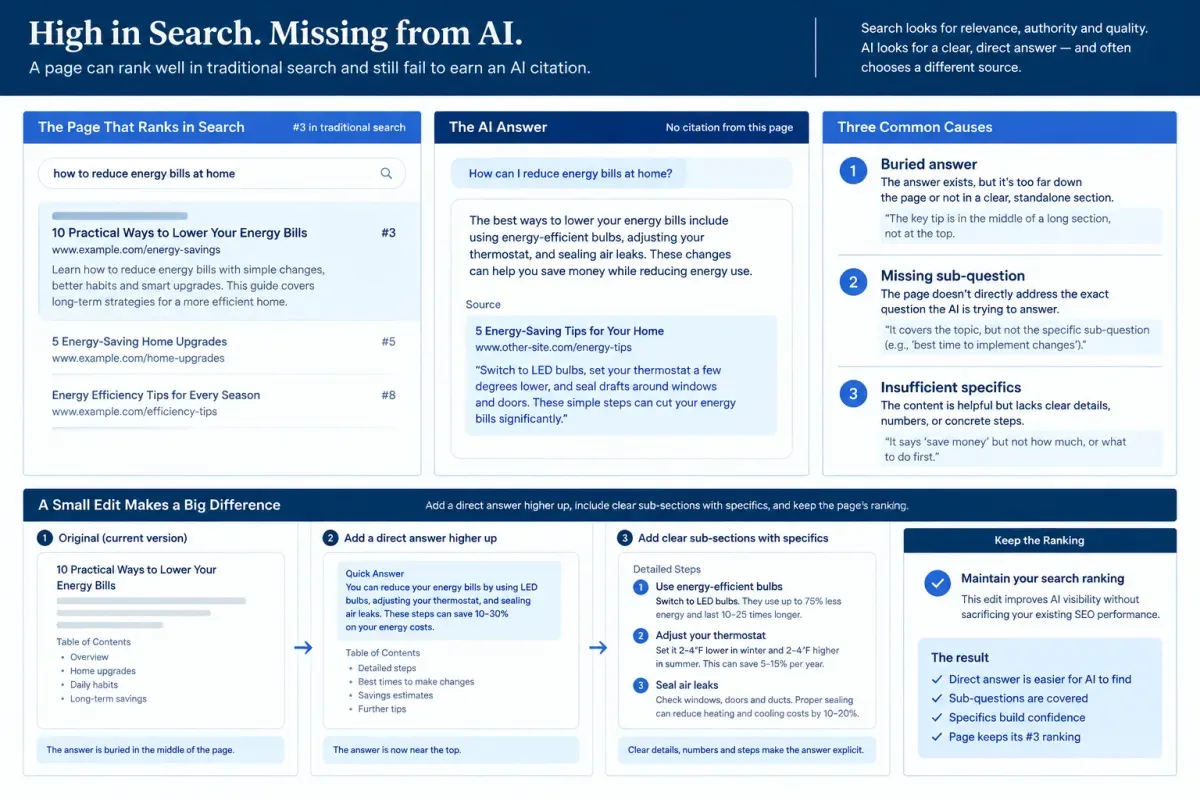
A ranking says the page is relevant to the query as a whole. A citation needs a passage an engine can lift to support one specific claim. Ranks but not cited usually means the page is relevant but not quotable, or the engine went elsewhere for the sub-questions it generated.
These causes are observed patterns, since engines don’t publish citation rules:
- The answer is buried: The useful statement sits below context, is spread across paragraphs or only makes sense with the surrounding copy.
- A sub-question is missing: The engine wanted a definition, comparison, step, limit, or exception your page doesn’t cover.
- Cited pages carry more specifics: They offer a precise definition, a named entity, a worked example, or a sourced figure.
- The engine prefers another source type: For some prompts, review sites, forums and publisher roundups appear ahead of brand pages.
- AI crawlers can’t read the page: Some engines crawl separately from Google. A robots.txt block or key text loaded only through JavaScript can keep a relevant page out.
Work the fix in this order:
- Compare the cited pages with yours. Check answer placement, sub-questions covered, specifics, and source type.
- Add a direct answer at the top of the relevant section. Put it next to the claim it supports.
- Cover the missing sub-questions. Give each one its own clearly headed section.
- Add the specific facts or examples the cited pages use. Source every one of them.
- Confirm AI crawlers can reach the page. The main text should be in the HTML, not loaded by script.
For step 1, AIRS Analyzer’s Most-Cited URLs table lists the pages to compare, and its Strategic Summary shows query fan-out.
Some gaps are off-page. If engines cite third-party sources rather than any brand page, rewriting your page won’t help. The work is earning accurate mentions in the publications, review sites and communities those engines already trust.
Edit additively so citation work doesn’t strip out what earns the ranking. Then rerun the same query to see whether the citation appears and the ranking holds.
Why Does a Page Get Cited but Not Rank?
Engines cite passages, not pages. A page that ranks low, or not at all, for the tracked query can still hold the clearest answer to one sub-question the engine generated. Cited but doesn’t rank means the content is useful but the page isn’t competitive for the head query.
The usual causes, again observed rather than published:
- Narrower match: The page ranks for a specific sub-query, not the broader tracked phrase.
- Different retrieval: The engine draws on its own index or search backend rather than Google’s organic results.
- Distinctive evidence: The page has a definition, data point or original example that competing pages lack.
- Weak page signals: The page is new or has few internal links, so it hasn’t built ranking signals yet.
- Format mismatch: A single how-to answers one generated question well, while the SERP for the head query rewards full guides.
Read the AI answer before you count citations. Find the claim your page supports and the sub-question it answers, then compare the page’s scope and format with what ranks for the head query. In AIRS Analyzer’s Source Comparison view, the comparison matrix puts Google and Bing SERP columns beside each AI engine, and rows on your own domain are marked. You can see which of your pages are cited and whether they also rank.
Then pick one of two paths:
- The page should own the head query. Close the ranking gap with the format and depth the SERP rewards and headings that reflect the query. Add internal links from related pages, and cover the subtopics ranking pages include.
- The page fits a narrower intent. Keep it as the cited answer. Build or strengthen the page that should rank for the head query, and link the two.
Protect the cited passage on either path. Rewriting it for rankings can remove the clarity that earned the citation.
What Do Mentions Without Clicks Tell You?
Mentions without clicks show AI visibility that isn’t turning into visits. Crediting revenue to that visibility is a separate job, covered in attributing revenue to AI search. A brand can gain visibility in AI answers and get no traffic, or keep its rankings while clicks fall. Read each pattern as a hypothesis to check, not proof that an AI answer caused the change.
- Named but not cited: The answer names your brand but credits another source for the claim, so there’s nothing to click. Check which domains the engine cited. The fix usually looks like the ranks-but-not-cited case, because the engine knows your brand but quotes someone else’s page.
- Cited but few visits: The answer may resolve the question in place. The link may also sit in a source list rather than next to the claim, or the prompt may not need a visit at all. Compare where the citation appears before you rewrite the page.
- Stable rankings, falling clicks: In Search Console, check whether impressions held while click-through rate dropped, and whether the query now shows an AI Overview or another SERP feature. Per Google’s Search Console documentation, a click on a link in an AI Overview or AI Mode counts as a click. Both features report in the Performance report under the Web search type, so the change lands in the same report as the ranking. The Organic Audit’s Priority view flags topics whose click-through rate falls below average for their position.
- Branded demand rising: Branded searches or direct visits may climb after AI visibility grows. Campaigns, seasonality, news, and ranking changes can produce the same pattern, so treat it as a demand hypothesis rather than a result.
Recheck the same queries after each fix to see whether a split closes or persists. For monitoring AI search visibility, Floyi’s Topical Authority Scorecard measures and trends brand visibility, share of voice and AI citations over time. Its AI data covers AI Overviews, AI Mode, ChatGPT, and Gemini. The Topics Gained & Lost view shows which topics entered or dropped out between refreshes. Floyi doesn’t attribute conversions or revenue, so it tells you whether the visibility side moved, and your analytics tell you whether visits followed.
To watch both sides of each split move after your fixes, track visibility in the Topical Authority Scorecard.
AI Search vs. SERP Performance FAQs
These questions cover why a top ranking doesn’t guarantee an AI citation, why engines cite different pages for one query and which gap to fix first.
1. Does a Top 10 Ranking Mean AI Engines Will Cite Your Page?
No. A ranking shows the page is relevant to the query as a whole. AI engines pick sources passage by passage, often for sub-questions they generate from the prompt, so a lower-ranking page can win the citation by answering one sub-question more directly.
Google’s documentation covers the Google side. To appear as a supporting link in a Google AI Overview or AI Mode, a page must be indexed and eligible to appear in Search with a snippet. Being in Search is a precondition there, not a guarantee of a citation. Other engines run their own retrieval.
2. Why Do AI Engines Cite Different Pages for the Same Query?
Each engine runs its own retrieval. It may draw on a different index, rewrite the prompt into different sub-queries and weigh source types differently. Answers also vary from run to run, so a citation in Google AI Overviews says little about ChatGPT, Gemini or Perplexity for the same query.
Report AI visibility by platform, one engine at a time. When one engine cites you and another doesn’t, compare the sources the second engine chose before you change the page.
3. Which Metric Matters More When Rankings and Citations Disagree?
Neither wins by default. Start with search intent analysis, and weight the signal that matches what the query should do for the business. When the reader has to visit a page to act, as with most Transactional and many Commercial queries, rankings and click-through rate carry more weight. When the answer itself resolves the need, as with many Informational and Generative queries, being named and cited matters more.
Navigational queries for your own brand are an accuracy check. Whether the AI answer describes your brand correctly matters more than position. Judge by persona intent and business value, never by search volume.
4. Should You Fix Ranking Gaps or Citation Gaps First?
Start with the topics that matter most to your buyers, then take the smallest fix first. A page that ranks but isn’t cited usually needs additive edits, such as a direct answer, missing sub-questions or specific facts. A page that’s cited but doesn’t rank needs ranking work, such as intent match and internal links. A topic with neither usually needs a new or rebuilt page.
About the author

Yoyao Hsueh
Yoyao Hsueh is the founder and CEO of Floyi, the topical authority platform, and the founder of Main Heading, an SEO and AI search agency. He is an expert in topical authority and topical mapping. He created Topical Maps Unlocked, a course studied by thousands of SEOs, content strategists and digital marketers, founded TopicalMap.com, a done-for-you topical mapping service for agencies and enterprise teams, and publishes the weekly Digital Surfer newsletter on SEO, content strategy and AI search.
About Floyi
Floyi is a closed loop system for strategic content. It connects brand foundations, audience insights, topical research, maps, briefs, and publishing so every new article builds real topical authority.
See the Floyi workflow