AI Search Trends and What They Mean for SEO in 2026
Explore 2026 AI search trends and build a governed topical-authority roadmap to prioritize citations, measure visibility, and guide SEO and GEO.
First-page rankings no longer tell the whole visibility story in 2026. AI search trends mean SEO must measure whether a brand is mentioned or cited as answer engines assemble responses, not only whether a URL earns a click. GEO prepares evidence-rich, extractable claims for that second form of discovery.
AI Overviews appeared in 13.1% of searches in March 2025, up from 6.49% in January, while Pew Research Center found lower link-clicking when summaries appeared. A repeatable operating sequence starts with four checks across answer environments, then scores cross-engine citation gaps and maps priority work into Pillar, Hub, Branch, and Resource pages.
Rankings, citations, mentions, referral quality, and assisted conversions need separate reporting because each reflects a different constraint. Use a fixed weekly prompt set and Floyi’s AIRS Analyzer to identify the evidence gap, publish the right asset, and measure whether answer presence improves.
AI Search Trends for SEO Key Takeaways
- AI search visibility includes rankings, brand mentions, citations, referral quality, and assisted conversions.
- SEO and GEO work together to support conventional rankings and answer-engine source selection.
- AI Overviews appeared in 13.1% of searches in March 2025.
- Answer engines select passages claim by claim, not one universal winning page.
- Track citations separately from unlinked brand mentions across each relevant engine.
- Prioritize prompts with high business value, low presence, and addressable evidence gaps.
- Measure a fixed weekly prompt set before and after publishing changes.
Which AI Search Trends Will Shape 2026?
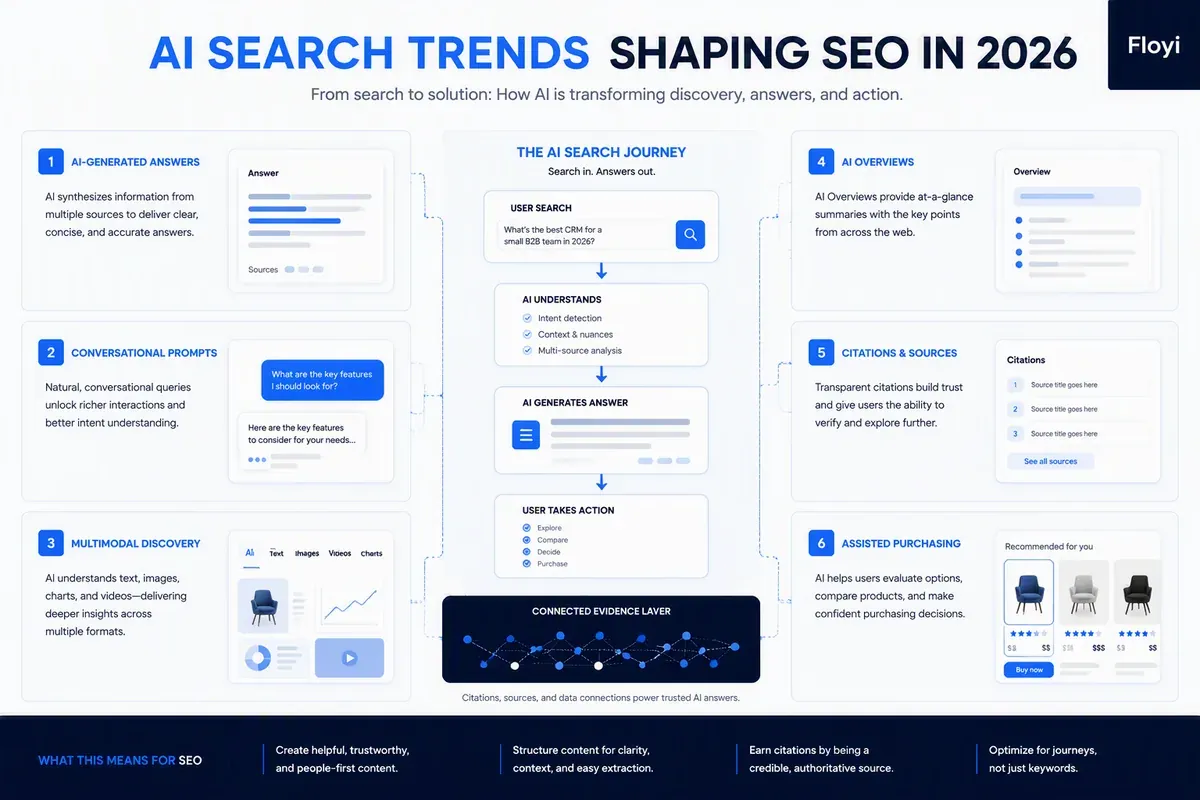
AI search trends 2026 move visibility beyond rankings and clicks. Artificial intelligence (AI) search systems synthesize sources into direct answers and buying journeys, making brand mentions, third-party citations, and share of voice meaningful before a prospect reaches your client’s site.
Search Engine Optimization (SEO) and Generative Engine Optimization (GEO) form one authority workflow. SEO supports conventional search visibility, while GEO prepares clear, verifiable material for AI systems to select, summarize, and cite. The AI search optimization landscape requires visibility assessment across Google results and standalone answer engines, because a first-page ranking alone does not confirm inclusion in an AI response.
Conversational search changes the input. Users ask scenario-specific prompts that combine research, constraints, comparisons, timing, and desired outcomes instead of issuing several short keyword searches. Pew Research Center puts ChatGPT use at 58% among U.S. adults under 30, and a Commerce and Future Commerce survey found about a third of Generation Z now prefer AI platforms for product research. Comprehensive coverage built around audience questions, buying stages, and use cases fits these prompts better than isolated pages targeting a single phrasing.
Multimodal discovery also changes what qualifies as useful evidence. Searchers use text, images, voice, and video to identify products, diagnose problems, and evaluate options. Google Lens processes close to 20 billion visual searches each month, while Circle to Search queries reportedly tripled over one year. Product, service, and instructional assets need interpretable visuals, explicit entity details, and evidence-rich copy that explains what an image or video demonstrates. An unlabeled image may help a shopper, but it offers an answer engine little dependable context.
AI Overviews are the most immediate visibility shift across many client portfolios. Semrush and Datos measured an appearance rate rising from 6.49% of searches in January 2025 to 13.1% in March 2025, especially for complex, instructional, comparison, and information-dense queries. Google reported in May 2025 that more than 1.5 billion people worldwide used AI Overviews. Exposure forecasting should account for query type and topical scope before consideration-stage research produces a click.
A practical review of AI SEO trends includes four checks:
- Compare answer environments: Use Floyi’s AIRS Analyzer to inspect domains and sources appearing across search engine results pages (SERPs) and AI engines.
- Separate citations from mentions: A citation links to or references a source selected by an engine. An unlinked brand mention indicates recognition but provides less traceable source credit.
- Test corroboration: Support owned pages with verifiable claims, visible evidence, dates, authorship, and precise entity details. Answer engines may select independent sources alongside your content.
- Map intent variations: Measure priority-brand visibility by audience, use case, and buying stage. The same prompt can return different answers based on user context and preferences.
AI-mediated purchasing is the business consequence. AI answers increasingly influence shortlists, vendor comparisons, and recommended next steps before a site visit. The future trends in AI search favor coverage that matches those evaluation moments and connects answer visibility to qualified visits, assisted conversions, and revenue where available.
How Will Discovery Shift Beyond Clicks?
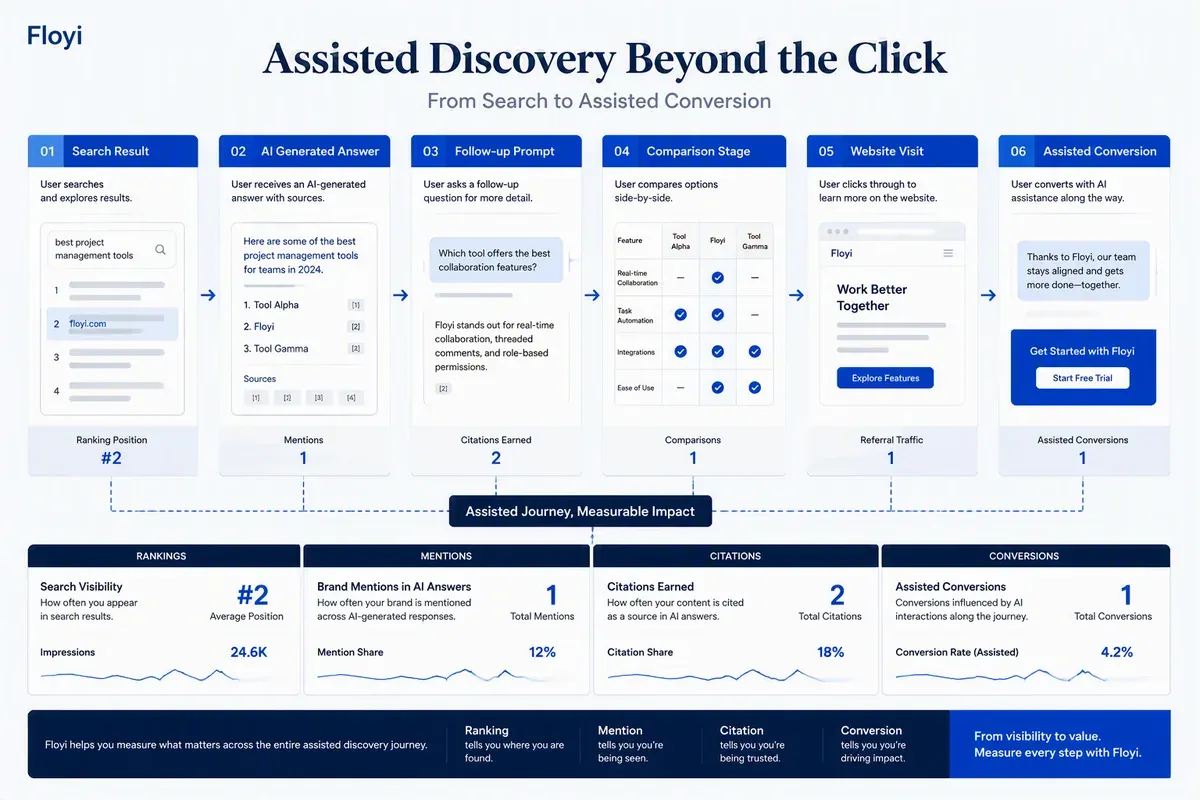
As AI-mediated purchasing reshapes visibility, discovery is an assisted path that can move from search results to AI-generated answers, follow-up prompts, and eventual site visits. A prospect may start with a broad problem, use conversational search to narrow requirements, compare options, and form a preference before opening a client’s site. For agencies, brand visibility means appearing across that research path, not only earning an organic session.
Zero-click behavior changes the value of visibility, but it does not make clicks irrelevant. Amsive reported a 15.5 percent click-through-rate decline for queries that trigger AI Overviews, while Pew found users clicked on 8 percent of searches with summaries, compared with 15 percent without them. Traffic can understate reach when a brand appears in an answer, yet people still visit when they need proof, detailed guidance, pricing, product specifications, tools, or an action page.
Google AI Overviews differ from standalone chatbot experiences. They combine a customized Gemini model with Google’s index, quality and ranking systems, and Knowledge Graph to address questions that might otherwise take several searches. The feature links to supporting web results for deeper investigation, so organic content remains both the evidence base and the destination for higher-intent visitors. Our guide on how AI reshapes ranking systems explains why those systems still shape visibility.
Chat Generative Pre-trained Transformer (ChatGPT), Gemini, and Perplexity serve a different kind of exploratory journey. Within these AI search engines, people can define a problem, add constraints, seek recommendations, compare features, and test an earlier response through follow-up questions. AI search is often used for early-stage questions, and those exchanges can still shape product discovery and purchase decisions (source).
Content should answer the opening question while anticipating the next decision points:
- Lead with a direct answer: State the claim early and show its basis through dated evidence, expert attribution, or first-party documentation.
- Prepare comparison paths: Address the criteria buyers use to distinguish options, including compatibility, implementation demands, service model, and price structure.
- Make claims extractable: Use clear headings, concise explanations, structured data, and source-backed details that an answer engine can select and cite.
Conventional search retains an advantage for known-item navigation, broad result-set exploration, local needs, time-sensitive information, and research requiring direct review of multiple primary sources. SEO earns rankings and qualified visits in those moments. Generative Engine Optimization improves selection and citation in AI-generated answers through clear, evidence-backed, extractable claims.
Reporting should follow the assisted-discovery path rather than treating sessions as the only outcome. seoClarity estimates roughly 20 background searches for every click from an AI search result, making answer presence, brand mentions, AI citation share, and assisted conversions useful alongside rankings and organic traffic.
Assess each client across Google results, AI Overviews, ChatGPT, and the answer engines that matter to its buyers. Connect those surfaces to the visits and conversions that require deeper evaluation, which makes discovery measurable beyond the click.
How Do Answer Engines Choose Sources?
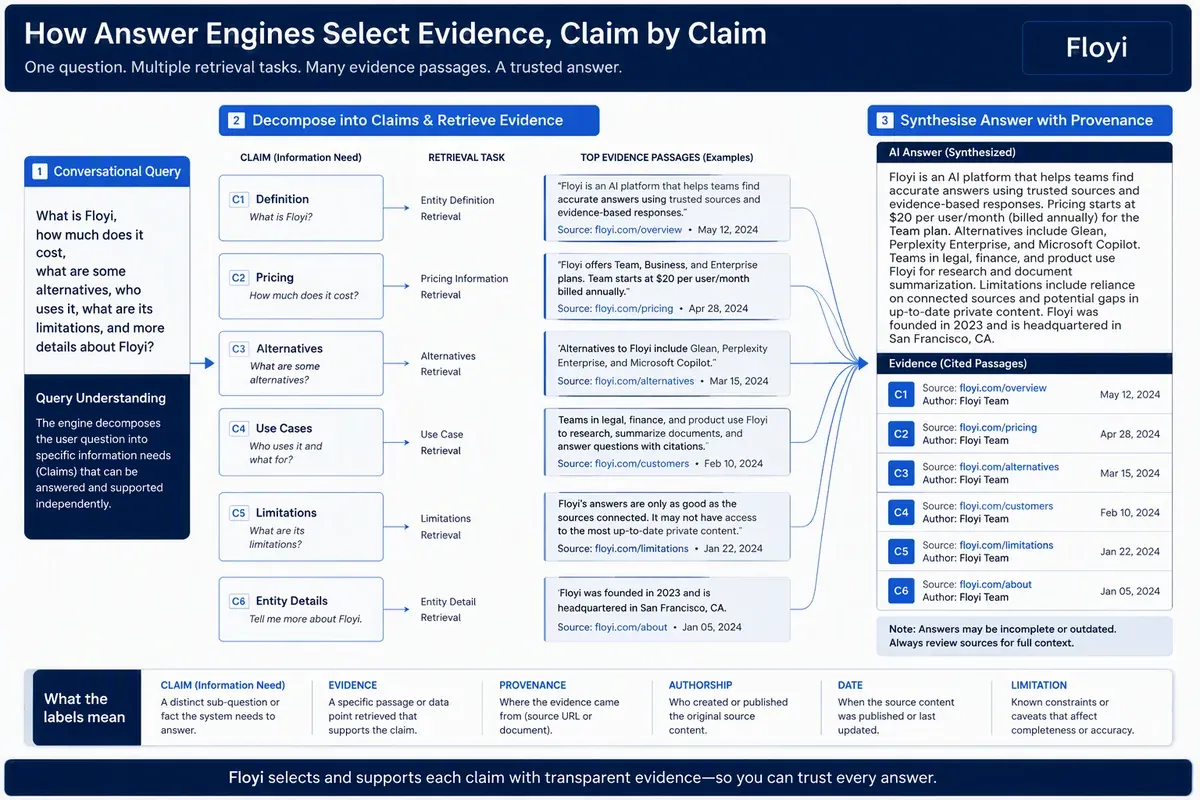
To assess visibility across those discovery surfaces, answer engines select evidence claim by claim, not by naming one universal winner. A single prompt can trigger query fan-out into related retrieval tasks, then systems retrieve passages, test source-to-claim fit, and synthesize AI-generated answers from the evidence that best supports each component.
The same visible question can produce different source sets across major AI search engines:
- Google AI Overviews and AI Mode: Google’s index, ranking signals, and freshness systems shape retrieval.
- ChatGPT and OpenAI Web: Their retrieval and synthesis policies can prioritize different passages or sources.
- Perplexity, Gemini, Microsoft Copilot, and Claude: Each system applies its own indexes, real-time signals, and citation behavior.
A software-category query, for example, may separately seek a definition, pricing, alternatives, use cases, limitations, and named-entity details. Our guide to how answer engines pick sources shows why a page must supply a complete answer at the passage level, not only at the page level.
Build pages so each section can stand on its own when retrieved:
- Descriptive subheadings: Name the definition, decision, or comparison the section resolves.
- Direct answers: Put the answer immediately below the heading before adding context or exceptions.
- Self-contained claim blocks: Keep the claim, date, supporting evidence, and limitation together.
- Extractable formats: Use lists and labeled tables when readers need comparisons, sequences, or structured answers.
E-E-A-T does not function as one universal source-selection score. Experience, Expertise, Authoritativeness, and Trustworthiness matter differently depending on the claim. Official organizations suit policy, regulatory, and product facts. Established subject-matter publishers can support analysis, while credible first-hand contributors are often better for experience-led questions.
Trustworthy sources make their authority easy to verify through visible authorship, editorial standards, dates, references, methodology, and firsthand evidence. Citation and provenance signals become especially important when a claim is disputed or likely to change.
Volatile topics need tighter evidence controls:
- Products, regulations, prices, and events: Current official pages or recent reporting may be more relevant than an evergreen explainer.
- Statistics and research findings: Original datasets and documented methodologies offer stronger provenance than secondary summaries.
- Schema: It can clarify entities and page meaning, but it cannot rescue vague or unsupported copy.
Your site remains necessary, but it is rarely the whole evidence base. An AirOps analysis of 21,311 brand mentions found 85% came from third-party domains and only 13.2% from the brand’s own site, with publishers, affiliates, communities, and user-generated sources supplying the remaining context. Pair first-party claims with independent corroboration instead of treating on-page optimization as the only route to AI citations.
Measurement must be engine-aware because Google rankings alone cannot reveal whether AI search engines view your evidence as extractable, current, credible, or independently validated. Floyi’s AIRS Analyzer compares winning domains, passages, entities, and fan-out queries across Google and Bing results, plus AI Overviews, AI Mode, ChatGPT, Bing Copilot, Claude Web, Gemini Grounding, OpenAI Web, and Perplexity.
Referral mix also deserves monitoring. seoClarity tracked a 130% month-over-month jump in ChatGPT referral traffic in June 2026, followed by a 424% jump for Claude in July 2026, showing how quickly engine priorities can shift. Compare source winners across engines, then measure whether revised pages gain citations, mentions, and qualified referral traffic.
How Do You Prioritize Cross-Engine AI Citation Opportunities?
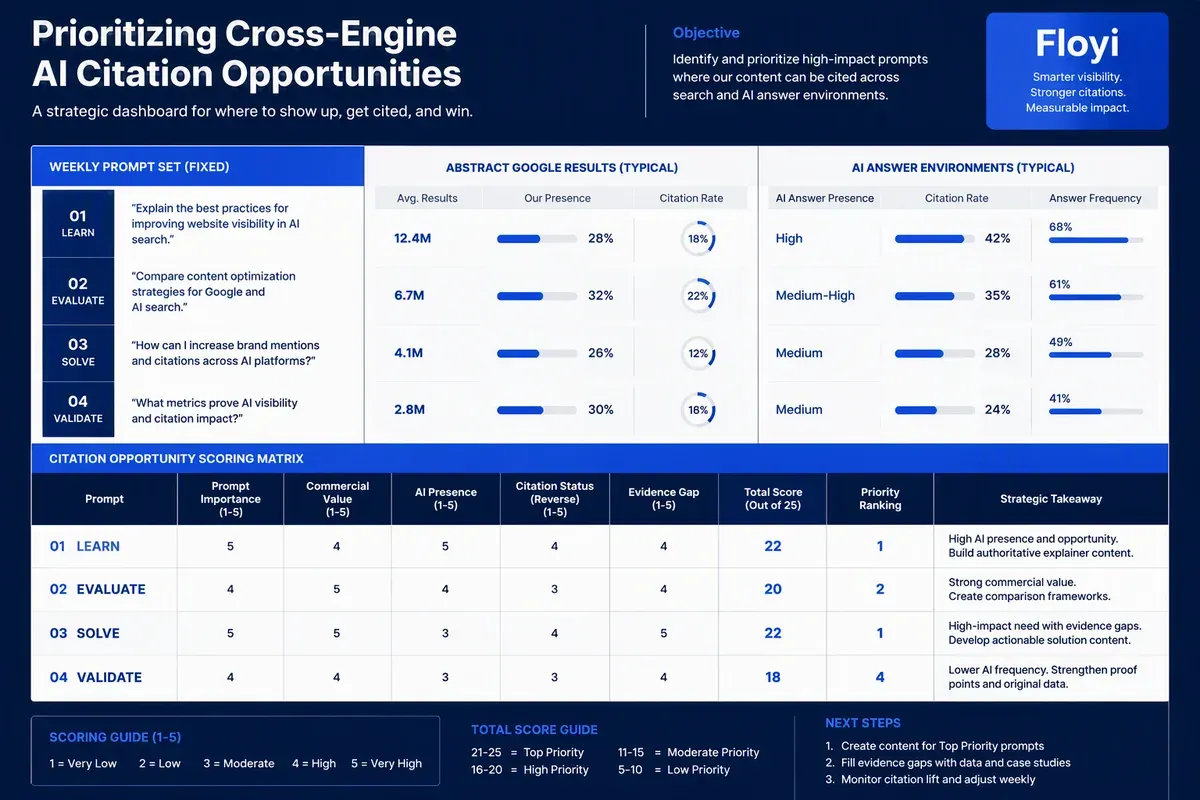
A repeatable AI search strategy starts with one defined topical scope and a fixed prompt set, then compares citation evidence before you plan content. Keep SEO rankings as context, but treat AI citations as the primary signal because generative answers assemble evidence from multiple sources.
Group prompts by the decision the reader needs to make:
- Learn: Conversational category questions and likely follow-up questions.
- Evaluate: Vendor, feature, method, and alternative comparisons.
- Solve: How-to queries and specific problems that require a practical answer.
- Validate: Questions that test a claim, methodology, or recommendation.
Run each prompt without changes across Google AI Overviews, Google AI Mode, ChatGPT, Microsoft Copilot, Claude, Gemini, OpenAI Web, and Perplexity. Finding AI search opportunities depends on stable wording, market settings, and test conditions, especially when you compare results across client accounts.
For every response, capture whether your domain is absent, mentioned, or cited, plus cited domains, page URLs, and source formats. The evidence type matters because a lost citation is not always a missing-article problem:
- First-party documentation: Product specifications, help content, and official guidance.
- Editorial explainers: Independent articles that clarify a concept or process.
- Research and datasets: Studies, original data, and documented methodologies.
- Reviews and community discussions: Firsthand evaluations and practitioner perspectives.
- Tools: Calculators, templates, databases, and utility pages.
A research-backed answer calls for a different asset than a prompt where engines favor comparison pages or practical tools. That distinction keeps content production focused on the evidence gap rather than volume.
Compare results by reader decision and engine. Prioritize complex, instructional, comparison, and information-dense prompts where cross-engine results diverge, since these queries can expose different source preferences across Google AI Overviews, ChatGPT SEO, and Gemini SEO.
Repeatedly cited domains form an authority map, so review the pages, claims, formats, and topical areas behind their citations. A coverage deficit means no comparable answer exists. A trust deficit means your page answers the question, yet publishers with stronger sourcing, specialist expertise, datasets, links, or mentions still receive selection. Near-duplicate articles rarely fix a trust constraint.
Use a transparent scoring model to rank opportunities:
| Factor | What it indicates |
|---|---|
| Prompt importance | Commercial value and audience relevance |
| AI presence score | Absent = 0, mentioned = 0.5, cited = 1.0 |
| Cross-engine absence | How consistently your domain fails to appear |
| Competitor concentration | Whether a small group repeatedly owns citations |
| Source-type mismatch | Whether the available asset uses the wrong evidence format |
| Topical fit | Whether the opportunity belongs within the approved scope |
Weight the AI presence score by prompt importance. Prompts with low presence across several engines, high audience value, and an addressable evidence gap should move first. Track mentions separately from citations because appearing in an answer is different from being selected as its source.
Turn each priority into a Pillar, Hub, Branch, and Resource roadmap. The Pillar answers the broad buyer question, Hubs and Branches address its query fan-out, and Resources provide original data, methodology, comparisons, or evidence pages. Preserve prompt, engine, cited domain, page URL, answer presence, citation share, and share of voice records, then rerun the same set after publication. Floyi’s Authority Planner and AI Authority view connect the evidence to roadmap updates while keeping AI citation performance separate from traditional rankings.
Build a Four-Level Topical Authority Roadmap
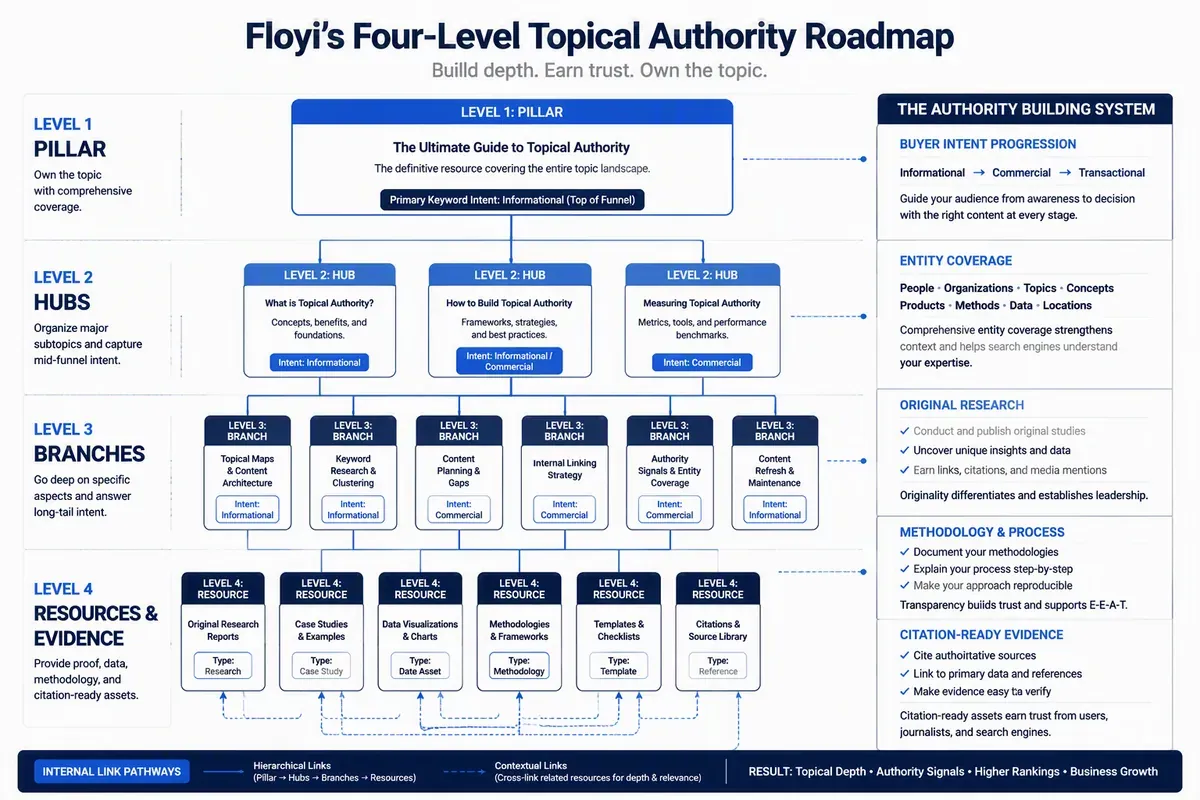
To turn citation priorities into production, a four-level roadmap turns topical expertise into a production sequence that moves from shared understanding to decision support and verifiable proof. Rather than treating query fan-out as a flat keyword queue, you plan topics not keywords according to the pages and concepts each later page depends on.
This order builds credibility with readers, conventional SERPs, and AI answer engines while reducing overlap between pages aimed at the same search intent. A comparison page cannot carry much weight when the site has not yet established the entities, relationships, and recurring questions that make the choice clear.
The four levels work together:
- Level 1, authority anchor: Establish the foundational entities, their relationships, and the top-of-funnel questions readers need before evaluating a solution. Compare entity coverage in winning pages and AI answers, then classify concepts as missing, covered, or overused. This exposes gaps early and prevents redundant pages or keyword cannibalization.
- Level 2, intent-specific hubs: Build pages around the highest-value scenario questions, comparisons, evaluations, and decision needs. AI search can support discovery, reviews, recommendations, and purchases, so topical roadmaps should cover more than one stage of the buyer journey. Each hub should connect to its authority anchor while serving one distinct job, rather than forcing every intent onto one page.
- Level 3, prompt-supporting resources: Create focused resources for longer, conversational follow-up questions from AI-assisted research. Narrow explainers, step sequences, decision tables, checklists, and question-led sections give answer engines material they can extract cleanly. A resource earns its place when it addresses a distinct situation, not when it rephrases an existing query.
- Level 4, evidence-rich proof assets: Add original analysis, documented methodologies, expert perspectives, first-party examples, and structured reference material where claims need verification. Clear separation of definitions, claims, evidence, and limitations makes an asset easier to quote, strengthens flagship hubs, and supports citation eligibility.
Start with topical scope, not publishing volume. Define the topic set the brand intends to own, identify adjacent areas to defer, audit the existing map, and set coverage targets at the hub level. Publish the Level 1 foundation and priority hubs before filling validated resource and evidence gaps.
Floyi’s Authority Planner prioritizes entity gaps and next pages against Google and AI-search visibility. Technical AI search readiness matters alongside this roadmap because even a well-scoped page needs accessible, indexable foundations before search systems can use it.
A stopping rule keeps topical authority from becoming content bloat. Stop expanding when the next page has weak intent, repeats an existing page, creates cannibalization risk, or adds little marginal value to the hub. Content depth supports trust, but it does not replace backlinks, credible sources, or clear internal linking.
The handoff from map to production should preserve each page’s assigned role. SEO, GEO, and AEO briefs carry relevant entities, intended search intent, evidence requirements, and internal-link relationships into drafting without asking every writer to reconstruct the topical map.
Measure progress by hub rather than raw URL count. Review shipped coverage, conventional search performance, and AI mentions or citations, then direct the next cycle toward the gaps still limiting authority.
How Do You Govern AI Search Content?
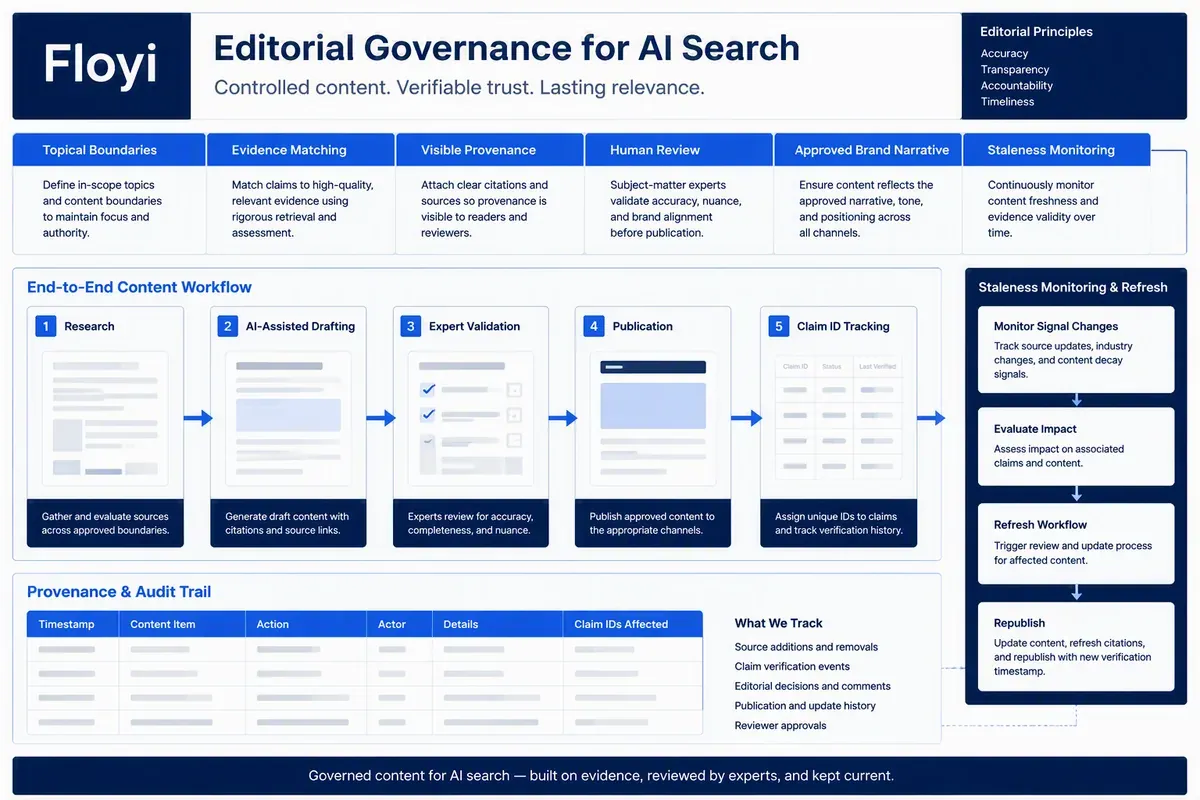
To maintain the roadmap as it expands, treat AI search content as a maintained evidence base, not a volume-production channel. Your AI search strategy starts with a defined topical scope, clear authority anchors, and explicit exclusions.
A practical governance model rests on four controls:
- Set boundaries before expanding: Build coverage around hubs, then prioritize gaps tied to the client’s market position. Stop when a proposed resource has low intent, duplicates existing coverage, or could cannibalize a stronger page. Query fan-out can generate an endless topic list, but it cannot decide what deserves publication.
- Match claim strength to evidence: First-party data can support statements about a client’s product, method, or observed results. Independently verifiable research supports broader market claims. Expert interpretation should be labeled as interpretation, while opinion remains opinion. Strong assertions need trustworthy sources, and genuine uncertainty calls for plain language rather than unsupported superlatives. This standard supports E-E-A-T when AI systems synthesize direct answers.
- Make provenance visible: Consequential claims should name an accountable author or organization, show a publication or update date, and include an on-page evidence anchor. A permanent claim ID can connect each canonical statement to its source, method, author, date, and page URL through a
/provenance.jsonindex exposed with arel="alternate"link. Keep visible copy, structured data, author details, and supporting evidence synchronized. Changing a Claim ID during a refresh breaks the audit trail it was designed to preserve. - Keep human judgment in the publishing path: AI can summarize approved research, suggest answer-first structures, and identify missing entities. Subject-matter experts and editors still validate accuracy, source fit, brand position, and query relevance before publication. Drafting guardrails should require the model to flag insufficient context and prohibit invented citations, quotations, results, or client-specific claims.
A single approved brand narrative prevents teams and markets from publishing competing versions of the same statement. Floyi’s Brand Foundation, Knowledge Base, and Audience Insights establish approved product language, audience terminology, and topical boundaries across client content. When a product description changes, the visible copy, schema, evidence record, and author information need to change with it.
Maintenance requires clear staleness triggers. Changed datasets, product capabilities, regulations, and search-interface behavior can make a previously sound page outdated. Baseline AI answer presence, citations, and share of voice before a material update, then review those signals weekly for four weeks alongside click-through rate and assisted conversions. Measuring AI search performance helps separate verified movement from informed hypotheses.
Tool selection follows the evidence standard, not the other way around. Different AI search tool categories can support research, drafting, monitoring, and cross-engine analysis, but none can make an unsupported claim citation-ready. Preserve the evidence trail, refresh it when conditions change, and protect each client’s topical scope.
How Do You Measure and Improve Visibility?
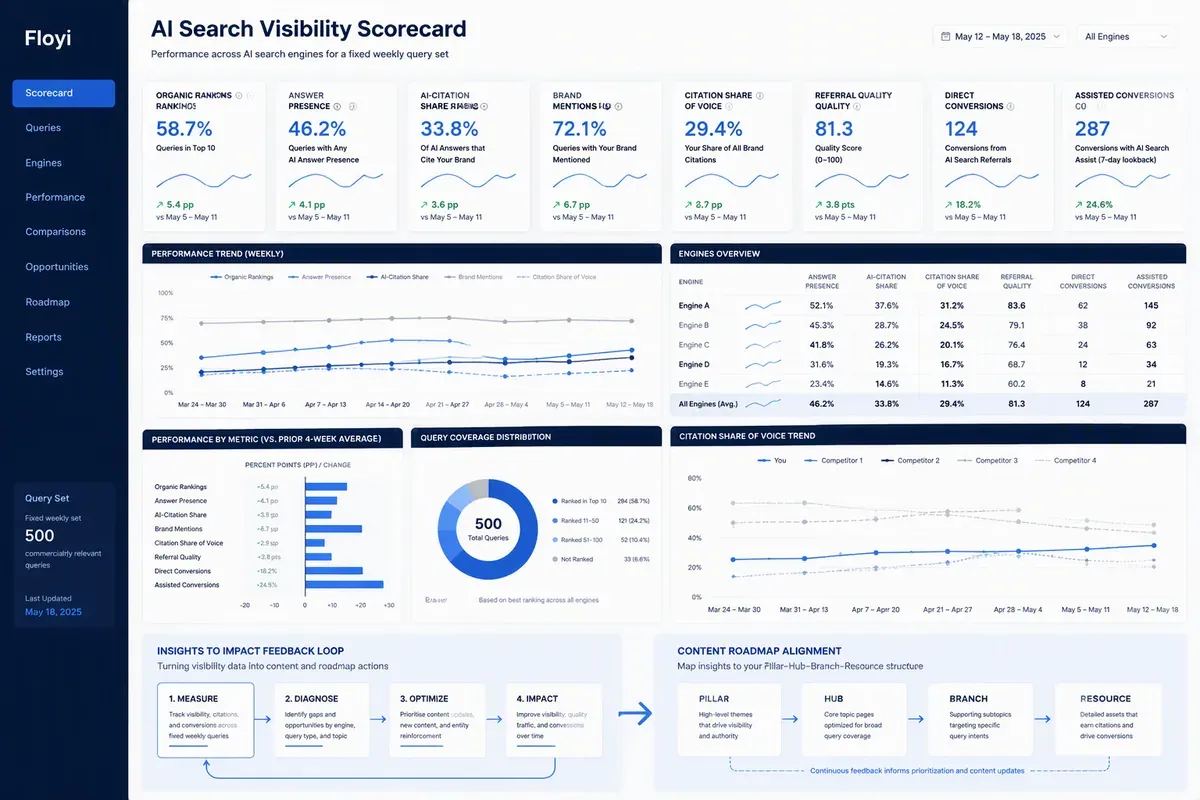
Brand visibility in 2026 cannot be reduced to rankings or clicks. A closed-loop scorecard keeps organic rankings, answer presence, AI-citation share, brand mentions, citation share of voice, referral quality, and direct and assisted conversions separate, so surface-level exposure is not mistaken for commercial impact.
Start with a fixed weekly query set built around commercially meaningful buyer questions. Check each query across Google, Bing, AI Overviews, AI Mode, ChatGPT, Bing Copilot, Claude Web, Gemini Grounding, OpenAI Web, and Perplexity. Stable query, landing-page, engine, and week identifiers make cross-engine changes comparable rather than anecdotal.
Each weekly record should capture:
- Answer presence: Whether your brand appears in an AI-generated response.
- Mentions and citations: Whether the brand is named, whether your domain is cited, and which domains appear beside it.
- Source patterns: The cited source types, such as original research, specifications, expert commentary, and proof resources.
- Organic performance: Applicable Google and Bing rankings, landing pages, impressions, and clicks from Google Search Console.
- Business outcomes: Referral sessions, qualified-session or engagement rate, direct conversions, and assisted conversions for AI-visible pages.
Use fixed definitions across every client account. Answer presence indicates that the brand appears in a response. AI-citation share is the proportion of tracked answers that cite your domain. Citation share of voice divides your citations by all cited domains in the same answer set. Combining these signals too early can conceal whether the actual constraint is recognition, attribution, traffic quality, or conversion.
An importance-weighted AI Presence Score makes query-level performance comparable. Apply it consistently across the query set, giving citations more weight because they indicate a source relationship, while recognizing that mentions still reflect recognition that can precede attribution. Weight each result by query importance so low-value informational prompts do not outweigh high-intent buyer questions.
Referral traffic is supporting evidence, not the final verdict. ChatGPT referral reporting can understate assisted discovery because roughly 20 background searches may occur per AI-result click, and Pew’s click-rate comparison points the same way. Direct and assisted conversions supply the context needed to judge referral quality.
Cross-engine evidence should determine the next response:
- Ranked but uncited pages: Add direct answers, structured steps, comparison tables, and quote-ready evidence that AI systems can attribute.
- Cited pages with weak referral quality: Align the buyer question, page promise, and next-step intent more closely.
- Competitors cited for stronger evidence: Close the evidence gap with original research, specifications, expert input, or proof resources instead of rewriting similar copy.
- Strong coverage with stalled visibility: Treat the constraint as a credibility gap and focus on digital public relations, partnerships, and distribution around authority pages and supporting hubs.
Floyi’s AIRS Analyzer compares cited domains and source patterns across conventional SERPs and AI systems before the next brief. Brand Foundation, Knowledge Base, and Audience Insights keep that recommendation tied to approved brand context and buyer needs across accounts.
Feed the scorecard into the Pillar, Hub, Branch, and Resource roadmap. Weak rankings paired with absent AI presence signal a coverage gap that calls for the next priority page or supporting resource. Strong coverage that stalls across engines points to a credibility gap, which should shift effort toward authority-building work. Check the same weekly baseline after publication and measure the metric that prompted the change.
Floyi tracks brand visibility, share of voice, and AI citations across engines so you can see where your coverage stands before the next planning cycle. Benchmark your AI visibility.
Future AI Search Trends FAQs
These FAQs examine future AI search trends, including shifts in discovery behavior and the evidence your agency can use to guide SEO and GEO decisions across client accounts.
1. Will AI Search Replace Traditional Search Engines?
AI search is more likely to extend traditional search than replace it. It works well for conversational, scenario-specific questions that once required several queries, while result pages still help you compare sources, verify claims, visit known sites, and research independently. Google’s AI Overviews rely on web indexes, ranking systems, and publisher links, keeping authoritative websites central to discovery. Although McKinsey found 44% of AI-search users name it their preferred source of insight, versus 31% for traditional search, measure both AI citations and SERP visibility.
2. Will AI Agents Complete Purchases in 2026?
AI agents will likely shape more purchase journeys in 2026, moving from conversational research into comparisons, review synthesis, recommendations, ads on AI platforms, and selected transactions. They won’t replace browsing or conventional retail paths, since much AI-search use still begins with top-of-funnel questions.
Visibility will depend on source pages with verifiable, structured product facts, including price, availability, variants, specifications, delivery, returns, and review evidence. McKinsey projects AI-powered search could influence $750 billion in US consumer spending by 2028, raising the value of dependable product data.
3. How Will AI Search Affect Local Businesses?
Google retains an advantage for local intent because location data, business categories, hours, service attributes, and human reviews influence nearby results. Keep these details consistent across your site and Google Business Profile, with local terminology and LocalBusiness or Organization schema. AI answers draw on a broader evidence base, where third-party domains supply the large majority of references. Accurate directories, reviews, community mentions, and provenance-backed pages corroborate local claims. Pew Research Center reported lower link-clicking when AI summaries appear (study).
4. Will Zero-Click Searches Reduce Website Traffic?
Yes. Zero-click searches can reduce aggregate organic clicks on affected informational queries: Pew found an 8% click rate when AI summaries appeared, compared with 15% without them, while Amsive reported a 15.5% decline for queries triggering AI Overviews. That shifts the traffic mix rather than erasing website value. Citations keep your brand visible when decisions form, and Google reports that AI Overview referrals spend longer on-site. Measure AI-citation share, answer presence, qualified referral engagement, assisted conversions, and sessions.
About the author

Yoyao Hsueh
Yoyao Hsueh is the founder and CEO of Floyi, the topical authority platform, and the founder of Main Heading, an SEO and AI search agency. He created Topical Maps Unlocked, a course studied by thousands of SEOs, content strategists and digital marketers, founded TopicalMap.com, a done-for-you topical mapping service for agencies and enterprise teams, and publishes the weekly Digital Surfer newsletter on SEO, content strategy and AI search.
About Floyi
Floyi is a closed loop system for strategic content. It connects brand foundations, audience insights, topical research, maps, briefs, and publishing so every new article builds real topical authority.
See the Floyi workflow