
AI Search Citations, Provenance, and Trust Signals Audit Framework
Learn how AI search citations, provenance, and trust signals support citation readiness through claim-level evidence, entity consistency, and visibility audits.
A citation in an AI answer does not prove that the linked source supports the claim. AI search citations provide attribution, while provenance records the question, retrieved evidence, processing path, and final claim behind that attribution. Trust signals depend on corroboration, entity consistency, accessibility, and evidence quality, not a model’s confident tone.
A linked URL can omit stronger conflicting evidence or point to a passage that doesn’t entail the answer. The audit framework tests claim-level support, creates stable claim_id records in /provenance.json, and checks entity and technical signals alongside extractable answers. Weekly observations across Google AI Overviews, AI Mode, Gemini, ChatGPT Search, and Perplexity keep citation share separate from mentions, then Floyi’s Authority Planner can turn recurring gaps into publishing priorities.
AI Citation Provenance Key Takeaways
- Citations attribute claims, while provenance records the evidence path behind generated answers.
- A confident AI response can still rely on weak, mismatched, or conflicting evidence.
- Test entailment by matching each claim’s wording, figure, population, and timeframe to its source.
- Use stable
claim_idrecords and/provenance.jsonto preserve claim-level traceability. - Citation-ready pages pair extractable answers with visible, firsthand evidence and meaningful update dates.
- Consistent entity details, schema, and technical accessibility support trusted retrieval and recognition.
- Track citations weekly by engine, query, citation share, CTR, and assisted conversions.
What Separates Citations, Provenance, Trust, and Uncertainty?
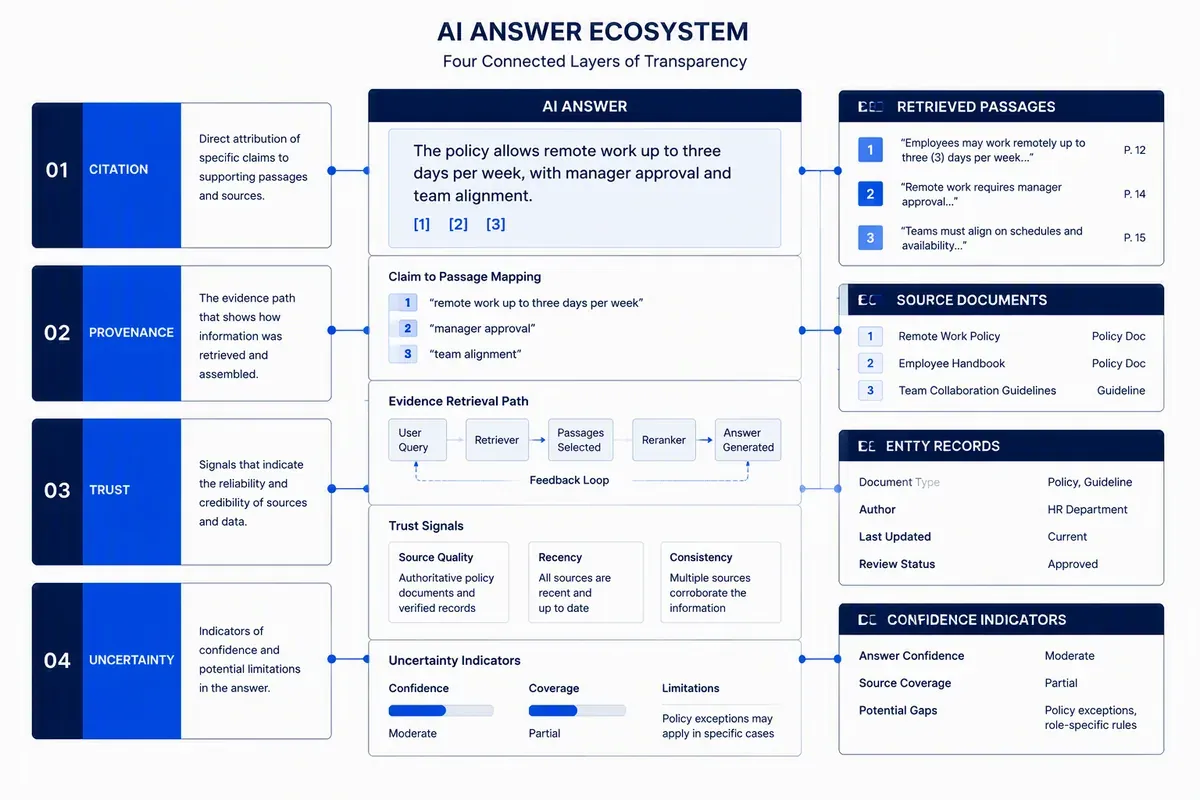
In artificial intelligence (AI) search, a citation attributes a specific claim to a source. Provenance in AI search traces the evidence from its original source through retrieval and processing to the generated answer. A linked URL supplies attribution, but it cannot show whether the system used that passage or overlooked stronger conflicting evidence.
These four signals answer separate questions:
- Citation: Which source is attached to this claim?
- Provenance: Which user question, retrieval actions, documents, passages, and processing steps led to it?
- Trust signals: Does the evidence support trusted entity recognition through corroboration, publisher credibility, technical accessibility, and consistent identity?
- Confidence: How uncertain is the model about its response?
Confidence does not establish authority. A model can state an answer with certainty while relying on weak, mismatched, or poorly corroborated material. AI search trust signals and trust signals for AI search therefore extend beyond domain-level reputation.
Multi-source AI answers are not conventional ranked results pages. Systems select passages from several documents, reconcile agreement or conflict, and generate a direct response with chosen citations. On recommendation queries, your brand may be absent rather than positioned lower. That change makes semantic understanding in SEO and the traditional SEO evolution toward claim-level evidence operational concerns.
An inspectable provenance chain exposes what a citation alone cannot: retrieved material left uncited, citations that do not support a claim, information supplied from model knowledge, and conflicts that were resolved or ignored. Citation readiness pairs that traceability with Search Engine Optimization (SEO) fundamentals.
A machine-readable /provenance.json index can tie a stable claim_id to a page anchor, dataset, author, date, and checksum. An AI search optimization strategy turns those records into a consistent publishing standard.
How Do You Evaluate Claim-Level Evidence?
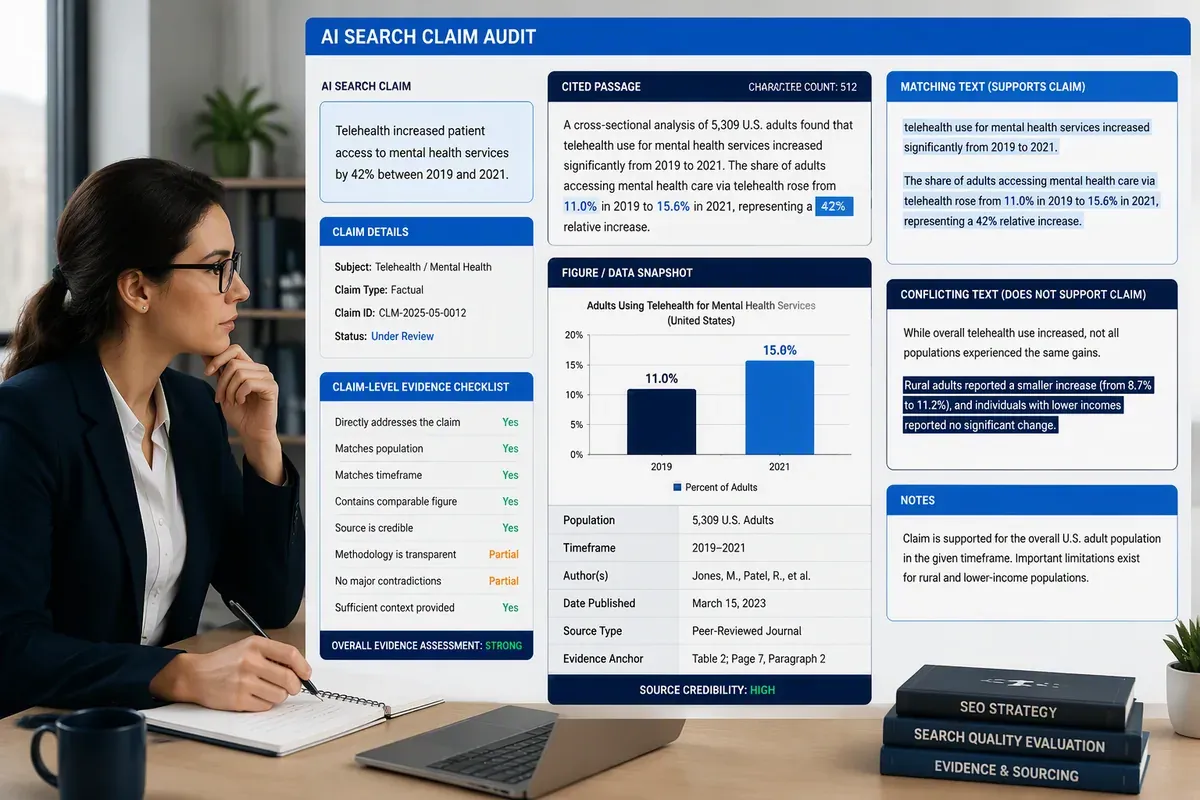
To apply those distinctions to individual statements, AI citation accuracy rests on whether each factual statement holds up to inspection, not on a familiar domain or a long reference list.
Review claims individually before publication:
- Test entailment: Match the cited material to the assertion’s exact wording, figure, population, and timeframe. Place the citation beside the sentence it supports. When evidence covers only part of the statement, narrow the claim, find additional support, or remove it.
- Prioritize original records: Favor original research, official datasets, primary documents, and peer-reviewed studies. Secondary reporting can supply context, but it should not replace the underlying record when that record is available.
- Capture source metadata: AI source verification records the publisher, page title, named author, publication or update date, source type, primary or secondary status, and a direct evidence anchor. Government and academic provenance matter where relevant, alongside author expertise, editorial review, correction practices, and independence from the subject.
- Check freshness and completeness: Visible dates matter for product specifications, policies, and market data. The source should also retain its definitions, methodology, underlying data, limitations, and context. An updated summary without methods may be less useful than an older primary dataset.
- Compare conflicting evidence: Test consequential claims against independent primary evidence, credible reporting, expert analysis, and reviews. Separate verified facts from interpretation and uncertainty. AI systems may lower confidence in claims that lack support or conflict with independent sources.
Citation provenance makes this work repeatable. A machine-readable /provenance.json index can connect a stable claim_id with a page URL, on-page anchor, author, date, dataset URL, and SHA-256 checksum. Stable identifiers preserve traceability when pages change.
Effective corroboration strategies avoid a common error: a reputable publication may be dependable overall while making a weak claim on one page. Read the cited passage against the precise assertion, then publish only what the evidence can carry.
How Do You Build Citation-Ready Content?
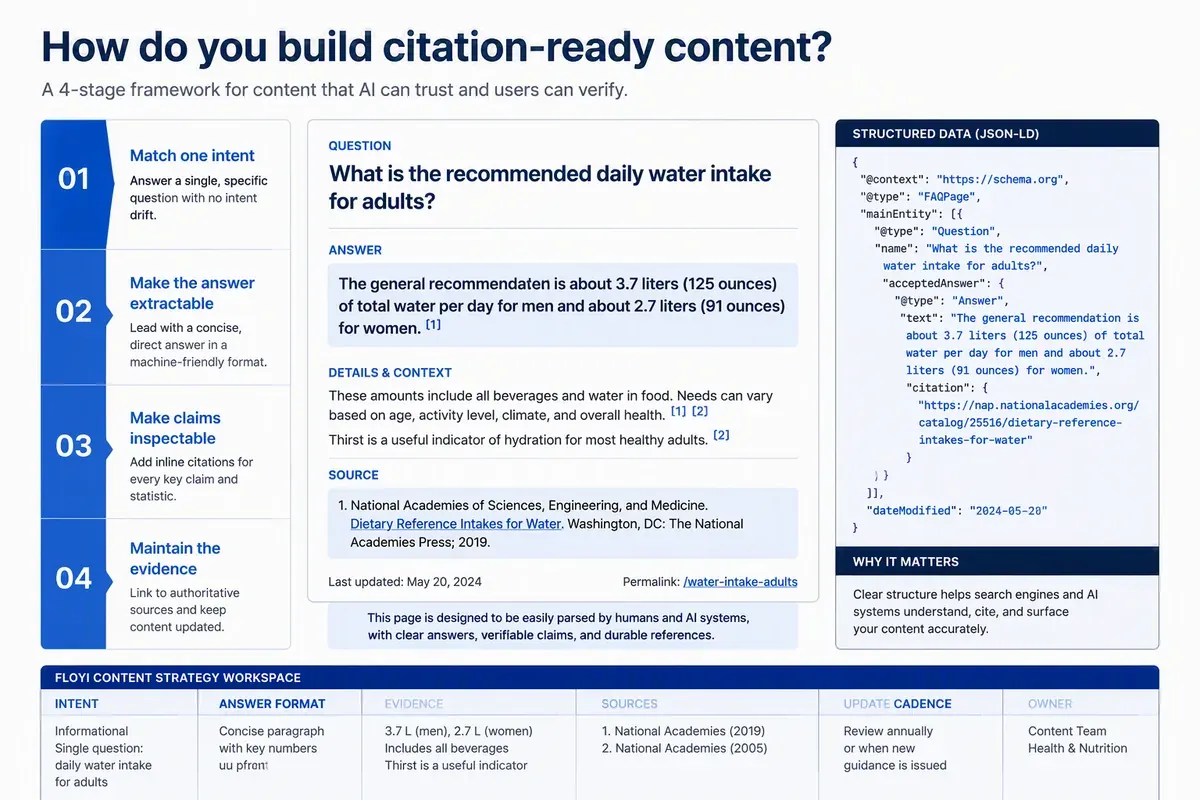
Once claims have passed individual review, citation-ready content reduces retrieval ambiguity. Each page should answer one intent, make that answer easy to extract, show the evidence behind material claims, and remain accurate as facts change. This approach strengthens the conditions for earning citations in AI answers, but it cannot require any AI system to select or cite your page.
The four-part Citation-Ready Page framework works as follows:
- Match one intent: Build the page around the dominant question behind a query, rather than several loosely related needs. Turn that question into a descriptive H2, then place a concise answer directly beneath it before qualifications or examples.
- Make the answer extractable: Use semantic HTML and a clear heading hierarchy. Add tables and lists only when they clarify the answer. A study of ChatGPT citation patterns found 72.4 percent of cited pages carry a self-contained answer directly after a title or question-led heading.
- Make claims inspectable: Place precise inline attribution beside every consequential claim, linking readers to the study, dataset, method, or firsthand source behind it. Separate observed facts from interpretation, and preserve page anchors and claim IDs through redesigns. For high-value assertions, a machine-readable provenance index can also record each claim ID’s evidence status.
- Maintain the evidence: Revisit time-sensitive statements and refresh the supporting material, not just the timestamp. Meaningful publication and update dates show that the underlying evidence was reviewed.
Structured data for AI search should describe what readers can see on the page. Use schema markup that fits the content, including WebPage for page context, Claim for a canonical assertion, Dataset for supporting data, and FAQPage or HowTo when the visible format supports those types. Organization schema and authorship markup can clarify publisher identity, credentials, relationships, publication dates, and dateModified.
SEO for generative engines requires more than markup. Although schema can improve parsing and retrieval, it cannot overcome weak corroboration, poor query fit, or an answer buried in unclear copy, and generative engine optimization and AI search optimization work best when your evidence holds across broad-consensus and specialized sources. ChatGPT and Perplexity may surface different source patterns, so audit high-value pages for intent fit, visible evidence, and meaningful updates before tuning for any one model.
Strengthen Entity Identity and Technical Accessibility
A brand needs a distinct, credible organization profile before AI systems retrieve or cite its content. A canonical brand entity profile keeps the legal and public-facing name, logo, description, website URL, address, phone number, and contact metadata aligned wherever the brand appears:
- Identity details: Maintain one approved version of each organization detail across the site and external profiles.
- Profile alignment: Keep consistent cross-platform profiles on LinkedIn, Crunchbase, Wikidata, Google Business Profile where applicable, Yelp, and the Better Business Bureau.
- Evidence standard: Complete, accurate profiles support trusted entity recognition, but they do not replace firsthand proof or justify listings that misrepresent the business.
Name Address Phone consistency also supports entity SEO. Matching positioning, service descriptions, contact details, and website links helps systems corroborate one organization rather than separate, conflicting records.
Organization schema provides a machine-readable identity record in JSON-LD. Floyi can auto-generate and publish Organization and Article JSON-LD with content, including authorship, update dates, and entity relationship markup, using verified values only, especially in sameAs, logo, and credentials fields:
{ "@context": "https://schema.org", "@type": "Organization", "name": "Floyi", "url": "https://floyi.com", "logo": { "@type": "ImageObject", "url": "VERIFIED_LOGO_URL" }, "description": "Floyi is the topical authority platform.", "contactPoint": { "@type": "ContactPoint", "contactType": "customer support" }, "hasCredential": { "@type": "EducationalOccupationalCredential", "name": "VERIFIED_CREDENTIAL" }, "sameAs": [ "VERIFIED_EXTERNAL_PROFILE_URL" ]}Technical accessibility determines whether crawlers can retrieve that evidence. Canonical pages need HTTPS, clean server responses, and critical content that does not depend on blocked crawling or delayed rendering. Semantic HTML landmarks, descriptive headings and links, useful image alt text, and ARIA only where native HTML falls short make the structure readable to crawlers and assistive technologies.
Core Web Vitals make retrieval quality measurable. Largest Contentful Paint (LCP), Interaction to Next Paint (INP), and Cumulative Layout Shift (CLS) indicate whether pages load quickly, respond reliably, and remain stable, while well-supported claims are still difficult to extract when a page is slow, shifting, or structurally opaque.
Pair Extractable Answers With Firsthand Evidence
An extractable answer needs visible proof beside it to earn trust, so on each priority page, place a 40 to 80 word canonical answer near the top, followed immediately by an evidence line naming the author, publication date, on-page anchor, source document, or dataset. Without an inspectable trail, a concise answer remains a well-formatted assertion.
E-E-A-T, or Experience, Expertise, Authoritativeness, and Trustworthiness, becomes visible through material generic AI text cannot reproduce:
- First-person case study: Identify the permitted client context, starting constraint, page changes, implementation timeline, measurement method, observed outcome, and limitations.
- Original research: Publish the sample, collection period, method, variables, caveats, and underlying dataset with the finding.
- Accountable expertise: Name the qualified person, their relevant credentials, and the specific observation or decision behind the claim.
Schema can reinforce this connection when a Claim or FAQPage JSON-LD entry matches the on-page answer with its evidence anchor, author, and datePublished value. Keep each claim ID permanent, and make the citation field point to the relevant evidence section rather than a general resource page. The difference between AI search mentions vs citations matters because a brand may appear in an AI response without providing the material that substantiates its claim.
Your corroboration strategies should prioritize primary studies, government data, peer-reviewed research, open datasets, official news, and established industry studies over chains of summaries. Independent Trustpilot, G2, and Capterra reviews, along with relevant specialist coverage and expert-community discussion, make customer satisfaction, legitimacy, and domain expertise observable beyond your site.
Each lead claim should give readers and AI systems a clear route to the underlying work, including its known limits.
How Do You Make Provenance Inspectable?
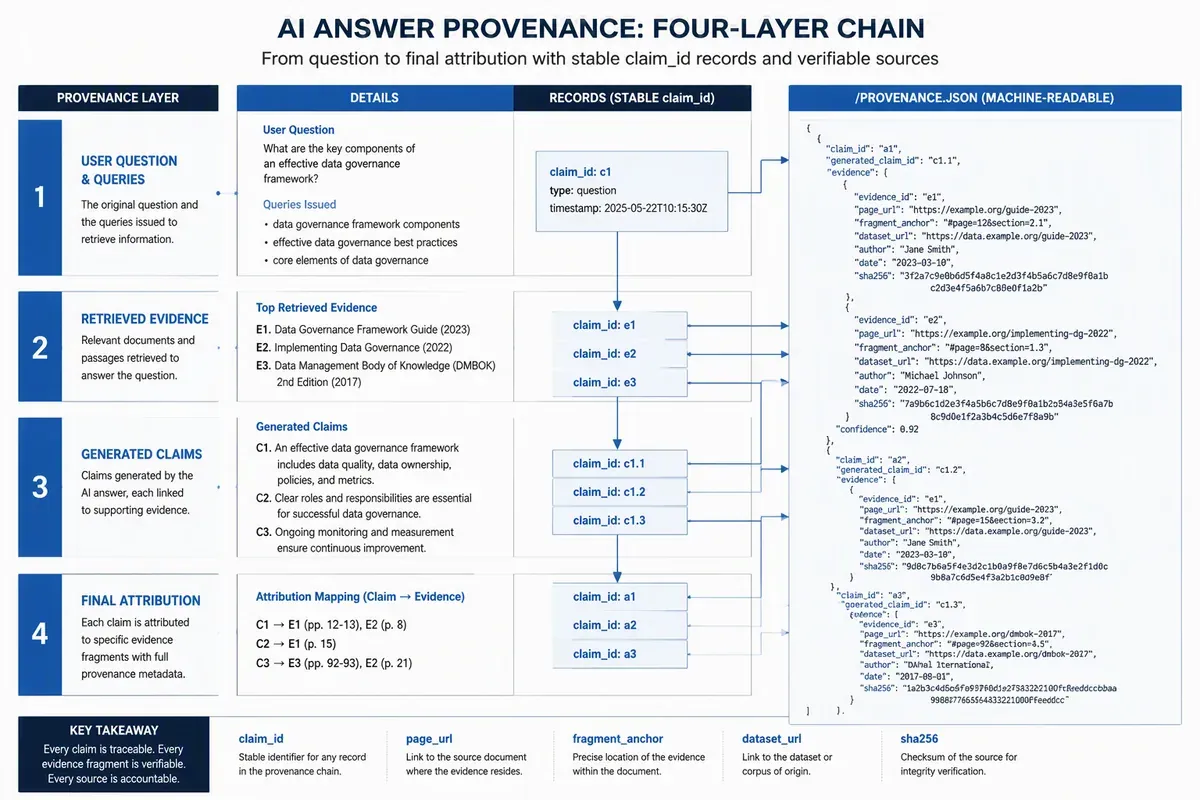
To verify the evidence behind citation-ready content, inspectable provenance gives every AI answer a claim-level chain of custody for facts, not a polished list of citations. Readers should be able to trace a question through the searches it triggered, documents and passages retrieved, claims produced, and citations attached to the final response. That is the working standard for provenance in AI search and AI source verification.
A useful inspection record keeps four layers separate:
- Question and queries: Retain the user’s wording and the searches or retrieval prompts used to answer it.
- Retrieved evidence: Capture every document considered, the exact passage, source type, publication or update date, and source independence.
- Generated claims: Connect each factual statement to its supporting passage. Flag model-knowledge content when no retrieved evidence supports it.
- Final attribution: Identify the sources cited in the answer and the retrieved sources that shaped the response but received no citation.
Retrieval is not attribution. An AI system can retrieve a relevant page, use it to form an answer, then cite another source or none at all. This attribution gap can conceal unsupported recommendations, selective sourcing, and weak citation provenance.
Evidence displayed beside an answer should also show claim-level citation coverage, agreement among independent sources, unresolved conflicts, repeated material, and uncertainty. Conflicting evidence must remain visible instead of being compressed into a confident conclusion. A chain of custody for facts only earns trust when it records what the system rejected, could not verify, or treated as incomplete.
For generative engine optimization, publish a compact /provenance.json file that maps a stable claim_id to its page_url, fragment anchor, author, date, dataset URL, and SHA-256 checksum. Add this declaration in the page head:
<link rel="alternate" type="application/json" href="/provenance.json">Keep claim_id, page URL, and anchor stable across deployments. Timestamp material changes in methods.md, and version underlying datasets through date-specific distribution URLs. This gives your team, human auditors, and AI search systems a durable way to verify that a cited claim still maps to inspectable evidence.
Map Claims to Sources With Provenance Records
Every material statement needs a stable, machine-readable record that connects its precise wording to visible evidence. This chain of custody for facts lets readers and AI systems inspect what supports a claim and where that support appears.
A compact /provenance.json pattern can hold the required record:
{ "claim_id": "claim-001", "claim": "Normalized claim text", "page_url": "/research", "anchor": "#methodology", "page_title": "Research Methodology", "publisher": "Your Brand", "author": "Named Author", "datePublished": "2026-08-01", "dateModified": "2026-08-15", "source_type": "academic_study", "primary_or_secondary": "primary", "relationship": "academic_study", "source_url": "/study", "dataset_url": "/data/release-2026-08.csv", "dataset_version": "2026-08", "collection_period": "2026-01 to 2026-06", "methodology_url": "/methodology", "checksum_sha256": "abc123...", "entailment_status": "directly_supported", "uncertainty": "Moderate", "supporting_source_count": 3, "contradicting_source_count": 0, "citation_coverage": 0.92}The anchor must resolve to the supporting passage, table, or methodology note, not the homepage. The relationship field distinguishes original research, official government data, academic study, independent reporting, and self-reported company information.
Use claim_id, page_url, and anchors as fixed keys for record-level comparisons. Dated dataset distribution URLs, SHA-256 checksums, and timestamped revision logs preserve an inspectable history when claims, methods, or source files change. The <link rel="alternate" type="application/json" href="/provenance.json"> declaration lets retrieval systems locate the index without inferring page structure.
Apply this standard to legitimacy evidence as well as performance claims. Editorial policies, author credentials, physical addresses, corporate history, and Organization or Article structured data each need their own on-page anchors. Clearly label first-party disclosures and connect them to independent corroboration where available.
Benchmarking AI search visibility becomes more defensible when records expose evidence changes as AI search ranking signal shifts occur. Track citation coverage to find factual claims that still lack traceable support.
How Do You Audit AI Citation Visibility?
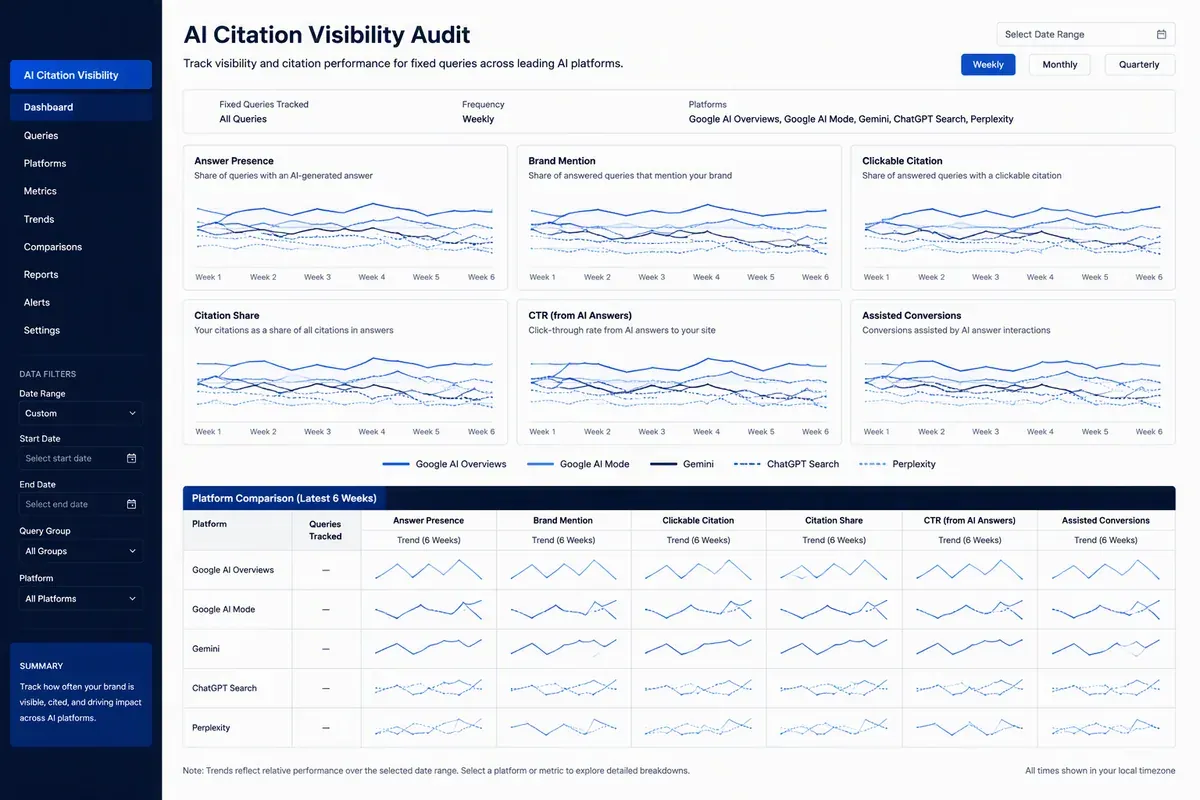
With provenance records exposing claim support, a reliable AI citation visibility audit holds the query set, collection conditions, and evidence standard steady before you interpret movement. Map an intent-balanced set of fixed queries to priority topics and each brand entity profile, then check it weekly in Google AI Overviews, Google AI Mode, Gemini, ChatGPT Search, and Perplexity. Preserve each full response with its date, locale, and visible engine version so prompt changes or platform updates do not appear as gains from AI search optimization.
Use stable telemetry for every query-engine observation:
| Field | What it records |
|---|---|
| week_start, engine, query, page_url | The fixed observation unit |
| answer_present, our_domain_cited | Whether an answer appeared and your domain received a clickable citation |
| cited_domains, ai_citation_share, sov | All cited domains, your citation share, and share of voice |
| notes | Prompt changes, model updates, site releases, and unusual results |
Separate an absent brand, a brand mention, and a clickable citation. We weight those outcomes by topic importance, which prevents entity SEO reporting from treating an unlinked mention as equivalent to inspectable evidence. Calculate AI citation share and share of voice against every cited domain, not as a binary mention metric.
Citation volume alone is a weak trust signal. For each source, record its type, publisher, publication or update date, relevant excerpt, and whether that passage supports the exact answer claim. AI citation accuracy depends on clickable links, passage-to-claim traceability, freshness, independent corroboration, visible disagreement, and clear uncertainty disclosures. Flag inaccessible, stale, unsupported, conflicting, or excerpt-free citations.
Source selection also differs by engine:
- Google AI-driven overviews and AI Mode: Track supporting links and subtopic fan-out, plus brand-owned authority, schema, and consistent cross-platform profiles.
- ChatGPT Search: Compare your evidence with consensus-oriented sources, including Wikipedia and LinkedIn when they appear.
- Perplexity: Monitor specialized publishers and community sources that cite competitors while omitting equivalent brand evidence.
For SEO for generative engines, compare matched treatment and control pages over 12 weeks. Set your success threshold before the test begins. We use a 10 percent AI-citation-share advantage sustained for three consecutive weeks as an internal working standard rather than a published industry benchmark, then validate it with click-through rate and assisted conversions. Calibrate your own threshold once you can see normal week-to-week variation in your query set. Floyi’s Authority Planner turns visibility trends, recurring omissions, and audited entity profiles into the next publishing priority.
How Do You Improve AI Search Trust Continuously?
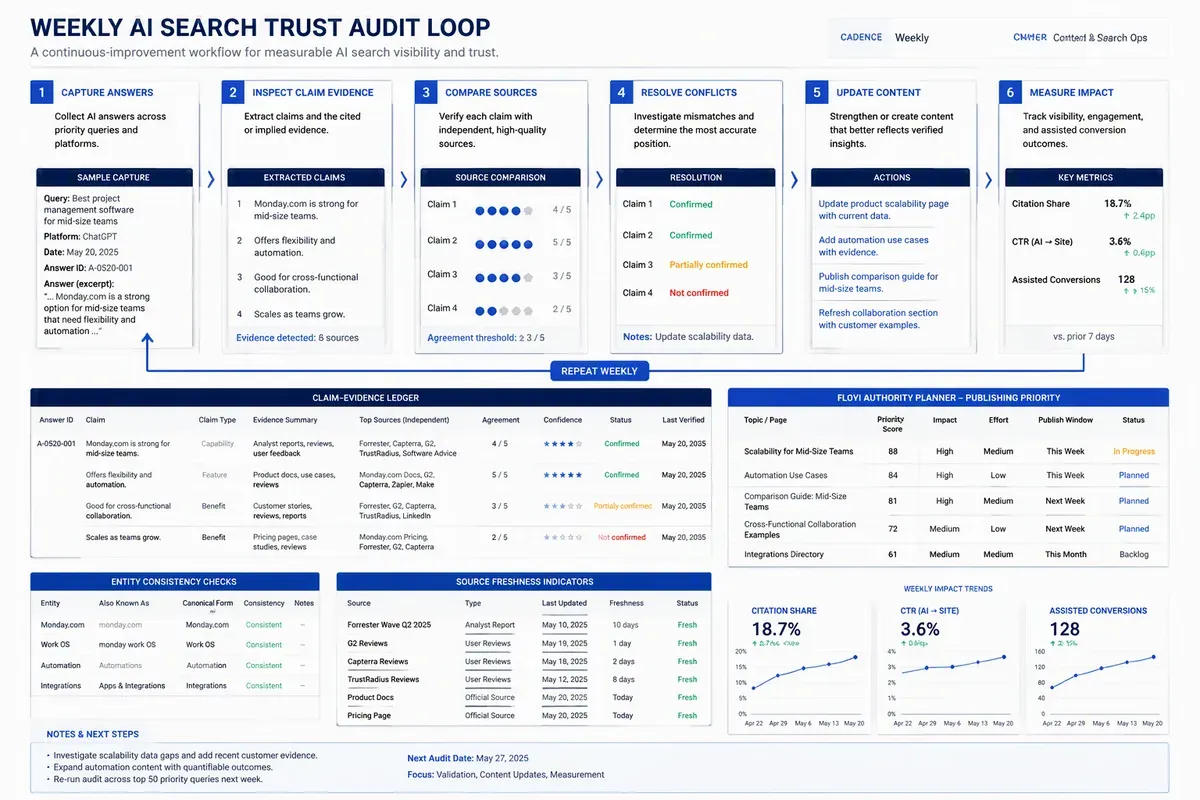
AI citations require ongoing evidence checks, not blind trust. Review claims and entities in tracked AI answers weekly, then address the highest-risk gaps first. Unsupported citations, outdated or non-independent sources, and inconsistent entity details across owned pages and credible third-party sources matter most because trust signals for AI search reflect external consensus, not one polished page.
Use a claim-evidence ledger to test every cited passage against the generated claim, confirming that the source supports the statement, is primary or independent, remains current, and does not omit material disagreement. When evidence fails, revise or remove the assertion, qualify uncertainty, or replace the source. Keep claim_id, page_url, and anchors stable, with dated change logs and versioned dataset URLs that preserve provenance after updates.
Third-party corroboration should reflect genuine experience or expertise, not mention volume:
- Independent reviews: Trustpilot, G2, and Capterra can substantiate customer experience when review content supports the claim.
- Subject-matter sources: Niche publications, expert communities, specialist forums, podcasts, and digital press can corroborate expertise.
- Open-web discussion: Reddit, Quora, and LinkedIn mentions can reveal how practitioners describe an entity, including disagreements absent from brand copy.
Continue weekly AI search trust signal captures across Google AI Overviews, Google AI Mode, Gemini, ChatGPT Search, and Perplexity. Add click-through rate (CTR) and assisted conversions to the audit metrics. For the measurement period, calculate:
lift = (Treatment_week12 − Treatment_week1) − (Control_week12 − Control_week1)Log model updates, seasonality, and major site edits before attributing lift. Check sustained AI-citation-share gains against CTR and assisted conversions (source).
Each engine shows a retrieval pattern, not a truth verdict. Perplexity may link original sources and apply Government, Academic, or Trusted labels while drawing from Reddit, forums, and specialist publications. Citations can increase user trust even when wrong, so badges and links never replace passage-level validation. Keep the ledger current and separate stronger citation visibility from factual reliability.
Floyi’s AIRS Analyzer records which domains each engine cites for your priority queries, separating linked citations from passing mentions. Audit your citation visibility.
AI Search Citations, Provenance, and Trust FAQs
These FAQs address practical questions about AI search citations, provenance, and trust signals, helping you assess whether your content gives AI systems clear, traceable support for its claims.
1. Do Google Rankings Guarantee AI Citations?
No. High Google rankings improve discovery, but they do not guarantee an AI citation. AI-driven overviews synthesize direct answers from multiple sources and may retrieve a top-ranking page while citing another with a clearer claim, closer evidence, a named author and date, or stronger entity signals. Google AI Overviews use core ranking systems and high-quality results, yet each query may produce a different source mix. Citation readiness rests on extractable, traceable claims and consistent brand information, not rank alone.
2. Can Review Platforms Improve AI Citation Chances?
Independent reviews on Trustpilot, G2, Capterra, specialist publications, forums, and expert communities can improve AI citation chances by corroborating customer experience, market presence, and legitimacy beyond your site. They complement, rather than replace, claim-level evidence.
A platform label, star rating, or high review count does not verify every product, performance, or expertise claim. Review recency, specificity, reviewer credibility, and feedback consistency, then support factual statements with directly inspectable sources and provenance.
3. Does Earned Media Influence AI Search Trust?
Yes. Earned media can strengthen AI search trust when independent reporting, qualified expert quotations, reputable partnerships, and editorial backlinks corroborate a specific brand claim. AI answers tend to reflect wider web consensus rather than relying on marketing copy alone.
Prioritize relevant publications that verify claims, name subject-matter experts, and link to primary data. Paid, vague, syndicated, or unsupported mentions may expand visibility without creating credible consensus. ChatGPT may reflect broad signals from sources such as Wikipedia and LinkedIn, while Perplexity often surfaces specialized publications and community sources.
4. Which AI Engines Cite Brands Most Often?
No AI engine favors one brand across every query. Google AI Overviews and AI Mode use query fan-out across related subtopics, so established entity signals, brand-owned authority, structured data, and coverage breadth matter. ChatGPT, Gemini, and Perplexity use distinct retrieval layers and answer formats, making one citation win a poor proxy for all engines.
Perplexity visibly links original sources and may apply Government, Academic, or Trusted labels while surfacing specialist publications, communities, and Reddit. Those labels do not validate every claim. Compare answer presence, cited domains, and share of voice by engine and query with Floyi’s AIRS Analyzer.
About the author

Yoyao Hsueh
Yoyao Hsueh is the founder and CEO of Floyi, the topical authority platform, and the founder of Main Heading, an SEO and AI search agency. He created Topical Maps Unlocked, a course studied by thousands of SEOs, content strategists and digital marketers, founded TopicalMap.com, a done-for-you topical mapping service for agencies and enterprise teams, and publishes the weekly Digital Surfer newsletter on SEO, content strategy and AI search.
About Floyi
Floyi is a closed loop system for strategic content. It connects brand foundations, audience insights, topical research, maps, briefs, and publishing so every new article builds real topical authority.
See the Floyi workflow