
Measure AI Search Performance and Prioritize Authority Work
Benchmark AI search performance with buyer-intent prompts, visibility, citations, recommendations, traffic, conversions, and competitors.
Only about 12 percent of URLs cited by AI assistants also rank in Google’s top 10 for the same query. That gap means measuring AI search performance requires more than rank tracking. Track presence, citations, recommendations, traffic, and conversions against a fixed buyer-intent prompt set.
A brand can be mentioned without being cited, cited without being recommended, or recommended with outdated pricing or inaccurate claims. Floyi’s Topical Authority Scorecard keeps Content Authority, Market Authority, and AI Authority visible across the Pillar, Hub, Branch, and Resource map while retaining the diagnostic signals behind each score.
Start with 20 to 30 branded and unbranded prompts, then expand toward 50 to 200 high-intent prompts as coverage improves. Use Citation Share, Share of Voice, citation prominence, and assisted conversions to prioritize the mapped authority gap with the strongest commercial evidence.
AI Search Performance Key Takeaways
- Separate public AI discovery metrics from internal knowledge retrieval evaluation.
- Measure visibility, influence, interaction, and revenue as distinct AI search performance layers.
- Track mentions, recommendations, and primary citations separately for every prompt and engine.
- Use fixed buyer-intent prompts and repeated runs to establish credible benchmarks.
- Compare Citation Share and Share of Voice by engine, prompt importance, and competitor.
- Connect AI referrals in GA4 to engagement, conversions, and assisted conversions.
- Prioritize mapped content gaps using buyer value, competitive pressure, and importance-weighted AI presence.
Are You Measuring Public Visibility or Internal Search?
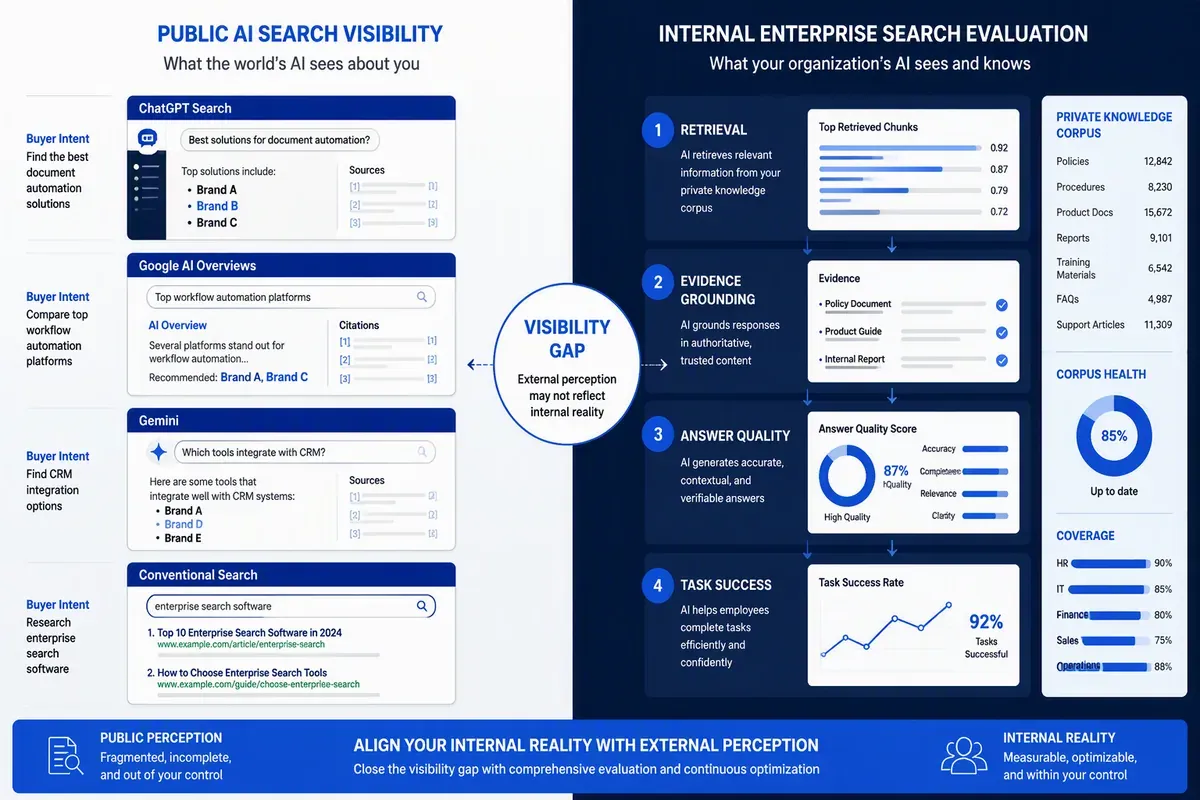
Measuring AI search performance begins by separating public discovery from internal knowledge retrieval. Public artificial intelligence (AI) search shows whether buyers encounter, trust, and act on your brand in Google AI Overviews, AI Mode, ChatGPT Search, Gemini, and conventional results. Internal enterprise search shows whether employees or customers can find dependable information in a private knowledge corpus.
The two systems inform different decisions, so they should not collapse into one dashboard score. Public AI search performance reflects market-facing authority and demand capture, whereas internal evaluation shows whether a knowledge system supports someone trying to complete a task with a correct answer.
Traditional SEO metrics, including keyword rankings, impressions, and click-through rate, still matter. They cannot capture conversational visibility alone. An AI engine may mention your brand without citing it, cite a page without recommending it, or influence evaluation before a visitor reaches your site. How to optimize for AI search starts with treating those outcomes as distinct signals.
Public measurement works across four layers:
- Visibility: Answer presence across a defined set of buyer-intent prompts and relevant AI engines.
- Influence: AI citation share, recommendation prominence, comparative positioning, and competitive share of voice.
- Interaction: Observable referral traffic and engagement where engine data, analytics, or platform logs expose them.
- Revenue: Direct and assisted conversions, paired with evidence that the answer met buyer intent.
Internal search requires its own evaluation framework. Measure retrieval quality, ranking quality, evidence grounding, reasoning quality, final-answer quality, search behavior, and task success separately. First-attempt tests should confirm that answers are correct, factual, relevant, and free of hallucinations. System-health signals can then distinguish a missing source document from a retrieval, ranking, reasoning, or generation failure.
Floyi’s Topical Authority Scorecard trends Content Authority, Market Authority, and AI Authority across your Pillar > Hub > Branch > Resource map. It measures rankings, competitive share of voice, brand visibility, and AI citations while retaining the diagnostic signals behind the composite. Use public metrics to find authority gaps, and internal evaluation to verify the knowledge supporting your content operation.
What Metrics Define Public AI Search Performance?
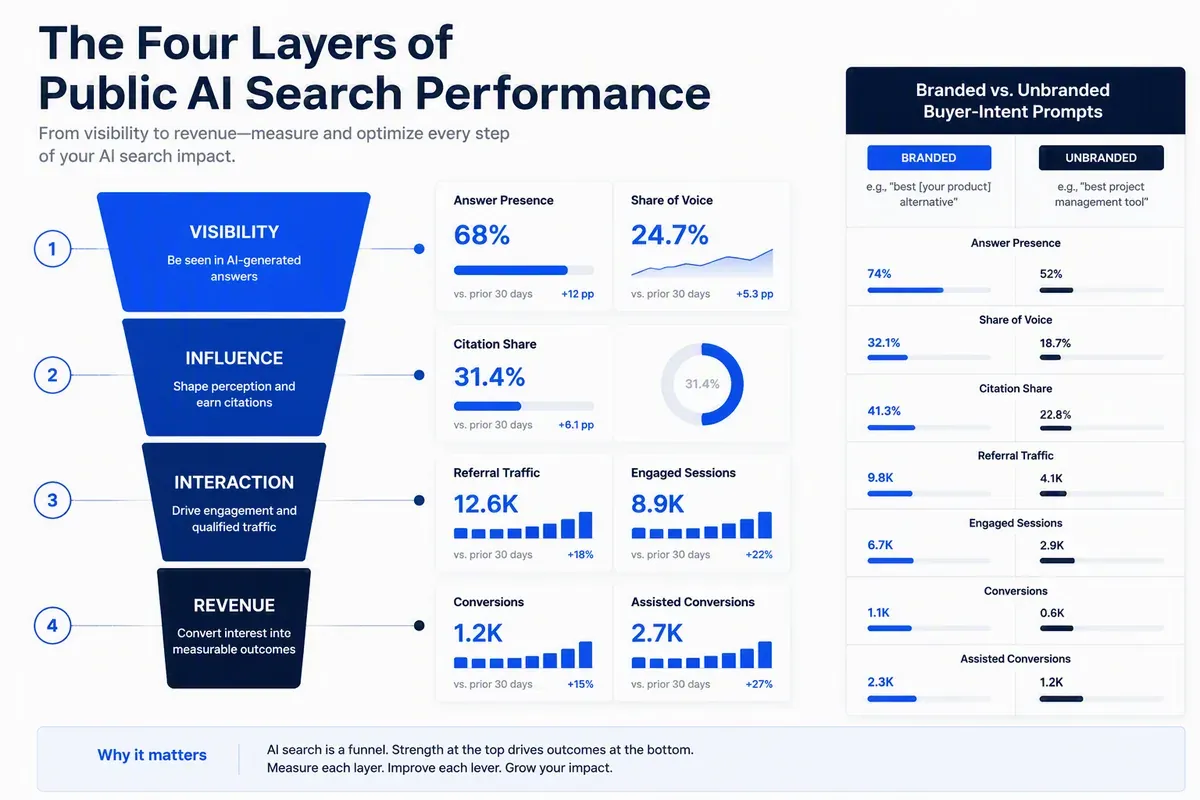
On the public discovery side of that distinction, AI search performance rests on four layers: Visibility, Influence, Interaction, and Revenue. Together, these AI search metrics show whether AI systems mention your brand, use it as a source, recommend it accurately, generate visits, and contribute to commercial outcomes.
| Layer | What it answers | Core measures |
|---|---|---|
| Visibility | Does the brand appear for buyer-intent prompts? | Inclusion rate, prompt coverage, cross-engine presence |
| Influence | Does the model source or favor the brand? | Citation rate, citation share, Share of Voice, Share of Model |
| Interaction | Do AI appearances produce visits? | Attributable referral traffic, click-through rate |
| Revenue | Do those visits contribute to business value? | Conversions, assisted conversions |
Visibility begins with a fixed prompt set built around research and buying intent. Inclusion rate equals the relevant answers that mention your brand or domain divided by all relevant answers tested. Separate branded prompts from non-branded prompts. Branded coverage reflects demand capture, while non-branded coverage shows category discovery and whether answer engine optimization reaches buyers before they know your name.
Influence measures competitive selection rather than mention volume alone. Share of Voice is your percentage of competitor mentions or citations across the tracked prompt set. Share of Model is your portion of recommendations or generative citations within a defined category, making it an AI discovery counterpart to market share when a model returns a shortlist instead of one answer.
Because an unlinked mention is not a source citation, citation rate needs separate treatment: it is the percentage of tested prompts that cite your domain, while citation share compares your presence with every cited domain in those answers. AI citation share and Share of Voice should be retained by Google AI Overviews, AI Mode, ChatGPT Search, and Google Gemini, then weighted by prompt importance. A high-value buying query should not count the same as a generic definition query.
Recommendation quality keeps rising totals from concealing brand risk. Capture the following details for each response:
- Recommendation status: Whether the brand is recommended and its placement in a shortlist.
- Sentiment: Whether the framing is positive, neutral, or negative.
- Accuracy: Whether pricing, features, value proposition, and positioning match the current offer.
An outdated price or invented feature can weaken AI search visibility even when inclusion increases.
Interaction and revenue complete the chain from generative engine optimization to business evidence. Track attributable referral visits and click-through rate, then review conversions and assisted conversions for journeys that touched cited or recommended pages. Stable prompt, page, engine, and treatment identifiers make baseline comparisons credible. Prioritize prompts where visibility rose without citations or engagement, since those gaps point to the content most in need of revision.
Measure Visibility, Citations, and Recommendations
AI search visibility needs three separate signals: a mention, a recommendation, and a primary citation. We classify each tracked answer so brand citations in AI responses do not receive equal value when one merely names your brand and another uses your page as evidence.
Use these classifications for every answer:
- Mention: Any reference to your brand, product, or page.
- Recommendation: A statement that presents your offer as a fit for the user’s stated need.
- Primary citation: An inline link to your domain that substantiates a material claim in the answer.
Report each classification as a share of tracked answers beside answer presence and share of voice. Citation share measures the answers that cite your domain, while share of voice compares your domain citations with every cited domain in those same responses. This makes it clear whether visibility comes from incidental references or evidence-backed recommendations.
Citation prominence measures whether generative citations influence the answer itself. Give more weight to a citation position in the lead summary, direct answer, or central explanation than to one confined to a learn-more module, passing reference, or supplementary source list. A strong score reflects an inline citation that supports a central claim. High citation share with low citation prominence can indicate that your pages are technically present but unlikely to shape user trust.
Placement alone is insufficient. Rate each cited page for topical reputation and demonstrated experience, expertise, authoritativeness, and trustworthiness. Then capture sentiment, category placement, competitor co-mentions, and contextual accuracy. A positive answer still fails the quality check if it misstates your audience, offer, capabilities, or limitations.
An AI citation and provenance audit evaluates grounding at the claim level, not just whether a URL appeared:
- Citation precision: The cited page supports the statement attached to it.
- Citation recall: Every material statement requiring evidence includes a citation.
- Attribution correctness and faithfulness: The response represents the source without distortion or overstatement.
- Context precision, context recall, and response relevancy: The cited material fits both the claim and the user’s question.
Keep these raw classifications beside a composite quality score. Each record should capture the engine, query, page URL, answer presence, whether your domain was cited, cited domains, citation type, prominence, authority, sentiment, support assessment, AI-citation share, and share of voice. Aggregate results by prompt, engine, page, and week to separate a rise in citations from a rise in accurate, primary recommendations.
Answer-first content optimization gives weak records a practical next action: strengthen the lead answer and its supporting evidence, then measure whether prominent, well-supported recommendations increase.
Connect Visibility to Traffic and Conversions
AI visibility begins the outcome path, but it is not the outcome. In Google Analytics 4 (GA4), separate AI referral traffic from organic search so you can determine whether citations produce qualified visits and commercial results.
An AI referral channel grouping should recognize known generative-search referrers and report performance by source and landing page:
| Measure | What it shows |
|---|---|
| Sessions and engaged sessions | Whether AI-referred visitors stay and interact |
| Engagement rate | Visit quality beyond raw volume |
| Key events and conversions | Whether visits produce meaningful actions |
| Conversion rate and revenue | Commercial value by source and page |
| Leads, opportunities, and purchases | Where AI-referred conversions enter the funnel |
Compare this view with organic and direct traffic. A smaller AI cohort can carry more value when the AI conversation has already covered research, comparison, and qualification before the click. Engaged sessions, conversion rates, and attributable revenue are more useful than referral volume alone in that situation.
UTM parameters help measure controlled links in AI-platform tests and campaigns, but tags cannot capture every citation. Untagged referrals and no-click journeys are common. Combine GA4 source and medium data with web-server logs to identify unusual referrers, agent-triggered requests, and broken referral URLs. Requests for removed or redirected pages can indicate that an AI engine attempted to cite an outdated URL.
AI search KPIs also need an assisted-conversion view. Keep the prompt, engine, cited page, answer presence, AI-citation share, share of voice, and outcome fields consistent across your records. This makes it possible to assess whether a cited or recommended page appeared before a later conversion without assigning the entire sale to one touchpoint.
Response quality belongs beside traffic data because a visible mention that users cannot trust will not reliably earn a visit. Review each first answer for:
- Accuracy: Claims match the cited page and source material.
- Relevance: The destination page answers the prompt.
- Traceability: Users can verify claims through accessible source documents.
- Latency: The cited response appears quickly enough to be useful.
- Hallucination risk: The answer adds no unsupported details.
Weak click-through rates, or CTR, often reflect a mismatch between the answer and its destination page. Review AI-referred conversions and assisted conversions alongside response quality before changing content, since the evidence may point to a citation issue rather than a traffic issue.
How Do You Build Reproducible Prompt Benchmarks?
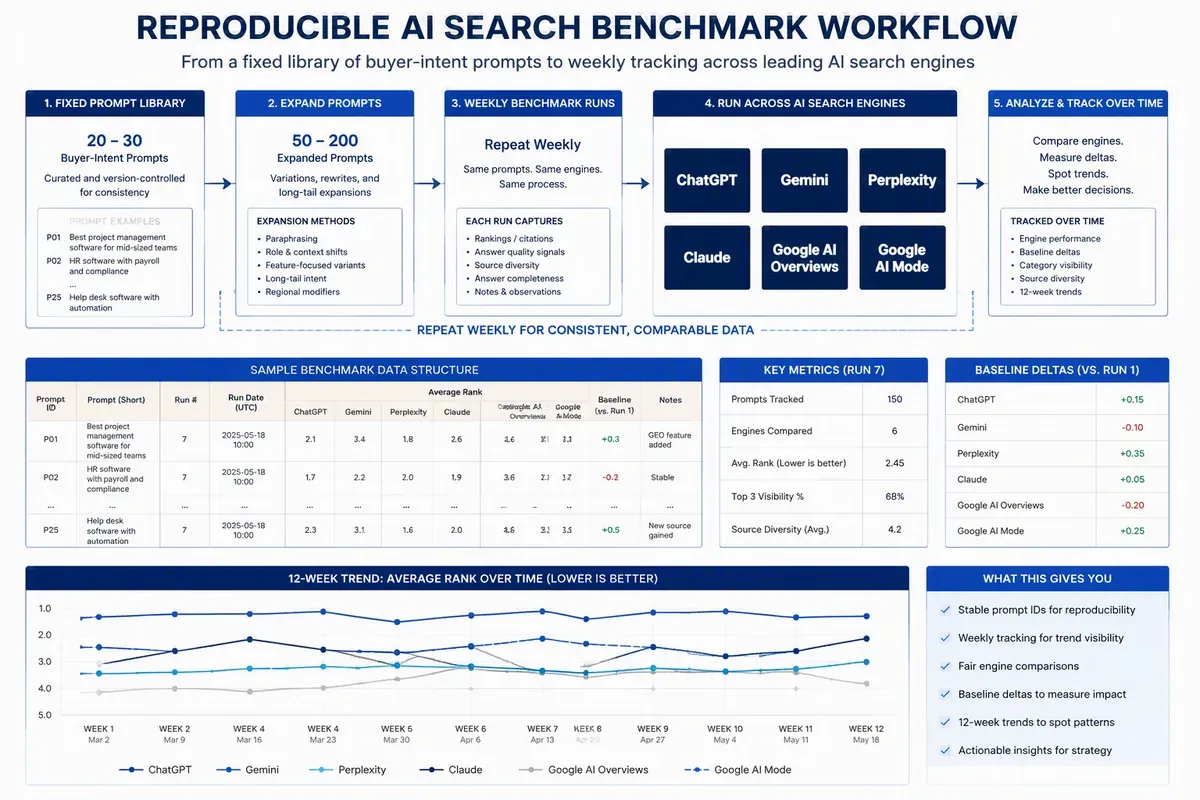
To make visibility, traffic, and conversion signals comparable, benchmarking AI search performance requires a fixed, buyer-relevant prompt library measured repeatedly, not a single answer snapshot. AI responses are probabilistic: session history, retrieval changes, source availability, model updates, and ordinary run-to-run variation can shift citations, wording, and recommendation order. Report averages, ranges, and response counts to separate persistent movement from noise.
Build the benchmark in this sequence:
- Establish the baseline: Manually audit 20 to 30 industry-relevant branded and unbranded questions before scaling to 50 to 200 high-intent prompts where your topical coverage supports it. Freeze exact prompt wording, target market, language, and inclusion rules so every later comparison uses the same query universe.
- Reflect buyer demand: Prompt tracking should mirror questions buyers ask across awareness, consideration, and decision stages. E-commerce sets should include product comparisons, sizing, delivery constraints, and seasonal availability. B2B SaaS sets should cover implementation research, integrations, alternatives, and procurement concerns. Local brands need location-qualified, service-specific, and ambiguous requests.
- Test the difficult cases: Include factual, comparative, multi-step research, freshness-sensitive, ambiguous, adversarial, and long-tail prompts. Generic question-answering datasets often miss the wording and intent patterns that determine whether your brand appears for real buyers.
- Repeat every prompt by engine: Run the unchanged library through ChatGPT, Gemini, Perplexity, Claude, AI Overviews, and Google AI Mode. Keep query and engine IDs stable, then report each platform separately. A composite score can hide a domain that receives frequent citations in Perplexity but little visibility in Gemini.
- Preserve observation-level telemetry: Capture the date and time, engine, exact query, country, language, account state, device context, run number, answer snapshot, cited domains, brand presence, and relevant model, site, or seasonal changes. Retain raw rows with stable fields such as
week_start,engine,query,answer_present,our_domain_cited,cited_domains,ai_citation_share,sov, andnotesbefore dashboard aggregation.
Capture answers weekly, then review Share of Voice and Citation Rate monthly or quarterly against both the original baseline and rolling averages. Use a 12-week observation window to identify durable movement. Log abrupt platform, site, and seasonal changes rather than crediting a one-week citation shift to a page edit.
Your reporting should show repeated-run averages by engine, baseline deltas, and protocol deviations or external changes that may explain volatility. Pair AI visibility measures with click-through rate and assisted conversions to prioritize authority improvements, while reserving causal claims for controlled testing.
Build Buyer-Intent Prompt Sets
A prompt matrix creates a defensible AI search baseline because it retains the way buyers ask for help, rather than reducing their needs to isolated keywords. Conversational AI queries are often longer and can include budget, industry, geography, technical constraints, and the outcome the buyer wants (source).
Use 50 to 200 prompts tied to revenue-critical buyer situations. If your program is new, begin with a focused pilot of 5 to 25 prompts, then expand when intent labels and categories show meaningful coverage. AI search tool evaluation should examine whether a platform retains full prompt wording and supports prompt tracking at this level.
Build the matrix in three passes:
- Map commercial relevance: Connect each prompt to the product, service, or category it may influence, the target persona, and the revenue-critical topic or page that should appear. Match prompt types to your business model:
- Ecommerce: Product fit, alternatives, availability, and delivery constraints.
- B2B SaaS: Workflows, integrations, security requirements, and vendor selection.
- Local businesses: Services, location, hours, and timing needs.
- Balance buyer intent: Include awareness research, consideration-stage evaluation, decision prompts such as “best enterprise software for need,” and direct comparisons. Limit named competitors to the one to three that recur in sales cycles or lead high-intent topics. Keep category recommendation prompts without your brand name, since they show whether the model considers your offering before brand preference shapes the request.
- Test difficult answer conditions: Add cases that reveal weak interpretation, stale details, or unsupported claims:
- Freshness-sensitive prompts: Ask about pricing, availability, policies, releases, or local information that may change.
- Ambiguous prompts: Retain plausible meanings instead of forcing one interpretation.
- Adversarial prompts: Introduce misleading premises, conflicting sources, and spam-like assertions to test whether the engine repeats them.
- Long-tail prompts: Require obscure, specific information that depends on meaningful web browsing rather than familiar factual recall.
Give every record a stable prompt ID, intent stage, persona, product or category, revenue-critical topic, query type, exact prompt text, and expected answer or evidence source. This structure lets you segment citation share, answer presence, recommendation prominence, and conversions by the buyer situation behind each result.
A useful prompt library reflects the decisions that produce revenue, not generic questions that merely fill a dashboard.
Document Sampling and Response Conditions
Repeatable AI search measurement begins with an observation record that makes each response comparable, not merely collectible. For every run in ChatGPT or another engine, capture the exact model or platform surface, local date, timestamp, time zone, test location, language, and device or browser context.
Record the response conditions before evaluating the result:
- Account and session state: Note whether the account was signed in or signed out, whether the session was fresh or continuing, and whether saved history, memory, or personalization was active.
- Response settings: Capture search settings, temperature when exposed, reasoning mode, and web-search mode. Any of these can alter wording, source selection, and domain citations.
- Prompt identity: Keep the buyer-intent prompt text fixed under a stable prompt ID and version. Include the run number, total planned runs, and whether the response followed a query reformulation.
Preserve the complete, unedited response text. A mention flag cannot show whether the first attempt was accurate, relevant, and free of hallucinated claims. SERP monitoring tools for AI-generated results are more useful when the underlying evidence remains available instead of being reduced to a visibility score.
Keep answer quality separate from citation behavior in the sampling log. A response can answer the question well without usable sources, while a heavily cited answer can still be incomplete or wrong. Capture response latency, every cited domain and destination URL, citation placement, and traceability, meaning a reader can open the cited page and verify the specific evidence behind the claim.
Validate every cited or referred URL when you collect it. Store the resolved URL, HTTP status, canonical destination when available, redirect chain, and crawl status. Broken referral URLs can indicate that an engine attempted to cite a page that no longer exists or has moved. Technical crawlability matters because an AI crawler cannot cite a page it cannot retrieve.
When search traces or tool activity are available, retain searches performed, reformulated queries, pages opened, tool calls, elapsed time, unique domains, redundant searches, search depth, early stopping, and conflicting-evidence signals. Stable IDs in CSV or JSON preserve original evidence while making repeated runs comparable by engine, query, prompt version, and observation conditions.
How Do You Benchmark Competitors Reliably?
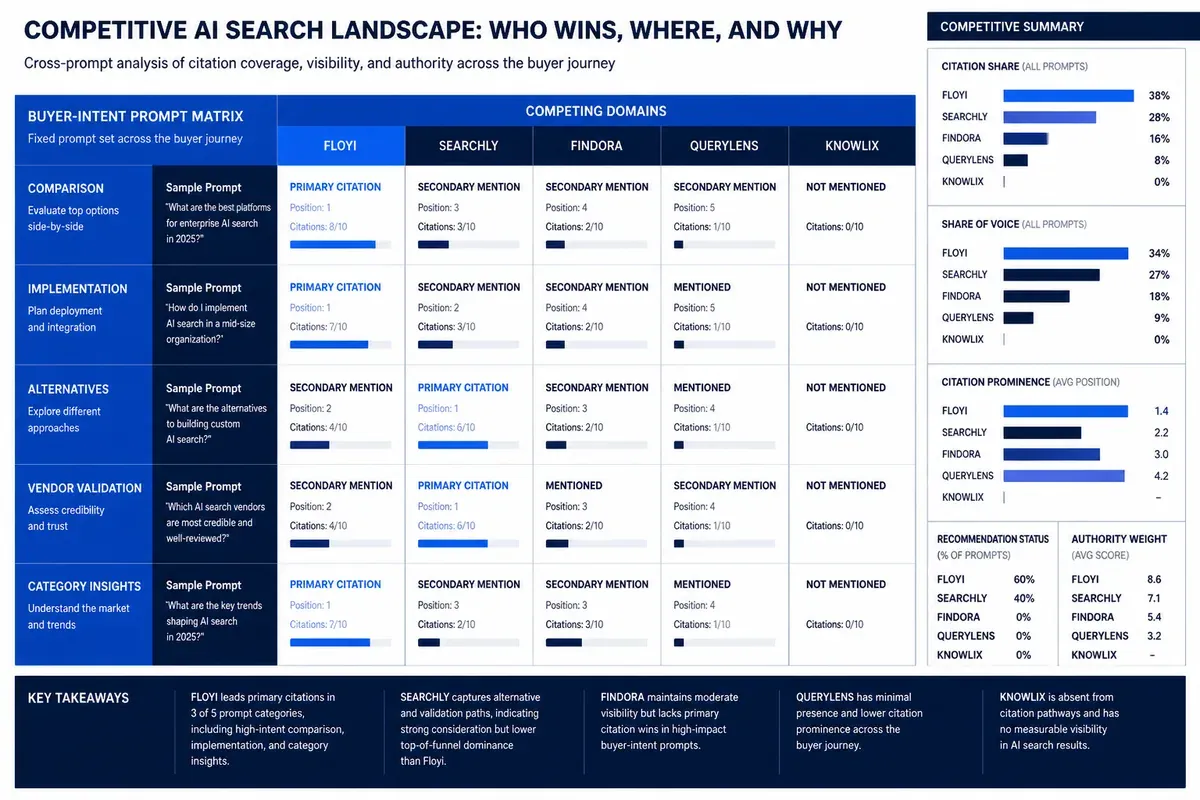
Using the fixed buyer-intent prompts and response conditions, reliable benchmarking AI search performance begins with one to three direct competitors that recur in sales cycles or high-intent buyer prompts, not the largest brands in the category. We keep the prompt set, AI engines, location, and response conditions fixed. With only two to seven domains typically surfaced per answer, broader lists obscure the real inclusion contest.
Test topical authority across adjacent buyer questions, comparison prompts, implementation needs, and broader category queries, not exact-match phrasing alone. Conventional rankings are not a proxy. Ahrefs found that AI-assistant citations show roughly 12 percent URL overlap with Google’s top 10 results. The useful gap is where a competitor appears across related buyer needs while your brand is absent.
An importance-weighted scorecard separates the measures that matter:
| Metric | Calculation | What it shows |
|---|---|---|
| Citation Share | Relevant answers citing a domain ÷ relevant answers measured | How often a domain earns a citation |
| Share of Voice | Brand mentions ÷ all brand mentions | How visible a brand is in the answer set |
| Share of Model | Brand recommendations or citations ÷ category recommendations or citations | A brand’s share of category recommendations or citations, the AI-discovery analogue to market share |
Weight each engine and prompt by commercial importance. A comparison prompt used by active buyers deserves more weight than a broad definition query, even when both support the same topical map.
Brand citations in AI responses need role-level classification:
- Passing reference: The brand appears without a recommendation or source link.
- Recommendation: The model explicitly suggests the product or service.
- Primary citation: The domain supports a substantive claim through a direct source link.
- Citation position: Record whether the link appears in the lead summary, body explanation, or a secondary learn-more list.
- Citation prominence: Apply an Authority Weight so a directly linked lead-summary citation receives more credit than an incidental mention.
A competitor’s advantage may reflect owned guides, third-party validation from G2, Forbes, Business Insider, or review sites, machine-readable structured data, recent public relations, recurring source overlap, or technical crawlability. Audit cited URLs and source domains, but treat each finding as a plausible driver rather than causal proof.
Weekly telemetry makes the benchmark repeatable because we use stable IDs for engine, query, page, cited domains, answer presence, Citation Share, Share of Voice, model updates, major site changes, and protocol deviations. Pair visibility trends with click-through rate and assisted conversions, because a one-week answer change does not establish durable competitive movement.
Floyi’s Authority Planner can connect validated gaps to the relevant Pillar, Hub, Branch, and Resource pages, giving your next content priority a measurable evidence trail.
How Do You Prove Content Caused Citation Gains?
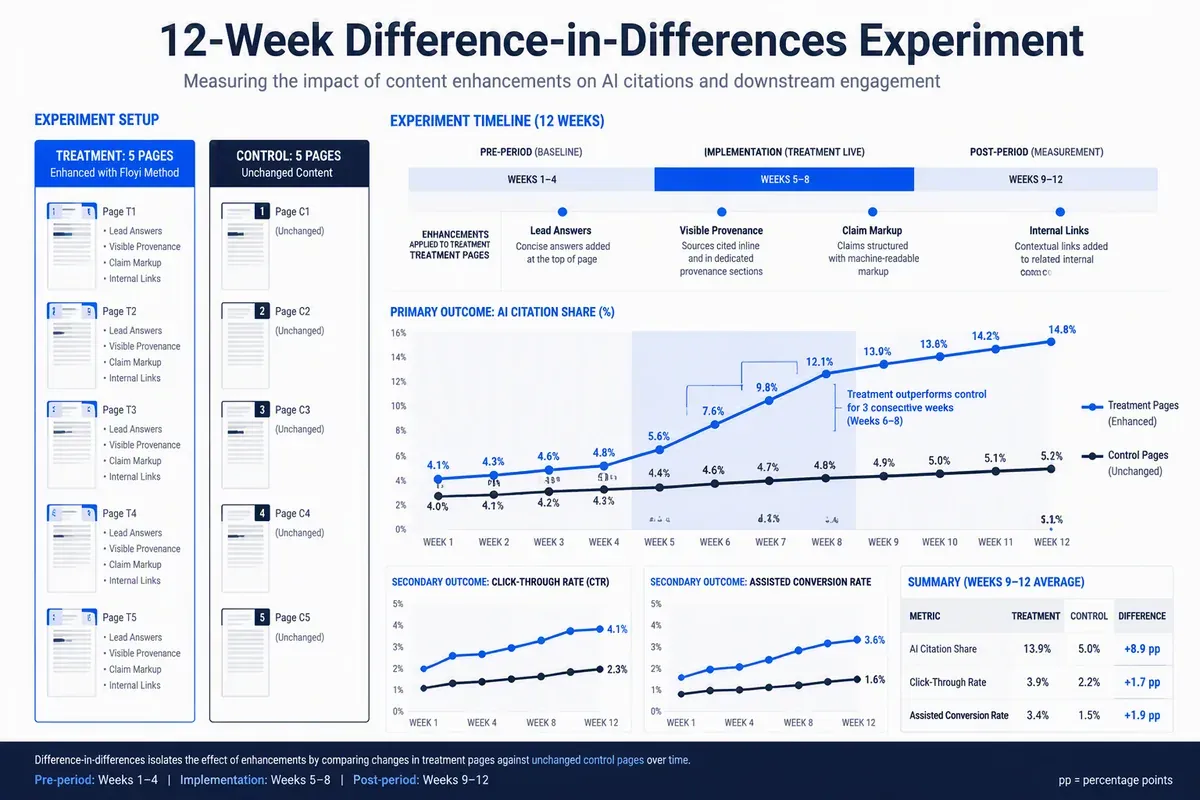
Beyond identifying competitor gaps, you can attribute citation gains to content only when a preplanned intervention beats a matched control group over time. A before-and-after snapshot cannot separate your work from model releases, retrieval changes, personalization, seasonality, or site updates.
Before publishing, preregister a 12-week hypothesis and define the eligible buyer-intent pages, fixed query set, primary AI citation-share metric, intervention, analysis method, and success threshold. This limits post hoc choices that can make a favorable result appear more convincing than it is.
Use ten pages within the same language, country, and topical scope. Pair pages by intent, traffic, crawlability, and internal-link depth, then randomly assign five to treatment and five to unchanged control. Apply the same package only to treatment pages:
- Lead answer: Add a direct 40- to 80-word answer near the top of each page.
- Visible provenance: Include the author, publication date, and evidence supporting the claim.
- Claim markup: Add structured claim markup with FAQPage or HowTo schema where it fits.
- Internal context: Add one descriptive internal link from a relevant page.
Freeze unrelated changes for the full test window. A product revision, title rewrite, or additional internal link can contaminate the comparison.
Capture a pre-change baseline, then collect the identical prompts across every tracked AI search surface each week from week 1 through week 12. Stable page, query, engine, and variant identifiers keep the telemetry comparable. Record answer presence, domain citation, cited domains, AI citation share, share of voice, response conditions, model updates, site releases, seasonality, and protocol deviations.
Difference-in-differences estimates incremental impact:
lift = (Treatment_week12 - Treatment_week1) - (Control_week12 - Control_week1)Set the success threshold before the test begins. We use treatment exceeding control by at least 10 percent in AI citation share for three consecutive weeks as an internal working standard, not a published industry benchmark. Calibrate your own once you can see normal week-to-week variation in your query set. Then check whether click-through rate, assisted conversions, and AI-referred conversions move in the same direction. Citation lift can still identify useful content signals, but it does not establish revenue impact on its own.
Citation frequency also needs a separate quality review:
- Citation precision: Whether each cited source supports its associated claim.
- Citation recall: Whether important evidence-dependent claims receive citations.
- Source quality: Whether cited sources have appropriate authority.
- Attribution correctness and faithfulness: Whether the answer accurately represents its sources.
- Context precision, context recall, and response relevancy: Whether retrieved evidence is relevant, sufficiently complete, and useful in the response.
High answer accuracy can coexist with poor citation behavior, and well-supported citations can accompany an inaccurate answer. Keep public-search retrieval, generated-answer quality, and agent task performance distinct so better summarization is not mistaken for stronger search visibility.
Publish the page list, fixed queries, weekly telemetry, preregistration, methods, analysis notebook, and license under one canonical URL. That record makes the result reproducible while exposing tradeoffs among groundedness, citation quality, task success, latency, and cost.
How Do You Turn Gaps Into Authority Work?
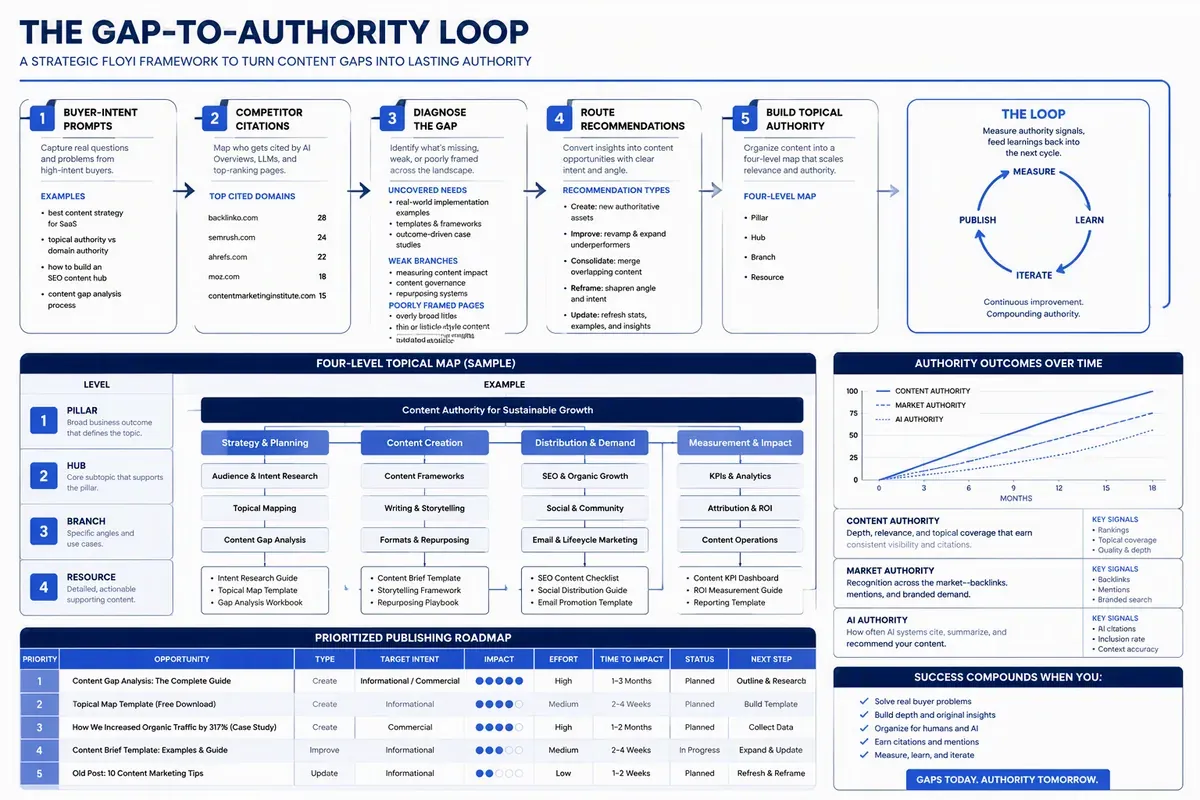
The Gap-to-Authority Loop converts benchmark misses into a publishable roadmap tied to the buyer journeys your brand needs to own, rather than a backlog of isolated AI search fixes.
- Map each buyer-intent prompt to its persona, brand context, and position in the Pillar, Hub, Branch, and Resource map. Test whether AI systems recognize your domain across the defined subject, not just an exact phrase. A missing citation can reveal an uncovered Resource, while a weak response in an established area may show that a Branch lacks sufficient evidence.
- Diagnose the failure before changing content. Assess retrieval quality, evidence quality, reasoning quality, answer quality, and user task success. Distinguish absent or uncited mentions from inaccurate framing, weak recommendation prominence, and cited answers that still do not help the reader complete the task. For priority journeys, track the share of tasks completed with correct, well-supported answers within defined time and cost limits.
- Review competitor citations as evidence of a wider advantage. Identify the domains that dominate recommendations in core categories, the assets AI systems cite, and the sources supporting those assets. Structured data, public relations, and credible third-party validation from Reddit or G2 can explain visibility that page depth alone cannot. Evaluate Citation Share, Authority Weight, Sentiment and Framing, and Coverage Gaps together, because an unfavorable mention does not indicate authority.
- Prioritize the smallest credible intervention. Buyer value, importance-weighted AI presence, and competitive pressure should determine where effort goes:
- Uncovered need: Build a new Resource.
- Weak Branch: Improve sources, internal links, and semantic coverage.
- Poorly framed cited page: Revise the existing page substantively rather than publishing a duplicate.
Hub-level coverage targets keep topical scope useful. Stop expansion when adjacent subjects are redundant, carry little buyer intent, or introduce cannibalization risk.
- Keep execution and measurement connected to the same map. Authority Planner surfaces high-importance unpublished topics with Google Search Console performance, matched URLs, internal-link context, and AI or search evidence. Its briefs and drafts retain the persona and brand rules behind the decision, while entity-gap views classify concepts as missing, covered, or overused.
KPI reviews should connect shipped work to authority and business outcomes. Content Authority measures coverage and performance for published pages. Market Authority reflects your share of total ranking value. AI Authority measures importance-weighted mentions and citations across AI Overviews, AI Mode, ChatGPT Search, and Gemini. Pair these with referral traffic, assisted conversions, citation share, sentiment, and task-success signals through AI search KPIs and ROI.
Use each review to expand, strengthen, revise, or deprioritize the mapped area with the clearest evidence.
Floyi’s Topical Authority Scorecard keeps this baseline in one place, trending Content, Market, and AI Authority against your topical map week over week. Start your scorecard.
AI Search Measurement FAQs
These FAQs cover the measurement decisions that make AI search performance comparable over time, from benchmark cadence and prompt-set size to the difference between a mention and a citation.
1. How Often Should You Run AI Search Benchmarks?
Capture answers weekly, then review Share of Voice and citation rate monthly or quarterly against both the original baseline and rolling averages. Use a 12-week window to judge durable movement. AI responses are probabilistic, so session history, retrieval changes, source availability, and model updates all shift results from run to run. A single week isn’t a trend. Log abrupt platform, site and seasonal changes rather than crediting a one-week citation shift to a page edit.
2. How Many Prompts Does a Reliable Benchmark Need?
Start by auditing 20 to 30 branded and unbranded questions by hand, then scale to 50 to 200 high-intent prompts where your topical coverage supports it. If the program’s new, a pilot of 5 to 25 prompts is enough to begin. Expand once intent labels and categories show real coverage. Freeze the exact wording, target market, language, and inclusion rules before you scale, so every later comparison runs against the same query universe.
3. Is a Brand Mention the Same as an AI Citation?
No. An unlinked mention isn’t a source citation, and the two need separate treatment. Citation rate is the share of tested prompts that cite your domain. Citation share compares your presence against every cited domain in those answers. Share of Voice measures your percentage of competitor mentions across the tracked prompt set, and Share of Model measures your portion of recommendations inside a category. Weight presence the same way every week: absence as 0, an unlinked mention as 0.5 and a citation as 1.0.
4. Can Google Analytics Alone Measure AI Search Performance?
No. Rankings, impressions and click-through rate still matter, but they can’t capture conversational visibility on their own. An engine can mention your brand without citing it, cite a page without recommending it, or shape an evaluation before anyone reaches your site. Pair analytics with answer presence, AI citation share and assisted conversions. Report each engine separately, because a blended score hides a domain that earns frequent citations in one engine and almost none in another.
Sources
- source: https://arxiv.org/html/2311.09735v3
- source: https://arxiv.org/html/2601.06007v2
- source: https://arxiv.org/html/2602.16942v1
- source: https://arxiv.org/html/2607.04282v1
- source: https://xbench.org/agi/aisearch
- ClickCease: https://clickcease.com
About the author

Yoyao Hsueh
Yoyao Hsueh is the founder and CEO of Floyi, the topical authority platform, and the founder of Main Heading, an SEO and AI search agency. He created Topical Maps Unlocked, a course studied by thousands of SEOs, content strategists and digital marketers, founded TopicalMap.com, a done-for-you topical mapping service for agencies and enterprise teams, and publishes the weekly Digital Surfer newsletter on SEO, content strategy and AI search.
About Floyi
Floyi is a closed loop system for strategic content. It connects brand foundations, audience insights, topical research, maps, briefs, and publishing so every new article builds real topical authority.
See the Floyi workflow