11 Best SERP Monitoring and AI Visibility Tools
Compare 11 SERP monitoring tools for AI-generated results, with Floyi as the best overall for SERP rankings, AI mentions, citations, and topical tracking.
Choosing SERP monitoring and AI visibility tools now means balancing live rankings with AI answer tracking. SEO teams often see one picture in Google and a different one in ChatGPT, Perplexity, or Gemini, which makes reporting messy fast. SERP monitoring tracks how a brand appears in search results, while AI visibility tools show mentions, citations, and sentiment inside generated answers. The comparison here shows which platforms fit that reality and where Floyi gives teams the clearest read.
Across the 11 reviews, the comparison covers Google AI Overviews, ChatGPT, Perplexity, citations, source URLs, Share of Voice, pricing, and agency versus in-house fit. It also shows which tools are better for fast checks, which ones support deeper reporting, and which ones connect visibility to topical strategy. Expect a practical decision framework for choosing between a lightweight tracker, a broader SEO suite, and a closed-loop platform.
These comparisons sit downstream of how to benchmark AI search performance. SEO operations managers, agency strategists, content operations directors, and multi-site brand marketers need a tool that can explain why a brand appears in one engine and disappears in another. One example in the comparison shows a brand cited in Perplexity but missing from Google AI Overviews, which points to a content gap rather than a ranking issue. Floyi is positioned for teams that want live SERP signals tied to brand voice, buyer intent, briefs, and ongoing monitoring. Teams that would rather drive it conversationally can run the same checks through Floyi’s MCP server for SEO, straight from a chat.
SERP Monitoring and AI Visibility Key Takeaways
- AI visibility requires mention, citation, and sentiment tracking.
- Google AI Overviews need browser-level SERP monitoring.
- Floyi combines 11-engine coverage with topical map tracking.
- Share of Voice reveals competitive visibility beyond snapshots.
- Historical answer storage helps teams track volatility over time.
- Lightweight tools suit audits, while enterprise platforms fit governance.
- Strong stacks pair SEO suites, AI visibility, and content execution.
Which Tools Rank Highest For AI SERP Monitoring?
The same brand can surface differently in Google AI Overviews, Bing Copilot, ChatGPT, Perplexity, Gemini, Claude, and other AI-generated results. That makes tool selection harder because the right platform depends on how many engines you need to cover, whether you need citation-level detail, and how tightly monitoring connects to your AI search performance measurement workflow. The comparison below evaluates each tool on platform coverage, citation and mention tracking, pricing fit, and use case alignment so you can match the stack to the team.
The comparison lens is straightforward:
- Platform coverage across AI and traditional search sources
- AI citations, source links, brand mentions, sentiment, and competitor presence
- Pricing fit for agency, in-house, and multi-site workflows
- Use case fit for content planning, technical SEO, and visibility reporting
Multi-platform monitoring matters because visibility shifts by engine, prompt style, and funnel stage. A citation in one system may show up as only a brand mention in another. Agencies, content operations teams, and multi-site brands need that broader view if they want reliable AI SERP monitoring instead of isolated AI Overview checks.
| Tool | Best fit | Pricing signal | Why it stands out |
|---|---|---|---|
| Floyi | Best overall for strategy-led visibility | Free plan, 500 credits, no credit card required | 11-engine coverage and topical map tracking |
| Ahrefs | Backlinks and keyword depth | $99 to $699/month | Strong link and keyword data |
| Semrush | Technical SEO workflows | Around $119 to $449/month | Broad SEO suite for larger teams |
| Nightwatch | Rank tracking plus large language model (LLM) visibility | Pricing varies | One view for classic rankings and AI tracking |
| Peec AI | Share of Voice and brand perception | EUR 90 to EUR 499/month | Strong brand-level reporting |
| Otterly.AI or Keyword.com | Lower-cost tracking | Around $29 to $99/month | Budget-friendly entry point |
| Profound or seoClarity | Enterprise visibility | Enterprise pricing | Better for larger programs and governance |
Across the full 11 reviews, each tool gets a fast answer on who it serves, which platforms it covers, whether it tracks citations and mentions, how it fits agency versus in-house work, and where it falls short. Ahrefs still wins for backlinks and keyword depth, while Semrush stays strong for technical SEO workflows. Floyi is the strategy layer you pair with those tools, not a replacement for them.
1. Floyi — Best Overall For Strategy-Led Visibility
Floyi is the stronger fit when your team needs AI visibility monitoring connected to the strategy and content system that acts on it. Most tools in this list track mentions or citations and stop there. Floyi ties monitoring to brand foundation, audience insights, topical maps, briefs, drafts, publishing, and authority measurement in one closed-loop workflow, which means the signal feeds execution instead of sitting in a dashboard.
Floyi tracks 11 engines: Google AI Overviews, AI Mode, ChatGPT Search, Perplexity, Gemini Grounding, Claude Web, Bing Copilot, OpenAI Web, and traditional Google and Bing SERPs. Each tracked query shows whether your brand is Mentioned, Cited, or Not Present, with full response text, source URLs, and ChatGPT web search queries when available. Separate delta indicators for SERP rankings and AI citations make it easier to see when ranking movement and citation movement diverge, which matters because a brand can rank well in traditional search and still be absent from AI answers.
The practical edge shows up in how monitoring connects to action:
- Topical map-anchored tracking instead of disconnected keyword lists
- Brand aliases for improving AI Overview name matching
- SOV Leaderboard showing Top 10, Top 20, or Top 100 domains with per-domain AI citation breakdowns
- Country, language, and location controls for localized tracking
- Daily, weekly, or manual refresh scheduling
- AIRS Analyzer for on-demand, per-query analysis across 10 AI engines and 2 SERPs — see the full AIRS Analyzer guide for setup and interpretation
| Need | Floyi fit |
|---|---|
| Strategy-led monitoring | 11-engine coverage tied to topical maps and brand strategy |
| Content execution | Briefs, drafts, and WordPress or GitHub publishing fed by live SERP and AI signals |
| Agency workflows | Per-client workspaces, exportable maps, authority scores, and up to 15 users on Scale |
| Competitive benchmarking | Competitor tables, SOV leaderboards, trend deltas, and silo-level heatmaps |
Pricing sits in the mid-market range. The Free plan includes 500 credits with no credit card. Pro is $99 per month and Scale is $299 per month with 50,000 credits and 8 seats, which puts it between entry-level trackers at $20 to $29 per month and enterprise platforms at $399 and up.
The tradeoff is scope. Floyi does not replace Ahrefs for backlink analysis or Semrush for technical audits and crawl diagnostics. It does not offer real-time NLP content scoring while you write, where Clearscope and Surfer are stronger. White-label reporting is not yet available, which matters for agencies that need fully branded client exports. And if your only job is lightweight keyword rank tracking, the platform will feel heavier than what you need. Choose Floyi when monitoring needs to feed topical authority, content production, and publish-ready next actions across AI and traditional search.
2. Semrush — Best SEO Suite With AI Tracking
Semrush is the better fit when you want AI visibility monitoring inside a broad SEO suite instead of a standalone AI-first workflow. It still covers keyword research, technical audits, backlink analysis, reporting, and classic SERP tracking. Semrush One starts around $139 per month based on published pricing, so it makes sense for teams already deep in the platform.
Its AI tracking layer is broader than many buyers expect:
- Position Tracking filters for AI Overview visibility
- AI Overview citation tracking to show whether your pages are used as sources
- Competitor mention tracking across AI answers
- Prompt-level reporting for specific queries
- An AI Visibility Index for ChatGPT and Gemini
- Brand Narrative analysis that shows how AI systems describe your company
That matters for optimizing content for answer engines because the view moves beyond rankings. You can see prompt-level visibility, citation presence, competitor inclusion, and whether AI answers frame your brand correctly. For GEO work, that is the difference between ranking and being represented well inside the answer itself.
| Tool fit | Best when you need | What it does best |
|---|---|---|
| Semrush | One platform for SEO operations plus AI tracking | Broad SEO, reporting, audits, and AI visibility inside an existing suite |
| Floyi | AI visibility tied to brand strategy and content production | Brand foundation, audience insights, topical maps, briefs, drafts, publishing, and tracking in one closed-loop system |
The stack call is straightforward. Many teams will keep one traditional SEO platform and one specialized AI visibility tool because the category is still early. Semrush works well as the suite layer if you already depend on it, while Floyi fits better when you want AI visibility tied to topical strategy and content execution, not just reporting.
Choose Semrush if you want an all-in-one SEO operations platform with AI tracking added. Choose Floyi if you care most about monitoring AI visibility across 11 engines with map-anchored tracking that reflects your brand, audience, and topical strategy.
3. Ahrefs — Best For Brand Radar And Citations
Ahrefs is a strong fit when your team already relies on enterprise SEO workflows and wants AI mention tracking, citation intelligence, backlinks, and brand visibility signals in one place. That keeps you from adding a separate dashboard just to see how authority shows up in AI answers. For mature SEO programs, the real win is staying close to the data you already trust.
Brand Radar gives you broad prompt coverage across major AI surfaces. Ahrefs describes its prompt database as 250M+ search-backed prompts drawn from real search behavior, not synthetic queries. That figure grows as Ahrefs expands coverage, so check the current count on their product page before you commit. The practical takeaway is simple. Broader coverage across ChatGPT, Gemini, Google AI Overviews, brand mentions, and citations makes Ahrefs’ Brand Visibility Score more useful because it reflects more of the surface your audience actually sees.
Brand Radar’s citation view is the other reason teams stick with it. You can see which source URLs Google or chatbots cite in AI-generated answers, then tie wins or gaps back to content, backlink authority, and digital PR. That makes AI visibility feel connected to organic authority instead of separate from it.
| Situation | Ahrefs fit |
|---|---|
| Already using Ahrefs | Cost-effective and easy to extend |
| Need only lightweight AI monitoring | Feels heavy next to $7.80 to $29 per month tools |
| Need mid-market AI tracking | Comparable to $59 to $129 per month options |
| Need broader SEO plus AI visibility | Strong all-in-one choice |
One competitor reports Brand Radar is free with any Ahrefs subscription that starts at $129 per month, with Brand Radar included on Advanced+. Most teams still pair one broad SEO platform with one specialized AI visibility tool.
4. Nightwatch — Best For Rank And LLM Tracking
Nightwatch is a smart hybrid choice when you still need Rank tracking and LLM visibility in one reporting flow. It keeps traditional SERP monitoring beside generative search tracking, which helps agencies that cannot replace legacy reports overnight.
The AI side goes beyond presence checks. Nightwatch combines traditional rank monitoring with tracking of the searches AI engines use to build answers, plus Citation-level sentiment analysis. That lets you see whether a brand shows up as positive, neutral, or negative at the mention level. For teams watching LLMs, that nuance is where the signal lives.
Local depth is another practical edge. Competitor research shows Nightwatch and AccuRanker can go down to ZIP code-level tracking. That makes Nightwatch useful for multi-location brands, local agencies, franchises, and service-area businesses that need to compare rankings and AI visibility by market.
| Need | Nightwatch fits well when you want… | Consider instead when… |
|---|---|---|
| Unified monitoring | Ranks, local positions, and AI citations in one place | SE Ranking or Peec AI better match your agency workflow |
| Enterprise scale | Dedicated rank-plus-LLM tracking without a broader suite | Profound or seoClarity fit enterprise programs better |
| Lower spend | Leaner tracking with fewer moving parts | Otterly AI or Keyword.com is the tighter budget fit |
| Full-suite SEO | A specialized monitoring layer, not a broad platform | Semrush or Ahrefs matters more than AI-specific depth |
The tradeoff versus Floyi is straightforward. Nightwatch is compelling when you want unified monitoring, rank tracking, and citation-level sentiment in one reporting environment. Floyi is stronger when those signals need to feed topical maps, briefs, and content execution.
5. Peec AI — Best For AI Share Of Voice
Peec AI is strongest when you need prompt-level AI Share of Voice, not a broad SERP suite. Prompt Share of Voice shows how often your brand appears across relevant AI queries compared with competitors. It helps you see when LLM answers mention you, skip you, or favor a rival.
Its workflow is simple. You track prompts, map brand mentions across multiple LLMs, and compare that visibility against competing brands on commercial, informational, and category searches. The Share of AI Voice view makes competitor benchmarking clearer because it shows who gets surfaced most often in the same prompts.
The daily snapshot model makes Peec AI useful for agencies. Instead of a one-time audit, you get recurring evidence of brand presence, share shifts, and sentiment changes over time. That gives client teams repeatable reporting without buying an enterprise monitoring stack.
Sentiment tracking adds another layer. A brand can appear often and still show up in weak, negative, or competitor-led framing. Pricing and fit are easier to judge with a quick market view:
| Tool tier | Typical monthly range | Best fit |
|---|---|---|
| OtterlyAI | $29/month | Entry-level AI visibility checks |
| Low-cost options | $7.80-$29/month | Lightweight tracking |
| Peec AI | EUR 90-EUR 499/month | Mid-market AI Share of Voice monitoring |
| Enterprise suites | Up to $1,499/month | Large-scale monitoring programs |
Peec AI is a solid choice for teams focused on brand analysis, prompt coverage, daily snapshots, and sentiment. Use it when AI Share of Voice monitoring is the main job and you do not need a broader content execution workflow.
6. Profound — Best Enterprise AI Visibility Platform
Profound is the right choice when you need enterprise AI visibility intelligence, not a lightweight rank tracker. It fits Fortune 100-style evaluations because it monitors 10+ engines in real time and adds the Brand Visibility Score, Prompt Volume Research, and Conversation Explorer. For SEO and content leaders, the real value is simple: it measures the AI conversation, not just a blue-link position on the SERP.
That shift changes how you read the data. Profound shows where your brand appears, how often competitors enter the answer, and which prompts or audience questions shape AI recommendations. That makes it more useful than many AI visibility tools that stop at mentions or snapshots and never connect those signals to the surrounding conversation pattern.
A quick budget view makes the fit clearer:
| Tool tier | Typical starting point | Best fit |
|---|---|---|
| Entry-level AI visibility tools | $7.80 to $29/month | Occasional GEO checks and small teams |
| Broader enterprise AI monitoring tools | $99 to $1,499/month | Larger programs with mixed requirements |
| Profound | $399/month | Enterprise brands needing dedicated AI visibility intelligence |
Profound also earns its place on technical scale. Competitor research points to content delivery network integration capabilities and real-time traffic analysis, which makes it a better match for large, complex sites than for small businesses running occasional GEO checks. That enterprise orientation is why it belongs lower on a broad best-tools list for most SEO teams, but higher for brands that need executive reporting, deeper integrations, and room to grow.
seoClarity ties AI visibility metrics to traffic and conversion impact, and Conductor links AI mentions to content performance for AEO and GEO strategy. Profound’s edge is its AI-native visibility layer, prompt intelligence, and conversation-level exploration.
7. OtterlyAI — Best Entry Level GEO Audits
OtterlyAI is a lean pick for GEO audits when you need visibility, not a full strategy stack. At the low end, competitor data places OtterlyAI at $29/month. That keeps it close to Rankscale AI’s $20/month basic tracking. For teams testing Generative Engine Optimization, it’s one of the cheapest dedicated AI search monitoring entry points.
Daily AI visibility tracking, brand representation, citations in AI summaries, competitor visibility, and mention-change alerts are its core strengths. That early-warning layer shows when large language model answers cite your brand, leave it out, or misstate it. SE Ranking also describes Otterly AI at $29/month for location-focused GEO audits with 25+ technical factors, which makes it practical for small SEO teams, local marketers, and agencies.
The tradeoffs are easier to see in comparison:
| Tool | Starting price | Best fit | What stands out |
|---|---|---|---|
| OtterlyAI | $29/month | Entry-level GEO audits | Daily visibility, alerts, citations, location focus |
| Rankscale AI | $20/month | Basic tracking on a tight budget | Simpler and cheaper |
| Leapd | Not listed here | Teams wanting guidance | AI agent audits sites, tracks 7+ AI platforms, and gives recommendations |
| Floyi | Free to $299/month | Teams needing a closed-loop system | Topical maps, SERP rankings, citations, content audits, briefs, and publishing workflows |
Leapd is the better step up if you want recommendation-led workflows, because its AI agent approach goes beyond raw monitoring. OtterlyAI makes more sense when you only need affordable mention, citation, competitor, and disappearance alerts. Floyi is stronger when you want AI visibility tied to strategy and publishing. For low-budget teams validating the channel, OtterlyAI is the right first buy. For teams that need a closed-loop monitoring-to-execution system, it’s too limited.
8. AccuRanker — Best For Fast SERP Refreshes
AccuRanker is the speed-first pick when you need a fast read on SERP rankings after a content update, technical fix, link change, or client request. Its on-demand keyword refreshes skip the usual 24-hour wait, so you can confirm whether an optimization moved the needle before the next crawl slows the decision.
That speed matters when you want classic rankings and AI discovery signals in the same workflow:
| Need | AccuRanker fit |
|---|---|
| Fast verification | On-demand refreshes for near-immediate SERP checks |
| AI visibility | AccuLLM prompt tracking across ChatGPT, Perplexity, and AI Overviews |
| Local precision | ZIP-code-level location tracking |
| Reporting style | Better for proof of change than deep narrative reporting |
AccuRanker’s AI value is practical. You can check whether a page or brand appears in AI Overview contexts, then use repeated refreshes to watch directional movement in rankings, prompt-level visibility, and AI presence. That makes it a strong choice when one snapshot feels too thin but a full reporting cycle feels too slow.
The caveat is important. A single daily AI or SERP snapshot can be noisy, so the better use is quick verification followed by a few refreshes to confirm the trend. Advanced Web Ranking is stronger when you want to compare AI Overview citations with traditional organic URLs and study impact in more depth. SEOMonitor fits better when you need share-of-voice reporting plus AI visibility for agency dashboards. AccuRanker sits in the faster-verification lane.
That lane matters for franchises, service-area businesses, and regional campaigns, where results can shift by city or ZIP code. Nightwatch is also known for similar location granularity, which makes the category especially relevant for local work. If you already have reporting in place and just need faster proof that an optimization changed what users see, AccuRanker is a strong fit.
9. SE Ranking — Best Value AI Search Toolkit
SE Ranking is a strong value pick if you want dedicated AI search monitoring without moving into enterprise-priced platforms. It sits in the mid-market value band, where competitor research puts many tools around $49 to $130 per month, while the broader market stretches from ProRankTracker at $13.50 per month to custom enterprise pricing from STAT and BrightEdge.
Its AI Results Tracker, part of the AI Search Toolkit, is the main reason it stands out. The system monitors brand visibility daily across Google AI Overviews, Gemini, ChatGPT, and Perplexity, so your team can review the major AI answer surfaces from one dashboard instead of checking each engine by hand.
A quick fit check looks like this:
| Need | SE Ranking fit |
|---|---|
| Daily AI answer monitoring | Strong |
| Cached AI SERP review | Strong |
| Source-link validation | Strong |
| Competitor visibility comparison | Strong |
| Closed-loop topical planning and publishing | Limited |
That evidence layer matters. Cached AI-powered Search Engine Results Pages (SERPs) show what actually appeared. Source links show whether visibility came from your own pages, third-party coverage, or a rival domain. Brand mention tracking adds another signal, so you can see when AI results name your company even if the link profile changes.
Competitive benchmarking is another real strength. SE Ranking can compare brand visibility against rival domains and track Share of AI Voice over time. That makes it useful for agencies and in-house teams that need to show whether a brand is gaining or losing answer presence versus known competitors.
The caution matters too. Daily monitoring is most useful in volatile categories like SaaS, finance, health, and AI Overview-heavy SERPs. In those environments, the smart move is to watch directional trends in mentions, citations, source inclusion, and Share of AI Voice. A single day’s snapshot can be noisy.
For budget-conscious teams that need practical AI visibility tracking plus competitor context, SE Ranking lands in a smart middle ground. It is less ideal if you need a closed-loop workflow that connects monitoring to topical maps, briefs, and publishing.
10. Mangools — Best Lightweight AI Monitoring
Mangools is a strong fit when you want low-cost, lightweight AI monitoring without paying for an enterprise AI visibility suite. That places it in the entry-level band where AI monitoring options start around $7.80 to $29 per month, which is easier to justify than mid-market tools at $59 to $129 per month or enterprise platforms that can run $99 to $1,499 per month. Small Search Engine Optimization (SEO) teams, freelancers, and lean content teams usually care more about quick keyword checks and simple workflows than deep LLM intelligence.
Compare the fit across the budget tier:
| Option | Typical price point | Best fit |
|---|---|---|
| Mangools | Entry-level | Basic visibility checks and simple workflows |
| Rankscale AI | About $20/month | Simple AI visibility tracking |
| OtterlyAI | Starts around $29/month | Lower-cost Generative Engine Optimization (GEO) audits |
| Mid-market tools | $59 to $129/month | Deeper reporting needs |
| Enterprise platforms | $99 to $1,499/month | Broad monitoring programs |
Rankscale AI and OtterlyAI keep Mangools in the same affordability conversation, so the real question is how much AI monitoring depth you need.
The tradeoff is depth. Mangools can keep lightweight tabs on visibility, but teams that need advanced evidence logging, historical AI answer storage, citation source tracking, sentiment analysis, or Share of Voice across ChatGPT, Perplexity, Gemini, and Google AI results will probably outgrow it. Nightwatch is a better fit for combined SEO and AI tracking, and Peec AI goes deeper on AI Share of Voice. If your buying requirement is classic rankings plus AI citations in one view, Mangools should not be treated as a full hybrid rank-and-citation platform.
11. Scrunch AI — Best For Brand Perception Monitoring
Scrunch AI is the better fit when you care more about how AI answers describe your brand than about classic SERP movement. It works best when the real question is whether the story is positive, neutral, or negative, and whether the positioning matches what buyers should hear.
For brand perception monitoring, full answer text matters more than raw counts. Brand sentiment tracking and Sentiment analysis work best when you can see whether the model recommends your brand, leaves it out, compares it unfavorably, or repeats stale claims in high-intent prompts.
The key signals to inspect are:
- Brand mentions versus competitor mentions across relevant prompts
- Prompt Share of Voice, or the share of relevant AI queries where your brand appears
- Explicit recommendations, citations, and answer position
- Whether the model frames you as a fit, an alternative, or a weaker choice
That split matters because being mentioned is not the same as being trusted. A brand can appear in an answer and still lose if competitors earn the citation, the recommendation, or the better framing. Scrunch AI is strongest when recommendation quality and sentiment matter, while broader tools may go further by prescribing briefs, URL structures, or third-party placement targets.
Scalenut GEO Watchtower adds a useful adjacent lens by tracking brand references across AI engines and surfacing content gaps that may block citations.
How To Use AI Engines For Visibility Testing
The AI engines below are not monitoring tools. They are the platforms your audience uses to find answers. Testing them directly shows how each engine frames your brand, which competitors appear, and whether your content earns citations. Use these checks alongside your monitoring stack to validate what dashboards report and catch signals that automated tracking may miss.
ChatGPT — Conversational Prompt Testing
ChatGPT is best used as a conversational prompt-testing surface, not as a full SERP rank tracker. It shows how AI answers describe your brand, whether they cite your content, which competitors they recommend, and how sentiment shifts across buying-intent prompts. Strong Google rankings do not guarantee ChatGPT visibility, because conversational models synthesize from multiple sources instead of echoing blue links.
A practical workflow is simple and repeatable. Run the same prompt set over time, then compare the responses. Good prompts mirror real buyer language, such as “best tools for AI SERP monitoring,” “alternatives to [competitor],” and “which platform should an agency use for AI visibility tracking?”
Track these signals in each run:
- Brand mentions and omission rate
- Citations, links, or source references
- Sentiment and framing
- Answer frequency across repeated runs
- Competitor visibility and recommendation patterns
That approach gives you a clearer read on prompt runs, mention share, citation share, and share of voice than a one-off manual search. It also exposes a real visibility gap. ChatGPT cites about 5.0 domains per response, while Google AI Overviews cite roughly 7.7 domains, so there may be about 50% fewer citation opportunities in ChatGPT-style answers. The real value is narrative testing. You can see whether the model puts your brand in the right category, recommends it for the right use cases, or skips it for a better-known vendor even when your site ranks well in Google.
Manual ChatGPT checks are useful for spot audits, but consistency matters once you need a real benchmark. Floyi’s AI Visibility helps operationalize the workflow with full response text and sources, ChatGPT web search queries when available, brand aliases, scheduled daily, weekly, or manual refreshes, country, language, and location controls, plus separate delta indicators for SERP rankings and AI citations. That gives you a steadier signal without pretending one answer tells the whole story.
Perplexity — Citation Source Discovery
Perplexity is strongest as a discovery layer for commercial prompts because it shows which source citations shape AI-generated answers. It is better at exposing citation paths than at classic rank tracking, especially for searches like “best SERP monitoring tools,” “AI visibility software,” or “GEO tracking platforms.”
A quick scan tells you whether your domain appears, whether a competitor is cited instead, and which exact URLs support the answer. Source URL analysis is the core workflow here:
| What you inspect | What it tells you |
|---|---|
| Cited URLs | Which pages Perplexity treats as evidence |
| Domain groups | Which brands keep getting referenced |
| Page type and intent | Whether vendor pages, comparison posts, review articles, documentation, or publisher content are shaping the response |
That view makes it easier to see which pages AI systems trust for commercial recommendations. It also shows where your own content is missing from the source set.
Citation Rate is the share of tracked queries where Perplexity links directly to your site. Pair it with AI citations, answer presence, and share of voice so you can compare visibility across a weekly query set. In practice, that means checking whether cited domains include your brand, Floyi, or competing vendors.
Perplexity is useful for citation discovery, but it is not a full SERP monitoring platform on its own. A broader system still needs to store trends, compare engines, and connect citation data to content strategy. Use Perplexity for citation-path research and pair it with a monitoring tool that tracks multiple engines over time.
Gemini — Google Ecosystem Visibility
Gemini is best as a Google-ecosystem signal, not a stand-alone verdict on AI visibility. It can show how Google’s own model frames entities, brands, competitors, and source preferences, which helps when your team is focused on Google-first search behavior.
That matters because AI visibility can shift across Google AI Overviews, ChatGPT, Perplexity, Gemini, Claude, and Microsoft Copilot. One competitor found that 89% of AI citations can come from completely different sources depending on the model queried.
The practical split looks like this:
- Gemini is useful for testing narrative framing, entity associations, and likely source patterns inside Google’s model environment.
- Google AI Overviews need direct validation in the live Google SERP for placement, citations, links, query layout, and answer composition.
- Browser-rendered evidence shows what searchers actually see.
- Country-specific checks reveal how language, local SERP surfaces, and regional source preferences can change the result.
That distinction matters because Gemini output is not the same as a live SERP or a Google AI Overview. Prompt wording, geography, model version, personalization, and volatility can all change what appears. API-based AI tracking may be cheaper and easier to scale, but it can return normalized output that looks cleaner than the live interface.
For agencies and multi-site brands, Gemini works best as a diagnostic layer. AIRS Analyzer helps compare evidence across AI Overviews, AI Mode, Gemini Grounding, ChatGPT, Perplexity, Claude Web, Bing Copilot, and traditional Google and Bing SERPs, so you can separate model-level patterns from live SERP reality.
Google AI Overviews — AI SERP Tracking
Google AI Overviews should be the first AI surface you test because they live inside Google’s main results, not a separate chatbot flow. Competitor benchmarks put AI-generated answers in 47% of Google results, and 60% of searches become zero-click. That makes blue-link rank an incomplete signal.
Strong tools track three layers at once:
- Classic organic rankings, so you still see where the page sits in the core SERP.
- SERP features like snippets, People Also Ask, and local packs, because they still shape attention.
- AI Overview visibility, because the answer box can appear, disappear, or push down the result you expected to own.
The practical test is simple. Your platform should detect when an AI Overview appears or disappears for a keyword, whether your brand is cited in the answer, and whether competitors are taking those citations instead.
Browser-rendered tracking is the key technical edge. Google’s AI results are visual and layout-driven, so placement, expansion state, inline citations, source cards, snippet shifts, and nearby organic results all change what users actually see. Tools that store screenshots, cached results, or browser-level captures are far more useful than tools that only log a text answer or a rank position.
ZipTie.dev stands out as the specialist option. It uses browser-level rendering to capture visual layout and inline citations, supports large keyword sets, and offers Share of Voice graphs. KB pricing lists ZipTie.dev at $69 to $159 per month, and its agency-focused multi-client dashboards make it a strong fit when you need screenshot proof for clients.
The measurement layer matters just as much as capture. Google says AI Overviews are built for complex queries, include links that support the answer, and may drive higher-quality clicks when people do click. Competitor data also shows AI answers can increase zero-click behavior, so presence alone is not enough.
Use this scorecard:
| Signal | What it tells you |
|---|---|
| AI Overview presence and disappearance | Whether the surface is live for a keyword |
| Answer presence and cited domains | Who gets visibility inside the overview |
| Your-domain-cited status and competitor citation share | Who is winning the trust signal |
| AI-citation share, Share of Voice, and click-through rate trends | Whether visibility is translating into impact |
AccuRanker belongs in the broader comparison because competitors cite it for tracking AI Overview presence and citations alongside traditional rankings. Floyi matters when you need that AI SERP signal connected to topical maps, brand and audience strategy, drafting, and publishing. If Google AI Overview proof is your only job, pick a dedicated browser-rendered tracker. If monitoring has to feed the content system too, choose the closed-loop platform.
Claude — Model Narrative Testing
Claude works well as a qualitative narrative-testing surface, not as a full AI SERP monitoring platform. It shows how a long-form answer frames your brand, category, competitors, strengths, and trade-offs, but it does not replace tools that run prompt sets at scale, store history, calculate visibility, or compare citations over time.
The strongest tests use realistic buyer prompts such as “best AI visibility tools for agencies,” “Floyi vs Semrush for AI search monitoring,” and “which platform tracks AI citations and SERP rankings together?” What you want is an answer that is accurate, positive, competitive, and complete. Brand sentiment tracking and Sentiment analysis belong in that scorecard because Claude can frame a brand as a trusted pick, a niche option, or an afterthought.
A simple recurring log keeps the test clean:
- Prompt text
- Test date
- Brand mentioned or missed
- Competitors mentioned
- Sentiment tone
- Recommended vendor
- Cited domains, when visible
- Narrative notes
Claude should sit inside a broader monitoring stack because visibility shifts across Google AI Overviews, ChatGPT, Perplexity, Gemini, Claude, Copilot, and other engines. One-off narrative checks are useful for spot diagnosis, but repeatable monitoring needs a tool that stores history, compares engines, and tracks citation changes over time.
Copilot — Microsoft Search Visibility
Microsoft Copilot belongs in your stack when Bing-powered discovery matters, but it is not a standalone SERP monitoring platform. Its answers reflect Microsoft’s search ecosystem, the Bing index, Microsoft Edge, Windows, and enterprise workflows. That means cited sources can look very different from Google AI Overviews or standalone Large Language Models (LLMs) like ChatGPT and Claude.
Track these signals separately:
| Signal | What to watch | Why it matters |
|---|---|---|
| Answer presence | Whether your brand appears inside the Copilot response | Blue-link rank alone misses direct answers |
| Citations and source URLs | Cited domains and Microsoft or Bing source links | These are the proof points users actually see |
| Sentiment and competitors | Brand tone, rival mentions, and share of voice | These show whether you are winning the comparison |
| Cross-engine coverage | The same query set in Google AI Overviews, Bing Copilot, ChatGPT, Perplexity, Gemini, and Claude | This reveals where Microsoft visibility is uniquely strong or weak |
That matters most for B2B, software, local, finance, professional services, and enterprise brands that get found through Bing, Microsoft 365, or Microsoft Edge. Keyword.com, for example, monitors source URLs, brand mentions, citations, sentiment, and whether a keyword triggers an AI result in AI Overviews and platforms like ChatGPT, Perplexity, and Gemini. Before you rely on one dashboard, verify that Microsoft Copilot is included and that you can compare Copilot movements against Google and other AI engines separately.
How Do AI Visibility Tools Differ From Rank Trackers?
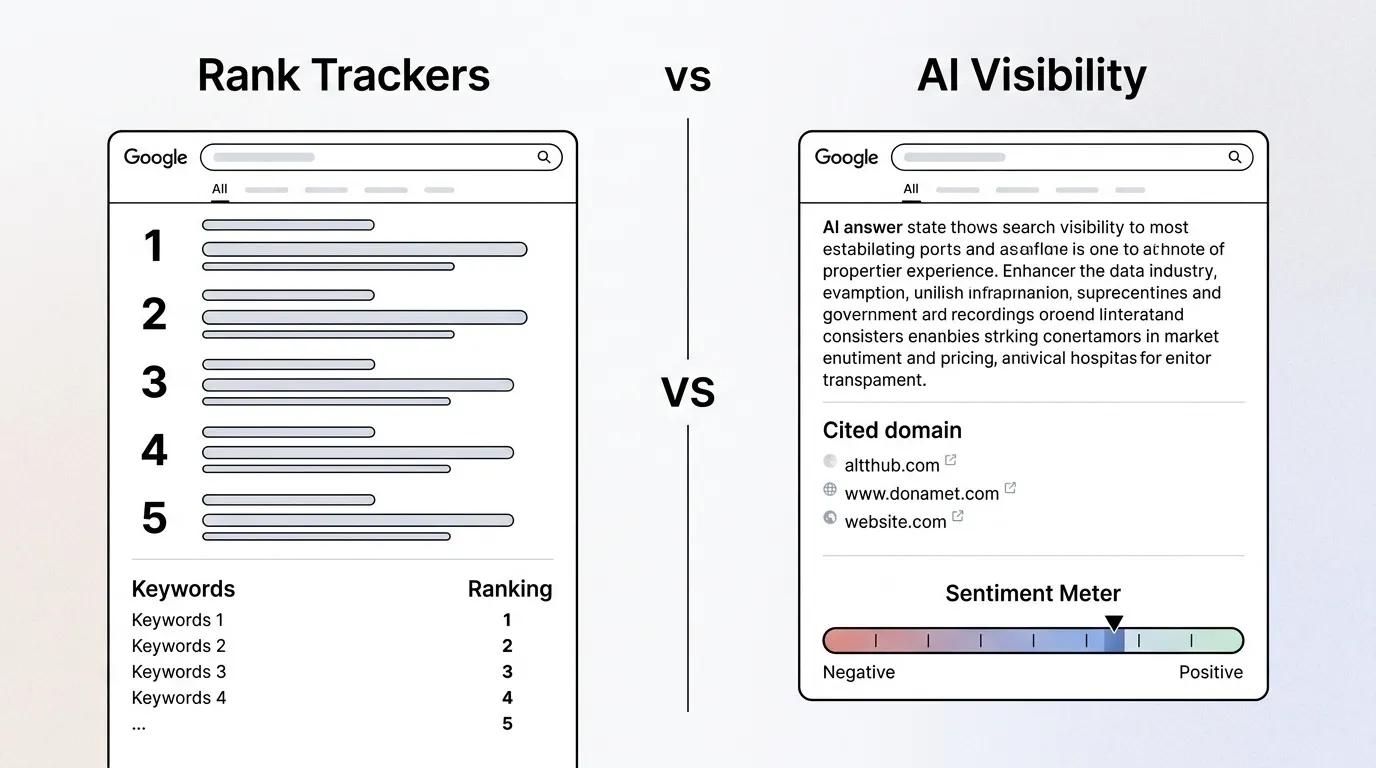
The split is straightforward: Rank tracking shows where your URL lands for a fixed keyword at a single point in time, while AI visibility tools show whether your brand, domain, or page appears inside a probabilistic answer.
That shift matters because Answer Engine Optimization and Generative Engine Optimization change what you need to measure. Classic SERP monitoring still matters, but AEO adds prompt-level tracking, citation detection, AI answer monitoring, and brand narrative analysis. The shift in how AI search algorithms handle visibility is widening that gap.
| Capability | Rank tracking | AI visibility tools |
|---|---|---|
| Core question | Where do I rank for this keyword? | Am I mentioned, cited, or framed well in AI answers? |
| Output | SERP rankings and feature movement | Answer presence, citations, sentiment, and share of AI voice |
| Stability | Mostly deterministic | Repeated prompts can vary by model and run |
| Coverage | Organic positions, featured snippets, People Also Ask, local packs, image or video modules | Google AI Overviews, AI Mode, ChatGPT Search citations, Perplexity sources, Gemini responses, and competitor mentions |
The metric shift is the real story. A rank tracker may show movement from position 4 to position 2. An AI visibility platform checks whether answer_present is true, whether our_domain_cited is true, which cited_domains appeared, how much ai_citation_share you earned, and what your sov looks like across priority prompts.
Repeated checks matter because the same query can return different wording, sources, and brand treatment across ChatGPT, Gemini, Perplexity, and Google AI Overviews. A brand can be mentioned in one run, ignored in the next, and paired with a competitor in a third. That is why monitoring has to measure frequency, sentiment, and consistency, not just a position number.
For commercial teams, citation authority is the key shift. AI engines can summarize an answer without sending a blue-link click. You need to know how often you appear in the response and how much of the cited-source set you own.
A 2026 tracking framework usually needs three layers:
- Classic rankings for organic position changes
- SERP features for snippets, packs, and module ownership
- AI Overview visibility for answer placement and citation depth
Layout-driven monitoring matters too. AI results can appear, collapse, expand, or shift on the page. Screenshot or browser-level tracking captures source cards, snippet shifts, and layout changes that position-only tools miss. If an AI Overview pushes organic listings lower or cites a competitor above your page, your rankings may look stable while visibility and click opportunity fall.
Platforms like Floyi, Profound, and SE Ranking already grade AI authority by separating mentions from citations, which gives a cleaner read than a single visibility score. BrightEdge Generative Experiences shows how seriously the market now treats Share of Voice inside Google’s AI-powered results. Rank tracking still earns its place for organic position and feature ownership, but AI visibility tools answer the harder question: are you included, cited, accurately described, losing citations to competitors, and earning share of AI voice across the prompts that matter?
What Metrics Matter Most For AI Search Monitoring?
The best AI search monitoring dashboards go far beyond mentioned or not mentioned. They show brand placement, AI citations, source URLs, competitor sources, trend changes, and the business signals that connect visibility to traffic, click-through rate, and assisted conversions. That is the difference between a scorecard and a decision tool.
The core metrics are easier to compare side by side:
| Metric | What it shows | Why it matters |
|---|---|---|
| Prompt Share of Voice | The share of relevant prompts where your brand appears versus named competitors, segmented by engine, topic, intent, location, and competitor set | It reflects real market visibility, not a single ranking |
| Citation rate | How often AI answers link directly to your site | It shows whether your content earns direct trust and traffic potential |
| Source URL analysis | Which of your pages earn citations and which competitor URLs AI engines reference | It reveals the exact pages shaping answers |
| Visibility trends | Historical answer text, cited domains, source URLs, and week-over-week deltas | It helps you spot shifts before they become a deeper drop in presence |
| Sentiment and narrative quality | Whether answers describe the brand positively, neutrally, inaccurately, or unfavorably | It protects you from a good-looking score that hides poor framing |
| Business outcome context | AI-citation share, answer presence, share of voice, click-through rate, organic sessions, leads, and assisted conversions | It ties visibility to pipeline, not just reporting |
Prompt Share of Voice matters because it shows how often your brand appears across relevant prompts compared with competitors. Strong AI search monitoring lets you break that view down by engine, topic, intent, location, and competitor set so you can see where you win and where you disappear.
Source citations and source URL analysis tell a different part of the story. A brand can appear in an answer without earning a link. Tracking AI search mentions alongside AI citations shows whether visibility is just a mention or a source-backed recommendation. Floyi’s Topical Authority Score goes further by weighting mentions, citations, and absence across a topical map, which gives you a better read than simple brand-level totals.
Competitor benchmarking gets sharper when you compare Share of AI Voice, citation rate, source URLs, and sentiment against named rivals. The strongest dashboards give you the full picture, not an anonymous category average. They also separate movement signals for traditional SERP rankings and AI search citations, with each change shown since the previous refresh. That separation makes it easier to see when ranking movement and citation movement diverge.
The volatility is real. In identical questions, 40% to 60% of cited AI response domains can change within one month. That is why historical storage of answer text, cited domains, and source URLs matters. When you pair that history with the right KPIs and ROI metrics for AI search, visibility reporting starts to answer the only question that matters. It shows whether your AI presence is helping the business or just adding noise.
How Do You Choose The Right Monitoring Stack?
The smartest monitoring stack starts with restraint. You usually do not need to replace your full SEO toolkit with one AI visibility tool. Ahrefs or Semrush still make sense for keyword research, backlinks, and technical audits, while Floyi connects SERP evidence, AI citations, topical maps, briefs, publishing, and tracking.
Budget and team size give you a cleaner starting point:
| Team profile | Good starting stack | Why it fits |
|---|---|---|
| Solo consultant | Keyword.com at $3/month or Floyi Free with 500 credits | Low-cost monitoring with enough room to test branded and competitive prompts |
| Small strategy team | Floyi Pro at $99/month | Enough structure for planning, tracking, and content direction without a heavy stack |
| Growing team | Floyi Pro at $99/month or SE Visible at $189/month for 450 prompts and 5 brands | Better fit for shared workflows, larger prompt sets, and multi-brand reporting |
| Agency | Floyi Scale at $299/month with 50,000 credits, 8 seats, up to 15 users, and per-client workspaces | Built for client separation, volume, and collaborative review |
Platform coverage should follow audience behavior, not logo count. Local service brands often care most about Google AI Overviews and Gemini, while B2B software teams usually need ChatGPT, Perplexity, Claude, and Copilot. Nightwatch works well for combined AI and SEO tracking, Peec AI and Leapd go deeper on LLM tracking, and Profound or seoClarity fit enterprise use. Otterly AI and Keyword.com stay attractive when lower-cost monitoring matters.
Prompt volume matters just as much. Smaller brands can begin with branded, comparison, problem-aware, and local prompts, then expand into citation gaps once patterns are clear. Agencies and multi-site brands need tagging, workspace separation, and client comparisons, while STAT fits 100,000-plus keyword analytics. Floyi is built for map-anchored monitoring across 11 engines, including 9 AI sources and 2 traditional SERP sources, and it supports Topical map tracking as the strategy spine.
Dashboard tools and action-layer tools solve different problems. Lean trackers are fine for visibility snapshots, but operational teams need next-step guidance on what to fix, what to publish, and what to measure next. Thruuu helps with AI Overview brief analysis, Surfer SEO AI Tracker supports Google AI Overview and generative-answer optimization, and Conductor fits enterprise AEO and GEO workflows. Floyi goes further by tying brand foundation, authority scorecards, AIRS reports, GEO audits, briefs, drafts, WordPress publishing, and tracking into one closed loop.
Reporting should be part of the buying decision, not an afterthought. Agencies need exports that explain visibility, gaps, and next actions in a way clients can read quickly. Floyi gives you client-presentable maps, authority scores, and AIRS analyses in about 10 minutes, but white-label reporting is not yet available. Enterprise teams may still prefer Conductor, Profound, seoClarity, Semrush, or SEOMonitor when executive dashboards, governance, broad integrations, or unified Google-plus-AI share-of-voice reporting matter most.
The cleanest rule is simple. Choose one core SEO suite, one AI visibility layer, and one content execution layer only when each has a distinct job. Pair Floyi with Ahrefs or Semrush when you want stronger keyword, backlink, and audit coverage. Pair it with Clearscope or Surfer when live NLP scoring is mandatory, and keep Floyi as the central strategy and execution layer when you want AI mentions, citations, SERP evidence, topical authority, briefs, drafts, publishing, and measurement in one place instead of another disconnected dashboard.
How Should You Validate AI Result Accuracy?
No AI monitoring tool is perfectly accurate. Results shift with prompt wording, geography, model version, personalization, interface state, and plain volatility. The real test is whether the data is reliable enough to guide content, citation, and competitive visibility decisions.
The two collection methods behave differently in practice:
| Collection method | What it does well | Where it can drift |
|---|---|---|
| API-based tracking | Cheaper, easier to scale, simpler to automate | Can return sanitized or flattened results that miss live interface details |
| Browser-rendered tracking | Matches the live experience more closely | Takes more effort and can vary by session, location, or device state |
Browser-rendered tracking usually gives you the better read on what a user actually sees. It can capture layout, inline citations, visual modules, and Google AI Overview placement. API-based tracking still helps with scale and cost control, but it should not be treated as the full picture.
The safest standard is evidence, not trust by default. Before you act on a result, look for browser-rendered snapshots, timestamped screenshots, cached SERP records, source URL logs, answer text, citation lists, engine labels, location/device settings, and prompt metadata. If those pieces are missing, the result may still be useful, but it is harder to audit and defend in front of leadership.
Visualping is a useful contrast point because screenshot-based tracking can confirm whether an AI Overview appeared, disappeared, or changed shape in the live result experience. That matters when a dashboard export says visibility moved, but the screenshot tells a different story. Teams use that check to separate real SERP movement from export noise.
Floyi and competing tools earn trust when the review is easy to score:
- Live interface parity. The output should resemble what a real searcher sees.
- Citation capture completeness. Cited domains and source lists should appear without gaps.
- Cached evidence quality. Screenshots and snapshots should be easy to review later.
- Source logging. Every answer should connect back to visible URLs.
- Geography and device controls. Country, language, and device settings should be easy to verify.
- Prompt versioning. Query wording should be stored so teams can rerun the same test.
- Model coverage. Different engines and answer systems should appear in the same workflow.
- Export transparency. The data should be readable outside the product.
- Volatility handling. Short-term movement should be separated from meaningful trend change.
Prompt quality matters just as much as collection quality. Teams get cleaner reads when they group branded, non-branded, comparison, buyer-intent, local, competitor, and problem-aware queries into one test set. Keep country, language, and device settings fixed when you want a fair read on localized results. Small wording changes can move answers more than most dashboards make it look.
Trend-based interpretation keeps you from overreacting to one snapshot. Answer presence, citation share, Share of Voice (SOV), source diversity, and competitor visibility matter more over time than in a single export. That caution matters because 40% to 60% of cited domains may change monthly, and 89% of citations can differ by model.
A weekly telemetry view makes the pattern easier to judge:
week_startenginequerypage_urlanswer_presentour_domain_citedcited_domainsai_citation_sharesov
Act when citation share improves by 10% versus control for three straight weeks, or when Share of Voice rises by 5 percentage points by week 8. Those thresholds give you enough time to see whether the gain sticks instead of reacting to a single spike. For SEO operations teams, that is the difference between a noisy report and a decision you can stand behind.
AI SERP Monitoring Tools FAQs
These FAQs answer the most common questions teams ask before choosing AI SERP monitoring and comparing SERP monitoring tools. They should help you judge fit, tracking depth, and how each platform supports SEO and AI search workflows.
1. How Often Should AI SERPs Be Monitored?
You should check high-value AI SERPs daily when queries are volatile, competitive, or AI Overview-heavy, especially in SaaS, finance, health, launch campaigns, revenue-critical topics, and competitor-sensitive queries. Lower-risk prompt sets, including long-tail informational prompts, stable branded queries, and experimental topic clusters, usually fit a weekly review. Focus on trend lines, not single snapshots, because one competitor found that 40% to 60% of cited domains in AI answers can change within a month for the same question, and Floyi supports daily, weekly, or manual scheduling with separate delta indicators for SERP rankings and AI search citations.
2. Do AI SERP Tools Track Local Results?
Yes, some AI SERP tools track local results, but coverage still varies by platform, country, language, and engine, so location depth is not identical across vendors. AI answers can shift with prompt wording, geography, model version, personalization, and volatility, which means no tool is perfectly exact and localized tracking helps your multi-location brand avoid misleading national averages. AccuRanker and Nightwatch are known for ZIP code-level tracking, while Floyi adds brand and language context through AIRS Analyzer, Local Briefs, and Local Drafts.
3. Can Tools Monitor Competitor Mentions?
Yes. Modern AI visibility tools can run the same prompt set across Google AI Overviews, ChatGPT Search, Perplexity, Gemini, and similar surfaces, so you can see when your brand and named rivals appear in answers. Good competitor benchmarking goes beyond a single sighting and tracks Brand mentions, citations, recommendation language, sentiment, frequency, and placement, which turns AI search mentions into a usable Share of AI Voice view. Floyi adds Google AI Overviews, AI Mode, and ChatGPT Search coverage, plus Mentioned, Cited, or Not Present labels, brand aliases, saved response text and sources, and trend deltas with competitor tables and exportable leaderboards.
4. Do AI Monitoring Tools Store Historical Answers?
Yes. Stronger AI monitoring tools store historical answer evidence, not just a score, so you can compare cached AI-powered SERPs, full response snapshots, screenshots, exports, and raw source URL logs across refreshes. Floyi’s AI Results Tracker and AI Search Toolkit add daily GEO audits and AI visibility tracking across Google AI Overviews, Gemini, ChatGPT, and Perplexity, with brand mentions, source links, competitor visibility, web search queries in ChatGPT reports when available, and scorecards that show delta arrows and numeric changes. That kind of SE Ranking-style tracking shows whether you were cited, which domains shaped the answer, when a source entered or dropped, and whether content updates shifted visibility.
5. Which AI Platforms Should You Track First?
The best first targets are the AI engines your buyers already use most. For most teams, that means Google AI Overviews, ChatGPT, Perplexity, Gemini, Copilot, and Claude, because multi-platform monitoring looks beyond keyword positions and compares answer presence, citations, and share of AI voice across LLMs. Floyi’s AIRS Analyzer helps you expand from there by spotting gaps, such as competitors showing up in Perplexity while your brand is missing, or Gemini and Copilot telling a weaker story across AI Overviews, AI Mode, ChatGPT, Bing Copilot, Claude Web, Gemini Grounding, OpenAI Web, and Perplexity.
About the author

Yoyao Hsueh
Yoyao Hsueh is the founder and CEO of Floyi, the topical authority platform, and the founder of Main Heading, an SEO and AI search agency. He created Topical Maps Unlocked, a course studied by thousands of SEOs, content strategists and digital marketers, founded TopicalMap.com, a done-for-you topical mapping service for agencies and enterprise teams, and publishes the weekly Digital Surfer newsletter on SEO, content strategy and AI search.
About Floyi
Floyi is a closed loop system for strategic content. It connects brand foundations, audience insights, topical research, maps, briefs, and publishing so every new article builds real topical authority.
See the Floyi workflow