How AI Changes Search Algorithms and AI Search Visibility
Learn how AI changes search algorithms, AI answers, and SEO visibility, then apply topical architecture, citation, measurement, and publisher controls.
Google says early AI Mode users ask questions two to three times longer than traditional searches. AI changes search algorithms by interpreting intent, entities, context, and likely follow-ups, while AI search visibility depends on whether a page can supply a useful, verifiable answer.
That shift doesn’t retire conventional SEO requirements. Googlebot still needs crawl access, rendered indexable content, and an HTTP 200 status before a page can compete in blue links or AI-generated results. Plan coverage through Pillar, Hub, Branch, and Resource relationships, then track answer presence, AI-citation share, and share of voice with a fixed weekly prompt cohort. Floyi’s Authority Planner connects those gaps to the next page worth publishing.
AI Search Visibility Key Takeaways
- AI interprets intent, entities, context, and follow-up needs beyond exact keyword matching.
- AI search journeys combine AI Overviews, AI Mode, ChatGPT, and traditional blue links.
- Crawl access, indexable content, and HTTP 200 status remain required for AI and conventional visibility.
- Pillar, Hub, Branch, and Resource architecture organizes coverage around connected user needs.
- Citation-ready passages answer directly and show visible evidence, authorship, dates, and source trails.
- Measure AI visibility weekly using fixed prompts, answer presence, AI-citation share, and share of voice.
- Use the least restrictive publisher control that protects sensitive content while preserving citation eligibility.
How Does AI Change Search Algorithms?
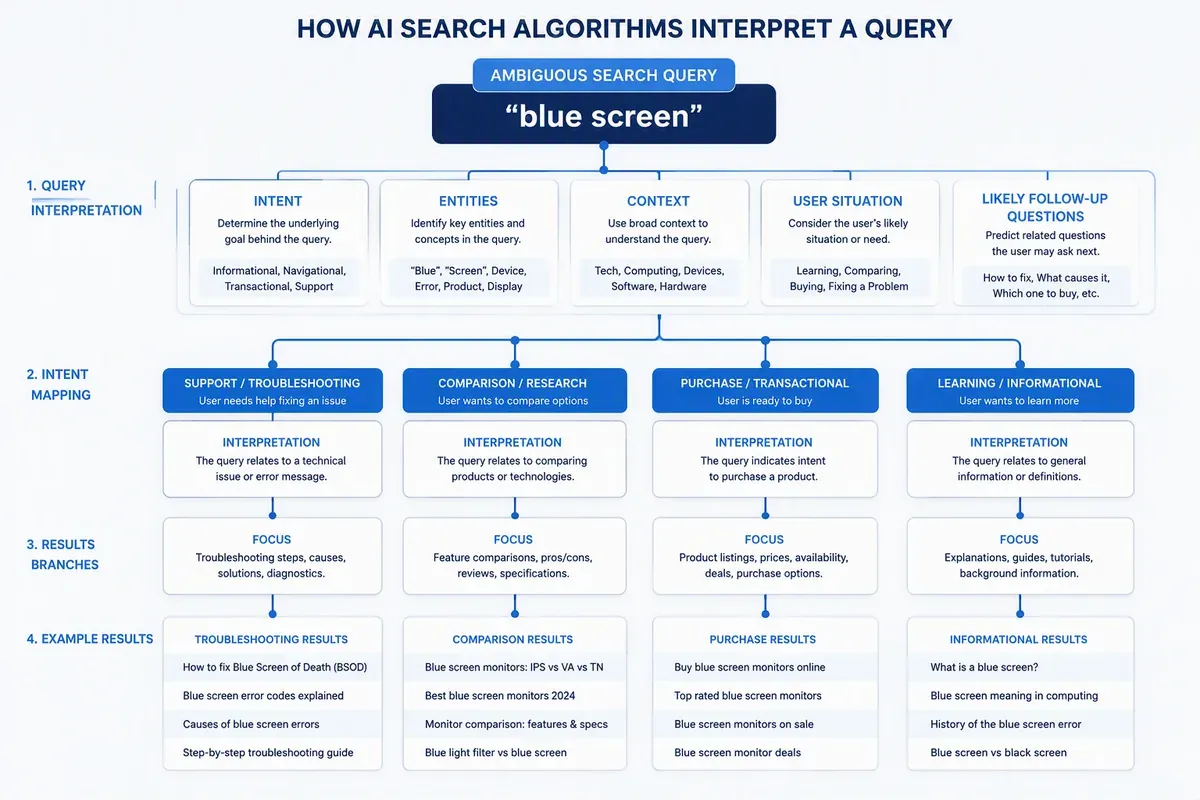
The impact of AI on search algorithms is primarily about how systems interpret queries and assemble results, not a replacement for baseline eligibility. Artificial intelligence (AI) helps search engines assess relationships among words, entities, pages, and historical query patterns, extending relevance beyond exact keyword matching.
Deep learning, neural networks, and natural language processing (NLP) help systems make sense of conversational, incomplete, and ambiguous searches. “Apple support,” for example, could relate to an iPhone repair, a MacBook warranty, or fruit. Surrounding terms, prior context, and the likely task help determine the strongest interpretation and the most useful result format, whether that is a support page, local option, comparison, or direct answer.
Query understanding also accounts for needs a searcher may have after the first query. A short search can indicate research, comparison, purchase readiness, troubleshooting, or navigation. Instead of treating each phrase as an isolated keyword string, search algorithms can connect related concepts and anticipate likely follow-up questions.
Search intent and user intent overlap, but they describe different signals. Search intent is the task expressed in the query, while user intent adds the circumstances behind that task, including location, device, session context, browsing behavior, purchase patterns, preferences, and prior searches.
The same query can call for different content depending on the person and situation:
- Experience level: A beginner may need definitions and examples, while an experienced practitioner needs implementation details and edge cases.
- Buying stage: An early researcher may prefer a guide, while a decision-maker may need specifications, evidence, and a clear comparison.
- Role and goal: A device owner seeking help needs a different path from someone evaluating a purchase.
- Context: Mobile use, local availability, and prior activity can change which answer format is most useful.
The AI search optimization discipline begins with that distinction. Planning around one generic interpretation leaves coverage gaps when audience needs differ. We recommend making each page’s topical scope, intended reader, purpose, and supporting evidence clear before selecting terms for the brief.
AI-driven retrieval does not remove technical requirements. Pages still need Googlebot access, an HTTP 200 success status, and indexable content before they can be considered for conventional results or AI-generated formats. Structured data should accurately represent visible information and help interpretation, but it cannot offset blocked crawling, thin copy, or unsupported claims.
Content quality remains the practical gate. AI may interpret language with more nuance, yet distinct, helpful, original, user-centered material gives crawlers and models something dependable to retrieve and assess. Make the audience, evidence, entities, and topical scope explicit, then measure whether the page appears in the situations it was built to serve.
How Do AI Answers Reshape Search Journeys?
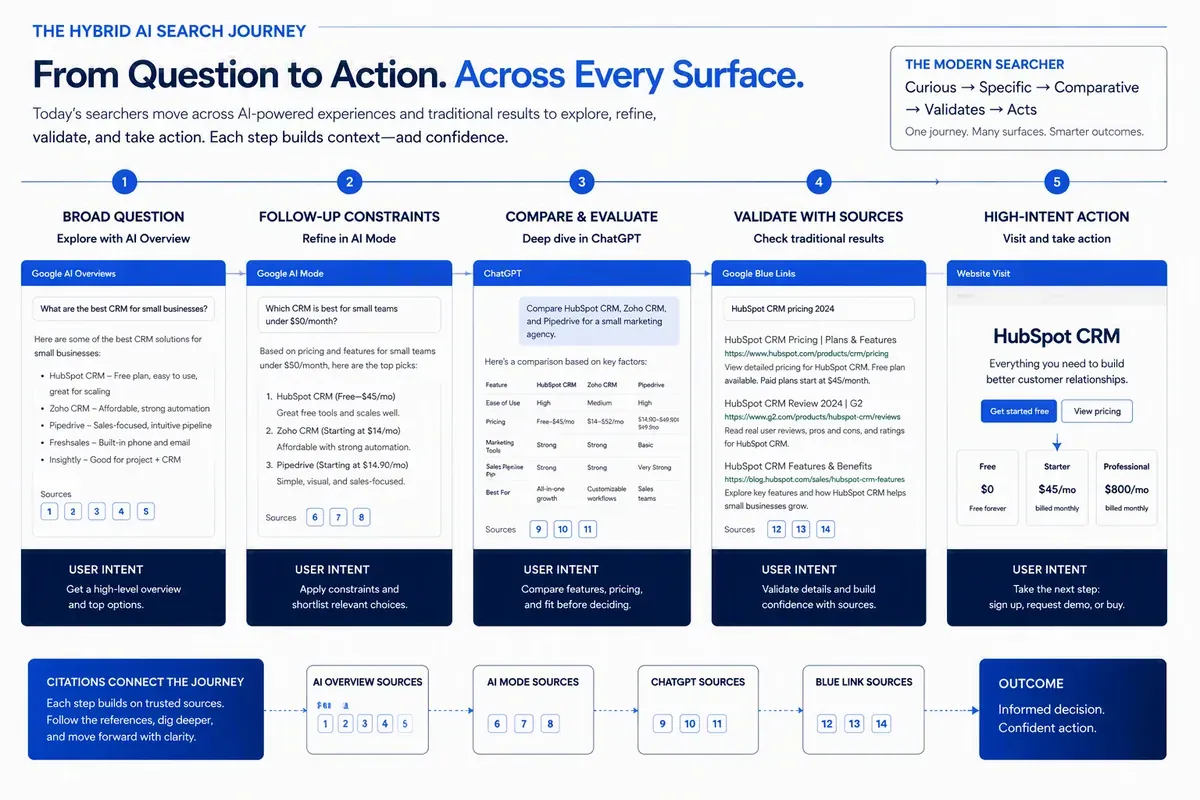
Because those situations often unfold across multiple queries, AI-powered search turns one query into an ongoing research path. Rather than stitching together short keyword searches, people can describe a situation, set constraints, compare options, and specify the result they need. Google has said early users of AI Mode ask questions that are about two to three times the length of traditional search queries (source).
The major answer paths have distinct roles:
- Google AI Overviews: A synthesized response within Google Search, supported by links to pages where readers can examine the topic in more detail.
- AI Mode: An opt-in Google experience for exploratory work, including comparisons, how-tos, planning, and questions that require follow-up.
- ChatGPT: A conversational route outside standard results that people may use to test an assumption, reframe a request, or ask for examples.
- Traditional blue links: The source path for original reporting, primary evidence, competing perspectives, and detail that a synthesized answer cannot fully contain.
This produces hybrid search behavior. A person might use Google AI Overviews for orientation, add a budget or location constraint in AI Mode, try another framing in ChatGPT, and return to traditional search results to validate the recommendation. The AI search trend outlook shows why visibility must reflect that wider path, not one ranking event.
AI Mode changes the middle of the journey by retaining context across follow-up prompts. Without repeating their initial query, searchers can question an assumption, request a concrete example, add a requirement, or compare alternatives, while Google’s query fan-out also runs related searches across subtopics and data sources to create several relevant discovery opportunities beyond the opening prompt.
A synthesized answer still requires source evaluation. Google AI Overviews are designed to ground claims in high-quality web results and link to supporting pages, with a higher threshold for Your Money or Your Life topics such as health and finance. For consequential choices, readers should verify that a cited page supports the precise claim, compare viewpoints, and favor primary or expert evidence when it is available.
The traffic tradeoff matters. A simple informational need may end in a zero-click search, while a complex decision can produce a higher-intent visit when someone needs evidence, context, or applied recommendations. Your reporting should capture AI search surfacing, citations, and follow-up investigation alongside rankings and visits.
Content should support the full conversational path, from the broad question through comparisons, objections, and verification. Build authority anchors, supporting hubs, and focused resources around relevant entities and subtopics. Preserve search engine optimization (SEO) fundamentals, including crawlability, technical accessibility, useful content, and clear page experience, then make the click worthwhile with transparent sourcing, original analysis, specific examples, and an unresolved question the page can answer.
Build a Topical Authority Content Architecture
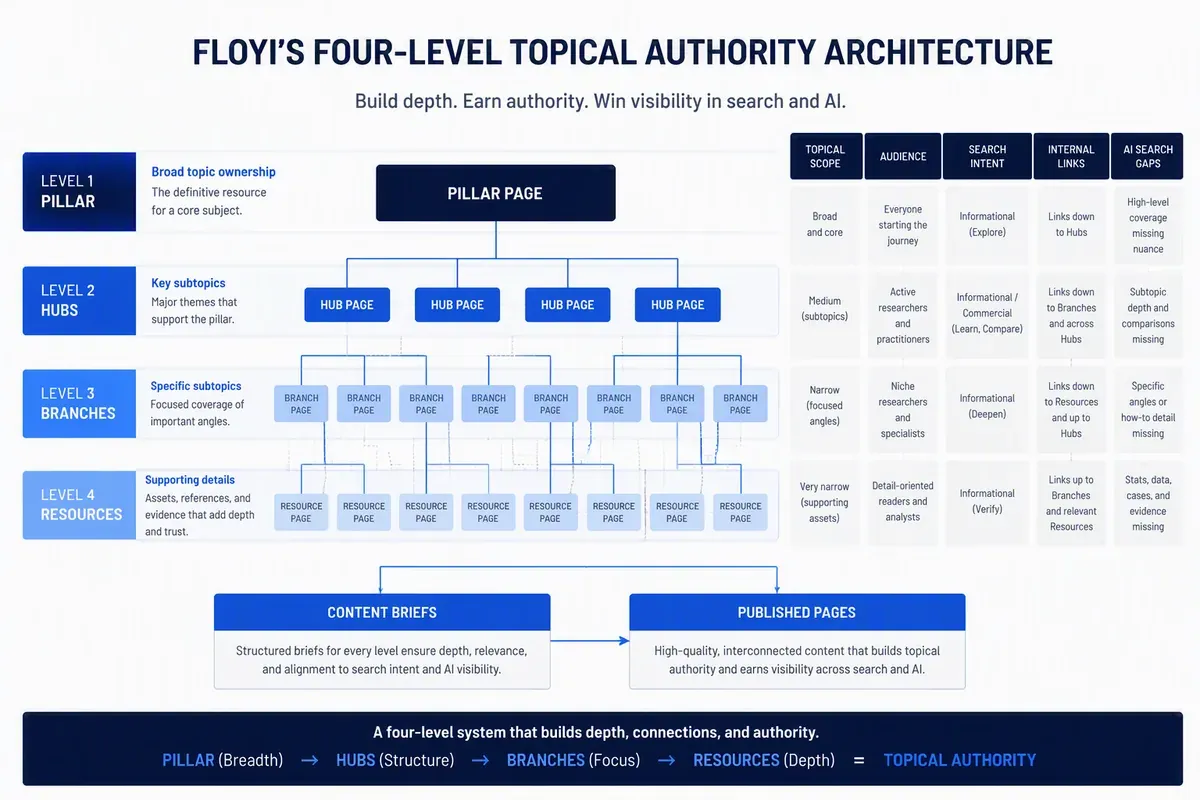
To support that full conversational path, AI search favors connected, original coverage built around user needs, not isolated keyword pages. Floyi’s Pillar > Hub > Branch > Resource architecture gives you a planning spine for search visibility and LLM optimization, with technically accessible pages that readers can use and AI systems can interpret.
A Pillar establishes the broad subject your brand intends to own, while Hubs separate its major intent areas. Each Hub should account for buyer role, experience level, buying stage, and search intent so executives, practitioners, beginners, and evaluators receive answers suited to their context. That separation protects content quality when a leadership overview and an operator procedure address the same subject differently.
This AI-search content map shows the parent-child path at every level:
| Level | Role, stage, and experience | Page intent | URL placement and linking |
|---|---|---|---|
| Pillar | All AI-search audiences, awareness | Explain AI search optimization and orient readers | /blog/ai-search-optimization/ links to each Hub |
| Hub | Agency content leaders, awareness to consideration | Plan an AI-search content architecture | /blog/ai-search-optimization/content-architecture/ links to its Pillar and Branches |
| Branch | SEO operations managers, intermediate, consideration | Measure AI citations and reporting gaps | /blog/ai-search-optimization/content-architecture/ai-citation-measurement/ links to its Hub and Resources |
| Resource | Practitioners, advanced, decision | Use a weekly AI citation reporting template | /blog/ai-search-optimization/content-architecture/ai-citation-measurement/weekly-report-template/ links back to its Branch, Hub, and Pillar |
Branches add the context a Hub needs to answer deeper questions. They can cover subtopics, entities, comparisons, recurring problems, and likely follow-ups. For example, an AI citation measurement Branch may include Resources on answer presence, share of voice, client reporting, and citation gaps.
Parent-Hub relationships should be visible in navigation and internal links. Without them, pages may be individually relevant but still appear disconnected to readers and search systems.
Resources resolve narrow, high-specificity needs through definitions, procedures, evidence-led explainers, and comparison tables. Answer-first formatting, clear sourcing, and appropriate structured data, such as Article, FAQ, HowTo, Organization, or BreadcrumbList, help AI systems interpret the page. Each Resource gains meaning from links back through the hierarchy.
The architecture is a feedback loop, not a one-time diagram. Floyi’s Authority Planner turns brand and persona context into topical scope and a four-level map, while discovering AI search openings can surface subjects conventional research misses.
AI Search Gaps and Content Optimizer compare competitor pages, AI answers, published content, and drafts. They classify entities, topics, and keywords as missing, covered, or overused before the findings enter a brief, helping you prioritize meaningful gaps instead of theoretical completeness.
Set coverage targets at the Hub level rather than working through an endless keyword queue. Publish pages that close authority or intent gaps, then stop when marginal topics are redundant, low-intent, or likely to cannibalize performance. Deep coverage identifies pages worth promoting, but backlinks, brand mentions, and other trust signals still determine whether those pages can compete.
Map Pillars, Hubs, Branches, and Resources
A four-level map reduces overlap and cannibalization.
Build from one authority anchor:
- Pillar: Defines the broad educational and commercial territory, such as how AI search changes agency SEO.
- Hub: Addresses one audience need, such as agency leaders assessing AI search visibility.
- Branch: Focuses on a narrower decision or use case, such as planning AI search coverage for an SEO operations team.
- Resource: Resolves the specific follow-up question, including how to separate AI mentions from LLM citations.
Set the audience and search intent before choosing a title. A pillar for agency leaders may answer an informational question, while an operations-focused branch may support comparative or action-oriented research. That separation protects content quality because no page has to satisfy every role, question, and expectation.
Each map row also needs a buying stage, experience level, and entity set. While an awareness-stage resource for beginners should establish essential concepts and related entities, a later-stage branch can address implementation tradeoffs and LLM optimization. This approach captures the longer questions and follow-up paths that AI search users pursue beyond the initial head term.
The map becomes a gap-closing pipeline when proposed pages are checked against competing results and AI answers for absent entities, unanswered subquestions, and keyword gaps. Brief templates for AI search retain the reader, intent, topical scope, evidence needs, page relationships, and internal-link targets. Authority Planner carries that map context into planning, while Content Optimizer evaluates competing coverage before strategy drifts in the draft.
Resources are publishable support for their parent branch, not isolated keyword pages. Keep the visible answer specific and quotable, then use structured data that matches the page content. Technical crawlability remains essential because Googlebot needs a crawlable, indexable URL that returns an HTTP 200 status. AI crawler and indexing setup helps you confirm eligibility across conventional and AI search experiences.
How Do You Earn AI Search Citations?
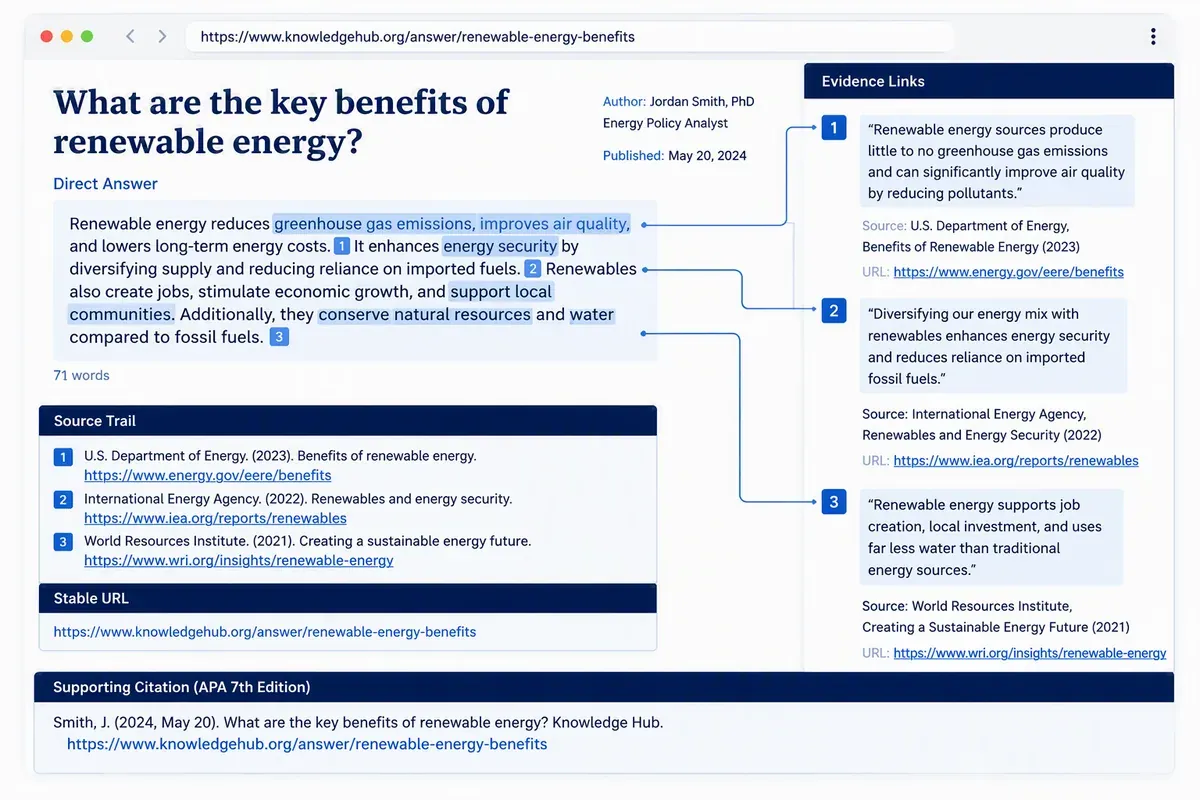
Within that architecture, AI search citations are earned when systems can retrieve, interpret, verify, and safely reuse a page’s answer without losing its meaning. They are not a separate generic ranking signal. A citation-worthy passage answers a real question plainly, identifies a credible publisher, and keeps its supporting evidence visible when an AI system summarizes it.
For each high-value prompt pattern, place a 40 to 80-word lead answer directly beneath the relevant heading. State the conclusion before the context, then reflect the intended audience, use case, and constraints. Guidance about AI search traffic for an agency team, for example, should not read like advice for a solo publisher. Keep definitions, conditions, limitations, and relevant dates within that passage so it remains accurate when quoted alone.
Specific claims give systems evidence they can check. Replace a vague statement such as “AI search improves visibility” with one canonical sentence that specifies what changed, for whom, and under what conditions. Name the author or organization, show a publication or update date, and point readers to the dataset, method, source, or documented first-party experience behind the claim. Trust signals in AI search separate attributable evidence from a polished summary another publisher could replace.
Citation-ready pages share four traits:
- Answer the prompt directly: The lead passage gives the conclusion before context and qualifications.
- Preserve standalone meaning: Definitions, timeframes, exceptions, and audience fit remain close to the claim.
- Make evidence visible: Readers and systems can locate an author, date, and source trail without depending on hidden markup.
- Address likely follow-ups within scope: Descriptive sections connect the main query to relevant entities, scenarios, comparisons, audiences, and constraints without turning one page into an unfocused reference library.
Topical architecture determines where follow-up coverage belongs. A page can establish how AI answers, SEO, publisher controls, measurement, and search visibility relate, while focused pages handle each subject in depth. AEO for AI answer surfaces centers this work on answer selection rather than keyword repetition. LLM citations are more plausible when a passage stands on its own while contributing to a coherent body of expertise.
Machine-readable packaging can support verification, but it cannot substitute for visible content. Keep URLs stable, use fragment anchors for evidence, and make sure authorship, dates, and JavaScript Object Notation for Linked Data (JSON-LD) match the copy readers see. Permanent claim IDs can connect an on-page statement with its evidence anchor, dataset, author, and date. HowTo markup should mirror visible steps only, never serve as a shortcut to citation.
Technical access remains the eligibility threshold. Googlebot needs crawl access, pages must return HTTP 200, and substantive answers must appear in rendered, indexable content. Aligned canonical URLs, XML sitemap updates, and descriptive internal links support discovery. Structured data cannot overcome blocked access, thin copy, inaccessible evidence, or content absent from the page. AI search conversion value and SEO traffic matter, but neither compensates for a page that AI systems cannot access or verify.
How Do You Measure AI Search Visibility?
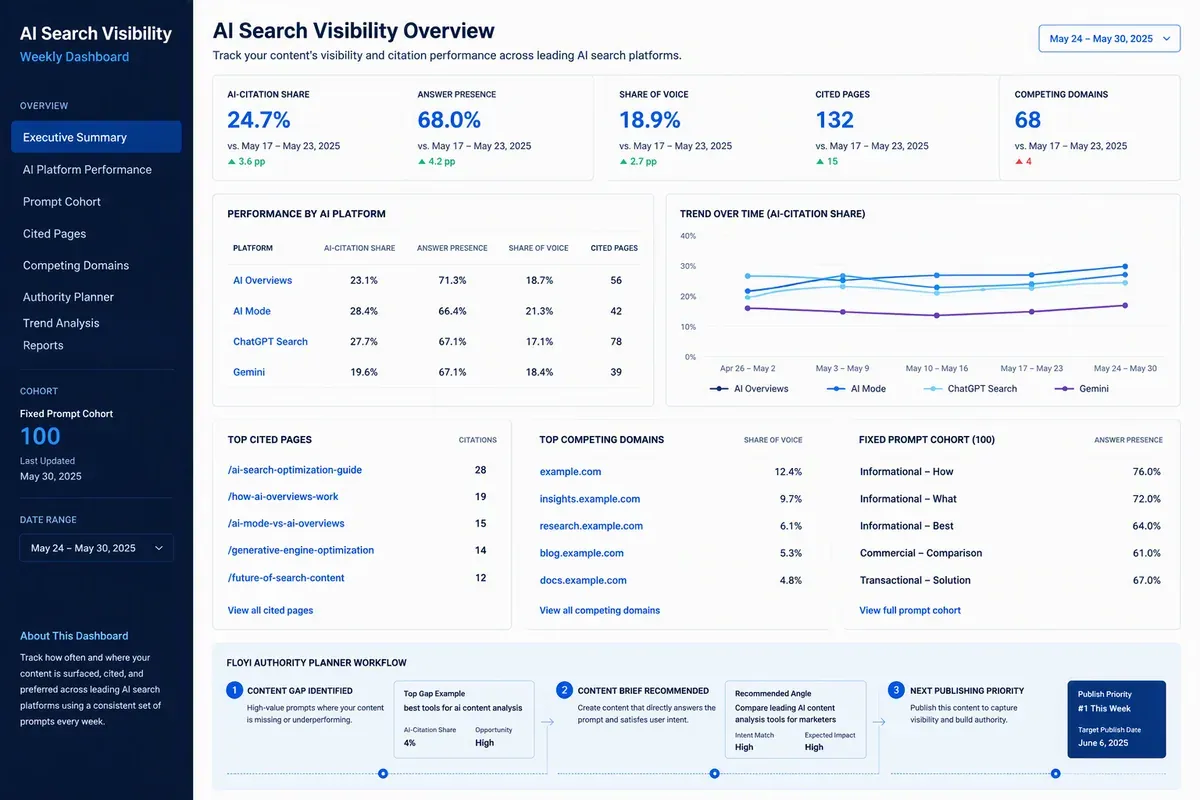
Treat AI visibility as a weekly channel separate from Google Search rankings and organic traffic. An importance-weighted prompt cohort gives each client a stable baseline for evaluating whether content appears in AI-generated answers and earns citations.
Build the cohort around topical scope, audience role, buying stage, and intent. Include broad discovery questions, detailed comparisons, and realistic follow-ups, since AI research often progresses from a general question to a specific decision. Tracking AI search outcomes depends on a fixed prompt set that remains stable long enough to distinguish a pattern from weekly variation.
Keep these AI-native metrics distinct:
- AI-citation share: The proportion of tracked answers that cite your domain.
- Answer presence: The percentage of answers in which your domain appears as a source.
- Share of voice: Your citations divided by all domains cited in the same answers.
Report each measure by prompt cohort and page. A strong aggregate can conceal a high-importance resource that is absent from comparison or late-stage answers.
Run every fixed prompt separately across Google AI Overviews, AI Mode, ChatGPT Search, Gemini, and approved answer engines. Weekly telemetry should record the engine, exact query, cited page, mention or citation status, competing cited domains, page variant, metric values, and dated notes on content, model, or site changes. This history makes an abrupt change interpretable after an engine alters its answer format or a page is revised.
Place AI results alongside SEO and commercial measures:
- Search performance: Rankings, impressions, clicks, click-through rate, and sessions.
- Commercial performance: Conversions, assisted conversions, and traffic value.
AI citations may generate no click during a zero-click journey, while strong rankings do not guarantee inclusion in an AI answer. Technical crawlability, Googlebot access, structured data, and guidance from Google Search Central remain shared requirements across both channels.
Use treatment pages and an intent-matched control group to test whether an intervention produced a meaningful result. Difference-in-differences subtracts the control-page change from the treatment-page change:
Lift = (Treatment change) − (Control change)
We use an AI-citation-share lift of at least 10 percent versus the control, sustained for three consecutive weeks, as our internal working threshold rather than a published industry standard. Set your own threshold once you have enough weekly observations to judge normal variation in your query set. Then validate expected movement in answer presence, share of voice, click-through rate, and assisted conversions. A favorable single week is often noise, especially after a platform-level update.
Move findings into the publishing queue by prioritizing high-importance topics with low answer presence or citation share. When competitors recur in cited answers, compare the entities, definitions, and explanations on their source pages. Floyi’s Authority Planner connects each gap to an authority anchor, hub, branch, or resource, while the Topical Authority Scorecard compares AI Authority with organic performance and Market Authority to separate AI-specific gaps from broader search weakness.
Tooling for AI search work should preserve prompt-level tracking, page-level attribution, and consistent weekly records. Publish against the weakest high-value area, then measure the same cohort against its established baseline.
Set Publisher Controls for AI Search
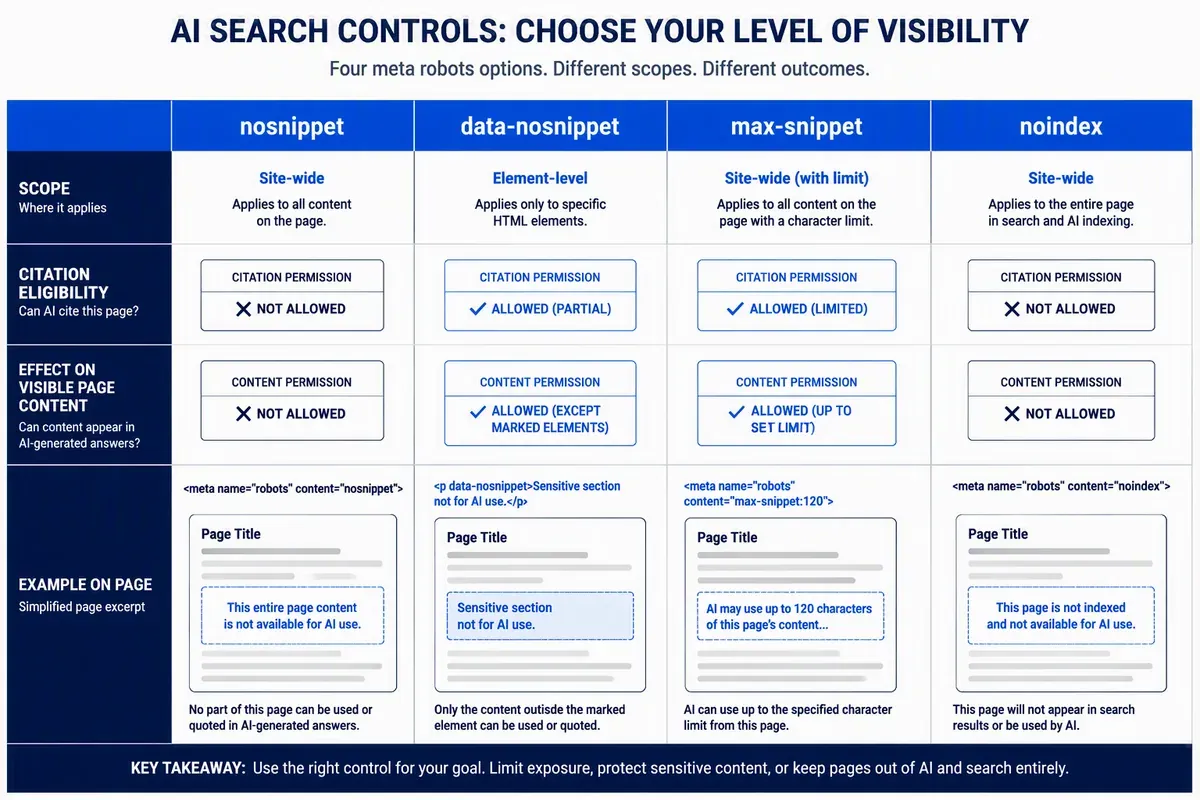
Alongside measuring visibility, publisher controls set the terms for what Google may display or reuse from a page. They do not improve rankings. In standard Search, AI Overviews, and AI Mode, publisher controls can affect snippet eligibility and how much page content is available to support AI-generated answers (source).
Google’s generative AI experiences draw from high-quality web results and send users to supporting sources. The impact of AI on search algorithms therefore extends beyond blue-link position. AI search visibility also depends on whether Google can access enough useful context to surface a linked citation.
The controls differ in scope and consequence:
nosnippet: This is the broadest snippet-level setting. The page can remain indexed as a traditional blue-link result, but Google cannot show text snippets or use page content in featured snippets and AI-generated Search experiences. It fits pages where explanatory reuse is unacceptable, with a clear loss of citation potential.data-nosnippet: This HTML attribute applies to a containing element rather than the whole page. It can protect proprietary methods, client-sensitive examples, or gated-content previews while leaving separate public definitions and evidence available for Search visibility and citations.max-snippet: This sets the maximum amount of text Google may use in Search results or AI experiences. It offers a middle path when a page may support citations but should not supply a lengthy answer-ready extract. Very small limits can remove the context needed for a complex source to be useful.noindex: This removes a URL from Google’s index, ending its ability to rank and sharply restricting its ability to support AI responses. Reserve it for material that should not be discoverable, not a traffic-focused page with a few protected passages.
Search algorithms still assess relevance and quality, but these directives determine how much eligible content remains after that assessment. A page can keep its blue-link presence with nosnippet while losing the explanatory material that could have supported an AI Overview or AI Mode citation.
For pages intended to earn referrals, keep factual claims, evidence, and clear explanations indexable and visible. Where sensitive content appears alongside public guidance, isolate only that material with data-nosnippet instead of suppressing the full asset. Apply the least restrictive setting that protects content you cannot permit Google to reuse.
Floyi’s Authority Planner turns these decisions into a four-level map, showing which pages to publish next and how each one connects to its Pillar. Map your AI-search coverage.
AI Search Algorithm FAQs
These FAQs address the practical questions agency teams face as AI search algorithms change visibility, citations, and content planning across client accounts. We focus on what those shifts mean for your SEO decisions and measurement.
1. Will AI Replace Traditional Search Engines?
No. AI is changing answer consumption, not eliminating search. AI Overviews and AI Mode can condense multi-query research, while multimodal search changes how people ask, so some informational queries may earn fewer immediate clicks. Google says more than 1.5 billion people use AI Overviews, which link to supporting pages. Query understanding and search accuracy still depend on keywords, indexed content, core ranking systems, the Knowledge Graph, and source evaluation. Websites remain the evidence AI cites, while blue links support deeper comparison, trust, and action.
2. How Do Multimodal Queries Change Rankings?
Multimodal and conversational queries favor pages that answer the full request rather than repeat an exact keyword. Because AI retains follow-up context, connect each authority anchor to relevant entities, constraints, and next-use-case questions. Search personalization can further change the appropriate result by session and user context.
Voice and image queries also require visual clarity. Googlebot needs accessible pages, an HTTP 200 response, and indexable text, while captions, surrounding copy, images, and linked resources should identify the visual subject and resolve the resulting question.
3. Do AI Search Results Personalize Rankings?
Yes. Search personalization means AI-generated results can differ for the same prompt based on prior queries, browsing behavior, preferences, location, device, immediate actions, and seasonal context. An AI Overview mention for one audience is not a universal visibility verdict.
Monitor priority prompts across country, language, location, device, experience level, and buying stage. Compare brand mentions and AI citations by segment, then address gaps with self-contained answers and clear contextual signals that help AI match each section to the intended reader.
4. What Is the 30% Rule in AI?
The “30% rule” reflects one sample’s estimate, not a measured constant: Semrush and Datos recorded AI Overviews on 13.1% of searches in March 2025. It is not a threshold for citations, traffic, or the share of your keywords that will trigger an overview. Google’s coverage varies by query set, favoring complex questions where a generative response can improve search accuracy. Assess AI Overview presence, citations, and organic performance across your non-brand queries, intent categories, and topical scope rather than applying 30% as a universal forecast.
Sources
About the author

Yoyao Hsueh
Yoyao Hsueh is the founder and CEO of Floyi, the topical authority platform, and the founder of Main Heading, an SEO and AI search agency. He created Topical Maps Unlocked, a course studied by thousands of SEOs, content strategists and digital marketers, founded TopicalMap.com, a done-for-you topical mapping service for agencies and enterprise teams, and publishes the weekly Digital Surfer newsletter on SEO, content strategy and AI search.
About Floyi
Floyi is a closed loop system for strategic content. It connects brand foundations, audience insights, topical research, maps, briefs, and publishing so every new article builds real topical authority.
See the Floyi workflow