
Optimize Content for AI Answers That Earn Citations
Use an AEO and GEO workflow to optimize content for AI answer generation, from answer-first blocks and proof to citations and visibility testing.
Organic visibility doesn’t establish citation eligibility in AI answers. Earning citations requires content that states a direct answer, identifies its entities, and places exact proof where systems can retrieve and verify it. SEO remains the technical baseline, while AEO and GEO address extractability and citation selection.
A polished FAQ or product page can still be skipped when its answer is buried, its claims lack evidence anchors, or essential copy appears only after JavaScript renders. Audit five conversion-relevant pages through technical accessibility, extractable content, authority and evidence, and competitive AI visibility. Put a 40 to 80 word answer near the top, then support it with the source, method, date, and qualification that substantiate the claim.
SparkToro and Similarweb put the share of mobile Google searches that end without a click at 77 percent, so a citation gain is not traffic by default. Track an importance-weighted AI Presence Score alongside GSC performance, referrals, and assisted conversions to connect answer visibility to business results.
AI Answer Citation Key Takeaways
- Treat SEO as the technical baseline for AI answer eligibility.
- Lead with self-contained 40 to 80 word answers.
- Support material claims with primary proof and stable evidence anchors.
- Use explicit entities and purposeful internal links to strengthen topical authority.
- Keep lead answers and evidence visible in initial HTML.
- Test fixed prompts weekly across AI Overviews, ChatGPT Search, Perplexity, and Gemini.
- Measure citations alongside GSC, referrals, and assisted conversions.
Audit Your AI Answer Readiness
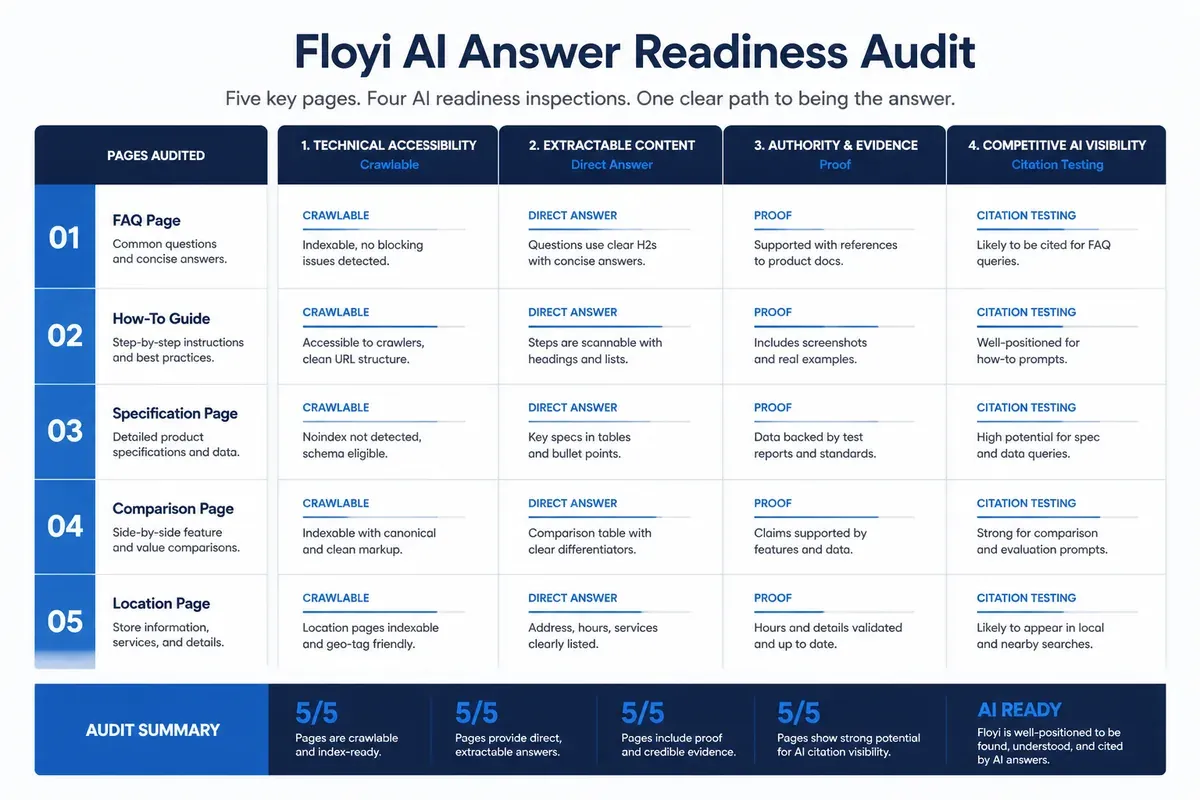
An AI answer readiness audit begins with search engine optimization (SEO) fundamentals, then checks whether artificial intelligence (AI) systems can retrieve, verify, extract, and cite a page’s claims. Generative Engine Optimization (GEO) and Answer Engine Optimization (AEO) extend SEO rather than replacing ranking quality, crawlability, indexability, or conventional snippet eligibility. Technical compliance improves a page’s eligibility for AI-generated answers, but it does not guarantee inclusion.
AI search optimization is an evidence and coverage discipline, not a keyword exercise. Select five conversion-relevant pages with viable search potential, ideally spanning intent types:
- FAQ: Addresses product, policy, or troubleshooting questions.
- How-to guide: Explains setup, use, or a defined process.
- Specification or service page: Includes compatibility, requirements, or decision details.
- Comparison page: Answers versus queries with clear criteria.
- Location page: Covers services, hours, and accurate business details.
Search Console queries containing who, what, how, and versus language can reveal the questions worth prioritizing. Review each chosen page through four connected lenses:
- Technical accessibility: Confirm that the URL is crawlable, indexable, canonicalized, included in the Extensible Markup Language (XML) sitemap, and internally linked from thematically relevant pages. It should also qualify for a conventional search snippet. Discovery barriers, orphaned pages, and competing URLs can send search systems to the wrong source.
- Extractable content: Put a direct 40 to 80 word answer near the top of the page in the searcher’s natural language. Question-led subheads and self-contained passages give AI answer engines material they can cross-reference across sources. Each passage should retain its meaning outside the page, answer the query directly, and point to visible supporting evidence.
- Authority and evidence: Check who made the claim, when it was published, which original data or method supports it, and whether entity details remain consistent across related pages. Unsupported assertions and isolated pages built around a single term are weak citation candidates. A visible author, publication date, and stable evidence anchor make a claim easier for readers and machines to validate.
- Competitive AI visibility: Run the same high-intent prompts in Google AI Overviews, ChatGPT Search, Perplexity, and Google Gemini. These systems synthesize modular passages from several sources instead of merely ranking one whole page. Record the surfaced page and passage, cited competitors, and the evidence patterns behind their inclusion.
Perplexity optimization should favor concise, well-supported claims over repetitive use of a static target phrase. The same principle applies across AEO and GEO workflows: clarity, verifiability, and human usefulness matter more than keyword repetition.
Page-level quality alone is not enough. Assess every URL against its full topical scope, including related Pillar, Hub, Branch, and Resource coverage. A comparison page may offer a strong lead answer but still lack the supporting hub content that demonstrates subject depth and intent coverage.
Create a repeatable baseline with an importance-weighted AI Presence Score:
AI Presence Score = Σ(importance × presence value) / Σ(importance)
Use 0 when the brand is absent, 0.5 when it is mentioned, and 1 when it is cited. Record the prompt, engine, surfaced page, passage, and competing domains each time. This measures share of model, while AI search visibility remains one signal beside content authority and market authority.
The answer engine optimization framework turns audit findings into focused page improvements. Preserve evidence records for material claims, then use the same prompt set to measure whether those changes improve citation and mention patterns.
Build Answer-First Content Blocks
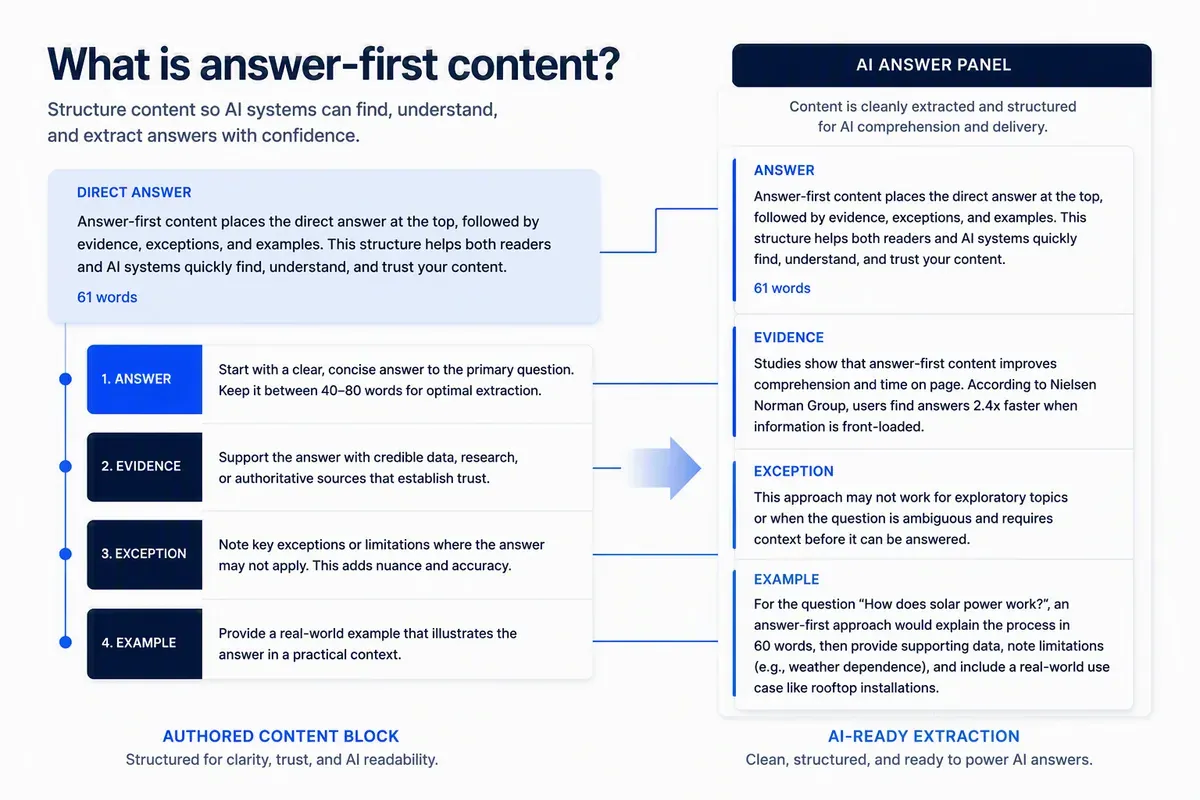
To turn audit findings into extractable passages, build each content block so the first one or two sentences answer the reader’s question before supplying context. This direct answer first pattern gives AI systems a complete passage to extract and gives readers a useful response without delay.
The Bottom Line Upfront method, also known as the BLUF approach, should match the scope of the query. A narrow definition or comparison generally needs a 40 to 60 word answer capsule, while a complex task may need a 40 to 80 word lead answer. Skip scene-setting unless it materially changes the decision.
A reliable answer-first block follows this sequence:
- Ask a specific question: Replace a generic label with a question-based heading that reflects the audience’s language and intent.
- State the answer: Put the conclusion, named entity, qualification, and practical relevance in the opening paragraph.
- Support the claim: Add evidence, mechanics, constraints, or an example that helps the reader use the answer.
- Address exceptions: Identify the condition where the standard guidance fails before moving to the next decision point.
“The Future of HubSpot” leaves both the audience and task unclear. “How can media companies automate ad sales with HubSpot?” names the product, audience, workflow, and intended outcome. That precision produces clear direct answers instead of broad commentary that an answer engine must interpret.
Coverage should reflect the choices buyers need to make:
- Definition: What is the product, method, or service?
- Function: What does it do in an actual workflow?
- Fit: Who benefits, and who should select another option?
- Cost: What pricing model, resource commitment, or tradeoff applies?
- Setup: What must be in place before implementation?
- Limitations and alternatives: Where does the approach fall short, and which other paths fit better?
Each answer capsule should remain understandable when separated from the page. Repeat “HubSpot,” “media companies,” or “advertising sales automation” instead of relying on “it,” “the platform,” or “this approach.” An extracted heading and lead paragraph need to communicate the exact subject, claim, caveat, practical relevance, and on-page evidence without nearby copy supplying the missing meaning.
Formatting is part of content optimization for AI, not a cosmetic pass. Use numbered lists for workflows, bullets for criteria or options, comparison tables for substantive distinctions, and distinct data blocks for specifications or cited evidence, while keeping paragraphs to two or three sentences with one purpose per paragraph.
Images and video can clarify a process, but written copy must carry the factual load. For claims that need stronger verification, connect the visible answer to an evidence anchor and structured data, such as a machine-readable provenance index with a stable claim ID, page URL, anchor, author, date, dataset URL, and checksum. Stable identifiers help retain the connection between AI-optimized content and the material supporting it through page updates.
Avoid building a page from disconnected snippets. The lead answer should resolve the query, and the remaining copy should add only decision-useful evidence, nuance, and exceptions while preserving a natural reading path.
Prove Every Material Claim
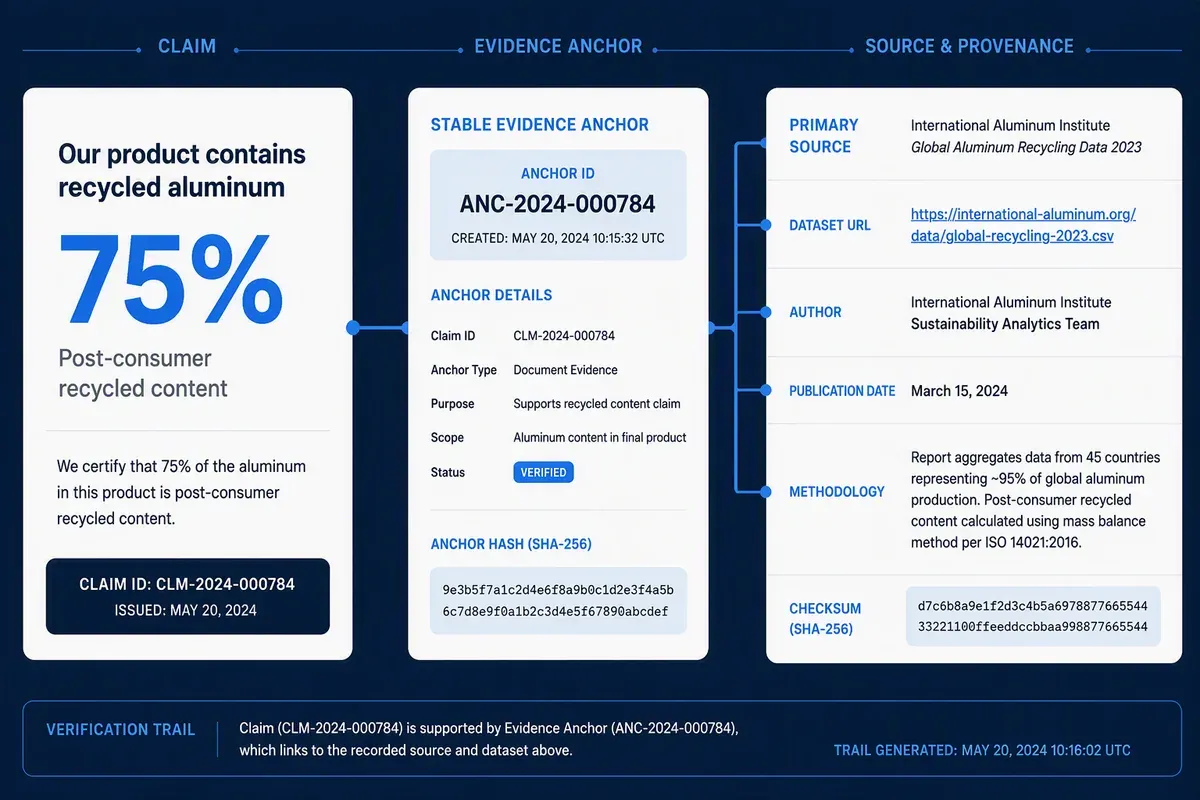
To make answer-first blocks citation-ready, any claim that could shape a purchase decision, change interpretation, or appear in an AI answer needs primary proof and an on-page evidence anchor that verifies its exact wording.
Use a claim-to-evidence standard that holds up under review:
- Identify material claims: Treat statements about performance, safety, cost, product capabilities, market behavior, and causation as material. General background still needs reliable support, but these claims require a higher bar.
- Match the closest proof: Use original research, government datasets, official records, source documentation, or first-party findings. A source that supports the topic but not the sentence’s precise claim does not qualify.
- Place a stable evidence anchor: Put the supporting table, source note, methodology, or official record near the claim at a durable page anchor. Readers and AI systems should be able to trace the statement without hunting through the page.
- Verify the claim’s scope: Check geography, dates, population, and causal strength before publication. AI-generated copy can turn correlation into causation or stretch a narrow finding across markets where it does not apply.
Every number needs an audit trail. For each statistic, benchmark, table, survey, or case study, disclose the dataset or population, collection period, applicable sample size, calculation method, and publication or update date. Original surveys, telemetry, and case studies become stronger citation assets when you publish their methodology, version history, licensing, and limits on what the data shows.
Firsthand experience can be equally useful when it is specific. State what changed, which page or site type was involved, the relevant audience or operating context, and what you observed, separating observation from interpretation. A team may find that an updated comparison page gained AI citations, but it cannot attribute that movement to one edit when a model update, seasonality, or a major site release also occurred.
Credible evidence includes results that do not support the preferred narrative:
- Counterexamples: Identify cases where the approach did not apply or produced a different outcome.
- Inconclusive findings: State when the data cannot distinguish between plausible explanations.
- Material constraints: Disclose self-reported inputs, observational methods, limited markets, short collection windows, model changes, and site-wide changes.
- Method changes: Note changes to collection logic, definitions, or calculations with dates that show where comparisons stop being like for like.
High-value answer blocks should identify the author or reviewing expert, publication date, last-reviewed date, and subject-specific credentials. Author-related structured data helps search and AI systems interpret that expertise, but it cannot substitute for a relevant biography or direct evidence behind the answer.
A machine-readable provenance file makes each claim easier to verify over time. Link the claims index from the document head with rel="alternate" and an application/json type. Each record should contain a stable claim_id, page_url, anchor, claim text, author, date, dataset URL, and checksum. Keep identifiers and anchors unchanged across deployments, version changed datasets, and retain a dated record of methodological changes.
Before publishing, fact-check every AI-generated assertion against its underlying source, then test whether individually accurate sources create a combined conclusion that goes further than the evidence allows. A reliable page lets a reviewer reach the exact proof, method, and accountable expert from every material sentence.
Strengthen Topical Authority and Entity Clarity
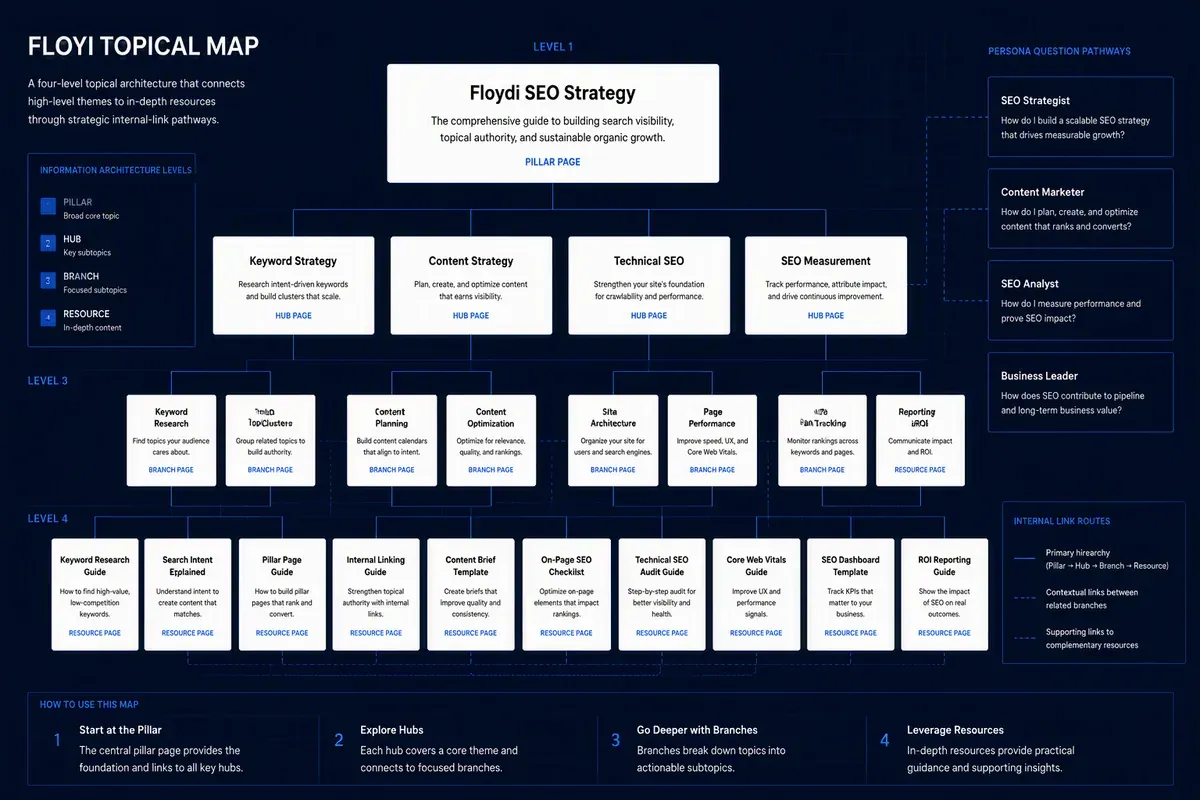
Beyond verifiable individual claims, topical authority comes from sustained, useful coverage of a defined subject area, not from publishing the highest number of pages. Each page should answer a real audience need, clarify its relationship to related content, and lead readers and AI systems to the next relevant explanation.
A practical authority workflow has four parts:
- Research persona questions: Map the definitions, use cases, costs, comparisons, limitations, and next steps each priority persona needs at every decision point. Traditional keyword intent covers only part of that work. Real prompt research and recurring audience phrasing can reveal answer-focused opportunities that broad keyword research misses, because conversational prompts often express creation, discussion, and reasoning needs that a keyword tool never surfaces.
- Set hub coverage boundaries: Give each hub one pillar page and distinct supporting pages, then prioritize gaps with the strongest audience value and competitive relevance. Set a coverage target before drafting. Stop when a proposed page has low intent, duplicates an existing answer, or creates keyword cannibalization risk. Filler content weakens the hierarchy by giving similar pages competing purposes.
- Make entities explicit: Define every product, concept, acronym, organization, method, date, and location at its first meaningful mention. State its category and direct relationship to adjacent entities. AEO focuses on making content easy for answer engines to extract, while GEO addresses how generative systems select and cite information. AI answer engines, citations, and AI visibility also need distinct definitions. Entity and semantic signals for AI answers help writers express those relationships rather than forcing systems to infer them.
- Standardize and validate terminology: Use one preferred name for each core entity across headings and body copy. Accepted variants belong only where they match audience language. An entity-gap review can classify concepts as missing, covered, or overused, giving writers a prioritized semantic-coverage plan instead of a generic keyword checklist.
Internal links turn the map into a clear site hierarchy. Connect broad guidance to the specialized page that answers the reader’s likely next question, using anchor text that names the destination topic. Although supporting pages can point back to a flagship answer when that relationship adds context, links added only for volume create noise, while purposeful paths clarify entity relationships and concentrate authority around the pages that matter.
Trust also depends on a consistent source identity. About, Team, and Product pages should establish Floyi as a closed-loop system that connects brand and audience insight to topical maps, drafts, and publishing. Verifiable author biographies, relevant credentials, and author-related structured data give readers and AI systems concrete evidence for evaluating expertise.
Expand a hub only when audience questions, search feedback, and competitive gaps support another page. Measure progress through entity coverage, internal-link paths, and visibility for each hub’s flagship answers.
Validate Crawlability and Appropriate Schema
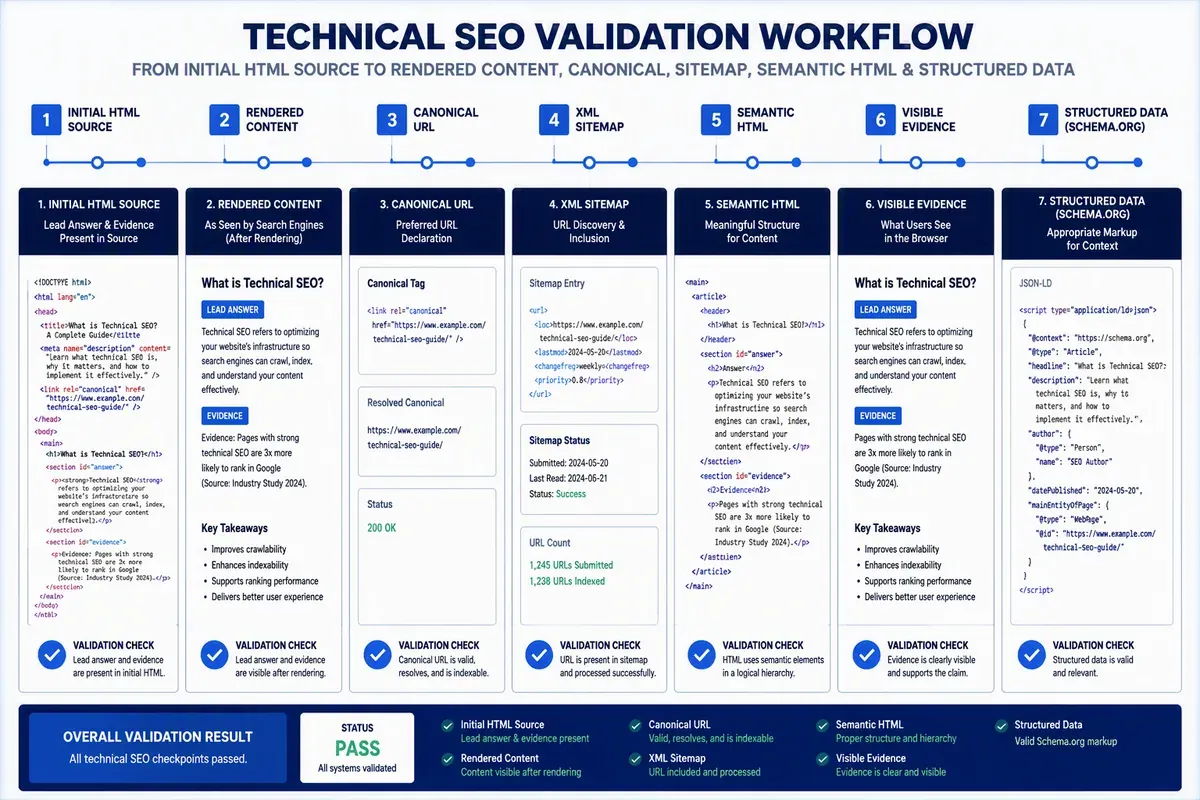
Technical eligibility establishes the conditions priority answer pages need for standard search and Google AI Overviews.
Apply the standard-search baseline before evaluating AI visibility. Each priority URL needs a successful HTTP status code, crawl and index access, the intended canonical URL, XML sitemap inclusion, and eligibility for ordinary search snippets. A technically valid page can still be bypassed if its evidence is weak or its answer does not match the query.
Validate each page in the order automated systems encounter it:
- Compare source and rendered content. Put the lead answer, material claims, evidence, and descriptive headings in the initial HTML. AI-readable content hidden behind heavy JavaScript, accordions, tabs, or complex visual components may be harder for crawlers to process (source). On JavaScript-dependent templates, compare source code with the rendered page. Use server-side rendering or static generation if essential copy appears only after rendering.
- Pair semantic HTML with page experience. A page needs one descriptive H1, a logical H2 and H3 hierarchy, native lists and tables, meaningful link anchors, and text alternatives for informative images. The main answer should load promptly on mobile, remain usable without JavaScript, avoid disruptive interstitials, and limit layout shifts. Consolidate duplicate URLs that lack a distinct user purpose, because unnecessary variants weaken canonical signals.
- Use structured data that reflects visible content. Schema.org structured data helps crawlers interpret page type, authorship, entities, and relationships. Use Article with Organization or Person authorship for editorial pages. Reserve HowTo schema for pages with genuine, visible ordered steps, and use FAQPage schema only when readers can find those same questions and answers on the page.
- Connect claims to visible evidence. Claim markup should reference a real on-page evidence anchor and supporting material, not an unverified statement. Keep each claim identifier, canonical URL, and anchor stable across deployments. A machine-readable provenance file can preserve the link between each claim and its evidence through updates.
- Test the deployed version before indexing. Place JSON-LD once per page, either in the head or before the closing body tag. Then validate markup, evidence anchors, robots directives, sitemap entries, and canonical URLs before requesting indexing. A broken anchor or a changed identifier can separate structured data from the proof it is meant to identify.
No AI-only Schema.org type, special markup, or technical setting guarantees inclusion in Google AI Overviews. Structured data provides context, but it cannot overcome inaccessible copy, unsupported claims, or weak query relevance.
If ChatGPT Search is a priority, allow OAI-SearchBot in robots.txt and allow requests from OpenAI’s published IP ranges. Keep staging and duplicate URLs protected through standard access controls and canonical management (source). Confirm the live configuration after deployment. Access may enable crawling, but it does not assure indexing, selection, citation, or prominent placement.
Test Citations Across AI Answer Engines
After establishing technical eligibility, citation testing measures whether AI-generated answers select and substantiate specific passages on your site, not whether a page merely ranks. Google AI Overviews and AI Mode use retrieval-augmented generation (RAG) and query fan-out, while ChatGPT Search, Perplexity, and Gemini assemble responses from modular material across multiple sources. Effective AI search optimization therefore evaluates claims, evidence anchors, and citations at the passage level.
Use a fixed weekly workflow so changes are comparable:
- Fix the prompt set: Include high-intent informational, commercial, comparison, and troubleshooting queries. Retain the exact wording, country, language, target page, intended claim, and supporting on-page anchor for each test. Comparison prompts should test whether your content offers balanced tables, side-by-side features, pros and cons, use cases, and clear cases where an alternative is not suitable.
- Test each engine consistently: Run every prompt in Google AI Overviews or AI Mode, ChatGPT Search, Perplexity, and Gemini using the same country and language settings. Capture answer text, cited URLs, citation placement, identifiable linked passages, brand mentions, recommendation status, and named competitors. Screenshots or exports matter because both citations and interfaces can shift between weekly checks.
- Match claims to evidence: For every material answer statement, record the cited URL and anchor, whether your domain or a competitor supplied the supporting material, and whether your page has a clearer, well-supported equivalent. Perplexity optimization requires this claim-level review, not a simple count of citations.
- Measure visibility against outcomes: Answer presence shows whether your domain appears in an answer. AI-citation share is the portion of tracked answers that cite your domain, while share of voice measures your citations against all cited domains in the same answer set. Establish a baseline before making page changes.
- Turn gaps into publishing priorities: Repeated competitor recommendations, unsupported claims, inaccessible or outdated cited passages, and missing third-party consensus indicate specific work to do. Reviews, forums, social discussion, and independent roundups can influence AI answer generation alongside your own pages. Strengthen the answer block, evidence anchor, dataset, comparison coverage, or external corroboration that addresses the observed failure.
Each weekly record should preserve the test context and evidence:
- Test context: Week start date, engine, query, country, language, and target page URL.
- Answer evidence: Answer presence, cited domains, citation placement, linked passage where identifiable, recommendation status, and competitors named.
- Outcome signals: AI-citation share, share of voice, Search Console impressions and clicks, referral sessions, click-through rate, assisted conversions, and notes on page or methodology changes.
AI search visibility and business impact are separate measures. Most mobile Google searches now end without a click, so a citation gain is not traffic by default. Compare weekly citation changes with Google Search Console, referral, click-through-rate, and assisted-conversion signals before treating visibility as commercial progress.
A machine-readable provenance index keeps weekly test records consistent. Publish it through a rel="alternate" link in the document head, tying each claim to a stable claim identifier, page URL, visible anchor, author, date, dataset or methodology reference, and checksum. Keep identifiers, URLs, and anchors stable across updates while versioning changed evidence and methods.
Feed the findings into Floyi’s AI Search Gaps and Authority Scorecard. The resulting queue should connect each failed prompt to the claim, page, and evidence improvement most likely to improve citation selection.
How Can You Operationalize AI Content With Floyi?
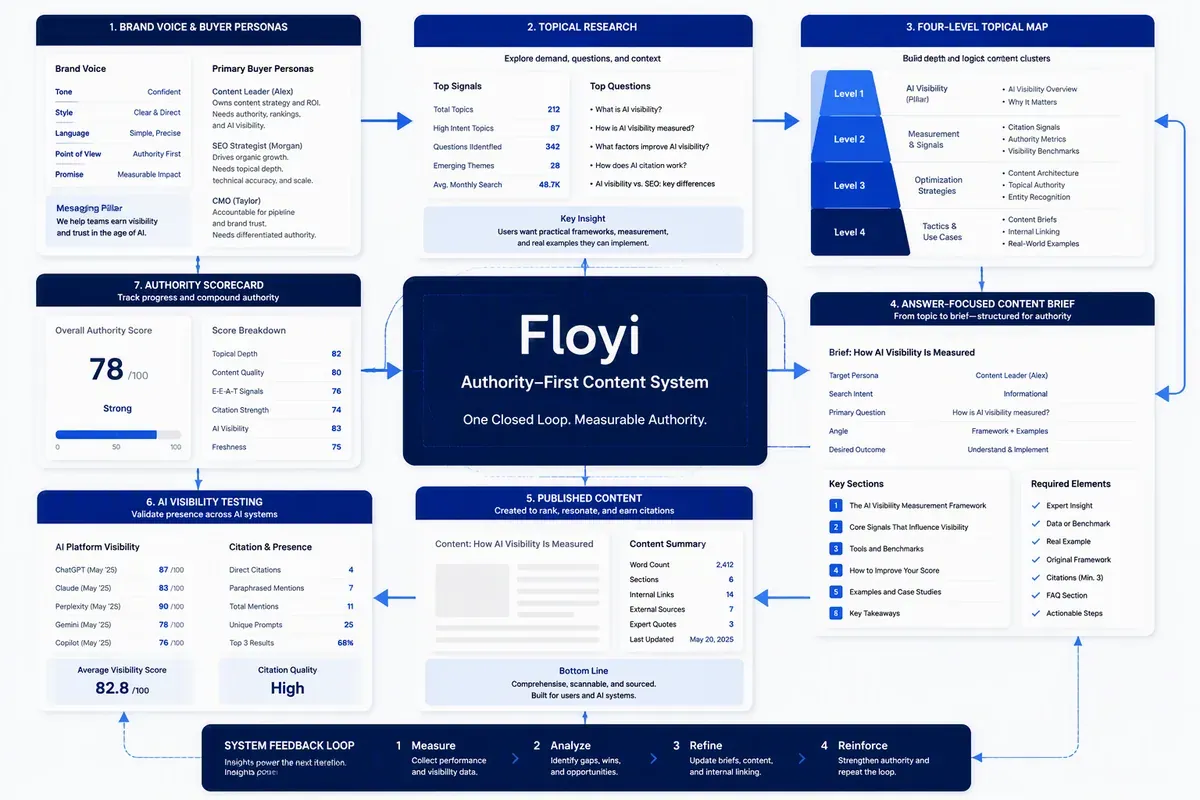
Floyi connects approved brand voice, positioning, buyer objections, and decision criteria to planning, production, and measurement. That continuity makes content optimization for AI more disciplined because answer engines need information that is clear, extractable, verifiable, and useful to people, not pages padded with isolated keywords.
The workflow keeps strategy connected to each page:
- Ground research in buyer perspectives: Audience Insights captures the roles, pains, objections, and decision criteria behind a prospect’s search. Topical Research uses that context alongside live search behavior to define topical scope beyond a brainstormed keyword list.
- Find gaps AI engines recommend: Audience Insights, Topical Research, and AI Search Gaps query ChatGPT, Gemini, and AI Mode through real buyer perspectives to identify recommended topics missing from the plan. Validated gaps can enter intent-based clusters, page priorities, and URL-aligned topical maps when they address a distinct need. Near-duplicate pages create cannibalization rather than stronger coverage.
- Set page priorities from performance signals: The Authority Planner combines opportunity signals with Google Search Console (GSC) matched URLs, clicks, impressions, queries, and trends. That evidence shows whether a page merits publication, an update, a merge, or lower priority.
- Feed results into the next plan: The Scorecard connects published work to AI visibility and authority signals, giving the next planning cycle a basis in search demand and answer-engine results.
Answer-focused briefs carry that system into production. Each Floyi brief inherits its topical map, audience context, search engine results page (SERP) evidence, competitor sources, internal-link intent, AI visibility signals, and only the Knowledge Base materials scoped to that assignment. Adding every internal document to every brief can introduce irrelevant claims or outdated product details.
A reusable answer block gives writers a reliable format for material AI systems can interpret:
- Question: State the reader’s decision or problem in plain language.
- Direct answer: Lead with a qualified conclusion rather than delaying it.
- Entities and evidence: Name the relevant product, method, standard, or concept, then support the claim with appropriate evidence.
- Exception: Identify the condition that changes the recommendation when the advice is not universal.
- Concrete example: Show how the guidance applies in a realistic situation.
Page intent should determine the format. Informational guides need direct explanations, evidence, and exceptions because readers are trying to learn or complete a task. Commercial product and service pages need a different information architecture, with the target customer, job to be done, operating mechanism, core activities, features, benefits, limitations, pricing, alternatives, evidence, sources, and last-updated date easy to find.
Floyi’s 24 content-type templates adapt those requirements to the page rather than forcing every asset into a generic FAQ. That distinction helps you optimize content for AI while preserving the structure a commercial evaluator or informational reader actually needs.
Connected execution still requires human review. In the editor, assess surfaced SERP competitors, research queries, and topical-map linking opportunities before accepting an automated recommendation. An internal link should support the reader’s next task, since links between loosely related pages add noise and weaken topical structure.
Measurement extends beyond rankings. Floyi’s Authority Scorecard separates Content Authority, Market Authority, and AI Authority while tracking mentions and citations in Google AI Overviews, AI Mode, and ChatGPT Search. Priority prompts, answer text, cited URLs, and selected passages gain meaning when reviewed alongside GSC performance and referral results.
Off-site evidence belongs in the same assessment. Reviews, forums, social discussions, and third-party roundups can shape the consensus behind AI recommendations even when the evaluated page sits on your domain. A missing citation, repeated objection, or unfavorable comparison points to the next evidence requirement or coverage gap worth addressing.
To put this into practice, Floyi turns an approved topic into a writer-ready brief with the entities, evidence requirements, and internal links already attached. Build a citation-ready brief.
Optimizing Content for AI Answer Generation FAQs
These FAQs address the practical decisions behind optimizing content for AI answer generation, including citation-ready claims, page structure, and measurement. They help you separate useful changes from generic AEO advice that doesn’t fit your content system.
1. Does Fresh Content Improve AI Answer Visibility?
Freshness can improve AI answer visibility for queries that depend on current prices, product versions, event details, statistics, or guidance. It is not a universal ranking factor for evergreen topics, where clear claims, credible evidence, and quote-ready language matter more than a recent edit date.
Update pages when sources, examples, recommendations, or product details have materially changed, and display an accurate Last Updated date only then. Automatic date changes and minor rewrites do not demonstrate freshness. Review fast-moving pages regularly, while stable pages need revision only when their evidence or advice changes.
2. Can Product Pages Appear in AI Answers?
Yes. Product pages can appear in AI answers when they answer a buyer’s decision questions in self-contained sections, not when they imitate an informational guide. State the intended customer, job to be done, what the product does, and how its workflow delivers that result. Make features, benefits, limitations, pricing, alternatives, evidence, and a visible last-updated date easy to extract. Each evidence anchor should substantiate its exact on-page claim, rather than relying on nearby sales copy.
3. Which Content Formats Earn AI Citations?
AI-optimized content is most citable when question-based headings lead with clear direct answers in a self-contained 40 to 60-word capsule. Put the direct answer first, then support it with original research, case studies, verified expert insight, or statistics that identify the author, publication date, methodology, and on-page evidence anchor. Keep supporting paragraphs under four sentences and use tables or distinct data blocks when they make evidence easier to extract.
4. Do AI Answers Favor Established Brands?
Established brands often have an advantage because years of credible coverage, backlinks, reviews, and recognizable experts give AI more independent signals to verify. That is an evidence and consensus advantage, not an automatic preference, and content depth alone rarely closes a trust gap in competitive topics.
Newer brands can improve recommendation eligibility by clearly defining who you are, your category, audience, and expertise across About, Team, and Product pages. Verifiable author credentials, appropriate author schema, firsthand evidence, and authentic third-party mentions help AI assess both your claims and your reputation.
About the author

Yoyao Hsueh
Yoyao Hsueh is the founder and CEO of Floyi, the topical authority platform, and the founder of Main Heading, an SEO and AI search agency. He created Topical Maps Unlocked, a course studied by thousands of SEOs, content strategists and digital marketers, founded TopicalMap.com, a done-for-you topical mapping service for agencies and enterprise teams, and publishes the weekly Digital Surfer newsletter on SEO, content strategy and AI search.
About Floyi
Floyi is a closed loop system for strategic content. It connects brand foundations, audience insights, topical research, maps, briefs, and publishing so every new article builds real topical authority.
See the Floyi workflow