Technical AI Search Optimization for Crawling, Retrieval, and Citation
Audit AI crawler access, indexing, retrieval, internal links, and citation readiness to prioritize technical SEO fixes across answer engines.
A page can rank in Google and still never appear in an AI answer. Technical AI search optimization starts with crawling, rendering, indexability, and canonical signals, then makes important passages usable for retrieval and citation. Schema can’t compensate for a blocked canonical URL or an answer hidden behind client-side interactions.
A 200 response alone doesn’t settle eligibility. A URL can redirect from an XML sitemap, carry conflicting noindex and canonical signals, or expose no useful server-rendered HTML to OAI-SearchBot, PerplexityBot, or ClaudeBot. URL-level audits classify pages as eligible, intentionally excluded, or blocked before testing rendering, structured data, evidence anchors, and internal-link paths.
Citation performance requires separate measurement from rankings and referral traffic. Floyi’s AIRS Analyzer evaluates individual queries across 11 search engines, while a fixed corpus of 50 to 500 commercial queries reveals whether failures occur in access, retrieval, answer selection, or conversion. Track answer presence, domain citations, AI citation share, click-through rate, and assisted conversions after every material change.
Technical AI Search Optimization Key Takeaways
- Technical SEO is the entry requirement for AI retrieval and citation.
- Audit crawlability, rendering, indexability, canonicals, and internal links at the URL level.
- Test AI bot access separately from Googlebot access using robots.txt, CDN, WAF, and origin logs.
- Serve lead answers and supporting evidence as stable, server-rendered HTML.
- Use descriptive headings, semantic HTML, and self-contained passages to support retrieval.
- Keep JSON-LD aligned with visible content, stable claim IDs, and evidence anchors.
- Measure citations, answer presence, referrals, and assisted conversions by query, engine, and page.
How Does AI Search Discovery Work?
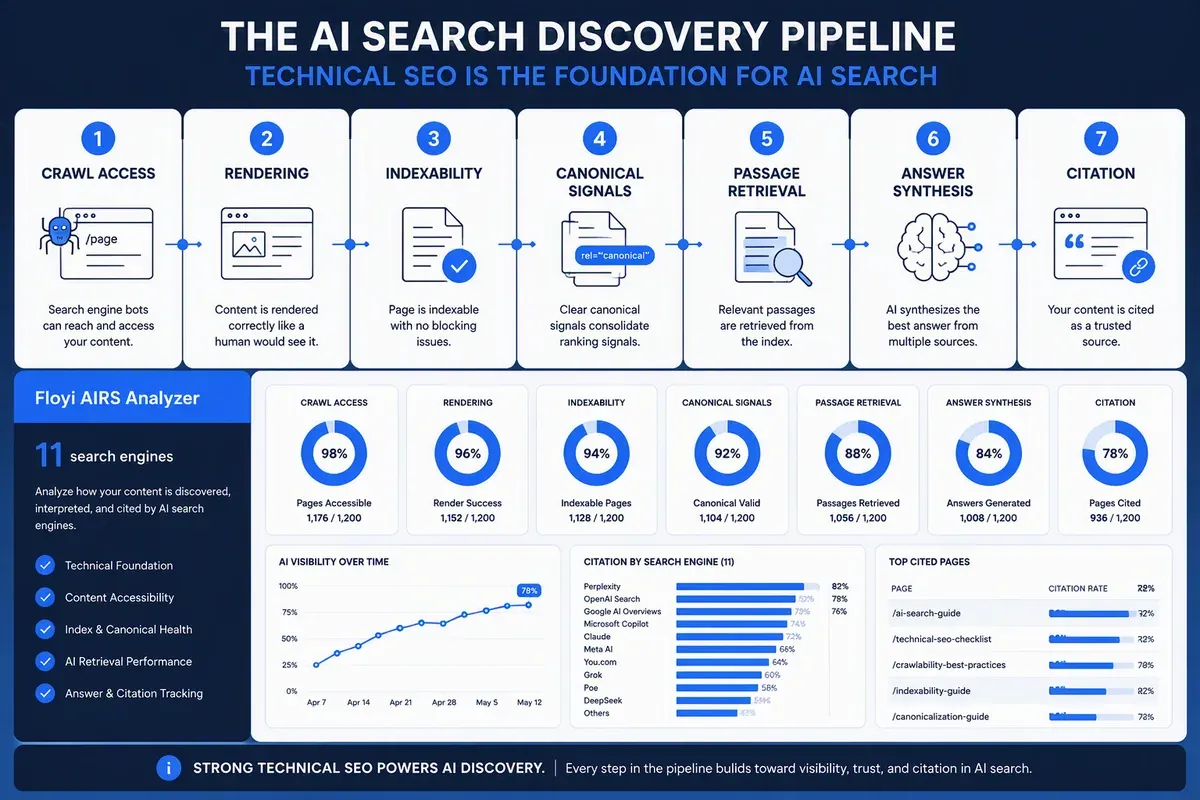
AI search discovery begins with the same technical eligibility checks as conventional search. A page can be used more reliably as source material when it is crawlable, renderable, indexable, canonical, and discoverable through internal links (source, source).
Technical search engine optimization (SEO) remains the entry requirement for AI search optimization. Audit crawling, rendering, canonicalization, indexability, and internal linking before assessing answer selection. An organic ranking alone does not ensure that an engine can extract the precise, well-supported passage needed for an answer.
Generative Engine Optimization (GEO), Answer Engine Optimization (AEO), and SEO for AI build on SEO rather than replacing it. Google AI search optimization across Google AI Overviews, ChatGPT, Perplexity, and Claude adds selection layers that determine whether a page becomes a cited source:
- Retrieve relevant passages: Retrieval-augmented generation (RAG) finds current material from an indexed corpus, often selecting passages instead of evaluating a page as one unit.
- Resolve entities and evidence: The system identifies the subject, connects claims to the right entities and topical scope, and checks whether nearby evidence supports the query.
- Synthesize and cite an answer: The engine composes a response from a limited source set, then selects citations that establish provenance and may lead users to deeper material.
Make important passages easy to extract with a direct lead answer, descriptive headings, stable fragment anchors, and evidence placed beside the claim. Clear authorship, visible publication or update dates, and consistent structured data reduce ambiguity when a passage is separated from its surrounding page during retrieval.
Citations create visibility in a zero-click environment, but they do not guarantee referral traffic. Your page still needs decision-ready detail, practical tools, datasets, or implementation guidance that gives users a reason to click. An AI search optimization program should treat citation accuracy and referral value as separate outcomes.
Measure AI visibility, referral traffic, and business impact by query, engine, and page, tracking answer presence, domain citations, AI-citation share, share of voice, click-through rate, and assisted conversions. Floyi’s Topical Authority Scorecard tracks AI citations, visibility, and share of voice over time, while AIRS Analyzer evaluates individual queries across 11 search engines. The AI impact on search algorithm becomes actionable when technical eligibility, extractable evidence, and conversion measurement appear in the same reporting view.
How Do You Audit Crawl Access And Index Eligibility?
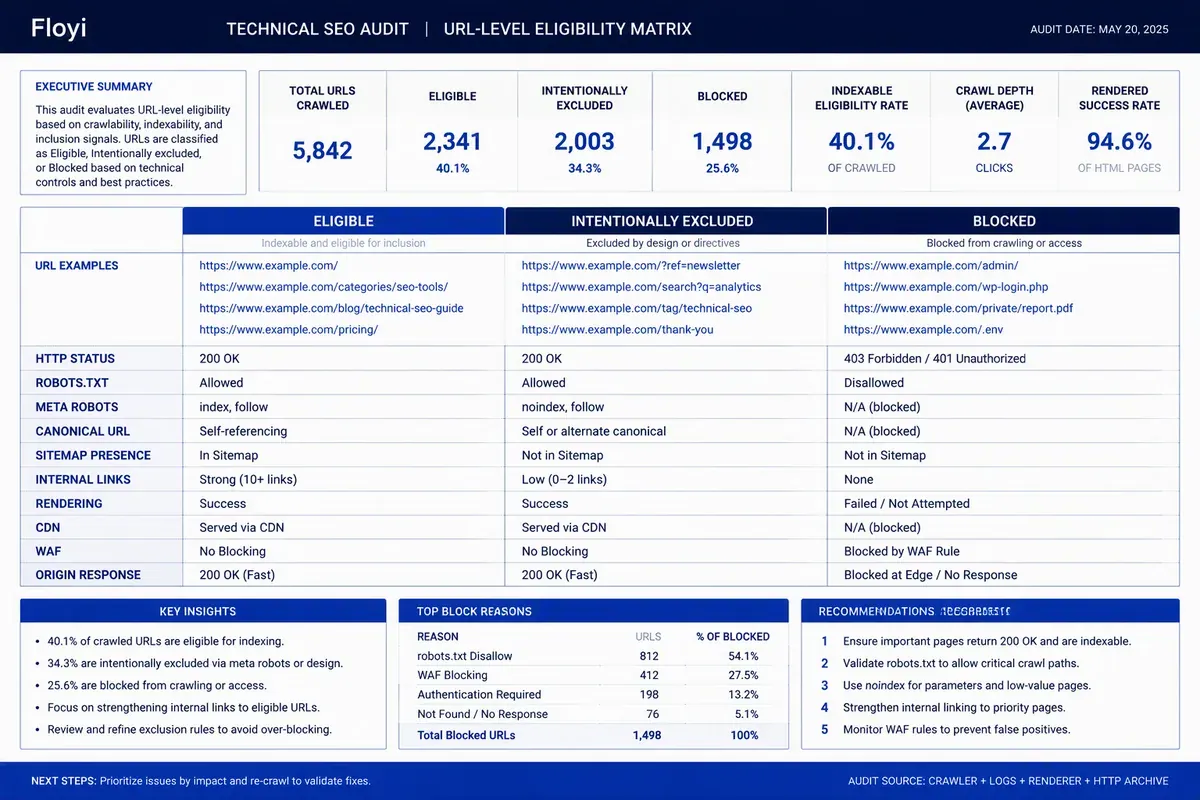
AI search indexing begins with URL eligibility: an important page must be discoverable, crawlable, indexable, retrievable, and citable before an artificial intelligence (AI) system can surface it in an answer. Technical SEO for AI search improves that eligibility, but it cannot guarantee website crawling, search engine indexing, rankings, or citation.
Build the audit at URL level, not domain level, combining Extensible Markup Language (XML) sitemaps, internal crawl discovery, Google Search Console landing pages, analytics data, and high-value templates. Prioritize product pages, documentation, high-value articles, and useful category pages because these pages carry the strongest commercial and topical value.
Each URL record needs enough evidence to support a clear classification:
- URL purpose: Capture page type, intended index status, sitemap presence, and whether the page should contribute to content discovery.
- Access signals: Record the requested URL, Hypertext Transfer Protocol (HTTP) status code, redirect destination, robots.txt result, meta robots directive, and X-Robots-Tag header.
- Preferred URL path: Note the canonical target, internal-link sources, and whether sitemaps, redirects, canonicals, and internal links identify the same representative URL.
- Rendering and infrastructure: Confirm whether JavaScript produces meaningful Hypertext Markup Language (HTML), then note authentication barriers, rate limits, content delivery network (CDN) behavior, web application firewall (WAF) rules, and bot-specific restrictions.
Classify every record as eligible, intentionally excluded, or blocked. An eligible URL usually returns a 200 response, self-canonicalizes or references its intended representative, receives relevant internal links, and appears in the sitemap when appropriate. Passing website indexing checks alone is not enough if rendered content is unavailable or the page lacks the information needed for retrieval.
Test both the requested address and its final destination. Sitemap URLs that redirect or error, internally promoted noindex pages, and canonical targets blocked by robots.txt send conflicting signals. Redirect chains, loops, HTTP and HTTPS variants, host variations, trailing-slash duplicates, parameters, and faceted combinations can divide signals and consume crawl activity without creating useful pages.
Deliberate exclusions require the same care as indexable pages. Internal search results, session URLs, duplicates, uncontrolled filters, and unsuitable utility pages should not be promoted. In contrast, an orphaned documentation page that should rank needs a crawlable internal path. Clear hierarchy and duplicate control support conventional search engine indexing and downstream AI retrieval.
Keep AI crawler access separate from the core crawlability audit. Tests for OAI-SearchBot and ChatGPT-User can reveal bot-specific restrictions, but they do not replace rendered-content validation or prove citation eligibility. Resolve conflicts on high-value URLs first, then measure how many priority pages remain eligible before moving to rendering, structured data, and evidence checks.
How Do You Verify AI Bot Access?
Googlebot access does not establish access for AI search engines. Build a bot-by-bot matrix for the production hostname and each public directory you want surfaced, then test robots.txt, edge controls, and origin responses independently.
| Crawler | Access purpose to assess | Representative policy |
|---|---|---|
| Googlebot | Google crawling and indexing | Allow intended public canonical pages |
| OAI-SearchBot | OpenAI retrieval | Allow citation-worthy public pages if desired |
| GPTBot | OpenAI training collection | Keep separate from retrieval policy |
| PerplexityBot | Perplexity crawling | Allow applicable public content |
| ClaudeBot | Anthropic crawling | Allow applicable public content |
Check the live /robots.txt file on the production host for reachability, currency, and valid syntax. Test representative canonical URLs with every applicable user agent. For example, GPTBot can access /public/ while /private/ remains disallowed. Retrieval and training are separate decisions, so you may allow OAI-SearchBot while declining GPTBot. Include Claude-User, Claude-SearchBot, and Perplexity-User when those agents matter to your website crawling policy.
An explicit Disallow, a missing robots.txt file, and a contradictory wildcard rule are different findings with different fixes. Redirects, staging policies, alternate hostnames, and documentation subdomains can also override the intended production rule. A crawler allowed on www may still be blocked on docs, where SaaS sites often publish their strongest technical evidence.
Robots.txt is only one gate. Confirm verified crawler requests in CDN, WAF, and origin logs, using documented user-agent strings with reverse-DNS or IP verification before treating traffic as authentic. Record the following for each crawler and page type:
- Edge response: Whether the request reached the CDN and whether cache behavior changed the response.
- Security response: Whether the WAF, firewall, bot controls, GEO restrictions, CAPTCHA, or JavaScript challenge intervened.
- Origin response: The final HTTP status, redirect chain, response size, and availability of server-rendered content.
- Rate-limit response: Whether several representative pages succeed without 403 or 429 responses.
Citation-worthy pages must return useful server-rendered content without logins, cookies, sessions, or human interaction. A single successful request is weak evidence because throttling may appear only after repeated fetches.
Finish with a crawler-by-page-type verdict covering robots.txt permission, edge observation, security acceptance, and final response. ChatGPT may also use Bing, Claude may use Brave Search, and Perplexity may rely on proprietary or partner retrieval systems, so access testing should sit beside ongoing citation monitoring.
How Do You Validate Rendering And Indexing?
After confirming bot access, validate rendered content, index eligibility, and passage-level evidence together. A page can look complete in a browser while its lead answer, supporting text, links, or schema depend on client-side behavior that crawlers may never receive. That gap is where technical SEO for AI search breaks down.
A retrieval-readiness check covers five areas:
- Compare three page versions: Inspect the initial HTTP response, the browser-rendered DOM, and Google Search Console URL Inspection for the preferred canonical URL. Lead answers, headings, internal links, structured data, and supporting passages should appear as selectable text after rendering.
- Confirm index eligibility: The canonical URL should return a successful HTTP status, use HTTPS, contain no noindex directive, and avoid conflicting canonical signals. Descriptive internal links and XML sitemap inclusion support website indexing, while duplicate signals, server errors, and rendering failures can prevent an otherwise visible page from becoming index-eligible.
- Remove interaction gates: Test high-value passages with JavaScript disabled and before clicks, scrolling, hovering, tab changes, or route transitions. Read More controls, accordions, infinite scroll, image text, canvas elements, and client-side routing can support usability, but they cannot be the only path to an answer.
- Check semantic structure: Use
article,header,nav,main,section,aside, andfooterelements to distinguish primary content from navigation and boilerplate. One descriptive H1 followed by logical H2 and H3 headings gives retrieval systems clearer passage boundaries. - Test stable evidence anchors: Place each important claim in a self-contained text block beneath a meaningful heading. Where a fragment URL is appropriate, its anchor must remain stable across deployments. Claim or HowTo JSON-LD must point to a real ID that matches the visible claim and its supporting evidence.
A provenance layer can make this technical structure more usable for AI search indexing. A site-level provenance file can be used to connect claims with page URLs, fragment anchors, authorship, publication dates, supporting datasets, and checksums, and it can be linked from the document head if your internal system defines that pattern (source).
<link rel="alternate" type="application/json" href="/provenance.json">Website speed belongs in the same validation pass. Render-blocking resources, oversized images, uncompressed assets, and excessive CSS or JavaScript can delay primary text or cause rendering failures under constrained crawl conditions.
Optimizing websites for generative AI features means serving a fast, secure, semantically clear document whose essential passages do not rely on fragile browser interactions. Recheck the rendered DOM and claim anchors after every template or deployment change.
How Do You Make Pages Ready for AI Retrieval?
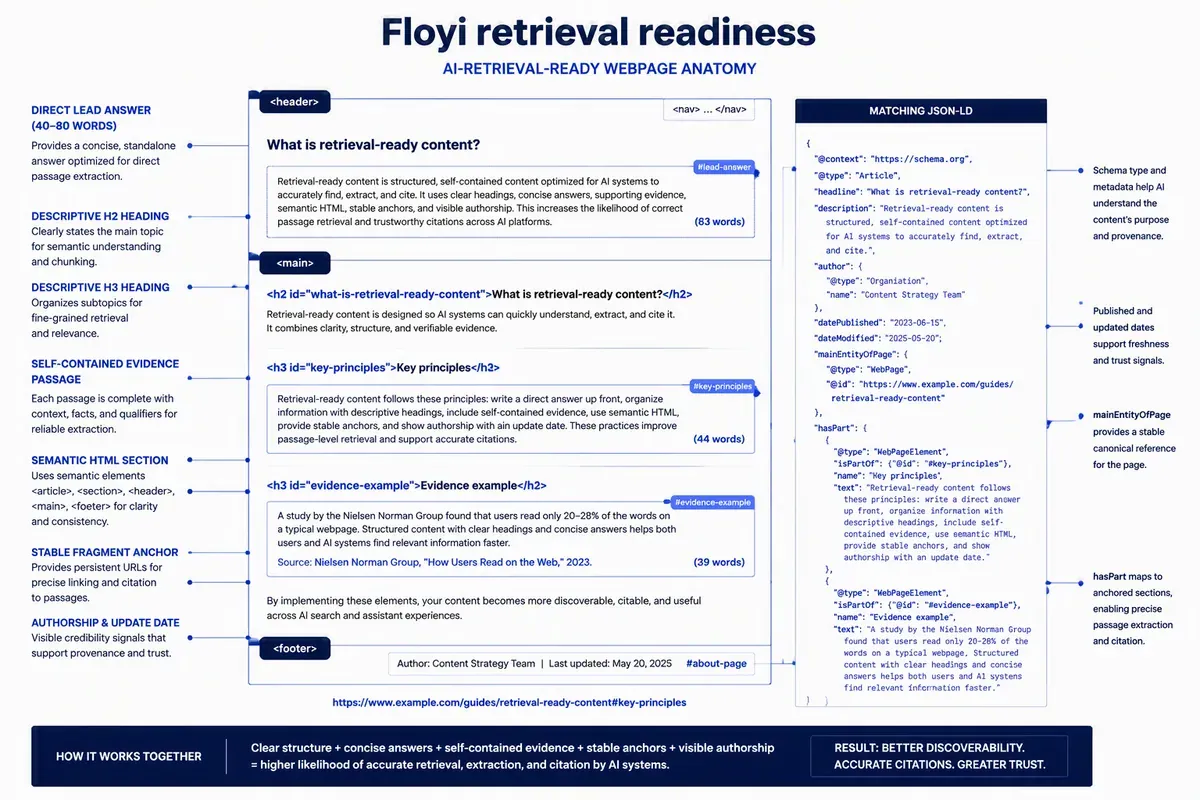
A page is ready for AI retrieval when an AI system can pull one precise passage from the URL and use it to answer a query with confidence. For SEO for AI, test that standard before adding more copy, schema, or keywords.
Directly below the introduction, place a 40 to 80 word answer and state the conclusion, the relevant entity, and the conditions that affect it in your audience’s language. Optimizing websites for generative AI features depends on explicit meaning, not repeated terms or implications a system must infer.
A retrievable page has a clear information structure:
- Give each URL one job: Center the page on one primary question or task. Move adjacent topics to supporting pages when they need a different answer, even if they share keywords.
- Use a descriptive hierarchy: Write H2 and H3 headings that accurately preview the content beneath them. Use semantic HTML to clarify relationships for users and crawlers.
- Make blocks self-contained: Open each high-value section with a definition or direct answer, then add qualifications, process details, or examples. Use numbered steps for sequences, tables for comparisons, and labeled facts for specifications.
- Validate rendered access: Ensure primary answers and evidence appear in rendered HTML, including on JavaScript-heavy templates. Mobile testing should expose delayed components, hidden tabs, or client-side dependencies that withhold essential material.
Technical clarity does not, by itself, establish content quality. Every material claim needs a visible evidence anchor that identifies the source or method, author, update date, and supporting dataset when applicable. Original content based on firsthand experience, expert analysis, or disclosed research gives AI systems evidence they can inspect. The AI search citations and trust signals framework shows why stable claim identifiers and anchors support citable pages through redesigns and deployments.
JSON-LD should mirror rendered content rather than decorate claims readers cannot verify. Use one page-level implementation and select the schema pattern that reflects the resource. Evidence-led pages can combine WebPage, Claim, and Dataset, while HowTo belongs only on pages with genuine task steps. Permanent claim IDs should map to real evidence anchors, with author, dates, and supporting materials matching the visible copy.
{ "@type": "Claim", "@id": "https://example.com/page#claim-001", "claimText": "A canonical, visible claim.", "identifier": {"@type": "PropertyValue", "value": "claim-001"}, "citation": {"@type": "CreativeWork", "url": "#evidence"}}Page experience is a retrieval prerequisite. Readable sections, logical navigation, and original images or video should clarify the answer instead of interrupting it. Website speed matters when essential copy or evidence arrives late, because an unrendered passage cannot be selected for AI search optimization.
The answer engine optimization guide applies these page-level principles to answer-focused content patterns. Start with one high-value page, then validate its lead answer, rendered HTML, evidence anchor, and matching JSON-LD.
How Do You Build Entity-Led Internal Links?
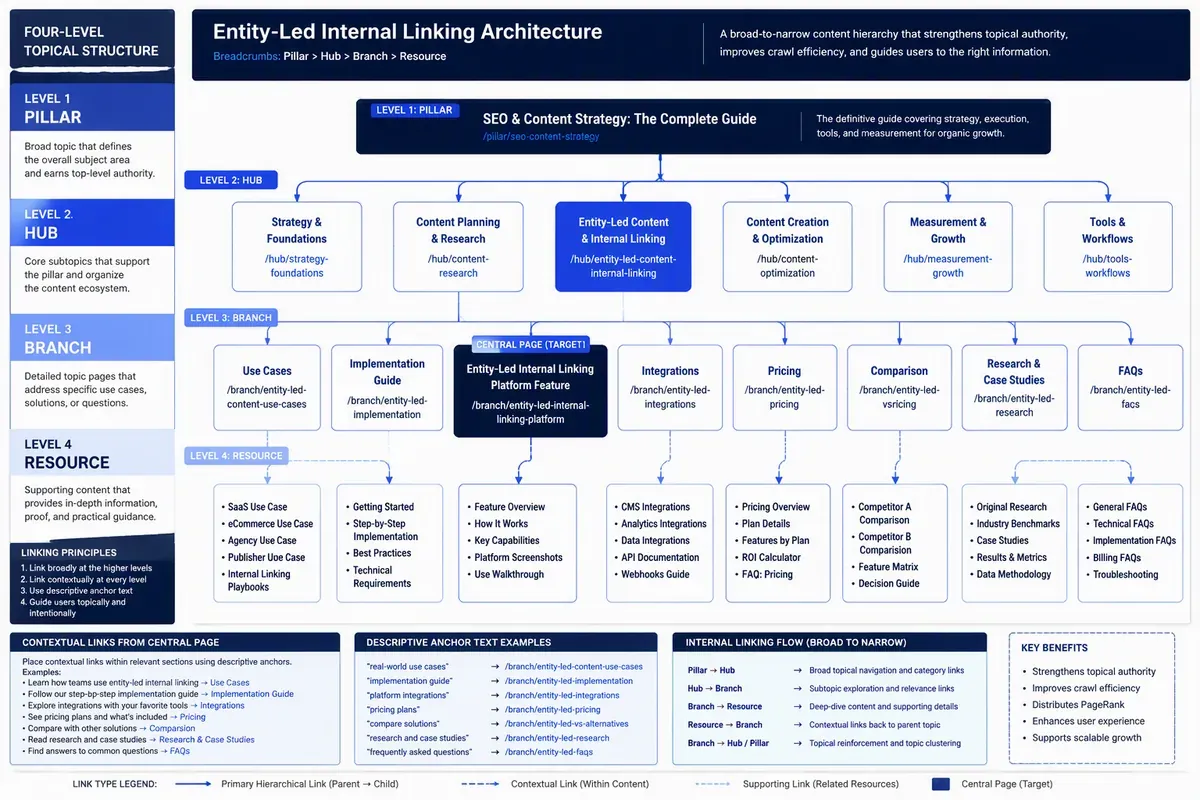
Once a page is retrieval-ready, a feature page for workflow automation should link to the use cases it supports, its implementation documentation, compatible integrations, and applicable pricing. Those connections form an entity-led internal-linking architecture, where the organization and product category sit at the center of a knowledge graph rather than a collection of isolated SEO articles.
Authority hubs should lead to increasingly specific child pages, while every child retains a clear route back to its parent. URL subdirectories, breadcrumbs, primary navigation, and contextual links need to express the same broad-to-narrow hierarchy. Floyi Site Architecture generates the URL hierarchy, page types, and parent-child blueprint before briefs and drafts add contextual links.
Relationship signals matter more than link volume:
- Descriptive anchors: Use anchors such as product pricing, feature implementation documentation, compatible integrations, product comparisons, or research supporting a capability. The destination entity and the reader’s likely next step should be clear from the link itself.
- Purposeful lateral links: Connect feature pages to relevant use cases, documentation, integrations, and pricing. Return use-case pages to the products and features that solve the stated problem.
- Evidence-led paths: Research pages should support the claims they evidence, then link to a comparison or FAQ only when it resolves a specific related question.
- Protected page roles: Documentation does not need a path to every commercial page, and pricing should not become a research library. A precise relationship carries more meaning than an inflated internal-link count.
This structure helps retrieval systems interpret relationships among entities, attributes, evidence, related entities, and authoritative sources. It also gives visitors a practical route from a broad product question to technical details, commercial evaluation, or supporting research.
AI search discovery still depends on the technical foundation beneath the graph. Linked pages must be crawlable and indexable before they can enter search indexes, appear as retrieved fragments, inform generated answers, or earn citations and traffic. Keep important contextual links in accessible HTML, and use semantic main, article, section, aside, and nav elements to separate primary content from boilerplate.
Audit each high-value entity page as a navigable graph. Short paths should reach its parent, relevant commercial and technical children, evidence, and common answers. Orphaned pricing, documentation, integration, comparison, and research pages deserve early attention, especially when generic anchors conceal what the destination represents.
How Do You Run Multi-Engine Discovery Diagnostics?
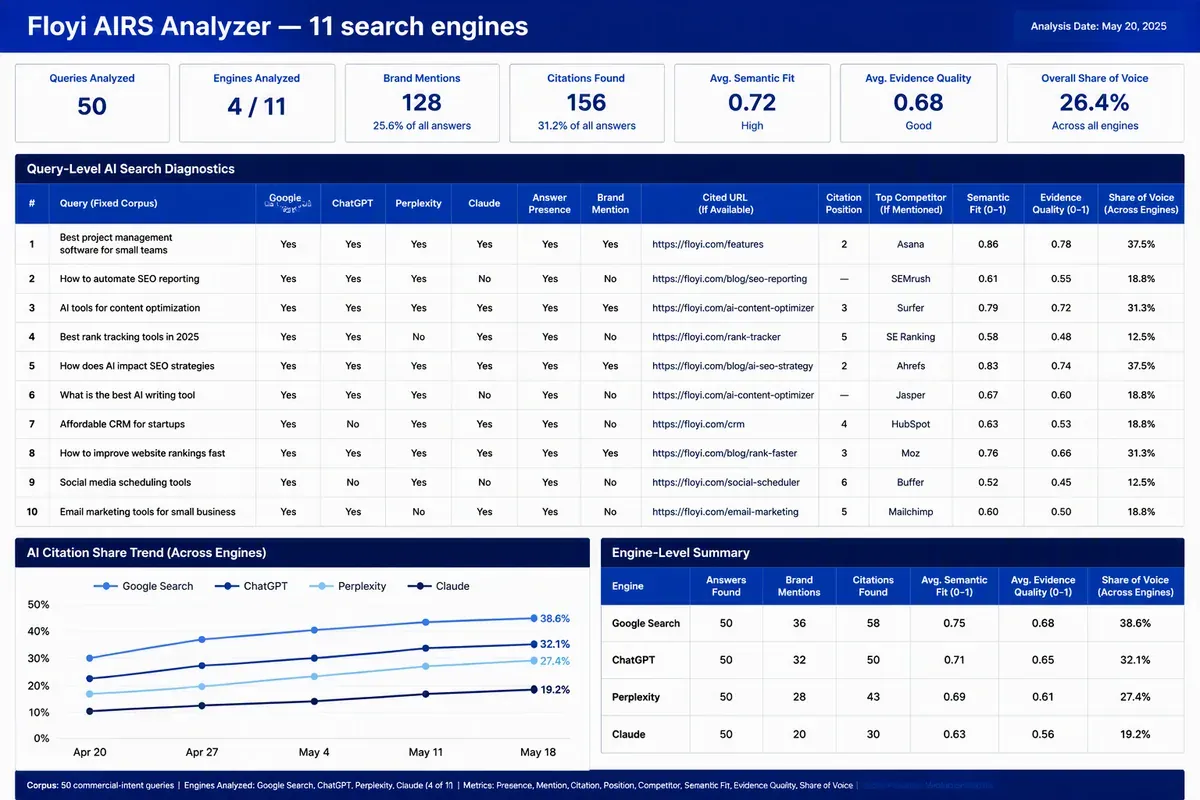
After auditing the entity graph, a multi-engine diagnostic uses the same controlled commercial query set in Google Search, ChatGPT, Perplexity, and Claude to separate technical eligibility from answer selection. AI search discovery goes beyond crawling and indexing. For content discovery to occur, an engine must find, extract, interpret, retrieve, and reuse a page in AI-generated answers. Google’s retrieval-augmented generation can draw on indexed pages for linked AI answers, but indexation does not ensure inclusion.
Build a fixed corpus of roughly 50 to 500 commercially important queries within one market, language, topical scope, and measurement period. Preserve each query’s exact wording for every weekly check. This range is large enough to reveal patterns while remaining manageable for a recurring diagnostic.
The corpus should cover the buying path:
- Category leaders: Searches for leading products, providers, and solution categories.
- Brand definitions: Queries that test whether AI search engines accurately describe your company and offer.
- Competitive evaluation: Brand-versus-competitor, competitor-adjacent, best-product, pricing, integration, use-case, and limitation queries.
- Demand balance: A representative mix of branded, non-branded, and competitor-related searches.
Run every query under consistent, documented conditions and trace its full path. In Google Search, assess indexation, snippet eligibility, standard-result visibility, and AI-result selection when available. In ChatGPT, Perplexity, and Claude, capture whether the response names your brand, retrieves the intended page, or replaces it with a competitor or third-party source.
A discoverable URL can still fail at passage-level retrieval. Vector embeddings encode content as high-dimensional numerical vectors, allowing semantic search to evaluate conceptual and contextual similarity rather than keyword density alone. AI systems may score individual paragraphs, tables, and lists, so inspect cited or paraphrased material for:
- Semantic fit: The passage answers the commercial intent directly.
- Standalone clarity: The answer makes sense without surrounding page context.
- Evidence: Claims have visible, verifiable support on the page.
- Explicit relationship: The passage clearly connects to the product, feature, or category.
Maintain stable query and page IDs in your telemetry. Each record should capture the date, engine, query, target page, answer presence, brand mention, citation status and position, cited URL and domains, named competitor, accuracy assessment, freshness, and diagnostic notes. That baseline supports reproducible AI-citation share, answer presence, and share-of-voice calculations instead of opaque health scores or screenshots.
Compare results by intent and engine before revising a page. An indexed page that no engine retrieves often has weak passage clarity, poorly placed evidence, or poor semantic alignment. A Perplexity citation without a ChatGPT brand mention can indicate an engine-specific selection difference, not a sitewide issue. Log model updates, seasonality, and major site changes before tying AI search ranking optimization trends to click-through rate and assisted conversions, then rerun the unchanged corpus weekly.
How Do You Prioritize Fixes With Citation Feedback?
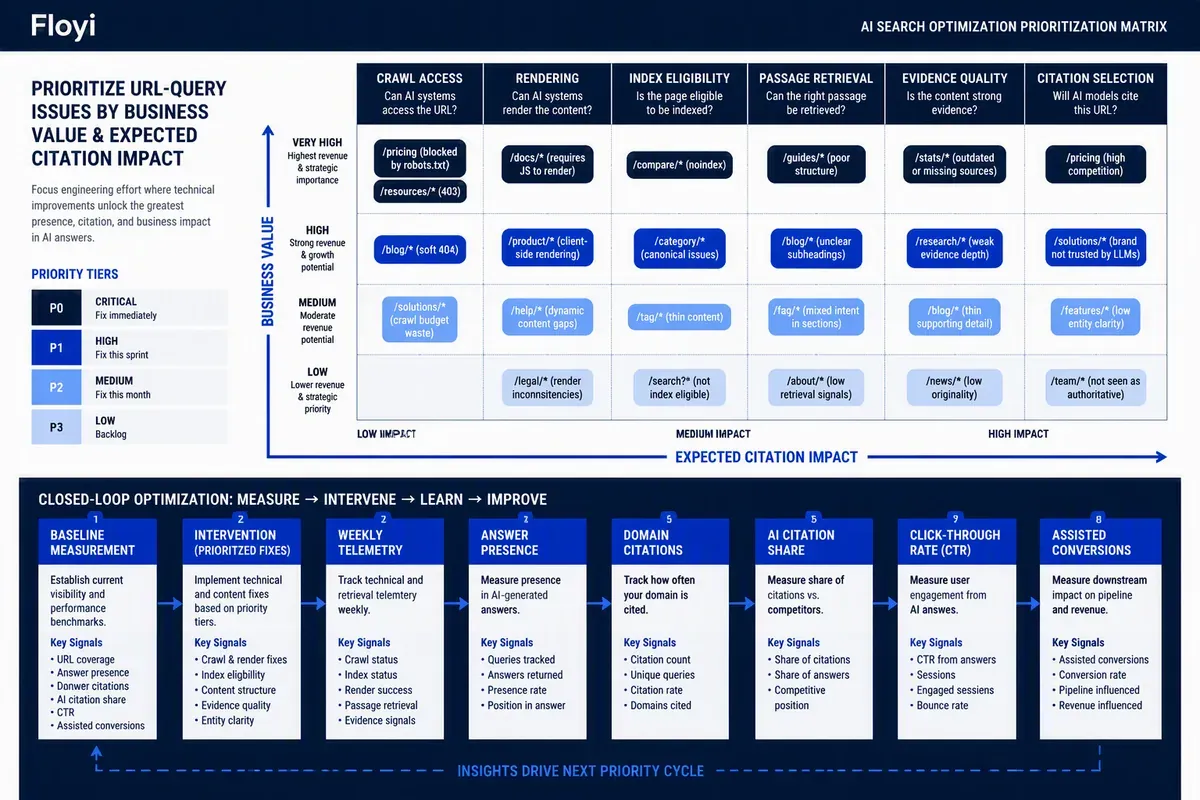
Using the diagnostic baseline, citation feedback matters when it identifies the URL and query pair worth fixing, the stage where selection failed, and the change you can validate against a baseline.
Use a closed-loop audit before treating a missing citation as a content issue. Start with high-value audience needs and conversion-supporting pages, then isolate the failure stage. A page may be inaccessible to crawlers, render incorrectly, lack index eligibility, miss retrieval, rank poorly, or reach retrieval but lose citation selection. Each condition calls for a different remedy.
Score each URL and query pair against the factors that affect priority:
- Business value and demand: Weight revenue relevance, assisted-conversion potential, and audience demand for the query.
- Failure stage: Prioritize pages that already rank or are retrievable but remain uncited. In this position, stronger evidence or a clearer answer format can outperform a full rebuild.
- Expected citation impact and effort: Compare the likely change in answer presence, domain citations, and AI citation share with the required engineering and editorial work.
- Topical fit: Keep the remedy within the relevant hub by using the Pillar, Hub, Branch, and Resource map, entity coverage, and authority signals. Floyi’s Authority Planner identifies gaps without pushing disconnected copy beyond the topical scope.
Inspect the citation winner before changing your page. Compare answer directness, placement, original insight, evidence quality, and topical fit. Complex queries can trigger related searches, so commodity summaries rarely hold an advantage. Non-derivative evidence gives AI systems more to select than another version of familiar material.
When content quality and entity coverage are sound but the page still loses, authority may be the constraint. Distribution, digital PR, or link building can matter more than publishing additional copy.
To turn extractability feedback into a precise on-page edit, place a neutral, factual answer of roughly 40 to 60 words directly beneath the relevant major heading and high in the document. Replace promotional claims with named sources, dates, current metrics where appropriate, and visible evidence anchors. AI search ranking optimization is page engineering, not prompt phrasing.
For relevant factual pages that remain difficult to verify, add a machine-readable provenance layer alongside semantic HTML, Schema.org structured data, and crawl controls. A provenance.json index can support verification of those claims.
<link rel="alternate" type="application/json" href="/provenance.json">Measure changes before calling them successful. Capture a pre-change baseline, then collect weekly URL-level telemetry by engine, query, and variant for:
- Answer presence: Whether your domain appears in the answer.
- Citation performance: Domain citations, AI citation share, and share of voice.
- Business outcomes: Click-through rate and assisted conversions.
Log every edit with its date. Over 12 weeks, compare matched treatment and control pages with difference-in-differences:
lift = (Treatment_week12 - Treatment_week1) - (Control_week12 - Control_week1)Reprioritize from observed movement rather than an undocumented health score. A reproducible record of the page, query, intervention, and business outcome gives your next Floyi plan evidence to act on.
Floyi’s AIRS Analyzer runs a single query across 11 search engines, so you can see which stage is failing before rewriting a page. Check your AI search eligibility.
Technical AI Search Optimization FAQs
These FAQs address the technical AI Search Optimization choices that shape crawl access, indexing, structured data, rendering, evidence, and measurement, helping you connect implementation work with Google visibility and AI citations.
1. Does Schema Markup Improve AI Search Visibility?
Schema markup does not give you a special path into Google AI Overviews or Google AI Mode. Google says both require no technical requirements or schema.org markup beyond standard SEO. Crawlability, indexability, answer-first content, and visible evidence still matter. Accurate JSON-LD adds technical clarity by helping systems interpret entities, authorship, dates, FAQs, datasets, and citations. Keep Article, FAQPage, Organization, Person, Dataset, Claim, or HowTo markup aligned with visible copy, stable IDs, and evidence anchors. Schema supports provenance, but it cannot guarantee retrieval, ranking, inclusion, or citation.
2. Should You Create an llms.txt File?
Creating /llms.txt is an optional, low-effort experiment rather than a requirement for AI visibility. This emerging Markdown convention sits at your site root and can direct participating LLMs to priority documentation, core resources, and data assets. An llms-full.txt file can add detail, but neither format is a universal web standard.
It won’t solve blocked crawlers, client-side rendering failures, weak index eligibility, or thin retrieval-ready pages. Robots.txt rules, crawlability, canonicalization, XML sitemaps, indexing, and on-page quality remain the technical foundation.
3. How Do Canonical Tags Affect AI Citations?
Canonical tags consolidate duplicate-page signals around a stable citation target for search and AI systems. Place a self-referential canonical on the preferred URL, point true duplicates to it, and use that same URL in internal links, XML sitemaps, and provenance references. Parameters, trailing-slash variants, and republished pages can otherwise divide retrieval signals.
A canonical does not replace crawl access, indexability, or accurate visible content. The preferred page still needs to be crawlable and useful. Use 301 redirects for permanent URL changes, and apply noindex only when you intend to exclude a duplicate.
4. Do XML Sitemaps Help AI Search Engines?
XML sitemaps help AI search systems find new, deep, or weakly linked pages and indicate which URLs you consider important. Include only preferred canonical, indexable URLs that return successful responses, with crawlable internal links, consistent URL normalization, appropriate noindex directives, and 301 redirects after permanent moves.
They reduce discovery friction but do not guarantee crawling, indexing, ranking, retrieval, or citation. AI answers still require accessible, indexable content that is relevant to the query and well supported by quality web results.
5. Can JavaScript-Only Pages Appear in AI Answers?
JavaScript-only pages can appear in AI answers, but only when relevant crawlers can execute the scripts and receive stable, indexable HTML containing the main answer. Results are conditional, so keep pages fast, secure over HTTPS, and compatible with the search and AI crawlers that matter to your visibility.
Serve critical claims and supporting evidence as server-rendered HTML. Content limited to images, canvas elements, client-side widgets, tabs, Read More controls, authentication, blocked resources, or failed rendering is less reliable for retrieval. Use progressive enhancement for interactive features while preserving the lead answer without JavaScript.
Sources
About the author

Yoyao Hsueh
Yoyao Hsueh is the founder and CEO of Floyi, the topical authority platform, and the founder of Main Heading, an SEO and AI search agency. He created Topical Maps Unlocked, a course studied by thousands of SEOs, content strategists and digital marketers, founded TopicalMap.com, a done-for-you topical mapping service for agencies and enterprise teams, and publishes the weekly Digital Surfer newsletter on SEO, content strategy and AI search.
About Floyi
Floyi is a closed loop system for strategic content. It connects brand foundations, audience insights, topical research, maps, briefs, and publishing so every new article builds real topical authority.
See the Floyi workflow