
How to Manage SEO Topical Maps Across a Team: Roles and Cadence
Learn to manage SEO topical maps across teams and brands with clear ownership, edit controls, brief handoffs, and review cadences that keep every map current.
When several account teams can edit the same plan, an SEO topical map turns into a topical map version control problem. To manage SEO topical maps across a team, give every brand one governed record, a named owner for each hub and a validation gate before briefs enter production. Each planned or live URL needs a defined role in the Pillar > Hub > Branch > Resource hierarchy.
A writer who spots a content gap may have good evidence. Adding a hub or changing a parent relationship without approval still creates overlap across sites. A RACI model for SEO teams separates structural decisions from editorial updates. Floyi’s Topical Map validates the hierarchy, preserves page metadata and generates URL slugs before approved nodes move into Planner.
Weekly production checks and monthly performance reviews keep priorities, missing slugs, stalled briefs, and cannibalization visible. Track validation pass rate, approval time, missing slugs, and brief-to-publish time by hub to confirm the operating model is working.
Managing SEO Topical Maps Across Teams Key Takeaways
- Keep one governed topical map per brand as the single source of truth for SEO.
- Give every hub one accountable owner who approves structural changes.
- Use a RACI split so taxonomy control stays separate from editorial work.
- Require a stable topic ID and URL slug before a topic enters production.
- Validate the map again every time stakeholder edits come back from an export.
- Tie every brief to an approved map node, its intent, its scope, and its internal links.
- Review production weekly and performance monthly, and log each decision with an owner and a date.
Set Up One Governed Map Per Brand
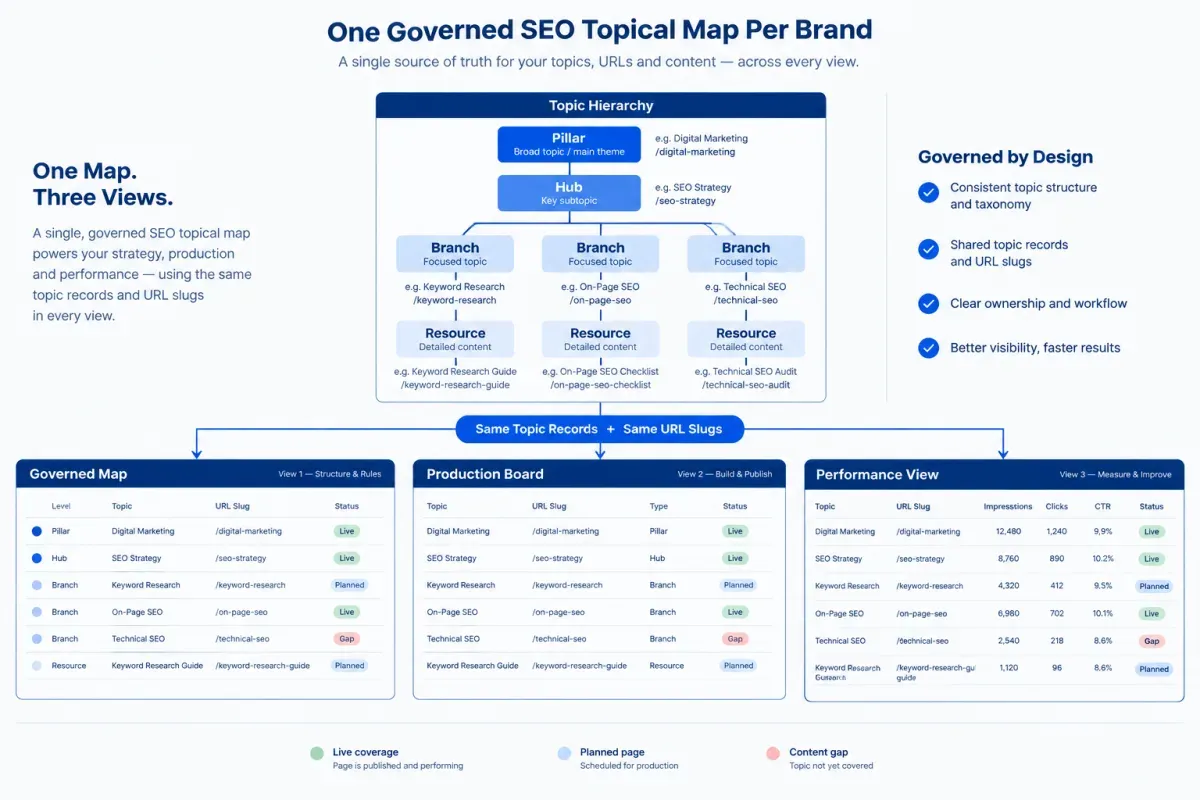
Give every brand or client one living topical map that works as the single source of truth for SEO. A keyword file goes stale once SEO content planning ends. A governed, collaborative topical map stays current because every team reads from it and writes to it.
A centralized topical map holds the approved structure from pillar pages through hubs, branches and page-level resources. Keep coverage, related URLs, ownership, approved changes, and internal-link opportunities in that same record. That stops strategists, editors and client approvers from working off separate spreadsheets.
Before you govern a map, check how the map gets built, because the hierarchy should mirror the site architecture you plan to publish. Broad parent pages lead to more specific supporting pages, and each page gets one role. Separate adjacent search intents, but don’t create two pages for the same role. That’s how you avoid duplicate content, orphan pages and cross-brand cannibalization. Visual tools such as Miro help test a structure, but only the validated map governs execution.
Three views should read from the same topic records:
- Governed map: hierarchy, live coverage, planned pages, and gaps.
- Production board: each approved topic’s brief, draft, publishing status, and contributor.
- Performance view: live URLs, authority signals and scorecards.
A persistent topic ID and URL, planned or live, ties the views together. Title, status and destination changes stay traceable without copying fields between tools.
A stable URL slug is the readiness gate for every planned page. It gives the topic a linkable identity for briefs, internal links, publishing, and scorecards. Floyi’s Topical Map validates the hierarchy, preserves page metadata through refreshes, generates URL slugs, and moves the approved structure into the Topical Authority Planner and Scorecard. Missing slugs should reach zero before a page enters production.
Assign Map Ownership and Editing Rights
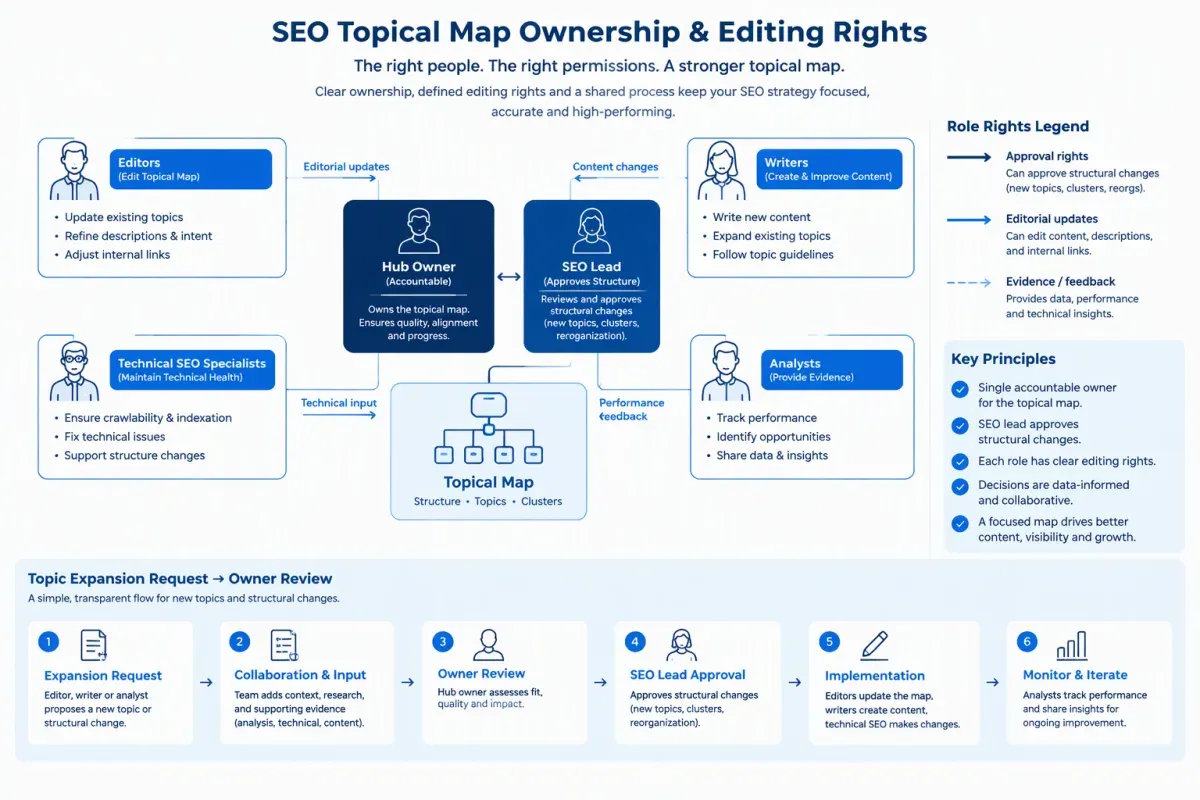
Every hub needs one accountable owner, even when one person covers several roles. That owner answers for coverage, search intent fit, prioritization, and overlap across pages, clients and brands. Topical map governance starts there, because shared ownership means nobody resolves conflicts.
A RACI split makes SEO team roles and ownership clear before competing edits create conflicting versions:
- Accountable owner: has the final say on topical scope, page ownership, priority, and overlap.
- SEO lead or topical architect: controls hierarchy, taxonomy, keyword validation, and expansion approvals. On small teams, this is often the accountable owner.
- Editors: turn approved nodes into briefs and check intent, scope, quality, and internal links.
- Writers and subject-matter experts: produce assigned pages and add page-level context without touching taxonomy.
- Technical SEO specialists: implement the approved architecture and URL relationships.
- Analysts: measure outcomes and flag evidence for the next review.
Keep structural access narrow. Only the owner or SEO lead adds, moves or renames parent hubs and settles disputes over page ownership and URL paths. Editors and contributors can update an assigned node’s title, evidence, angle, and intent notes. They don’t add hubs, reassign topics or change parent-child relationships.
When drafting reveals a gap, the writer files an expansion request. It names the proposed subtopic, its search intent, the supporting evidence, the likely parent hub, and any URL it might overlap. The owner weighs it against the brand’s SEO content strategy and the existing topical scope, then approves, revises, defers, or rejects it. That keeps topical map management across a team responsive without letting production change strategy by accident.
Floyi’s workspace roles cover access, not map structure, so the RACI split is a team agreement. Owners handle billing, seats and team deletion. Admins manage members, invites and brands, including brand deletion. Members use the full product and can create and edit brands, but they can’t delete them.
Control Changes Before Production Begins
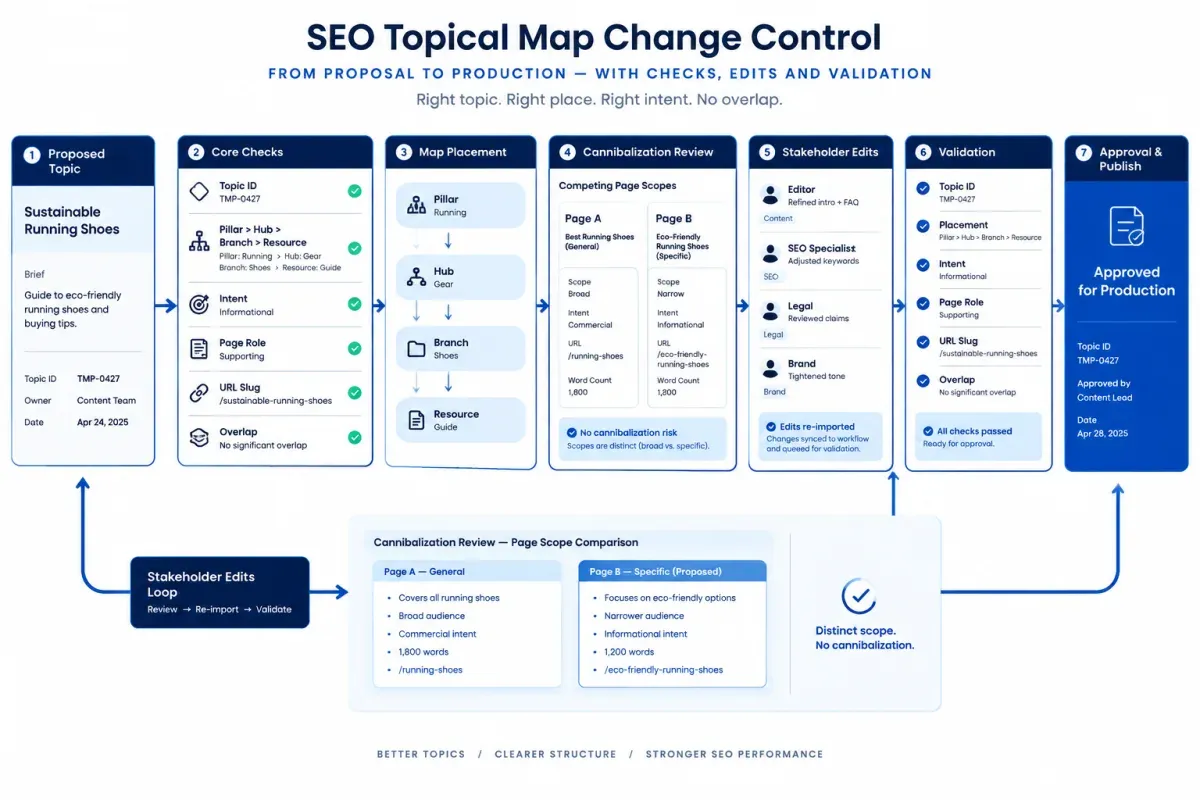
Change control means every row in an SEO topical map is a defined content opportunity or an existing URL, never a loose keyword. Before a row is approved, give it a stable topic ID and a place in the Pillar > Hub > Branch > Resource hierarchy.
Standardize the SEO topical map fields so reviewers compare like with like. Each row carries the topic, primary and secondary keywords, search intent, page role, priority, owner, status, target slug, and required internal links. Use controlled values for the fields that drive decisions:
- Intent: informational, navigational, commercial, or transactional.
- Page role: pillar, supporting article, comparison page, or landing page.
- Status: proposed, under review, approved, in production, published, or optimizing.
- Link relationships: parent pages, sibling pages, link direction, and anchor-text guidance.
A map isn’t ready for briefs, drafts or scorecards until its hierarchy passes validation and every page-level node has a proposed URL slug. Confirm the canonical URL once a CMS draft exists.
Every new URL also needs an overlap decision. Compare existing pages, SERP results, audience needs, and intent. A keyword variation alone doesn’t justify another page, but related pages can coexist when their scope or intent differs. Record whether the proposal gets differentiated, folded into an existing page or declined. Floyi’s Planner flags cannibalization when multiple pages compete for the same topic.
Stakeholder review runs through an export-and-revalidation loop. Floyi exports the validated map as an XLSX file with two sheets, a Hierarchical View and a Markdown Outline. Stakeholders comment on the export. You re-import the approved edits and Floyi validates them again. That second validation catches structural changes that comments can introduce.
Promote only a validated, slug-complete map into the Topical Authority Planner. Track validation pass rate, fixes applied, missing slugs, and time to approval for each project. Those numbers show whether the gate holds or whether teams are working around it.
Turn Approved Topics Into Content Briefs

In an SEO content workflow, the approved map is your production queue, not an ad hoc keyword list. Before a brief goes out, confirm the node’s planned slug, existing-page status, priority, and page purpose. Link the task to that node so the owner, writer and due date live in one record instead of three tools.
A standardized content briefing workflow gives writers and editors the decisions they need before drafting. Each SEO content brief sets the search intent, audience, buyer-journey stage, and topical scope. It names the subjects a parent hub or sibling page already owns, which keeps the page focused and prevents cross-brand cannibalization.
Every content brief tied to a topical map should make four things visible:
- Page purpose: the reader need the page serves and the adjacent intent it excludes, especially when another brand already owns it.
- Evidence package: SERP consensus, AI answer context and the brand evidence behind an original angle. Flag unsupported ideas as research gaps.
- Internal links: required parent and sibling destinations, the reader path each one supports and approved anchor options.
- Map record: the node ID and planned URL, so editors can check the page against the approved architecture.
We cover the mechanics of turning map topics into writer briefs separately. On a team, the point is that the brief carries the map record instead of a copy of it. That matters when one team serves several accounts with similar services or overlapping audiences.
In Floyi, Planner generates topic-anchored briefs that carry the node’s ID, name, title suggestion, intent, buyer-journey stage, and notes. Each brief pulls current SERP and AI answer context, and Planner shows its processing status until it’s done. Voice changes by client too. Keeping one brand voice across every writer turns a valid topic into the right page for that brand.
Publication is a control point, not permission to change strategy. Check intent alignment, on-page SEO, required links, approved URL use, and topical scope. A failed check sends the page back for revision. The map node doesn’t change.
Run a Shared Review and Audit Cadence
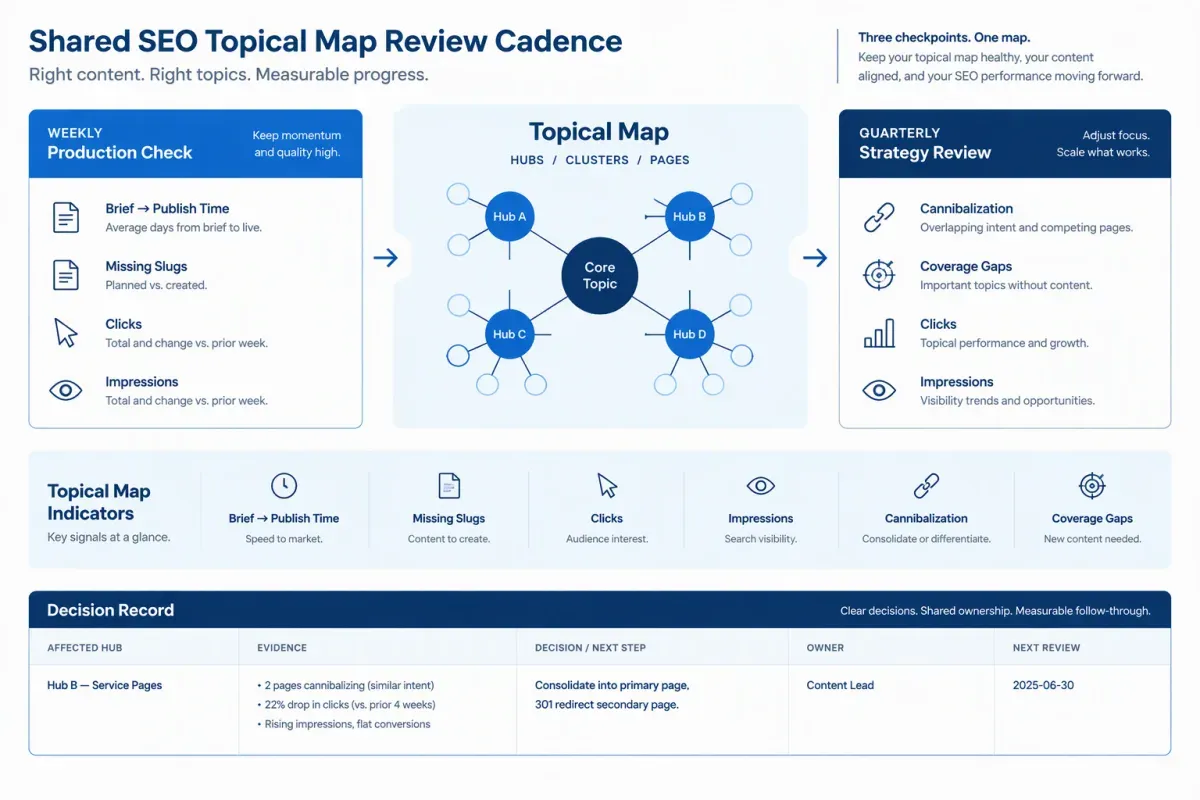
After publication, a shared review cadence keeps the map tied to search evidence and business outcomes instead of article volume. It also gives an agency a team SEO workflow and steady SEO team collaboration without filling calendars with meetings. Three review points cover it:
- Weekly production check: a 20 to 30 minute review of overdue briefs and drafts, competing assignments, upcoming dates on the SEO content calendar, missing expert input, and missing slugs. Log each decision with the affected hub, a named owner and a dated next action.
- Monthly topical map audit: a 45 to 60 minute review of Search Console data next to the live map. Look at clicks, impressions, positions, non-brand traffic, conversions, and coverage gaps by hub.
- Quarterly topical map audit: a deeper reset of the baseline and the SEO roadmap. Compare topical strength, cannibalization, page-to-map match rate, and changes in leads or signups.
Structural calls such as merging or retiring pages come out of a recurring map maintenance cycle. The quarterly review is where the map owner signs off on them.
Weekly flow metrics show where production stalls before it becomes a client-facing problem. Track brief-to-publish time, on-time delivery and backlog age by hub. A brief that ages because it’s unapproved or missing a slug needs a documented fix before the next review.
Judge hubs by qualified traffic, not page count. A hub with dozens of articles and little qualified traffic usually needs better intent alignment or internal links, not more pages.
After every monthly and quarterly review, keep one short decision record. It lists the affected hub or URL, the evidence, the decision, the owner, and the next review date. That gives each client approver a shared audit trail of what changed and why. To run this cadence across every client map in one workspace, see how Floyi works for agencies.
Managing SEO Topical Maps Across Teams FAQs
These FAQs cover the ownership and coordination questions that come up when managing SEO topical maps across a team or across brands.
1. Who Should Own the Topical Map on a Team?
One named strategist owns each brand’s map and approves structural changes, including new topics, moves, merges, and retirements. Editors and contributors can propose changes and flag overlap, but they don’t apply them. A single owner prevents duplicate or unowned URLs and keeps slugs, intent and internal links consistent. Once a topic is approved, the strategist hands it to a writer through a brief.
2. How Do Teams Handle Shared Audience Segments?
Give each shared audience segment one accountable hub owner, even when two brand teams serve it. When teams overlap, compare query intent, page purpose, target URL, existing coverage, and commercial relevance. Keep one canonical assignment when intent and purpose match. Split it only when the audience need, brand proposition or target URL is materially different. That prevents duplicate pages and conflicting briefs.
3. Can Regional Teams Use One Topical Map?
Regional teams can share one topical map when they serve the same brand, site, language, and search intent. Add locale notes for country-level SERP differences. Split the records when the language or the buyer needs change. Separate domains with their own approval paths also need separate records.
A shared spreadsheet suits a small regional team. Linked records in Airtable or Notion help across international sites and large URL inventories. Project management tools for content teams handle approvals and deadlines.
4. How Do Mergers Affect Existing Topical Maps?
A merger needs a fresh URL and ownership audit against the combined map. Match every live page to one destination hub. Assign each overlapping page to a single owner, who decides its future through the normal maintenance review. Keep a decision record with the prior and new hub, the URL, any redirect target, the rationale, and the approval date. Then reflect the approved hierarchy in category paths, URL taxonomy, redirects, and schema markup. Validate the hierarchy and slugs before briefs or publishing resume.
About the author

Yoyao Hsueh
Yoyao Hsueh is the founder and CEO of Floyi, the topical authority platform, and the founder of Main Heading, an SEO and AI search agency. He is an expert in topical authority and topical mapping. He created Topical Maps Unlocked, a course studied by thousands of SEOs, content strategists and digital marketers, founded TopicalMap.com, a done-for-you topical mapping service for agencies and enterprise teams, and publishes the weekly Digital Surfer newsletter on SEO, content strategy and AI search.
About Floyi
Floyi is a closed loop system for strategic content. It connects brand foundations, audience insights, topical research, maps, briefs, and publishing so every new article builds real topical authority.
See the Floyi workflow