
SEO Service Level Agreement (SLA) Template for Agencies
Copy this SEO agency SLA template with fill-in fields for scope, deliverables, response times, reporting, and change requests, plus what it must never promise.
An SEO SLA isn’t a promise that rankings or traffic will rise. It is the operating schedule attached to an SEO retainer agreement. It states what gets delivered, when it is due, who approves it, and how blocked work is handled. A copyable agreement sets measurable service commitments without turning Google or AI search outcomes into contractual obligations.
A monthly content count alone leaves room for disputes over briefs, implementation, revisions, reporting, and client feedback. Fill-in fields and a deliverables table make topical maps, audits, drafts, response targets, and acceptance criteria visible before work enters the queue.
Delayed access, fragmented feedback and unapproved scope changes can move delivery dates without counting as an agency breach. Legal counsel should review the SLA alongside the governing services agreement before anyone signs.
SEO Agency SLA Template Key Takeaways
- Attach the SLA to the governing services agreement and name the document that controls conflicts.
- Use fill-in fields for parties, properties, term, service package, and review dates.
- List the included topical maps, briefs, audits, optimization, reporting, and implementation duties.
- Set monthly deliverable limits, due dates, responsible parties, and acceptance criteria.
- Specify communication channels, response targets, approval windows, and client access duties.
- Report completed work and observed search performance without treating outcomes as commitments.
- Exclude guarantees for rankings, traffic, conversions, backlinks, and AI search visibility, then get legal review.
How Should You Use This SEO SLA Template?
Use this template as the client-facing operating schedule for an ongoing retainer. It is not a 24/7 uptime promise, and it does not replace the commercial terms in your SEO agency contract.
Base each commitment on recurring client needs and the delivery capacity your team has already shown. The schedule can cover topical maps, briefs, audits, reporting, communication, approvals, response times, and remedies when a stated commitment is missed.
Complete these fields before you share the SEO agency service level agreement with a client:
- Agreement details: Version, effective date, agency and client legal names, and covered websites or properties.
- Service frame: Purpose, topical scope, initial term, renewal method, and review cadence.
- Contract relationship: The main services agreement, plus the document that controls if scope, payment, intellectual property, termination, or other terms conflict.
Attach the schedule to the main services agreement. If you run multi-brand authority operations, one shared schedule keeps scope consistent across every client property.
The agreement can commit the agency to professional care, agreed search-engine guidelines, applicable laws, defined turnaround times, and reporting obligations. Rankings, traffic and AI search movement belong in the report as observed results, not in the commitments.
Copy This SEO Agency SLA Template
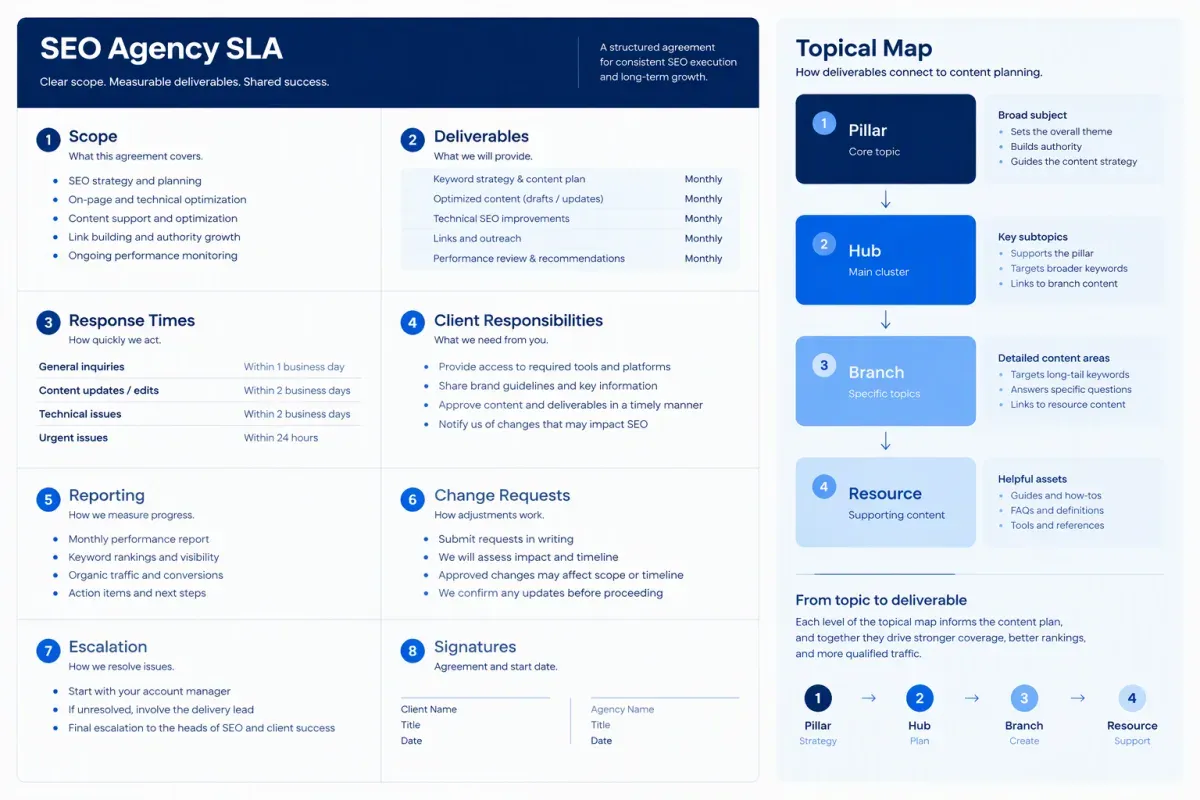
This copy-ready SEO service level agreement template is a bilateral schedule that attaches to your master services agreement. Each field is a plain-language label followed by a blank to complete. Any quantity or deadline in these agency SLA clauses is an example to replace with your own targets.
Copy this header into each client agreement:
- SLA version: ____
- Effective date: ____
- Agency legal name: ____
- Client legal name: ____
- Websites or properties covered: ____
- Service package: ____
- Monthly fee or statement of work reference: ____
- Initial term: ____
- Renewal method: ____
- Next review date: ____
- Governing services agreement: ____
The clause blocks below cover scope, service levels, client responsibilities, reporting, change requests, escalation, and signatures.
Define Scope and Topical Deliverables
Within the template, the SEO scope of services names the work included in the retainer instead of a promise to “do SEO.” The scope may include:
- Technical audits and health monitoring: A technical SEO audit, issue prioritization and recurring checks.
- Research and mapping: Keyword research, search-intent analysis and keyword mapping.
- On-page optimization: Titles, metadata, internal links, schema, and page-level recommendations.
- Content and links: SEO content strategy, content briefs, optimization, backlink analysis, and agreed link acquisition.
- Performance review: Reporting and strategy reviews tied to the approved plan.
Local SEO belongs in the agreement only when the package names it, so optional work does not become assumed retainer work.
The topical map governs content deliverables. We provide a client-approved topical map organized into pillars, hubs, branches, and resource pages, with coverage priorities. Each planned page shows its intent, target or proposed URL, parent topic, and internal-link relationship. The map becomes a publish and optimization queue for new pages, refreshes, cannibalization fixes, and internal-link improvements, not a pile of isolated keyword pages.
The approved monthly SEO work plan sets these SEO agency deliverables:
| Deliverable | Quantity or limit | Expected output | Responsible party | Due date | Acceptance criteria |
|---|---|---|---|---|---|
| URLs optimized per month, up to | ____ | Completed changes or recommendations | ____ | ____ | ____ |
| Content briefs per month | ____ | Brief with intent, topic, URL, and internal-link guidance | ____ | ____ | ____ |
| New or refreshed pieces per month | ____, each ____ to ____ words | Draft, revision or published page | ____ | ____ | ____ |
| Keyword and metadata mappings | ____ | Mapping file or CMS updates | ____ | ____ | ____ |
| Internal-link improvements | ____ | Implemented links or recommendations | ____ | ____ | ____ |
| Backlink outreach activities | ____ | Agreed activity record | ____ | ____ | ____ |
| Technical monitoring | ____ | Findings and prioritized next-month action plan | ____ | ____ | ____ |
The agreement states whether we implement approved technical, on-page, content, and link-related changes, or supply recommendations for your team or another vendor. Where implementation sits outside our control, delivery timing may shift. We record material recommendations, blockers and risks, and we do not accept responsibility for third-party delays or decisions.
Monthly SEO deliverables should show visible progress through the prioritized queue. Floyi’s Topical Authority Planner, for example, turns Scorecard insights into a prioritized list of topics to publish or refresh. It also shows per-topic Search Console data once Search Console is connected.
Set Service Levels and Client Responsibilities
Once the deliverables are defined, the SLA fixes the operating calendar, communication channels and response times before work enters the queue. Set SEO service level targets that match your agency’s actual capacity:
- Business days: ____
- Service hours: ____
- Time zone: ____
- Observed holidays: ____
- Primary communication channel: ____
- Agency day-to-day contact: ____
- Agency escalation contact: ____
- Client day-to-day contact: ____
- Client escalation contact: ____
Routine requests sent by email, voicemail or text fall outside committed response times unless they come through the agreed channel. Use the onboarding questionnaire to capture contacts, CMS access and intake details before you set the first delivery date.
Urgency levels separate a preference from a real production blocker:
| Request type | Qualifying condition | Response target |
|---|---|---|
| Routine inquiry | A question or standard request that does not block approved work | Routine inquiries acknowledged within: ____ business days |
| Urgent blocker | A confirmed issue preventing scheduled work, publishing or required reporting | Urgent issues acknowledged within: ____ business hours |
| Critical incident | A live site, access or publication issue materially affecting active work | Critical incidents acknowledged within: ____ business hours |
Your agency might use one business day for routine acknowledgment, two business days to review a standard request and four business hours for urgent issues. These are examples, not industry benchmarks. An acknowledgment confirms receipt, ownership and the next expected update. It does not confirm completion, a fix or a revised delivery date.
Rush requests go through the escalation channel, with this field: Rush requests answered within: ____ business hours. Feasibility depends on topical scope, approved effort, dependencies, and whether the request displaces the agreed queue. Confirm timing, scope and budget changes before work begins.
Delivery commitments use the same plain-language format:
- Initial audit and strategy delivered within: ____ business days after required access is received.
- Monthly optimization work completed by: ____ day of the month.
- Revisions delivered within: ____ business days after complete, consolidated feedback.
- Client feedback due within: ____ business days of delivery.
Clear SEO client responsibilities keep approval windows from turning into silent delays. The client provides CMS, analytics, Search Console, and required third-party access within: ____ business days of request. The client also names one approver and returns consolidated feedback. Incomplete access, delayed approvals or fragmented feedback move dependent milestones by the length of the delay. They do not create an agency breach.
For content work, match the SLA’s approval window to the approval stages each deliverable passes. Late preference changes then don’t disrupt planned hub completion, optimization or reporting.
Document Reporting, Changes, Escalation, and No Guarantees
These agency SLA clauses define the monthly report, change requests and the escalation procedure. They also keep monthly updates from being read as SEO performance guarantees. Tailor the language to your agreement and have it reviewed for your jurisdiction.
Monthly reporting clause: We will deliver a monthly SEO report using the agreed data sources. It covers Search Console clicks and impressions, organic sessions and conversions from the agreed analytics platform, plus visibility and ranking trends for agreed terms. It also covers technical health and indexation, content published, optimized or recommended, relevant backlink changes, completed and outstanding work, blockers, and the next prioritized queue.
Where Floyi is in scope, the report can add agreed measures from the Topical Authority Scorecard, such as coverage, share of voice and AI search visibility over time.
The SEO reporting schedule uses these fill-in fields:
- Monthly report delivered by: ____ business day of each month, covering the prior calendar month.
- Review call length: ____ minutes.
The review covers what shipped, what changed, unresolved dependencies, and proposed priorities. It helps both parties read organic search traffic and agree on the next queue. It is not a commitment that any SEO KPIs will rise in the reporting period.
Change request clause: Work beyond the agreed topical scope, deliverable volume, service levels, platform access, or timeline needs written confirmation from both parties before it becomes due. Delayed feedback or implementation, unavailable access, website releases, third-party outages, search-engine changes, and newly found technical issues may affect delivery or results. The monthly report or a written change notice records the effect on dates, dependencies and revised deliverables.
Escalation and remedy clause: If we expect to miss, or have missed, a material service commitment, we will notify you in writing. We will explain the cause and provide a reasonable corrective-action plan with a revised date.
- Alleged SLA failures reported in writing within: ____ business days.
- Good-faith discussion to correct, adjust or reschedule within: ____ business days.
Service credits, fee adjustments or termination rights apply only when the agreement states them expressly. No credit applies automatically.
No-guarantee clause: We do not guarantee rankings, organic search traffic, leads, conversions, revenue, backlinks, or visibility in AI search responses. Outcomes also depend on algorithms, competitors, demand, site changes, and client implementation decisions.
- Agency signature: ____
- Printed name: ____
- Title: ____
- Date: ____
- Client signature: ____
- Printed name: ____
- Title: ____
- Date: ____
How Do You Adapt the SLA?
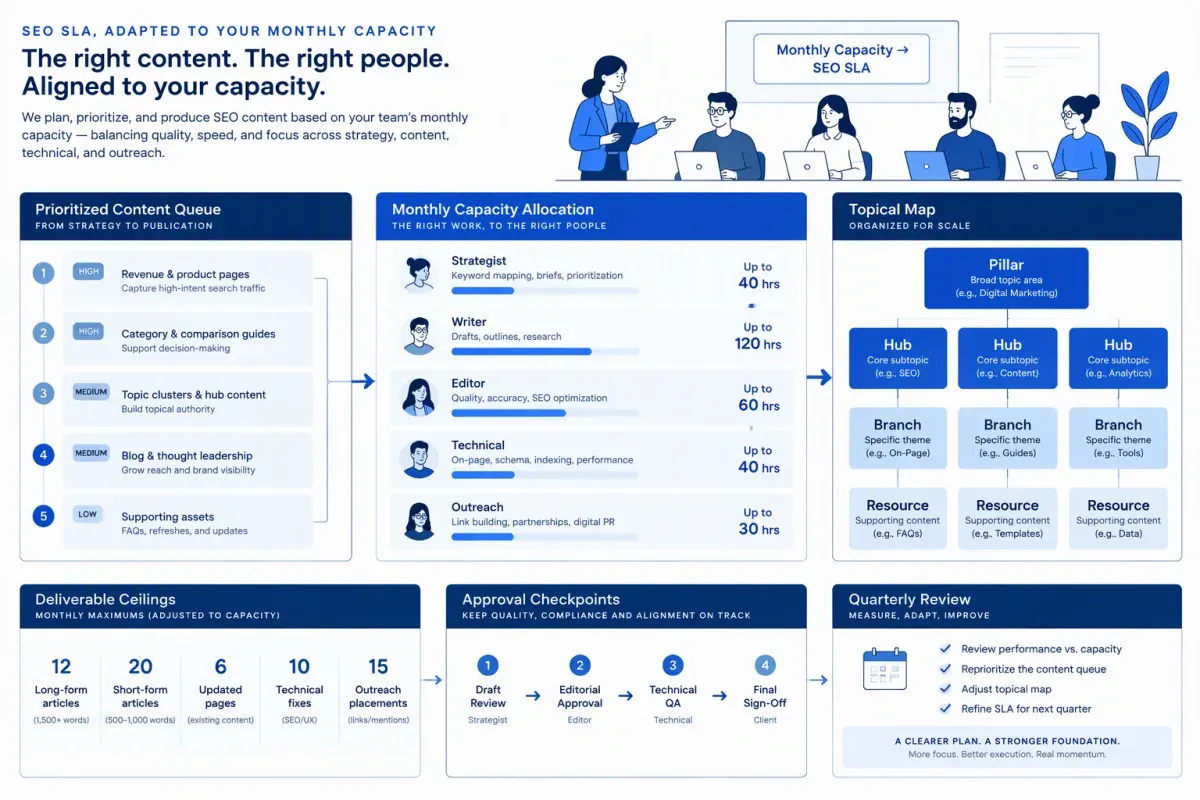
Adapt the SLA to the retainer you can staff and fund, not to generic production quotas. Set targets around the strategist, writer, editor, technical, and outreach capacity you actually have. Build content scope from the topical map and hub-level coverage goals. Stop expanding when the next topics are redundant, low intent or likely to create cannibalization.
Run this SLA customization checklist before each new client signs:
- Capacity: Every quantity in the deliverables table fits the hours your team can staff each month.
- Ceilings: Each deliverable shows a maximum, so extra pages or links need a change request.
- Next-month priorities: The queue names pages or hubs chosen from coverage gaps, competitor movement and Search Console performance.
- Implementation: The SLA says who publishes, who implements technical fixes and who signs off.
Written approval must come before change requests for added pages, new markets, accelerated deadlines, expanded technical work, or another content hub. Record the added fee, the schedule impact and whether a separate statement of work applies before work begins.
Quarterly reviews keep commitments aligned with changing requirements. Either party may request a review after a material shift, such as a product launch, market expansion, staffing or competitor changes, or revised priorities. Amendments reset commitments using current coverage, performance and AI visibility signals.
Review This Template with Legal Counsel

This template is general information, not legal advice. Have qualified counsel in your jurisdiction review it together with the governing services agreement before you sign it or send it to a client.
Counsel should check defined terms, precedence provisions, incorporated policies, and any conflict over deliverables, response times or scope changes.
Keep commercial terms consistent across the SLA and the governing SEO services agreement:
- Retainer: The amount and the included services.
- Invoicing: The invoice schedule and payment due date.
- Additional work: Rates or approval terms for out-of-scope requests.
- Payment obligations: Taxes, approved expenses, late-payment consequences, and any right to suspend overdue work.
Also confirm liability caps, termination terms, confidentiality, data protection, and governing law. Where credits or price adjustments apply, the main agreement should set the calculation, timing, exclusive-remedy status, and related termination rights.
If your team runs topical maps, briefs and drafts for several clients, see how Floyi supports agency teams.
SEO Agency SLA Template FAQs
These FAQs cover term length, pricing, ownership, third-party tools, and freelancer use of an agency SLA template.
1. How Long Should an SEO SLA Last?
Match the SLA term to the main services agreement so the two documents never create conflicting commitments. Set an initial period long enough for the agreed deliverables and review cycle. Then state whether the SLA renews automatically or only in writing. A written notice period, for example 30 or 60 days, sets how either party ends it. Termination rights, breach remedies and transition support stay in the main agreement.
2. Should an SEO SLA Include Pricing?
Yes, as long as both documents agree. The SLA may list the retainer, invoice cadence, due date, and rates for extra work, or it can cross-reference the controlling services agreement. If it lists them, keep late-payment terms and any right to pause work for overdue invoices identical in both documents. Write rush or out-of-scope rates as fill-in fields, such as Rush rate: ____. Quote the added cost before any out-of-scope work begins.
3. Who Owns SEO Deliverables Under an SLA?
The main services agreement should state ownership, not the SLA. After payment, the client receives the agreed client-specific outputs, such as approved topical maps, briefs, audits, reports, and final drafts. Your templates, methods, software, and reusable know-how stay with the agency. Third-party materials follow their own licenses. Exit terms should cover which files and credentials are handed over, which access ends and how unpaid work is treated.
4. Should an SEO SLA Cover Third-Party Tools?
Yes. Name the analytics, search-data, rank-tracking, and reporting platforms behind your technical SEO services, plus the baseline, attribution settings and measurement period. These tools supply evidence, but your agency does not control or guarantee them.
Treat outages, data delays, API changes, access restrictions, and material discrepancies between tools as exceptions. Record the issue and use the agreed primary source where possible, rather than treating a vendor failure as an agency breach.
5. Can Freelancers Use an SEO Agency SLA Template?
Yes. Freelancers can use the same framework, scaled to their own capacity and services. The agreement should still define topical deliverables, communication channels, revision limits, client duties, and the no-guarantee clause. Name one client decision-maker and set an approval window, such as five business days. Late access, brand input or approvals can then extend the affected delivery dates once you share the updated timeline.
About the author

Yoyao Hsueh
Yoyao Hsueh is the founder and CEO of Floyi, the topical authority platform, and the founder of Main Heading, an SEO and AI search agency. He is an expert in topical authority and topical mapping. He created Topical Maps Unlocked, a course studied by thousands of SEOs, content strategists and digital marketers, founded TopicalMap.com, a done-for-you topical mapping service for agencies and enterprise teams, and publishes the weekly Digital Surfer newsletter on SEO, content strategy and AI search.
About Floyi
Floyi is a closed loop system for strategic content. It connects brand foundations, audience insights, topical research, maps, briefs, and publishing so every new article builds real topical authority.
See the Floyi workflow