
Free SEO Client Onboarding Questionnaire Template to Copy
Copy this free SEO client onboarding questionnaire, with questions grouped by the planning decision each answer informs, red flags and an access checklist.
A signed contract doesn’t give your team enough context to plan SEO without guessing. This copyable SEO client onboarding questionnaire captures the decisions behind the work: commercial priorities, brand rules, buyer context, SEO history, approvals, and access.
Search Console access alone won’t tell you which offers deserve priority, whether a migration introduced risk or who can approve a regulated claim. So the questions below are grouped by the planning decision each answer informs. Each block ends with red-flag answers, and the template closes with an access checklist and a short version for smaller clients.
Missing context pushes teams toward legacy services, unqualified traffic, unsupported claims, and plans nobody can implement. Use the intake to close those gaps before the first brief is written.
SEO Client Onboarding Questionnaire Key Takeaways
- Tie every intake question to a specific planning decision.
- Capture profitable offers, priority markets and excluded services before setting topical scope.
- Separate required brand language from prohibited claims and unsupported promises.
- Record buyer questions, decision-makers, direct competitors, and indirect alternatives.
- Request SEO history, migrations, prior reports, and known access risks.
- Define conversions, KPIs, budget constraints, and named approvers before planning.
- Use invitation-based access and never collect passwords in a questionnaire.
How Should Clients Complete This Template?
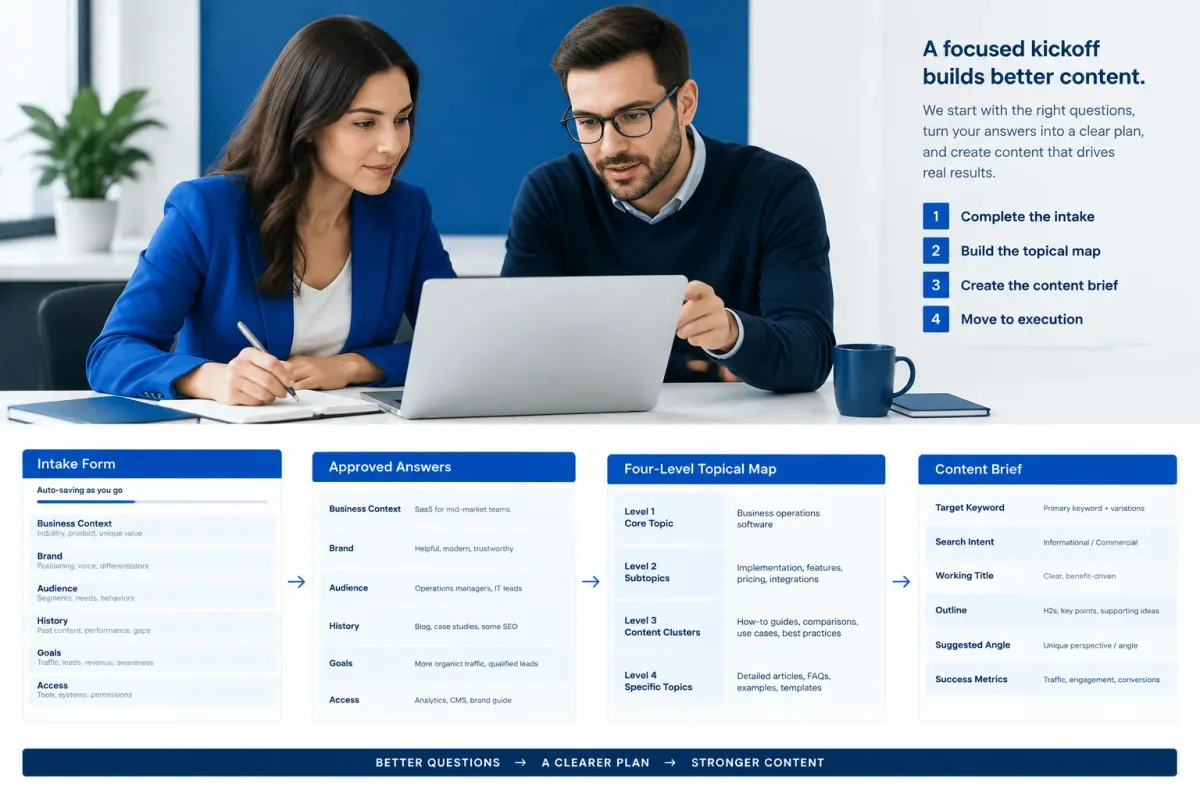
Clients should complete this SEO client questionnaire after signing and before kickoff, answering from what they know firsthand and flagging what they don’t. Treat it as the first step of your SEO client onboarding process, not administrative homework. The answers give your team the business, brand, technical, and historical context to review existing data, shape a topical map and keep the kickoff focused on decisions.
A structured SEO client onboarding questionnaire ties each answer to a planning decision. That matters even more when you’re scaling authority across client brands, because every brand’s map, briefs and drafts start from what its client approved here. When a client skips a block, your team still makes that decision. It just makes it on assumptions.
Each block below opens with what its answers make possible:
- Business and offers: Commercial priorities and authority anchors.
- Brand voice: The rules every brief and draft follows.
- Buyer personas and competitors: Topical scope, plus the buyer concerns generic content misses.
- Content and SEO history: Priorities for the onboarding content audit and the risks to raise early.
- Goals, constraints and approvals: KPIs, publishing sequence and the sign-off rules an SEO service level agreement should reflect.
- Access and data sources: The baseline you’ll measure progress against.
Give clients a firm return date that leaves time to review answers before kickoff. Smaller local engagements can use the short version at the end. Broader topical authority work needs the full SEO client intake form.
Use an interactive, auto-saving format so clients can answer across several sessions instead of burying context in email threads. Google Forms, Typeform, Content Snare, Notion, a Word document, or a fillable PDF all work. Tell clients where to upload brand guidelines, customer research, prior reports, competitor lists, and screenshots.
Useful answers don’t need technical precision. Ask clients to mark uncertain answers “not sure” and leave fields that don’t apply blank. Partial context still helps: links, documents, screenshots, or the name of a colleague who can fill the gap.
Before kickoff, your team reviews the answers and files, flags gaps or contradictions and uses the call to confirm the priorities that need a client decision.
Copy Business and Offer Questions
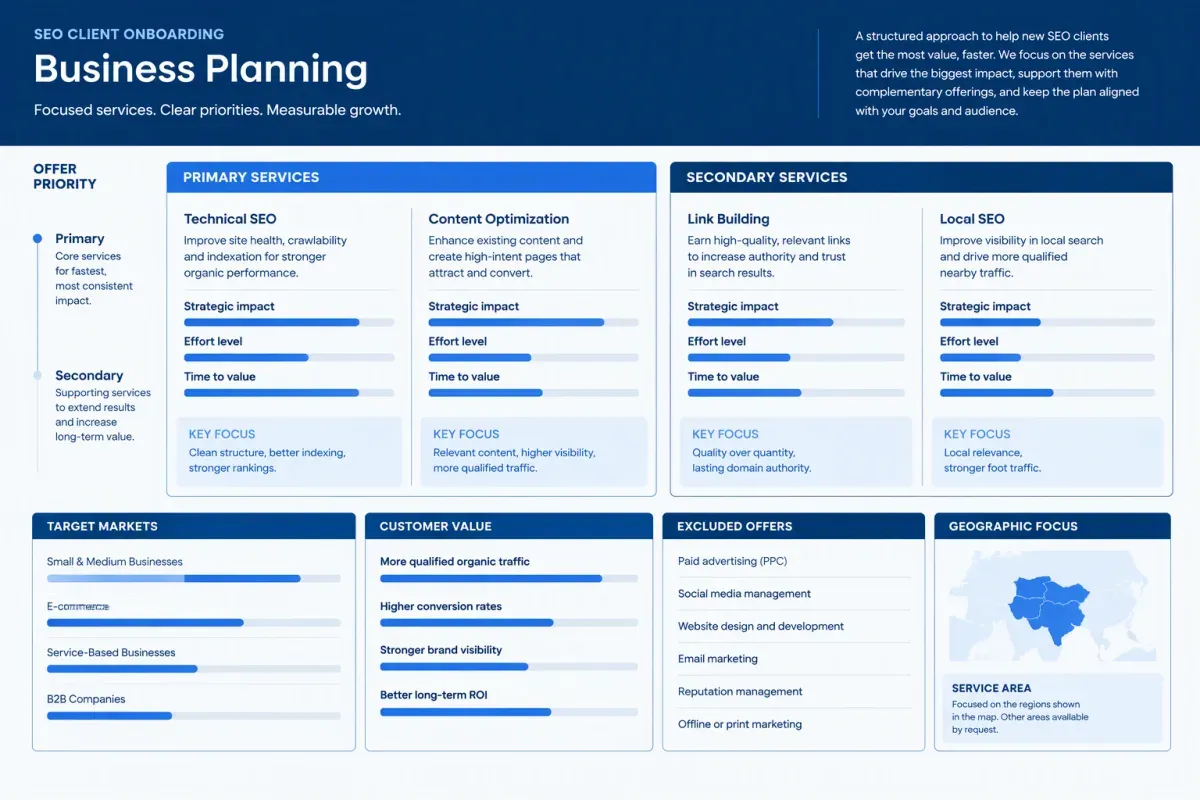
These answers decide which offers get pillar or hub coverage first, which markets your topical map targets and which services stay out of scope. Among the questions to ask new SEO clients, this block goes past directory details to the commercial priorities behind rankings and organic traffic.
Copy these SEO agency onboarding questions into your intake form:
- Business identity: What are your legal and trading names, website, primary contact, industry, and business model? Which public name, address, phone number, email, opening hours, and business profiles must stay consistent?
- Location and service area: Where is the business based, and which cities, states, regions, or countries does it serve? Do customers visit you, does your team travel to them or is delivery online? Which markets are excluded?
- Operating history: When was the business founded? Have there been rebrands, acquisitions, expansions, or major service changes? Which credentials, qualifications and experience can you back up with evidence?
- Active offers: Which products and services do you sell? For each one, note who it’s for, how it’s delivered, what problem it solves, its typical price range, and whether it’s a primary offer or an add-on. Which offers need their own landing page?
- Commercial priority: Which offers produce the most revenue, gross profit or strategic value? What’s a typical order, project or contract value? Where you know them, what are a qualified lead, a new customer and a customer’s lifetime value worth?
- Buyer choice: Why do customers pick you over the alternatives? Which objections, comparison questions and decision criteria come up before purchase? Which approved claims, value propositions and proof points should content lead with?
- Boundaries: Which offers are paused, discontinued, low priority, or not profitable enough to promote? Are any locations, audiences, pricing statements, claims, or regulated subjects off-limits?
Commercial context sets page priority. A consultancy might sell audits, workshops and annual retainers, with retainers as the first authority anchor because they carry the long-term growth model. Rough figures still help. An illustrative $20,000 annual retainer carries different planning weight than a $50 introductory offer, even if the cheaper offer gets more searches.
Geography needs the same care. A Chicago law firm that serves Illinois businesses shouldn’t get nationwide recommendations just because its site shows up outside the state.
Differentiation needs proof, not slogans. Specialist expertise, transparent pricing, faster implementation, and a documented method can shape briefs when the client can verify them. “We’re the best” can’t, and it slows approvals.
Pause planning if you see these red flags:
- Universal targeting: “We serve everyone, everywhere,” with no defined market or buyer.
- No commercial hierarchy: Every service is treated as equally important.
- Unknown economics: Nobody can say which offers are profitable.
- Conflicting promotion: The client wants rankings for a paused, discontinued or restricted service.
Resolve these at kickoff, before you build the map. Otherwise content drifts toward legacy pages, unqualified traffic and services the business no longer wants to sell.
Copy Brand Voice Questions
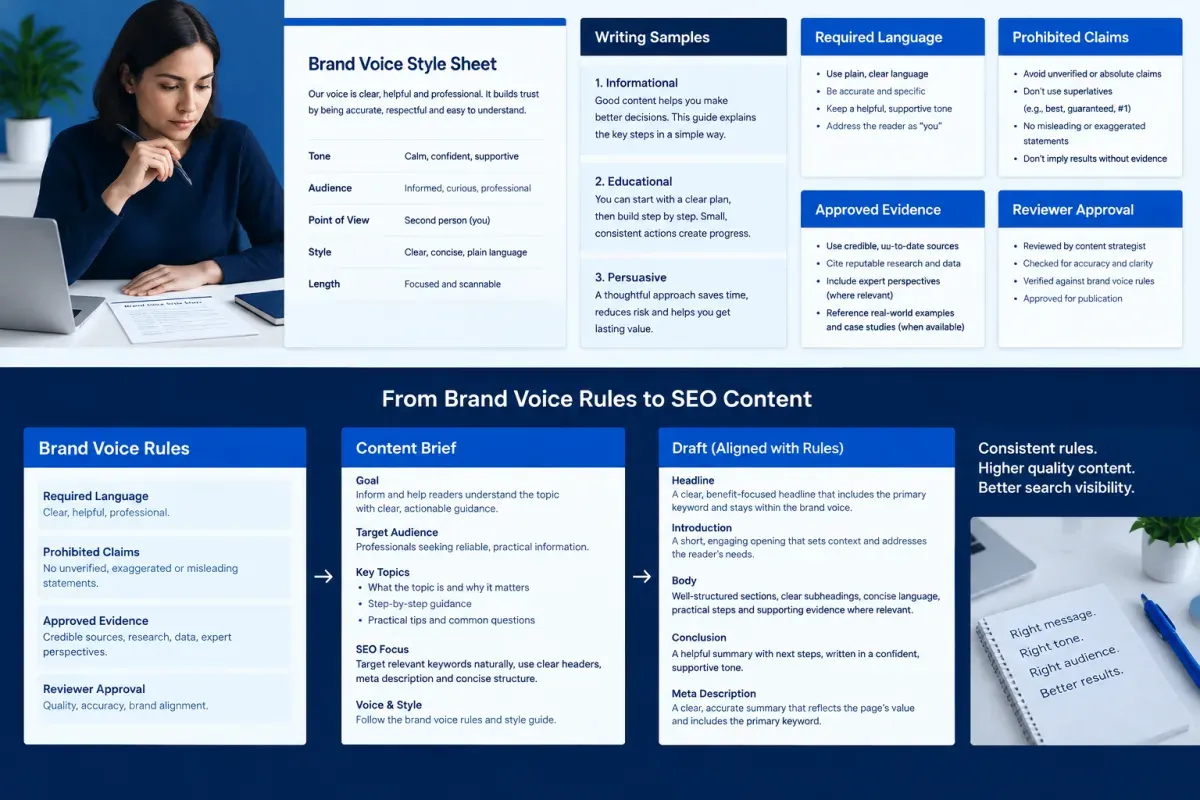
These answers become the voice rules, required terms, prohibited claims, and approved proof that every brief and draft follows. A brand intake template for topical authority onboarding turns brand voice into a working standard, so writers don’t guess at positioning anywhere in your SEO content production workflow.
Copy these questions into your client intake:
- Guidelines and voice: What brand guidelines can you share? If none exist, what’s the closest approved substitute? Describe the tone, reading level and point of view you want, plus examples that do and don’t sound like you.
- Writing samples: Which three to five published pieces best represent your voice?
- Required language: Which product names, differentiators, messaging pillars, disclosures, and calls to action must appear exactly as approved? Does any of it change by market or language?
- Prohibited language: Which terms, claims, promises, or competitor references are off-limits? Which regulated statements need review before publication?
- Evidence and expertise: Which subjects can you support with firsthand experience, proprietary research or documented evidence? Which topics need product, technical, clinical, legal, or compliance review?
- Assets and permissions: Which testimonials, customer stories, research, screenshots, images, and logos can appear in organic content? Do you have explicit permission for each image and testimonial?
- Review and publishing: Who confirms brand accuracy, factual accuracy, compliance language, and publishing readiness? Which feedback updates the brand foundation, and which applies to one draft only?
Vague guidance drifts. “Sound professional” leaves every writer to interpret the request. A testable rule such as “use active voice” or “don’t make performance comparisons without documented evidence” gives the team a standard it can apply the same way every time. Keep required and prohibited language as separate rules instead of burying them in a long PDF.
Authority boundaries need the same precision. A healthcare client can support authority anchors around its treatment process and clinician-reviewed patient resources, but not unsupported outcome claims. That keeps topical scope tied to evidence the client can defend.
Pause before briefing any content if you see these answers:
- No usable guidance: There are no guidelines and nobody will approve a substitute.
- Imitation request: The client wants writers to copy a named competitor’s voice.
- Unverifiable claims: Nobody can back up a requested promise or performance statement.
- Missing reviewer: Regulated, technical, clinical, or legal content has no named reviewer.
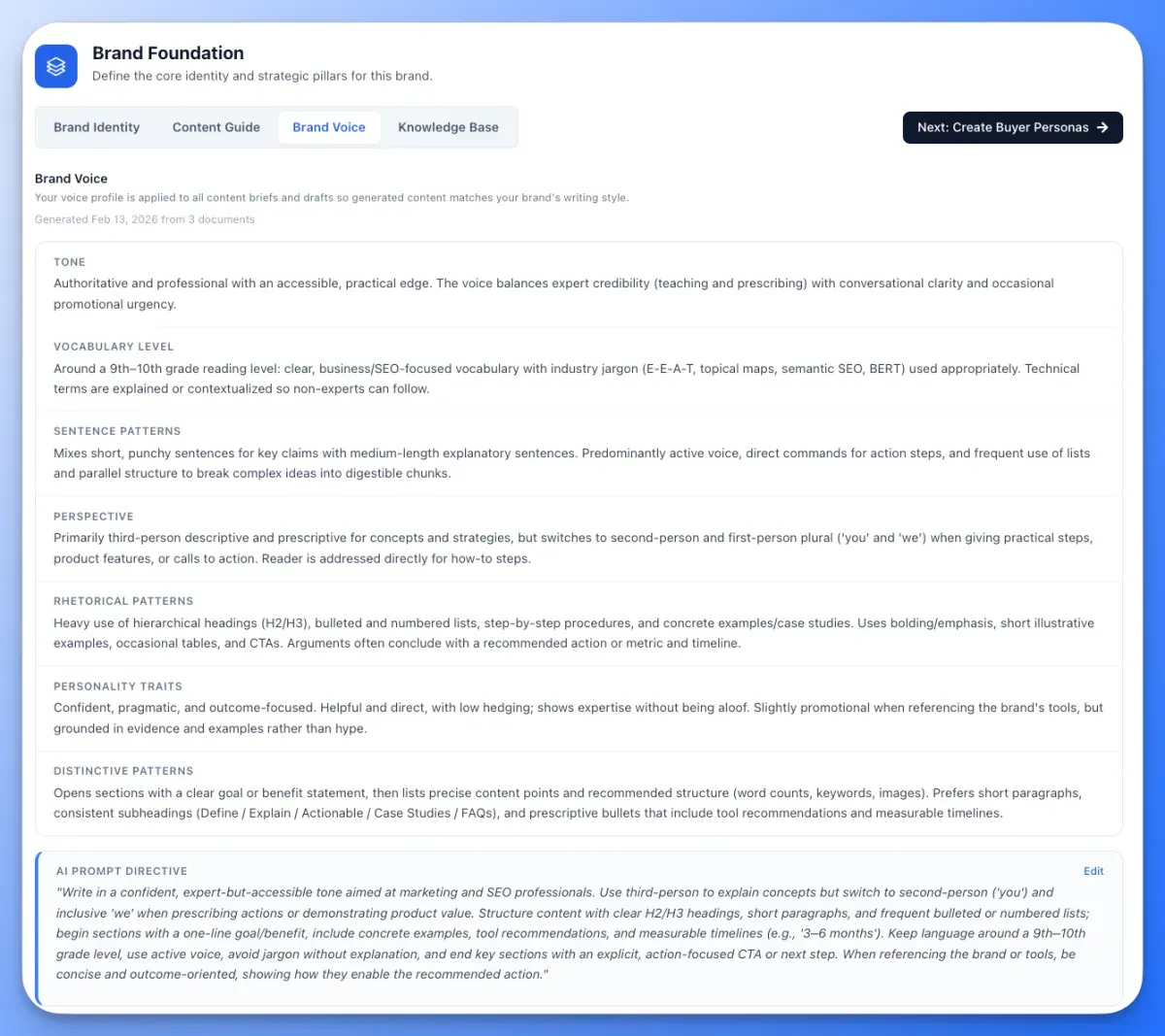
In Floyi’s Brand Foundation, you can generate the foundation from the client’s website URL or enter it manually, then export it to XLSX or DOCX for stakeholder approval. Brand Voice analyzes the three to five writing samples you collected. When positioning changes, regenerate with Regeneration Notes so the approved change lands in the foundation rather than in a single draft. Record the approved version and date so downstream briefs share one reference.
Copy Buyer Persona and Competitor Questions
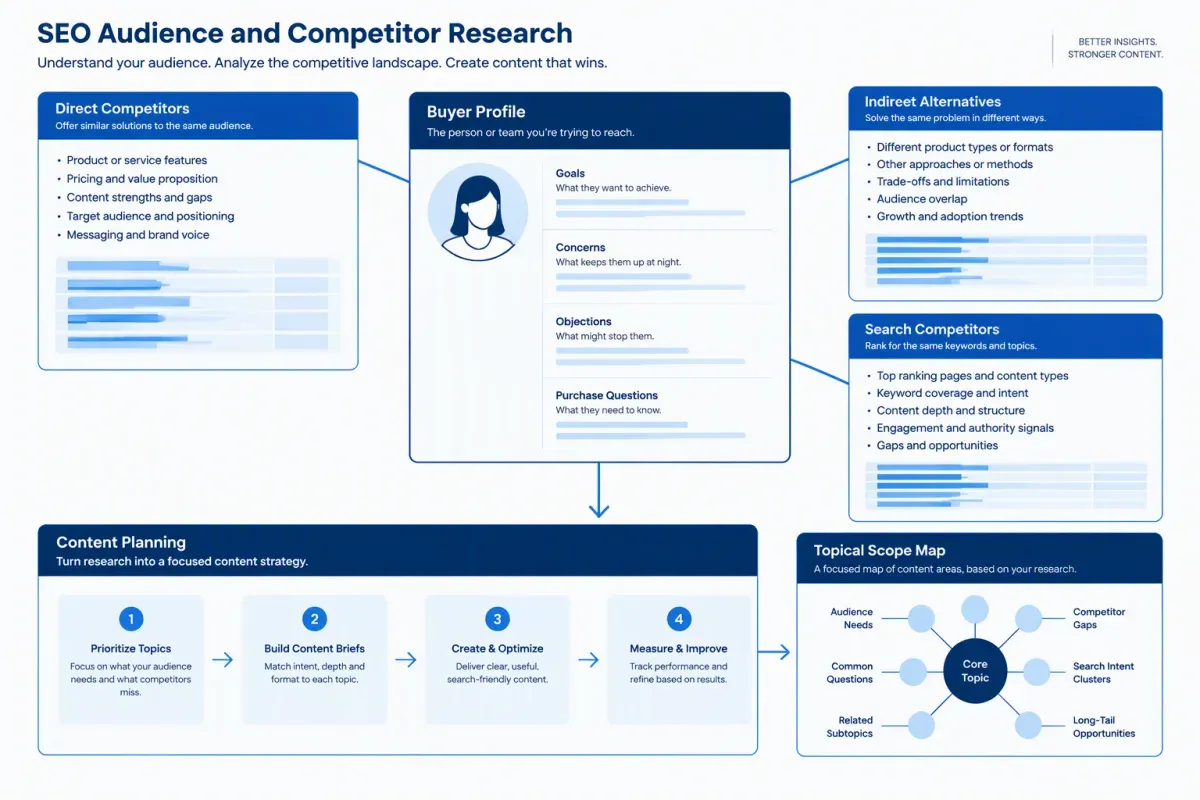
These answers set your topical scope: who the content serves, what it must answer and which competitors set buyer expectations. They keep a topical map from treating every visitor as the same buyer.
Copy these SEO target audience questions:
- Customer segments: Which customer types bring the most revenue or strategic value? For each, note B2B or B2C, company profile or demographics, role, seniority, budget context, and whether the segment is primary, secondary or excluded.
- Decision-making unit: Who has the problem, researches options, influences the purchase, controls the budget, and signs the contract? What goals, fears and success measures guide each role? Capture each role’s own terminology and a representative quote. A managing partner may describe the need as protecting reputation and winning higher-value clients, not growing organic traffic.
- Geographic priorities: Which countries, regions, cities, service areas, and languages matter in the next 12 months? Which locations are excluded or served by different offers? Do buyers search locally, nationally or internationally, and does location change their terminology or criteria?
- Search trigger: What event starts the search? Which pain points, risks, misconceptions, and desired outcomes bring buyers to the site? Where do they research, and whom do they trust? Objections matter here because they show where comparison content and evidence can move a decision.
- Questions before purchase: What do prospects ask in sales calls, demos, emails, reviews, or support conversations? What proof, pricing context and risk reassurance do they need? Separate early research questions from evaluation and purchase questions.
These answers should produce more than a generic persona slide. Floyi’s Audience Insights turns them into structured personas covering goals, pain points, fears, information sources, objections, and representative quotes. You can attach those personas to briefs, so writers work from one audience reference instead of reinterpreting the intake.
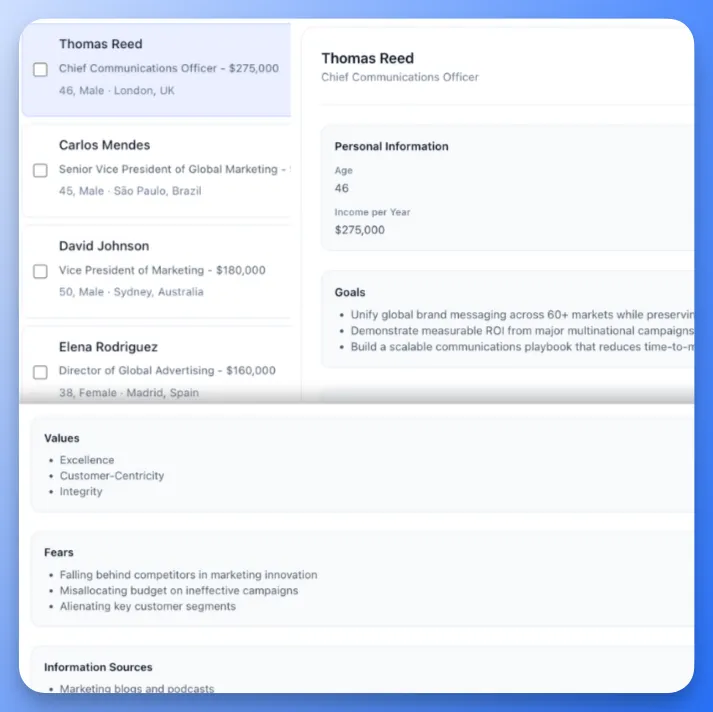
SEO competitor analysis questions need the same precision:
- Direct competitors: Which three to five companies compete for the same buyer? Include each website URL, the overlapping offers and the strengths prospects associate with them.
- Indirect alternatives: What else do buyers consider, including in-house work, adjacent providers, existing tools, and doing nothing?
- Search competitors: Which sites outrank your priority pages, and which industry publications shape buyer expectations?
- Admired brands: Which brands do you admire for positioning, content or website experience, and what specifically works?
Admired brands can guide positioning, but they aren’t automatically search competitors. Search competitors are the ones that show the content gaps, search intent and topical scope your strategy has to address.
Treat these answers as red flags before research starts:
- “We have no competitors.”
- “Anyone who needs us is our buyer.”
- No access to sales or support questions.
- Admired brands offered as the only competitor list.
A client-approved audience and competitor record gives your topical map a defensible starting point.
Copy Content and SEO History Questions
These answers set the audit’s starting priorities, show which pages deserve protection and surface risks that can change your first recommendation. A mature resource center with high-intent service pages needs a different starting point than a site with scattered posts and no clear owner. The answers also give you SEO performance benchmarks, so you judge rankings and organic traffic against the client’s actual history.
Copy these questions to assess content capacity:
- Publishing presence: Do you run a blog, resource center or learning library? Which formats do you publish, such as articles, landing pages, videos, tools, guides, or case studies?
- Production capacity: How much content did you publish in the past 12 months? Who writes and approves it, and which subject matter experts can contribute?
- Engagement scope: Does this engagement cover content creation, content optimization or strategic advice only? How does content move from idea to publication today?
- Priority assets: Which URLs, products, services, and locations need protection or improvement first?
Ask for the materials that show what the business has produced and measured: content inventories, sales collateral, paid-search landing pages, keyword research, editorial calendars, past briefs, and prior reports. They reveal content gaps and overlapping pages before new work enters the queue.
Then ask what the client wants to be found for, so visibility goals become a defined topical scope rather than a request to rank everywhere:
- Search priorities: Which products, services, locations, and topics need more visibility? Which five to ten phrases do customers use to find those offers?
- Customer language: Which questions keep coming up in sales calls, support tickets, reviews, or People Also Ask results?
- Ranking expectations: Which rankings matter, and how do they connect to SEO campaign goals such as qualified leads, e-commerce revenue or organic traffic?
- Boundaries: Which claims, audiences, locations, subjects, or competitors should content avoid?
Treat these answers as starting assumptions that SEO keyword research and SERP checks will test later. A commercially important phrase can still be wrong for a proposed page when the SERP favors category pages, comparison content or local results.
Publishing constraints matter as much as topics. Ask which formats performed best and worst, and which subjects were deliberately avoided. Seasonal launches, product changes, compliance rules, and approval timing all limit what the plan can ship.
Prior SEO work holds useful evidence and costly dead ends. Ask which agencies, consultants or internal teams worked on SEO, when, what they delivered, and what frustrated the client. Request past SEO audits, technical recommendations, migration notes, keyword lists, dashboards, and the rank tracking tools still in use. Unimplemented recommendations may point to a resourcing problem, not a bad strategy.
Flag these answers for kickoff:
- Link history: Purchased backlinks, automated link building or outreach campaigns with no records.
- Unexplained losses: Sharp traffic or ranking drops, suspected algorithm hits or Google manual actions with no documented recovery work.
- Access gaps: A former agency holds the only administrator access.
- Migration risk: A recent migration has no redirect map or record of affected pages.
This history tells you which rankings and traffic to protect while you prioritize work the client can carry through.
Copy Goals, Constraints and Approval Questions
These answers set the KPIs, sequencing and sign-off rules the work will be judged by. They also define the budget, scope and delivery capacity the plan has to fit.
Copy these questions to set SEO business goals and success metrics before research turns into a publishing queue:
- What’s the primary SEO objective for the next six to 12 months? Pick one leading outcome, such as qualified leads, e-commerce revenue, local visibility, or traffic to priority pages. Then rank the supporting SEO campaign goals by the offer, audience and market each one serves. Planned launches and seasonal demand can change the order of work.
- What counts as a conversion, and what’s it worth? List purchases, booked calls, form fills, demo requests, and any lead-quality or revenue threshold that matters. Record baseline organic traffic, rankings, conversions, and priority-page performance. Benchmarks should connect topical coverage to commercial impact, not publishing volume.
- What has to be true at each checkpoint? Let the client set their own checkpoints, for example at three, six and 12 months. Early checkpoints might cover foundations such as an approved topical map, priority briefs and technical fixes. Later ones name the outcome that supports renewal, plus the SEO KPIs and targets for growth, coverage, share of voice, and visibility in AI answers. Writing these down keeps short-term expectations from derailing a longer authority plan.
- What has the client bought, and what can both teams execute? Confirm the budget, contract term, client-side resources, and included services. Services might cover strategy (audit, topical map and briefs), content (drafts and optimization), implementation (internal linking and technical fixes), and reporting. A roadmap fails when it assumes writing capacity, developer time or approval availability the client hasn’t funded.
- Who gets updates, and what must reporting include? Name the decision-maker, the day-to-day contact, the report recipients, and the preferred channel and frequency. Ask whether stakeholders expect a monthly PDF, a Loom walkthrough, a live dashboard, or a presentation. Rankings and organic traffic should sit next to the business metrics leadership already uses, and reports should land before internal reporting or board deadlines.
- What can’t change, and who approves changes? List protected pages, active campaigns, legal disclaimers, and brand claims. Name the approvers for strategy, content, technical recommendations, and publishing, plus their usual review time. Developer availability, compliance review and fixed launch dates decide whether recommendations make it into production.
Treat these answers as kickoff red flags:
- Guaranteed outcomes: The client expects rankings or traffic by a fixed date, whatever the market, site health or implementation capacity.
- Traffic without value: Success means organic traffic alone, with no conversion event, revenue signal or lead-quality threshold.
- No approver: Nobody can sign off on strategy, content, technical work, or publishing.
- Scope-budget mismatch: The requested deliverables exceed the budget or the client’s available resources.
Resolve these before the plan becomes a promise. Clear goals, named checkpoints and realistic approval paths give the plan a workable route from audit to execution.
Copy the Access Checklist and Short Version
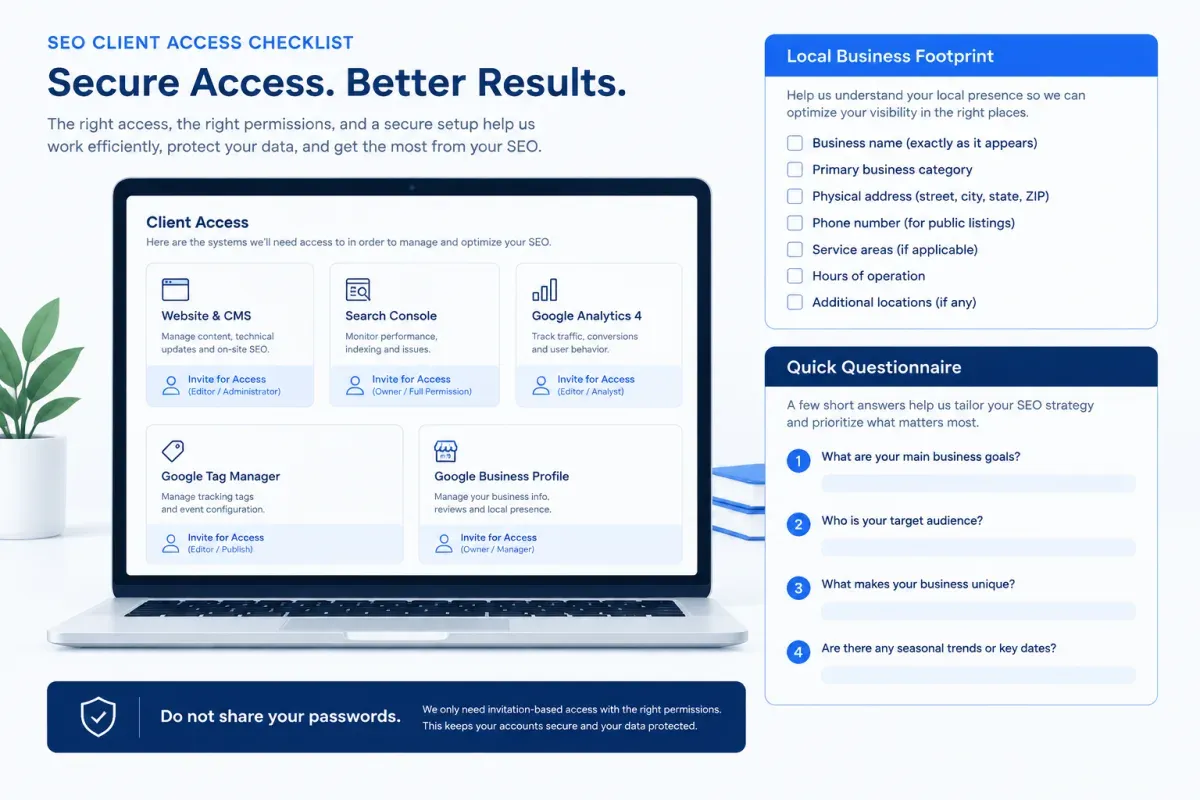
The right access gives you reliable baselines, tracking you can trust and a clear view of who can ship approved changes. Collect permissions alongside baseline data, so the strategy reflects both the site’s opportunity and its implementation limits.
Use this SEO access checklist once intake answers are approved. Ask only for the systems the engagement needs:
- Website and CMS: Platform and login URL, CMS and website backend access, the site owner, development contacts, hosting and DNS providers, the e-commerce platform, and staging availability.
- Implementation path: Whether your team ships approved fixes or hands recommendations to an in-house developer or another agency.
- Search and measurement: Search Console, Google Analytics 4 access for SEO agency work, Google Tag Manager, Google Ads, Merchant Center, and any dashboards or reporting tools.
- Tracking readiness: Priority conversions, event setup, known data-quality problems, and any historical reports or baselines.
Keep access invitation-based and limited to the role the work requires. Record each platform’s administrator, but never collect passwords through a questionnaire or plain-text email. Clients can invite your named accounts or use an approved password manager. Roles to request include Google Analytics 4 Editor, Search Console Full user, Google Business Profile Manager, and Google Tag Manager Publish.
Technical SEO history decides what enters the plan first. Capture past migrations and known crawling, indexing, site-speed, and tracking problems, plus redesigns, URL changes or domain moves planned in the next 12 months. Pages and templates about to change shouldn’t lead the queue, while content needed before a migration may need to move up.
Resolve these red flags before you pull baselines:
- Shared credentials: Passwords arrive by email or appear in the intake form.
- No accountable owner: Nobody on the client side controls Google Analytics 4 or Search Console.
- Former vendor control: A previous agency owns the accounts and the client can’t confirm it can recover admin access.
- Unverified conversions: Tracking exists, but nobody has checked whether events still fire.
Local, service-area and multi-location businesses need one more layer:
- Business footprint: Primary category, target areas, physical premises, and location count.
- Local visibility: Relevant directories, industry associations, listing consistency, and review practices.
- Google Business Profile: Verification status and manager or owner access.
These answers decide whether the topical map needs location pages, service-area coverage or local proof. A multi-location company with one generic service page needs a different topical scope than an online-only national brand.
For smaller engagements, this short version works as a local SEO client questionnaire and fits in one sitting:
- What’s your primary offer, and why do customers choose it?
- Which market, city or service area matters most?
- Who’s your core buyer, and what do they ask before buying?
- Which three competitors serve the same customers?
- What SEO work has happened before, including migrations, penalties or paid links?
- Which business goal matters most, and what counts as a conversion?
- Who approves content and technical recommendations?
- Which pages, claims or brand elements can’t change?
- Can you invite our named account to Google Analytics 4, Search Console and your CMS?
- If local visibility matters, can you give us Google Business Profile access?
Approved answers should become planning inputs, not sit in an intake document:
| Intake block | Planning output |
|---|---|
| Offers and differentiators | Authority anchors |
| Buyer personas and competitors | Topical scope |
| Brand voice and required claims | Brief and draft constraints |
| SEO history and technical risks | Audit priorities and sequencing |
| Business goals and conversions | Publishing priorities and measurement |
In Floyi, approved brand and audience inputs shape a Pillar > Hub > Branch > Resource topical map, so each planned page has a defined role in the structure. Start by loading the approved answers into Floyi Brand Foundation so every brief and draft works from the same client context.
SEO Client Onboarding Questionnaire FAQs
These answers cover timing, length, tailoring, and how the questionnaire differs from the kickoff call.
1. When Should You Send the SEO Questionnaire?
Send it as soon as the contract is signed, while goals, stakeholders and expectations are fresh. Ask for completed answers a few business days before the strategy meeting, and allow more time when several people contribute. That window lets you check the data, spot missing context and bring focused follow-up questions to kickoff instead of gathering basics there.
2. How Many Questions Should the Template Include?
Include only SEO onboarding questions that change a planning decision for the scope or budget you’ve agreed. Treat this SEO questionnaire template as a question bank, not a mandatory form. Use the short version for focused engagements and pull from the full blocks for broader work. Clients can skip items that don’t apply and give their best answer when they’re unsure of technical detail.
3. Should Every SEO Client Use the Same Template?
Keep the core blocks the same so answers stay comparable across clients, then add modules for the business model. Local businesses need prompts on target locations, premises, location count, primary category, directory consistency, reviews, and Google Business Profile access. An SEO client questionnaire for e-commerce needs product, category and buying-guide priorities. B2B and SaaS clients need feature pages, industries, use cases, integrations, sales cycles, and decision-makers. Leave prompts that don’t apply blank.
4. How Does the Questionnaire Differ From a Kickoff?
The questionnaire collects business, brand, technical, and historical context before the call. Close it with prompts about upcoming changes, open SEO concerns and anything else the client wants you to know, plus a confirmation that the answers are accurate.
The SEO client kickoff turns those answers into decisions. Use the call to resolve gaps, confirm priorities and expectations, clarify access and approval contacts, and set next steps for the audit and topical map.
About the author

Yoyao Hsueh
Yoyao Hsueh is the founder and CEO of Floyi, the topical authority platform, and the founder of Main Heading, an SEO and AI search agency. He is an expert in topical authority and topical mapping. He created Topical Maps Unlocked, a course studied by thousands of SEOs, content strategists and digital marketers, founded TopicalMap.com, a done-for-you topical mapping service for agencies and enterprise teams, and publishes the weekly Digital Surfer newsletter on SEO, content strategy and AI search.
About Floyi
Floyi is a closed loop system for strategic content. It connects brand foundations, audience insights, topical research, maps, briefs, and publishing so every new article builds real topical authority.
See the Floyi workflow